KINGSPORT, Tenn. — March 22, 2021 — In celebration of the International Day of Forests on March 21, Eastman, Eastman Foundation and GP Cellulose worked with The Longleaf Alliance (LLA) to provide 60,000 longleaf pine seedlings to Torreya State Park in Northwest Florida. This conservation collaboration is intended to help protect forest ecosystems, support delicate wildlife communities, and help repair the planet for future generations.
The planting is part of a larger effort to restore important longleaf habitats that provide homes to endangered, threatened and at-risk species such as the gopher tortoise and the eastern indigo snake. Restoring longleaf pine forests can also help protect Florida’s water quality.
The Torreya State Park site was selected because of the devastation to the area from Hurricane Michael in 2018. Eastman Foundation and GP funded the conservation project due to their shared commitment to restoring and maintaining these fragile forest ecosystems.
“Eastman recently announced our vision for A Better Circle to address climate change, mainstream circularity and build a more inclusive and equitable world,” said Jon Woods, general manager, textiles for Eastman. “As part of this vision, we also announced our Naia™ sustainability commitments, where our Naia team underlines our full commitment to the protection of forest ecosystems across the globe. We are proud to work with The Longleaf Alliance and Georgia Pacific to restore a threatened ecosystem so that it may thrive once more for future generations. Through the restoration of the longleaf habitat at Torreya State Park, we pledge to educate communities on the importance of responsible forest management, playing our part in building awareness on the vital role of forests.”
According to the Florida Forestry Association, there are 17 million acres of forestland in Florida, covering almost half of the state’s total land area. The forest industry contributes $25 billion to the state’s economy, and ten counties economically depend on the forest industry.
Hurricane Michael’s destructive path inflicted damage to more than 1.4 million acres of forest, including severe damage to about 96 percent of the longleaf pine forests in Liberty County, where the planting took place.
“Our support of reestablishing the longleaf habitat and the diverse ecosystem it enables is one of many ways we demonstrate our commitment to sustainable forestry,” said Munir Abdallah, president of GP Cellulose. “Since 2015, Georgia-Pacific has supported 10 longleaf planting projects that added well over 400,000 seedlings in the Southeast. Doing business in a sustainable way and contributing to a healthy environment is an expectation we have of ourselves and that our customers now have of us.”
“Guiding the restoration, stewardship, and conservation of longleaf pine ecosystems is core to the function of The Longleaf Alliance. We are thrilled to be working with Eastman, GP Cellulose and Florida State Parks to restore longleaf habitat at Torreya State Park. By restoring this area back to longleaf, the park will be building a healthy forest that is not only one of the most biodiverse ecosystems in North America, but also provides tremendous value through forest products, reduced wildfire risk and protection of source water quality,” says Carol Denhof, president of LLA.
The theme for each International Day of Forests is chosen by the Collaborative Partnership on Forests. This year’s theme is “Forests and Biodiversity.” The Torreya State Park planting campaign both supports and celebrates this theme.
TOKYO — March 22, 2021 — Teijin Frontier Co. Ltd., the Teijin Group’s fibers and products converting company, announced today that it has established Teijin Frontier India Pvt. Ltd. in Gurugram, India, to conduct sales and trading activities that will further strengthen its global business. Teijin Frontier India will start its operation on April 1.
India has the second largest population in the world and its domestic market is expected to grow steadily. The Teijin Group established its first local subsidiary in 2007 aiming to develop the local market and Teijin Frontier has been conducting market research and sales activities in India since 2010 incorporating diverse sales platforms. The establishment of Teijin Frontier India will strengthen Teijin Frontier Group’s ongoing global business expansion in strategic fields including the environment, mobility and high-performance textiles, three sectors where India is expected to be a key player in terms of both supply and consumption.
Going forward, Teijin Frontier plans to continue strengthening its global value chain for producing yarns, fabrics and finished products
Spinners were once again provided with some positive news in in March, as The Conference Board Consumer Confidence Index®, an indicator of Americans’ willingness to increase spending on some items, improved again in February to 91.3 after increasing to 88.9 in January. The Present Situation Index — based on consumers’ assessment of current business and labor market conditions — climbed from 85.5 to 92.0. However, the Expectations Index — based on consumers’ short-term outlook for income, business, and labor market conditions — fell marginally, from 91.2 last month to 90.8 in February.
The monthly Consumer Confidence Survey®, based on a probability-design random sample, is conducted for The Conference Board by Nielsen, a leading global provider of information and analytics around what consumers buy and watch. The cutoff date for the preliminary results was February 11. The survey results did not fully capture the events surrounding the Texas power crisis nor the loosening of dining restrictions in New York City.
“After three months of consecutive declines in the Present Situation Index, consumers’ assessment of current conditions improved in February,” said Lynn Franco, senior director of Economic Indicators at The Conference Board. “This course reversal suggests economic growth has not slowed further.
Coupled with increased vaccinations and an increased output of personal protective equipment (PPE) from the U.S. textile industry, Americans are looking forward to a period when many the COVID-19 restrictions are relaxed or eliminated. “While the Expectations Index fell marginally in February, consumers remain cautiously optimistic, on the whole, about the outlook for the coming months, “Franco said. “Notably, vacation intentions — particularly, plans to travel outside the U.S. and via air — saw an uptick this month, and are poised to improve further as vaccination efforts expand.”
The Conference Board said the percentage of consumers claiming business conditions are “good” increased from 15.8 percent to 16.5 percent, while the proportion claiming business conditions are “bad” fell from 42.4 percent to 39.9 percent. Consumers’ assessment of the labor market also improved. The percentage of consumers saying jobs are “plentiful” increased from 20.0 percent to 21.9 percent, while those claiming jobs are “hard to get” declined from 22.5 percent to 21.2 percent.
Consumers, however, were marginally less optimistic about the short-term outlook in February. The percentage of consumers expecting business conditions will improve over the next six months fell from 34.1 percent to 31.0 percent; however, the proportion expecting business conditions will worsen also declined, from 19.0 percent to 17.7 percent. Likewise, consumers’ outlook regarding the job market was somewhat mixed. The proportion expecting more jobs in the months ahead decreased from 30.4 percent to 26.1 percent; however, those anticipating fewer jobs also declined, from 22.1 percent to 20.6 percent. Regarding short-term income prospects, 15.2 percent of consumers expect their incomes to increase in the next six months, down slightly from 15.8 percent in January. Conversely, 13.2 percent expect their incomes to decrease, down from 15.5 percent last month.
New Trade Representative
Longtime congressional staff lawyer Katherine Tai was confirmed by the U.S. Senate on March 17 as the first woman of color to serve as the top U.S. trade negotiator.
The Senate approved her nomination 98-0, an unusually bipartisan vote in what has been a deeply divided Senate.
Chief among her responsibilities will be advising President Joe Biden about existing tariffs on most imported Chinese products, presiding over enforcement of a new trade deal with Mexico and Canada — the recent Trump-negotiated USMCA trade pact — and seeking a negotiated end to a long-running commercial dispute with the European Union.
Tai will be instrumental in implementing the “worker-centered” trade policy that President Biden has promised and making sure his efforts to promote domestic manufacturing comply with U.S. trade commitments.
Tai’s appointment was greeted with enthusiasm by National Cotton Council Chairman Kent Fountain, who said: “Tai has proven to be a skillful negotiator who we believe can advance workable trade pacts and enforce them. This is crucial as we are acutely focused on the importance of fair and reciprocal trading relationships that offer opportunities for the cotton and textile industries to expand exports of cotton fiber, yarn and fabrics.”
Cotton Prices Still On The Rise
Spot market prices for the base quality of cotton (color 41, leaf 4, staple 34, mike 35-36 and 43-49, strength 27.0-28.9, and uniformity 81.0-81.9) in the seven designated markets measured by the USDA continued to increase, reaching 81.96 cents per pound for the week ended March 11.
Domestic mill buyers inquired for a heavy volume of 2021-crop cotton, color 41-51, leaf 5 and better, and staple 32 and longer for fourth quarter 2021 through fourth quarter 2022 delivery. No sales were reported. Operating schedules were incrementally increased at some locations as finished product orders improved. Personal protective equipment continued to be produced for frontline workers and consumers. Demand through export channels was moderate. Agents throughout the Far East inquired for any discounted styles of cotton.
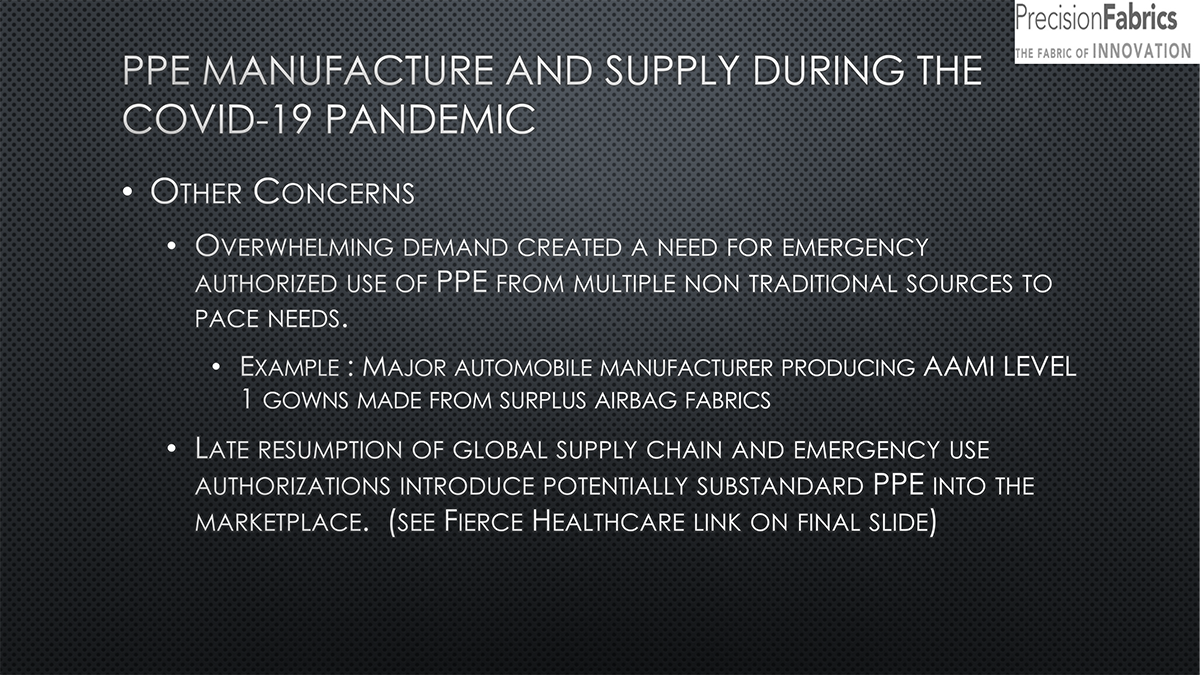
How many friends and family knew what the acronym PPE stood for before the COVID-19 pandemic? Now the term has been thrust upon the global stage where arguably everyone knows what PPE stands for and what it is.
Unfortunately here in the United States, we discovered how woefully unprepared we were regarding proper PPE supply in the event of a massive pandemic like we have seen this year regarding SARS-CoV-2 or more commonly known as Covid -19.
The presentation below is a brief but hopefully informative outline about what PPE is and its purpose. More specifically, the presentation deals with synthetic woven fabrics and the minimum requirements needed to produce reusable medical PPE gowns for medical environments.
The latter slides address what the U.S. healthcare industry has seen and experienced due to offshoring critical PPE supply chains in search of the least cost; the reality of resuming global supply which includes non-traditional suppliers anxious to capitalize on the increased demand and emergency authorizations introducing substandard PPE into the marketplace; and trends that are being seen as healthcare providers take a new and fresh look at their PPE supply chains, taking on a more proactive role in specifying where and how much PPE they will inventory will be highlighted along with a consideration of the advantages of reusable PPE.
The final slide contains web addresses where more detailed information can be located.
1 of 16
Editor’s Notes: This article appears on TextileWorld.com courtesy of the Synthetic Yarn And Fabric Association (SYFA) and was shared with SYFA members as one in a series of articles designed to keep its members informed during a time period when in-person interactions have been severely limited and conferences cancelled.
SYFA is a non-profit organization comprised of individuals affiliated with the synthetic yarn and fiber industry. SYFA members represent a wide variety of organizations including fiber producers, texturizers, staple yarn manufacturers, fabric producers for the apparel, automotive, upholstery, and industrial markets; raw material suppliers, equipment manufacturers, universities, and service providers related to the industry.
Steve Glosson is the research and development department manager for Precision Fabrics Group (PFG), Woven Fabrics Division. He is a 29 year veteran of the textile industry and in his 16 years at PFG has held technical roles in R&D, quality management and technical sales of barrier and protective apparel fabrics. He holds a Bachelor of Science degree in textile chemistry from North Carolina State University.
Precision Fabrics Group, Inc. has been providing reusable barrier fabrics to medical environments for over 30 years.
I would like to highlight the U.S. textile industry’s extraordinary efforts and response to the COVID-19 pandemic, as well as our business outlook and NCTO’s priorities this fall [2020] in Washington.
NCTO is the national voice of the domestic textile industry. Our member companies are manufacturers who are experts at transforming raw materials into an entire spectrum of modern textile products.
Many NCTO members are century-old textile companies that have used ingenuity, technology, and persistence to survive the Great Depression, the onslaught of imports over the past 40 years, and the recent Great Recession.
We have a world-class industry with enormous capabilities and the ability to pivot quickly to manufacture a limitless number of products.
In the spring, our industry received urgent requests-from the highest levels of government to nurses and doctors on the front lines- asking for immediate assistance to make lifesaving personal protective equipment (PPE).
Putting aside competitive differences, our industry proactively constructed multi-company PPE supply chains virtually overnight.
Our member companies have made hundreds of millions of urgently needed items, including gowns, masks, and testing kit swabs at a time when global supply failed to meet the needs required to face this crisis head on.
Our industry is now at a critical juncture. U.S. manufacturers are seeking certainty in the marketplace while also addressing the challenges associated with PPE procurement and the prospects for onshoring a supply chain capable of making the United States more self-sufficient in this critical area.
While we have withstood several macroeconomic challenges over the decades, the once-in-a-generation COVID-19 pandemic hit our member companies particularly hard at the onset of the coronavirus this spring.
Business Outlook
Overall industry performance was strong in 2019 and prior to the COVID-19 pandemic.
From fiber to finished product, the U.S. textile supply chain accounted for 585,000 jobs and $29 billion in exports in 2019. The value of shipments for man-made fiber, yarns, fabrics, apparel, and non-apparel sewn products was almost $76 billion last year. Capital investment in U.S. textiles and apparel totaled $2.5 billion in 2018, the latest year for which information is available. Moreover, the United States is a world leader in textile innovation and the world’s second largest exporter of textiles.
The employment, output, exporting and investment statistics for 2019 were all in line with recent years, where the domestic industry has enjoyed stability and growth.
However, the economic crisis spawned by the onset of the COVID-19 crisis led to a sharp drop in demand from retail customers through the spring, in turn forcing some of our member companies to idle capacity due to the rampant cancellation of customer orders in the first half of the year.
The collapse in demand was quantified by the U.S. Census Bureau, which reported clothing sales relative to February fell by 49 percent in March, 87 percent in April and 63 percent in May. This three-month decline alone represents $44 billion in lost sales. As a result, many U.S. textile companies were barely running at 10 percent of capacity during the height of the crisis earlier this year.
In August, textile mills reported a return to some growth in production, according to a closely watched manufacturing survey and report from the Institute for Supply Management (ISM).
However, the volatility in the economy caused by the COVID-19 crisis will continue to create uncertainty for manufacturers the remainder of this year.
NCTO Engages Members of Congress on PPE Policy Priorities
While domestic textile manufacturers have undertaken heroic efforts to confront the ongoing crisis, the economic toll coupled with the ongoing pandemic has created uncertainty in the business environment.
We need the certainty of a permanent domestic supply chain and that will only materialize if proper government policies and other actions are put in place to help domestic manufacturers survive the current economic crisis while incentivizing the long-term investment needed to fully bring PPE production back to the United States.
NCTO and our partners throughout the entire U.S. PPE production chain are in agreement on the principles we need to adopt, as outlined in a joint statement that serves as a policy roadmap on American PPE.
This fall, NCTO will be working on several fronts to garner support for legislation introduced this summer that is aimed at expanding domestic procurement requirements for PPE and building a permanent domestic PPE supply chain.
Our industry strongly supports congressional efforts to create a “Berry Amendment for PPE” and other proposals aimed at reshoring and strengthening American PPE manufacturing. Among these proposals, the following are top priorities:
H.R. 7841, American PPE Supply Chain Integrity Act, Sponsors: Rep. Patrick McHenry (R-NC) and Rep. Bill Pascrell (D-NJ)Supports the public health industrial base by creating a “Berry Amendment for PPE”
S.4578, Make PPE in America Act, Sponsors: Sen. Rob Portman (R-OH) and Gary Peters (D-MI)Provides stability to manufacturers and workers by issuing long-term PPE contracts
S.4264, The U.S. MADE Act, Sponsor: Sen. Lindsey Graham (R-SC)Ensures our Strategic National Stockpile has high-quality PPE made here in America
S.4368, Protecting American Heroes Act, Sponsor: Sen. Sherrod Brown (D-OH)Maps out U.S. PPE supply chains and incentivizes public-private PPE partnerships
More information about these initiatives is available at our website MakeAmericanPPE.org.
U.S. textile companies are willing and capable of investing the hundreds of millions of dollars needed to reconstruct a domestic PPE industry, but will not do so without the help of the federal government.
The acceptance of such significant risk will only be undertaken if investments can be justified through a clear demonstration of contracting support and consistent demand for U.S.-made product on the part of the federal government.
Without a comprehensive set of procurement, trade, and enforcement policies designed to foster domestic PPE production, U.S. manufacturers will continue to be undercut by state- sponsored and exploitive offshore competitors, namely China.
Please do not hesitate to reach out to me or the NCTO staff for any questions related to our policy priorities this year.
We are happy to work with SYFA and other industry groups to ensure our domestic manufacturing sector has a seat at the table in Washington and policies in place to maintain a permanent base in the future.
This article appears on TextileWorld.com courtesy of the Synthetic Yarn And Fabric Association (SYFA) and was shared with SYFA members as one in a series of articles designed to keep its members informed during a time period when in-person interactions have been severely limited and conferences cancelled.
SYFA is a non-profit organization comprised of individuals affiliated with the synthetic yarn and fiber industry. SYFA members represent a wide variety of organizations including fiber producers, texturizers, staple yarn manufacturers, fabric producers for the apparel, automotive, upholstery, and industrial markets; raw material suppliers, equipment manufacturers, universities, and service providers related to the industry.
Kim Glas is president and CEO of the Washington-based National Council of Textile Organizations (NCTO), a trade association representing U.S. textile manufacturing.
Tutterow’s presentation was titled “On The Economic, Political and Business Climate.”
By Dr. Roger Tutterow
The national economy entered 2020 with good momentum in growth. The economy had expanded by 126 months through December 2019, the longest expansion of the post-World War II era. The nation’s gross domestic product (GDP) had grown at 2.25 percent during 2019 and was expected to rise, admittedly at a modestly slower pace, in 2020. However, there were some risks on the horizon.
First, concerns remained that trade tensions in tariff wars could pose a threat for the manufacturing and trade sectors. Second, there was growing concern that a virus in China was spreading and could potentially become a global pandemic. Both of these outcomes were seen as risk to the economic expansion in 2020. While the former concerns were not realized, the latter risk proved to be the catalyst for the first truly exogenous recession in recent decades.
As the pandemic, now identified with COVID-19, spread into the United States, economic activity plummeted in March of this year. For the first quarter, the nation’s gross domestic product contracted at a 5 percent annualized rate. The National Bureau of Economic Research identified February as being the peak of the last economic expansion. However, the first quarter GDP contraction was negligible when compared with the 31.4 percent drop in the second quarter.
Not surprisingly, 70 percent of the drop in the second quarter GDP was due to a pullback in consumer spending. Some of this reduction was due to households voluntarily reducing activity in response to lower consumer confidence and a softening of labor markets. However, the effects of the pandemic were magnified by government-mandated closures that were particularly onerous in the retail and hospitality industries — where sales dropped by over 22 percent between January and April.
With the reduction of retail activity, so too consumption of motor vehicles fell sharply. After finishing 2019 with sales in excess of 17 million units, domestic motor vehicle sales fell to just over 9 million in the Spring. This level matched that recorded during the “great recession” of 2008-09. However, sale surge back in the summer months and 2020 will likely end up with domestic sales averaging a bit under 15 million units for the year.
In line with the contraction in output, employment dropped as well. Between February and April 2020, nonfarm employment fell by 14.5 percent — most of it in April when payroll employment fell by over 20.7 million jobs. By November, over half of the employment reduction had been recovered with payrolls down by a more moderate 6.6 percent. However, the pace of employment recovery will soften as it will likely take until at least late 2021 to recoup the remainder of the job losses.
While the downward trajectory of the economy during the first half of the year is well known, several open questions remain about the pace and duration of recovery.
First, it is important to acknowledge that the economics of the pandemic are subordinated to the epidemiology of the virus. In past pandemics, populations have endured several waves of infection. Indeed, it appears that another of infection is in force in the fourth quarter 2020. However, there is significant good news on this front. Several pharmaceutical companies reported very promising clinical trials results in November. Moreover, many medical experts believe the Covid-19 virus to be relatively stable, reducing the likelihood that the virus would mutate in a manner that reduces efficacy of vaccines and therapeutics.
Second, while there has been significant discussion regarding the merits and effects of government-mandated shutdowns, it is also worth noting that there are a variety of households and businesses who have voluntarily restricted activity throughout the year.
Third, there remain open questions regarding how the economy will perform as it wrestles with two “cliffs” — fiscal and forbearance.
In response to the pandemic recession, substantial fiscal and monetary stimulus was provided. Beginning in March, the Federal Reserve cut short-term interest rates to zero and launched a variety of credit facilities designed to inject liquidity into virtually every corner of the negotiable debt markets. The “Fed” has been clear that it plans to keep monetary policy accommodative throughout 2021 and likely beyond. While that translates into lower cost for debt, economic uncertainties will still weigh upon access to credit.
On the fiscal side, a variety of stimulus programs were offered. These included PPP loans, enhanced unemployment benefits and other CARES Act provisions including the “carry back” of 2020 net operating losses to recoup corporate taxes paid in previous years.
These programs clearly contributed to the strong recovery in the third quarter where GDP rose by 33.1 percent. However, much of this fiscal stimulus has been fading away and is unlikely to be replaced until after Inauguration Day.
In addition, creditors have extended forbearance arrangements to debtors through much of 2020. At the federal level, debt obligations associated with student debt and many mortgages were eligible for deferment. Equally important, financial institutions and the owners of commercial real estate extended forbearance to their debtors as well. As we move into 2021, it remains a bit of an open question as to how well debtors will be able to service existing obligations when forbearance agreements expire.
Economic policy is rarely independent of the political climate — 2020 and 2021 are no different. The apparent election of Joe Biden as the 46th president will shift economic policy — and not only in terms of the response to the pandemic. It seems highly likely that a President Biden will revisit trade deals executed during President Trump’s tenure. In addition, we will likely see reversals in regulatory policy, particularly as it relates to environmental issues and regulation of financial institutions.
During the 2020 campaign, candidate Biden signaled that he expected changes in the tax code that would increase the highest marginal tax rates on both corporate and individual income. The increase in the corporate tax rate, if implemented, would reverse a reduction from 35 percent to 21 percent under the Trump presidency. It is also likely that individual income tax rates, including those on capital gains, will be under review.
When foreshadowing likely policy shifts under President Biden, it will be important to monitor the background of those nominated for senior policy posts. Early appointments may be signaling a preference for more seasoned (and perhaps more moderate) candidates over that of self-identified progressives. However, in building out his team, Biden will likely offer “nods” to a variety of Democratic constituencies.
The appointment of Janet Yellen to Treasury may signal a more moderate approach to tax reform than some candidates had advocated. However, the selection of John Kerry to serve as Special Envoy for Climate, signals a likely reentry into the Paris Accord and potentially other environmental policies that could have significant impact on the manufacturing sector. As off this writing, the top posts at Labor and Commerce remain unclear, the later playing an important role in trade policy.
Finally, despite the apparent victory by Joe Biden in the presidential race, a “blue wave” never materialized and the Democrats lost seats in the U.S. House. Further, poll-defying victories by Susan Collins (ME), Joni Ernst (IA) and Thom Tillis (NC), ensured that the Republican control at least half the seats in the Senate. While the outcome of two runoff elections in Georgia will play a pivotal role, it is also likely that several moderate Democrats could cross party line on legislation seen as too aggressive.
As 2020 moves toward an end, the development of several vaccines and the resolution of the presidential elections paves the path for more economic clarity in 2021. Such clarity is necessary if the corporate sector is to deploy capital and rebuild payrolls to pre-pandemic levels.
Editor’s Notes: This article appears on TextileWorld.com courtesy of the Synthetic Yarn And Fabric Association (SYFA) and was shared with SYFA members as one in a series of articles designed to keep its members informed during a time period when in-person interactions have been severely limited and conferences cancelled.
SYFA is a non-profit organization comprised of individuals affiliated with the synthetic yarn and fiber industry. SYFA members represent a wide variety of organizations including fiber producers, texturizers, staple yarn manufacturers, fabric producers for the apparel, automotive, upholstery, and industrial markets; raw material suppliers, equipment manufacturers, universities, and service providers related to the industry.
Dr. Roger Tutterow, is a professor of Economics at Kennesaw State University where he holds the Henssler Financial Endowed Chair. He has served as a consultant to a variety of businesses and is a frequent speaker at SYFA events.
Groz-Beckert offers needles for all applications, and makes finding the right one easy
TW Special Report
“Looking for a needle in a haystack” describes an almost impossible mission to find something. Finding the perfect needle for sewing — given that manufacturer Groz-Beckert offers a range of 3,000 different types — might also seem quite a challenging job. Actually, it isn’t. The Germany-based company develops each needle to suit its intended application perfectly, and then meets user needs in the same way through its specially-designed Customer Portal for sewing.
Customer Portal
The Customer Portal was launched in 2015 and has since continued to expand. Customers from nearly every part of the world now have the option of accessing the portal’s wealth of information relating to needles and sewing, as well as its online ordering function. The real need for the platform has been proved: in 2020, half of total sales came through orders in the Customer Portal.
More recently, the Customer Portal Sewing was switched to a technically upgraded version — optimized for use on mobile devices. Another new addition is the individual start page, which shows recent orders and most frequently-purchased products. The personal customer account offers views, analysis and a dashboard displaying all relevant details about purchases.
The product catalog has been improved with new and optimized functions to find the right needles faster. The product detail page gives extensive information on the selected needle: in addition to technical details and the available point styles, users can also identify suitable applications for each needle.
Below: Special application needle SAN® 5.2 — the second-generation sewing machine needle for technical textiles
Key Components
What’s the use of the best sewing machine if skip stitches occur and threads as well as needles break? If material damage or seam puckering arises? It’s essential to choose for each task the appropriate needle in Groz-Beckert quality, especially for sensitive and challenging applications. Groz-Beckert SAN® 5.2, SAN 6, SAN 10 and SAN 10 XS incorporate what needles make a key component.
Airbags, carrying straps, car seats, upholstered furniture, protective clothing, sun protection systems … the list could continue with countless applications in the field of technical textiles, where sophisticated needles are a must. Also essential are great stability through special blade reinforcement, reliable loop pick-up for a greater safeguard against skipped stitches, uniform seam appearance and constantly gentle handling of the sewn fabric. These are the ‘musts’ but not the only advantages of SAN 5.2, the 2nd-generation sewing machine needle for technical textiles.
Special application needle SAN® 10 XS for gentle processing of fine and finest fabrics.
Thread breakage and skipped stitches are a headache in denim sewing. SAN 6 provides the cure. SAN 6 needles have a larger eye, which enables the thicker threads mostly used for this kind of application to slide through smoothly. Thicker threads can be used without increasing the needle size. The solution for skipped stitches is the Loop Control® geometry offering increased security.
Gentle and stable — perfectly designed for fine and finest fabrics — is how the special application needles SAN 10 and SAN 10 XS are best described. SAN 10 combines the requirements regarding protection of the material and needle stability. Its slim design results in a reduced cross-section in the eye area, reducing the stress on the material as the needle penetrates it. At the same time, the special geometry in the blade area offers sufficient needle stability to avoid needle breakages. SAN 10 XS is even more gentle on the material. The cylindrical blade enables a very gentle penetration of the material by the needle.
The special application needle SAN® 6 for sewing applications that require high needle stability and process security.
Top Value, Top Service
Quality has its price, but in case of Groz-Beckert sewing needles increased productivity and reduced production cost is always part of the development genius. Coming back to the Customer Portal: when logged in, users immediately see prices and availability of the needles. Reliability, as well as quick delivery, is what Groz-Beckert is perhaps best known for. How much do you value the ability to start planning for tomorrow today?
Univent Medical uses automated assembly lines to transform roll-fed materials into output of up to 4 million Atemious Pro FFP2 respirators per week, making it one of Europe’s largest FFP2 respirator producers. Photograph courtesy of Univent.
Autefa and Emerson contribute technology to respirator production line installed by Univent Medical.
By Didier Perret
The COVID-19 pandemic hit simultaneously around the world in early 2020, putting tremendous pressure on governments, industries, healthcare organizations and others to find ways to protect the public.
On April 9, 2020, Germany’s federal government established a task force, under the direction of the Federal Ministry for Economic Affairs and Energy (BMWi), to coordinate expanded production of personal protective equipment, tests and testing equipment, and active ingredients for COVID-19 testing in Germany and the European Union (E.U.). In short order, the BMWi task force developed an estimate that Germany would need annual production of 750 million FFP2 and FFP3 filtering respirators and 1,750 million medical face masks to meet the added level of demand.
Soon thereafter, the German federal government sought to contract with mask and respirator manufacturers to meet its ambitious goals. Univent Medical of Schwenningen, Germany, a maker of high-quality respiratory masks, received a contract that required it to dramatically increase production of its Atemious Pro FFP2 respirator.
At the time of the government’s huge request, Univent looked for new automated manufacturing lines to produce 1 million FFP2 respirators per week. Autefa Solutions Switzerland AG, Frauenfeld, Switzerland, a global machine builder, took an existing production machine concept and transformed it to comply with European safety regulations. This concept initially used ultrasonic welders, sourced in Asia, that were of entry-level quality. While these welders could support ordinary production rates in the mask-making machines, they lacked the features required to deliver and sustain superior quality at maximum rates of production. Of particular concern was their consistency and repeatability in bonding the four-layer mask laminate with the required strength at increased production speeds (see sidebar).
After ultrasonic welding equipment bonds multiple fabric layers together and attaches earloops, nearly completed respirators are folded and cut to the finished shape. Photograph courtesy of Univent.
Autefa contacted Emerson, the maker of Branson™ ultrasonic plastic welding equipment, to recommend welders that could deliver the power, quality and speed that Univent required. Emerson recommended retrofitting the four ultrasonic welding stations with high-performance Branson DCX Series ultrasonic power supplies and newly optimized ultrasonic production tooling. Weld tooling included new converters, boosters and weld sonotrodes specialized to each welding task. The tooling was fabricated and maintained by the local Emerson representative Pascal Baechtiger in Switzerland.
Accepting Autefa’s advice, Univent approved the equipment retrofits. Emerson filled the order — for 32 ultrasonic welding power supplies and the needed tooling — in less than six weeks. Upon delivery of the welders, Emerson representatives offered on-site technical support as Autefa personnel completed the welder retrofits. “The experience and responsiveness of Emerson’s Branson ultrasonic welding team enabled Autefa to start the equipment rebuilding program quickly, without a long learning curve,” said André Imhof, Autefa’s CEO Autefa Solutions Switzerland AG.
When the revamped mask-making machines resumed production, Univent felt the impact right away. Thomas Vosseler, director and co-owner of Univent, stated, “Due to the reliability and performance of the new Branson power supplies and weld tooling, each of our eight production machines have increased their speed and output with high reliability, enabling us to increase production to 4.5 million Atemious Pro FFP 2 respirators each month.”
When it comes to improved production speed and quality, every detail counts. For example, two of the four ultrasonic welding stations on each mask-making machine are dedicated to attaching the elastic earloops, which are essential to ensuring a comfortable, airtight fit. The new Branson technology affixes the left and right earloops simultaneously and in less than a quarter of a second. And, using the “energy mode” of the Branson DCX welding power supply, the welds are made perfectly reliable — a substantial increase in both quality and speed over any entry-level welding system.
Completed Atemious Pro FFP2 respirators are removed from the production line, inspected and readied for packaging. Photograph courtesy of Univent.
Vosseler estimated that using high-end Branson welding equipment “enabled 95-percent efficiency of the existing automated lines, compared to less than 60-percent production efficiency generally observed with the entry-level ultrasonic welding equipment.” He defined production line efficiency as the ratio between how long the machine is producing good parts at full speed, compared to the time the machine slows down or stops due to technical issues, alarms or maintenance.
Based on the improved production and quality figures for the revamped production lines, Univent asked Autefa to build and deliver an additional 20 mask-production machines in 2021. Upon installation and startup of the last of these new machines, Univent estimates that it will be producing 3.5 to 4 million Atemious Pro FFP2 respirators per week, making it one of Europe’s largest FFP2 respirator producers.
This close-up shows a finished Atemious Pro FFP2 medical respirator. Embossed areas show ultrasonic welds, which are used to bond multiple layers into the outer rim of the mask, contain the foldable nose-piece, attach the earloops, and form the curve that shapes the front of the mask. Photograph courtesy of Univent.
The Atemious Pro FFP2 Respirator
The Atemious Pro filtering respirator is built to exceed Conformité Européenne (CE) FFP2 testing standards and has been demonstrated in testing to capture more than 98% of the tiny solid and liquid particles that can spread COVID-19. Like the N95 respirator to which its performance may be compared (N95 is a respirator standard for the U.S. National Institute for Occupational Safety and Health [NIOSH]), Univent’s Atemious Pro respirator forms an airtight seal with the wearer’s face, so its design must not only balance excellent particle filtration with wearer comfort but also minimize any added exhalation resistance that can cause wearer fatigue over hours of use.
While many surgical masks and filtering respirators utilize a laminate of three layers of nonwoven fabric, the Atemious Pro respirator utilizes four layers, which are bonded together using ultrasonic welding. Closest to the skin is a layer of moisture-absorbing derma fleece. Then inside this are two special layers that perform the fine-particle filtration. They are made of an extremely tight web of meltblown polyethylene fibers. This is topped by a protective outer covering of polyethylene fleece providing the structural strength. To ensure a tight, yet comfortable fit, the laminated fabrics in the respirator incorporate an adjustable nose bridge and upper/lower attachment points for a soft, stretchable ear band and are also available with head loops.
Editor’s Note: Didier Perret is Medical Business Development manager, Branson Welding and Assembly at Emerson
RESEARCH TRIANGLE PARK, N.C. — March 17, 2021 — Companies that are part of BASF’s e3® Sustainable Cotton program — a cotton sustainability program that delivers item-level sustainability promises — can now directly show their support for the program’s farmers through the e3 Sustainable Cotton Grower Fund.
The fund is a unique and unprecedented effort to provide additional economic support for farmers in the program who commit to growing sustainable cotton. Vidalia Mills and General Standard are the first two companies to contribute to the fund, which launched in February.
“We’re excited to have Vidalia Mills and General Standard join us in this first-of-its-kind commitment and look forward to even more brands pledging to the fund,” said Jennifer Gasque-Crumpler, e3 Sustainable Cotton program manager for BASF. “Our vision for honest, fair, sustainable cotton isn’t possible without our dedicated farmers, and we’re grateful to our cotton fiber value chain collaborators who understand the importance of rewarding their effort.”
Brands, retailers, mills and other cotton fiber value chain companies sourcing e3 Sustainable Cotton will have the opportunity to contribute a monetary amount to the fund. At the end of each year, 100 percent of those funds will be distributed equally to e3 Sustainable Cotton farmers, which is in addition to a $2.50 per bale premium BASF provides to farmers enrolled in the program.
Cotton farmers like Elizabeth Lague will be direct recipients of the fund. Lague grows Stoneville® cotton in Tennessee and has been part of the e3 Sustainable Cotton program for the last two seasons. She also is a BASF Business Representative. As a farmer, she appreciates the opportunity she has through the BASF program to connect her cotton with companies that want to create traceability and transparency through the entire cotton fiber value chain, starting with sustainable farming practices.
“For many generations, our family has worked the land with the mindset of leaving it better than we found it,” said Lague. “It’s encouraging to see brands support this mentality and reward the farmers behind the cotton.”
The e3 Sustainable Cotton Grower Fund is part of a program that provides unmatched field-level traceability and is driven by comprehensive verification and a valued reputation for growing socially equitable, economically viable and environmentally responsible cotton. Farmers who are part of the e3 Sustainable Cotton program commit to tracking eight sustainability measures on 100 percent of their eligible cotton acres, ranging from water use and pesticide management to soil conservation and greenhouse gas emissions reduction. Through a series of digital platforms, the cotton they grow can be traced from an individual cotton bale in their field, all the way to the end consumer. To learn more about the e3 Sustainable Cotton program, visit www.e3cotton.us.