Sensormatic Solutions Expands Options For Sewn-In RFID Source Tagging Strategies

NEUHAUSEN, Switzerland— June 2, 2026 — Sensormatic Solutions, the leading global retail solutions portfolio of Johnson Controls, now offers two discreet radio-frequency identification (RFID) tagging alternatives for clothing, apparel and accessory for brands and retailers seeking deep insights without compromising garments’ look and feel. Its new RFID Seam Tag and RFID Brand Label—which are now available to retailers worldwide—can be sewn directly into garments without altering fit, function or impact on branding. This approach can extend the life of RFID investments, helping brands to help verify authenticity, help deter theft and remove friction to help enable a seamless shopper journey. Both will be on display at NRF Protect, Booth #1116, June 8-10, 2026 in Grapevine, TX.

“These tagging solutions turn inventory intelligence into comprehensive brand protection,” said Tony D’Onofrio, president of Sensormatic Solutions. “They represent the next era of omnichannel retail intelligence tools, pairing full product visibility and protection in a discreet package. They’re designed to be permanent and tamper-resistant, providing retailers with information needed to address total retail loss from the source through their supply chains and sales floors, and beyond. This helps enhance shopper experiences, preserve revenue, and control shrink.”

These small and discrete RFID tagging solutions are highly durable and built to last, helping retailers expand the value of their RFID and inventory intelligence investments:

  • Fast, seamless integration into apparel production
    RFID Seam Tag and RFID Brand Label are designed with the natural feel of fabric and the needs of versatile, fast production environments. The RFID Seam Tag’s narrow and flexible design allows it to be embedded in the seam of apparel and accessories whereas the RFID Brand Label is sewn-into the garment according to the retailer’s brand discretion. As such, retailers can protect merchandise without damaging or compromising merchandise while also reducing the labor needed to execute enterprise-wide tagging.
  • Extend and support RFID-based intelligence throughout the supply chain
    The RFID Seam Tag and RFID Brand Label are designed to stay with the item for the product sales cycle. It’s applied at the source and built to be an all-in-one solution for inventory visibility and management throughout enterprise operations and through the sales cycle. Each tag can become a unique and long-lasting digital fingerprint, providing item-level identity from factory to store and beyond to enable inventory and omnichannel accuracy.
  • Harden targets while improving shopper experiences
    RFID tagging solutions should be perceived as a part of the product rather than a traditional security addition, intended to add defeat resistant friction for thieves while streamlining self-checkout and return processes for paying customers. Their design is intended to curb counterfeiting and unauthorized resales to enhance satisfaction. Further, adding RFID Seam Tag or RFID Brand Label at the source can bolster shrink analytics systems with additional context, helping retailers refine their practices to preserve shopper satisfaction and revenue alike.
  • Protect brands at scale
    They can help validate that the product is authentic and are designed so that they cannot be easily removed without damaging the merchandise, thus enabling identifiers that allow retailers to validate origin, help verify authenticity and protect against counterfeiting, grey-market sales and return fraud on scale.

These RFID tagging solutions are compatible with retailers’ existing RFID ecosystems and are available as part of Sensormatic Solutions expanding source tagging services. The brand operates RFID Service Bureaus around the world bringing the capabilities closer to retailers anytime, anywhere. To learn more, visit the RFID Seam Tag or the RFID Brand Label pages on sensormatic.com.

To schedule a meeting or a demonstration at NRF Protect (June 8-10), Booth #1116, click here: Meet us at NRF Protect 2026.

Posted: June 2, 2026

Source: Sensormatic Solutions

Eton’s AI-Driven Sorting System Targets Growing Resale Market

STOCKHOLM, Sweden — May 28, 2026 — At the recent Texprocess exhibition in Frankfurt, Eton Systems – a member of TMAS, the Swedish textile machinery association – demonstrated its new aUPS module for the rapid sorting of used garments.

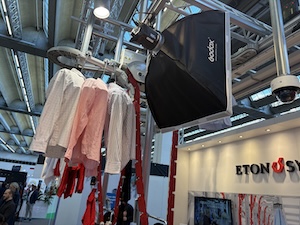
The aUPS in action at the Frankfurt show.

Based on Eton’s well-proven UPS transport system for material handling and powered by the company’s ETONingenious Factory 4.0 software, the aUPS exploits the latest AI to instantly grade individual garments by colour, size, style, and where possible manufacturer. It also instantaneously analyses and highlights any damage to the garment and makes recommendations for possible repairs, while calculating a resell price.

“The collected information is fed into a calculation model that, based on market data, makes suggestions for a sales price,” explained Eton Sales and Marketing Manager Sven Sørbo in Frankfurt. “At the same time, the garment is photographed for marketing and then transported to a warehouse to await sale.”

The potential of the aUPS module has already been recognised by several prominent retail brands who are currently trialling it. It was developed as part of the Microfactories System Innovation project which has also involved specialists at the Swedish School of Textiles in Borås, the Automation Region innovation cluster at Mälardalen University and the iHubs Sweden national collaboration platform.

The project builds on previous work that had mainly focused on developing small-scale, local and needs-based production. Now the focus is on the growing market for reuse.

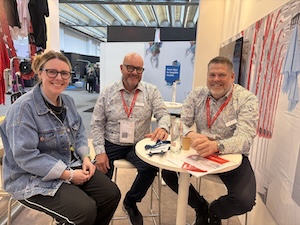
Pictured at Texprocess 2026 are Ellen Flybäck, Sven Sørbo and Jan Johansson.

“The online resale segment alone is huge and forecast to double over the next five years and volumes are now so large that handling has to be automated for it to work,” said Ellen Flybäck, a consultant affiliated with the Swedish School of Textiles in Borås. “The new EU regulations requiring the separate collection of textiles are without doubt having an impact, but we are also seeing an increasingly positive attitude towards reuse and greater awareness of the textile industry’s environmental footprint.”

“Collaboration with universities and innovation environments helps us to be at the forefront,” added Eton’s sales and marketing director Jan Johansson. “We can participate in freer and more visionary development, without having to take on all the work ourselves. But above all, it is about contributing to a more circular industry, where materials can be used for longer and in a smarter way.”

Many TMAS member companies are now developing technologies that support the textile industry’s shift towards more circular and resource-efficient business models.

“Eton’s development clearly illustrates how Swedish innovation is moving beyond traditional production efficiency towards enabling entirely new value chains based on reuse, automation and AI,” said TMAS Secretary General Therese Premler-Andersson in conclusion.

Posted: June 2, 2026

Source: TMAS, The Swedish Textile Machinery Association

Easy Care For Fresher Air: New Pur-Ease Technology On Smartstrand Styles Is Asthma & Allergy Friendly® Certified

CALHOUN, GA  — May 31, 2026 — Mohawk is setting a new standard for carpet in homes where allergy and asthma concerns are top of mind.

The company announced today that its SmartStrand carpet styles are the first treated carpet products to earn the Asthma & Allergy Friendly® Certification, made possible by an innovative built-in technology that helps control and reduce indoor allergens.

New Pur-Ease™ technology uses natural probiotics integrated into the carpet to reduce common household allergens — such as pet dander, pollen, and dust mite allergen — by up to 75% compared with untreated carpet, with continued allergen reduction over time, even after deep cleanings.

The SmartStrand portfolio, now enhanced with Pur-Ease, strengthens Mohawk’s longstanding commitment to innovation and builds on more than two decades of proven performance. These

advancements reaffirm SmartStrand’s position as the softest, most durable and easiest to clean

carpet available, now with the added benefit of built-in allergen reduction.

The Asthma & Allergy Friendly® Certification, an independent, science-driven program, verifies

that carpet with Pur-Ease meets rigorous standards for allergen reduction and indoor air quality.

This Certification proves, through strict scientific testing, that carpet treated with Pur-Ease

meaningfully reduces exposure to household allergens and irritants, making the carpet better

suited for people with asthma and allergies.

“Innova>on has always been at the core of who we are at Mohawk,” said Joe Semaan, president, residential carpet, Mohawk Flooring. “Achieving the Asthma & Allergy Friendly® Certification for carpet with Pur-Ease reinforces that commitment and brings real, meaningful benefits to the homes of our consumers.”

The Asthma & Allergy Friendly® Certification Program is a unique, groundbreaking collaboration between the Asthma and Allergy Foundation of America (AAFA) and Allergy Standards Limited (ASL). The program tests and certifies products against strict standards to prove their suitability for people with asthma and allergies. Products passing these tests earn the Asthma & Allergy Friendly® Certification Mark. The Certification Program works with retailers and manufacturers to offer consumers products for a healthier home.

For more information on the Asthma & Allergy Friendly® Certification and the Asthma and Allergy Foundation of America, visit aafa.org/Certified. To learn more about Mohawk’s innovations in flooring, visit mohawkflooring.com.

Posted: June 2, 2026

Source: Mohawk Industries

Lenzing AG Appoints Georg Kasperkovitz As Chief Executive Officer

LENZING, Austria — May 31, 2026 — The Supervisory Board of Lenzing AG has appointed Georg Kasperkovitz, Member of the Management Board and Chief Operations Officer, as Chief Executive Officer (CEO) of Lenzing AG with effect from June 1, 2026.

Georg Kasperkovitz

Kasperkovitz will assume this role in addition to his current function as Chief Operations Officer (COO). Kasperkovitz has been a member of the Management Board of Lenzing AG as Chief Operations Officer since June 2025. In this role, he has most recently led the Fiber Division (sales, production, and supply chain) as well as the further development and execution of the performance program. He has achieved significant progress in operational excellence and the profitability of the fiber production sites.

As CEO, in addition to overseeing the company-wide fiber production sites, he will also assume global responsibility for fiber sales, supply chain, and human resources. Kasperkovitz’s mandate as CEO runs for three years until May 31, 2029.

Supervisory Board emphasizes continuity and performance

Patrick Lackenbucher, Chairman of the Supervisory Board of Lenzing AG, commented: “Over the past months, the Supervisory Board has intensively addressed the appointment of the CEO position and evaluated both internal and external candidates. It became clear that the current Management Board works very effectively together and that Georg Kasperkovitz manages his areas of responsibility extremely successfully. He has achieved measurable progress in operational performance and profitability. His appointment as CEO is therefore a logical step that ensures stability and execution strength, particularly in challenging market environments.

The Management Board will continue to consistently focus on structural profitability and strengthening competitiveness, with the aim of further expanding Lenzing’s position as a leading integrated premium supplier of regenerated cellulose fibers.”

Focus on transformation, profitability, and growth

Georg Kasperkovitz said: “I would like to thank the Supervisory Board for their trust and for appointing me as CEO, and I am very much looking forward to actively shaping Lenzing’s future. A clearly prioritized strategy focused on premium products, the consistent execution of our performance program, and a strong leadership team are key drivers of Lenzing’s continued transformation.

We will drive sustainable growth in high-margin market segments, such as nonwovens applications in hygiene and filtration, while further advancing next-generation technologies such as Tree-to-Textile.

At the same time, we will consistently implement measures to further strengthen our cost position and global competitiveness. Our goal is to unlock the company’s full value-creation potential.”

Management Board structure remains unchanged

The composition of the Management Board remains unchanged and continues to consist of Georg Kasperkovitz (CEO), Mathias Breuer (CFO), and Christian Skilich (CPO/CTO).

The extended Executive Committee, consisting of six members, also remains unchanged.

About Georg Kasperkovitz

Georg Kasperkovitz holds a PhD in Mechanical Engineering (Vienna University of Technology) and an MBA from Harvard Business School. He has more than 15 years of international management experience across Europe, North America, Asia, and China—Lenzing’s key production regions and markets. Prior to joining Lenzing, he served as Business Unit CEO at the international packaging and paper company Mondi plc (2016–2019) and as CEO of Rail Cargo Austria AG (2012–2016). He previously worked as a partner at the global consulting firm McKinsey & Company.

Posted: June 2, 2026

Source: Lenzing Aktiengesellschaft

Harper Hygienics Introduces Cleanic Probiotic – Everyday Comfort And Support For The Natural Microbiome

WARSAW — June 1, 2026 — Harper Hygienics introduces Cleanic Probiotic – a new line of menstrual pads created for women who expect reliable protection, everyday comfort and a more conscious approach to intimate hygiene.

Cleanic Probiotic pads have been enriched with carefully selected Lactobacillus strains, which support the natural balance of the microbiome. Thanks to probiotics incorporated into the absorbent layer, the product not only helps maintain a feeling of freshness and comfort, but also supports the natural protective barrier of intimate areas.

The pads feature a top sheet made from 100% organic cotton, providing softness and gentleness in contact with sensitive skin. Their triple absorbent core effectively absorbs moisture, helping to ensure reliable protection throughout the day and night. Hydrophobic wings provide additional stability and comfort, keeping the pad securely in place during everyday activity.

The line includes two variants:

  • day pads with wings – pack of 10
  • night pads with wings – pack of 8

Cleanic Probiotic combines effective protection, softness and microbiome support – offering a modern approach to everyday intimate hygiene.

Posted: June 2, 2026

Source: Harper Hygienics S.A. 

European Flax-Linen And Hemp Step Into Advanced Manufacturing: Enabling Filament Winding, 3D Printing And High-Performance Composite Processes

PARIS — June 1, 2026 — The Alliance for European Flax-Linen & Hemp announces a new wave of technological advancements demonstrating how flax-linen and hemp fibres are now being successfully integrated into advanced composite manufacturing processes. These developments mark a transition beyond traditional hand lay-up techniques, positioning natural fibres as credible, scalable solutions for high-performance industrial applications.

European flax-linen and hemp biocomposites are rapidly evolving, with cutting-edge manufacturing technologies unlocking new levels of performance, precision and repeatability. As a result, flax-linen and hemp are emerging as serious contenders across demanding sectors including automotive, construction, design and advanced engineering.

Recent progress in thin-ply prepreg technology has enabled flax rovings, such as those developed by Depestele, to be transformed into ultra-lightweight, high-performance composite structures. Leveraging the ‘thin ply effect,’ these materials demonstrate enhanced damage tolerance, while automated prepreg systems and back-injection moulding are facilitating efficient, high-volume production, particularly within the automotive sector.

At the forefront of innovation, coreless filament winding is redefining the possibilities of natural fibre composites. This advanced robotic process enables resin-impregnated flax fibres to be precisely wound into complex three-dimensional geometries without the need for traditional moulds, significantly reducing material waste while enabling structurally optimised designs. The FIBRAS project at Eindhoven University of Technology is exploiting these techniques and developing specialised handling methodologies for flax rovings that address the inherent variability of natural fibres in highly controlled manufacturing environments, to create lightweight, resource-efficient and more sustainable architectural structures for the construction industry.

The DynaMill project, led by ContiTech AVS France (a subsidiary of OESL-Automotive), Nautix and ComposiTIC (a technical centre attached to the University of Southern Brittany), co-funded by the Brittany region and supported by ID4Mobility and EMC2 clusters, has successfully developed and mechanically validated a lightweight automotive engine support connecting rod manufactured using injection moulding and automated fibre placement with flax fibre reinforcements and bio-based PA11 matrix. Filament winding has been also investigated with promising results. Building on earlier lightweighting work under the Dynafib programme, the project highlights the growing potential for high-performance, bio-based composite structures that combine renewable materials, reduced weight and scalable manufacturing technologies for future automotive applications.

In parallel, the University of Stuttgart’s ICD/ITKE continues to pioneer novel applications for natural fibres. Supported by Safilin, researchers have developed the “Con[knit]uous Rubble” process, which uses continuous circular knitting to encase unprocessed demolition waste in seamless flax fibre structures. This innovative method allows for the construction of self-supporting architectural forms such as arches and columns without binders or mortars, while enabling full disassembly and material reuse. Future developments aim to integrate bio-based resins to further enhance durability and performance.

Additive manufacturing is also rapidly expanding the potential of flax-based composites. Continuous flax fibre-reinforced 3D printing now delivers mechanical properties comparable to traditional composite processes through the co-extrusion of flax yarns with thermoplastics such as PLA. This opens new opportunities for rapid prototyping and customised structural components. Meanwhile, compounded flax fibre filaments are gaining traction in more conventional 3D printing applications.

This momentum is reflected in the design sector, where French designer Alyssa Cartaut was recently awarded the City of Hyères Prize for Fashion Accessories at the 40th International Festival of Fashion, Photography and Accessories. Her collection, The Cushion Issue, features footwear components 3D-printed using PLA filament reinforced with European flax-linen fibres, offering a bio-based alternative to conventional materials. The Alliance supported this project by facilitating access to certified fibres and connecting the designer with material specialists.

Looking ahead, 4D printing introduces an additional dimension to natural fibre composites. By incorporating materials that respond to stimuli such as heat or moisture, researchers are developing structures capable of adapting their shape and function over time. Professor Antoine le Duigou, based at the Institut de Recherche Dupuy de Lôme, is leading research in this field in collaboration with Coriolis Composites, focusing on bio-inspired materials for decarbonisation applications.

Advances are also being made in hemp processing. New capabilities in long-fibre hemp pultrusion have enabled the development of high-strength structural elements, exemplified by the Hemp Halo Canopy – a 3.3metre architectural prototype presented at JEC World. Developed as part of the EU-funded RAW project (in relation with Terre de Lin, Safilin and Linificio Canapificio Nazionale), the structure combines pultruded hemp profiles with CNC-knitted hemp surfaces to create a fully bio-based, lightweight and structurally efficient system, demonstrating the potential for waste-free construction.

In the field of functional materials, Composites Edge GmbH has introduced a next-generation adaptive acoustic panel made from natural fibres and thermoplastic resins. At less than one millimetre thick, the panel can be manufactured using automated fibre placement (AFP), is fully recyclable and waterproof, and is capable of absorbing up to 95% of low-frequency noise. The innovation was recognised as a finalist in the CAMX Awards for most creative application.

“European Flax-linen and hemp are redefining what’s possible in biocomposite manufacturing, moving far beyond traditional lay-up into highly automated processes like filament winding, prepreg systems and additive manufacturing,” comments Bruno Pech of the Alliance for European Flax-Linen & Hemp. “These innovations are unlocking new levels of precision, design freedom and performance, proving natural fibres are ready for the most advanced industrial applications.”

Posted: June 2, 2026

Source: The Alliance for European Flax-Linen & Hemp

USDA Launches Great American Cotton Plan To Revitalize The Cotton Farm Economy

WASHINGTON, D.C. — May 28, 2026 — U.S. Secretary of Agriculture Brooke L. Rollins today announced the Great American Cotton Plan (PDF, 2.7 MB), a comprehensive USDA initiative to strengthen the cotton farm economy, restore domestic textile manufacturing, expand cotton trade opportunities, and increase demand for products made with American-grown cotton.

“Since 1607, cotton has helped build and sustain rural America. Our farmers grow some of the highest-quality cotton in the world, but over the last several years America’s cotton growers have been crushed by rising costs, unfair foreign competition, and a flood of cheap synthetic products. In 2023, we lost our status as the world’s top cotton exporter to Brazil. This change starts today,” said Secretary Rollins. “The Trump Administration is committed to ensuring American cotton once again becomes the fiber of choice with the Great American Cotton Plan — a bold effort to restore profitability for cotton producers, strengthen rural economies, rebuild domestic textile manufacturing, and bring American cotton back into the products families use every day.

“Supporting natural fibers like cotton also aligns with the Make America Healthy Again agenda as Americans grow increasingly concerned about microplastics and synthetic materials in everyday products. Cotton is natural, breathable, biodegradable, and proudly grown by American farmers — not manufactured from petroleum-based plastics that can shed microplastics into our soil, water, and bodies.”

The announcement comes as cotton producers face a fifth consecutive year of negative returns driven by rising input costs, trade distortions, and increasing competition from synthetic materials. As part of the plan, USDA will elevate the “Plant Not Plastic” initiative to encourage consumers to purchase products made with healthy natural American cotton fibers rather than synthetic plastic-based alternatives.

Cotton remains one of the most economically significant crops in the United States, supporting producers and rural communities. USDA estimates every $1 generated at the cotton farm gate creates approximately $15 in direct economic activity across related industries.

However, the cotton industry continues facing severe economic pressure. USDA forecasts producers could lose approximately $2.6 billion across 9 million planted acres during the upcoming crop year. Since 1980, the number of U.S. cotton gins has declined from 2,254 to 446, while domestic textile production facilities have sharply contracted over the last two decades.

At the same time, nearly 70 percent of the world’s textile fibers are now synthetic, most of them plastic-based materials such as polyester.

Cotton is a natural fiber harvested from the cotton plant’s seedpods and has been used in clothing and household products for thousands of years due to its breathability, softness, durability, and comfort. Unlike synthetic fibers such as polyester, nylon, and acrylic, which are petroleum-based and chemically manufactured, cotton is biodegradable and naturally breathable.

As part of the Administration’s broader Make America Healthy Again priorities, USDA and HHS are promoting greater awareness around natural fibers and the potential impacts of synthetic materials. Cotton’s natural structure allows for strong air circulation and moisture absorption, helping keep consumers cooler and more comfortable. Cotton can absorb up to 27 times its weight in water, making it especially effective at pulling moisture away from the skin during hot weather and physical activity. By contrast, synthetic materials often trap heat and reduce breathability.

The Great American Cotton Plan addresses these challenges through four key pillars:

Promoting Domestic Cotton Consumption

  • USDA and HHS are promoting the “Plant Not Plastic” initiative to encourage consumers to choose products made with American cotton
  • USDA is ensuring the BioPreferred Program remains funded so biobased products, including cotton products, can continue using the BioPreferred label
  • USDA is implementing increased marketing loan rates for upland and extra-long staple cotton authorized through the Working Families Tax Cuts Act

Providing Affordable Cotton by Increasing Domestic Demand and Production

  • USDA is prioritizing cotton processors and manufacturers within Rural Development’s Business and Industry Guaranteed Loan Program to increase domestic production capacity
  • The Economic Adjustment Assistance for Textile Mills program payment rate will increase from 3 cents to 5 cents per pound of cotton processed
  • USDA will continue working with Congress to support the bipartisan Buying American Cotton Act

Improving Cotton Trade

  • USDA is implementing the Administration’s Three-Point Trade Plan to expand export opportunities for U.S. cotton
  • Cotton Council International participated in an Agribusiness Trade Mission to Indonesia for the first time in program history earlier this year
  • USDA and USTR secured commitments from Indonesia and Bangladesh that will support future U.S. cotton purchases and textile production using American cotton
  • USDA continues supporting cotton exports through the Market Access Program and COTTON USA™ licensing initiatives

Protecting Cotton Growers from Adverse Risk

  • USDA Agricultural Research Service scientists are advancing research efforts to combat the spread of the cotton jassid pest
  • Cotton producers now have expanded access to Supplemental Coverage Option insurance tools
  • The Working Families Tax Cuts Act increased the seed cotton reference price for ARC and PLC programs by 14 percent beginning in fall 2026

USDA will continue coordinating with industry stakeholders, manufacturers, cotton growers, retailers, and Congress to advance policies that strengthen the cotton supply chain from the field to the fabric.

Posted: June 1, 2026

Source: U.S. Department of Agriculture

American Apparel & Footwear Association Celebrates 250 Years Of Fashion

WASHINGTON, D.C. — June 1, 2026 — The American Apparel & Footwear Association (AAFA) today launched its new  250 Years of Fashion  archival platform, celebrating individuals and brands that have contributed to American fashion and culture over the last two and a half centuries. The platform complements AAFA’s role as a supporting partner of  America250, a bipartisan initiative celebrating American contributions and milestones this semiquincentennial.

The “250 Years of Fashion” platform provides snippets of American history through iconic American brands including Columbia Sportswear, Fruit of the Loom, Gap Inc., Gildan, Jockey International, Inc., Kayser-Roth Corporation, L.L. Bean, Levi Strauss & Co., New Balance Athletics, Inc., Perry Ellis International, Inc., Ralph Lauren Corporation, Spanx, LLC, and Worldwide Responsible Accredited Production (WRAP); featuring the story behind classic American fashion like blue jeans, khakis, the “Bean Boot,” and more.

Developed through submissions from AAFA members, the platform showcases how fashion has evolved alongside the nation itself, reflecting cultural shifts, innovation, craftsmanship, and entrepreneurship across generations. Members proudly share elements of their company’s heritage, including stories of founders and other contributors.

Steve Lamar, American Apparel and Footwear Association (AAFA)

“Through the lens of our 250th birthday, we’re giving Americans an inside look of the choices that have shaped what they now wear every day. Every article of clothing, every shoe, and every accessory carries a story. In many cases, your favorite pair of jeans or most comfortable sweater reflects a story that is profoundly American,” said  President and CEO of AAFA, Steve Lamar. “The semiquincentennial offers a unique opportunity to celebrate the vibrant American heritage behind iconic brands and pieces that are woven into our daily lives and play a vital role in shaping our nation’s identity, economy, creativity, and culture.”

Providing just a small sample of the many diverse voices, perspectives, and contributions that have shaped the success of America’s fashion industry, AAFA is proud to celebrate these snapshots in “250 Years of Fashion.” The organization recognizes that the industry’s progress has been made possible through ongoing reflection, learning, and the activism that continues to drive meaningful improvement.

AAFA also acknowledges that this work is never complete. As the industry moves forward, it will continue to navigate challenges and opportunities related to corporate responsibility, sustainability, and other evolving dynamics.

As part of this semiquincentennial reflection, AAFA is inviting participants to consider the question, “What will our industry look like on July 4, 2076?” through a virtual time capsule that will be opened during America’s tricentennial celebration. Contributors are encouraged to share their aspirations for the future of fashion, offering insights that will help future generations understand how today’s industry imagined the road ahead.  Throughout the rest of the year, AAFA will continue sharing stories and historical reflections through member and media engagement.

Posted: June 1, 2026

Source: The American Apparel & Footwear Association (AAFA)

2026 World of Wipes Innovation Award® Finalists Revealed

CARY, N.C. — June 1, 2026 —  INDA, the Association of the Nonwoven Fabrics Industry, announced the three finalists for the 2026 World of Wipes Innovation Award®. The finalists are The Clorox Company for their Clorox™ Refreshables™, Lenzing Fibers, Inc. for their Lenzing™ DualWipe, and Rockline Industries for their First Defense™ Fentanyl Detection Wipe.

These finalists will present their products at the World of Wipes® (WOW) International Conference, June 29-July 2, at the Grand Hyatt Nashville in Nashville, Tennessee. The winner will be announced during the closing session on July 2.

Presented annually, the World of Wipes Innovation Award recognizes breakthrough achievements in nonwoven product design, technology, and application across the wipes supply chain. Selected by INDA’s Technical Advisory Board, finalists are honored for creativity, technical excellence, and distinctive advancements in areas such as raw materials, fibers, converting, packaging, binders, additives, active ingredients, sustainability, and end-use performance.

The 2026 Award finalists are:

The Clorox Company: Clorox Refreshables In-Dryer Clothing Refresher – The power of the wash without the wait. Clorox Refreshables In Dryer Clothing Refresher turns dryers into a 15-minute wardrobe reset, no washing machine needed. These innovative wet dryer sheets work like a fast, fabric-friendly tune-up: just toss one towelette into the dryer with an outfit for 15 minutes to revive lightly worn items, tackling odor, wrinkles, static and pet hair while leaving a crisp, lasting Spring Fresh scent.

Lenzing Fibers, Inc.: Lenzing DualWipe – enabled by Lenzing’s Nonwovens Technology (LNT), integrates two functional surfaces within a single material: an abrasive side for effective removal of dirt and residues, and a soft, highly absorbent side for wiping and finishing. DualWipe contains no synthetic fibers, binders or finishing chemicals, and eliminates the risk of plastic and microplastic shedding typically associated with conventional synthetic wipes. Its compatibility with standard converting processes supports broad applicability across industrial, professional and household cleaning segments.

Rockline Industries: First Defense Fentanyl Detection Wipe – Rockline Industries, in collaboration with Visual Detection Systems, developed the First Defense Fentanyl Detection Wipe, a single-use presumptive test that rapidly detects trace fentanyl through a visible color change. Featuring specialized indicators bound to viscose fibers with a starch-based system, the wipe improves field usability and reliability. Tested with pharmaceutical and street-grade fentanyl and other opioids, it is designed for law enforcement, first responders, military, airports, schools, and correctional facilities.

The 2025 award winner was Cookware Care’s Seasoning Wipes™ which offer a simple, convenient, mess-free solution for maintaining cast iron and carbon steel cookware. Made from 100 percent viscose and infused through a proprietary process using a combination of non-petrochemical oils and beeswax, the formula contains no water, emulsifiers, or synthetic additives.

For more information or to register for WOW 2026, visit www.worldofwipes.org.

Posted: June 1, 2026

Source: INDA, the Association of the Nonwoven Fabrics Industry

Manufacturing PMI® At 54%; May 2026 ISM® Manufacturing PMI® Report: Textile Mills Report Growth

TEMPE, Ariz. — June 1, 2026 —  Economic activity in the manufacturing sector expanded in May for the fifth consecutive month, say the nation’s supply executives in the latest ISM® Manufacturing PMI® Report.

The report was issued today by Susan Spence, MBA, Chair of the Institute for Supply Management® (ISM®) Manufacturing Business Survey Committee.

“The Manufacturing PMI® registered 54 percent in May, 1.3 percentage points higher than in April and its highest reading since May 2022 (55.9 percent). The overall economy continued in expansion for the 19th month in a row. (A Manufacturing PMI® above 47.5 percent, over a period of time, generally indicates an expansion of the overall economy.) The New Orders Index expanded for the fifth consecutive month after four straight readings in contraction, registering 56.8 percent, up 2.7 percentage points compared to April’s figure of 54.1 percent. The May reading of the Production Index (54.3 percent) is 0.9 percentage point higher than April’s reading of 53.4 percent. The Prices Index remained in expansion (or ‘increasing’ territory), registering 82.1 percent, a 2.5-percentage point decrease from April’s reading of 84.6 percent. The Backlog of Orders Index registered 52.2 percent, up 0.8 percentage point compared to the 51.4 percent recorded in April. The Employment Index registered 48.6 percent, up 2.2 percentage points from April’s figure of 46.4 percent,” says Spence.

“The Supplier Deliveries Index indicated slowing performance for the sixth month in a row after one month in ‘faster’ territory. The reading of 60.6 percent repeated its April figure after the index increased in each of the previous five months. (Supplier Deliveries is the only ISM® PMI® Reports index that is inversed; a reading of above 50 percent indicates slower deliveries, which is typical as the economy improves and customer demand increases.)

“The Inventories Index registered 49.9 percent, up 0.9 percentage point compared to April’s reading of 49 percent. The Customers’ Inventories Index reading of 42.7 percent is 3.6 percentage points higher as compared to the 39.1 percent recorded in April.

“The New Export Orders Index returned to expansion territory with a reading of 50.6 percent, 2.7 percentage points higher than the 47.9 percent registered in April. The Imports Index registered 53 percent, 2.7 percentage points higher than April’s reading of 50.3 percent.”

Spence continues, “In May, U.S. manufacturing activity remained in expansion territory, growing at a faster pace compared to the month before. Of the five subindexes that make up the PMI®, the New Orders index indicated faster growth compared to the previous month, the Supplier Deliveries index stayed the same, the Production Index grew at a faster rate, and the Employment and Inventories indexes remained in contraction, though both improved.

“In May, 25 percent of the comments were positive and 69 percent negative, with a 1-to-2.7 ratio of positive to negative sentiment. Among comments, the Iran war was mentioned in 42 percent and tariffs in 18 percent; 57 percent of the panelists mentioned pricing volatility as an issue for their companies.

“Three of four demand indicators (the New Orders, Backlog of Orders, and New Export Orders indexes) were in expansion. The Customers’ Inventories Index remains in ‘too low’ territory, contracting at a slower rate. A ‘too low’ status for the Customers’ Inventories Index is usually considered positive for future production.

“Regarding output, the Production Index is in expansion for the seventh month in a row, and the Employment Index increased by 2.2 percentage points but remained in contraction. Among panelists, 50 percent indicated that managing head counts remains the norm at their companies, while 50 percent are hiring.

“Finally, inputs (defined as supplier deliveries, inventories, prices and imports) were mostly improved month over month. With the same reading as in April, the Supplier Deliveries Index stayed at its highest level since May 2022 (65.7 percent). The Inventories Index contracted at a slower rate, the Prices Index declined by 2.5 percentage points and the Imports Index grew at a faster rate.

“Looking at the manufacturing economy, only 2 percent of the sector’s gross domestic product (GDP) contracted in May, compared to 19 percent in April, and the percentage of manufacturing GDP in strong contraction (defined as a composite PMI® of 45 percent or lower) was also 2 percent, the same as in April. The share of sector GDP with a PMI® at or below 45 percent is a good metric to gauge overall manufacturing weakness. All of the six largest manufacturing industries expanded in May, in the following order: Computer & Electronic Products; Machinery; Transportation Equipment; Petroleum & Coal Products; Chemical Products; and Food, Beverage & Tobacco Products. In May, all indexes headed in a direction that suggests sustained growth,” says Spence.

The 16 manufacturing industries reporting growth in May — listed in order — are: Printing & Related Support Activities; Textile Mills; Nonmetallic Mineral Products; Paper Products; Electrical Equipment, Appliances & Components; Plastics & Rubber Products; Primary Metals; Miscellaneous Manufacturing; Computer & Electronic Products; Furniture & Related Products; Machinery; Transportation Equipment; Petroleum & Coal Products; Chemical Products; Fabricated Metal Products; and Food, Beverage & Tobacco Products. The only industry reporting contraction in May is Wood Products.

WHAT RESPONDENTS ARE SAYING

  • “Impact of Iran conflict starting to directly and negatively impact cost of supply chain. Oil and related commodities are escalating in price.” [Transportation Equipment]
  • “The Middle East conflict is triggering shipment delays and uncertainties. Elevated gas prices and inflation will surely impact our purchases. However, over the last quarter, we’ve seen increased demand that was unexpected.” [Machinery]
  • “As with all companies, we have felt the effects of fuel-related inflation and general market uncertainty due to overall economic variability and geopolitical events that have impacted such markets as construction, automotive and agriculture, as well as the general industrial sector.” [Chemical Products]
  • “Continuing trends of 15-percent sales increase in April, cost increases on a majority of raw materials, and fuel charges on many inbound and outbound deliveries. We remain cautiously optimistic that if global economic factors stabilize and the Iran conflict ends, we can continue with increased sales and maintain acceptable margins.” [Chemical Products]
  • “Cost of diesel is having huge impacts on our profitability. Confusion abounds around tariff refunds. We purchase many imported goods but in most cases are not the importer of record, so it is currently unclear to what we may be entitled.” [Food, Beverage & Tobacco Products]
  • “Prices continue to rise for many products — some due to increase in data center creation for electronic components, others as a result of the Iran war and reductions in availability of oil/petroleum.” [Computer & Electronic Products]
  • “Supply constraints continue to propagate and are a key headwind to supporting increased aerospace and defense demand. Semiconductors, critical minerals and certain types of raw materials are illustrative examples of sales plans at risk. Corporate risk mitigation actions are underway to secure supply in the midst of constraints.” [Transportation Equipment]
  • “The current atmosphere is one of extreme uncertainty and concern for the future in terms of both price stability and longer-term supply continuity related to the Iran conflict and Strait of Hormuz closure. We have a lot of negotiations in process related to requested price increases, some related to oil prices and some still fallout from the 2025 tariff/geopolitical climate.” [Miscellaneous Manufacturing]
  • “Continued dynamic random-access memory (DRAM) volatility, increased gas prices and tariffs are causing long lead constraints and price hikes that customers are not willing to bear. Panic is starting within our industry.” [Electrical Equipment, Appliances & Components]
  • “Business appears to be weakening — uncertainty surrounding the Iran war, rising energy prices and customers unwilling to commit to expenditures beyond a very short term.” [Fabricated Metal Products]
MANUFACTURING AT A GLANCE

May 2026

Index Series

Index

May

Series

Index

Apr

Percentage

Point

Change

Direction Rate of

Change

Trend*

(Months)

Manufacturing PMI® 54.0 52.7 +1.3 Growing Faster 5
New Orders 56.8 54.1 +2.7 Growing Faster 5
Production 54.3 53.4 +0.9 Growing Faster 7
Employment 48.6 46.4 +2.2 Contracting Slower 32
Supplier Deliveries 60.6 60.6 0.0 Slowing Same 6
Inventories 49.9 49.0 +0.9 Contracting Slower 13
Customers’ Inventories 42.7 39.1 +3.6 Too Low Slower 20
Prices 82.1 84.6 -2.5 Increasing Slower 20
Backlog of Orders 52.2 51.4 +0.8 Growing Faster 5
New Export Orders 50.6 47.9 +2.7 Growing From Contracting 1
Imports 53.0 50.3 +2.7 Growing Faster 4
OVERALL ECONOMY Growing Faster 19
Manufacturing Sector Growing Faster 5

ISM® Manufacturing PMI® Report data is seasonally adjusted for the New Orders, Production, Employment and Inventories indexes.
*Number of months moving in current direction.

COMMODITIES REPORTED UP/DOWN IN PRICE AND IN SHORT SUPPLY

Commodities Up in Price
Acrylic Products (2); Aluminum (30); Aluminum Products (2); Brass; Carbides; Chemical Products (3); Cooking Fats and Oils (3); Copper (11); Copper Based Products (6); Corn (3); Corrugated Products (2); Diesel Fuel (3); Electronic Components (5); Ethylene; Freight (3); Fuel (3); Gasoline; Maintenance, Repair, and Operating (MRO) Supplies; Memory Components (3); Metal Products (2); Methanol (3); Ocean Freight; Oil (2); Oil Based Products (2); Packaging Materials (2); Paper Products (2); Petroleum Based Products (2); Plastic Based Products (2); Plastics (3); Polyethylene Resins (2); Polypropylene; Resins (4); Soybean Products (3); Steel (7); Steel — Carbon (2); Steel — Hot Rolled (5); Steel — Stainless (4); Steel Products (6); Sulfur Products (2); Transportation Costs (2); Trucking Services; Tungsten Products (4); and Wire and Cable (2).

Commodities Down in Price
None.

Commodities in Short Supply
Aluminum (2); Electrical Components (11); Electronic Components (15); Memory (5); Propylene Glycol (2); Resins; Semiconductors (3); Steel Products; and Tungsten Products.

Note: The number of consecutive months the commodity is listed is indicated after each item.

MAY 2026 MANUFACTURING INDEX SUMMARIES

Manufacturing PMI®
The U.S. manufacturing sector expanded in May for the fifth straight month following a 10-month period of contraction, registering 54 percent, an increase of 1.3 percentage points as compared to April. This is the highest PMI® reading since it registered 55.9 percent in May 2022. Of the five subindexes that directly factor into the Manufacturing PMI®, three (New Orders, Production and Supplier Deliveries) were in expansion territory, the same as in April. The Employment and Inventories indexes both stayed in contraction but improved compared to April. All of the six largest manufacturing industries expanded in May. A reading above 50 percent indicates that the manufacturing sector is generally expanding; below 50 percent indicates that it is generally contracting.

A Manufacturing PMI® above 47.5 percent, over a period of time, generally indicates an expansion of the overall economy. Therefore, the May Manufacturing PMI® indicates the overall economy grew for the 19th straight month. “The past relationship between the Manufacturing PMI® and the overall economy indicates that the May reading (54 percent) corresponds to a 2.2-percent increase in real gross domestic product (GDP) on an annualized basis,” says Spence.

THE LAST 12 MONTHS

Month Manufacturing
PMI®
Month Manufacturing
PMI®
May 2026 54.0 Nov 2025 48.0
Apr 2026 52.7 Oct 2025 48.8
Mar 2026 52.7 Sep 2025 48.9
Feb 2026 52.4 Aug 2025 48.9
Jan 2026 52.6 Jul 2025 48.4
Dec 2025 47.9 Jun 2025 49.0
Average for 12 months – 50.4

High – 54.0

Low – 47.9

New Orders
ISM®‘s New Orders Index expanded in May with a reading of 56.8 percent, an increase of 2.7 percentage points compared to April’s reading of 54.1 percent. “Of the six largest manufacturing industries, four (Computer & Electronic Products; Chemical Products; Transportation Equipment; and Machinery) reported increased new orders. Demand sentiment was positive in May, and for a second straight month, there was a 1.6-to-1 ratio of positive to negative comments,” says Spence. A New Orders Index above 51.9 percent, over time, is generally consistent with an increase in the Census Bureau’s series on manufacturing orders (in constant 2000 dollars).

The 14 manufacturing industries that reported growth in new orders in May, in order, are: Nonmetallic Mineral Products; Printing & Related Support Activities; Paper Products; Electrical Equipment, Appliances & Components; Textile Mills; Primary Metals; Miscellaneous Manufacturing; Computer & Electronic Products; Furniture & Related Products; Chemical Products; Transportation Equipment; Plastics & Rubber Products; Machinery; and Fabricated Metal Products. The only industry reporting a decline in new orders in May is Wood Products.

New Orders %Higher %Same %Lower Net Index
May 2026 30.9 55.2 13.9 +17.0 56.8
Apr 2026 31.6 53.2 15.2 +16.4 54.1
Mar 2026 29.1 56.3 14.6 +14.5 53.5
Feb 2026 30.3 56.9 12.8 +17.5 55.8

Production
The Production Index expanded in May for the seventh month in a row, registering 54.3 percent, a 0.9-percentage point increase compared to April’s reading of 53.4 percent. “Of the six largest manufacturing industries, five (Transportation Equipment; Machinery; Computer & Electronic Products; Food, Beverage & Tobacco Products; and Chemical Products) reported increased production. Panelists had a 1.75-to-1 ratio of positive to negative comments regarding output,” says Spence. An index above 52 percent, over time, is generally consistent with an increase in the Federal Reserve Board’s Industrial Production figures.

The 14 industries reporting growth in production during the month of May — listed in order — are: Printing & Related Support Activities; Textile Mills; Nonmetallic Mineral Products; Primary Metals; Electrical Equipment, Appliances & Components; Miscellaneous Manufacturing; Plastics & Rubber Products; Paper Products; Fabricated Metal Products; Transportation Equipment; Machinery; Computer & Electronic Products; Food, Beverage & Tobacco Products; and Chemical Products. The only industry reporting a decrease in production in May is Wood Products.

Production %Higher %Same %Lower Net Index
May 2026 26.7 57.8 15.5 +11.2 54.3
Apr 2026 28.3 58.7 13.0 +15.3 53.4
Mar 2026 24.5 62.8 12.7 +11.8 55.1
Feb 2026 25.2 58.8 16.0 +9.2 53.5

Employment
ISM®‘s Employment Index registered 48.6 percent in May, 2.2 percentage points higher than April’s reading of 46.4 percent. “The index posted its 32nd consecutive month of contraction after expanding in September 2023. Since January 2023, the Employment Index has contracted in 40 of 41 months. Of the six big manufacturing industries, three (Computer & Electronic Products; Transportation Equipment; and Machinery) reported higher levels of employment in May. The panelist comment ratio of hiring to managing/reducing head counts was 1 to 1 in May,” says Spence. An Employment Index above 50.3 percent, over time, is generally consistent with an increase in the Bureau of Labor Statistics (BLS) data on manufacturing employment.

Of the 18 manufacturing industries, nine reported employment growth in May, in the following order: Printing & Related Support Activities; Wood Products; Computer & Electronic Products; Furniture & Related Products; Nonmetallic Mineral Products; Plastics & Rubber Products; Transportation Equipment; Electrical Equipment, Appliances & Components; and Machinery. The five industries reporting a decrease in employment in May are: Food, Beverage & Tobacco Products; Chemical Products; Fabricated Metal Products; Miscellaneous Manufacturing; and Textile Mills.

Employment %Higher %Same %Lower Net Index
May 2026 17.0 67.6 15.4 +1.6 48.6
Apr 2026 17.5 62.3 20.2 -2.7 46.4
Mar 2026 14.2 70.8 15.0 -0.8 48.7
Feb 2026 18.8 60.8 20.4 -1.6 48.8

Supplier Deliveries
Delivery performance of suppliers to manufacturing organizations was slower in May for the sixth consecutive month after one month of faster deliveries. “The Supplier Deliveries Index registered 60.6 percent, the same as in April and a repeat of its highest reading since May 2022 (65.7 percent). Of the six big industries, five (Computer & Electronic Products; Food, Beverage & Tobacco Products; Chemical Products; Machinery; and Transportation Equipment) reported slower supplier deliveries,” says Spence. A reading below 50 percent indicates faster deliveries, while a reading above 50 percent indicates slower deliveries.

The 14 manufacturing industries reporting slower supplier deliveries in May, in order, are: Computer & Electronic Products; Nonmetallic Mineral Products; Plastics & Rubber Products; Textile Mills; Food, Beverage & Tobacco Products; Chemical Products; Paper Products; Fabricated Metal Products; Machinery; Miscellaneous Manufacturing; Furniture & Related Products; Electrical Equipment, Appliances & Components; Primary Metals; and Transportation Equipment. No industry reported faster deliveries in May.

Supplier Deliveries %Slower %Same %Faster Net Index
May 2026 24.6 71.9 3.5 +21.1 60.6
Apr 2026 22.6 75.9 1.5 +21.1 60.6
Mar 2026 19.5 78.8 1.7 +17.8 58.9
Feb 2026 14.0 82.2 3.8 +10.2 55.1

Inventories
The Inventories Index registered 49.9 percent in May, up 0.9 percentage point compared to the reading of 49 percent in April. “Of the six big industries, five (Petroleum & Coal Products; Machinery; Transportation Equipment; Food, Beverage & Tobacco Products; and Chemical Products) expanded inventories in May,” says Spence. An Inventories Index greater than 44.5 percent, over time, is generally consistent with expansion in the Bureau of Economic Analysis (BEA) figures on overall manufacturing inventories (in chained 2000 dollars).

Of 18 manufacturing industries, the nine reporting higher inventories in May — in the following order — are: Textile Mills; Petroleum & Coal Products; Paper Products; Electrical Equipment, Appliances & Components; Machinery; Transportation Equipment; Miscellaneous Manufacturing; Food, Beverage & Tobacco Products; and Chemical Products. The six industries reporting lower inventories in May — listed in order — are: Nonmetallic Mineral Products; Wood Products; Computer & Electronic Products; Plastics & Rubber Products; Fabricated Metal Products; and Primary Metals.

Inventories %Higher %Same %Lower Net Index
May 2026 18.1 65.4 16.5 +1.6 49.9
Apr 2026 14.5 68.3 17.2 -2.7 49.0
Mar 2026 16.7 64.3 19.0 -2.3 47.1
Feb 2026 14.2 71.8 14.0 +0.2 48.8

Customers’ Inventories
ISM®‘s Customers’ Inventories Index remained in “too low” territory in May, with reading of 42.7 percent, an increase of 3.6 percentage points compared to the 39.1 percent reported in April. (For more information about the Customers’ Inventories Index, see the “Data and Method of Presentation” section below.)

The two industries that reported that customers’ inventories were too high in May are: Textile Mills; and Miscellaneous Manufacturing. The 10 industries reporting customers’ inventories as too low in May, in order, are: Furniture & Related Products; Machinery; Electrical Equipment, Appliances & Components; Primary Metals; Food, Beverage & Tobacco Products; Fabricated Metal Products; Transportation Equipment; Computer & Electronic Products; Chemical Products; and Wood Products. Six industries reported no change in customers’ inventories in May compared to April.

Customers’
Inventories
%

Reporting

%Too

High

%About

Right

%Too

Low

Net Index
May 2026 73 7.0 71.3 21.7 -14.7 42.7
Apr 2026 73 7.6 62.9 29.5 -21.9 39.1
Mar 2026 74 6.9 66.3 26.8 -19.9 40.1
Feb 2026 76 5.7 66.1 28.2 -22.5 38.8

Prices
The ISM® Prices Index registered 82.1 percent in May, a decrease of 2.5 percentage points compared to its April reading of 84.6 percent, indicating raw materials prices increased for the 20th straight month. Five of the six largest manufacturing industries — Chemical Products; Machinery; Food, Beverage & Tobacco Products; Computer & Electronic Products; and Transportation Equipment — reported price increases in May. “The Prices Index reading is still being driven by (1) increases in steel and aluminum prices that impact the entire value chain, (2) tariffs applied to many imported goods and (3) increases in petroleum-based products as a result of the Middle East conflict. Higher prices were reported by 66.3 percent of respondents in May, down 4 percentage points from April’s 70.3 percent,” says Spence. A Prices Index above 52.8 percent, over time, is generally consistent with an increase in the Bureau of Labor Statistics (BLS) Producer Price Index for Intermediate Materials.

In May, the 16 industries that reported paying increased prices for raw materials, in order, are: Furniture & Related Products; Nonmetallic Mineral Products; Paper Products; Plastics & Rubber Products; Printing & Related Support Activities; Textile Mills; Fabricated Metal Products; Chemical Products; Electrical Equipment, Appliances & Components; Machinery; Miscellaneous Manufacturing; Food, Beverage & Tobacco Products; Computer & Electronic Products; Primary Metals; Transportation Equipment; and Wood Products. No industries reported paying decreased prices for raw materials in May.

Prices %Higher %Same %Lower Net Index
May 2026 66.3 31.5 2.2 +64.1 82.1
Apr 2026 70.3 28.5 1.2 +69.1 84.6
Mar 2026 59.4 37.8 2.8 +56.6 78.3
Feb 2026 45.4 50.2 4.4 +41.0 70.5

Backlog of Orders
ISM®‘s Backlog of Orders Index registered 52.2 percent in May, an increase of 0.8 percentage point compared to the April reading of 51.4 percent. Of the six largest manufacturing industries, three (Computer & Electronic Products; Machinery; and Transportation Equipment) reported expansion in order backlogs in May.

The nine industries reporting higher backlogs in May — listed in order — are: Furniture & Related Products; Nonmetallic Mineral Products; Textile Mills; Electrical Equipment, Appliances & Components; Computer & Electronic Products; Plastics & Rubber Products; Machinery; Fabricated Metal Products; and Transportation Equipment. The three industries reporting lower backlogs in May are: Wood Products; Food, Beverage & Tobacco Products; and Chemical Products. Six industries reported no change in backlog of orders in May as compared to April.

Backlog of

Orders

%

Reporting

%Higher %Same %Lower Net Index
May 2026 87 20.4 63.5 16.1 +4.3 52.2
Apr 2026 90 22.1 58.6 19.3 +2.8 51.4
Mar 2026 90 24.6 59.6 15.8 +8.8 54.4
Feb 2026 90 26.8 59.5 13.7 +13.1 56.6

New Export Orders
ISM®‘s New Export Orders Index registered 50.6 percent, up 2.7 percentage points from April’s reading of 47.9 percent, marking a return to expansion territory. “For every positive comment on exports, there were two negative comments,” says Spence.

Of the 18 manufacturing industries, the five that reported growth in new export orders in May are: Primary Metals; Chemical Products; Miscellaneous Manufacturing; Computer & Electronic Products; and Transportation Equipment. The eight industries that reported a decrease in new export orders in May — in the following order — are: Wood Products; Printing & Related Support Activities; Textile Mills; Plastics & Rubber Products; Food, Beverage & Tobacco Products; Fabricated Metal Products; Electrical Equipment, Appliances & Components; and Machinery.

New Export

Orders

%

Reporting

%Higher %Same %Lower Net Index
May 2026 74 12.8 75.6 11.6 +1.2 50.6
Apr 2026 75 10.4 75.0 14.6 -4.2 47.9
Mar 2026 74 12.1 75.5 12.4 -0.3 49.9
Feb 2026 74 9.2 82.2 8.6 +0.6 50.3

Imports
ISM®‘s Imports Index increased in May to 53 percent, a 2.7-percentage point increase compared to April’s reading of 50.3 percent.

The eight industries reporting higher imports in May — in the following order — are: Printing & Related Support Activities; Wood Products; Electrical Equipment, Appliances & Components; Miscellaneous Manufacturing; Transportation Equipment; Machinery; Food, Beverage & Tobacco Products; and Fabricated Metal Products. The three industries that reported lower volumes in May are: Textile Mills; Paper Products; and Chemical Products. Seven industries reported no change in imports in May compared to April.

Imports %

Reporting

%Higher %Same %Lower Net Index
May 2026 85 15.4 75.2 9.4 +6.0 53.0
Apr 2026 85 10.6 79.3 10.1 +0.5 50.3
Mar 2026 87 15.1 75.0 9.9 +5.2 52.6
Feb 2026 87 15.8 78.1 6.1 +9.7 54.9

The Supplier Deliveries, Customers’ Inventories, Prices, Backlog of Orders, New Export Orders, and Imports indexes do not meet the accepted criteria for seasonal adjustments.

Buying Policy
The average commitment lead time for Capital Expenditures in May was 171 days, a decrease of 3 days compared to April. The average lead time in May for Production Materials was 81 days, the same as April. The average lead time for Maintenance, Repair and Operating (MRO) Supplies was 48 days, an increase of two days compared to April.

Percent Reporting
Capital

Expenditures

Hand-to-

Mouth

30 Days 60 Days 90 Days 6 Months 1 Year+ Average

Days

May 2026 17 5 7 11 34 26 171
Apr 2026 15 4 7 13 35 26 174
Mar 2026 17 3 10 12 32 26 170
Feb 2026 18 3 7 14 27 31 179
 
Percent Reporting  
Production

Materials

Hand-to-

Mouth

30 Days 60 Days 90 Days 6 Months 1 Year+ Average

Days

 
May 2026 8 25 27 25 11 4 81  
Apr 2026 7 26 25 28 10 4 81  
Mar 2026 8 26 27 26 7 6 82  
Feb 2026 9 25 26 26 10 4 79  


Percent Reporting
MRO Supplies Hand-to-

Mouth

30 Days 60 Days 90 Days 6 Months 1 Year+ Average

Days

May 2026 27 39 16 12 4 2 48
Apr 2026 27 36 18 14 4 1 46
Mar 2026 29 38 15 13 4 1 44
Feb 2026 29 37 18 11 3 2 46


Posted: June 1, 2026

Source: Institute for Supply Management

Sponsors