
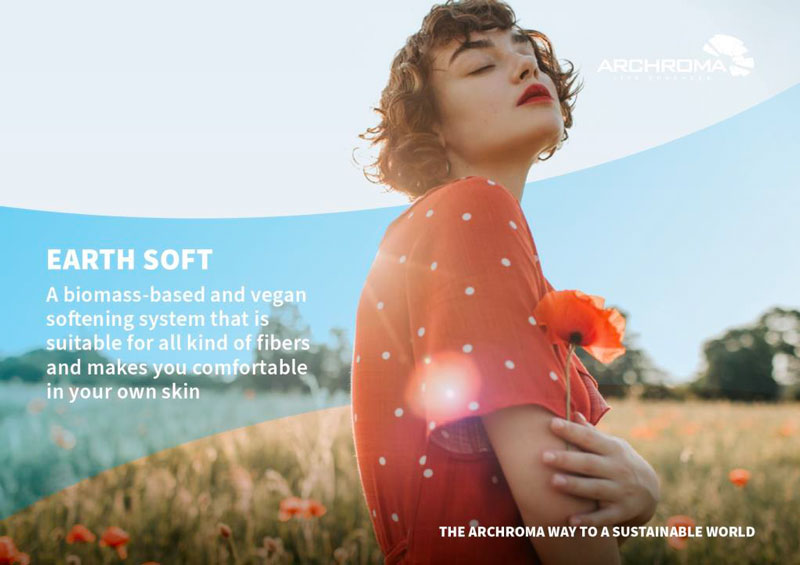
Archroma Launches EARTH SOFT System Based On Siligen® EH1, A New Vegan Textile Softener With One-Third Plant-Based Active Content

PRATTELN, Switzerland — February 1, 2022 — Archroma, a global supplier of specialty chemicals towards sustainable solutions, today announced the launch of EARTH SOFT, a new softening system for textile and fashion applications, based on Archroma’s latest innovation, a vegan silicone softener, Siligen® EH1, with 35-percent plant-based active content.

Siligen EH1 is the latest addition in the plant-based innovations developed by Archroma in recent years, such as EarthColors® dyes and Appretan® NTR binders, as alternatives offered to manufacturers and brands looking to reduce the use of fossil fuel based ingredients without compromising performance.

The range has been developed in line with the principles of “The Archroma Way to a sustainable world: safe, efficient, enhanced, it’s our nature”. More than 35 percent of the Siligen EH1 softener’s active content is based on plant-based, renewable raw materials. In addition, the product features ultralow cyclic siloxanes (D4, D5, D6) which are classified by the European Chemicals Agency as “Substances of Very High Concern” due to their very persistent and bioaccumulative properties.

Siligen EH1 is ideally suited for shirts, underwear, sportswear, towels, bed sheets, etc. as it provides an excellent wearing comfort by supporting a good moisture transportation and delivering a smooth and soft touch.

The new softener, and the EARTH SOFT system which also includes a Hydroperm® wicking agent to boost hydrophilic properties on synthetic and blended fibers, can be applied on all natural and synthetic textile fibers.

Siligen EH1 is suitable for both woven and knitted articles. It can be applied by padding process, as well as by exhaust process as it shows a very good shear stability and a low foaming profile. It can be used on white articles and those treated with optical brighteners, as it doesn’t cause thermomigration nor phenolic yellowing.

Paul Cowell, head of Competence Centers for Brand & Performance Textile Specialties at Archroma, commented: “The new EARTH SOFT system based on Siligen EH1 softener adds to our growing portfolio of innovations based on natural and renewable plant-based resources. This new breakthrough innovation by Archroma helps us and our partners in the textile and fashion industry to minimize our dependence on petroleum fossil fuel products.”

Posted: February 1, 2022

Source: Archroma

High Energy Costs Undermine Crucial Transformation Of The Textile And Clothing Industry

BRUSSELS — January 31, 2022 — The current energy crisis is impacting on the competitiveness of the European textile and clothing industry. Because there are limited alternatives to the use of gas in different parts of the production process, production costs increase sharply. EURATEX asks the European Commission and Member States to urgently support the industry to avoid company closures. At the same time, we need a long-term vision to move towards climate neutrality, while keeping the T&C industry internationally competitive.

EURATEX presented ten key requirements to Kadri Simson, European Commissioner for Energy, to develop such a vision:

  1. The apparel and textile industry needs a safe supply with sufficient green energy (electricity and gas) at internationally competitive prices.
  2. The transformation of industry requires access to very significant amounts of renewable energy at competitive costs. Additional investments in infrastructure will also be needed to guarantee access to new renewable energy supplies.
  3. Until a global (or at least G 20 level) carbon price or other means for a global level playing field in climate protection are implemented, competitive prices for green energy must be granted at European or national levels (e.g. CCfDs, reduction on levies, targeted subsidies).
  4. As the European textile and clothing sector faces global competition mainly form countries/regions with less stringent climate ambitions, it is of utmost importance that the European textile and clothing companies are prevented form direct and indirect carbon leakage.
  5. EU-policy should support solutions, e.g. through targeted subsidies (for hydrogen, energy grids, R&D, technology roadmap studies etc.).
  6. A dedicated approach for SMEs might be appropriate as SMEs do not have the skills/know-how to further improve their energy efficiency and/or becoming carbon neutral.
  7. CAPEX and OPEX support will be necessary for breakthrough technologies, like hydrogen.
  8. The Fit-for-55-Package must support the European Textile and Clothing industry in decarbonization and carbon neutrality. The EU must therefore advocate a global level playing field more than before. The primary goal must be to establish an internationally uniform, binding CO2 pricing, preferably in the form of a standard at G-7 / G-20 level.
  9. EU-policy must not hinder solutions, e.g. we need reasonable state aid rules (compensating the gap between national energy or climate levies and a globally competitive energy price should not be seen as a subsidy).
  10. The European Textile and Clothing industry has made use of economically viable potentials to continuously improve energy efficiency over many years and decades. The obligation to implement further measures must be taken considering investment cycles that are in line with practice. Attention must be paid to the proportionality of costs without weakening the competitive position in the EU internal market or with competitors outside the EU.

Posted: February 1, 2022

Source: EURATEX

Generational Equity Advises Tampa T-Shirts In Its Sale To Private Investor

DALLAS — January 31, 2022 — Generational Equity, a mergers and acquisitions advisor for privately held businesses, is pleased to announce the sale of its client, Tampa T-Shirts to a private investor. The acquisition closed January 20, 2022.

Located in Tampa, Fla., Tampa T-Shirts is an apparel decorating and branded merchandise firm serving many industries including construction, retail, education, government, restaurants, automotive, and many diverse industries throughout the Tampa Bay area. The company specializes in custom screen-printing and embroidery applied to a broad selection of wearables and accessories to accommodate all budgets.

Generational Equity Executive Managing Director, M&A-Technology Practice Leader, David Fergusson, and his team led by Senior M&A Advisors, Nick Arnheim and Tony Blair, with the support of Managing Director, M&A, Alex Mironov, successfully closed the deal. Senior Managing Rick Buchoz established the initial relationship with Tampa T-Shirts.

“We couldn’t be more pleased with the result of a perfect partnership between the seller and buyer in this transaction,” Arnheim said. “The seller has built a well-respected reputation over the past 37+ years in the local community, and we are excited that the buyer will continue to make the Tampa T-Shirts name proud for many years to come.”

Posted: January 31, 2022

Source: Generational Equity

The LYCRA Co. Introduces THERMOLITE® EcoMade Fiber Made From 100-Percent Textile Waste For Insulations

WILMINGTON, Del. — January 26, 2022 — The LYCRA Co. announced today it has launched THERMOLITE® EcoMade fiber made from 100-percent textile waste, now for insulation applications. The new fiber for battings is the latest sustainable offering from one of the most recognized warming technology brands among consumers worldwide.

This new warming technology involves recycling textile waste from cutting room floors that would have been sent to a landfill or incinerated, and transforming it into high performance fibers for insulation. Once fabric scraps are collected from garment makers, they go through a four-step process before becoming a finished product: 1) depolymerization and refining 2) chip manufacture 3) fiber formation and 4) batting and insulation production.

“Our new textile waste fiber can be used in unique batting constructions to deliver outstanding warming performance infused with unparalleled sustainable attributes,” said Arnaud Ruffin, vice president, brands and retail at The LYCRA Co. “We are initially promoting the fiber in two versions of insulation — both thin-loft and mid-loft battings, each made with ≥ 85 percent of recycled fibers, including ≥ 50 percent Thermolite fiber made from recycled PET bottles and ≥ 35 percent made from the new textile waste product. Both batting offerings deliver durability and outstanding levels of performance combined with unmatched sustainability credentials for the outdoor industry, while warmth per unit weight and other insulation characteristics meet the industry’s highest expectations.”

By using textile waste as an input to make commercial performance fibers, The LYCRA Co. is providing a solution to help the industry deal with its textile waste problem, as well as creating a starting point for circularity.

Thermolite EcoMade insulation made from textile waste is available now.

Posted: January 31, 2022

Source: The LYCRA Co.

Birla Cellulose Aims ‘Net Zero Carbon Emissions Across All Its Operations By 2040’

MUMBAI, India — January 31, 2022 — Birla Cellulose — the pulp and fiber business of Grasim Industries Ltd. and a flagship company of the Aditya Birla Group — today announced its goal to bring down its net carbon emissions to zero across all its operations by 2040, with a possibility to reach it earlier by 2035. According to the company, this is the most ambitious target set by any company in the man-made cellulosic fiber (MMCF) industry globally.

The company also targets to reduce its greenhouse gas (GHG) emissions intensity to half by 2030 from the baseline of 2019. Birla Cellulose’s commitment to carbon neutrality and GHG reductions includes scope 1, scope 2, scope 3 emissions, and the carbon sequestration in managed forests and are derived using science-based methods.

Sharing his thoughts on the announcement, H K Agarwal, managing director, Grasim Industries and Business Director, Birla Cellulose, said: “This is a natural progression in Birla Cellulose’s global leadership in the area of sustainability. Birla Cellulose’s climate target is at the core of its business strategy that aims to address climate change-related risks and adapt to changing consumer preferences for more sustainable, nature-based, and low emission products. With a legacy of innovation in the MMCF industry spanning seven decades, Birla Cellulose continues to work on cutting-edge technologies that will accelerate this transition.”

The roadmap would include increased use of renewable energy in its processes, investment in innovative low emission technologies, net positive carbon sequestration in its managed forests, and a sharp focus on circular fashion.

Currently, around 40 percent of the energy for the global operations of Birla Cellulose comes from renewable sources. In addition to this, in an assessment carried by E&Y in 2019, the carbon sequestered in its directly managed forests exceeded the entire scope 1 and scope 2 emissions from global sites during the year.

Birla Cellulose leads the industry in sustainability practices such as sustainable forestry (ranked #1 in Canopy Hot Button Ranking 2021) and has set the industry benchmark for the lowest water intensity for viscose and lyocell production. It has recently commissioned the first Zero Liquid Discharge (ZLD) plant in the MMCF industry globally and has the largest social responsibility program in the industry.

Posted: January 31, 2022

Source: Birla Cellulose

Piana Technology Achieves UL Formaldehyde-Free Claim Validation For Tintoria Piana Products

CARTERSVILLE, Ga. — January 26, 2022 — Piana Technology, the 439-year-old textile company known for innovations within the fiber and nonwovens textiles markets, kicks off 2022 by receiving UL formaldehyde-free certification for their flame retardant (FR)-treated fibers. UL’s environmental claim validation (ECV) program validates claims that a product does not contain formaldehyde or formaldehyde precursors. The certification comes after the company’s announcement of E/SMART™, its high-performance nonwoven fiber technology named a CES® 2022 Innovation Awards Honoree.

Formaldehyde is a volatile organic compound (VOC) that quickly off-gasses but very slowly breaks down in the environment, and typically enters the body through inhalation. Bioaccumulation of this compound has been linked to serious health issues such as cancer and hormone disruption. The EPA states that every American is exposed to at least small amounts of formaldehyde off-gassed from household products.

Such risks have inspired demands to remove formaldehyde from fire retardants in consumer products, specifically in the textile industry. Piana Technology’s patented FR chemistry is a solution to this problem, as it have never contained formaldehyde. To verify this, Piana Technology partnered with UL to audit their processes and raw material inputs, testing chemical residue from their FR treated fibers at their Tintoria Piana facility in Cartersville, Ga. The findings showed that no formaldehyde or formaldehyde precursors were present.

“We are always working to improve our technologies in meaningful ways. This achievement exemplifies not only our commitment to creating safe products for everyday use, but also the deep importance we place on transparency,” said a sustainability spokesperson  at Piana Technology.

Posted: January 31, 2022

Source: Piana Technology

NCTO: Broad Industry And Labor Group Coalition Sends Letter To House & Senate Leadership Urging Support For De Minimis Provision In House America COMPETES Act

WASHINGTON — January 31, 2022 — A broad coalition of industry and labor groups has sent a letter to House and Senate leadership urging support for the Import Security and Fairness Act (included in the broader House America COMPETES Act), which aims to stop China from exploiting the de minimis threshold that allows imports valued under $800 to come into the United States without paying duties and taxes, bypassing U.S. Customs inspections and providing a backdoor to Chinese goods produced with forced labor.

The coalition sent the letter to Senate Majority Leader Charles Schumer (D-NY), Senate Minority Leader Mitch McConnell (R-KY), Speaker of the House Nancy Pelosi (D-CA) and House Minority Leader Kevin McCarthy (R-CA), urging the leaders to strongly support and prioritize the provision in the underlying China bill.

See the full letter here.

The letter was signed by the following organizations:

  • AFL-CIO;
  • Alliance for American Manufacturing;
  • Coalition for a Prosperous America;
  • International Brotherhood of Teamsters;
  • Narrow Fabrics Institute;
  • National Council of Textile Organizations;
  • Service Employees International Union;
  • U.S. Footwear Manufacturers Association;
  • U.S. Industrial Fabrics Institute;
  • United Steelworkers; and
  • Workers United/SEIU.

Posted: January 31, 2022

Source: National Council of Textile Organizations (NCTO)

Comau And California-Based EV Manufacturer Mullen Automotive Team Up For Full Scale Automotive Body Assembly In The US

GRUGLIASCO, Italy— January 31, 2022 — Comau announced today a strategic alliance with Mullen Automotive Inc., an emerging electric vehicle (EV) manufacturer for the build out of a vehicle body shop at Mullen’s Advanced Manufacturing and Engineering Center (AMEC) in Tunica, Miss.

Comau and Mullen Automotive are joining forces to develop the state-of-the-art body shop for the new and upcoming Mullen FIVE EV Crossover. Comau’s competency stems from over 45 years of field proven-experience and a strong presence within every major industrial country. Comau and Mullen are working to deliver the most accurate and quality body shops to enhance the overall production of the FIVE.

Comau is supporting Mullen’s plans in designing the processes and equipment for the AMEC facility in Tunica, MS where the FIVE will be produced. Comau’s vast experience in designing Body Shops for the automotive industry give Mullen a leading edge in efficiency and quality for the BIW (Body in White).

Laerte Scarpitta, Comau’s leader of the Americas, said: “Comau continues to focus its advanced competencies and longstanding experience toward the development of strategic markets such as Electrification. As such, it is always a pleasure to work with a new electric vehicle manufacturer to support the widespread deployment of E-Mobility solutions. This project confirms our commitment to progressing the mobility of the future.”

“Comau is an international leader in developing world class automation technology and vehicle body shops for the automotive industry.  We are excited to have them working on developing our body shop plan for Tunica AMEC,” said David Michery, CEO and chairman of Mullen Automotive.

The FIVE is built on an EV crossover skateboard platform that offers multiple powertrain configurations and trim levels in a svelte design that is “Strikingly Different™” and exciting to experience in person.

Posted: January 31, 2022

Source: Comau

Oerlikon Nonwoven Participates In FILTECH: Meltblown And Spunbond Technology For The Production Of Synthetic Filter Media On Display

NEUMÜNSTER, Germany  — January 27, 2022 — “We love building systems, machines and components that sustainably manufacture the materials your successful products are made of,” promises Dr. Ingo Mählmann, head of sales at Oerlikon Nonwoven. This claim expresses the company’s passion for continually improving its technology and the strong partnerships with its customers. Oerlikon Nonwoven is now — for the very first time — exhibiting at the leading trade fair for filter and filtration systems — the FILTECH in Cologne, Germany, March 8-10, 2022. The Germany-based manufacturer of nonwoven systems and equipment will be taking the opportunity to focus on market- and customer-oriented system solutions for filtration applications. Trade fair visitors will be able to meet the team and delve into the company’s comprehensive product and process know-how at trade fair stand B18 in Hall 8.

Filtration: leading meltblown competences from Neumünster

Unique and highly-sophisticated nonwovens for filtration, insulation and sorption applications can be simply and efficiently manufactured thanks to Oerlikon Nonwoven’s meltblown technology. The polymers used to produce the filter media and membranes are as diverse as their field of applications. The spectrum ranges from classical polyolefins (PP, PE), PET, PLA, PBT and PA all the way through to special plastics such as PPS and TPU. All these, and other raw materials, can be reliably processed using the Oerlikon Nonwoven meltblown technology.

Filter media can be efficiently electrostatically charged with the ecuTEC+ electro-charging unit developed by Oerlikon Nonwoven for increasing the filtration performance of meltblown media without reducing air permeability. It distinguishes itself from other concepts currently available on the market as a result of its extreme flexibility. Users can choose from numerous possible variations and hence set the optimum charge intensity for their respective filter applications. However, ecuTEC only represents the beginning of an era of new charging and treatment systems available from Oerlikon Nonwoven for further increasing media filtration performance and product diversity. Trade visitors are invited to visit the Oerlikon Nonwoven stand to take a closer look at this brand-new product and its unexpected performance possibilities.

High-performance technology for industrial nonwovens – Spunbond solutions for filter applications

Oerlikon Nonwoven systems for industrial nonwovens are capable of high production capacities and yields with simultaneously low energy consumption. In addition, spunbond products are also becoming increasingly important in filtration applications — both as backing materials for filter media and as the filter media itself. An engineered nonwoven structure permits the inclusion and/or combination of different customer-specific requirements for various functions into just one layer. It is Oerlikon Nonwoven’s many years of bi-component spinning experience in particular that enable the creation of completely new nonwoven structures and hence the incorporation of various functions in a single material. The bi-component spinning process allows the combination of various fiber cross-sections and simultaneously the manufacture of different fibers from a single or different polymers using only one system. The spectrum ranges from classical core-sheath and side-by-side bi-component filaments, splittable fibers all the way through to so-called mixed fibers.

Posted: January 28, 2022

Source: Oerlikon

Filo At Milano Unica With FiloFlow

BIELLA, Italy— January 26, 2022 — On February 1 and 2, Filo will be present at Milano Unica (Fiera Milano – Rho) showing FiloFlow’s yarns.

Within the Trends Area of the High-end Textile and Accessories Salon — entitled in this edition “MU Hotel” — a dedicated space is reserved for Filo, where it proposes the materials that are the basis of the fabrics on display. The presence of Filo in Milano Unica wants to underline in a concrete and immediate way the link between yarns and fabrics of the highest quality, protagonists of the upstream part of the Made in Italy chain of excellence.

In particular, the yarns shown at Milano Unica are those exclusively proposed by Filo’s exhibitors in the scope of FiloFlow, Filo’s sustainability project, which has been launched some editions ago.

Paolo Monfermoso, manager of Filo, says: “Filo has been participating in Milano Unica for many years, with very good results both in terms of professionals’ satisfaction and visibility of our Exhibition. The synergy between Milano Unica and Filo is in fact key to give concrete visibility to the strength of our supply chain and increase its value on international markets. The sinergy is founded on two essential concepts for textile industry: sustainability and traceability, which Filo expresses through the FiloFlow project.”

The 57th edition of Filo will take place at MiCo – Milano Convention Center February 23-24, 2022.

Posted: January 28, 2022

Source: Filo

Sponsors


