Online The “Languages” Of The 58th Edition Of Filo

BIELLA, Italy — June 9, 2022 — Starting today, “Languages” – the creative proposals carried out for the “Dialoghi Creativi” of the 58th Filo edition – are available on Filo’s website in a digital format ( https://filo.it/en/online-the-languages-of-the-58th-edition-of-filo/ ).

The proposals for the “Dialoghi Creativi” of the 58th edition of Filo – developed by Gianni Bologna (responsible for Filo’s creativity and style) – are described in an extremely evocative video, whose title is “Languages”. The general macro-theme is then expanded in four textile interpretations: “Pictograms”, “Body language”, “Emoji”, and “Silence”.

With a view to the 58th Filo edition, Filo continues to favour the publication of the creative proposals exclusively through the online format, and Paolo Monfermoso, responsible for Filo, explains why: “The release of the video containing the inspirations for the next edition is one of the most awaited and appreciated events not only for Filo’s exhibitors, but also for all the professionals working in the textile-apparel industry. That’s why we have decided to release Filo’s style proposals as widely as possible, by choosing the digital channel, for the added value that it represents for our supply chain in terms of communication – and inspiration – towards the companies”. Mr. Monfermoso adds: “Filo’s proposals have a unique connotation in the panorama of textile fairs: they focus on products, proposing yarns, processes and materials that can result into multiple textile solutions, to the point of imagining end products. Starting by this edition, we have decided to call them “Dialoghi Creativi”, since they represent a great source of inspiration for each company, which will then be able to create and customise products according to their needs and following their creative ideas, in a continuous “dialogue” between Filo and the companies which take part in it. In conclusion, our intention is to offer to the companies a real “technical and stylistic handbook” to be consulted at any time and from anywhere, by simply browsing our website”.

This is how Gianni Bologna explains the theme chosen for the 58th edition of Filo: “We are dwelling on “Languages” since nowadays communication is not just a mean of transmission anymore; it actually replaces what we defined as “reality” and “identity”. The four themes that we have selected identify four aesthetic expressions and ways to wear garments linked to these identities which hover around these identities, more or less “influenced” by communication. They are four languages expressing “oneself”, that can distinguish types of consumption and self-representation: naturalness, connection, awareness of body and physical wellness, need for abstraction”.

The 58th edition of Filo will be held on the 14th and the 15th of September 2022 at MiCo Milan.

Posted: June 9, 2022

Source: Filo

Crealet Management Passes To The Next Generation: Andreas Wirz Named New Crealet CEO And Mario Kuster Is Head Of R&D

Andreas Wirz

WALD, Switzerland — June 9, 2022 — Crealet has a track record of wise decision-making spanning 20 years. First, the company correctly recognized the ongoing growth in technical textiles, focusing on the increasing potential for electronic warp feeding systems in both wide and narrow fabric weaving. Now, the founders are preparing for future challenges by handing over management duties to the next generation.

Crealet AG was founded through a management buyout from Willy Grob AG in 2003. The advantages of existing operational know-how, experience and relationships with suppliers and customers were already in place. But a new brand name was needed. The name Crealet derives from “creative let-off motion,” based on the core competence of warp feeding and the specialty of engineering unique customized solutions.

Opportunity and challenge

Since the late 1990s, increasing competition from the Asian textile industry was having a strong impact in Europe. Leading manufacturers responded by shifting their business focus towards the ever-growing market for technical textiles. Textile companies saw chances in special fabrics for those markets with most demanding requirements. “We saw an opportunity for our company in this challenging field of specialty fabrics. Successful production of woven technical textiles requires know-how and ingenious ideas as well creative warp let-off systems,” said Walter Wirz, one of the founders and Crealet CEO.

Crealet built a strong reputation for its knowledgeable support for weaving professionals, with a reliable range of products and innovative solutions. At this time, the global business climate was tough, and many countries were facing a recession. “We proved our creativity and technical excellence to respond to market demands. We were focused on practical and forward-looking solutions that bring real and tangible benefits to our customers,” said Leo Kuster, another founder and head of Engineering at Crealet.

New generation

In 2007, Mario Kuster joined Crealet as mechanical engineer. He specialized in plant engineering and drove the latest developments in feeding carbon fiber from creel to the weaving machine. He also took responsibility for engineering projects for the automotive industry. Qualified electrical engineer Andreas Wirz joined the company as technical administrator, and extended his area of responsibility in 2015, becoming sales manager, progressing into operational management later. He today leads product development in the field of electronic applications.

These two, the sons of the aforementioned founders, now take on management duties. Andreas Wirz is the new Crealet CEO and Mario Kuster is Head of R&D. The official handover was on May 9th, 2022. At the same time as the management change, there is a change of location. Crealet moves its headquarters from Eschenbach to Wald (an area in Switzerland where textile history started from 1800). Larger production halls were needed to assemble warp systems of up to 540 cm standard length and 650 to 680 cm on customer request with a diameter of up to 1600 mm.

Clear mission

Crealet continues to focus on responding to the increasing demand for clever — and inspiring — solutions and products in the field of electronics and embedded systems. Ambitious textile companies in particular are looking for software-supported innovations. “Our recent and future developments go clearly in this direction and include a supplement to our product range in the area of tension-controlled creels,” Kuster said. Crealet will also launch a new product for warp tension control for belt weaving, for which field trials are ongoing.

Certainly, supply chains need to be challenged, as the new management strives to keep pricing stable as far as possible. Another short-term goal focuses on after-sales visits and face-to-face customer meetings, which have suffered as a result of the pandemic. For a start, the company will welcome business partners at Techtextil Frankfurt 2022, from June 21 to 24. The Crealet booth will be a one-stop choice for advanced customized warp yarn feeding systems and weaving preparation solutions.

“Since the first day of Crealet, our goal has been to provide products and solutions for peace of mind for our customers. We are very proud of what has been achieved, but we will never be satisfied. Nothing inspires us more than satisfied customers. We’re looking forward to meet you at Techtextil,” says Andreas Wirz.

Posted: June 9, 2022

Source: Crealet AG

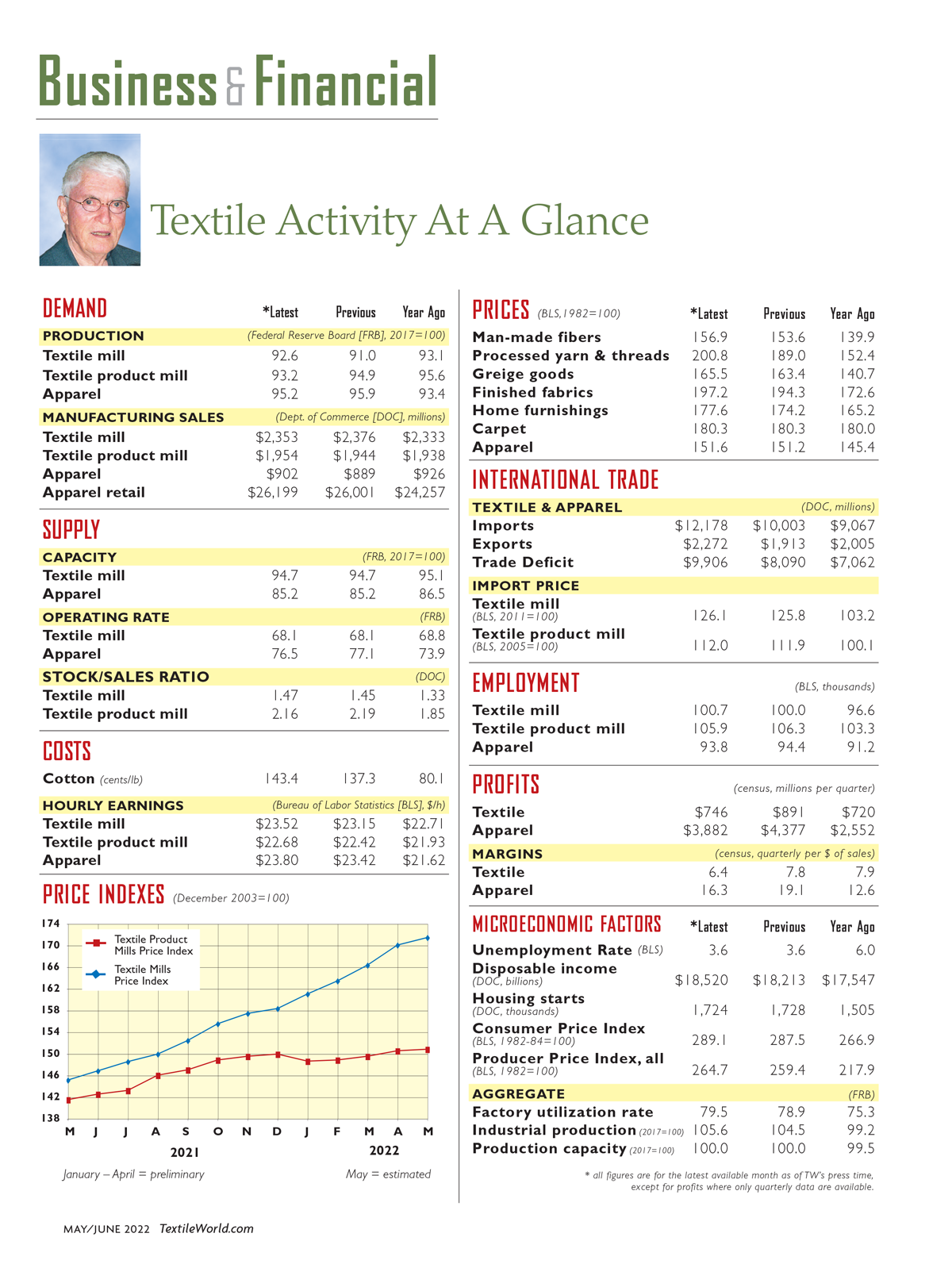
May/June 2022: Textile Activity At A Glance

May/June 2022

AAPN Honors Ed Gribbin And Dr. Lynne Sprugel At Annual Meeting

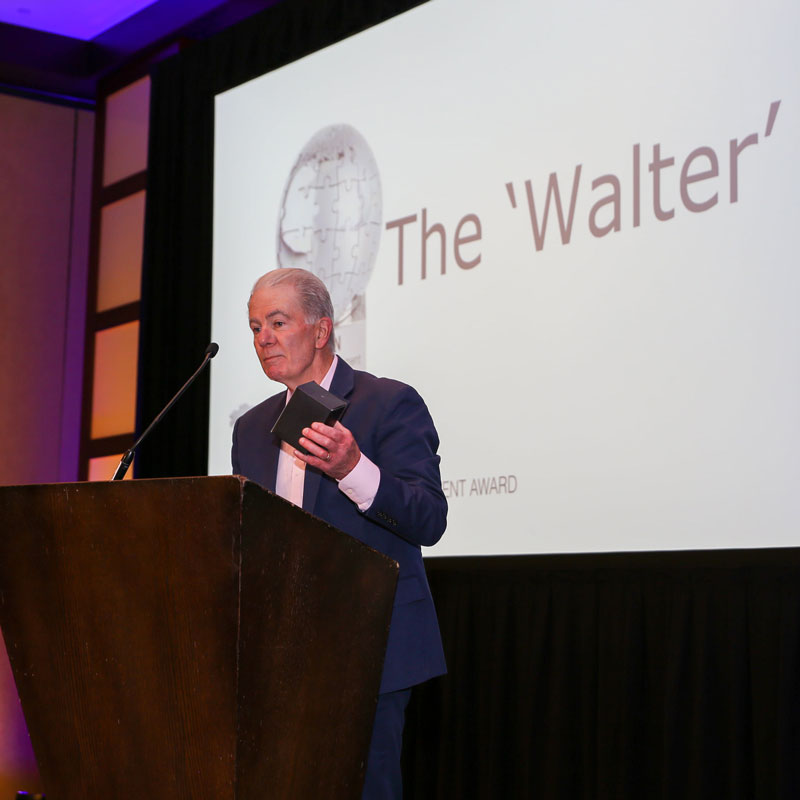
Ed Gribbin, recipent of the 2022 AAPN Walter T. Wilhelm Industry Achievement Award

During its recent annual pro:Americas Annual Conference, the Atlanta-based Americas Apparel Producers’ Network (AAPN) honored Ed Gribbin and Dr. Lynne Sprugel with the newly-renamed AAPN Walter T. Wilhelm Industry Achievement Award. Previously known as the AAPN Industry Acheivement Award, the name change recognizes Wilhelm’s decades of contributions to the organization as well as his leadership. The puzzle globe trophy conferred to the recipient also was renamed “The Walter” in his honor.

Gribbin was selected as a recipient of the award this year for his work when the COVID-19
pandemic began. According to AAPN: “In March 2020, when the virus hit, Ed created a database of over 1,000 producers and literally ran production of billions of masks and millions of gowns across the U.S. Ed was alone in this brilliant initiative and kept many thousands of people working.”

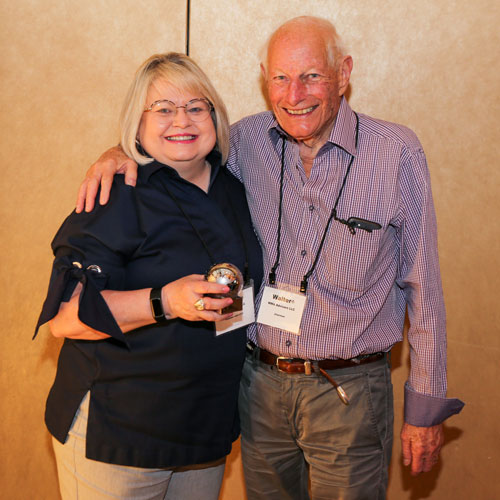
Lynne Sprugel with Walter Wilhem

Dr. Sprugel also was chosen to receive the award in 2022. AAPN cited her contributions to the AAPN Future Forums in its reasons for the honor: “In 2020, with all AAPN events canceled, Lynne organized a survey that created the AAPN Future Forums, generating 28 sessions with over 50 people creating over 7 hours of original content. These future-looking insights were an industry exclusive.”

May/June 2022

Bespoke Manufacturing Opens New Facility In Phoenix

Bespoke Manufacturing Co. (BMC), Phoenix, reports it will open a 50,000-square-foot,
state-of-the-art facility in Phoenix employing 250 people. The print and cut-and-sew company specializes in one-off and on-demand garments, as well as home fashion items. BMC uses the latest technology from companies including Kornit Digital Ltd., Lectra, Fetch Robotics and Juki to offer a production capacity of more than five dresses per minute.

“We chose to build our first plant in the heart of Phoenix because of the talented sewers the city has to offer,” said J. Kirby Best, BMC founder.

“Quality is of the utmost importance. We have hired first-rate tailors and sewers from around the world who are eager to show that the United States is a competitive force in apparel manufacturing.”

“With talented fabric and consumer-product innovators, Greater Phoenix continues to attract technology-focused companies and manufacturers,” said Chris Camacho, president and CEO of the Greater Phoenix Economic Council. “We’re excited to welcome BMC as the latest high-tech manufacturer choosing to expand in the region and look forward to being a partner in their continued growth and success.”

May/June 2022

New Name For IFAI

After more than 40 years as the Industrial Fabrics Association International (IFAI), the association now goes by the name Advanced Textiles Association (ATA). The change was made after 85.6 percent of its members cast a vote in favor of the new name.

A change had been under discussion for several years as the association sought to position itself in the best way to meet the needs of its members and the overall industry.

“This is an exciting time for our great association,” said IFAI Chairman Amy Bircher. “President and CEO Steve Schiffman and his staff have worked hard to meet the needs
of our members in finding a name that reflects the vision for our future while still honoring the past and recognizing the importance of our history.”

“We wanted a name that is more inclusive, easier to remember, and reflects advances in
and the future of all the industries we currently serve and will serve in the future,” Schiffman noted.

ATA will unveil its new rebranding soon. The association also will transition its website from ifai.com to textiles.org.

In other recent IFAI news, the Upholstery & Trim Group and its members — comprised of manufacturers and distributors of fabrics and accessories for applications in the automotive, marine, industrial and contract markets — have joined IFAI.

May/June 2022

State of the U.S. Textile Industry: Better Than Expected

By Jim Borneman, Editor In Chief

Each year, Textile World editors look forward to the National Council of Textile Organization (NCTO) Chairman’s state of the industry presentation from NCTO’s annual meeting (See “2022 State Of The U.S. Textile Industry,” TW, this issue).

It is not just a recap of NCTO’s activities, which are highlighted, but also a look at the U.S. textile industry’s performance, challenges and future outlook. It paints a solid picture of the U.S. industry featuring a collection of aggregated industry data, as well as opinion of industry members living those data.

The NCTO chairman for 2022-23 and presenter of this year’s address is David Poston, founder and president of Palmetto Synthetics LLC, Kingstree, S.C. (See “Palmetto Synthetics: Custom-Designed Fiber Solutions,” TW, May/June 2021).

Poston points to the positive performance of the U.S. textile industry and a “solid
year in 2021,” referencing “a rebound of remarkable proportions” with increases in overall shipments of U.S. manmade fibers, textiles and apparel; increased U.S. exports; and strong capital expenditures.

Poston stated: “Capital expenditures have remained strong. Investment in yarn, fabric, apparel and sewn product manufacturing in 2020 — the latest figure that we have — hit $1.85 billion. Since 2011, capital investment in U.S. yarn, fabric, apparel and sewn products manufacturing totals $20.2 billion.” Keep in mind those are billions with a “b” and up from the $1.58 billion invested in 2011.

In textile exports, roughly half are within the United States-Mexico-Canada Agreement member countries with Mexico receiving $3.9 billion in U.S. fibers, yarns and fabrics; and Canada receiving $2.0 billion — respectfully the U.S. textile industry’s strongest export markets.

Dominican Republic-Central America Free Trade Agreement members received $3.5 billion in U.S. exports of fibers, yarns and fabrics, with Honduras — the U.S. textile industry’s fourth strongest export partner of those products — taking in $1.3 billion.

Referring to the overall U.S. textile and apparel exports to the Western Hemisphere, Poston stated, “The bottom line is the fundamentals for the U.S. textile industry are sound and a testament to our industry’s resilience in the face of a perfect storm of supply chain disruptions, rising costs and a once-in-a-generation healthcare crisis.”

This one sentence seemingly captures the true “state” of the industry — an industry that always rises to the occasion, whether it’s for personal protective equipment, test kit swabs or any other demand seemingly out-of-the-blue.

“Strong underlying economic fundamentals and expansion in the U.S. and Western Hemisphere in 2021 created a sound business environment for our industry, and we remain optimistic that the business climate will continue this year,” Poston concluded.

In a personal note, Poston added, “I am optimistic about the future, knowing the strength of the industry, buoyed by its incredible trade and lobbying organization in Washington, will overcome emerging challenges and continue to carve out a niche as an important backbone in the U.S. economy and the Western Hemisphere.”

A powerful summation from an industry veteran who has seen it first-hand and continues to voice the optimism of the U.S. textile industry.

May/June 2022

Looking Toward The Future: What’s Next?

By Jim Phillips, Yarn Market Editor

The U.S. textile industry was an industrial powerhouse that led the world in style, volume and quality during the middle of the 20th century. Unfortunately, by the early days of the 21st century, the industry has fallen to where it was a shadow of its former glory, ravaged by imports from government-subsidized Asian companies that paid very low wages.

One by one, spinners, weavers and knitters turned the lights off and shut the doors forever. Some experts and analysts predicted the industry had no future and would eventually all but disappear.

Despite all the naysaying, textile leaders were not ready to throw in the towel. Instead, they transitioned from mass production of commodity products to creating specialty, niche and high-tech products. They espoused a new value proposition that refocused the industry’s priorities. No longer would U.S. companies try to compete on volume and price. Instead, they promised to be world’s best in quality, service and speed to market. They realigned manufacturing capacity to more realistically align with demand. And they saw orders, revenue and profits skyrocket. The U.S. industry reclaimed its place among the world’s elite. All was well — at least until news broke of a highly contagious virus that was decimating China and beginning to spread around the world.

The industry hit bottom during the first half of 2020. Plants shut down. People sheltered in place. Stores and restaurants closed. Container ships full of products and supplies
were lined up at ports across the world with no way to unload their cargo.

Perservering

Ever resolute, the industry persevered, and when the economy began to reopen, spinners and their sister companies once again began to recover. Orders improved — some companies even finished 2020 close to their original projections. Yet, even with a decent degree of recovery, things were not quite the same. Many companies had problems keeping qualified employees even before the pandemic began. After the initial quarantine period, many of those who were temporarily laid off decided not to return to work. A shortage of qualified labor, coupled with a global supply chain in disarray, meant customers were not getting their orders as quickly as before.

“Demand remains solid,” said one industry expert. “The problem is getting product to the customers. Between production problems and shipping problems, the time from order to delivery has increased substantially.”

And that negates two of the three U.S. industry’s foundational advantages. Quality is still there. Service and speed to market are not.

So, that leads to the question: what’s next?

A number of consulting companies and analysts have assessed the current state of manufacturing in America, including the textile industry, and have suggested several steps companies can take to solve the current labor problem, as well as prepare for a secure future.

Recommendations

Consulting company Deloitte, for example, has recommended manufacturers need to watch and act upon specific trends to secure their future. Three of those trends apply specifically to spinners and others in the textile industry. In dealing with the workforce shortage, Deloitte recommends finding ways to add flexibility and work/life balance to manufacturing jobs. Many displaced workers became used to a more balanced lifestyle and chose not to return to a more restrictive manufacturing environment.

Logistics challenges, including shortages of truck drivers, dock workers and others, are likely continue — maybe into the first half of 2023. As a result, spinners will likely incur higher costs, which are likely to be passed on through to customers. Companies should carefully plan and map out their supply networks. Deloitte says, “digital supply networks and data analytics can be powerful enablers for more flexible, multitiered responses to disruptions.”

The third applicable trend is sustainability. Deloitte reports: “The fast rise of environmental, social, and governance factors is redefining and elevating sustainability in manufacturing as never before.” This is something at which many spinners excel. Efforts by such companies as Unifi and Elevate Textiles have gained considerable global attention. More and more companies in the industry are undertaking concerted sustainability initiatives.

May/June 2022

IDEA® 22: Nonwovens In Person

INDA President Dave Rousse (center) and guests cut the ribbon to open the trade show floor.

INDA’s IDEA® 22 was one of the first major textile industry trade shows to resume business as usual this year.

TW Special Report

As the world attempts to get back to “normal” following the onset of the COVID-19 pandemic and the subsequent shutdowns, so does the trade show world. No one fully understands how the trade show and event industry will be changed long term as we learn to navigate in the COVID environment, but the one thing that is clear is that people want face-to-face interactions and sales networking opportunities in person. The demand for trade shows exists.

“There is no doubt communicating through digital means helped us get through the pandemic,” said Holger M. Steingraeber, senior vice president, Global Marketing & Communications, Freudenberg Performance Materials. “However, virtual meetings cannot completely replace face-to-face interactions. At Freudenberg Performance Materials, connecting to the customer is vital to better understand challenges, develop solutions, and strengthen our partnerships. Therefore, we are very happy in-person trade shows are possible again.”

The IDEA® 22 nonwovens trade show held recently in Miami Beach and organized by the Cary, N.C.-based Association of the Nonwoven Fabrics Industry (INDA), was one of the first major textile industry trade shows to resume business as usual this year. With its triennial schedule, IDEA luckily avoided any pandemic-related cancellations or reschedules, and the 21st edition of the show took place as planned at the Miami Beach Convention Center. The event was also collocated with INDA’s FiltXPO™ exhibition and conference.

The combined events offered training classes; conference sessions on nonwoven trends, forecasts and market information for China, Asia, South America, North America and Europe, as well as filtration statistics and trends; and a welcome reception. INDA also presented its IDEA Achievement Awards and IDEA Lifetime Achievement Awards. FiltXPO also featured the first “Summit for Global Change.”

According to INDA, approximately 5,000 participants — exhibitor personnel and visitors — took the opportunity to interact face-to-face. “The event attracted a high level of participation among key decision makers despite lingering travel restrictions, which is a testimonial to the show’s importance within the international nonwovens and engineered materials industry,” said INDA President Dave Rousse.

“The size and scope of IDEA and FiltXPO have been excellent for us as both exhibitors and as visitors,” noted Rolk Kammermann, head of sales and marketing, Innovative Swiss Made Nonwovens.

Award Recipients

Val Hollingsworth, board chair and CEO of Hollingsworth & Vose, was recognized as the IDEA 2022 Lifetime Achievement Award winner. The IDEA Entrepreneur Achievement award was presented to Doug Brown, president of Biax-Fiberfilm/5K Fibres.

The IDEA 2022 Achievement Awards were presented in six different categories. Winners included Herrmann Ultrasonics Inc., Rem Brands Inc., LifeSavers Wipes, Mann + Hummel GmbH, Glatfelter Corp./Blue Ocean Closures, and Suominen Corp.

The next IDEA show is planned for April 23-25, 2024, in Miami Beach. FiltXPO will return to an individual event on a new 18-month schedule with the next event taking place October 10-12, 2023, in Chicago.

May/June 2022

SYFA Talks Global Textiles

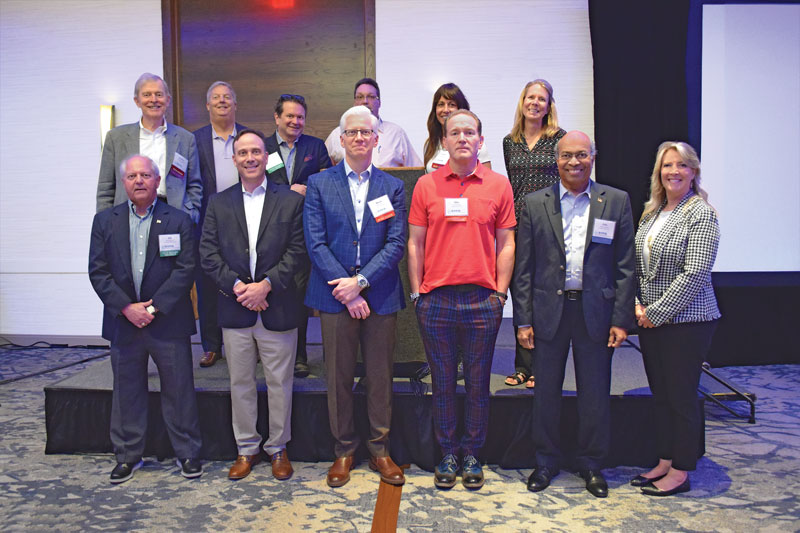
SYFA officers and directors (front row, left to right) Bill Rothermel, Immediate Past President Dan Sistrunk, President Hardy Sullivan, Mike Becker, John Amirtharaj and Kim Hall; (back row, left to right) Alasdair Carmichael, Stan Pendergrass, Bart Krulic, Managing Director Rodney Turner, Celeste Ramsey and Nikki Brooks.

SYFA recently held a successful spring conference and is preparing for its 50th anniversary celebration this fall.

TW Special Report

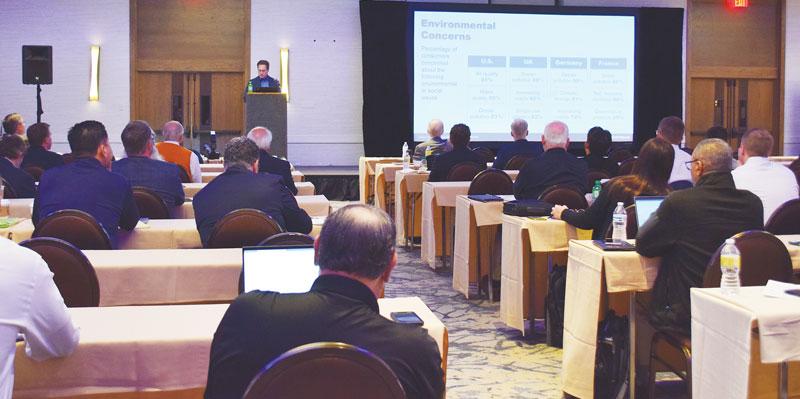
The Synthetic Yarn and Fabric Association (SYFA) held its 2022 spring conference recently at the Sheraton Charlotte Airport Hotel, Charlotte, N.C.

The theme for the event was “Global Textiles … It’s a Small World After All.” Presenters came from companies and organizations including Stäubli Corp., Eastman Chemical Co., ClearTrackHR, Wells Fargo, the National Council of Textile Organizations, American Apparel & Footwear Association and Textile Technology Center at Gaston College.

Conference sponsors for the spring event included Gold Sponsors Premiere Fibers Inc. and Jomar Softcorp International Inc.; Silver Sponsors Pulcra Chemicals LLC and Unifi Inc.; Bronze Sponsors Goulston Technologies, PolySpinTex, Milliken & Company and Avient; and Patrons The Association of the Nonwovens Fabrics Industry (INDA) Milliken & Company (facemasks) and Measured Solutions Inc. (hand sanitizers).

The SYFA also introduced new board members — Nikki Brooks, Goulston Technologies; Bart Krulic, Palmetto Synthetics; and Bill Rothermel, Precision Fabrics — and outgoing board President Dan Sistrunk took a bow after serving the association for the past three years as president.

“At our last conference in the fall of 2021, I stated that it was good to be back and emerging from the post-COVID world to a period that resembled a more normal textile environment, but little did we know the next round of challenges that we were going to encounter,” Sistrunk said. “Since the last SYFA conference, we have faced a new set of challenges ranging from labor shortages and growing inflation to geopolitical destabilization. However, I firmly believed then and it remains true today that with these challenges there is great opportunity for the SYFA organization and the industry. By harnessing the power of industry organizations like SYFA, each member, through the networking and collaboration the organization provides, will be able to better understand, uncover, and tap into some of this opportunity amidst the chaos we are all currently facing.”

John Woods, vice president, Fibers and Analytical Service Technology, Eastman Chemical Co., delivered a presentation entitled “Materials Circularity: The Way to a Sustainable Future.”

Incoming President Hardy Sullivan is ready to helm the SYFA for the next two years and had kind words to share about Sistrunk as he stepped down. “Like so many organizations that rely on face-to-face engagement, Covid was a real test,” Sullivan noted. “I’m so thankful for Dan Sistrunk’s leadership and the sustained effort by board volunteers. We maintained relevance by publishing technical and economic-focused papers quarterly, and we navigated the rocky waters of trying to meet virtually and safely.”

Sullivan is especially excited to celebrate the association’s 50th anniversary this year in the fall. “It’s exciting to think that an organization like SYFA can survive 50 years,” Sullivan noted. “The organization began with a focus on textured yarn, but, over time, its reach has broadened, spanning fiber to end-use. It’s a testament to, now as much as ever before, there’s real value in sharing technical, economic, and industrial knowledge.

“The needs for sustainability, innovation, and commercialization are here to stay, so this is just SYFA’s first 50 years. The board is planning a special ‘Past, Present, and Future’ celebration for the fall conference. It will be special and, as always, very worthwhile. We hope to see you there.”

The fall 50th anniversary conference will take place at the Sheraton Charlotte Airport Hotel November 3-4, 2022. Plans for the event include a panel discussion among top-level textile executives, and a cocktail reception followed by an evening sit-down dinner for all attendees. For more details as the event gets closer and to register, visit the association’s website, thesyfa.org.

May/June 2022

Sponsors