Techtextil North America and Texprocess Americas was well attended for the first Atlanta event in four years.
TW Special Report
It had been four years since Techtextil North America, incorporated with ATME-I, and Texprocess Americas, co-produced by SPESA, convened in Atlanta with the last show taking place in 2018. Organizers were really excited to gather the entire textile supply chain again at the Georgia World Congress Center in 2022.
“After such a long hiatus, it was really wonderful to finally hold these events together under one roof, “said Kristy Meade, vice president of Technical Textiles & Technology Shows, Atlanta-based Messe Frankfurt Inc. “COVID-19 proved to be a challenge for everyone, but it is clear that these industries are resilient overall, and more motivated than ever to continue to push for innovation and advancement. We’re happy to be able to provide a platform for them to do so.”
As always, the combined event proved to be a convenient place to view the latest technology, technical textiles, nonwovens, textile machinery, and sewn products and equipment. Visitors were able to touch and feel new products up close and in person, watch live demonstrations on the show floor, and participate in a variety of networking opportunities. The educational program also offered something for everyone with 16 symposium sessions between the two events, as well as some 20 complimentary sessions held on the show floor.
“We attend the symposiums every year and there is always something new to learn, not only from the speakers but also the questions asked during the sessions,” said Edwin Rosado, Fruit of the Loom. “The show is a very good experience, we will continue to attend because it is always going to be very helpful.”
Participation
Overall, booth traffic was steady and consistent. Perhaps not quite back to pre-COVID levels, but as is typical for this event, attendees were high level and engaged.
“We were pleased with the quality of visitors during the entire event,” said Oliver Meier, Textile director – North America, Stäubli Corp., Duncan, S.C. “Our sales team was able to conduct constructive meetings with potential and existing customers.”
“Lots of quality people, a great restart,” said Bruce Stroupe, Perlon (Hahl Inc.), Lexington, S.C. “It was nice to be able to truly focus on meetings with people who are ready to make purchases. We will definitely be back next year!”
“BastCore had an amazing show with constant traffic at our booth,” said Coleman Beale, BastCore. “It’s great to see buyers with a real interest in sustainability.”
“The Techtextil show in Atlanta was the first trade show I attended in several years due to the pandemic,” said Christopher Skaggs, engineering manager, Hexcel Corp., Seguin, Texas. “It was a great opportunity to re-establish contact with numerous suppliers. With customer demand recovering, we are working on projects for machinery, facilities, and testing equipment. I was able to generate solid leads in all three of these areas. Another great thing about Techtextil is the ease of travel. With a direct flight, using MARTA and plenty of hotel availability, I was able to spend a full day at the show with just an overnight trip.”
“I’m thrilled to be at Texprocess Americas because innovation in manufacturing and textiles is where my focus is,” said Sherri Barry, visitor and speaker, Fabric Fashioneer/Adea Every Day Luxury. “It is so great to have an opportunity to collaborate with people who are like-minded, and to learn the newest and greatest things happening in the industry. I’m already planning on coming back next year!”
Next Scheduled Event
To fall in sync with the Germany-based sister shows Techtextil and Texprocess, the Atlanta-based events will occur again in 2023, and thereafter on a biennial schedule. This puts the shows on an odd year cycle in the United States and an even year cycle in Germany, flipping the traditional schedule. Techtextil North America 2023 and Texprocess Americas 2023 will take place May 10-12, 2023, in Atlanta.
In the wake of DuPont Biomaterials’ rebranding to Covation Biomaterials, CEO Dr. Mike Saltzberg talks about its Sorona® polymer and the opportunity to expand the reach of its bio-based products as part of the Huafon Group.
TW Special Report
Commercialized in 2000, Sorona® polymer from Covation Biomaterials (CovationBio™) is not new but is now more relevant than ever as a demand for high-performance, sustainable textiles and circular production grows. CovationBio, formerly known as DuPont Biomaterials, took one of the first industry steps into this space when it launched Sorona for apparel and carpet end-uses in 2006. Sorona polymer features 37 percent renewable plant-based ingredients, which reduces the use of fossil fuels, and significantly improves environmental impact versus petro-based incumbent materials.
Bio-PDO™, the key ingredient for Sorona polymer, is produced from corn sugar, which is fermented in a process similar to beer brewing to create a bio-based 1,3-propanediol (Bio-PDO). When terephthalic acid is added to the Bio-PDO monomer, triexta — the generic name for a subclass of polytrimethylene terephthalate (PTT) polymers — is born. Sorona is CovationBio’s brand name for this polymer, which features attractive attributes such as exceptional drape, incredible hand feel, and built-in stain- and wrinkle-resistance, according to the company.
CovationBio reports that compared to nylon 6, Sorona consumes 30 percent less energy and results in 50 percent less greenhouse gas emissions.
CovationBio strives to enable a more circular economy — one in which affordable and high-performing biomaterials are accessible to everyone.
Textile World recently had the opportunity to speak with Dr. Mike Saltzberg, CEO of CovationBio, about Sorona’s origins, advantages, and future in a textile industry increasingly focused on sustainability.
TW: Sorona fiber was introduced in 2000, more than 20 years ago. What drove CovationBio to develop a fiber based on renewable plant-based ingredients?
Saltzberg: We were aware of the performance benefits of the Sorona PTT polymer based on research conducted in the 1950s and 1960s. However, the key monomer required to make Sorona — propanediol (PDO) — was not commercially available using petrol-based processes. Through groundbreaking innovation in biotechnology, we developed a plant-based fermentation route to manufacture PDO in an economically viable way that allowed us to commercialize Sorona. This Bio-PDO process also offers enormous environmental benefits versus a traditional petrochemical process.
TW: Sorona is partially plant-based. Are there other features of the fiber that make it more sustainable than traditional textile fibers?
Saltzberg: Sorona enables garments with exceptionally durable stretch and recovery, which means they retain their shape and have longer bagging resistance. This means end-consumers can hold on to their clothes longer, reducing the number of garments that consumers purchase over time and that end up as waste. Sorona also empowers a superior resistance to fading and pilling, which reduces micropolymer pollution caused by laundry. Finally, Sorona is mechanically recyclable in traditional polyester (PET) waste streams.
TW: What other properties make Sorona unique?
Saltzberg: Sorona exhibits many exciting performance attributes including exceptional softness, drape, quick-dry capability and even lightweight, breathable warmth when used in insulation. These attributes result in Sorona being used across a wide range of applications such as faux fur, puffer jackets, leggings and even cosmetic brushes. When spun in a bicomponent format together with PET, fibers are created with superior stretch and stretch recovery as compared with other elastomeric fibers like spandex.
TW: How is your team working to reduce global reliance on petroleum? Are there other fibers in development with a higher percentage of sustainable components?
Saltzberg: CovationBio supplies to industries that historically have relied on the production of petro-based man-made polymers for fashion, home textiles and industrial packaging. Now as part of the Huafon Group, a highly successful materials company, we are uniquely positioned to expand the reach of our current bio-based products and accelerate the introduction of new offerings and technologies to the market.
We will continue to build on our decades-long legacy and successful suite of products currently available in the market, including scalable, commercial offerings like Sorona and Susterra®, which are sourced from renewable feedstocks. Susterra is exciting as it provides a 100 percent plant-based, high-performance building block that reduces the need for petroleum-based components while enhancing end-product attributes.
Its applications range from footwear and outdoor apparel to coatings, inks and functional fluids.
We also have an exciting pipeline of innovations and materials in development and are working closely with our customers and stakeholders to deliver new products. This includes new materials that will enable high performance fibers that also have higher renewable and/or recycled content.
TW: In apparel, Sorona has found a myriad of applications. Talk about some of the innovative uses and how the fiber contributes to a more sustainable apparel industry.
Saltzberg: Sorona polymer can be spun into bicomponent stretch fibers, homofilament for shape memory fabrics, staple for use in insulation and spun yarns — in combination with natural fibers like cotton or wool — and other types of fibers. These fiber types can be incorporated into a wide variety of fabric qualities. We launched our Common Thread fabric certification program in 2020 to drive better trust and transparency throughout our supply chain.
Beyond the performance attributes for the five sub-brand fabric types — which include Agile, Aura, Luxe, Profile and Revive — our mills and brands using certified fabrics have access and permission to use our logos, proper brand colors and marketing language to discuss the bio-based components of the polymer included in the fabrics.
We are also seeing an increase in the use of Sorona for footwear. Using Sorona in footwear allows for movement, stretch and longer-lasting performance.
TW: Explain how Sorona is a suitable substitute for spandex? What are the environmental advantages of Sorona over spandex fibers?
Saltzberg: As mentioned earlier, when spun in a bicomponent format, Sorona-based fibers are created which “self-crimp,” meaning that they behave like tiny springs with a mechanical stretch and recovery effect. Traditional spandex gets its stretch from the elastomeric nature of the material itself, similar to a rubber band. This different stretch mechanism gives Sorona bicomponent fibers superior stretch recovery and durability to spandex. Sorona Agile is our sub-brand for spandex replacement for use in many, but not all, applications. Sorona Agile fabrics have better stretch and recovery than traditional spandex-based fabrics, while delivering superior recyclability and durability.
TW: How does Sorona differ from traditional carpet fibers? What sets the fiber apart?
Saltzberg: From a performance perspective, Sorona offers unparalleled softness, crush resistance and built-in stain resistance that is not available from other fiber types. Compared to nylon 6, Sorona production consumes 30 percent less energy and results in 50 percent less greenhouse gas emissions. In the carpet industry, Sorona carpets are generally regarded as the best option available on the market for consumers.
TW: How does CovationBio’s Sorona fiber impact the concept of circularity?
Saltzberg: Like other biomaterials, Sorona reduces society’s reliance on fossil feedstocks by providing an alternative source of high-performance chemicals and materials. Another important aspect of the circular economy is reducing consumers’ overall consumption and thus their waste production. As mentioned previously, part of this is enabling customers to reduce the amount of clothing they are buying and sending to a landfill. Sorona empowers garments with attributes that make it longer lasting and looking newer for longer.
It is, however, important to note that Sorona is not a biodegradable polymer but is mechanically recyclable in a traditional PET waste stream.
TW: What is the impact of the Common Thread Fabric Certification Program?
Saltzberg: In March of 2020, CovationBio launched its Common Thread Fabric Certification Program, a brand architecture and hangtag program designed to bring clarity and transparency for designers, apparel brands, and end customers. New fabric collections offered by mills are tested and certified through the program to assure the fabrics meet a certain level of biobased content and quality standards.
TW: How is the CovationBio team working to address the textile landfill issue?
Saltzberg: The number of textiles discarded and ending up in a landfill is directly connected to their durability. By extending the useful life and improving the performance of garments, particularly stretch garments, Sorona is reducing the amount of clothing wearers need to purchase.
For example, stretch fabrics and garments such as leggings made with Sorona-based fibers maintain their stretch performance and comfort through many more wash cycles than similar fabrics made with fossil-based spandex, helping customers and brands produce less textile waste.
Glen Raven is “Continuing its Pattern of Good” as it shares progress towards its goals set in its inaugural corporate sustainability report.
TW Special Report
Glen Raven Inc., Burlington, N.C., recently released a report detailing the company’s progress in 2021 towards its goals set forth in its inaugural corporate sustainability report.
“When we issued our first corporate sustainability report last year, we wanted to share a set of aspirational goals to inspire advancement,” said CEO Leib Oehmig. “This updated report is another step in that journey, further demonstrating our commitment to accountability with metrics about our progress so that we can keep striving for improvement.
“Glen Raven desires to have a positive impact on our global community by supporting the planet on which we live and the communities that we serve,” Oehmig noted. “Throughout the company’s history, this is Glen Raven. It’s who we are as a company and it’s about doing the right thing. This is a reflection of the Gant family values and is core to Glen Raven.”
Textile World recently had the chance to catch up with Oehmig to discuss the company’s progress detailed in the report.
TW: The progress report focuses on two foundational pillars — “Supporting Our People and Communities” and “Sustaining Our Planet.” In what areas do you believe the company has made the most progress in the past year?
Oehmig: The year 2021 was a year in which we were really working to build some of the foundational elements. Supporting people and communities has been a hallmark and focus for Glen Raven throughout its 142 years.
So, in terms of new opportunities and sources of new, measurable improvement, I would say we have made more progress in sustaining our planet this year.
As was noted in the report, over the past couple of years we have gone from zero use of renewable electricity to now 25 percent use. Outside the United States — both in France and China — we have achieved 100-percent utilization of renewable energy.
Additionally, we were very deliberate in terms of our desire and intention as it relates to sustaining our planet when working on the design for our new capital projects to expand capacity. It really gave us an opportunity to look at power utilization and efficiencies in equipment and process design in ways that would be most impactful.
We are equipping our plants with state-of-the-art weaving machines, LED lighting and modern HVAC systems. These improvements, and others, helped us decrease our scope 1 and 2 carbon emissions by 33 percent between 2019 and 2021. As it relates to our broad sustainability efforts, it certainly was an opportunity to see the measurable impact we are having and that really provides the motivation to push further and to aspire to do much more.
This report gives us the opportunity to drive a stake in the ground and not only look for new and innovative ways to support both our associates and the communities that we serve, but also to hold ourselves accountable.
TW: Tell us about the steps Glen Raven has taken to foster a more diverse and inclusive workplace. How has the plan impacted and fortified the company’s existing culture?
Oehmig: We’ve always viewed ourselves as a relatively diverse company. When you consider that we operate in 23 countries, we’ve always had a global point of view and certainly have benefited from differing points of view and different cultures. For us, it came down to being able to identify new opportunities and then establish goals that we can share with our associates and collectively hold ourselves accountable to do more.
As I mentioned, this really was a foundational year for Glen Raven. We engaged BSR [Business for Social Responsibility™] — a leader in diversity, equity and inclusion [DEI} — to help guide our journey to fostering a diverse and inclusive workplace. We defined what constitutes leadership and first line supervision across our regions and divisions to establish a clear baseline for measurement, among other foundational actions.
From a cultural standpoint, the company reflects the values of the founders — the Gant family — and how we can support both our associates and the communities that we serve has always been top of mind for us.
TW: Some 73 percent of Glen Raven employees recommended the company as a great place to work. But given the nature of the current economy with low labor participation and low unemployment, how difficult has it been to attract and retain new associates?
Oehmig: It has been difficult. We are operating in the same environment as our peers, and across all industry sectors it appears we have similar challenges. Part of Glen Raven’s communication with current and prospective employees is to make that compelling case — to be transparent about things we are doing that have a positive impact on our global community and to really articulate why Glen Raven is a great place to work.
But also, our industry continues to work to tell the story about the textile industry today versus what it may have been for our parents’ and grandparents’ generation. If you are successful in the textile industry today, it’s likely you are doing something pretty special. So, it’s not only us telling Glen Raven’s story and what makes it compelling in terms of working here, but also from a broader industry perspective we are working across the industry and for our peers to help tell the story of what a great place it is from an industry sector point of view.
TW: How receptive have employees been to the people goals, particularly in volunteering?
Oehmig: Very receptive. We have a community impact team that works to identify causes our associates are passionate about because we really want to respond to the communities that we serve. We currently serve more than 200 charities globally.
We want to determine where Glen Raven can make the greatest impact on our global community, and where we can focus our resources to allow us to move to needle in the greatest way. For us to be able to look for new and impactful ways to support the communities in which we operate is a tremendous priority.
One of the areas we have focused on, but now are really shining a light on, is early childhood education. That is not only through a teacher leadership academy that we support, but also in China where we are supporting a program that helps support young children to make sure they have the resources that they need to get a great start and achieve early success. Studies show you need to make an impact before a child reaches the third grade, and that’s why Glen Raven has identified early childhood education as an area of focus.
TW: In serving the community, what areas have been most impactful over the past year?
Oehmig: We really try to respond to the individual needs of each community, whether that is disaster relief, keeping the community clean, or supporting children in need, for example. There was so much hardship related to the pandemic and supporting families and children who lacked basic needs was a focus. We have reached out to individual communities and let them make the decisions at the local level in terms of where the company can make the biggest impact.
TW: In terms of global impact, what has been the most important thing Glen Raven has achieved in the “Sustaining the Planet” pillar?
Oehmig: Number one is diverting waste from the landfill. We have a goal to implement 100 percent landfill-free practices by the end of this year, and we’re proud to have reached a diversion from landfill rate of 97 percent for the overall company in 2021.
Number two is energy management. Twenty-Five percent of our energy usage comes from renewable sources now. And as stated earlier, we are actively working to reduce emissions.
And finally, number three is the increased utilization of recycled materials — making products using recycled content, as well as working throughout the supply chain to help recycling efforts to collect fabrics and bring them back for reprocessing. We have improved our use of recycled materials 50 percent since 2019 and are designing new products that will increase the use of recycled content. We also have recycling efforts underway, “Recycle My Sunbrella®” being one of those efforts, where we have recycled more than a million pounds of fabric to date. That’s something we’ve put a heightened focus on with a goal of recycling another million pounds by 2025.
TW: Are products featuring recycled content different from standard products, or marketed differently?
Oehmig: All of these recycled programs are under the Sunbrella® brand, and therefore they have to meet the same performance attributes as their peer products. We’re not going to jeopardize the brand promise from a product design standpoint. When we first started creating products utilizing recycled materials, we came at it with the sustainability story, but what we found is that products were adopted more for their aesthetics and the design. The recycled content piece was secondary. But, that gives us a great story to tell — it not only means we have a positive impact on the planet, but we’re also designing beautiful products that meet the same performance criteria and have the same performance attributes as all of our Sunbrella products.
TW: Has the dramatic increase in energy prices since the goals were originally created impacted the company’s progress towards energy sustainability?
Oehmig: To date, it has not. We remain focused on the goals that we outlined, and as I mentioned 25 percent of our energy today comes from renewable sources. We do feel that we will remain on that track.
Obviously in Europe, we’re facing incredible challenges. But that is where we use more renewable energy and I don’t see that slowing down. We have a presence in France, which is one of the leading adopters of renewable energy, so that is certainly positive. And we are using biomass in China. In its five-year plan it has its own sustainability goals with renewable energy as a piece of that, and we are participating there.
Certainly, the United States is where we are now very aggressively working to move more of our own requirements to certified renewable sources. That move has been a bigger focus over the past couple of years, but our interest in renewables goes back to 2011 when we built our first solar installation. Glen Raven now owns two of the largest privately held solar installations in North and South Carolina, which was all part of our learning curve. We started down this path towards utilization of renewable energy making sure that we understand the implications and how to make the most of our efforts.
TW: Do you foresee any business challenges that may affect Glen Raven’s future sustainability progress?
Oehmig: We have to adapt to the environment in which we are operating, and our resolve to meet these objectives has not wavered at all.
Glen Raven has always operated under the mantra of “do the right thing,” and now the next generation of shareholders, associates, prospective employees and customers really want transparency and they want to know what you stand for. They want to know not only which markets you participate in and how you’re going to participate, but they also want to know why we participate, which is really the purpose of why we exist and how we can make a positive impact on our global community. And that’s ultimately the foundation on which everything we have talked about today has been built.
Germany-based Trützschler Nonwovens & Man-Made Fibers GmbH and partner Italy-based Texnology S.r.l now offer complete production lines for needlepunched nonwovens under the name T-SUPREMA. Trützschler contributed its fiber preparation knowledge to the project, while Texnology brought its needlepunching expertise. The partners report the first installation is complete and in operation.
“With Texnology, we have an innovative and reliable partner at our side,” said Klaus Wolf, managing director, Trützschler Nonwovens. “Trützschler Nonwovens is returning to needlepunching solutions. In the partnership, we are able to serve this interesting market segment with precisely fitting production lines. With T-SUPREMA needlepunching becomes as easy as never before.”
Austria-based ANDRITZ has installed a new inline Welace™ CP pilot line for wipes at its France-based center of competence. The process combines spunlace and wetlaid — inline drylaid and wetlaid — forming technologies with hydroentanglement bonding to produce a high-performance natural fiber wipe that is cost efficient and polymer-free.
The installed line in France was rebuilt to incorporate a new headbox inside the spunlace line. Pulp may be fed in directly and entangled with carded staple fibers to produce unique nonwoven fabrics for wipes.
Andritz has focused on sustainable production processes with optimized raw materials use.
Helsinki-based Suominen reports it has upgraded a production line in Nakkila, Finland, to strengthen its capabilities in sustainable products. The 6 million euro investment is expected to be completed in the second half of 2023.
“As we foresaw in our strategy the market demand in Europe has changed remarkably towards more sustainable products. With this investment we respond to the increased demand for environmentally friendly products and also enhance our operational performance in terms of safety, quality and productivity,” says Petri Helsky, President and
CEO of Suominen.
Seoul-based Hyosung reports it has received eco-product certification for its creora® biobased spandex fiber from Standard Global Services (SGS). The certification guarantees that the biobased fiber is made using plant materials, and is produced in a harmless and eco-friendly environment. According to Hyosung, a recent third-party life cycle assessment also found that the biobased creora spandex reduces its carbon footprint by 23 percent when compared to the production of regular petroleum-based spandex.
“As a sustainable textile solution provider, it was very important for us to certify and document creora biobased spandex so that our brand partners are able to pass along this verification and sustain consumer loyalty,” said Mike Simko, global marketing director, Textiles.
Plant-based nylon 6 may soon be a reality. San Diego-based Genomatica alongside its collaborator Italy-based Aquafil report they have completed the first demonstration scale production runs for a plant-based nylon 6. The companies manufactured several tons of plant-based caprolactam, have converted it to nylon 6 polymer, and now are
working to transform the polymer into yarns for textiles and carpets as well as engineering plastics.
“We’re working to build purposeful, traceable and transparent supply chains, in this case for nylon 6, with the goal to provide more sustainable products that consumers demand and material solutions that can help brands achieve their ESG goals,” said Christophe Schilling, Geno CEO.
Bangkok-based Indorama Ventures Public Co. Ltd. (IVL) has acquired Tollegno 1900
S.p.A.’s wool spinning businesses, comprising a spinning and top-dyeing operation in Poland and a yarn dyeing operation in Italy. The strategic purchase helps IVL grow its wool business, strengthens the company’s footprint for worsted yarns in Europe, and extends IVL’s wool products globally with trading subsidiaries in America and Asia.
The businesses will operate under the new name Filatura Tollegno 1900. The company CEO, Giovanni Germanetti, will continue his role within the IVL organization; and President and Co-CEO Lincoln Germanetti, becomes COO.
INCA Renewtech has set goals with regards to environmental, social and governance (ESG) initiatives.
INCA Renewtech is using knowledge in plant genomics, hemp cultivation, fiber processing and composites manufacturing to develop new types of natural fiber composites.
By Camille Saltman
Powerful market forces are leading industry to adopt more environmentally friendly, domestically sourced materials in their products. These forces include government regulations to reduce plastics pollution, sequester carbon and achieve higher lifecycle performance. They also include investor focus on environmental, social and governance (ESG) initiatives. These metrics are now being used to measure investment risk and deter-mine the value of corporations. Equally important is growing consumer demand for less toxic, more sustainable products. Consumer purchasing repre-sents 70 percent of the U.S. economy and as customers change their buying patterns major brands are transitioning to recyclable products.
Price Affecting Adoption
These powerful market trends have led to significant innovations in biobased polymer chemistry and natural fiber reinforced materials. Today, many of the same products that are synthesized from hydrocarbon molecules derived from oil and natural gas can be produced from carbohydrates derived from agriculturally grown plants. This includes plastics, textiles, fertilizers, building materials, furniture, papermaking, packaging, and industrial fillers used in paints, plastics and adhesives, pharmaceuticals, nutraceuticals, and cosmetics.
The potential benefits of biobased materials are very promising. Petroleum-based products are energy intensive to refine, generate harmful byproducts in the process, and often are difficult to recover and recycle at the end of their useful lifecycles. Plant-based products sequester carbon, generate no toxic byproducts, and are much more easily recovered, recycled, or even composted. How-ever, there are two significant barriers to their wide scale adoption — price and performance.
Many biopolymers including poly-hydroxyalkanoate (PHA) and poly-lactic acid (PLA) are more expensive than petroleum-derived incumbents such as polypropylene (PP) and polyethylene. This is mainly because of scale. New materials have to compete with enormous, vertically integrated petrochemical companies that have invested billions of dollars in manufacturing infrastructure. Price is impeding the formation of the major industrial product development partnerships necessary to develop high performance solutions. Until more sustainable, biobased materials can compete on price, biomaterials will remain niche products.
Hemp Biomass For Industrial Use
Canada-based INCA Renewable Technologies (INCA Renewtech) is attempting to solve this pain point in the marketplace. Instead of procuring natural fiber from overseas, as competitors do, INCA is purchasing hemp biomass from Canadian farmers growing hemp seed for plant-based protein. The company will process this renewable resource into a set of proprietary high value products for major industrial customers.
Just as the petroleum industry leverages its expertise in exploration, extraction, and chemicals manufacturing to maximize financial return on every barrel of oil, INCA will leverage the company’s expertise in agronomics, fiber processing, composites innovation and manufacturing to maximize return on every bale of hemp.
Vertical Integration
To achieve this vertical integration INCA will build two factories — one in Alberta, Canada, within a 150-mile radius of hemp cultivation; and a second in Indiana within 150 miles of customers in the automotive, recreational vehicle (RV) and consumer products industries.
Hemp has been legally cultivated in the Canadian Prairies for more than 20 years where it is primarily grown for plant-based protein. The remaining stalks contain some of the strongest natural fiber on earth. If properly refined and manufactured, hemp fiber can function as a direct replacement for glass fiber in composites.
Whole hemp bales will be decorticated, a process that mechanically separates the long outer bast fiber from the short inner core, called hurd. The bast fiber will be further refined to create the ultra-clean material required for its products. In Alberta, the hurd will be used to manufacture INCA BioBalsa™, a product designed as a direct replacement for the balsa wood used in boats and wind turbine blades. The refined bast fiber will be sent via rail to the company’s second factory in Bristol. There it will be manufactured into three additional products — INCA BioPanels™ for the RV industry; INCA Prepregs™ for the automotive industry; and INCA BioPlastics™ for the consumer products industry.
Domestically sourcing and processing hemp lowers raw material and logistics costs and reduces sup-ply chain challenges, versus importing expensive jute, flax or kenaf from Southeast Asia, as other bio-composite manufacturers do.
A Brief History Of Hemp
Hemp, or Cannabis sativa L., was one of the first crops cultivated by man. Recorded use dates back more than 8,000 years. Hemp cultivation began in what is now China and spread quickly across Asia, Europe, Africa and later South America. It was such a strategic crop that in 1533 King Henry VIII fined English farmers if they did not raise hemp. Britannia could not have ruled the waves without hemp rope and canvas. Until the late 1800s, most of the paper in the world was produced from hemp pulp.
Hemp was originally introduced to North America in 1606 where it was grown for papermaking, cordage, lamp fuel and clothing. However, at the turn of the 20th century powerful forces set out to delegitimize the cultivar. It was seen as a direct competitor by the pulp and paper industry, and by Dupont, which invented nylon as a petroleum-based substitute for hemp textiles. Backed by powerful industry lobbyists, hemp was included in the 1938 Opium and Narcotic Drug Act in Canada, and the 1937 Marijuana Tax Act in the United States which essentially killed the hemp industry.
Hemp is experiencing a major rebirth in North America and around the world. In 1998, it became legal to grow hemp in Canada for commercial production. Canada’s Industrial Hemp Regulations, part of the Cannabis Act 2018, allows for whole plant utilization of the crop. In 2020, there were approximately 53,000 acres of hemp being cultivated and this is expected to expand dramatically as the market for plant-based protein and fiber grows for the following reasons:
Hemp matures in as little as 90 days and can be grown with low water and chemical inputs;
As a rotational crop it breaks disease cycles and has a long tap root that aerates the soil;
It yields four times the biomass of a forest in one season, compared to 25 years of tree growth, and;
Every portion of the plant can be commercialized, creating multiple revenue streams.
Since the 1970s, the recreational vehicle industry has been dependent upon rainforest hardwood plywood from Southeast Asia to construct side walls and roofing systems. Hard-wood plywood’s strength, light weight and smooth surface make it a product in high demand not only for RVs but also transport trailers, furniture, decorative paneling and even Hollywood movie sets. In 2021, the RV industry alone used 620 million board feet of lauan plywood. Unfortunately, the popularity of this material has led to devastation of primordial rain forests throughout Indonesia, Malaysia, Borneo and the Philippines. Plywood prices have sky-rocketed, quality has fallen, and manufacturers are actively seeking alternatives.
To construct an RV, sheets of ply-wood are seamed together like stick frame housing. Exterior wall panels are laminated with aluminum or fiberglass, and interior walls with paper or vinyl. Urethane foam insulation is sandwiched between the inner and outer walls. However, plywood off-gasses formaldehyde, absorbs moisture, and burns easily. After just a few years, seams telegraph through the exterior walls of the vehicles.
Oriented strand board (OSB) is much heavier than plywood and it too absorbs water and off-gasses formaldehyde. Fiberglass reinforced plastic panels are more expensive and labor intensive, and delaminate, warp, and offer poor insulative properties.
INCA has developed a revolutionary panel product made from a blend of hemp fiber and a proprietary thermoset resin system. The company has signed an exclusive sales agreement with Elkhart, Ind.-based Genesis Products Inc., which designs, engineers, and manufactures a range of products for the RV, construction, transportation, and furniture markets. Genesis has facilitated a product development agreement with Winnebago for the company’s entire panel production capacity.
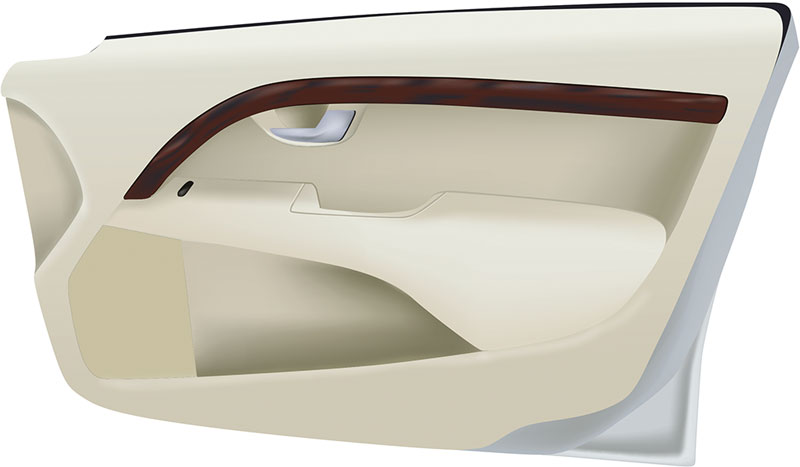
INCA PrePregs™ will be molded by manufacturers into 3D vehicle interior trim components.
Automotive
The automotive industry utilizes resin infused panels, called prepregs, to mold 3D interior trim components such as door panels, seat backs, headliners and package trays. Prepregs can incorporate glass, natural fiber or even carbon fiber to reinforce the thermal melt polymer matrix. Prepregs can come in the form of flat panels or nonwovens such as those produced by Indiana-based companies FlexForm Technologies in Elkhart, and Carver Non-Woven Technologies in Fremont. The automobile industry was an early adopter of these prepreg materials because of their lower cost and high strength-to-weight ratio, which results in better fuel mileage and improved customer safety.
Automotive manufacturers heat these prepregs in hot presses, surface them with cover stock, and compression mold them into final 3D components. While nonwovens have proven to be of great value to the automotive industry, they depend upon expensive natural fiber such as jute or kenaf imported from South-east Asia. They also use a high percentage of polymer fiber, adding considerable cost.
On behalf of Toyota, INCA has developed a methodology to deposit a multi-layered mat of hemp and polymer fiber and consolidate the material on a twin steel belt press to produce thermoformable prepregs for the automotive industry. These prepregs will be stronger, improving side impact resistance, and lighter improving mileage. They can be easily recycled back into new products once vehicles have reached the end of their useful lifecycles.
Thermoplastics
Plastics are a multi-billion-dollar industry led by the world’s largest petrochemical companies. Thermoplastics such as PP, high density polyethylene (HDPE), and polyvinyl chloride (PVC) are used in packaging, furniture, flooring, roofing membranes, automobile interiors, medical devices, and countless other consumer products. Their relatively low cost, high moisture resistance, and ability to be heated and shaped using injection, compression or extrusion molding machines make plastics ubiquitous in the modern world. The top polymer producers include Dow Chemical, Lyondell Basell, Exxon Mobil, SABIC, INEOS, and BASF.
Most polymers are derived from petroleum or natural gas. Extraction and refinement of these raw materials generates millions of tons of carbon dioxide equivalents (CO2e). They often contain toxic chemicals that may bio-accumulate in humans and animals. As only 9 percent of plastic products are recycled, they cover the earth and pollute the oceans. Often thermoplastics are compounded with glass fibers to reinforce the polymer matrix and enhance structural properties. However, these materials increase the cost and weight of the resulting products. Glass fiber is extraordinarily energy-intensive to manufacture. It has high tensile strength, but low impact strength. Glass is also abrasive on processing equipment and difficult to recycle once products have reached the end of their useful life cycles.
Biobased polymers represent a small percentage of the millions of tons of plastics produced annually. However, the global bioplastics and biopolymers market is growing rapidly. Market drivers include industry and consumer demand for sustainable products, increasingly stringent regulatory mandates, and growing public concern regarding plastics pollution.
Europe has been the major hub for biobased innovation and currently produces 55 percent of all biopolymers, but capacity now is expanding rapidly in Asia and North America. Many of the companies leading the charge are agricultural bioscience companies, or petrochemical companies making the transition to plant-based chemistry.
Bainbridge, Ga.-based Danimer Scientific produces PHAs using oils derived from plant seeds such as canola and soy. The Netherlands-based Total Corbion operates a 75,000 ton-per-year PLA production facility in Thailand and has plans to build a second PLA factory in France. Plymouth, Minn.-based Nature-Works LLC, owned by Cargill and PTT Global Chemical, has a refinery in Minnesota capable of producing 300 million pounds of PLA per year from corn feedstock. While these polymers show great promise, they tend to be significantly more expensive than incumbent petroleum-based polymers and lower in structural performance.
INCA has developed a novel manufacturing methodology to replace glass fiber with natural hemp fiber as a reinforcement in polymeric composites. In INCA’s process, hemp fiber is refined to precise geometries and then blended with various polymers and additives under relatively low heat and pressure. This preserves the structural properties of the natural fiber as well as the polymer. Product benefits of INCA Bio-Plastics include cost and weight reduction, improved stiffness and impact strength, and lower wear on processing equipment. Unlike glass fiber, refined hemp fiber is more amenable to multiple recycling episodes without significant loss in structural properties.
INCA will formulate materials to meet customer specifications. For example, one company may want to utilize recovered PP to lower product costs and increase recycled content, while a second customer may specify a biobased polymer such as PLA or PHA to create 100-percent biobased products. These formulations will be brought together in the form of com-pounded “masterbatch” pellets, that can be shipped directly to manufacturers for use in their injection or compression molding operations with little or no modifications to their existing lines. Final products will be stronger, lighter and less expensive.
Wind Turbine Blades
The balsa tree, Ochroma pyramidale, is a large, fast-growing species native from southern Mexico to southern Brazil. Although classified as a hardwood, balsa is exceptionally soft and lightweight because the trunk of the tree has large cells that store water. When cut and dried these empty cells retain their structure, giving the resulting lumber exceptionally low density and high compressive strength. As a result of these properties, balsa is widely used as a core material in automotive, aerospace and marine applications.
Recently, balsa has become one of the most sought-after materials in the construction of wind turbine blades where it is used to reduce blade weight and increase blade stiffness, particularly in the root section where the mechanical forces are most demanding. This is accomplished by placing shaped balsa in the core of the blade and encapsulating it with styrene-resonated glass fiber to form stressed skin panels. Blade skins are put into tension on one side and compression on the opposite side and held in opposition by the balsa core to resist collapse.
Historically, most balsa wood came from the rainforests of Ecuador, but the species has been largely clear cut, with devastating impacts on ecosystems and indigenous communities. Sixty percent of balsa wood is now plantation grown. However, without the many years required to grow mature trees large enough to produce solid lumber, the industry has adopted end-grain balsa — essentially slicing logs across the grain, milling rectangular pieces, and gluing them back together to form board stock. This has added considerable cost to the product, reduced consistency and lowered technical properties. As a result, many blade manufacturers are turning to high-density polyethylene terephthalate (PET) and PVC foams in the tips and mid-sections of the blades. Unfortunately, foams are expensive and lack the compressive strength to replace balsa in the root section of the blades.
INCA engineers have developed a novel methodology to transform refined hemp hurd into a balsa-like material with high, uniform compressive strength, and a density of 10 pounds per cubic foot, the ideal weight for turbine blades. Unlike balsa wood, it can be formulated to increase moisture resistance, and “tuned” to be compatible with specific resin systems. Unlike PET foams, it has the sheer strength required for installation in all sections of the turbine blade, including the root section. These characteristics provide significant advantages to engineers who are no longer forced to compensate for variations in the material properties of plantation-grown trees.
INCA has signed a strategic development agreement with Switzerland-based Gurit Services AG to develop and manufacture BioBalsa. Gurit develops and manufactures advanced composite solutions for the wind energy, aerospace and marine industries. Its portfolio of structural core materials, prepregs, adhesives, and engineering services is recognized worldwide. Gurit’s customers actively are seeking alternative core materials that can deliver the compressive and sheer strength of balsa as well as meet aggressive sustainability goals.
Lifecycle Analysis
INCA commissioned Canada-based GreenStep Solutions Inc., an independent research and certification organization, to undertake a Product Life Cycle Analysis of the company’s products versus conventional alternatives utilizing the Greenhouse Gas Protocol Product Life Cycle Accounting and Reporting Standard.
The company’s in-depth report considered the impacts of industrial hemp farming, product formulations, raw material extraction and processing, energy and water inputs, product manufacturing, and fuel consumption at each stage of the process including downstream transportation and distribution. Their findings demonstrate that:
INCA BioPanels will reduce carbon emissions by 76 percent, waste production by 89 percent, and water consumption by 82 percent com-pared to lauan rainforest plywood. One square meter will sequester 4.27 kilograms (kg) of CO2e.
INCA BioPlastics when com-pounded with recycled polypropylene will reduce carbon emissions by 91 percent, waste production by 64 percent and water consumption by 59 percent compared to glass fiber reinforced plastics (GRP). One cubic meter will absorb 517.96 kg of CO2e.
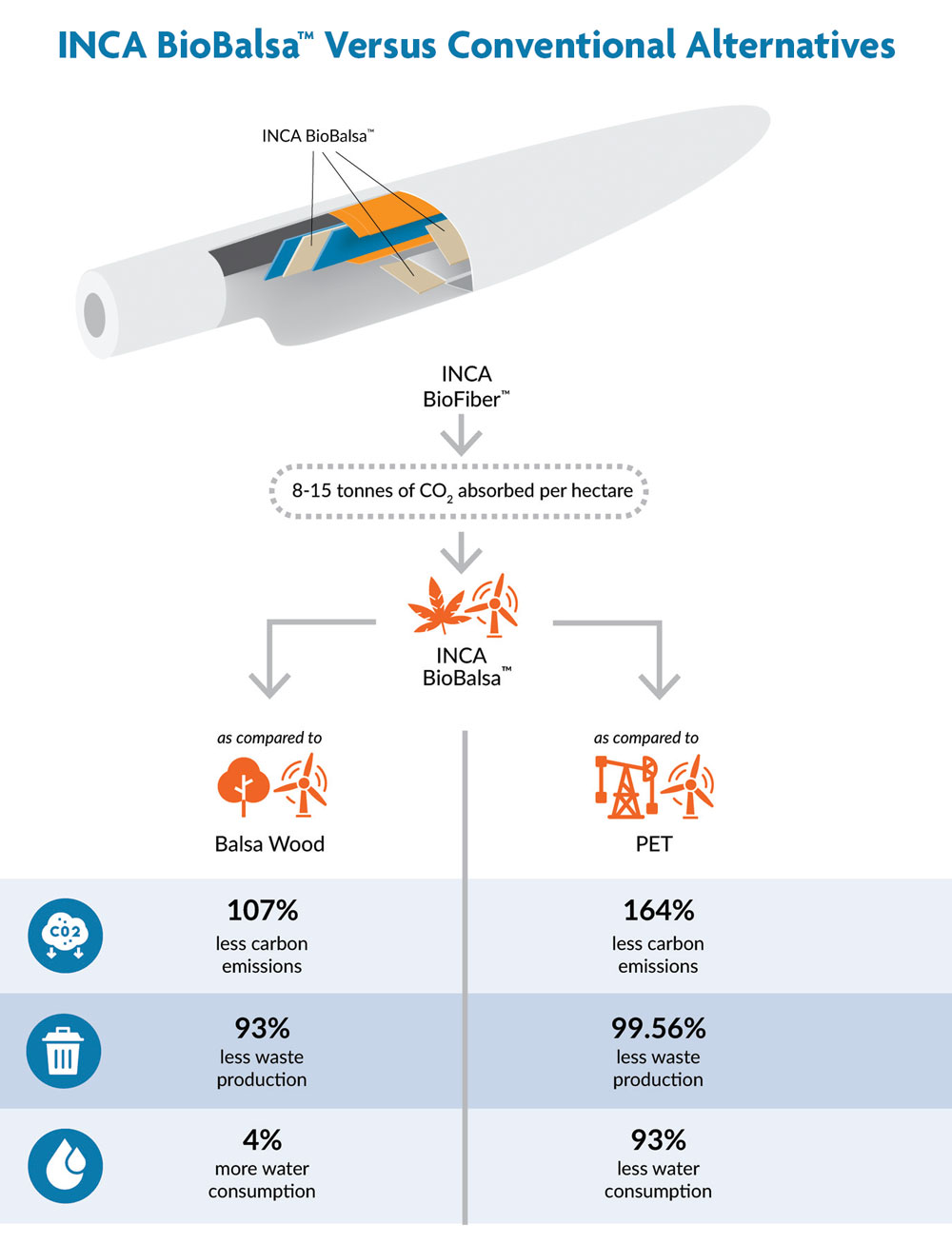
INCA BioBalsa will have 164-percent less carbon impact than PET and 107- percent less than balsa wood. Production will result in 93-percent less waste than balsa and 99.56-per-cent less than PET. It also means 93-percent less water consumption during manufacturing than for PET. One cubic meter of BioBalsa will absorb 262.31 kg of CO2e.
INCA’s goal is to deliver the trifecta to its customers — price, performance and sustainability — in order to overcome the current barriers to wide scale industrial adoption of biomaterials.
Editor’s Note: Camille Saltman is chief marketing and sales officer, INCA Renewtech

 Techtextil North America and Texprocess Americas was well attended for the first Atlanta event in four years.