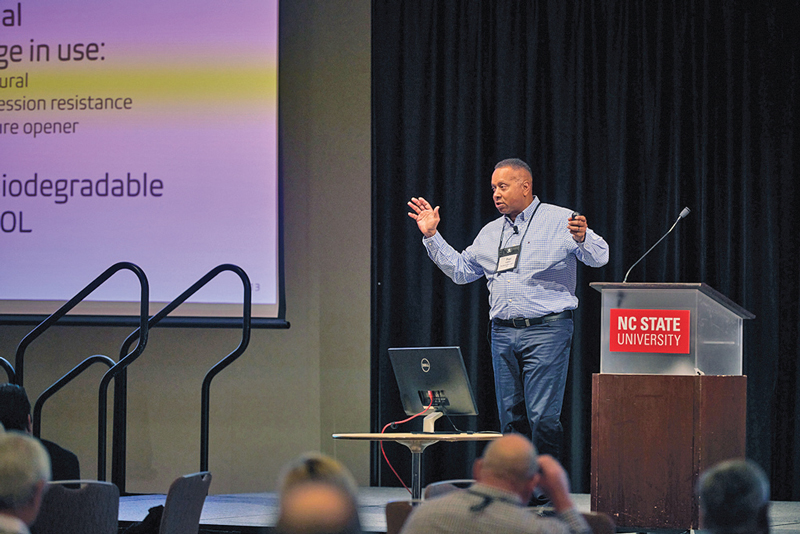
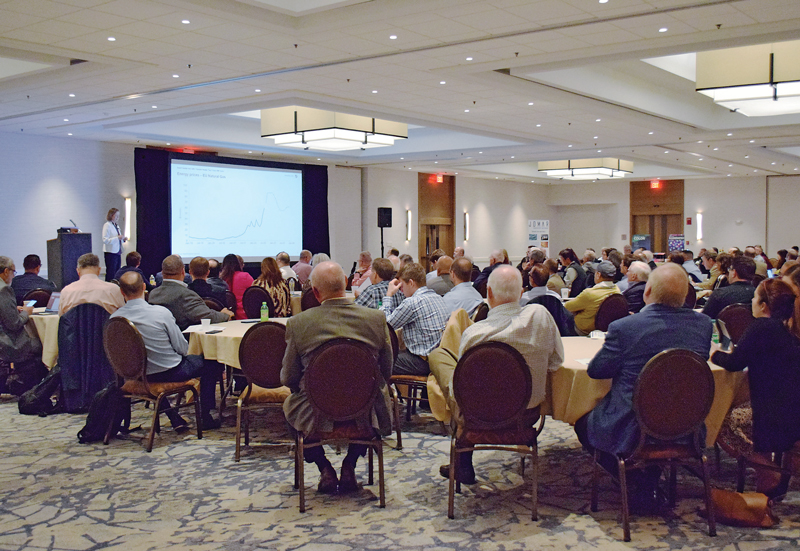
Recycling and sustainability took center stage at INDA’s 2022 Rise® Conference.
By Jim Kaufmann, Contributing Editor
If the recent 2022 Research, Innovation & Science For Engineered Fabrics (RISE) Conference — organized by the Association of the Nonwoven Fabrics Industry (INDA) and held at NC State University in Raleigh, N.C.— were to be made into a book or movie, it undoubtedly would become a hit because this year’s conference had something to suit everyone’s tastes. Presentations offered tidbits of mystery, intrigue, comedy, suspense and truly compelling storylines. Interesting concepts, technologies and products were presented; theories were offered; and some puzzling questions were raised, mostly centered on the conundrum of circularity, recycling and sustainability.
For those present, the conference may have raised more questions than answers. But it was refreshing to see that some of the tough, unspoken questions were asked. One question that stood out was, “Is the recycling effort broken”? Unfortunately, the general consensus appeared to be yes. “The economics of recycling is our biggest challenge,” offered Dr. Jason Locklin, University of Georgia’s director at the New Materials Institute. “It takes a very large infrastructure, which truly isn’t in place, to effectively gather and recycle products at any realistic level.” He and others further reasoned that legislation specific to recycling and sustainability can be a good thing if the legislators are properly informed. However, there currently appears to be a disconnect between many of the certification bodies and actual reality.
Recycling options were discussed and filtered into three main streams of circularity — chemical recycling, mechanical recycling and composting. Each offer potential opportunities and show promise, but each also presents drawbacks. Suggestions were made that we need to “consider the origin of materials as well as the after-use possibilities” of items we purchase in order to further streamline the options for achieving circularity.
Biopolymer opportunities were discussed in several talks. What is clear, according to Benham Pourdeyhimi, executive director of The Nonwovens Institute: “Biopolymers are not the full solution. They’re only part of the solution.” It was suggested in several presentations that there is a need for more companies producing biomaterials, such as polylactic acid, because competition is good and this drives interest, volumes and ultimately innovation throughout the supply chain.
A growing variety of natural fibers have seen a rise in popularity as sustainable alternatives to man-made fibers, however they aren’t without challenges. According to Paul Latten, director of Research and Development at Southeast Nonwovens: “A more holistic view of sustainability is needed. Natural fibers are mostly straight and uncrimped, which does present issues in textile processing. Hemp fiber cost is currently two times that of polyester and the costs of other natural fibers may be even higher, but ultimately the decisions around natural fiber usage and sustainability in general will come down to personal choices and behavior. The question really becomes ‘what are we willing to do differently?’”
The contrasting views of the presenters could best be summed up by “Here’s how we save the future” versus “The recycling system is broken, we need to fix it.” Unfortunately, the challenges we face were truly made clear when one of the presenters stated, “If it costs more or performs less, we humans likely won’t use it.”
Three facts garnered during the conference really stood out:
In 2020 alone, 1.6 billion disposable masks entered the ocean;
Every minute, 300,000 disposable diapers are landfilled or incinerated; and
It takes 450 years for polyester to biodegrade!
As Dr. Locklin stated, “It’s really hard to do the right thing,” but hopefully, we’re finally asking the right questions.
SYFA held lively fall conference to celebrate its 50th anniversary with 170 people registered.
TW Special Report
The Synthetic Yarn and Fabric Association celebrated its 50th anniversary during its recent fall conference. Under the theme “Past, Present & Future,” SYFA looked back on its 50 years while looking to the future of the industry.
To mark the occasion, the association prepared an augmented agenda that included its traditional speaker lineup over the two days of the event, along with a sit-down dinner featuring keynote speaker Kim Glas, president and CEO of the Washington-based textile advocacy group the National Council of Textile Organizations, and a panel discussion featuring six industry leaders who talked about the ideas of the past, present and future in-line with the conference’s theme.
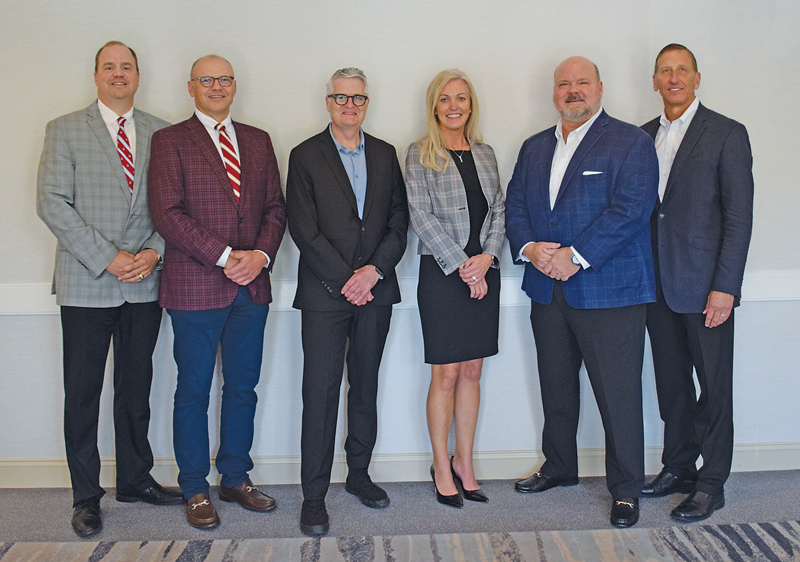
The panel — moderated by Textile World’s Editor In Chief Jim Borneman — comprised:
Amy Bircher, founder and owner of MMI Textiles Inc., Brooklyn, Ohio — a supplier and manufacturer of technical textile products;
Cameron Hamrick, president of Gaffney, S.C.-based weaving company Hamrick Mills Inc.;
Charles Heilig, president and CEO of yarn manufacturing company Parkdale Mills Inc., Gastonia, N.C.;
Eddie Ingle, CEO and director of Unifi Inc. — a producer of premium, value-added fibers;
Leib Oehmig, CEO of Glen Raven Inc., Burlington, N.C. — a fabric manufacturing and marketing company; and
Jeff Price, executive vice president of Strategic Initiatives at Milliken & Company — a global manufacturing company with textile, chemical, floor covering and healthcare divisions.
The gathered group held a thoughtful discussion that was quite lively at times sharing experiences and concerns, as well as opportunities for the textile industry in the coming years.
Talking points touched on history, challenges such as the Covid-19 pandemic, sustainability, energy, automation, and artificial intelligence, among other topics.
(left to right): Cameron Hamrick, president, Hamrick Mills Inc.; Charles Heilig, president and CEO, Parkdale Mills Inc.; Eddie Ingle, CEO and director, Unifi Inc.; Amy Bircher, founder and owner, MMI Textiles Inc.; Leib Oehmig, CEO, Glen Raven Inc.; and Jeff Price, executive vice president of Strategic Initiatives, Milliken & Company.
“From my perspective the opportunity to be part of a panelist with five other individuals that have a solid track record of industry leadership, growth, innovation and sustainability conscience was a very exciting and rewarding experience,” Bircher said. “MMI Textiles is a much smaller company than the others, however, we have been aggressive in our approach to be relevant and passionate about our industry as a whole — from partnerships to collaboration, we need to support each other and figure out ways to overcome the many challenges that our industry faces. We will not stop investing in our industry and the vision we have to continue to overcome those obstacles, but rather propel us successfully into the next chapter.”
“I would like to congratulate SYFA on its 50th anniversary,” Oehmig said. “I would also like to thank each SYFA member company, and Textile World, for all you do to keep our industry moving forward. It is always inspiring for me to be among industry leaders from whom I continue to learn so much. Therefore, to have an opportunity to participate in a panel discussion with peers and friends in the industry was a great day.”
Attendees enjoyed the event and especially the panel discussion. “Thanks to the SYFA for an outstanding 50-year-anniversary conference in Charlotte, N.C.,” said Eva Welsh, North American market manager, Evolon, Freudenberg Performance Materials, who was attending the event for the first time in a number of years. “Outstanding textile industry panel discussion during the conference.”
Speakers And Sponsors
Presentations were given by Wood MacKenzie’s Laura Murphy; Walmart’s Julie Rader; Gildan’s Nello Masciarelli; NC State’s Wilson College of Textiles’ Dr. Andre West; and Consultant Jeff Dugan. Murphy also presented Alasdair Carmichael’s “RPET in Fibers — What is Next for Sustainability” talk because the long-time SYFA board member was unable to attend the event. In addition, Joseph Plasky, a retired DuPont employee and former TYAA president was a guest speaker.
Conference sponsors for this special event included Diamond Sponsor Premiere Fibers Inc.; Gold Sponsors Goulston Technologies and Jomar Softcorp International Inc.; Silver Sponsors Pulcra Chemicals LLC and Teijin Aramid USA; Bronze Sponsors Avient, Thies Corp., Measured Solutions Inc. and Unifi Inc.; and Patrons Mariplast North America Inc. and Textile World.
New SYFA Scholarship Fund, Golf Tournament
SYFA also announced the creation of the SYFA Scholarship Fund for Gaston Community College’s textile program. The association is planning a fundraising golf tournament before the Spring 2023 conference to support ongoing funding for the scholarship. “I know I’m not alone feeling a personal connection to supporting textile students financially, because, for many of us, scholarships are what initially attracted us to the industry,” said SYFA President Hardy Sullivan. “Whether it’s drawing people into textile manufacturing or the 2+2 feeder program with NC State University’s Wilson College of Textiles, we’re proud to be making a tangible effort to support the industry that has supported us.
Sullivan reflected on the event as the association is already looking to the next one.
“The conference was a fitting celebration of SYFA’s 50-year history of education and relationship building, and it was a great launching pad for what lies ahead,” he said. “For a normal SYFA conference we would be happy to bring in a speaker from Wal-Mart to discuss re-shoring, Gildan to cover resource conservation, or have a panelists of top industry leaders hosted by Jim Borneman. But to have them all, and more, in a single conference, was really special.
“The SYFA Board of Directors is so appreciative of everyone who sponsored, participated and attended the fall conference,” Sullivan continued. “There were a lot of new faces, and we look forward to seeing them again in the spring!”
The next SYFA conference is scheduled for April 20-21, 2023, at the Sheraton Charlotte Airport Hotel in Charlotte, N.C.
FyberX has announced plans to invest $17.5 million to open a production and headquarters location in Mecklenburg County, Va. Founded in 2019, the company developed technology to turn raw agricultural biomass into refined natural fibers. It will process hemp and other agricultural products into textile fibers and employ 45 people when the facility opens.
“This industry is an emerging market in the United States, and I welcome the opening of the headquarters of FyberX which will unlock its growth potential in the Commonwealth,” said Virginia Governor Glenn Youngkin. “This industry provides a sustainable alternative for industrial and consumer products that will also bring economic benefits to Virginia communities and farmers, and we look forward to a successful partnership with FyberX.”
Eastman, Kingsport, Tenn., and Sweden-based Renewcell have signed a letter of intent to develop Naia™ Renew ES yarns sourced from Renewcell’s Circulose® 100-percent recycled raw material. Circulose is a dissolving pulp made using 100-percent textile waste such as worn out clothing and production scraps. Naia Renew is a blend of 60-percent sustainably sourced wood pulp and 40-percent certified recycled waste plastics.
“Eastman considering Circulose as a feedstock in the production of a premium yarn like Naia Renew reflects very well on the Renewcell team’s ability to work with partners to adjust and optimize our product for new fiber applications,” said Renewcell CEO Patrik Lundström.
Morrisville, N.C.-based AlgiKnit has announced a new name — Keel Labs™. The company’s rebranding initiative supports its “mission and capacity to support a sustainable product at scale.” The rebranding also includes a name for Keel Labs’ seaweed-based yarn, which is now known as Kelsun™. The company, founded in 2017, focuses on aquaculture-based technologies derived from nature as sustainable materials.
Polyvinyl chloride resin and technical textiles producer Ronald Mark Associates Inc. (RMA) has announced plans to open a manufacturing operation in Tazewell County, Va. The investment will result in 29 new jobs. A $116,000 grant was provided by the Commonwealth’s Opportunity Fund to assist the county with the project, and the company is eligible to receive state benefits from the Virginia Enterprise Zone Program administered by the Virginia Department of Housing and Community.
“The progressive talent of Tazewell County is a perfect place to start, create, and produce infrastructure fabrics and technical textiles for our Ronald Mark customers,” said RMA President Michael Satz.
A delegation from Union City, Ga.-based TenCate Protective Fabrics group recently toured the Netherlands-based Saxion University including its Circular Textile Lab and Thermoplastic Composites lab of the Lightweight Structures Research Group. Recognizing the advantages of leveraging combined resources and industry experience in protective fabric development, the two organizations signed a memorandum of understanding (MoU) that represents a shared collaboration commitment moving forward.
“As two organizations devoted to textile innovation, we’re excited at the chance to unlock this new, scientific partnership,” said Michael Laton, vice president, Global Strategy & Innovation, TenCate Protective Fabrics.
On the heels of multiple investments in North America in recent months, France-based Saint-Gobain held a groundbreaking ceremony for a new glass mat facility recently on its CertainTeed Roofing campus in Oxford, N.C. The investment of $167 million is the company’s largest ever investment in a U.S.-based roofing facility. The plant will produce polymer resin-bonded fiberglass filament mats that are a key component in roofing shingles. The investment was supported by more than $700,000 in incentives and grants from the State of North Carolina including the One North Carolina Fund and a Rural Division Building Reuse Grant.
Hemp seeds for textile use are planted very close together to encourage the plant to grow tall and thin with very few branches.
Bear Fiber Inc., a forerunner in the textile hemp fiber movement, sees tremendous opportunity for hemp in the U.S. textile, apparel and fashion arena.
By Rachael S. Davis, Executive Editor
Buzzwords come and go in the textile industry, but two words in particular have had some staying power over the past handful years — sustainability and hemp. Not surprisingly, the two words are connected, and one man chasing hemp as the next big thing in sustainable fibers is Guy Carpenter. He is not alone in the United States in that endeavor but is widely acknowledged as one of the forerunners.
Carpenter’s experience in the fiber industry goes back many decades, and his exposure and interest in hemp began when he was working in Europe. He eventually co-founded Bear Fiber Inc. in 2017 when he realized no one else was exploring the potential of hemp fiber in the United States.
Bear wants to be the supplier of choice when it comes to high-quality textile grade hemp fiber, and the company is highly invested in reestablishing American hemp as a source of sustainable, natural fibers. The company operates under the trademarked motto “Hemp Makes It Better™,” and it’s a motto Carpenter firmly believes in.
Hemp! Why Hemp?
While a hot topic and buzzword in the textile industry lexicon, hemp for textile use is not new. Hemp is acknowledged as one of the earliest known textile fibers and has come and gone from the textile landscape throughout history. However, hemp has a checkered history in the United States due in part to its association with cannabis and the negative thoughts this connection invokes.
The current rebirth of the fiber in the United States coincides with the 2018 Farm Bill Act that removed industrial hemp from inclusion in the Controlled Substances Act (See “Hemp: A Reintroduction To One Of The Original Textile Inputs,” Textile World, November/December 2020). The bill made commercial production of hemp legal in the United States, and thus, an opportunity was born for textile hemp fiber.
Current market research reports looking at the value and potential growth of the hemp fiber industry vary depending on the market research company. But two things researchers agree on is the growth numbers are in the billions of dollars and increased use of hemp in the textile industry is driving the growth.
Carpenter isn’t focused purely on dollar signs. He understands the significance and widespread value of the industry from the farmer to the textile producer and wants to help develop the United States hemp fiber industry while also continuing to grow the global hemp industry. “We’re trying to create an industry, not just run a business,” he emphasized. “They say there’s 25,000 different things you can do with hemp, but my brain is tracked to one thing and one thing only — textile grade fiber for apparel and footwear.”
Guy Carpenter, co-founder of Bear Fiber Inc.
What Hemp Brings To The Textile Table
The benefits of hemp fiber, a member of the bast fiber family, are not in dispute. Hemp is an environmentally friendly and sustainable fiber. It is strong, durable and absorbent. It also has natural antimicrobial properties and exhibits resistance to ultraviolet light. Its benefits in textile apparel applications are evident.
“Using at least 30 percent hemp in a yarn blend with cotton makes for a new natural fiber-based technical textile, which is strong and will last longer,” Carpenter noted. “The blend allows for the familiar touch and comfort feel of cotton made better by the positive attributes of hemp.
“I should talk about sustainability, regenerative agriculture, carbon sequestration, and hemp’s strength and technical attributes,” Carpenter said. “But I like making apparel with hemp because it feels good, and it lasts a long time. It’s that favorite jacket, sweatshirt, T-shirt, socks, shirt or jeans that just keeps getting softer and softer over time. Hemp wears in, it doesn’t wear out!”
Growing Hemp
China and Europe already have established industrial hemp markets growing the plant for food, cannabidadiol (CBD) and textile use. There are many, many different hemp varieties depending on the end use for the plant.
Hemp grown for CBD, marijuana or food uses is cultivated to be as leafy as possible. More branches mean more buds and flowers where the cannabinoids are concentrated, and the plants are grown with ample space between each plant to allow this leafy growth, which also encourages thicker, stronger stalks.
Hemp plants are similar to trees with branches and everywhere there is a branch on the stalk, there is a knot hole. “Each knot hole is an interruption in the fiber growth of the long, straight fiber that we require for textile applications,” Carpenter said.
“Where fiber fineness is not a consideration, grain hemp stalk can be used,” Carpenter said. Applications may include nonwovens and composites for construction and geotextile products. “Because the stalk has matured by necessity to support the weight of the flower and then the grain itself, the fibers become stiffer and thicker in order to support the weight at the top of the stalk. These fibers are inherently too mature for textile yarn spinning applications.”
Therefore, the approach for growing hemp for high-quality textile fiber is quite different. The seeds are planted very, very close together, which encourages the plant to grow tall and thin with little in the way of branches. Hemp grows rapidly — the stalk can be 10 inches tall in as little as 14 days — and as the plant develops its first set of leaves, the leaves create a canopy that inhibits sunlight from reaching the ground, thus providing natural weed prevention so little to no herbicides are required.
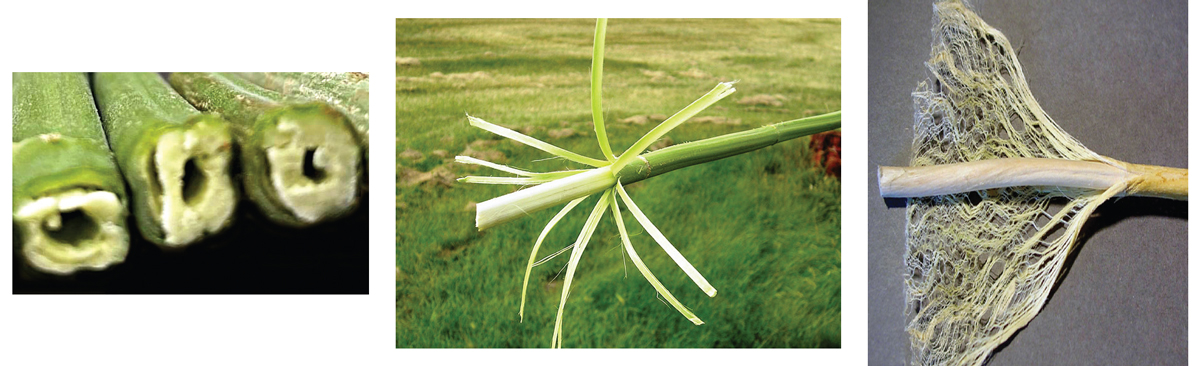
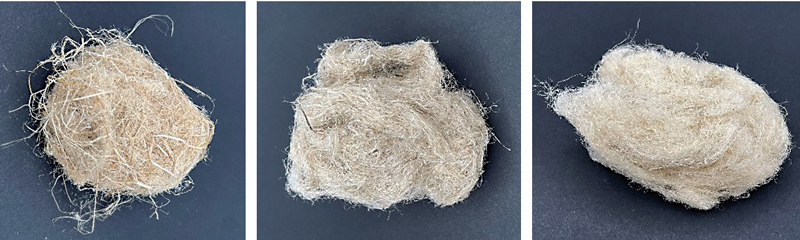
Once the plant is ready to flower, and before the fibers get too tough for textile applications, the fields are cut and the stalks lay on the ground to begin dew retting. This is a natural process whereby bacteria begin to degrade the pectin, which is the gummy substance that binds the fiber to the woody hurd — or center — of the stalk (See Figure 1). After retting, the stalks are baled and sent to a processor to be decorticated — a process that physically separates the fiber from the hurd in a manner similar to any bast fiber process. After decortication and refining, the fiber is ready to be degummed to remove the lignin “glueing” the individual fibers in bundles and ribbons. Extracting the lignin allows the fiber bundles to release the individual fibers during the next process — opening.
Figure 1: Hemp fiber is bound to the woody hurd at the center of the stalk with gummy pectin.
Developing The U.S. Hemp Industry: The Journey
Hemp is a natural fiber and as such, producing the best fiber for apparel and fashion uses is not an exact science. Carpenter has spent extensive time in China over the past 25 years learning about hemp farming and hemp fiber production, but knows he still has a lot to learn.
“It’s been a learning process here in the United States using the equipment available,” Carpenter said. “It’s been an adaptive process, and we have not always been successful!”
Cotton has enjoyed the benefit of decades of research and development in the United States, which along with the work the farmers do, means the United States grows the best and most consistent cotton the world.
To spin yarns, fiber consistency is imperative. Providing that consistency to the hemp industry is Bear Fiber’s biggest challenge.
To start, farmers need to grow the hemp variety that is best for textile fiber use as well as the best variety for the region in which they are based.
Encouraging U.S. hemp farming briefly led Bear Fiber into the hemp seed business. “Everyone wanted to grow European hemp varieties for us, and these varieties were not developed for textile grade fiber, or developed to grow successfully in the United States,” Carpenter said. “We were getting maybe 8 percent useable fiber from the stalks, whereas the Chinese had specifically been developing varieties for greater amounts of textile grade fiber that could be grown in a faster manner.” So, Bear Fiber began importing Chinese seeds, which was a whole new educational process that required forming a new business network.
Hemp is a hardy plant that can be grown in a variety of climates, although it prefers a temperate climate and fertile, loamy soil. “Honestly, we don’t yet know where the best place to grow hemp in the United States is,” Carpenter confessed. “But we are pretty sure where hemp can grow in 100 days or less and likely provide double digit textile grade raw fiber yield, which is what we are looking for. This also allows us to pay a fair price to the farmer or processor for the fiber.”
Carpenter believes there is a real opportunity for farmers, especially those in agriculture and textile producing states — such as Georgia, and North and South Carolina — where the spinning mills already exist. “However, we intend to be agnostic,” Carpenter said. “If the fiber is healthy and clean, we’ll ship it from any state in the union. It’s worth it.”
Bear Fiber currently is using textile hemp from North Carolina, Pennsylvania and Montana — where there are quantity processors that have fiber available to date. But the company also is working with newer processing operations in Missouri, Alabama, Texas, California and Oregon. “We want to help grow this industry and help create opportunity for the farmers across the country,” Carpenter said.
“Some states — including New York with a $10 million investment — have programs in place to advise and financially assist American farmers who risk growing this new fiber crop,” Carpenter continued. “But farmers have to pay bills just like anyone else, and if they can’t get real support, they can’t take the chance.”
(left to right): Bast hemp fiber, refined hemp fiber and degummed or “cottonized” hemp
North Carolina has a fantastic advocate at NC State University by the name of Dr. David Suchoff, who is an alternative crops extension specialist in the department of Crop & Soil Sciences in the College of Agriculture and Life Sciences. Dr. Suchoff heads agricultural research stations and leads a national public/private hemp consortium. The goal of the consortium is to address many of the issues relating to the hemp industry through collaborative research with other institutions across the country. Suchoff also plans to expand hemp farm fiber outreach opportunities with emphasis on underserved farming communities.
Dew retting harnesses moisture that develops overnight to encourage bacteria growth. “That makes it harder to get good textile fiber from hemp grown in Montana where there is no dew,” Carpenter said. “But there are different varieties of hemp, and we are learning about techniques to promote bacterial growth for retting in geographic areas that don’t enjoy the same climate as say North or South Carolina.”
Decortication also is key step in hemp fiber processing to preserve the textile grade fiber. Any kinks or damage caused during decortication may weaken the fiber, which results in poor performance in downstream processing. “Great care has to be taken when decorticating textile grade fiber,” Carpenter said.
Bear Fiber’s Expertise
Circling back, one of Bear Fiber’s goals is to be the supplier of choice when it comes to high-quality textile grade hemp fiber. “Where Bear Fiber comes into play is we know how to separate the hurd and clean the fiber to where it needs to be so it can then be put through the wet processing of degumming,” Carpenter said. “The most important thing about this process is that raw fiber with any percentage of hurd must be cleaned and refined. Fiber with any percentage of hurd mixed in is not as valuable as raw fiber that is cleaner.”
Carpenter said in American hemp fiber processing currently, the raw fiber is anywhere from 1 to 6 inches long in bands or ribbons gummed together. Bear Fiber uses an alkaline process to degum the fiber. There are many methods available to degum hemp fiber — including boiling, electrification, acid and enzyme techniques — but Carpenter likes an alkaline process developed by the Chinese because it’s simple and cost effective. The end goal is fibers that are 1 to 2 inches long.
“We’re trying to achieve a uniformity in the degummed fiber so that it can be blended with other fiber from the United States,” Carpenter said. “Each bale is tested before degumming against a standard formulation, but we might have to adjust the alkalinity or the chemistry in some way if we need to lighten the fiber to achieve a more consistent fiber grade based on where the hemp came from and how well it was retted.”
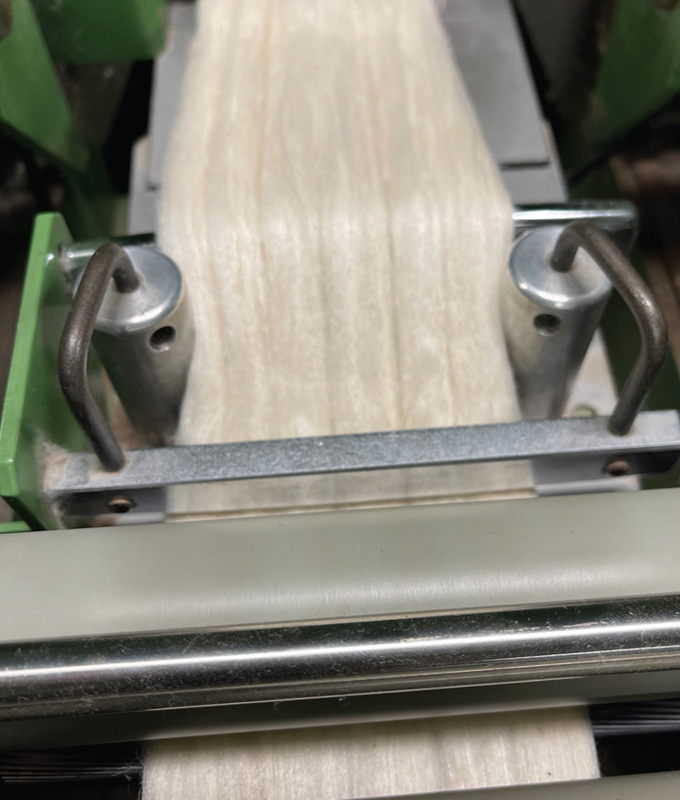
A hemp/cotton sliver on the drawing frame
Hemp fiber is valuable. Carpenter shared that currently, hemp fiber compares to alpaca fiber in price. “Right now, it’s still pretty expensive because everything that has come through our pipeline so far has been part of the development process,” Carpenter shared.
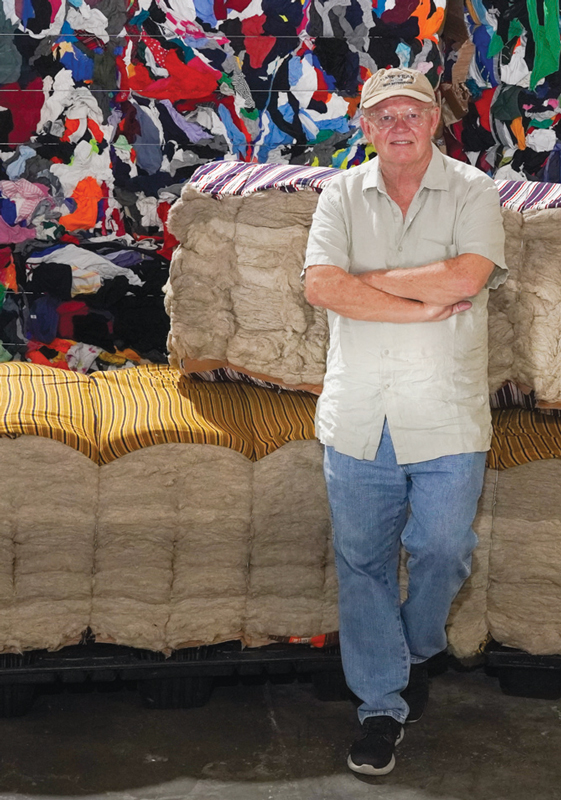
Carpenter has been busier than usual over the past several months. The company relocated within North Carolina from Wilmington to Morganton, to be closer to manufacturing partners. “We hope one day to grow into our own spinning and will focus on spinning natural fibers, recycled fibers and regenerative fibers” Carpenter said. “In Morganton, I’m surrounded by 120,000 pounds of recycled fiber. Material Return [a solution for custom circularity that works with manufacturers and brands to transform textile waste into new products], for example, is here in Morganton and it has a Smart Wool return program for socks. Bear Fiber looks forward to eventually blending innovative technical yarns comprised solely of natural, sustainable, recycled and regenerative fibers.
“The hemp fiber industry doesn’t really have a competitive environment yet,” Carpenter mentioned. “We haven’t produced enough fiber to make a difference in any market. To date, the only commercial products made using U.S. hemp and manufactured in the United States are Bear Fiber socks.” The socks are developed and knit in partnership with the Manufacturing Solutions Center in Conover, N.C.
“Our industry manufacturing partners have been receptive to hemp and a number of companies have been true first movers,” Carpenter shared.
Collaborative Approach, Partnerships Are Key
Carpenter has embraced a collaborative approach to growing the U.S. hemp industry. He has worked with brands, both big and small, and consults with and mentors anyone wanting to learn more about hemp and the opportunities it presents. “We all work together better than alone,” he said. “I always prefer to look for partners and establish relationships. We are all allies working together to create a market. I’m willing to help and share the knowledge I have in order to advance and grow this industry.”
While Carpenter is widely acknowledged to be a hemp “guru” of sorts, he does want to make it patently clear that he is not any sort of isolated Don Quixote character operating independently. “There is no way that one person could have achieved much without the help of dozens and dozens of people who believe that hemp fiber is an important and viable asset to the American textile and apparel industry,” Carpenter stressed. “It’s been a journey and I wouldn’t be where I am without the help I had along the way.
“I’d like to name and thank everyone, but there’s just not enough space in the magazine. For Bear Fiber, farmers, processors, spinners, weavers, knitters, finishers, the Textile Technology Center, NC State’s Wilson College of Textiles, VF Corp. and Vans all have been working to create a circular collaborative effort. We also would have been at a dead stop for months without processing help and fiber from IND Hemp — an amazing team that works with farmers to grow hemp out West and processes fiber, grain and hurd in Montana.”
“Guy Carpenter was the first person I turned to when I wanted to learn about Made-in-USA hemp, and he has continued to be a source of both technical and business knowledge as the Wilson College of Textiles and NC State University develop our position in growing, cultivating and manufacturing hemp,” said Dr. Andre West, director of the Zeis Textiles Extension for Economic Development at NC State’s Wilson College of Textiles. “Guy’s passion for a sustainable future led him to embrace hemp early on as a solution and build a unique knowledge base that has allowed him to mentor others as they build hemp-based products. He is grounded, knowing this is a long journey and a lifestyle change. And, he is playing his part to educate everyone that hemp fiber is a part of creating a better future for the planet and has a place in manufacturing textiles in the United States.”
One person who benefited from Carpenter’s willingness to mentor is Claire Crunk, founder and CEO of Trace Femcare Inc., a period care company that produces tampons using hemp and cotton fibers from fully traceable sources. “When I got my start in hemp fiber almost five years ago, I was a total neophyte,” Crunk said. “When I cold called Guy, he was gracious and clearly an expert, so right then and there, I asked him to be my mentor. Guy has been a consistent and selfless mentor since then — teaching, encouraging, and providing more than any conference or curricula ever could. He is one of our company’s most important partners, and I admire him both professionally and personally and am privileged to now call him a colleague and friend.
“As one of the first brands to sell products made from U.S.-produced textile-grade hemp fiber, we are proud that our work ultimately supports our partners, like Guy, in their success to provide textile industry quality hemp fiber at scale.”
A finished hemp/cotton blend yarn
Vans: Mainstream Interest In Sustainable Fibers Like Hemp
Brands are taking an interest in hemp too. VF Corp. believes “hemp has the potential of filling in some of the gaps in our fiber toolkit for brands and products that would like to utilize more natural fibers.”
“VF recently set ambitious goals for the reduction of greenhouse gas emissions utilizing science-based targets, and as one of VF’s largest brands, Vans is committed to supporting these goals,” said Emily Alati, director, Materials Innovation, Vans. “We believe supply chain innovations in natural fibers, including hemp, are necessary and if cultivated with sustainable agricultural methods and processed with lower energy inputs, it can be a competitive advantage to help VF reach those goals.”
According to the company, Vans has used hemp in its products for years, so supporting U.S. hemp agriculture and textile processing also aligns with its consumer and supply chain needs. Vans is currently sourcing hemp fiber from North Carolina in small quantities and hopes to increase that volume over time.
“We are also supporting those hemp farmers in their transition to regenerative agriculture practices to reduce the overall environmental impact of hemp farming,” Alati said. “Ultimately, we are eager to utilize regeneratively grown and U.S. hemp fiber while supporting minority farmers. Long term, we hope to see all VF brands utilizing domestic industrial hemp fiber and textiles for various end-uses across our global markets.”
Vans’ collaboration with Bear Fiber benefits both companies. “The relationship is based on expertise, trust and results,” Alati said. “Bear Fiber has demonstrated that hemp fiber suitable for short staple spinning can be grown and processed entirely in the United States. Its relationships with textile universities, labs and processing partners have led to commercial textiles in a relatively short time span.”
For Bear Fiber, the support received from VF Corp. and Vans starting some two-and-a-half years ago has been incredibly important. “You have a lot more credibility when you walk into a room with people employed by one of the most important brand companies in the world who say ‘we are behind hemp, we think hemp is important and we think this is the future,’” he stressed.
Bear Fiber currently is producing fabric for Vans. The yarn is spun by National Spinning Co. Inc. at its Whiteville, N.C., plant; the fabric is woven by Central Textiles Inc., Central, S.C.; and finishing is performed by Mount Vernon Mills Inc., at its facility in Trion, Ga.
Bear Fiber offers socks made using U.S. hemp that are developed and knit in partnership with the Manufacturing Solutions Center in Conover, N.C.
BFFs: Hemp And Cotton
Hemp is also seen as a potential competitor to cotton, which at times, hampers adoption of the plant for farming and textile use. Carpenter wants to stress that he doesn’t see hemp as a competitor or replacement for cotton and just wants to sell the value of another fiber crop. He sees the two as complementary fibers — best fiber friends (BFFs) — that can help both the farmer and the textile industry. “We are not asking farmers to grow hemp instead of cotton,” he noted. “We are asking them to grow it along with cotton.
“We want to replace 50/50 cotton/polyester blends with 65-percent cotton/35-percent hemp,” Carpenter continued. “We export our cotton everywhere because it’s of the highest quality. One day I hope to be exporting U.S. hemp fiber because it’s sought after for its quality. And the opportunity for hemp blended with U.S. cotton is tremendous.”
Carpenter considers Bear Fiber’s perseverance its greatest asset. “We know yarns and fabrics can be made to meet the quality standards that the brands and consumers are looking for because we’ve been doing it for 25 years in China.”
Ultimately, Carpenter wants what is best for the U.S. fiber industry and the U.S. textile industry.
“I want to help grow the hemp fiber industry into the American textile, apparel and fashion industries,” Carpenter said. “I think an American hemp fiber industry not only can provide consumers with better garments that last longer and feel better but can also be a huge benefit to small farmers and fiber farmers who are already growing cotton.
“The only competition we have is China, and we’re going to be better than them,” Carpenter predicted. “Consumers today have a heightened awareness of natural fibers and sustainability, and are demanding better choices. It’s up to the U.S. textile manufacturing industry to take advantage of this opportunity, to innovate and promote from the ground up our own domestic value chain. In the United States, we’ve already got the best cotton in the world, and that’s a huge advantage. But you know what? Hemp makes it better!”
On Montex®Coat coating lines, the possibilities range from the single-sided application of finishing agents to the creation of materials for sophisticated lightweight construction and automotive and aerospace components.
European-built coating technology is allowing Monforts’ customers to move into new markets.
TW Special Report
The flexibility offered by the latest Monforts Montex®Coat coating units — with their multiple coating head options and modular construction for bespoke projects — is proving a big hit with manufacturers of technical materials.
These machines are designed and engineered in Germany and assembled at the Montex plant in Austria, which is celebrating its 40th anniversary in 2022.
“The market has definitely been looking for this kind of added-value proposition,” said Monforts Engineer for Textile Technologies Alexander Fitz. “Since we acquired the coating technology that our systems are based on a number of years ago, we have made a lot of refinements and all of them are reflected in higher coating accuracy and the resulting quality of the treated fabrics.
“We’ve been kept very busy recently with both new installations and on running trials on the Montex Coat line at our Advanced Technology Center (ATC) in Germany, with a number of further new orders confirmed.”
Possibilities
On Montex Coat coating lines, the possibilities range from the single-sided application of finishing agents for outdoor clothing and adding functionality to home textiles, to the creation of materials for sophisticated lightweight construction and automotive and aerospace components.
Layouts for the technical textiles and nonwovens industries now account for more than 25 percent of Monforts’ turnover and systems are in place for applications ranging from outdoor and medical fabrics to filter media which must perform in extreme temperatures and flame-retardant barrier fabrics.
All of these materials require expert coating and finishing for maximum efficiency and the ability to switch quickly from one fabric formula to the next, without compromising on the economical use of energy or raw materials.
“Many more applications are possible with the Montex Coat, such as the overdyeing of denim, the creation of double-face coated materials, fabrics awnings, tents and medical drapes and the pre-treatment of substrates for digital printing,” Fitz explained. “A range of different doctor blades and their combinations can be supplied to meet individual requirements, including air knife, roller knife, foam and paste, screen and magnetic roller coating.”
Fully Adjustable
Magnetic roller coating is an interesting option, especially for wider widths, in enabling a wide range of coatings and finishes to be carried out due to the fully-adjustable positioning of the magnet within the roller. With different magnet positions, it can be set to operate both as a direct coating system and as an indirect coater.
With traditional dip coating systems, as well as with many standard knife coating technologies, there is always a difference in the tension between the center and the edges when wide width fabrics are being treated — and hence, the amount of pressure with which the coating is applied. With the use of a magnetic roller, equal pressure is applied across the full width of the fabric, with entirely consistent results. In addition, adjusting the roller surface, rather than changing the coating formulation to match the required add-on and viscosity for each coating effect required, leads to much higher output from the line.
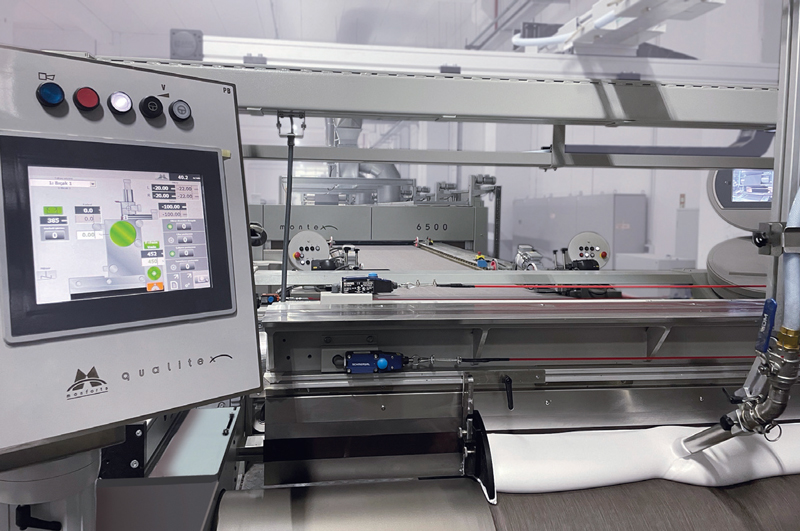
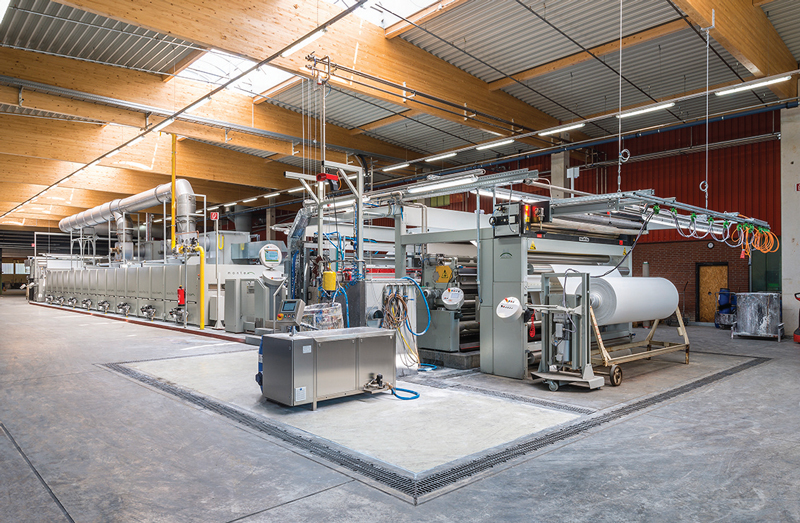
A modern coating range with an integrated Monforts Montex®Coat unit installed in Germany.
Niche Applications
Recent new Montex Coat customers include Germany-based Dolinschek, a knitting, dyeing and finishing specialist. Dolinschek attributes its success in part to the continuous successful identification of profitable new niche markets.
“There is just so much more to textiles than clothing,” said Technical Director Theo Dolinschek. “We handle many different technical materials such as automotive components, geotextiles and wallcoverings, but also those for more unusual applications such as inlays for extractor hoods, cut protection fabrics and even wool felts which are employed as insulation on wind turbines.”
The company has installed a new seven chamber Montex TwinAir tenter range with a Montex Coat coating unit in knife execution, enabling the coating of dimensionally stable knitted fabrics with polyurethane or acrylate.
A unique feature of this line is a Teflon-coated transportation belt through the system, and it is also equipped with integrated heat recovery and exhaust gas purification to ensure the most resource-efficient processing available on the market. The exhaust air goes from the Monforts heat recovery system into an existing air/water heat recovery system and then into an electrostatic precipitator.
Highly-intuitive Monforts Qualitex visualization software allows all machine functions and process parameters to be assessed and controlled easily, and thousands of article specific settings and formulations to be called up at any time — with 100-percent reproducible results.
Weatherproofing
Scotland-based Halley Stevensons also has commissioned a new Montex finishing range with a Montex Coat coating unit in knife execution for paste and foam coating, to further boost the company’s highly flexible operations.
Founded in 1864, Halley Stevensons has amassed unique technical know-how and manufacturing experience in the art of waxed cotton for weatherproofed fabrics. The company exports worldwide and its premium brand customers include Belstaff, Barbours, Filson and J.Crew.
The new range enables the company to pigment dye, direct coat and pad apply finishes and provides more scope for research and development.
“R&D is the lifeblood of our business,” said Managing Director James Campbell. “The precise process control functions of the line give our technicians confidence to make new products as well as finely tuning the energy requirements of existing products. We love the fact that we can record the energy used on each production batch and use this for continual improvements and efficiency savings. The touchscreen software is visual and easy to use, moving from one screen to another to check the various parameters of processing.”
Foam Application
Turkey-based home textiles and furnishing fabrics producer Altun Tekstil has meanwhile recently commissioned the first Montex Coat coating system in Turkey.
The advanced line has been installed at the ever-expanding family-owned company’s industrial complex in Bursa and is being employed to provide an anti-slip and textured backing to upholstery fabrics with a stable and uniform foam, via knife-over-roller coating.
“With the Montex Coat unit, Altun is able to achieve an even foam application at high speed which results in a very economic process,” said Monforts Sales Manger Thomas Päffgen.
Advanced Functions
Other special features on an integrated Montex Coat tentering line relate to the ability to treat materials not only at temperatures of up to 320°C, but also to be able to treat the top and bottom faces of certain materials at different temperatures within a single pass through the machine.
To achieve this, the chambers of the tenter are fitted with TwinTherm chamber system with separate burners for individual top/bottom temperature. A temperature differential of up to 60°C can be achieved between the upper and lower nozzles within the chamber, depending on the treatment paramenters.
“There are many applications where employing two separate temperature treatments is beneficial, such as floorcoverings, where the textile face fabric is treated at one temperature and the rubber backing at another,” Fitz explained.
In addition, Monforts can provide the necessary explosion-proof ranges for solvent-based coatings and high temperature processes up to 320°C, such as polytetrafluoroethylene coating of nonwoven filter material. These lines are equipped with special tenter chains and insulation.
“Monforts is the only manufacturer to offer completely integrated coating lines from a single source and the coating machine is tailored to the subsequent Monforts drying technology — with all the benefits resulting from a fully integrated PLC control,” Fitz concluded. “Our systems have the shortest fabric path from the coating unit into the tenter and we have all variations of coating application systems too — and all of these options are available in wider widths, with the engineering and manufacturing from a single source here in Europe.”
Dickson-Constant Anchors Its Presence In Hauts-De-France With The Assistance Of Monforts
Dickson-Constant recently opened its second brand new plant in northern France in response to growing demand for its range of well-known technical fabrics. New technology installed at the plant includes a highly-customized Monforts Montex 8500 tenter.
Know-How
The oldest weaving operation in France, with roots dating back to 1836, Dickson- Constant specializes in woven acrylic fabrics and has been part of Glen Raven since 1998. Its Dickson-branded solar protection and flooring materials and Sunbrella home upholstery and market-leading marine industry fabrics are renowned for their quality and durability.
Representing a 40-million- euro-investment, the new Dickson-Constant plant, located in Hordain, Hauts-de-France, builds on many of the proprietary practices and the processing know-how established over many decades at the company’s existing plant less than an hour’s drive away in Wasquehal, France.
Various locations were considered for the plant, and its selection provided a significant boost to the region’s textile industry. In the absence of suitable technical textile training in the immediate vicinity of Hauts-de-France, Dickson-Constant also created a training center to fully train its 75 new plant employees, in addition to other new textile technologists entering the industry.
With many new weaving machines, the plant increases the company’s overall manufacturing capacity by 50 percent while providing the flexibility to accommodate more medium-sized orders and meet requests from certain customers for full exclusivity in respect of specific performance fabric ranges.
Non-Stop
The seven-chamber Montex tenter for drying, heat-setting and polymerizing applied resins has a maximum working width of 2.2 meters. It is installed in line with the washing compartments and is equipped with special entrance and exit fabric accumulators to enable non-stop processing during batch changes, in addition to an integrated vertical infrared dryer and exhaust air cleaning. Two weft straighteners provided by Germany-based Mahlo GmbH & Co. KG also ensure maximum regularity of fabric batches at strategic points in the line.
“The line is very specific to our requirements, building on the experience of running our highly-efficient warping and weaving operations and the Montex tenter for many years in Wasquehal,” explained Process Manager Louis Masquelier. “The new plant in Hordain has a similar layout, but is adapted to new market requirements, since the Wasquehal plant is not set up to enable single runs of under 500 meters of fabric.
The tenters at both plants, he added, have the potential to cause a major bottleneck in operations, should anything go wrong.
“We have also made considerable upgrades to the existing Montex stenter in Wasquehal, including upgrading the electrical components and inverters, as well as ensuring we have all spare parts in-house to ensure all our operations continue to run smoothly. Monforts and its local partner Monel Industrie Services have always provided us with prompt service when needed.”
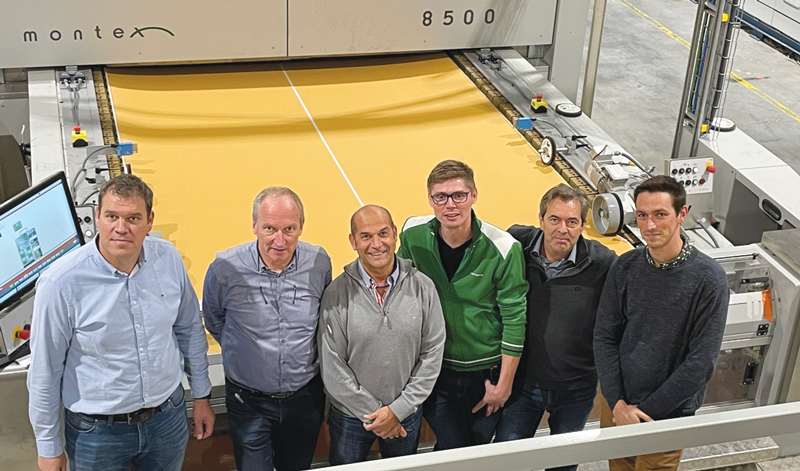
(left to right): Monforts’ Volker Gingter and Havenith with Dickson-Constant team members Herculano Pacheco, Romauld Bellengier, Bertrand Clorennec and Louis Masquelier at the new Hordain plant.
Coatings
Dickson-Constant develops all of its specialized coatings and finishes in-house, and a good example of its prowess in this field is in the latest development for advanced dirt-resistant woven flooring fabrics — the result of more than three years of research.
CleanGuard technology adds an invisible varnished overlay to the woven wear surface, delaying soiling while enhancing its stain resistance and ease of maintenance. The layer of varnish is integrated directly into the finished product, providing additional protection.
The woven flooring system is made up of five distinct layers, each of which provides unique technical features such as a minimum sound absorption of 18 decibels, a dimensional stability of less than 0.1 percent and almost zero risk of fraying thanks to its monofilament construction, which also ensures a clean cut for quick and efficient fitting and a neat finish.
“Sustainability is now paramount to our company and in addition to working towards ISO 50001 standards at both plants, our R&D team is currently focused on developing an oil repellency coating formulation that does not rely on flurocarbons, yet is as effective,” Masquelier said. “We have had a record year in 2022 but the energy situation in Europe is now causing some turbulence. The latest advanced technology, including the Montex tenter, have equipped us to maximize our resource savings and face the current market challenges with confidence. In addition, we have also invested in a water treatment plant allowing the plant to reuse 50 percent of its exhaust water.”