U.S. Textile Investment Annual Roundup

Milliken and Company announced plans to expand its Magnolia Finishing plant.

U.S. textile industry investments illustrate a broad range of commitments from traditional textiles through cutting edge technologies.

TW Special Report

Textile World’s annual review of textile investments highlights a broad-ranging investment horizon including what may be described as traditional textile investments — spinning, weaving, dyeing and finishing — as well as apparel and on to leather alternatives for sustainable automotive interiors.

A review of TW’s 2022 “New Plant & Equipment, M&A” news section yields interesting insight into where investors see the future opportunities in the U.S. textile industry and what areas may possibly be reinvigorated in a post-pandemic world.

Leading Firms On The Move

Well established textile companies continued to invest in 2022. Mauldin, S.C.- based Mount Vernon Mills announced that it has agreed to acquire Wade Manufacturing Co.’s yarn spinning and weaving facility located in Rockingham, N.C. The company stated that with the acquisition, Mount Vernon Mills will be vertically integrated from yarn production to finished fabric in certain products and will be in greater control of the company’s supply chain.

“The Rockingham facility is a modern, cost-efficient operation with an experienced and stable workforce, making it a great fit as we increase the amount of control that we have over our yarn supply, weaving operations and overall costs,” said Bill Duncan, CEO, Mount Vernon Mills. “We are also proud to expand our footprint in the U.S. and build upon our made in America commitment and heritage.”

The company stated that initially, the Rockingham facility will produce open-end spun yarn for Mount Vernon Mills and woven greige goods for the company’s flame resistant (FR) products.

Spartanburg, S.C.-based Milliken & Company made two significant announcements this year leading off with the acquisition of one of the Frontier yarn plants located in Mayodan, N.C. The company said that this acquisition from Gildan will expand Milliken’s open-end yarn production for its protective fabrics, workwear, government and defense, industrial, and napery textile business units.

Frontier Spinning Plant #3, which will be renamed the Two Rivers Plant as a nod to its dedicated team and the community it serves, will become a spinning hub for Milliken. Multiple Milliken textile plants throughout the Southeast will source their yarn needs from the Two Rivers Plant.

Milliken also announced a plan to expand operations at its Magnolia Finishing plant in Cherokee County, S.C. The company plans a $27.4 million investment that will create 75 new jobs. The expansion will include newly added production lines to increase manufacturing capacity. The facility specializes in workwear, military and FR apparel.

Additionally, Milliken launched a new polypropylene clarifier plant in Blacksburg, S.C., that will enhance access to the Millad® NX® 8000 additive for customers worldwide. This facility will enable Milliken to meet increasing demand for plastic additives and colorants well into the future.

Beverly Knits’ Owners Ron and Janet Sytz recently purchased the assets of Gentry Mills renaming the company Creative Dyeing & Finishing LLC.

Creating A New Business

Albemarle, N.C.- based Beverly Knits Inc. purchased the assets of Gentry Mills. The new business — Creative Dyeing & Finishing LLC — will continue to provide dyeing & finishing services to the textile industry. The operation complements the Beverly Knits group of companies — Creative Fabrics, Creative Ticking, Altus Finishing and Hemingway Sewing Solutions.

At the time of the announcement, Ron Sytz, CEO of Beverly Knits Inc. said: “A combination of factors led to the decision to invest and expand. We have been producing quality circular knit textile products for over 42 years in Gastonia, North Carolina. We feel that this is the right time to further expand our capabilities into dyeing and finishing of fabrics. This continues to support the re-shoring of textile production and to strengthen our capability to produce goods ‘Made in the USA.’ With this addition, Beverly Knits companies have the ability to provide solutions from knitting all the way to a completed garment.”

The Creative Dyeing and Finishing operation will provide fabric dyeing, finishing, napping and printing services to the apparel, industrial and bedding markets.

Hemingway Sewing Solutions — a subsidiary of Beverly Knits, announced plans to establish operations in Williamsburg County, S.C. The company’s $3.3 million investment was slated to create 242 new jobs. Hemingway Sewing Solutions plans to manufacture a variety of textile products for brands including Purple Mattress, Indigo and Vapor Apparel, as well as the U.S. Department of Defense.

Wool And Cotton

In other acquisition news, Faribault, Minn.-based brand Faribault Woolen Mill Co. — maker of handcrafted blankets, decorative throws, apparel and accessories — added cotton to its product line up with the acquisition of Brahms Mount, a Monmouth, Maine-based manufacturer of high-quality cotton blankets, throws and other textiles. Terms of the deal were not disclosed.

“This acquisition is a great extension of our strategic focus on building Made in USA jobs,” said Faribault Mill President and CEO Ross Widmoyer. Brahms Mount will continue its cotton product manufacturing in Maine and retain the current employee base.

As part of the acquisition, Faribault Woolen Mill Co. will rebrand as Faribault Mill to reflect the product offering expansion. A new line called The Brahms Mount Collection by Faribault Mill will launch later in the spring.

Going Solar

Piana Technology, the 439-year-old Italy-based textile company known for innovations within the fiber and nonwovens textiles markets, has gone live with a solar panel system at its nonwovens facility in Cartersville, Ga.

The facility specializes in vertically- and crosslapped nonwovens. Since 2016, the facility has manufactured a variety of intermediate products that are behind many of the common household products used today.

Piana partnered with Southern View Energy, a local solar electrical design and solar installation company, to carefully review the facility’s energy profile and pilot an installment project. The new 471 kiloWatt system is poised to supply more than 622,000 kiloWatt hours each year and avoid an estimated 460 tons of carbon dioxide per year, which is equivalent to 125 acres of trees. Although most of this energy will go towards the facility, on days where there is overproduction, energy will go back to the city of Cartersville for redistribution.

Finishing Equipment Capacity

Fab-Con Machinery Development Corp., is a manufacturer of textile finishing equipment that has relocated to Salisbury, N.C. The company announced a $5.3 million investment to relocate its headquarters and manufacturing operation to Rowan County. Serving the knitwear industry for more than five decades, Fab-Con designs, builds, and exports finishing machines for men’s, women’s, and children’s clothing, outerwear and underwear. Fab-Con has a global footprint that supports a major market share of more than 200 customers in Asia, and North, South, and Central Americas. This relocation will be the new home of the company’s global headquarters in a 90,000 square-foot facility as well as its machine manufacturing, administration, and sales operations.

“By relocating to North Carolina, Fab-Con will be more competitively positioned to operate at a lower cost,” said Chris Snyder, vice president, Fab-Con Machinery. “Several recently obtained U.S. and E.U. patents have given us a strong competitive advantage over our competitors both domestically and internationally.” The new positions, including machinists and fabricators, have a combined average annual salary of $73,081, which exceeds Rowan County’s overall annual wage of $48,360. Once filled, these new jobs have the potential to create an annual payroll impact of more than $1.9 million for the community.

Apparel Gets A Boost

New York City-based Ferrara Manufacturing, a family-owned apparel manufacturer announced the launch of Ferrara Uniform. Ferrara Manufacturing produces garments worn on the runways of New York and Paris-as well as by American Olympians and the U.S. military. Located in Manhattan’s Garment District, Ferrara Uniform is a new division of the company focusing specifically on uniforms made in the USA.

With the addition of Ferrara Uniform, the company now is made up of three specialized divisions serving diverse markets — tailoring, uniforms, and protective garments. Ferrara Supply Co. was one of the first federal partners to provide domestically made personal protective equipment (PPE) as part of the 2021 American Rescue Plan, and made millions of gowns and masks in the U.S. during the pandemic for the U.S. government.

BELLA+CANVAS, which employes more than 1,000 people in Los Angeles is expanding and adding an advanced cutting facility in Wetumpka, Ala.

Cutting In Alabama

Los Angeles-based BELLA+ CANVAS announced a $11.9 million investment to establish an advanced fabric-cutting facility in Wetumpka, Ala. The operation was to open in a portion of an 890,000-square-foot building vacant since 2013, when Russell Brands departed from the Elmore County city.

BELLA+CANVAS produces clothing for the retail and wholesale markets, while also offering clothing design and manufacturing services. The company is known for its domestic manufacturing mission, the development of innovative new fabrics and its sustainability practices.

At the time of the announcement, Chris Blakeslee, president of BELLA+CANVAS, said, “We are thrilled to be part of the community and look forward to creating jobs and opportunities for many in Alabama.

“After a comprehensive search, we ultimately concluded that our new location in Wetumpka, Alabama was not only optimal to enhance our manufacturing footprint and technologically advanced operations levels, but also ideal in terms of support from the local government and access to great new team members.”

BELLA+CANVAS employs more than 1,000 people at a Los Angeles cutting facility it reports is North America’s most advanced, thanks to proprietary software and specialized cutting tables. The Wetumpka facility is expected to be modeled after this operation.

League And Legacy

New York City-based Sentinel Capital Partners, a private equity announced the acquisition of L2 Brands, a designer, manufacturer, and marketer of custom apparel and headwear for the collegiate, destination and leisure, and corporate markets.

With a heritage dating back more than 30 years, L2 Brands has grown into a diversified business with a successful history of long-term profitable growth. L2’s two brands — League and Legacy — offer widely recognized lines of premium apparel and headwear.

“L2 has a three-decade reputation for offering leading brands, excellent customer service, and high-quality products,” said Sentinel Partner John Van Sickle. “Sentinel is excited to partner with L2 and its talented management team for its next chapter of growth.”

League was founded in 1991 and Legacy was launched one year later and has become the brand of choice in customized headwear and winter knits. These brands include more than 150 styles for men and women that are sold into the collegiate, destination and leisure, and corporate markets.

Freezerwear Acquisition

Dahlonega, Ga.-based RefrigiWear, a supplier of insulated work apparel for the cold chain, announced its acquisition of Samco Freezerwear Co. (Samco). Founded in 1968, Samco is a provider of freezerwear, insulated industrial workwear, and other insulated industrial apparel and accessories for workers in the food-related cold chain.

“We are excited to welcome Samco to the RefrigiWear family. This acquisition will help us serve our customers with a broader range of choices,” explained Ryan Silberman, RefrigiWear CEO. “For us, it’s all about the customer and gaining capabilities to serve the ever-changing and demanding environments they face in the cold chain.”

Both companies offer a selection of products that keep workers warm and safe in temperature-controlled distribution and production facilities, which can sometimes operate in temperatures well-below freezing. RefrigiWear and Samco continue to operate under separate brand names with diverse product offerings for customers both small and large.

Glacier Glove

Michael Southard, managing director of Beachwood, Ohio-based Elvisridge Capital LLC, announced the acquisition of Glacier Outdoor Inc. (Glacier Glove). Based in Reno, Nev., Glacier Glove manufactures gloves and other apparel for the fishing and hunting industries. Glacier now joins Elvisridge Capital’s other fishing-related brands, Blackfin Rods and fishing line manufacturer BBS (FINS Fishing).

“Glacier fits well with our existing portfolio companies in this space,” Southard stated. “Our strategy will be to continue to add distribution points, as well as increase the speed and quantity of product development.”

Memphis Campus Expansion

Memphis, Tenn.-based Radians® — a manufacturer of personal protective equipment including Radwear® high visibility apparel, rainwear, hand protection, head gear, cooling products, heated jackets, workwear, N95 respirators and face masks/gaiters among other products —announced the expansion of its Memphis campus.

“We’re very happy that the new space is conveniently located next door to our Discover buildings and very close to our Distriplex headquarter buildings,” said CEO Mike Tutor. “The increase in space is significant because the expansion represents a 20 percent increase in Radians’ overall square footage, bringing our Memphis campus footprint to approximately eight acres under roof.”

According to Tutor, the expansion allows Radians to have more inventory in-house strengthening its supply chain capabilities and provides the needed space required for its growing warehousing operations and workforce.

“Our employees are ecstatic about having a larger and more efficient workspace at Mineral Wells,” said President Bill England. “Thanks to our employees, sales team, large distributor networks, and product innovations, we have experienced explosive growth in multiple product lines. It was time for more space and resources to support this growth.”

Furniture Focus

Headquartered in Conover, N.C., furniture manufacturer Vanguard Furniture Company Inc. announced an investment of more than $5.9 million for an expansion of its upholstery manufacturing operations to Morganton, N.C.

“North Carolina continues to be the global leader for furniture manufacturing,” said North Carolina Governor Roy Cooper in a press release.

Vanguard Furniture is a manufacturer and marketer of high-end case goods and upholstery. It is a family-held company, employing 680 associates operating out of seven manufacturing facilities in Conover, N.C., and Hillsville, Va., with flagship showrooms showroom in High Point, N.C., and Las Vegas.

East Coast Operation

Sausalito, Calif.-based high-end furniture company Serena & Lily announced it will locate its first East Coast operation with a new $55 million, 1.2-million-square-foot distribution facility located at the Georgia International Trade Center in Effingham County, Ga.

“Our unmatched logistics infrastructure through air, land, and sea is an asset to any company that chooses to locate here,” said Governor Brian Kemp. “We are home to the nation’s fastest-growing port, and Georgia has established itself as the logistics hub of the Southeast. We are excited Serena & Lily chose Georgia to grow their business, and we look forward to helping them reach markets all over the world.”

Sean Connelly, COO of Serena & Lily said, “With its proximity to the Port of Savannah and our East Coast customers, this facility will play an integral role in supporting our infrastructure network to shorten lead times and ultimately enhance our customer experience.”

MycoWorks, developer of the Fine Mycelium™ process for making the leather alternative Reishi™, is opening a facility in Union County, S.C.

Leather Alternative

Biotechnology company MycoWorks, a firm that specializes in mycelium-based materials as sustainable, luxury-quality leather alternatives, has announced plans to establish operations in Union County, S.C. The company’s $107 million investment will create 400 new jobs.

Established in 2013, MycoWorks’ patented Fine Mycelium™ process produces materials including Reishi™ — a globally recognized breakthrough in materials science — that mimics the performance of animal leathers and lowers environmental impacts. The material offers creative solutions and new design possibilities for fashion and luxury brands while offering relief to supply chain constraints.

MycoWorks also announced its newest investor GM Ventures — the investment arm of General Motors Co. — and their long-term agreement to co-develop Fine Mycelium materials for potential use in a range of applications within automotive design. MycoWorks’ collaboration with GM marks the exploration of its entry into one of the largest end-use markets for leather and demonstrates the significant opportunity to create more sustainable materials for the automotive space.

Technical Textiles

Hillside, N.J.-based technical textile manufacturer Ronald Mark Associates Inc. (RMA), a producer of custom resin and vinyl fabric formulations and technical services, announced a $13.5 million investment to establish a manufacturing operation in Tazewell County, Va.

“Ronald Mark Associates has selected the State of Virginia to expand their operations in advanced fabric coating. The progressive talent of Tazewell County is a perfect place to start, create, and produce infrastructure fabrics and technical textiles for our Ronald Mark customers,” said RMA President Michael Satz.

RMA has been marketing, distributing, and packaging PVC resin since 1971 and manufacturing vinyl films and technical textiles since 1979. RMA has positioned itself as an innovator and streamlined manufacturer in the flat roof membrane market as well as critical proprietary fabrics for infrastructure.

Graniteville Specialty Fabrics recently installed a Baldwin Texcoat G4

TexCoat G4 At Graniteville

St. Louis-based Baldwin Technology Co. Inc. has announced the installation of its state-of-the-art TexCoat G4 finishing system at Graniteville Specialty Fabrics. Using Baldwin’s cost-efficient and highly sustainable spray finishing technology, Graniteville Specialty Fabrics will be able to increase production efficiency, and minimize chemical and water waste.

Based in Graniteville, S.C., Graniteville Specialty Fabrics produces coatings and coated fabrics that are resistant to water, fire, ultraviolet rays and weather for the military, marine and tent markets, among other markets. The company excels in developing and sourcing custom coatings, and creating specialized technical solutions to meet specific, and often unique, end-user requirements. The installation of Baldwin’s TexCoat G4 is part of a major facility upgrade to maximize production efficiency and capacity in the durable water-repellent finishing and coating line to meet growing customer demand for advanced engineered products.

“We are pleased to be a key partner in Graniteville Specialty Fabrics’ modernization project,” said Rick Stanford, Baldwin’s vice president of Global Business Development, Textiles. “The team reached out to us, and it was clear that the TexCoat G4 was the right tool to help them minimize waste and increase productivity.”

Fiber In The News

New York City-based Victor Capital Partners announced that an affiliate has entered into a definitive agreement to sell PrimaLoft Inc. to Compass Diversified. PrimaLoft is a developer of advanced insulations and fabrics that global brands use to deliver high performance and comfort while also reducing impact on the environment. Based in Latham, N.Y., PrimaLoft technologies are integral components that balance innovation, performance, and sustainability, and have been widely adopted in the finished products of over 950 brands.

Victor Capital acquired a majority interest in PrimaLoft in 2017 in partnership with the management team, which maintained a significant investment in the business.

The more than 950 global brand partners of PrimaLoft include outdoor brands Patagonia, Helly Hanson, LL Bean, and Arc’teryx; athletic brands Nike, Adidas, lululemon and Athleta; fashion/lifestyle brands Polo Ralph Lauren, Stone Island, J.Crew and Prada; and home goods brands The Company Store and Boll & Branch. PrimaLoft also offers a licensing program, providing its technologies and branding to an expanded set of nonwoven and other textile markets.

Dyneema® Sold

Cleveland-based Avient Corp. completed its purchase of the protective materials business of DSM (including the Dyneema® brand), which will now be called Avient Protective Materials and reported within the company’s Specialty Engineered Materials segment.

“With the addition of the Protective Materials business, we have significantly increased the size of our fastest growing platform and firmly established Avient as a leader in the advanced composites space,” said Chris Pederson, president, Specialty Engineered Materials, Avient.

The foundation of Avient Protective Materials is the renowned technology and globally admired brand of Dyneema, the World’s Strongest Fiber™. The ultra-lightweight specialty fiber is 15 times stronger than steel and is used in demanding applications, such as ballistic personal protection, marine and sustainable infrastructure, renewable energy, industrial protection and outdoor sports. The business includes six production facilities, four research and development centers and approximately 1,000 employees located around the world.

BFT Purchased Lumberton Cellulose

Bast Fibre Technologies Inc. (BFT), a manufacturer of premium natural fibers, completed its purchase of Georgia-Pacific’s Lumberton Cellulose LLC. The Lumberton, N.C., site is a highly automated state-of-the-art manufacturing facility with approximately 25 employees that will now operate under the new name of BFT Lumberton.

BFT plans to significantly expand capacity to over 30,000 metric tons per year, establishing BFT Lumberton as one of the largest fully integrated natural fiber processing parks in North America.

“As changes in consumer preferences and single-use plastics legislation drive demand for alternatives to synthetic fibers, consumer brand companies are seeking to manufacture products using fiber with minimal ecological impacts,” said BFT President Jim Posa. “The BFT Lumberton plant will produce all-natural, clean, soft, compostable fibers that are capable of displacing synthetics fibers in many nonwoven and textile applications and will bring valuable cleantech sector jobs to the local community.”

In addition to the planned capacity increase, the acquisition of the Lumberton facility diversifies BFT’s natural fiber offerings allowing entry into complementary product categories for cosmetic cotton, filtration, hygiene, and other nonwoven applications.

Hemp Investment Continues

FyberX Holdings, a developer of technology to process raw agricultural biomass into refined natural fibers, will invest $17.5 million to establish its U.S. headquarters and production operation in the former Kinderton Distribution Center building in Mecklenburg County, Va. The new facility will process hemp and other agricultural products, producing fibers to supply the textile industry, and will create 45 new jobs.

“Industrial hemp fiber has great potential in Virginia, and FyberX can unlock that potential and create a sustainable market for the Commonwealth’s hemp producers, with its investments into the processing infrastructure for this crop,” said Secretary of Agriculture and Forestry Matthew Lohr. “I commend FyberX for their bold vision and commitment to bringing this needed infrastructure to Southern Virginia.”

“Southern Virginia is strategically positioned to play a vital role in unlocking the economic potential of industrial hemp fiber in a variety of markets including textiles, construction, packaging, automotive, and bioplastics,” said Ben Young, FyberX CEO.

FyberX was founded in 2019 to build the foundational infrastructure required to process raw agricultural biomass into refined natural fibers, creating more environmentally friendly manufacturing solutions. The company focuses on industrial hemp sources in the United States. and will use its technology to process hemp for use in sustainable replacements for the textile, packaging, and construction industries.

Too Many To Cover

The year 2022 was a healthy year for textile investment and the preceding announcements are just a snapshot to illustrate the breadth of interest in U.S. textile investment. There were many additional investments in fiber though finishing — like the investment in retrofitting at TSG Finishing’s plant in Hickory, N.C.

Still many other investments go unreported because of privacy requests and the competitive nature of the business.

TW editors try to report what they can, and if textile investment is of particular interest, keep an eye on TW’s “New Plant & Equipment, M&A” section under the news menu on TextileWorld.com.

Let’s see if 2023 — an ITMA year — shows continued growth and strength.

January/February 2023

January/February 2023

Switzerland-based Rieter reports Norbert Klapper, Rieter CEO for the past nine years, plans to leave the company to pursue other professional challenges. Thomas Oetterli will succeed Klapper as CEO of Rieter on March 13, 2023.

Web Industries Inc., Marlborough, Mass., has named John Madej CEO and Amy Reardon Doherty vice president, Legal.

Helsinki-based Ahlstrom has named Helen Mets president and CEO. She succeeds Hans Sohlström who is leaving the company.

Gunnar Meyer was named managing director of A. Monforts Textilmaschinen GmbH & Co. KG, Germany.

Jessica Adler

Jessica Adler has joined outdoor performance and lifestyle brand Merrell® as vice president of U.S. sales. She reports directly to Merrell’s Global Brand President Chris Hufnagel.

Sonobond Ultrasonics Inc., West Chester, Pa., announced Manning Smith IV is the new president. He replaces Janet Devine who recently retired. She will operate in an advisory position during a transition period.

Effective April 30, 2023, John Hrdlick will retire from INX International Ink Co., Schaumburg, Ill., at which time Bryce Kristo will take over as president and CEO.

Alex Heiman

Standard Textile Co. Inc., Cincinnati, announced Alex Heiman will succeed his father Gary Heiman as president of the company. He will be the fourth-generation family member to be president of the company. Gary Heiman will continue as chairman and CEO.

Darn Tough Vermont®, Northfield, Vt., has hired Kristen Graf as global director, Environmental and Social Responsibility.

Christopher Bernat was appointed general manager of North America and the Caribbean markets for Italy-based MS Printing Solutions and JK Group. He is based in Charleston, S.C.

Cornell University School of Integrative Plant Science Scientist and Professor Dr. Michael Gore was awarded the 2022 Cotton Genetics Research Award at the recent 2023 Beltwide Cotton Improvement Conference.

Paul Cleary is the new president and CEO of Momentum Textiles & Wallcovering, Irvine, Calif.

Singapore-based DyStar named Yalin Yu managing director and president of DyStar Group; and Eric Hopmann was named chief commercial officer with a focus on sales and marketing reporting to Xu.

Südwolle Group GmbH, Germany, has appointed Stéphane Thouvay managing director, sales and marketing. Effective April 1, 2023, he also will lead the company’s global
marketing organization.

MaryJo Lilly

The Cary, N.C.-based Association of the Nonwoven Fabrics Industry (INDA) has named MaryJo Lilly Market Intelligence Leader.

Humbolt, Tenn.-based Jones Family of Companies has named former Executive Chairman Ralph Jones III chairman and CEO. In addition, Scott Butler was promoted to president and John French has joined the senior leadership team CFO.

England-based Pincroft has hired Louise Sheridan as the company’s business development manager.

Aquafil USA, Cartersville, Ga., has welcomed back Ian Burt as its director of sales and marketing.

London-based Eco-Age has promoted Harriet Vocking from chief strategy officer to CEO.

David Heiman

David Heiman has joined Milliken & Company, Spartanburg, S.C., as account manager for the outdoor fabrics category on the Textile Businesses’ Décor team.

New York City-based PVH Corp. has appointed Eva Serrano global brand president of Calvin Klein.

The board of directors at the United States Fashion Industry Association (USFIA) has chosen Chris Lucas, senior director, associate general council at American Eagle Outfitters Inc. as its new chair.

Jyl Davis has joined Standard Fiber, Burlingame, Calif., as vice president, sales and merchandising.

Simon Whitmarsh-Knight was named textile global marketing director for Seoul-based Hyosung.

Steve Rendle has decided to retire from his position as chairman, president and CEO of Denver-based VF Corp. Benno Dorer has been named interim president and CEO, and Richard Carucci will serve as interim chairman of the board.

January/February 2023

MMI Textiles To Supply Milliken’s Tegris® Fabric

MMI Textiles, Brooklyn, Ohio, recently inked an agreement with Milliken & Company to supply Milliken Tegris® thermoplastic composite fabric. Tegris is a lightweight, but stiff material design to protect from blasts and projectiles. It also is suitable for plate carriers and belt applications. MMI is positioned as a Tegris expert and can now offer the material at quantities previously unavailable.

“Being able to offer Tegris and partner with a leader in the textile industry like Milliken further illustrates MMI’s commitment to provide innovative products to the end customer, especially those that protect our warfighters,” said Joey Smith, MMI’s director of business development.

January/February 2023

Avgol Invests In Capacity, Wins P&G Excellence Award

Bangkok-based nonwovens company Avgol® has announced an investment in a new high-speed, high-capacity flexible multiple beam Reicofil 5 line for its Mocksville, N.C., plant. The line, supplied by Germany-based Reifenhäuser Reicofil GmbH & Co. KG, is the sixth line in Mocksville.

“The addition of this new line enables us to have even greater production capacity, delivering component materials that are Made in America and offering more sustainable options for the growing North America market and around the world,” said Avgol CEO Tommi Bjornman. “This additional new line also enables the Mocksville facility to deliver additional meltblown nonwovens, ensuring we have extra capacity to meet market demand.

In other company news, Avgol was recently honored for the first time with a Supplier Excellence Award from Procter & Gamble (P&G) as a notable and valuable supplier to the company’s Baby Care business unit.

January/February 2023

Trützschler Announces Card Clothing Expansion

Germany-based Trützschler Card Clothing (TCC) reports it will invest 12 million euros to expand its Neubulach, Germany, card clothing production facility. Production, warehouse and offices will be upgraded, which will expand the range of services offered at the site. The company has seen increased demand for its card clothing products that are used in carding processes in nonwovens as well as spinning applications.

January/February 2023

Stein Acquires Fibertex Fiber Operation

Stein Fibers LLC, Albany, N.Y., has purchased the North American fiber operation of Fibertex Corp. The combined operation will benefit both companies and expand the North America fiber product portfolio.

“I am excited to partner with the Stein Fibers organization, which shares the same core values and believe the combination will provide an opportunity to grow our relationships with both customers and suppliers.”

“We are truly excited to work with Ernest as Fibertex and Stein Fibers have similar histories rooted in a deep family commitment to the textile industry that has stretched generations,” said Stein Fibers’ COO Robert Taylor.

January/February 2023

Kraig Introduces Hybrid Dragon Silk™ Silkworms

Kraig Biocraft Laboratories Inc., Ann Arbor, Mich., reports it has delivered the first two hybrid-cross Dragon Silk™ silkworm strains to its third-party production partner in Vietnam. The current issue limiting large-scale production is robustness of the silkworms in a large-scale production environment. The new hybrid strains were developed to address this hurdle and combine the mechanical performance of the company’s original Dragon Silk worms with the size and robustness of native production silkworm strains.

“Work with our production partner in Vietnam has accelerated the identification of challenges and opportunities in scaling up production to metric tonnage levels,” said Jon Rice, COO, Kraig Biocraft Laboratories.

January/February 2023

Nilit Introduces Made In USA SENSIL® EcoCare

Israel-based Nilit recently introduced a version of its SENSIL® EcoCare recycled nylon 6,6 that is produced at its North American facility in Martinsville, Va., using only U.S. materials. SENSIL EcoCare is made using post-industrial recycled nylon 6,6. According to the company, its recycling process retains the properties of virgin fiber for high-quality nylon fibers and yarns. The new yarns are compliant with the Berry Amendment as well as the United States-Mexico-Canada Agreement and Dominican Republic-Central America Free Trade Agreement rules.

January/February 2023

Riding The Wave: The Evolution Of Marine Textiles

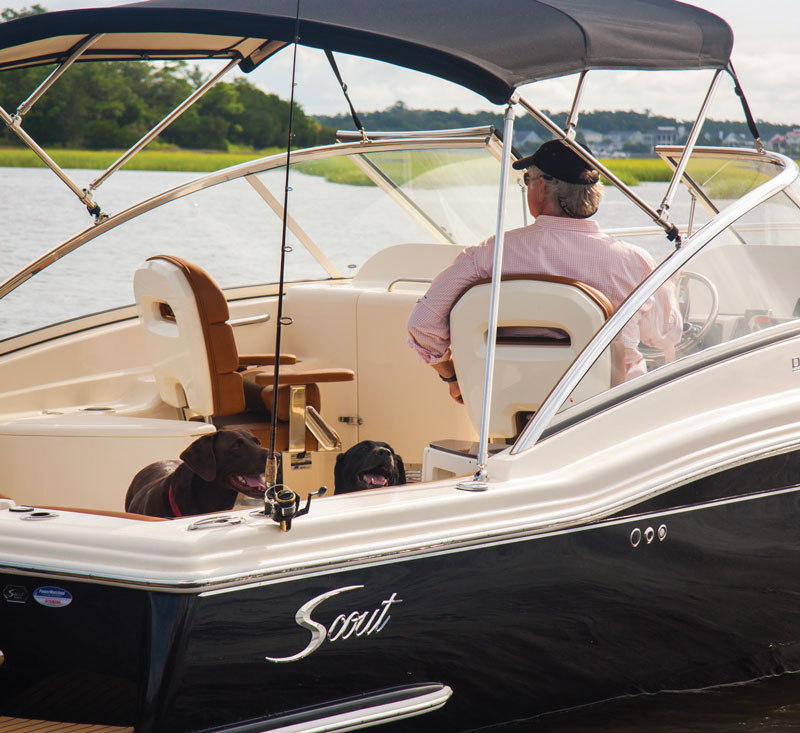
Sunbrella fabrics can be applied throughout the entire boat, from Bimini tops that provide comfort from the sun to soft seating, pillows and durable covers that keep boats clean and free of debris when stored so boaters can leave the dock at a moment’s notice. (Photograph ©Steve Exum)

Following the company’s ethos that fabrics should be beautiful, comfortable and functional, Sunbrella marine fabrics are designed and engineered to meet the needs of boaters today and tomorrow.

By Kirk Fitzsimmons

The post-pandemic surge in recreational boating activity reignited the marine industry with new opportunities for innovation and connection. Ongoing research from the National Marine Manufacturers Association affirms this momentum will continue, which is why it has become increasingly important for marine textile companies to understand evolving consumer habits and apply those insights to develop new marine products and enhance existing ones to meet the needs of boaters today and tomorrow.

From commercial yachts that require premier textiles with a soft and luxurious hand to consumer fishing boats, pontoons and catamarans with seating crafted to protect against challenges such as microbial pinking, there has never been such an exciting opportunity for textile companies that serve the boating industry. How can we help boaters with different desires create memorable experiences on the water? How can we best serve each of our stakeholders — from boaters to manufacturers to fabricators — based on their specific needs? These are some of the questions posed every day at Sunbrella since the company entered the market more than 60 years ago — but these words now have new meaning.

As the Sunbrella team approaches 2023 at full throttle, they also are taking time to reel it back and reflect on how far Sunbrella has come as a brand with a purpose and ethos the company feels proud to stand behind. For decades, the company’s success has been centered on a legacy of complete performance, from fabrics that stand the test of time in demanding environments to the service and support that Sunbrella extends to customers. The company hopes that by sharing its knowledge, it can educate and inspire those that are part of the marine community because the future is bright for all.

Putting A Stake In The Ground

Sunbrella began in 1961 when the brand’s founders identified an opportunity to develop an awning canvas with a substantially longer lifespan than cotton. The patented material that was created not only delivered on that longevity, but also offered an unprecedented resistance to fading. Sunbrella fabric was the first of its kind and the company quickly began to lead the awning market.

It wasn’t long before Sunbrella realized that its performance fabrics could extend beyond shade structures. In the years that followed, the founders brought the innovative spirit of Sunbrella into several new environments and applications, including marine. From superyachts to speedboats, the state-of-the-art fabrics began appearing on vessels of all sizes around the world as a result of the protection they offered against the elements. The company feels proud to have redefined what consumers could expect from performance textiles in those initial years.

An Ongoing Commitment To Excellence

Ever since Sunbrella entered the marine market, it has been a priority for the brand to deliver premium fabric that gives boaters, manufacturers and fabricators the materials they need to create the extraordinary in textile design, whether that be a vibrant color palette or niche function. Sunbrella is founded on the belief that fabrics should be beautiful, comfortable and functional. For marine applications, this translates to a luxurious experience on the water with Bimini tops that provide comfort from the sun, soft seating and pillows that deliver worry-free performance and are engineered to stand up to everything from splashes to spills, and last but not least, durable covers that keep boats clean and free of debris when stored so boaters can leave the dock at a moment’s notice. It also means producing fabric offerings in a wide range of colors and patterns to reflect a consumer’s unique style. The expansive Sunbrella portfolio includes textiles that are all woven with careful attention to detail. The brand stand behind its textiles with industry-leading warranties. This has been critical to earn and maintain the trust of trade partners and consumers in the marine space.

Today, the term “performance fabric” is used broadly to refer to any textile designed to be easily cleanable and withstand wear and tear, but not all performance fabrics are created equal. Some rely on a sprayed-on topcoat or finish that wears away over time or after consistent exposure to ultraviolet (UV) rays from the sun. The proprietary performance of Sunbrella is engineered into the core of its fabrics with yarns saturated at the fiber level with exclusive UV-stable pigments. For example, Sunbrella marine canvas fabrics block 98 percent of harmful UV light. Sunbrella shade fabrics are further recommended by the Skin Cancer Foundation as part of a complete sun protection regimen alongside regular use of sunscreen to aid in preventing sun-induced skin damage.

Sunbrella continues to push the boundaries with its formulations to ensure the innovative fabrics exceed the expectations of modern life, including new products that work harder and smarter for boaters to combat marine-specific phenomena like microbial pinking or salt residue. From sourcing raw materials to manufacturing to distribution, the company adheres to strict standards to ensure its fabrics perform and the company’s vertically integrated production process aligns with company values. All fabrics must pass an extensive combination of 33 rigorous in-house and third party-certified tests to ensure they provide exceptional quality and durability to perform in the harshest of environments. These tests gauge things such as colorfastness, flame retardancy, abrasion resistance, weathering and more.

Built on a legacy of complete performance, Sunbrella continues to push the boundaries of what’s possible with its innovative marine fabrics.

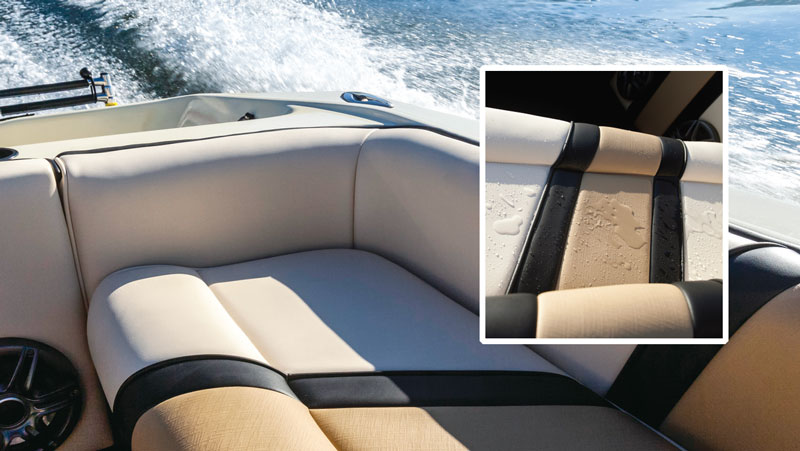
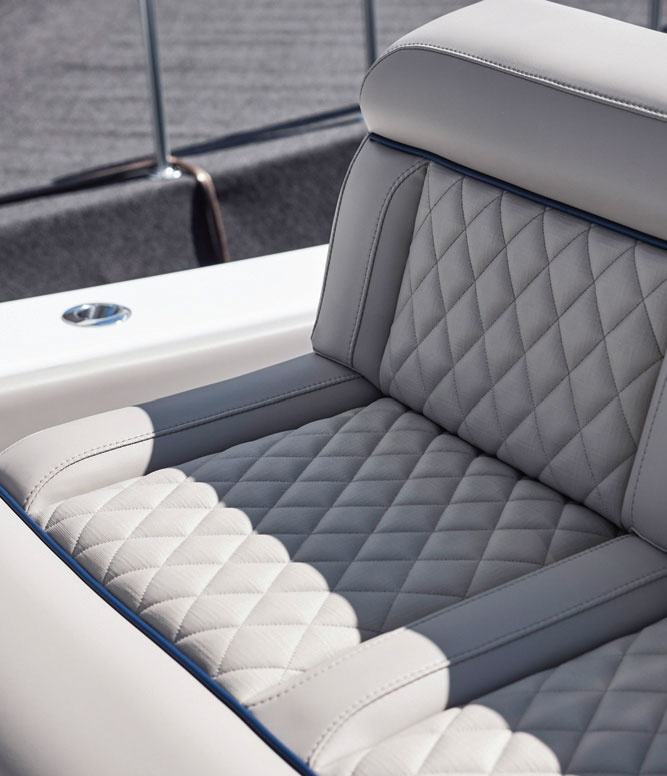
Most recently, the company launched Sunbrella Horizon marine vinyl — the company’s first non-woven upholstery fabric. Horizon offers revolutionary resistance against microbial pinking, four-way stretch and recovery and lasting performance for years of worry-free enjoyment. It also features a knit-backed construction that prevents misshaping. This soft vinyl fabric is suitable for numerous marine upholstery applications, including captain’s chairs, cushions, bench seating and sunpads, and is designed to complement and coordinate with gelcoat and Sunbrella marine canvas fabrics. Additionally, Horizon is weather-, mold- and mildew-resistant, resists cold cracking and is easy to clean — even with bleach — so boaters can spend more time on the water and less time on maintenance and care. Horizon also features highly UV-stable pigments for optimal color retention over time with strong protection against fading from sunlight. The product is now available in more than 30 styles, 25 colors and two embossing patterns, and is being used by a growing number of boat manufacturers.

Expanding The Sunbrella Footprint For The Long Term

Sunbrella customers always have been more than a purchase order to the company and over the years, the company has learned that by making a commitment to product excellence, it is investing in their success. Customers deserve the best for their customers — and everyone must work with the greater success of the industry in mind.

To keep up with early and ongoing success across a growing number of industries, the parent company of Sunbrella, Glen Raven, significantly expanded its manufacturing facilities over the past few decades to have a global footprint across three continents. While the Sunbrella headquarters and primary production facilities are located in the United States, there are additional manufacturing facilities in Lille, France, and Suzhou, China —two strategic locations that have enabled the company to deliver on the growing demand.

Today, these capital investments span new technologies such as B2B portals for customers to see inventory in real time, as well as a multiphase $250+ million capacity expansion plan — 75 percent of which is focused on Glen Raven’s U.S. footprint — to continuing to increase production, warehousing and testing capabilities.

Getting Involved

In the marine industry, relationships are everything. Sunbrella takes a holistic approach to supporting the industry and by sharing more about its approach, the company hopes it can inspire other companies to consider similar tactics. The industry is a close-knit group of good people who trust each other. Word of mouth is an invaluable learning tactic in this industry, but more importantly, these conversations allow Sunbrella to better support its partners and understand their needs.

For decades, Sunbrella has partnered with regional, national, advocacy and trade associations that reach various sectors of the business and at all levels. These associations are central to the marine industry as they provide fabricators, distributors, manufacturers, companies and their customers with support and education to make informed business and purchasing decisions. This approach has brought immense value not only to the company’s research and product development, but to its customer relationships as well.

Sunbrella also has benefitted from involvement with trade associations such as the Advanced Textiles Association (ATA) and Marine Fabricators Association. Through regional events, workshops and conferences, a longstanding partnership with ATA has helped Sunbrella build strong and lasting relationships with the fabricators that are critical to its business and the industry at large. The Marine Fabricators Conference each January is an annual highlight for the Sunbrella team.

The company also takes pride in its involvement with regional associations like the North East Canvas Products Association and the Chesapeake Marine Canvas Fabricators Association. These associations help Sunbrella reach awning and marine canvas dealers and fabricators in the places where they have operated for years. These connections give Sunbrella the opportunity to learn about its trade partners, hear feedback and determine how the company can continue to provide support and help them address their unique challenges.

Horizon marine vinyl is the first non-woven upholstery fabric from Sunbrella.

In addition to its relationships with associations, Sunbrella always has prioritized attending and exhibiting at boat shows across the country. These events are one of the most effective ways to promote brand awareness. The company sees the events as opportunities to demonstrate its category leadership for Sunbrella alongside other key players in the industry. From Seattle to Miami to Newport, in-person conversations at these shows with consumers and the trade help Sunbrella communicate important messages about the design excellence and top performance for which Sunbrella is known in a setting that promotes trust. This learning goes back to the idea that word of mouth and authenticity are critical in driving brand awareness for marine textiles. When consumers can pair the tactile feel of a soft vinyl fabric like Sunbrella Horizon with advice they’re receiving in real time based on experience, they are more likely to walk away with trust in that product.

As individualization in design is increasingly sought after, consumers must start by understanding their fabric options to best personalize their boat. That understanding should also incorporate knowledge of the brand they are choosing and what it stands for. In the case of Sunbrella, the brand’s goal is to support consumers with the education and tools they need to choose Sunbrella with confidence to enjoy their experience on the water.

Respecting The Planet

Being a good corporate citizen and steward of the environment has defined Glen Raven for decades. The company is committed to the greater good of its people, its communities and the planet. Sustainability practices are being increasingly evaluated and prioritized across industries, including marine, but these practices have always been part of the company’s DNA.

The performance woven into Sunbrella fabrics allows them to maintain their color through wear and tear and in the harshest marine environments, delivering not only a superior product but also one that needs to be replaced less often, providing a more sustainable option and ultimately reducing waste over time.

In addition to longstanding sustainable practices, Sunbrella is passionate about two philanthropic marine partnerships. The first is with SeaCleaners, a nonprofit association that encourages coordinated joint action against plastic pollution in the oceans. The second partnership is with Bonefish & Tarpon Trust, a science-based organization with a mission to conserve bonefish, tarpon and permit species, their habitats and associated fisheries. By working with SeaCleaners, Sunbrella has been able to make a direct impact on preserving oceans and marine environments; and with Bonefish & Tarpon Trust, the company has been able to promote healthy fisheries and their marine environments for the long term.

Looking Ahead

The marine industry is dynamic, filled with a storied history and brimming with growth opportunities. Sunbrella has many exciting projects on the horizon and the company will continue to meet the needs of its customers while respecting the planet. Led by relationships and best-in-class textiles, Sunbrella looks forward to championing the growth of the marine industry in 2023 and beyond.


Editor’s Note: Kirk Fitzsimmons is director of Shade & Marine at Sunbrella.


January/February 2023

Sustainable Denim Production Using Open-End Versus Ring Spun Yarn

Kontoor Brands is examining its manufacturing processes to look for ways to reduce energy and its carbon footprint.

TW Special Report

It is unequivocal that anthropogenic carbon dioxide (CO2) emissions are causing climate change. The rate of these emissions is unmatched in the last 2,000 years of human history1. Consequently, the world has been experiencing unprecedented climate extremities. From devastating flooding in Pakistan and the United States, to a record-breaking heat wave in the United Kingdom, 2022 saw many climate anomalies2.

The consensus among scientific communities is that the global temperature rise needs to be kept below a 1.5°C rise from preindustrial levels during the period 1850-1900. Beyond this point, the world may experience far more catastrophic climate change effects on its people and ecosystems1. Keeping the temperature rise at less than 1.5°C requires halving global carbon emissions by 2030 from 2010 levels and achieving net zero by 2050. In plain terms, this decade — from 2020 to 2030 — is the last window of opportunity for humanity to redefine the climate future.

Kontoor Brands — owner of iconic Wrangler® and Lee® brands, among other brands — recognizes this urgency and sustainability is an end-to-end commitment included in the company’s strategic priorities. It is aware that the global fashion industry contributes roughly 2 percent of carbon emissions — approximately 1.05 gigatons of CO2 equivalents — every year3. Hence, Kontoor constantly is looking for ways to improve any part of the processes used to manufacture its products to reduce the impact on the planet and the people living on it. At the end of 2022, Kontoor submitted its Science-Based Targets (SBTs) to align its emissions reduction strategy with the 1.5°C climate target. SBTs are enterprise-wide binding commitments to reduce CO2 emissions, overseen by the Science-Based Targets initiative (SBTi)4.

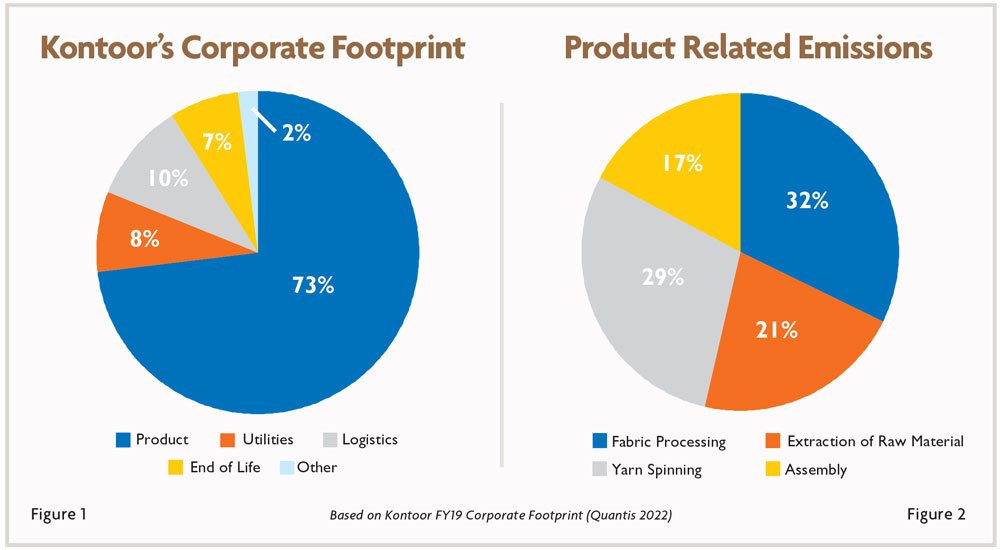
Through a corporate carbon footprint assessment, Kontoor has found that product related emissions account for approximately 78 percent of its carbon footprint, excluding consumer use of product (See Figure 1). This refers specifically to the emissions associated with the extraction, development, and processing of products’ raw materials as well as the assembly of final products including packaging. Breaking it down further, spinning accounts for about 20 percent or one-fifth of the total product related emissions (See Figure 2). Therefore, it is beneficial to explore alternative options to reduce emissions from spinning, and Kontoor is currently examining the feasibility to expand open-end spinning in all denim and related products.

What is Open-End Yarn?

Open-end (OE) yarn is a type of yarn that can be produced without using a spindle. In OE spinning, the roving process is omitted, and the sliver is fed directly into a rotor after the drawing process. The fineness of the yarn can be altered by adjusting the rate at which the fibers are drawn out of the rotor relative to the rate at which fibers are fed into the rotor. The process is based on principles of centrifugal force. Imagine the fibers are pressed into a groove on the inside of the rotor until the desired count is achieved.

The primary difference between OE yarns and ring-spun (RS) yarns is the process used to form the yarn. RS yarn is formed by inserting twist into a continuous strand of fibers. A piece of OE yarn is formed by collecting individual fibers from the inside surface of a rotor and combining them using centrifugal forces. RS yarn may be described as formed from the outside in, while OE yarn is formed from the inside out.

Where Are These Yarns Used?

OE yarns often are found across multiple product categories in basic apparel. However, use of OE yarn remains in the minority, with RS yarn accounting for around 70 percent of the yarn used for clothing purposes today5. OE yarns are often found in towels, where the yarn works well for both feel and water absorption. As technologies and processes continue to evolve, the applications for OE yarns also are evolving. With the sustainability gains of OE yarns, more opportunities for application are on the horizon.

What Makes OE Spinning Different From Ring Spinning?

Less Time and Energy — The primary difference that makes OE spinning a better process than ring spinning is its high efficiency. OE spinning has fundamentally fewer steps in its process than ring spinning. Since OE spinning only requires one pass of drawing — versus two passes for ring spinning — and no roving frame procedure, it is a faster process than ring spinning.

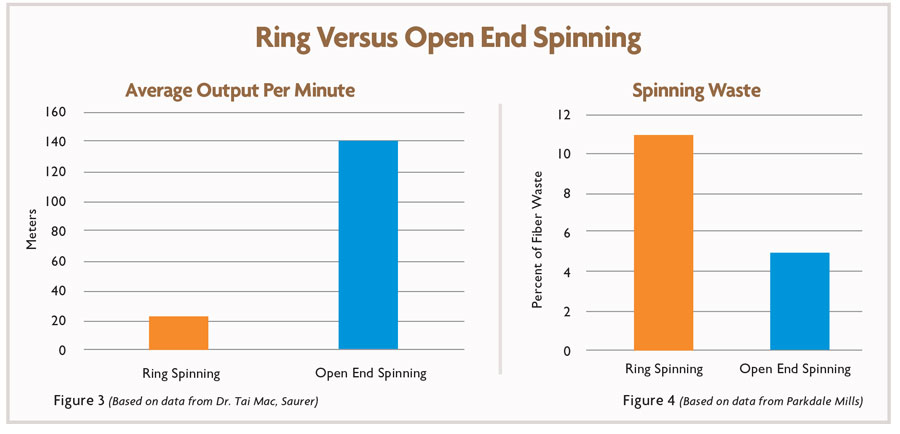
Cem Yalcin, head of Sales and Marketing for Switzerland-based Saurer AG, described OE spinning as “unbeatable in productivity and energy savings.” Considering only the spinning process of OE compared to ring spun, it is simply faster in this area as ring spinning machines are relatively slower. The OE process is faster because of the remarkably high rotor speed in OE machines. Figure 3 shows a direct comparison of the output of a ring spinning machine versus an OE spinning machine using a typical denim yarn in the time frame of one minute. The graph illustrates the glaring difference in speed. The elimination of roving and winding steps leads to yarn production speeds that are six to eight times faster than ring spun yarns6,7,8. Also, with fewer steps, the floorspace required is less for the OE spinning process.

Along with improving efficiency, having less steps in the process also results in reduced workforce requirements. Brad Johnson, vice president of Manufacturing at Cone Denim, estimated that for the full ring spinning process, approximately three to four times as many operators are needed than are required for OE spinning. Despite the need for fewer operators for OE spinning, the output is still considerably higher. Great advances actively are being made in the automation stages of OE spinning, requiring even fewer operators. For example, optical and capacitance systems are able to continually assess fiber characteristics, such as linear density, making it possible to quickly identify and remove faults or mistakes, often automatically. A study from Das and Alagirusamy9 predicts that there are possibilities of full automation of the yarn spinning process within the world of OE spinning. This concept also typically results in tighter statistical controlled processes from a quality perspective. While full automation of mills has not yet been realized, full automation is much closer with OE spinning than it is with ring spinning, according to experts at Saurer.

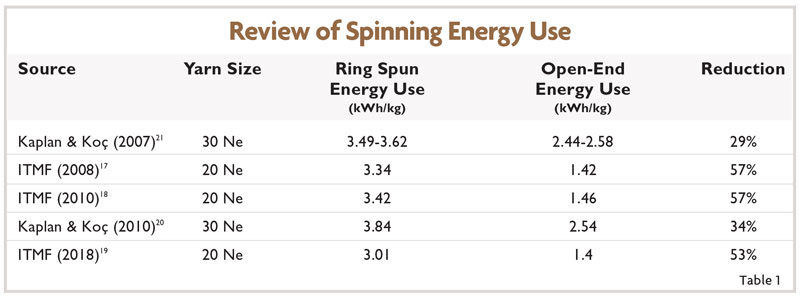
The shortened process and improved efficiency greatly affects the energy consumed during OE spinning, which creates a meaningful sustainability advantage when compared to ring spinning. There are multiple publications and reports that compare the energy usage of the two spinning methods (See Table 1). OE spinning consistently uses less energy than ring spinning, with reductions as high as 57 percent.

Based on the most recent numbers from the United States Energy Information Administration10, the OE spinning energy savings are equivalent to a minimum of thirteen cents per kilogram of yarn produced. When that number factors towards the hundreds of thousands of kilograms mills produce weekly, it becomes significant.

Less Waste Generated — Besides energy savings, OE spinning generates less fiber waste when compared to ring spinning. Cheryl Smyre, director of Advanced Materials at Parkdale Mills, shared the variance in waste between OE spun yarn and RS yarn (See Figure 4).

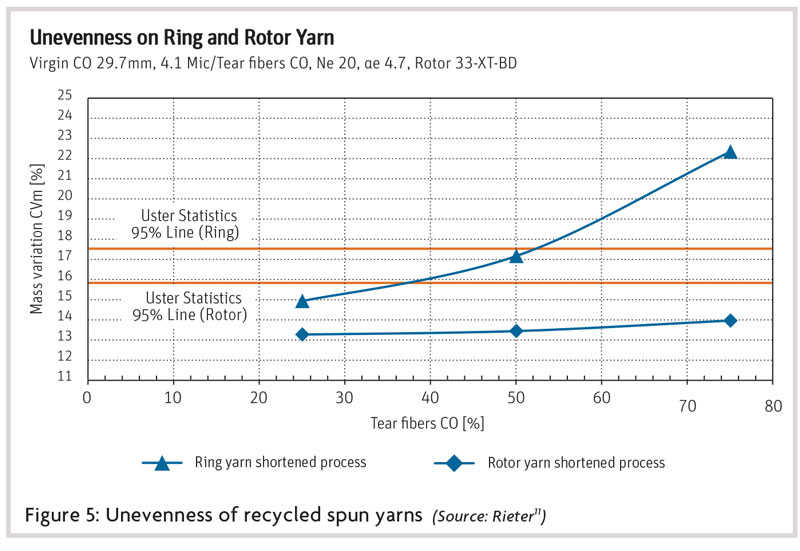
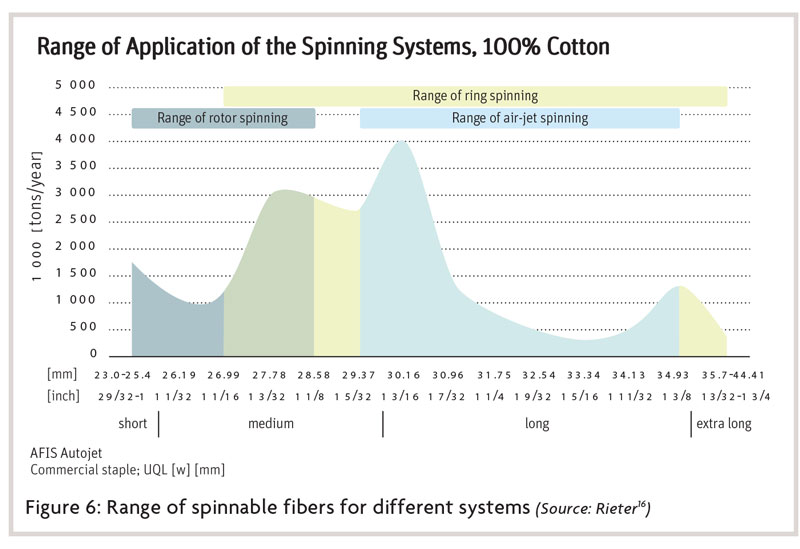
Recycled Fiber Usage and Circularity — The OE spinning process also offers advantages when it comes to compatible fiber types. OE spinning can utilize shorter fibers, while ring spinning can only use fibers of a minimum length and high uniformity. The use of shorter or lower grade cotton fiber in OE spinning processed does not compromise yarn integrity and allows yarns of the same quality to be produced using less expensive cotton than the ring-spinning process. In addition, it is easier to process recycled fibers in the OE spinning process. Although ring frames can process almost all fiber types, more short fiber content tends to result in a higher number of yarn breaks and higher wastage. Therefore, the quantity of recycled fibers used in RS yarns is considerably lower compared to OE yarns. Switzerland-based Rieter11 evaluated the unevenness of RS and OE yarns as a function of torn recycled fibers (See Figure 5). Figure 6 shows the range of acceptable fiber sizes for different spinning methods.

For acceptable yarn quality and operational reliability, a blend containing up to 75-percent recycled content is possible in OE spinning. With ring spinning, recycled content is typically kept below 25 percent6. OE spinning offers the opportunity to better utilize recycled materials versus ring spinning where recycled fiber use is more limited.

The need to recycle fabrics already is on the rise in some regions. France recently passed a law to combat waste that makes the destruction of unused textiles illegal. Such waste must be recycled or donated12. Other regulations have been proposed in the European Union that call for a mandatory minimum use of recycled fibers for fashion companies by the year 2030. Circular material flows — such as reuse and recycling — also is recommended in IPCC’s13 climate change mitigation strategy. The ability to utilize recycled fiber for apparel products is something that will become increasingly important in the coming years and OE spinning will be a helpful strategy.

What Are the Limitations?

One of the main obstacles of OE yarn relates to its strength and durability. A study from Cary, N.C.-based Cotton Incorporated14 found that OE spun yarn was 10- to 30-percent weaker than RS yarn on average. In addition, light man-made fibers such as polyester cannot be effectively spun alone using the OE spinning process. For instance, a durable, but exceptionally lightweight garment likely could not be produced using OE spun yarn.

Another common concern when comparing OE to RS yarn is the fact that RS yarn is easily placed on a core while OE yarn is not. Core spinning is the process of spinning fibers around a pre-existing yarn core. The core can be comprised of different yarns. For example, a polyester core would add strength to the garment, while an elastic core would allow the garment to stretch. This stretch property is especially important when making modern slim fit and skinny jeans because certain level of stretch often is incorporated for comfort as well as the ability to expand and adjust. The required stretch can be conferred by a spandex core yarn in the center of the cotton. Though this is one of the drawbacks of OE, technology is being developed that enables stretch yarns to be produced on OE spinning machines.

One example of this technology is the Rotona process developed by Rieter. The process involves wrapping OE-spun yarn around a core that can be elastic or non-elastic15. Another solution to this problem is to use a combination of OE and RS yarn in products that require a degree of stretch. While it is no argument that a garment made entirely out of ring-spun yarn with an elastic core would certainly stretch more, the combination of OE yarn and elastic RS yarn may be sufficient for some consumers and products.

One non-technical drawback to this combined option would be to address consumer perception, as most consumers are used to the feel of the standard RS fibers. OE spinning produces a slightly coarser yarn count, and the structure of the yarn itself is slightly different than RS, with OE-spun yarn having fewer parallel fibers. An OE-spun yarn cannot currently be produced in the same caliber of fineness that a RS yarn can. It is difficult to produce finer yarns above 40 Ne with this system; this does not pose a major challenge in denim manufacturing, as denim yarns range from 10 to 30 Ne. These variances result in a slightly different hand — one that the consumer may notice when purchasing products. For a heavier fabric, such as denim, these attributes of OE-spun yarn are not as much of a concern.

Kontoor’s Plans For OE Yarn

Kontoor has submitted a science-based target in line with a 1.5°C temperature reduction scenario. As shown in Figure 2, yarn spinning accounts for roughly 20 percent of Kontoor’s product related emissions. Hence, innovation in cotton spinning processes would produce a notable reduction to the company’s overall carbon footprint. For example, an internal analysis from Quantis revealed that replacing 50 percent of Kontoor’s current ring spun volume with an OE process can potentially save 6 percent emissions from scope 3, which are defined as value chain emissions. Therefore, the potential impact of OE spinning cannot be ignored.

OE spinning offers advantages in a wide array of distinct aspects of the garment-making process. The process requires fewer workers, less energy and factory floor space, and produces less waste, while increasing efficiency, opportunities for automation, and opportunities to recycle fibers. When viewing all these advantages, OE spinning is a more sustainable choice when producing garments. In addition, overall cost savings, including the cost of lower grade cotton, makes it a financially viable strategy.

Kontoor encourages spinning machine manufacturers to continue innovating. The future of the spinning process relies on finding ways to increase efficiency to decrease waste and emissions. Kontoor also encourages other brands to consider the possibilities related to using OE spinning for some or all of their product lines. The potential positive environmental impact is substantial. At Kontoor, sustainability is defined as the dynamic process of continual improvement for its people, product, and planet. In support of this, the company is always searching for innovation and activities that can improve performance relative to these objectives. Kontoor views OE spinning as an area that can impact the sustainability of apparel products. As a good steward in the sustainability space, Kontoor hopes to see other brands pursue these same types of initiatives.

Every Action Counts

Limiting global warming to less than a 1.5°C rise would require accelerated and far-reaching transitions in energy and industrial systems. It is a global issue, and everyone needs to pull together in every possible way. Each action towards emission reduction counts, no matter how big or small. From reduction in fossil fuel use to deployment of low-emission energy sources to energy efficiency and conservation, every opportunity needs to be seized in order to fight climate change. OE yarn spinning is just one of the many solutions available. Kontoor is hopeful that this will catalyze others and that the fashion industry will be able to do its fair share to deliver on climate targets.


References

1 IPCC (2021). Summary for Policymakers. In: Climate Change 2021: The Physical Science Basis. Contribution of Working Group I to the Sixth Assessment Report of the Intergovernmental Panel on Climate Change. https://www.ipcc.ch/report/ar6/wg1/downloads/report/IPCC_AR6_WGI_TS.pdf

2 NCEI (2022, Sep 14). Assessing the Global Climate in August 2022. NOAA. https://www.ncei.noaa.gov/news/global-climate-202208

3 Ley, K., Perkins, L., van Mazijk, R., Gaines, R. & Hugil, R. (2021). Unlocking the trillion-dollar fashion decarbonization opportunity: existing and innovative solutions. Apparel Impact Institute & Fashion for Good. https://apparelimpact.org/wp-content/uploads/2021/11/Aii_UnlockingTheTrillion-DollarFashionDecarbonisationOpportunity_Report_v11.pdf

4 https://sciencebasedtargets.org/

5 Singh, M. K., & Nigam, A. (2013). Effect of various ring yarns on fabric comfort. Journal of Industrial Engineering, 2013.

6 Goyal, A., & Nayak, R. (2020). Sustainability in yarn manufacturing. In Sustainable Technologies for Fashion and Textiles (pp. 33-55). Woodhead Publishing.

7 Kiron, M. I. (2021, January 28). An overview of open-end rotor spinning. Textile Learner. https://textilelearner.net/an-overview-of-open-end-rotor-spinning/#:~:text=The%20production%20rate%20of%20rotor,used%20in%20
cotton%20carded%20spinning.

8 Dr. Tai Mac, Saurer, personal communication, 2022

9 Das, A., & Alagirusamy, R. (2010). Fundamental principles of open end yarn spinning. In Advances in yarn spinning technology (pp. 79-101). Woodhead Publishing.

10 United States Energy Information Administration. (2022, July 26). Electric Power Monthly. U.S. Energy Information Administration (EIA). https://www.eia.gov/electricity/monthly/epm_table_grapher.php?t=epmt_5_6_a

11 Rieter (2021). The Increasing Importance of Recycling in the Staple-Fiber Spinning Process. Switzerland: Rieter Spinning

12 Casert, R. (2022, March 30). EU to propose new rules to discourage consumers against Fast Fashion. PBS. https://www.pbs.org/newshour/world/eu-to-propose-new-rules-to-discourage-consumers-against-fast-fashion# :~:text=New%20rules%20proposed%20by%20the,conditions%20in%20the%20garment%20industry.

13 IPCC (2022). Summary for Policymakers. In: Climate Change 2022: Mitigation of Climate Change. Contribution of Working Group III to the Sixth Assessment Report of the Intergovernmental Panel on Climate Change. https://www.ipcc.ch/report/ar6/wg3/downloads/report/IPCC_AR6_WGIII_SPM.pdf

14 Cotton Incorporated. (2003). Introduction to open end Spinning – Cotton Incorporated. Retrieved August 5, 2022, from https://www.cottoninc.com/wp- content/uploads/2017/12/TRI-1004-Introduction-to-Open-End-Spinning.pdf

15 Hehl, R. (2004). Rotona: An open-end core yarn, especially suitable for denim. 59-61.

16 Rieter (2015). Processing Indian Raw Cotton. Switzerland: Rieter Spinning

17 ITMF (2008). International Comparison of Manufacturing Costs, Spinning/Weaving/Knitting, Sweden: International Textile Manufacturers Federation.

18 ITMF (2010). International Comparison of Manufacturing Costs, Spinning/Weaving/Knitting, Sweden: International Textile Manufacturers Federation

19 ITMF (2018). International Comparison of Manufacturing Costs, Spinning/Weaving/Knitting, Sweden: International Textile Manufacturers Federation.

20 Kaplan, E., & Koç, E. (2010). Investigation of Energy Consumption in Yarn Production with Special Reference to Open-End Rotor Spinning. Fibres & Textiles in Eastern Europe.

21 Kaplan, E. & Koç, E. (2007). An Investigation on Energy Consumption in Yarn Production with Special Reference to Ring Spinning. Fibres & Textiles in Eastern Europe, (4 (63)), 18-24.


Editor’s Note: The following people contributed to this article Brad Johnson, vice president of Manufacturing at Cone Denim; Carole McFee, senior director of Quality Assurance and Product Stewardship of Jeanswear at Kontoor Brands; Cem Yalcin, vice president, head of  Sales and Marketing at Saurer; Cheryl Smyre, director of Advanced Materials at Parkdale Mills; Dhruv Agarwal, vice president – Sustainability, Innovation, Development at Kontoor Brands; Jacob Knego, developer, Textile Research at Kontoor Brands; Jeff Frye, head – Sustainability, Innovation, Product Development, Procurement at Kontoor Brands; Jordan Brewster, manager of Global Sustainability Engagement at Kontoor Brands; Lauren Fields, senior manager of Global Sustainability Data and Reporting at Kontoor Brands; Logan Fortenberry, Sustainability intern at Kontoor Brands; Matthew Hawthorne, Sustainability consultant at Quantis; Randy Fortenberry, Former Supply Chain executive; Dr. Sarif Patwary, senior Sustainability Analyst at Kontoor Brands; Dr. Tai Mac, vice president, director of Business Line Open-End Spinning at Saurer.

In addition, the paper was reviewed by Dr. Rong Yin, assistant professor, Textile Engineering, Chemistry and Science, Wilson College of Textiles, North Carolina State University; and Larry Hubbard, associate director, Fiber Processing and Spinning, Cotton Incorporated.

Figures 1 and 2 as originally published in the print version of “Sustainable Denim Production Using Open-End Versus Ring Spun Yarn,” TW, January/February 2023, have been updated online. The numbers disclosed in the new figures shown here are the most accurate and up-to-date. The changes were warranted based on an update in footprint accounting methodology. 


January/February 2023

Sponsors