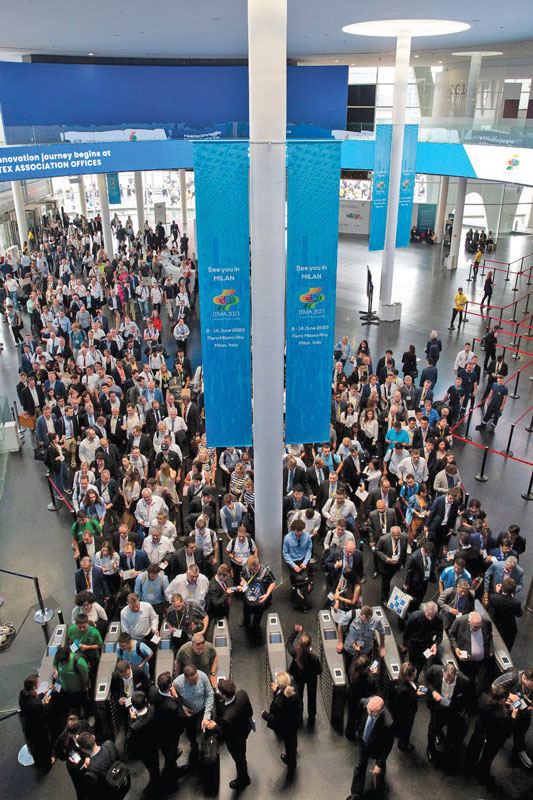
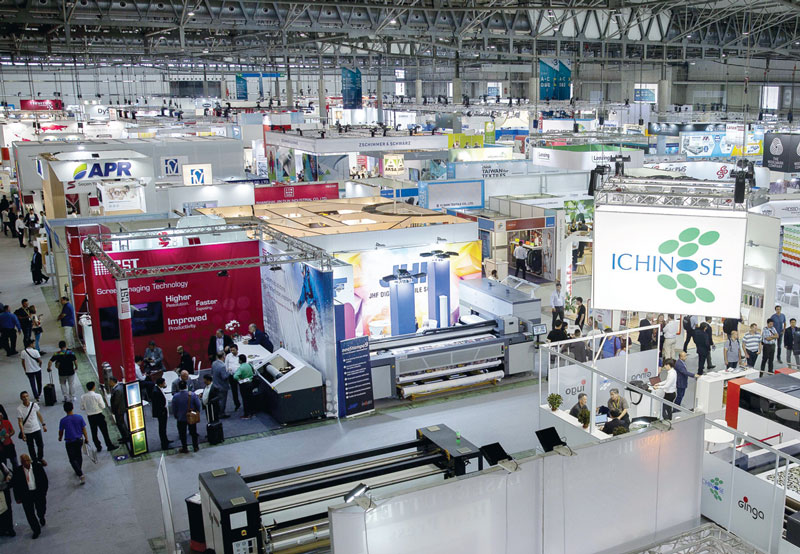
 Final preparations are underway for the 19th edition of ITMA to be held in Milan, Italy, this June.
TW Special Report
ITMA 2023 will be held June 8-14, 2023, at the Fiera Milano Rho fairgrounds in Milan, Italy. Milan is hosting ITMA for the sixth time since its inception at the now 19th edition of the show. ITMA is owned by the European Committee of Tex-tile Machinery Manufacturers (CEMATEX) and is organized by ITMA Services.
The show is regarded as the largest and most comprehensive global textile machinery trade show. Held once every four years, ITMA has evolved into a platform for emerging trends, innovative solutions, new knowledge and best practices. It is also known as a place to network and establish new relationships, as well as rekindle relationships and catch up with old friends.
The overall theme for ITMA 2023 is “Transforming the World of Textiles.” Four sub-themes under this umbrella title include advanced materials, automation and digital future, innovative technologies, and sustainability and circularity.
Global Uncertainties
On the tails of a global pandemic, organizers and exhibitors aren’t daunted by the current clouds of a global banking crisis and the war in Ukraine, among other economic difficulties. ITMA Services recently reported that the 200,000 square meters of exhibition space reserved for the exhibition at the Fiera Milano Rho is 100-percent booked by exhibitors. More than 1,600 exhibitors from 44 countries are expected in Milan and there is a waitlist for exhibition space of some 100 companies.
“Since the last ITMA exhibition in Barcelona in 2019, the world has changed drastically due to the coronavirus pandemic and geopolitical situation,” said Charles Beauduin, chairman of ITMA Services. “Despite various disruptions, we are glad that space in ITMA 2023 is fully booked. Companies are buoyant about the outlook of the market with most borders now fully open.”
With Italy as the host country, the Association of Italian Textile Machinery Manufacturers (ACIMIT) reports Italy-based exhibitors are fully committed to ITMA 2023. “Our manufacturers are very confident about next June’s event,” said ACIMIT President Alessandro Zucchi. “As shown by the figures on the Italian presence at the event: Almost 400 Italian exhibitors, about 36,000 square meters, with an increase in the occupied surface area of over 20 percent compared to the previous edition held in Barcelona. 30 percent of the total exhibition area at ITMA 2023 will be taken up by Italian machinery manufacturers.”
ACIMIT is promoting the activities of its members at ITMA 2023 under the theme “Shaping the Future.” “Shaping the future is a concept that aims to show how Italian manufacturers are key players in the development of the entire textile supply chain, able to outline virtuous paths that testify to the proactive nature of the entire sector and that enables the future of the sector to be shaped through the three pillars, technology, digitalization, and sustainability, which are also the key themes of ITMA 2023,” Zucchi explained.
Zucchi did caution that positive results in 2022 for Italy-based machinery manufacturers — includ-ing production and export increases of more than 10 percent year-on-year — do not cancel out obstacles companies continue to face. “The critical issues following the COVID-19 pandemic have been amplified by the ongoing Russian-Ukrainian conflict,” Zucchi noted. “Even in this early 2023, unfavorable conditions to business still exist, such as high inflation, constraints on the functioning of value chains, and energy commodity prices above the average of recent years. However, forecasts prepared by our Economic Office show an improvement in the second half of the year and in the 2024-26 period, which gives us hope.”
ACIMIT suggested that ITMA 2023 could be a driving force to stimulate investment in the global textile industry.
At a recent press conference to discuss ITMA and why it is the “greatest show on earth,” Cornelia Buchwalder, secretary general of the the Swiss Textile Machinery Associa-tion —the representative body for Switzerland’s producers of textile equipment, systems and services —reminded attendees that ITMA serves as a benchmark of progress in the textile industry.
“Not only for us, but for the visitors from the textile manufacturers, ITMA is vitally important, and a major element in the overall development of the textile industry world-wide,” Buchwalder said. “The 2023 ITMA is fully booked — clear evidence of its continued appeal as the essential marked place for textile machinery. … ITMA remains a four-yearly milestone in technology, where industry visitors rightly expect to see the best and latest ideas from their suppliers.”
Like ACIMIT, the Swiss Textile Machinery Association also reports robust participation from its member companies at ITMA 2023. “… its importance is underlined by the participation of more than 50 Swiss exhibitors, most of which are members of the textile machinery association. We will be there in Milan, because we know it’s the perfect opportunity to show the world what we offer,” Buchwalder emphasized.
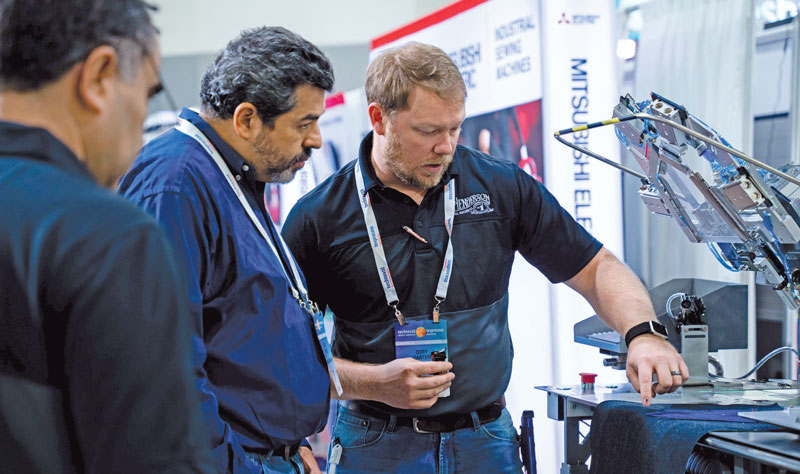
She also pointed out during the press conference that while much information is available online today, there still is nothing better or more exciting than seeing a new machine running live and in person. “Live demonstrations at timed intervals are often crowded with eager visitors —for a good reason,” Buchwalder said. “It’s the way to be inspired and find solutions that could literally change your business outlook, and actually grow your profits.
“Ultimately, ITMA is a celebration of achievements of the global textile community, and an opportunity to foster the kind of innovative developments that future generations will be proud of,” she concluded.
 Visitor Attractions
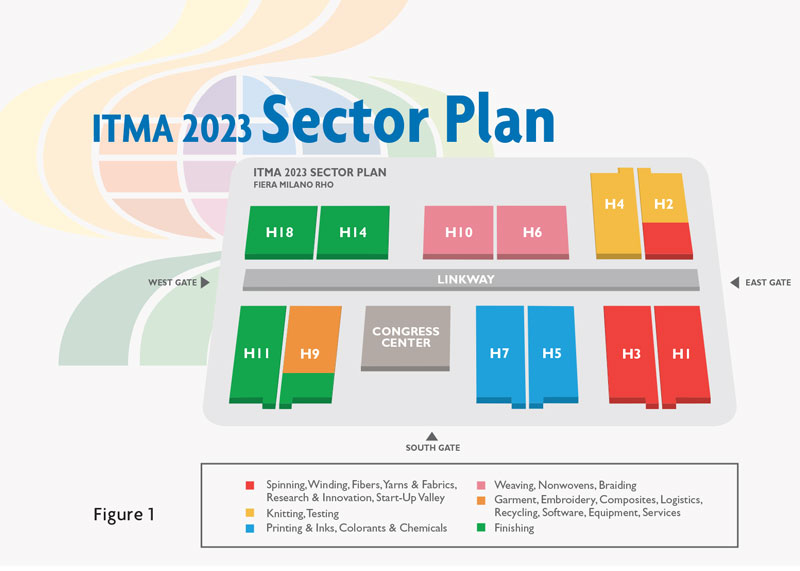
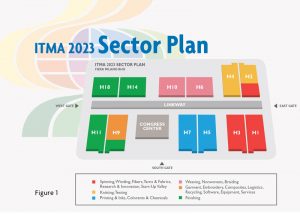
ITMA offers plenty for visitors to do and see. The comprehensive range of exhibits spans some 20 sectors of the textile industry. The sector plan color codes exhibits to help visitors find what they are most interested in seeing at the show (See Figure 1).
Innovation is the name of the game, and ITMA offers several ways for visitors to learn about the latest textile innovations. The Start-Up Valley is a new initiative featuring companies in early stages of developments “with new and game changing solutions and technologies to support and inspire innovation for the textile, garment and fashion industry.” Sixteen start-ups were selected by an expert panel from a pool of applicants.
ITMA 2023’s Research & Innovation Lab forms a hub for innovation at the show. The lab features 20 organizations from 11 countries to showcase new developments from educational and research institutions as well as the industry. The Innovation Video Showcase also will highlight innovations in materials, and textile and garment technologies offered by exhibitors.
In addition, the ITMA Sustainable Innovation Award will recognize the achievements of the global textile industry in advancing sustainability using innovative solutions and notable research.
Education Opportunities
Visitors to ITMA 2023 also can take advantage of the education offerings hosted by ITMA as well as partner organizations (See “Collocated & Associated Events”). This year, ITMA is hosting the complimentary Innovator Xchange event. The sessions will focus on the ITMA Innovation Award winners and finalists as well as the four ITMA sub-themes of advanced materials, automation and digital future, innovative technologies, and sustainability and circularity. ITMA also is again offering the Textile Colourants and Chemicals Forum as well as the Nonwovens Forum. Partner events include the ZDHC Impact Day 2023 and Planet Textiles.
 New 2023 Show Features
Organizers have launched the ITMAconnect platform for 2023 show participants. The year-round sourcing platform and knowledge hub is now open and comprises five main facets — an agenda to view, bookmark and register for ITMA events; artificial-intelligence powered business matching to pair people, companies and products for in-person meetings; exhibitor digital space to learn more about the participating companies; a schedule to view and manage meetings and events; and a smart messaging system for chat and video calls with exhibitors. The platform allows visitors to engage prior to the exhibition, and conversations will also be able to continue after the event.
ITMA is hosting 45-minute onboarding webinars for visitors to learn about the ITMAconnect plat-form. Upcoming sessions take place April 11, April 27 and May 9. Visit the ITMA website to learn more and RSVP for a session.
In addition, the ITMA website now features a smart exhibitor list with integrated floor plan. This inter-active floor plan allows visitors to explore and locate exhibitors on the show floor while learning more about the product offerings.
Register To Attend
Visitor registration is currently open. To encourage visitors to register ahead of time, ITMA is offering an early bird rate through May 7, 2023, on its website. Visitors may purchase a one-day pass for 40 euros and a seven-day pass for 80 euros. After May 7, rates rise to 55 euros for a one-day badge and 95 euros for a seven-day badge. On site rates are 85 euros to attend for one day or 125 euros to attend for all seven. Students are welcomed anytime June 10-14 at a discounted rate of 25 euros for a five-day badge. The show is open June 8-13 from 10:00 a.m. until 6:00 p.m. each day. On June 14, the show opens at 10:00 a.m. and closes at 4:00 p.m.
Looking Forward To Innovations, Collaboration
“Our visitors can look forward to ITMA 2023 to preview the latest innovation,” said CEMATEX President Ernesto Maurer. “We hope that textile and garment manufacturers, brands and retailers will take this opportunity to meet at ITMA to source and collaborate with leading members of the textile industry. In addition, they can also gain insights into industry trends and developments at various complementary events.
“Sustainability is no longer just a buzzword; the industry has to move faster to adopt the sustain-ability agenda to secure the future of their business,” Maurer also noted. “During the pandemic, many of our members channeled their resources into R&D activities. ITMA 2023 is perfectly timed to offer our exhibitors an opportunity to showcase these new products and cutting-edge technology. If, and when, R&D is paired with sustainability efforts, this will be the formula for success.”
Colocated & Associated Events
Thursday, June 8
ITMA Sustainable Innovation Award Presentation
(By invitation only)
Launched in 2015 by CEMATEX, the awards honor collaborative efforts in innovative and sustainable products in two categories —Industry Excellence and Research & Innovation Excellence.
Friday, June 9
ITMA Textile Colourants and Chemicals Forum
10:30 a.m.-4:30 p.m.
The fourth iteration of the forum will cover trending subjects in the textile colorants and chemical industry including reducing carbon footprints in chemical treatment, improving dyehouse output treatment, fiber fragmentation and working towards safe and sustain-able chemistries. Content is aimed at brands and retailers; color and chemical specialists; dyestuff, color and chemical manufacturers; sustainability managers; and technical engineers and dyehouse managers. Featured keynote speakers are Prasad Pant, director, South Asia, ZDHC Foundation, India; and Sophie Mather, co-founder and executive director, The Microfibre Consortium, England. Registrants must be ITMA 2023 visitors with a valid ITMA badge. The forum has an additional registration fee of 219 euros (or 189 euros with a supporting organization preferential rate). VAT at the prevailing rate, if applicable, will be added to the registration fee.
Innovator Xchange — Presentation by ITMA Sustainable Innovation Award Winners and Finalists
10:30 a.m.-12:30 p.m.
Winners and finalists of the ITMA Sustainable Innovation Awards will present their innovations to a wider audience. Innovator Xchange events are free to attend with a valid ITMA 2023 visitor badge.
Saturday, June 10
ITMA Nonwovens Forum
10:30 a.m.-4:00 p.m.
The forum focuses on expanding nonwovens applications and integrating nonwovens manufacturing into current manufacturing operations. Topics cover nonwovens machinery and processes, emerging applications, trends and the latest innovations in nonwovens manufacturing with sustainability in mind. Dr. Bryan Haynes, technical director, Global Nonwovens, England-based Kimberly-Clark Corp., will present the keynote speech. Registrants must be ITMA 2023 visitors with a valid ITMA badge. The forum has an additional registration fee of 219 euros (or 189 euros with a supporting organization preferential rate). VAT at the prevailing rate, if applicable, will be added to the registration fee.
Innovator Xchange —Advanced Materials
10:30 a.m.-4:00 p.m.
ITMA’s Innovator Xchange offers visitors the chance to learn about the innovations on display at ITMA as well as gain insight from industry experts in four trending areas over four days of sessions. The keynote speaker for the first session, Advanced Materials, is Parikshit Goswami, professor of Technical Textiles at the University of Huddersfield, England. Goswami’s areas of expertise include flexible materials and chemistries for functionalizing textiles. Innovator Xchange events are free to attend with a valid ITMA 2023 visitor badge.
Sunday, June 11
Innovator Xchange —Automation & Digital Future
10:30 a.m.-4:00 p.m.
ITMA’s Innovator Xchange offers visitors the chance to learn about the innovations on display at ITMA as well as gain insight from industry experts in four trending areas over four days of sessions. The keynote speaker for the second session, Automation & Digital Future, is Kevin McCoy, vice president Made, New Balance Athletics Inc., Boston. McCoy is a product expert with experience in footwear development from ideation to mass production. Innovator Xchange events are free to attend with a valid ITMA 2023 visitor badge.
Partner Event — ZDHC Impact Day 2023 organized by the ZDHC Foundation
The ZDHC Impact Day 2023 will highlight the organization’s efforts, achievements and impact over the past year. The group also will share its new strategy for the next seven years including the Roadmap to Zero until 2030. The event is open to ZDHC contributors, friends of ZDHC and selected industry stakeholders. Contributors receive two free tickets. The fee for in-person attendees is 599 euros, and 199 euros for virtual participants. Attendees must have a valid ITMA 2023 badge.
Monday, June 12
Innovator Xchange — Innovative Technologies
10:30 a.m.-4:00 p.m.
ITMA’s Innovator Xchange offers visitors the chance to learn about the innovations at ITMA as well as gain insight from industry experts in four trending areas over four days of sessions. The keynote speaker for the third session, Innovative Technologies, is Dr. Jess S. Jur, director of Ecosystem Technology, Advanced Functional Fabrics of America Inc., Cambridge, Mass. Dr. Jur leads efforts to discover advanced textile technologies for the defense market. Innovator Xchange events are free to attend with a valid ITMA 2023 visitor badge.
Partner Event — Planet Textiles Day 1, organized by the Sustainable Apparel Coalition
8:00 a.m.-5:00 p.m.
Planet Textiles is an international sustainability conference organized by the Sustainable Apparel Coalition (SAC). This year’s two-day event will cover the latest Higg Index updates, the role of manufacturers in driving change and the future of science-based targets, as well as explore innovations in circularity, sustainability measurement, decarbonization, and more. Participants must be registered ITMA 2023 attendees with a valid ITMA badge. Tickets cost 340 euros for non-governmental organizations/non-profit personnel, 750 euros for SAC members, and 850 euros for non-SAC members.
Tuesday, June 13
Innovator Xchange — Sustainability and Circularity
10:30 a.m.-4:00 p.m.
ITMA’s Innovator Xchange offers visitors the chance to learn about the innovations at ITMA as well as gain insight from industry experts in four trending areas over four days of sessions. The keynote speaker for the fourth session, Sustainability and Circularity, is Germán García Ibánez, head of Sustainable Raw Materials & Circularity, Edificio Inditex, Spain. García Ibánez is focused on sustainable raw material sourcing strategies, next generation materials, dyeing technologies, textile-to-textile recycling, traceability and impact measurement. Innovator Xchange events are free to attend with a valid ITMA 2023 visitor badge.
Partner Event — Planet Textiles Day 2
8:00 a.m. — 5:00 p.m.
 March/April 2023