NCTO Member Auburn Manufacturing Hosts Deputy Assistant Secretary Jennifer Knight, Highlights Maine Manufacturers & U.S. Textile Industry’s Competitiveness

WASHINGTON — May 17, 2023 — Today, National Council of Textile Organizations (NCTO) member Auburn Manufacturing Inc.(AMI) — a manufacturer of advanced textiles for extreme-heat environments — hosted Jennifer Knight, Deputy Assistant Secretary for Textiles, Consumer Goods, Materials Industries, Critical Minerals and Metals with the U.S. Department of Commerce’s International Trade Administration, at the company’s state-of-the art manufacturing facility in Auburn, Maine.

A Maine textile manufacturer with over four decades of experience, AMI is a leading producer of fire-and heat-resistant materials, manufacturing the most advanced products to meet U.S. safety standards. AMI textiles are used as protection from extreme high heat in mining, shipbuilding, steelmaking and other critical industries. The company also manufactures end-use products, including a patented, modular removable insulation kit.

During the visit and tour of AMI’s facilities, AMI CEO Kathie Leonard highlighted the company’s important textile innovations and vitally important products that help fuel the Maine economy and contribute to the broader U.S. textile and apparel industry which produced $65.8 billion in output in 2021 and employed 538,000 workers.

Leonard also discussed policy priorities that have far-reaching implications for AMI, Maine manufacturers and the entire U.S. textile industry. She outlined the importance of policies directed at holding China accountable for unfair trade practices and the dumping of products on the U.S. market. Leonard also emphasized the importance of maintaining a domestic textile and apparel supply chain, enforcing “Buy American” policies in government procurement, and closing a legal loophole in U.S. trade law that continues to undermine American manufacturing and give China an advantage. Earlier this year, AMI once again spurred federal action against China, with the Commerce Department officially scrutinizing Chinese exports of silica fabric to the U.S. market.

“We were honored to host Deputy Secretary Jennifer Knight at our Auburn plant,” said Leonard. “It gave us an opportunity to not only showcase AMI’s incredibly advanced technologies, innovation and dedicated workforce but to also discuss firsthand trade policies that impact our daily operations. AMI and this entire industry have weathered severe challenges over the past three years, due to the pandemic, and ongoing pressure from China’s unfair trade practices, but we remain resilient. We appreciated the opportunity to showcase how AMI and the industry can prosper with this kind of collaboration with trade officials like Ms. Knight and the federal government as a whole.”

“SMEs [small and medium-sized enterprises] are the backbone of the U.S. economy and it was my privilege to visit AMI, a state-of-the-art woman-owned U.S. manufacturer which employs 50 and exports its products to more than 30 countries,” said Deputy Assistant Secretary Knight. “ITA’s mission directly supports the strength and resilience of our domestic textile industry by strengthening the global competitiveness of American companies through exports and safeguarding both U.S. industry and workers against unfair trade practices through the rigorous enforcement of trade laws and agreements.”

AMI, an industry leader in the manufacture of advanced textiles for extreme-heat environments, is certified as a Women’s Business Enterprise, operating in two manufacturing facilities located in both Mechanic Falls and Auburn, Maine, and employing over 50 people.

Posted: May 17, 2023

Source: National Council of Textile Organizations (NCTO)
EURATEX: European Textile Industry Increasingly Exposed To Global Pressure

BRUSSELS — May 17, 2023 — European textile industry is exposed to global pressures more than ever before; policy makers need to consider that global dimension.

EURATEX released today its 2023 Spring Report, which analyses latest trade flows for textiles and clothing products.

In 2022, EU trade in textiles and clothing has exceeded, for the first time in history, the €200 billion mark. This record growth of total trade is mainly due to a sharp increase of clothing imports (+36,6% in value), especially from China and Bangladesh, which outweighs our positive export performance. As a result, the EU’s trade deficit in textiles and clothing has increased to €70 billion, which is 48% higher than the year before.

Such a growing deficit is a cause for concern; the objective of the EU’s Industrial Strategy to strengthen our resilience and “strategic autonomy” is not happening. Instead, our dependency has increased, and becomes critical in certain raw materials and fibres.

It also challenges the Commission’s ambition is to promote – and prevail – high quality and sustainable textile products on the Single Market – regardless where they have been produced.  With imports now reaching €140 billion, it will be a challenge to effectively control the quality and compliance over these imports. Market surveillance will need to be stepped up massively, without becoming a barrier to trade.

We also need to strengthen our efforts on the EU’s export performance, so as to rebalance our trade relations with the rest of the world. EU companies are world leader in high end fashion products and in technical textiles. More needs to be done to support their activities in established markets but also emerging economies. For instance, the ongoing FTA negotiations with India should focus on improving market access and ensure “fair” competition with local companies.

The EURATEX Spring Report highlights significant differences between trade in value and in volume. EU’s export of textile products has increased by 13% in value, but actually dropped by nearly 7% in volume. This obviously reflects the very high inflation figures from last year, caused initially by the rising energy prices and changing central bank policies. This in turn leads to uncertainty with the consumer, resulting in low demand and gloomy prospects for the entire value chain.

Director General Dirk Vantyghem commented on these latest figures: “This report confirms once again that “textiles” is one of the most globalised sectors of the European economy, and hence the importance of taking that global dimension into account, when designing EU and national policies. Failing to do so may have a devastating effect on the global competitiveness of the European textile industry.

Looking forward, he added: “It is essential to stabilise inflation, restore consumer confidence and ensure a level playing field for all operators in the textile industry. On that basis, European companies can prosper and offer quality jobs to 1.3 million workers”.

Posted: May 17, 2023

Source: EURATEX

ITMA 2023 Exhibitor Preview: PLEVA GmbH

EMPFINGEN, Germany — May 17, 2023 — “ITMA is the place to be for textile production. Here you can see the technology of tomorrow and what possibilities there are to make processes more cost-effective, sustainable, transparent, and above all more efficient – which is nowadays more important than ever,” stated Dr. Ralf Pleva, managing director. “And that is exactly our claim. We enable textile producers to save large amounts of energy, improve product quality and make even complex processes more traceable and reproducible by using high-end sensors and controls with latest technology. In other words, we are unlocking the gateway to tomorrow’s production.”

Make sophisticated processes transparent and efficient with PLEVATEC pro: The new, advanced process control system PLEVATEC pro allows an integration of a huge variety of process critical data with all information at one glance and optimal controls. It is designed to enhance and simplify operation even at complex production lines with different modules.

Hereby, tolerances can be set as well as parameters saved and loaded within the integrated recipe management system. The customizable system provides solutions to a huge range of processes, e.g. a production line with foulard, coating and stenter frame.

In general, an integration of the following PLEVA devices is possible:

  • Exhaust humidity FSX for great energy savings;
  • Fabric/air temperature TDS for transparent drying/heat-treatment processes;
  • Residual moisture RR, RF/AF for improved fabric quality and efficiency;
  • Application moisture/coating AF/MP for savings of valuable chemicals; and
  • Pick/course density CAM for high quality fabric.

Through the continuous process monitoring and control of the parameters, a significant optimization of even very complex production processes is possible. And by having more stable processes, a constant, high quality of the goods is ensured. This means that there are no expensive adjustments or second-choice goods, which saves valuable resources.

The smart way of weft-straightening SL smart: The SL smart is designed for knitted and woven fabrics with a plurality of solutions customizable to fit the individual customer needs. It includes options like fully-integrated accessories for tension- sensitive fabrics, Industry 4.0 applications and more. The heart of the SL smart is the well-established traversing camera technology which is unique in weft-straightening.

The high-resolution camera captures more than 20 measuring points per meter of fabric width. This gives a complete overview of the fabric instead of few fixed positions. Finally, advanced evaluation algorithms ensure an ultra-precise distortion analysis

which enable perfect straightening results in a blink of time. With the weft-straightener SL smart only one round through the production line with the respective fabric is needed and the aimed result is directly produced. This, of course, also saves energy and enhances the production efficiency directly from the beginning.

The all seeing eye – CAM series 400: For the assessment of quality parameters but also weft-straightening, precise detection and advanced image processing is the most important aspect. The brand new CAM offers cutting-edge technology with many novelties for best results: Completely new lighting with increased brightness and special lighting possibilities allow a detection of all kinds of fabric independent from density or color.

This in combination with a four times higher calculation power, higher resolution with five-times more pixels and revised algorithms for calculation of distortion and pick/course density makes it the leading technology in the area. On top, it is also designed as a retrofit for existing PLEVA systems with easy connectors and is fitted for even the harshest conditions thanks to an improved housing design.

Sizing made sustainable and efficient with updated AS 120: Sizing is the crucial preparation for weaving and high yarn quality. Therefore, sizing agents are applied with a squeezing unit to the warps. To be on the safe side often 10-25% more sizing is applied than required. This implies disadvantages like higher use of expensive sizing agents, more wastewater, unstable yarn quality, lower weaving efficiency, etc. To eliminate those disadvantages, a measurement and control is needed.

The AS 120 measures the size add-on after size box constantly. It includes a newly designed special construction with integrated protection against steam vapours and high temperatures as well as a faster, even more precise electronic. This enables a reliable, continuous monitoring and control. As a result, 1.5% up to 4% higher weaving efficiency is easily possible and at the same time production gets greener.

Besides those new developments, PLEVA also offers special versions of sensors for special demands such as the TDS sensor for fabric and air temperature fitted for EX-zones, state of the art interfaces like Profinet and the PLEVA Remote Service for even faster support of your production. Whether for standard applications or demanding processes, PLEVA is your partner for the sustainable and efficient production of tomorrow.

PLEVA is looking forward to show all highlights live in hall 11 booth A101!

Posted: May 17, 2023

Source: PLEVA GmbH

ANDRITZ Converting Line For Baby Diapers Starts Operating At Naturopera, France

GRAZ, Austria — May 17, 2023 — International technology group ANDRITZ has successfully delivered, installed, and commissioned a converting line for manufacturing baby diapers at Naturopera’s new plant in Bully Les Mines, France.

The eXcelle converting line from ANDRITZ Diatec features special technology to produce both traditional and bio-based baby diapers, supporting Naturopera in its efforts to become a leading producer of a new generation of sustainable diapers.

While most diapers available on the market consist of 70-percent fossil-based plastic, Naturopera is preparing to produce diapers made of 90-percent bio-based raw materials. This groundbreaking diaper concept was developed in a close collaboration between Naturopera and ANDRITZ. It replaces the traditional spunbond and meltblown nonwoven layers with spunlace nonwovens mostly made of natural fibers. A prototype of the 90-percent bio-based diaper was recently produced at Bully Les Mines.

Claire Stévignon, Babycare Marketing manager at Naturopera, said: “Thanks to the support of ANDRITZ Perfojet for the spunlace fabrics and ANDRITZ Diatec for converting, we are moving in the direction of producing bio-based diapers. We will soon start offering green premium diapers using the jointly developed concept. This initiative will make an important contribution towards more sustainability in diaper production.”

The ANDRITZ converting machine operating at Naturopera is highly flexible, taking just a few settings to switch to the production of bio-based diapers. It is designed for a multiple-size process, features an operator-friendly interface, and guarantees a production speed of 800 ppm.

Naturopera is a French company producing baby care, femcare and household products with a strong focus on local production and sustainability.

Posted: May 17, 2023

Source: International Technology Group ANDRITZ

Amba Projex Supports Growth For India’s Candour Techtex With The Latest Coating And Lamination Line

MANCHESTER, England — May 17, 2023 — Candour Techtex, a Melegaon JR Group company, is so happy with the latest coating and lamination line supplied by the UK’s Amba Projex it has immediately ordered a second, wider one to meet booming demand.

“We are very pleased with how this installation went,” said Amba Managing Director Barry Goodwin. “Our team installed the machine and got it running from Day One, producing three-pass blackout thermal linings and technical laminations to a quality never before seen in India.”

Based in High Peak near Manchester, BTMA member Amba Projex has more than 40 years’ experience in the design and manufacture of special purpose technical textile machines, with coating and laminating installations around the world.

“We serve manufacturers in many different countries with an experienced network of agents on the ground and in India we are brilliantly supported by Jayessh S Nanavati and his team at Sainite Exports,” Goodwin said. “They have been instrumental in securing sales for us in India. We strive to provide the most effective machinery, on time and within budget and also provide consultation services for customers based on our extensive process know-how.”

Amba will be working closely with Candour over the next five years, to establish an Indian technical textiles powerhouse capitalizing on the U.K. technology provider’s long experience in the field.

Focus

Formerly Chandni Textiles Engineering Industries, Candour Techtex of the Malegaon JR Group assumed its new name in 2022 to reflect its focus on a wide range of technical textiles at its new plant in Malegaon in the Nashik District of Maharashtra.

The company was founded in 1986 and at its existing plant in Ankleshwar, Gujarat, produces an annual 1.2 million meters of light velvet fabrics mainly for the domestic market for apparel and light home furnishings. In 2020 it also began operations at a plastic moulded components division in Gonde, Nashik, with a capacity of 4,500 tons per annum.

Candour Techtex is already seeing growing demand for a number of its new products.

“The future for the technical textile industry in India is very positive with increasingly strong consumption rates in the domestic market, as well as a growing demand for exports,” says Managing Director J R Mehta. “Currently a lot of coated and laminated technical textiles are being imported to India so we see big potential in manufacturing them here, but we also have a competitive advantage in exports, and Amba is assisting us in identifying these market opportunities.”

Blackout fabrics

In particular, the new Amba Projex system enables blackout fabrics to be produced efficiently and at scale.

Blackout fabrics are installed in rooms where complete light shielding is required, such as in public institutions like hospitals, and retirement homes, in hotels and conference rooms, and also in the home, especially in bedrooms.

They obtain their light impermeability by a special three-layer blackout coating which works on textiles of all colors. Only the middle layer of the three coatings needs to be black for obtaining the necessary light absorption. The fabrics are usually also treated for permanent flame-retardancy, and also with water or stain-repellent finishes. In addition to locking out light and providing maximum privacy, blackout curtains also help to insulate a home and reduce energy costs, in addition to protecting furniture and carpets from fading due to sunlight exposure.

Rapid installation

With its 2-meter-wide new coating and lamination unit now in full operation, Candour has ordered a second Amba Projex machine, with a wider working width of 3.5-meters.

“We are extremely pleased with the rapid installation of this machine and its faultless commissioning by Amba and Sainite Exports,” Mehta said. “They have proved to be partners we can solidly rely on as we continue to expand our business.”

“Companies looking to enter new areas of advanced textile production have a lot to gain from partnering with British technology suppliers with a lot of experience in the field like Amba Projex,” added Jason Kent, BTMA managing director. “This is a perfect example of an ongoing win-win cooperation between machine builder and manufacturer, at a very exciting time for India’s growth.”

Posted: May 17, 2023

Source: British Textile Machinery Association (BTMA) Member Amba Projex

Renewcell Partners With TextileGenesis™ For Circulose® Pulp-To-Retail Transparency

STOCKHOLM — May 10, 2023 — After participating in industry trials, Renewcell and TextileGenesis™ have the intention to establish an agreement for full pulp-to-retail traceability for Renewcell’s CIRCULOSE® recycled raw material across the entire textile supply chain. This announcement is being made today at an industry event in Milan, Italy called Challenge the Fabric, initiated and hosted by Ekman & Co.

Renewcell uses a patented process to breakdown and recycle cotton and other cellulosic textile waste, such as worn-out jeans and production scraps, to create CIRCULOSE, a biodegradable raw material that can be used to create viscose, lyocell, modal, acetate and other man-made cellulosic fibers. These regenerated fibers are then spun into yarns, woven or knitted into fabrics before being cut and sewn into new high-quality textile products.

With TextileGenesis, Renewcell will be able to share real-time digital traceability with its customers and supply chain partners.

  • The platform uses digital tokens to ensure a secure chain of custody for all supply chain processes from raw materials to retail.
  • The company’s “fiber-forwards” traceability captures real-time shipments; its Fibercoins™ digital tokens verify point of origin and eliminate “double counting” of sustainable materials.
  • Its AI (augmented intelligence) engine verifies transactions between supply chain partners.

Furthermore, TextileGenesis is already partnering with fiber producers including Lenzing AG, Eastman, and Birla Cellulose as the leader in textile traceability.

“Since Renewcell was founded in 2012, we have been on a mission to create circularity in the fashion industry. We have the unique ability to make a pulp, branded as CIRCULOSE, made from 100-percent textile waste which is actually recycleable again. CIRCULOSE can create new fibers which are equal in quality while reducing textile waste going to landfills,” says Patrik Lundstrom, Renewcell Chief Executive Officer. “Our new facility in Sundsvall, Sweden, is helping move us towards our goal of recycling the equivalent of more than 1.4 billion T-shirts per year. But we also need a trusted and transparent supply chain to ensure the authenticity of products made from CIRCULOSE from our facilities all the way to the retail consumer. That is what TextileGenesis brings to the table.”

“Traceability is fast becoming a key prerequisite to sustainable product offerings. Our partnership with Renewcell will create unprecedented supply chain traceability for CIRCULOSE pulp towards retail brands. It moves forward the sustainable fibers industry to create end-to-end traceability,” said Amit Gautum, TextileGenesis founder and CEO. “Renewcell has engineered a truly circular process to make CIRCULOSE. TextileGenesis helps Renewcell verify every step of the supply chain and carry that authentic and transparent message all the way to their brand and retail partners.”

Posted May 16, 2023

Source: Renewcell

Outdoor Research And Nikwax Announce Strategic Partnership

SEATTLE — May 10, 2023 — Outdoor Research (OR), a leading outdoor gear and apparel company, has announced a strategic partnership with Nikwax, a pioneer in aftercare solutions for outdoor gear, apparel, and footwear. The partnership will officially launch in September 2023.

Under the partnership, Nikwax will become OR’s preferred partner for after-purchase Durable Water Repellent (DWR) care and treatment. This collaboration is part of OR’s commitment to transitioning away from intentionally added per- and poly-fluoroalkyl substances (PFAS), which will be virtually complete by the Spring 2024 product line.

“This new relationship plays a vital role in our transition to a PFAS-free environment by providing our customers with the best-in-class aftercare products in the market. Our goals are to help educate the consumer and our retail partners on the proper care of technical apparel to ensure their investment will maintain the high level of performance they expect from OR,” said Alex Lauver, Sr Director of Materials, Innovation, & Sustainability at OR.

Education is a crucial focus for both OR and Nikwax. Outdoor Research is committed to teaching consumers how to properly care for their products to ensure they last longer, perform better, and ultimately reduce their environmental impact. Nikwax shares this mission, as they have been providing high-quality, PFAS-free  aftercare solutions since 1977 and are dedicated to reducing the environmental impacts associated with the manufacture of outdoor gear.

“Circularity and clean chemistry have always been critical components of our business at Nikwax,” says Brian Davidson, President of Nikwax North America. “From our easy-to-use solutions that help people extend the life of their outdoor clothing, footwear, and gear, to our commitment to developing the highest performing DWR, while never having used PFAS. We are thrilled to have found a partner in Outdoor Research with a shared vision of promoting these sustainable practices.”

The partnership between OR and Nikwax will provide consumers access to high-quality aftercare solutions that promote sustainability and extend the life of their outdoor gear.

Posted May 16, 2023

Source: Outdoor Research

Standard Textile Recognized As A U.S. Best Managed Company

CINCINNATI —May 11, 2023 — Standard Textile is proud to announce it has been selected as a 2023 US Best Managed Company. Sponsored by Deloitte* Private and The Wall Street Journal, the program recognizes outstanding U.S. private companies and the achievements of their management teams.

The 2023 designees are U.S. private companies that have demonstrated excellence in strategic planning and execution, a commitment to their people and fostering a dynamic culture, as well as strong financials. Designees propelled their businesses forward and remained true to their purpose and values by investing in their people, creating advantage through digital transformation, taking measurable action on sustainability, and demonstrating their commitment to diversity, equity, and inclusion.

“We’re incredibly honored to be named one of the nation’s Best Managed Companies for a third consecutive year,” said Alex Heiman, president of Standard Textile.  “This recognition reflects the collective efforts of every individual in our organization and reaffirms the ideals upon which Standard Textile was founded. After more than 80 years in business, we remain committed to helping build a better standard of life, whether through the innovations and services that support our customers or through the programs and donations that impact our communities. I’m so proud of our One Standard team.”

Applicants are evaluated and selected by a panel of external judges focused on assessing hallmarks of excellence in four key areas: strategy, ability to execute, corporate culture and governance/financial performance. They join a global ecosystem of honorees from more than 46 countries recognized by the Best Managed Companies program.

*Please see www.deloitte.com/us/about for a detailed description of our legal structure.

Posted May 16, 2023

Source: Standard Textile

Raschel Machine Brings Smart Textile Projects Forward

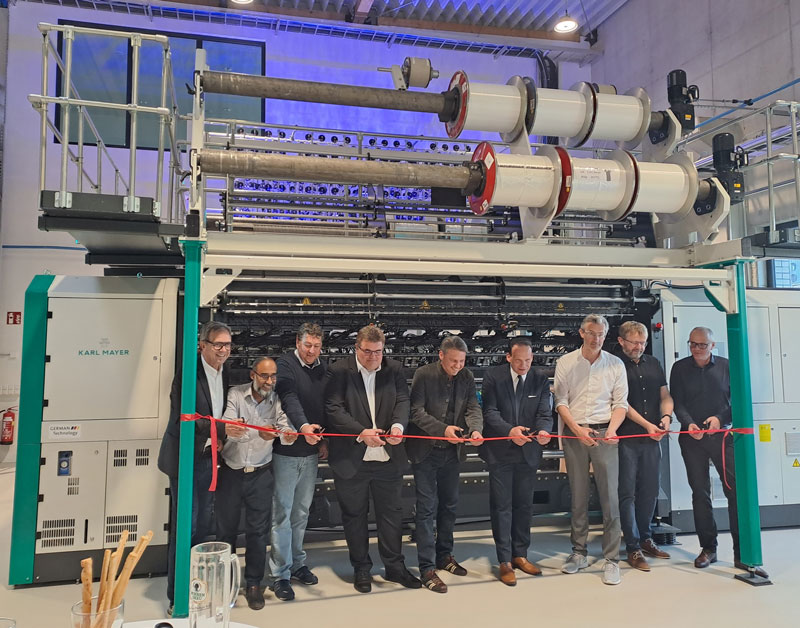
OBERTSHAUSEN, Germany — May 15, 2023 — Inauguration of an MJ 52/1-S from KARL MAYER for processing electrically conductive yarns at Grabher GROUP

The combination of electrically conductive material with textiles opens up a wide range of new possibilities, especially in the sports sector. The analysis of mobility through sensors, for example, helps to avoid incorrect overload to the body and to increase the fun factor during physical activity. The work of a consortium consisting of component and sports product manufacturers, service providers and research institutions, including the University of Salzburg with its sports, movement and computer scientists as the scientific lead centre, aims to demonstrate how the potentials can be utilized through specific, marketable products.

As a partner from the textile production chain, the Grabher GROUP is involved in the cooperation. A milestone was celebrated at the research subsidiary of the leading manufacturer of high-tech products, V-Trion GmbH, in Lustenau on May 3, 2023: Managing Director Günter Grabher inaugurated the MJ 52/1-S from KARL MAYER, a key machine for project work in the smart textile sector. On the Raschel machine with jacquard and multibar technology, electrically conductive yarns can be worked into warp knitted fabrics directly and placed as required in order to easily implement functional elements such as sensors, conductors and coils. The textile properties remain unchanged. The integrated production method saves additional process steps and reduces environmental pollution compared to other processes, such as conductive printing pastes.

The MJ 52/1-S will also be used for projects of the Smart Textiles Platform Austria. This network association brings together more than 80 international companies and research institutes. The Grabher GROUP and the KARL MAYER GROUP are members.

Fig.: Inauguration of the MJ 52/1-S at the Grabher GROUP in a ceremonial round, among the participants Michael Kieren (3rd from left) and, following in the picture to the right, Christof Naier from the KARL MAYER GROUP, Lustenau’s mayor Dr. Kurt Fischer and Günter Grabher, managing director of the Grabher GROUP

Posted May 16, 2023

Source: Karl Mayer Group

Better Cotton Offers Input On The United States FTC Green Guides

LONDON — May 15, 2023 — Better Cotton, the world’s largest cotton sustainability initiative, has submitted feedback to the United States Federal Trade Commission (FTC) as part of an ongoing review of its Guides for the Use of Environmental Marketing Claims(Green Guides).

The FTC is a bipartisan federal agency of the US government that champions the interests of American consumers. Its Green Guides framework was launched in 1992 to ensure that product sustainability claims made by companies are accurate and substantiated, with guidance updated intermittently to best reflect a modern context.

The guidance made available to companies covers general principles that apply to all environmental marketing claims, including information on how consumers are likely to interpret particular claims and how these can be substantiated, and how marketers can qualify their claims to avoid deceiving consumers.

As part of this latest review, Better Cotton has submitted feedback to ensure that the document considers an agricultural context and what constitutes progress at field-level.

Notably, one of the six components of the Better Cotton Standard System (BCSS) is its Claims Framework, through which it provides support to eligible members to communicate their commitment to Better Cotton in a clear, transparent and credible way.

The ability for Better Cotton Members to communicate about their financial investment in Better Cotton to consumers strengthens their commitment to its farm-level programmes which seek social, environmental and economic improvements for cotton farmers and farming communities.

Better Cotton is supportive of the FTC’s initiative, through its revised Guides, to establish a common framework through which US companies can ensure they communicate their sustainability efforts in a credible, verifiable and accurate manner.

In doing so, businesses benefit from a level playing field and are empowered to continually pursue bolder sustainability targets with the opportunity to relay such ambitions to an increasingly sustainability-conscious consumer base.

That said, to improve the guidance in its current form, Better Cotton considers that the FTC should continue to include examples of substantiation from a range of methods and avoid limiting substantiation to one standard methodology.

Establishing one single method as the standard methodology for the substantiation of claims such as lifecycle analysis (LCA) or product environmental footprints (PEF)would not be appropriate as, to date, there is no standard methodology available that can cover all relevant impact categories for all product types.

Moreover, LCA raises specific challenges when applied to an agricultural context. If this approach is adopted in the revised Guides, some of the most trusted and widely used sustainability schemes and their labels would effectively be unable to provide environmental marketing claims for their members.

Posted May 16, 2023

Source:

Sponsors