How apparel-grade comfort and fit are becoming workwear essentials — supporting safety, productivity and inclusivity on the job.
Textile World Special Report
Today’s workers have lived their lives in performance fabrics for years — their activewear stretches and supports their bodies, their outerwear provides just-right thermal comfort and their everyday gear fits comfortably and holds its shape.
They expect the same on the job. Workwear, though, has long been treated as the exception: a category where protection came first, of course, while comfort was an afterthought, at times even in conflict with safety. Now, workers no longer have to compromise.
With labor markets tighter, standards shifting and expectations around well-being at work on the rise, no longer is simply meeting a standard enough. Delivering better is a market opportunity, not just a nice-to-have. And the right fiber ingredients can make the difference.
The Comfort-Safety Connection
When workwear doesn’t feel comfortable for the wearer, there can be real safety consequences.
Picture a worker whose heavy, rigid high-vis jacket doesn’t breathe and causes overheating. They’re bound to unzip it, remove it, or avoid wearing it altogether, just to cool down.
This is true across industries and work sites. A 2025 study1 published by Frontiers in Public Health found a roughly 50% PPE compliance rate across sectors, with workers citing discomfort — including overheating, poor fit, lack of breathability and the weight of a garment — as a key reason for not wearing it. Data cited in that report found that workers who did not wear PPE were at nearly three times the risk of suffering a workplace injury compared to those who wear it.
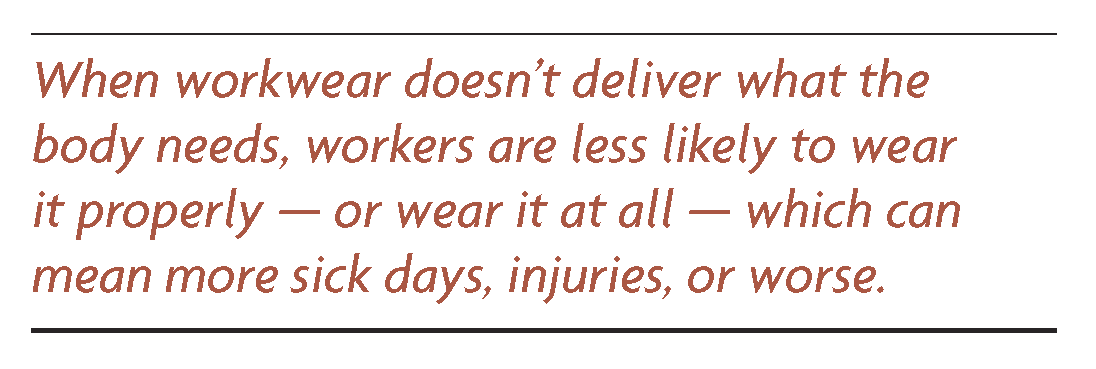
Put simply, when workwear doesn’t deliver what the body needs, workers are less likely to wear it properly — or wear it at all — which can mean more sick days, injuries, or worse.
With textile fibers and fabrics that support well-being, workers can feel better in their gear and are more likely to keep it on — opening the door to increased safety-gear compliance, better morale, higher productivity and satisfaction from the business that the job is getting done right. The LYCRA Company, known for its expertise in high-quality apparel fibers, is primed to deliver.
Across its portfolio of heritage brands, including LYCRA®, COOLMAX® and THERMOLITE® brands, the company offers fibers that enhance the comfort and performance of workwear while helping fabrics meet international safety standards.
LYCRA® ANTISTATIC fiber is a recent offering from the iconic stretch brand. It’s a special spandex fiber that delivers all-day comfort while effectively dissipating static charge, replacing the rigid carbon and silver fibers typically found in antistatic workwear. It supports fabrics to meet EN 1149, IEC 61340-4-9, ANSI/ESD S20.20 and other global antistatic standards. For workers in industrial environments and clean rooms, they get the benefit of stretch comfort without the fear of dangerous sparking.
 COOLMAX® Hi-Vis fiber is another unique offering with a range of benefits. Delivering the signature cool-and-dry comfort of COOLMAX® fiber, this highly durable product also qualifies for the ISO 20471 and ANSI 107 norms, retaining its high-vis properties through harsh industrial laundering and demanding drying processes. That means safety gear can perform its critical role and remain bright while wicking moisture away from the body and allowing wearers to feel cool and dry throughout their shifts.
For outdoor laborers, COOLMAX® ALL SEASON fiber stands out. As seasons blend and regional weather patterns become increasingly unpredictable, multipurpose products are essential. With COOLMAX® ALL SEASON fiber, a durable, industrially launderable product, wearers get year-round comfort, staying cool when it’s hot and warm when temperatures drop — without the need for multiple uniforms. This keeps wearers comfortable as they work, more likely to remain in their gear and more focused on getting the job done.
Designing For Inclusivity
The benefits of apparel-grade fiber technology go beyond comfort, particularly for women laborers. Women make up a growing share of the skilled trades — in the US, women’s participation in the trades reached an all-time high in 2021, according to the Department of Labor2, as reported by Forbes in March 2024 — and the number is likely to keep climbing as trade wages rise and white-collar job opportunities tighten. The workwear segment must keep up.
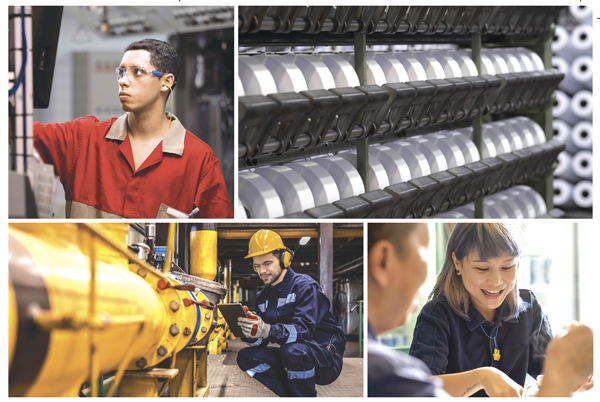
Women in the trades are typically given smaller versions of men’s workwear, rather than garments fitted and sized for their bodies and proportions. That can mean too-long sleeves, wrong-sized pants and jackets, and garments that cause friction and overheating. This has consequences: Research cited by the British Standards Institution3 in a 2025 report on inclusive PPE found that over 80% of women experience problems with their PPE, with 57% reporting that their PPE “sometimes or significantly hampered their work.”
Using patterns designed for women’s bodies can go a long way, and choosing the right textile fibers can turn a well-cut garment into one that performs on the job.
The LYCRA® brand has defined stretch comfort for more than 65 years and today the company offers several innovative solutions for workwear.
For workwear brands crafting size-inclusive garments, such as in-flight uniforms and medical scrubs, LYCRA® ADAPTIV fiber offers unique benefits. An easy-stretch fiber, this product allows a single garment size to fit a wider range of bodies, so sizing systems can be streamlined and workers can enjoy real comfort as their bodies move and change throughout the day.
For moisture management and stretch comfort in a single, durable product, LYCRA® T400® fiber stands out. This fiber provides permanent stretch and recovery plus moisture-wicking benefits and can withstand the rigors of industrial laundering for long-lasting, high-quality wear. In garments designed to fit a broader range of bodies, this fiber checks the boxes: resilient stretch plus thermal comfort for the ups and downs of a busy workday.
The New Baseline
It’s clear that comfort-driven design isn’t just a trend — it’s the new baseline expectation, and it presents an opportunity for workwear makers to meet a critical need.
When workers are comfortable — in well-fitting garments that meet their needs — they’re more likely to keep those garments on, staying safer and more focused on the task at hand. Brands that recognize this shift stand to gain workers’ and companies’ trust, loyalty and long-term use of the safety gear they’re counting on.
The LYCRA Company works alongside workwear manufacturers to help meet this moment, applying decades of fiber innovation to build garments that perform as hard as the people wearing them. The company’s fiber experts work closely with brands and mills, ensuring safety requirements are met and comfort expectations are exceeded.
The line between fashion and workwear is only going to keep blurring. The brands that treat comfort, fit and inclusivity as core performance features — not afterthoughts — will be the ones defining what workwear looks like next.
References:
- https://pmc.ncbi.nlm.nih.gov/ articles/PMC12715716/
- https://www.forbes.com/sites/jackkelly/2024/03/07/why-more-women-should-consider-a-job-in-the-skilled-trades/
- https://www.bsigroup.com/en-GB/ insights-and-media/insights/whitepapers/enabling-the-provision-of-inclusive-ppe/
For more information on workwear solutions, visit LYCRA.com/workwear.
Sponsored content provided by The LYCRA Company.
2026 Quarterly Issue III