Textile World Special Report
To many people, the word “composites” brings to mind NASA rockets, aerospace applications and Formula One cars. But composites are also close at hand. The tires on a car depend on reinforcing cords and fabrics; a fishing rod may rely on carbon fiber; and boats, bicycles and building products also make use of composite materials.
In many cases, the textile component is largely out of sight. Yet it often helps determine how a product carries load, holds its shape, resists damage or can be manufactured efficiently. That is where the textile industry enters the composite story.
From woven glass fabrics and nonwoven mats to braided carbon preforms and 3D-woven structures, textile technologies give composite materials much of their practical utility. The same basic relationship between reinforcement and matrix appears in products ranging from tires and sporting goods to industrial equipment, infrastructure and aerospace structures.
The Textile Contribution
The role of textiles in composites becomes clearer when the materials are considered as a system. Fibers, arranged as yarns, fabrics, mats, braids or other preforms, provide reinforcement. Resin holds the structure together and helps transfer loads among the fibers.
A textile preform is more than fabric awaiting impregnation or coating. Its architecture is part of the engineering design. Yarn count, fiber type, weave construction, crimp, areal weight, porosity, thickness and fiber orientation influence stiffness, strength, impact behavior, permeability, surface quality and manufacturability.
In manufacturing, permeability is particularly important. It refers to how readily resin can flow through a dry textile preform during processes such as resin transfer molding or vacuum infusion. A construction that is difficult to wet out consistently can slow production or contribute to dry areas and voids in the finished part. The best textile choice is not always the reinforcement with the highest fiber properties; it is the construction that performs reliably in the intended process and end use.
A 2023 review published in Oxford Open Materials Science grouped textile preforms into four principal categories: woven, knitted, braided and nonwoven. Woven structures interlace warp and filling yarns; knitted structures use interlocking loops; braids intertwine yarns into flat, tubular or shaped forms; and nonwovens are fiber webs bonded mechanically, thermally or chemically.
Each architecture creates different technical and commercial possibilities:
- Woven fabrics offer repeatable construction, dimensional stability and the ability to place yarns in defined directions.
- Knitted structures can provide extensibility and conformability for complex shapes.
- Braids can form tubular, tapered and other near-net-shape preforms, reducing the need to cut and assemble flat plies.
- Nonwovens can support efficient coverage, isotropic or near-isotropic reinforcement and cost-effective molding systems.
- Multiaxial noncrimp fabrics position fiber layers at selected angles and are used when designers seek directional reinforcement with limited yarn crimp.
- Three-dimensional woven structures add through-thickness yarns, creating an integrated architecture rather than a stack of separate two-dimensional plies.
For textile manufacturers, the management implication is clear: a reinforcement supplier increasingly is expected to contribute to process capability as well as material supply. Textile construction affects lay-up time, scrap, resin use, cycle time, part quality and the degree of automation a fabricator can achieve.
Top Textiles Used In Composites
Composite reinforcements are identified by fiber chemistry but supplied in many textile forms. Glass fiber remains the dominant volume reinforcement because it balances cost, tensile performance and processing versatility. It is used in rovings, chopped strands, woven fabrics, mats and multiaxial constructions. Mordor Intelligence estimated that glass fiber represented 61.22% of the global fiber-reinforced composites market by revenue in 2025.
Carbon fiber provides high specific stiffness and strength relative to weight for aerospace, automotive, energy, sporting goods, industrial and defense applications. Its cost and processing requirements make material efficiency important.
Aramid offers toughness and impact resistance, while basalt, natural, ceramic and quartz fibers serve specialized needs. Natural fibers, including flax, hemp and other cellulosic fibers, are considered where renewable content, appearance, weight or particular sustainability objectives are relevant. Ceramic and quartz fibers serve high-temperature environments.
Ultimately, manufacturers select among unidirectional materials, woven or knitted fabrics, braids, mats, multiaxial constructions and shaped preforms based on the application, resin system, part geometry and manufacturing process.
From Soft Goods To Structural Parts
Textile-based composites range from flexible coated fabrics to highly engineered aircraft structures. Flexible composites, such as coated fabrics, membranes, conveyor belts and protective materials, retain flexibility while textiles provide tear resistance, strength and dimensional stability.
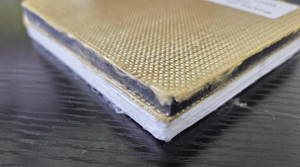
Rigid structural composites use cured resin to form load-bearing parts reinforced with woven glass, carbon or aramid fabrics, nonwovens or chopped fibers. Sandwich composites combine lightweight cores with reinforced skins for bending stiffness at low weight. Other categories include textile-reinforced concrete and 3D textile composites.
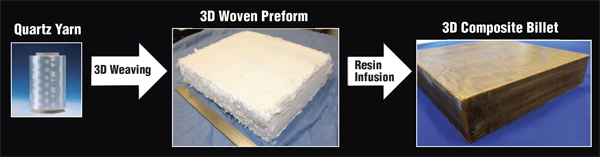
Three-dimensional textile composites extend reinforcement architecture beyond layers stacked in a laminate. In 3D weaving, yarns are introduced through the thickness, or Z direction, rather than only in the length and width directions. This can improve resistance to delamination — separation between layers under load — and create complex, single-piece preforms. Textile World has reported that 3D weaving can reduce crack risk and production time in appropriate applications.
This range means that composites are not a single market for the textile sector. A supplier of high-volume glass mat faces a different competitive environment, capital requirement and quality framework from a company developing 3D carbon preforms for aerospace or defense structures.
Scale, End Uses And Value Chain
There is no single public measure that isolates the dollar value or tonnage of all textiles used in composites. Reinforcements can be sold as yarn, fabric, mat, prepreg, chopped fiber or a fabricated preform, and market reports do not always use identical definitions.
However, published composites data demonstrates the scale of downstream markets served by textile reinforcements. The American Composites Manufacturers Association, headquartered in Arlington, Va., reported that more than 1.9 billion pounds of glass-reinforced polyester/ vinyl ester thermoset composites were sold in the U.S. and Canada during the first half of 2025. ACMA identified construction as 34% of sales, infrastructure as 26% and transportation as 21%. The figure covers composite materials rather than textiles alone, but it provides a useful indicator of the markets supported by glass-fiber reinforcements.
At a global level, Mordor Intelligence estimated the textile composites market at $34.94 billion in 2026 and projected it would reach $49.70 billion by 2031. The figures should be treated as directional estimates rather than as an industry census because market definitions, forecasts and methodologies vary.
Common end uses include corrosion-resistant pipes, tanks, ducts and process equipment, marine hulls and structures, wind-energy components, automotive parts, rail and truck components, sporting goods, building panels, infrastructure products, aircraft components, protective equipment and consumer goods.
The property sought varies by application. A marine customer may value corrosion resistance and maintenance performance. A transportation manufacturer may focus on weight reduction, production volume and cost. An aerospace customer may place greater emphasis on repeatability, traceability, certification and long-term structural behavior. An infrastructure customer may prioritize durability, ease of installation and resistance to environmental degradation.
Modern High-Tech Applications
Some advanced textile-composite applications use fiber architecture to address structural or manufacturing problems that conventional flat laminates cannot easily solve.
Braided preforms can follow tubular, tapered and other complex shapes. They may reduce cutting, scrap and assembly compared with a process that begins with multiple flat plies. Multiaxial fabrics can position fibers at selected angles with limited yarn crimp. Three-dimensional weaving can integrate through-thickness reinforcement and support shaped, single-piece preforms.
The broader implication is not that all carbon-fiber applications will move rapidly into high-volume markets. Rather, lower-cost fiber pathways, more efficient preforming and faster molding processes can expand the range of applications where advanced reinforcements are commercially feasible.
The U.S. Department of Energy describes IACMI’s work as focused on lower-cost, higher-speed and more efficient manufacturing and recycling processes for advanced composites.
Demand For Textile Professionals
Composite manufacturing needs personnel who understand both textile formation and downstream part production. That demand extends beyond laminate technicians. It includes textile engineers, fiber and polymer scientists, weavers, braiders, process engineers, tooling specialists, quality professionals, automation engineers and technicians trained in cutting, kitting, lay-up, infusion, molding and inspection.
The need is especially clear when a preform is engineered rather than purchased as a commodity fabric. Teams must understand yarn handling, tension control, fiber placement, fabric drape, permeability, nesting of plies and defects such as wrinkles, gaps and misalignment. They also must connect textile variability with resin flow, void content, cure behavior and finished-part consistency.
For textile manufacturers, this creates an opportunity as well as a challenge. Traditional textile competencies — fiber handling, fabric construction, tension management and process control — are directly relevant to composites. However, companies seeking to participate in advanced-composite supply chains also need expertise in resin systems, fabrication processes, testing requirements, digital-manufacturing tools and customer qualification procedures.
ACMA has identified workforce training and outreach as industry priorities. The association provides educational resources for the fiber-reinforced polymer composites sector, including information relevant to material specification and construction applications.
IACMI includes workforce development as part of its mission. The institute connects industry, government and academia to advance the development and adoption of advanced-composites manufacturing technologies.
The Society for the Advancement of Material and Process Engineering, or SAMPE, headquartered in Diamond Bar, Calif., provides a complementary resource. Founded in 1944, SAMPE brings together professionals working in advanced materials and manufacturing processes through conferences, technical sessions and professional networking. Its relevance to textile-composite suppliers lies in the cross-disciplinary nature of product development: fiber and textile engineering must work alongside resin chemistry, tooling, automation, fabrication and end-use design.
For textile companies entering or expanding in composites, these organizations offer more than event calendars. They provide access to technical education, industry contacts and a clearer view of evolving customer requirements.
The opportunity for textile professionals lies in connecting their expertise in fibers, yarns, fabrics and preforms to the performance of the finished composite part. From reinforcing the tires on a car to enabling advanced aerospace structures, textiles give composites much of their strength, form and manufacturing versatility. Companies that understand both textile formation and downstream composite processing will be best positioned to turn that capability into new products, partnerships and markets.

CAMX 2026: A Textile-Composites Connection
CAMX — the Composites and Advanced Materials Expo — offers textile-industry professionals a concentrated view of the downstream markets for fiber reinforcements and engineered preforms. The event brings together material suppliers, equipment producers, fabricators, researchers and end users, working across the composites value chain. For textile companies, the practical value is seeing how woven, multiaxial, braided, nonwoven and other reinforcement forms are specified, handled and incorporated into finished parts.
Produced by the American Composites Manufacturers Association, headquartered in Arlington, Va., and the Society for the Advancement of Material and Process Engineering, headquartered in Diamond Bar, Calif., CAMX 2026 will take place at Atlanta’s Georgia World Congress Center. The conference runs Sept. 21-24; the exhibition is scheduled for Sept. 22-24. The program includes technical presentations, education and hands-on tutorials, providing a useful venue for companies evaluating new applications, manufacturing methods and customer requirements.
2026 Quarterly Issue III