Barmag And Object Carpet Validate BICO BCF Technology For The Next Generation Of Carpet Yarns

NEUMÜNSTER, Germany— August 6, 2026 — In a joint development project with other partners, Barmag and Object Carpet have successfully tested BICO BCF yarn in the carpet manufacturing process. The results show that this innovative yarn technology offers significant performance advantages and opens up new possibilities for recycling-oriented carpet constructions.

Filament cross-section of BICO BCF 70% PET / 30% PBT.

These trials marked an important developmental milestone for the carpet industry. For the first time, the bicomponent technology—already known from other synthetic fiber applications—was successfully transferred to the BCF process and validated across the entire carpet value chain. The trials demonstrate the potential of a new class of yarn that combines improved performance characteristics with new possibilities for modern carpet constructions.

More volume, elasticity, and performance

“The tests show that a BICO BCF carpet offers more volume, high elasticity, and proven heavy-duty performance compared to standard carpet yarn. The PET-based material combination also enables recyclable carpet concepts,” says Product Manager Markus Reichwein, summarizing the test results.

Proven technology meets new applications
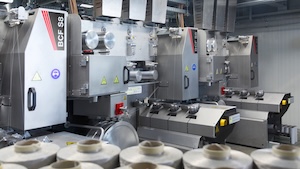
The yarn was produced on a Neumag S8 BCF system with a BICO spinning beam.

The yarn was manufactured on a Neumag S8 BCF line equipped with a BICO spinning beam. The principle of bicomponent yarn is already well-established in other synthetic fiber spinning processes—what is new, however, is its successful integration into the BCF process. Due to the differing shrinkage and elongation properties of the polymers used, the unique material combination causes the yarn to self-crimp, thereby creating its characteristic voluminous structure.

The successful trials on a Neumag S8 BCF system now demonstrate that this approach can also be implemented on an industrial scale for the carpet industry. Likewise, all subsequent process steps—from cabling and heat setting to tufting and coating—consistently yielded good results.

Impressive results throughout the entire process chain

After heat setting, the yarn exhibited pronounced bulk combined with high elasticity. The material also performed well in the tufting process: despite the increased titer, the yarn could be processed without any problems. Thanks to the yarn’s elasticity, it was also possible to produce more running meters of raw fabric than initially anticipated.

Furthermore, the yarn is characterized by its good coverage of the substrate. Process reliability was further confirmed during the coating process—both woven and knitted fabrics could be processed.

Successful quality testing for continuous use

The developed carpet constructions were extensively tested, including chair-castor and Vettermann tests in accordance with DIN EN 1307. Result: All constructions are suitable for continuous use in commercial settings and achieved a wear class of up to Class 33, depending on the carpet construction. “The results impressively demonstrate that BICO BCF technology can not only be reliably integrated into existing production processes but also offers significant advantages in product performance,” said Markus Reichwein.

A future-proof solution for a wide range of applications

The overall conclusion of the tests is clear: BICO BCF yarn impresses with its high opacity, excellent processing properties, and strong performance. The technology thus offers a promising solution with new options for developing high-performance and differentiated products for carpet manufacturers—in both the residential and commercial sectors. The successful industrial validation demonstrates that BICO BCF is not only technically feasible but also has the potential to shape future carpet constructions in a sustainable way.

Posted: August 8, 2026

Source: BARMAG – A Subsidiary of the Rieter Group

NONWOVENN Targets Doubling USA Revenue With Key Senior Director Appointment

BRIDGWATER, England — August 6, 2026 — One of the world’s leading nonwoven fabric-tech companies, Nonwovenn has appointed industry expert, Robert Green, as Business Development Director for its US operations. Green brings with him over 30 years of knowledge of the US market and a track record of driving commercial growth having most recently built and led the first commercially successful biopolymer fiber / nonwovens business bringing high-performance solutions to a range of markets.

Robert Green

In the next phase of Nonwovenn’s growth, further solidifying the position within the US market will be a key element. 25% of revenue currently comes from the US market, with an expectation that this will grow to 50% within the next three to five years. Nonwovenn identified the need for a senior leader to head up the US operations and strengthen client relationships, with Robert perfectly fitting that position. He will be focused on growing sales and delivering high-performance products and solutions in the market, specifically across the PouchTech and ProTech divisions. The business is also seeking acquisitions in the US technical materials sector, which Robert can lend his expertise to.

Alongside his commercial and technical experience, Robert has been actively involved in leadership positions with the two major global nonwoven industry associations, INDA and Edana.

Robert served on the INDA Technical Advisory Board and chaired the RISE Nonwovens conference for the last several years. For EDANA Robert sat on the Board of Governors for several years while growing the biopolymer nonwovens business. Robert was also a co-author of a series of articles on biopolymers recently featured in International Fiber Journal.

Commenting on his appointment, Robert Green said: “What attracted me to Nonwovenn was the impressive team offering a broad range of experience and expertise. Add to this the sharp focus on delivering big performance solutions in the markets the business serves and you have the perfect pairing. The markets Nonwovenn operates in are some of the most demanding in the industry and require the very best of the best when it comes to thinkers and solutions. It’s a fantastic opportunity for me to continue to learn and grow in this exciting industry, and I can’t wait to see where we can take the business next.”

David Lamb, Chairman of Nonwovenn
Picture by Roger Moody / Guzelian

David Lamb, Chairman of Nonwovenn, added: “Robert is joining our team at a very exciting time for the business, especially as we step into the next phase of growth. It was vitally important to have a senior person on the ground in the US to lead the business, and Robert is an incredibly impressive, capable and technically qualified person who fit the role perfectly.

“His experience to date, including building his own very successful consulting business, meant we were immediately comfortable putting him in front of very high-level clients. His insight and nuances from the country will inform our growth plans and next stage of product development.”

Posted: August 8, 2026

Source: Nonwovenn

KARL MAYER: How Innovative Spacer Fabrics Are Transforming The Athletic Footwear Market

OBERTSHAUSEN, Germany — August 6, 2026 — KARL MAYER’s new TEXTILE INNOVATION CENTER is set to become a driving force behind the next generation of performance footwear. The athletic footwear market promises steady growth. By 2030, it is expected to grow by about 15% annually worldwide and reach a volume of approximately 462 billion U.S. dollars. /1/ Textile innovations are the primary drivers of this expansion.

The development of advanced warp knitted fabrics and new textile concepts for footwear is one of the key areas of focus for Michael Kieren, Senior Expert Textile Development at KARL MAYER’s TEXTILE INNOVATION CENTER.

This experienced textile industry professional has been working intensively with spacer fabrics for more than twenty years; thanks to their versatile design possibilities, these textiles have become firmly established in the footwear sector. In an interview with my TEXTILE NEWS editor Ulrike Schlenker, he explains how spacer fabrics are transforming the world of footwear, which trends are shaping the market, and what role the TEXTILE INNOVATION CENTER plays in this.

my TEXTILE NEWS, (mTN): Let’s start by looking back: How have the demands on the sports and athleisure footwear market changed over the past ten years?

Michael Kieren, (MK): The evolution in style is particularly striking. Athletic shoes have become significantly more colorful and design-oriented. The ability to create complex patterns directly on the warp knitting machine and combine different materials has greatly expanded the range of style options.

At the same time, functionality has come increasingly into focus. Features such as breathability, a secure foothold in every movement, and targeted support during peak loads are crucial today. However, these performance characteristics are being visualized less and less. Modern athletic shoes combine performance and design without openly flaunting their technical qualities.

The issue of sustainability has also gained importance in recent years. Manufacturers are responding to the rising demand for eco-friendly products by using recycled materials and developing recyclable single-material solutions.

In terms of market volume, the athletic shoe sector is benefiting from the genre shift in fashion: sneakers with a suit are just as socially acceptable in our crossover era as kicks with a little black dress. This change is possible because athletic shoes have become significantly higher quality, and society’s mindset regarding dress codes has fundamentally transformed since the onset of the pandemic, if not before.

mTN: How lasting are these trends? What are your expectations for the next five years?

MK: We expect the trend toward more color and more complex patterns to continue. That’s why we’ve developed the RDJ 7/3, a new double needle bar raschel machine that significantly expands the boundaries of what’s possible. Notable new features include mesh designs with nearly perfectly round and even larger holes and integrated patterns and functional zones that can be realized with significantly more varied contours and variations, directly on the machine.

In addition, a wide range of colors enables exciting multicolor effects across a diverse array of design applications.

The integration of performance areas into the fabric directly during the textile production process – that is, without additional processing steps – and near-shape manufacturing are becoming increasingly important. They simplify production and enable footwear solutions that, in some cases, we cannot even imagine today. The transition from 2D to 3D and entirely new functionalities play a key role in this.

We’re also seeing a reversal of the trend toward coarse flat-knits, with fabrics featuring fine pattern structures gaining in popularity. We’ve just launched a double needle bar raschel machine with Jacquard in E 32 gauge and have produced our first shoe uppers on it, which have been very well received by our customers.

mTN: So, there’s a lot going on in the athletic shoe industry! How can the warp knitting industry help drive future developments?

MK: Warp knitting technology combines exceptionally high productivity with a wide range of designs and remarkable ecobility. This makes it a unique textile-producing technology. Warp knitting is significantly faster than flat knitting – just at the last Techtextil in Frankfurt, we successfully showcased a three-bar high-speed tricot machine with a PLUS configuration in the production of shoe fabrics via video.

Furthermore, warp knitting results in a significantly smaller ecological footprint than, for example, waterjet or airjet weaving.In addition, the warp knitting offers enormous potential for technological advancements and, consequently, for additional customer benefits. The journey from the first simple double needle bar raschel machines for unpatterned spacer fabrics to today’s modern machine with wireless jacquard bars – on which highly sophisticated, integrated multicolor designs can be produced – impressively demonstrates just how dynamic this technology is.And we are far from reaching the end of this development.

With the ideas and expertise within our company, new technological solutions are currently being developed, and we will continue to make history.

mTN: Let’s stay with the possibilities offered by KARL MAYER. The company has just opened a TEXTILE INNOVATION CENTER at its headquarters in Obertshausen. How will this new development platform support customers in the footwear sector and drive innovation in the industry?

MK: Our TEXTILE INNOVATION CENTER, or TIC for short, helps our customers, brands, and other partners develop textile innovations more quickly and successfully and turn them into market-ready products. This globally unique platform brings together inspiration, textile expertise, state-of-the-art machinery, and international networks across 7,500 m² of space in centers located in three countries.

There, customers can work with KARL MAYER experts to develop new ideas, test materials and machine solutions, and produce prototypes under real-world conditions.

At the same time, the TIC provides important impetus for the entire textile industry. It brings together stakeholders across the entire textile value chain, promotes the exchange of knowledge, brings future trends to life, and creates space for collaboration and inspiration. Facilities include a showroom featuring current trend exhibitions, an Inspiration Hub offering insights into nearly 90 years of pattern development, the KARL MAYER Academy with a wide range of courses, and a development and testing area equipped with a unique array of machinery for warp knitting, warp preparation, and technical textiles.

We invite the textile world to experience all of this and to join us in developing new applications, textile innovations, and forward-looking business models.

/1/ https://www.databridgemarketresearch.com/de/reports/global-athletic-footwear-market

Posted: August 8, 2026

Source: KARL MAYER Verwaltungsgesellschaft SE

NRF: Import Cargo’s Early Peak Season Is Winding Down

WASHINGTON — August 7, 2026 — This year’s peak shipping season is coming to an end, with import volume at the nation’s major container ports expected to remain high this month before starting to decline for the remainder of 2026, according to the Global Port Tracker report released today by the National Retail Federation and Hackett Associates.

“We had an early peak season this year as retailers brought in merchandise ahead of tariff changes in late July and responded to other uncertainties in the supply chain like the ongoing disruption brought by the conflict in Iran,” NRF Vice President for Supply Chain and Customs Policy Jonathan Gold said. “One round of tariffs has been replaced with another, but retailers will be well stocked for the coming holiday season. Retailers know how to adapt to shifting situations and are well prepared to meet consumers’ demand for affordability and choice.”

Temporary 10% Section 122 global tariffs that took effect in February expired on July 23 but a new round of 10% to 12.5% Section 301 tariffs regarding forced labor covering 60 economies and affecting 99% of U.S. imports took effect the next day.

“Consumers might have been expected to become more cautious as cost-of-living pressures persist,” Hackett Associates Founder Ben Hackett said. “Even so, consumer spending has remained resilient despite persistent geopolitical uncertainty.”

U.S. ports covered by Global Port Tracker handled 2.23 million Twenty-Foot Equivalent Units — one 20-foot container or its equivalent — in June, the latest month for which final numbers are available. That was up 13.2% from a year earlier, when imports were down sharply because of last year’s “Liberation Day” tariffs, but down 0.7% from May. The first half of 2026 totaled 12.7 million TEU, up 1.1% from the same period in 2025.

Ports have not yet reported July numbers, but Global Port Tracker projected the month at 2.21 million TEU, down 7.6% year over year.

August is forecast at 2.22 million TEU, down 4.2% year over year. Imports are expected to decline steadily each month for most of the rest of the year, although volumes will be above 2025. September is forecast at 2.16 million TEU, up 2.8% year over year; October at 2.13 million TEU, up 2.7% year over year; November at 2.03 million TEU, up 0.3%, and December should pick up slightly at 2.06 million TEU, up 2.5% over last year.

While ports have remained busy this summer and spread out the peak season, this year’s busiest month appears to have arrived in May, when they handled 2.24 million TEU. The peak shipping season, which historically came in late summer or fall, has become earlier and smoother in recent years amid reasons ranging from supply chain disruptions to expected tariff increases.

While a whole-year total is still pending, 2026 is expected to total 25.5 million TEU, up 0.1% from last year. Imports totaled 25.4 million TEU in 2025, down 0.3% from 25.5 million TEU in 2024.

Global Port Tracker, which is produced for NRF by Hackett Associates, provides historical data and forecasts for the U.S. ports of Los Angeles/Long Beach, Oakland, Seattle and Tacoma on the West Coast; New York/New Jersey, Port of Virginia, Charleston, Savannah, Port Everglades, Miami and Jacksonville on the East Coast, and Houston on the Gulf Coast. The report is free to NRF retail members, and subscription information is available at NRF.com/PortTracker Subscription information for non-members can be found at www.globalporttracker.com.

Posted: August 8, 2026

Source: The National Retail Federation (NRF)

Hyosung TNC Expands Personal Hygiene Spandex Production In Brazil Facility

SEOUL, South Korea — July 29, 2026 — To further strengthen its global production network and reinforcing its commitment to providing reliable, localized supply for customers around the world, Hyosung TNC, a producer of spandex for the personal hygiene industry, announces the expansion of spandex production for personal hygiene products at its manufacturing facility in Brazil. Production is expected to commence by early fourth quarter of 2027 with an expanded capacity of up to 3,000 tons per year.

Hyosung Brazil Facility.

The expansion establishes a global manufacturing footprint for Hyosung’s personal hygiene spandex business, with production that will now span South Korea, China, India, Turkey and Brazil. Together, these facilities enable Hyosung to better serve both global and regional customers with greater manufacturing flexibility, improved supply chain resilience, and localized support.

The Brazil expansion brings production closer to customers throughout the Americas, providing shorter lead times, faster response times, and potential savings through reduced logistics, duties, and taxes. In addition, the Hyosung’s local manufacturing and technical teams will collaborate more closely with customers to accelerate product innovation, enhance quality, and respond more quickly to evolving market needs.

“The expansion of our Brazil facility marks another important milestone in building a global manufacturing network for our personal hygiene spandex business,” said Scott Blackadar, global leader, personal hygiene at Hyosung TNC. “By adding production in the Americas, we’re bringing manufacturing closer to our customers, enabling faster response times, greater supply chain resilience, and stronger collaboration to support innovation and meet the growing demand for high-quality personal hygiene products worldwide.”

As global supply chains continue to evolve amid geopolitical uncertainty, Hyosung’s diversified manufacturing network provides customers with greater security of supply and risk mitigation while ensuring consistent access to high-quality personal hygiene spandex.

With five personal hygiene spandex manufacturing facilities worldwide, Hyosung is well positioned to support future market growth through continued capacity investments, ensuring customers have access to reliable, high-quality supply as demand for personal hygiene products continues to increase.

Posted: July 31, 2026

Source: Hyosung TNC

BARMAG: New 6020 Ceramic Oiler — Optimized Yarn Quality For Low-Titer Applications

REMSCHEID, Germany — July 30, 2026 — With the new type 6020 ceramic oiler, Barmag is introducing a powerful addition to its product portfolio for processing PA6 and PA6.6 yarns. The solution is specifically designed for low-titer applications in the range of 5 to 100 denier.

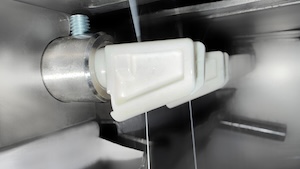
Designed specifically for PA6 and PA6.6 applications: The new Barmag Type 6020 ceramic oiler.

Technological advancement for stable processes

A key feature of the new model is the particularly filament-friendly yarn inlet area, where the yarn is saturated with oil before it comes into contact with the ceramic — a prerequisite for fluff-free processing. The three-waves geometry also ensures minimal yarn contact.

The integrated ceramic shaft completes the design — unlike other solutions, where metal shafts are glued in place — and eliminates typical sources of error such as clogged oil lines or ceramic parts falling out. In combination with optimized thread guidance, the geometry of the 6020 ceramic oiler ensures uniform and efficient spinfinish application with minimal spray-off and very high application uniformity (low OCV).

Significant quality and efficiency advantages

The new ceramic oiler was specifically developed for demanding production environments and offers significant practical advantages. It ensures consistently high yarn quality through stable process parameters such as high spinfinish application rate (OPU) and a good distribution uniformity (OCV), while also enabling filament-friendly processing without yarn breaks or loop formations. Thanks to the significantly reduced spray-off — especially in the sensitive low-titer range — material losses are minimized, oil contamination of the quench and winding areas are reduced to a minimum, and process reliability is increased. Furthermore, the solution stands out for its ease of use: A clearly visible and easily accessible thread guide facilitates threading, while precise adjustment options allow for quick and reliable setup during operation.

Successfully tested in practice

Initial applications at international customers demonstrate the performance of the new oiler. In tests with PA6 / PA6.6 POY yarns, completely spray-off-free processing and significantly more uniform yarn tension were achieved. Furthermore, an increase in the spinfinish application rate of approximately 23% was achieved compared to standard solutions. Its performance was also confirmed in applications with PET POY fulldull and very critical flatyarn: In a direct comparison of various suppliers, the 6020 nozzle was the only solution to deliver a stable performance without any loops or BF. With the 6020 spinfinish nozzle, Barmag offers a forward-looking solution for low-titer applications in filament production. The integrated ceramic shaft, combined with optimized yarn guidance and excellent process parameters, enables a sustainable improvement in yarn quality, process reliability, and production efficiency

Posted: July 31, 2026

Source: BARMAG – A Subsidiary of the Rieter Group

Luxinar Strengthens Reliable Femtosecond Laser Supply For Industrial Manufacturers

KINGSTON UPON HULL, UK— July 30, 2026 — Luxinar has expanded its femtosecond laser production to meet growing demands for reliable supply. With Pulsecore® femtosecond lasers, this means stable, predictable delivery within 3-4 months, even as volumes increase. This helps system integrators and machine builders to reduce project risk, maintain production schedules, and secure long-term availability for critical projects.

Low material loss with diamond laser cutting

“For many system integrators, delivery reliability has become a critical part of project success,” said Stefan Hackl, CEO of Luxinar. “Our investments in manufacturing capacity, application support, and continuous product development enable customers to access high-performance femtosecond laser technology with the predictable lead times they need to keep projects on track.”

To support increasing demand, Luxinar continues to invest in both femtosecond technology development and production capacity. Backed by decades of industrial laser manufacturing experience, these investments help ensure long-term availability, application support, and a reliable supply of high-performance femtosecond lasers. Following the recent launch of the Aionis ultrafast laser, ongoing validation has demonstrated even stronger real-world performance than originally specified, achieving more than 100 W of output power and pulse durations below 350 fs. Combined with a predictable 3–4 months delivery time, this gives customers access to a high-performance industrial femtosecond laser platform without extended lead times.

Fast validation backed by application expertise

Reliable femtosecond integration starts with fast, proven application validation. That’s why Luxinar has strengthened its application capabilities – expanding its femtosecond expertise with additional testing capacity in Europe, including established labs in Germany and a dedicated smart lab in the UK equipped with cameras that provide live-streamed laser processing, instant feedback from applications engineers and real-time adjustments.

This gives faster access to sample testing and process validation, helping them confirm feasibility earlier, reduce integration risk, and accelerate the path to production. With stable and repeatable performance, Pulsecore® femtosecond lasers ensure future customers move from testing to production with confidence.

Industrial femtosecond processing for demanding applications

Pulsecore® femtosecond lasers are available at 515 nm, 1030 nm, and the unique 1950 nm wavelength. By selecting the appropriate wavelength, material interactions can be tailored for surface processing, sub-surface features, or processing through transparent materials – ablation, cutting, drilling or material modifications. The distinctive 1950 nm wavelength opens new possibilities for advanced applications that are difficult to achieve with conventional ultrafast laser wavelengths.

Delivering high-precision results across multiple industries

Aionis femtosecond lasers have been engineered for demanding industrial applications that require exceptional precision, reliability, and around-the-clock operation. They enable high-quality micromachining and material processing across a broad range of applications, including:

  • Semiconductor manufacturing
  • Microelectronics processing
  • Glass & ceramics processing
  • Diamond processing
  • SiC processing
  • Thin foil cutting
  • Photovoltaic production
  • Medical device and biotechnology applications

These represent some of the most common femtosecond laser applications, with many additional opportunities supported through Luxinar’s application development expertise.

Designed for continuous industrial operation

Built specifically for 24/7 industrial use, Aionis combines advanced functionality with robust reliability. Key features include:

  • Reliable continuous operation in industrial environments
  • Tunable pulse duration down to < 350 fs and up to picoseconds
  • Excellent pulse-to-pulse and power stability
  • Laser power up to 100 W
  • Advanced operating modes such as pulse on demand and bursts

This unique combination of performance, flexibility and reliability makes Aionis an ideal solution for manufacturers seeking the highest levels of precision and productivity in ultrafast laser processing applications.

A partner built for continuity and flexibility

For many system integrators, relying on a single femtosecond laser supplier has become an increasing risk – especially when project timelines depend on stable availability. Evaluating a second, reliable source is therefore a logical step to secure long-term continuity.
With Pulsecore® femtosecond lasers, Luxinar offers a proven laser platform backed by expanding production capacity, strong European support, and growing application expertise. In addition to femtosecond lasers, Luxinar supports manufacturers with nanosecond and CO₂ laser technologies, enabling broader application coverage and future technology flexibility within a single supplier relationship.

This allows manufacturers to validate applications earlier, reduce dependency on a single supplier, and increase supply-chain resilience. The result: more flexibility in sourcing decisions, lower delivery risk, and greater confidence to keep projects on track.

Posted: July 31, 2026

Source: Luxinar Ltd

Freudenberg Performance Materials Acquires Foshan United Medical

WEINHEIM,, Germany— July 31, 2026 — Effective July 31, 2026, Freudenberg Performance Materials (Freudenberg), a leading global manufacturer of technical textiles, has acquired Foshan United Medical Ltd. (UMT).

The sellers are UMT founder Dr Xiaodong Wang and a private Chinese founding partner. UMT is a leading full-service supplier of advanced wound care products. The company with headquarters and state-of-the-art production facilities in Foshan, China, has a workforce of some 200. The parties have agreed not to disclose the purchase price.

Dr. Andreas Raps

“Freudenberg Performance Materials and Foshan United Medical are a perfect strategic match. Going forward, the merger will enable us to offer a unique portfolio of technologies and products as an innovative full-service supplier in the market for advanced wound care”, Dr. Andreas Raps, CEO of Freudenberg Performance Materials, commented.

Dr. Xiadong Wang, CEO and founder of UMT, underscored: “The innovative strength and high level of customer orientation characteristic of both our companies make for an ideal fit, they are the cornerstone for expanding our success.”

State-of-the-art technologies and regulatory know-how

UMT has state-of-the-art technologies at its disposal. Core competencies range from fiber manufacturing or functionalization to nonwoven production and final packaging, sterilization and marketing authorization.

UMT’s regulatory know-how, successful international first approvals for products as well as patents granted in China, Europe and the USA are another key element for expanding the healthcare business of Freudenberg Performance Materials.

Individual solutions for customers

With UMT, Freudenberg Performance Materials becomes a full-service provider of advanced wound care.
Source: ©Freudenberg Performance Materials

With the UMT takeover, Freudenberg Performance Materials can cover all important steps in the value chain in-house, and thus offer one of the broadest technology platforms in the market for advanced wound care. In future, the company will provide a wide range of solutions for different applications: dressings made of polyurethane foam, with silicone coatings or antimicrobial agents such as silver. Alginate-based absorbent fiber solutions, chitosan- and CMC-based wound dressings supplement the portfolio. The broad technological foundation unlocks comprehensive options for individual adaptation and enables tailormade solutions for customers all over the world.

Posted: July 31, 2026

Source: Freudenberg Performance Materials 

Messe Frankfurt And Supima Introduce Prefab – A New Curated Fabric Sourcing Event In New York City

FRANKFURT AM MAIN, Germany — July 30, 2026 — Messe Frankfurt is expanding its international textile network with the launch of Prefab, a new boutique-style sourcing event dedicated exclusively to high-quality fabrics. Taking place January 19-20 2027 at the Altman Building in New York City, the event will bring selected Supima member fabric mills together with senior designers, fabric directors, product developers and sourcing decision-makers from premium and luxury brands.

With a carefully curated exhibitor line-up and a targeted visitor approach, Prefab is designed to create a focused business setting in which material quality, expertise and meaningful exchange take priority over scale.

Prefab introduces a compact format for the North American market. Instead of a conventional trade show, it places fabrics and expertise at the center. A uniform, design-led presentation gives each mill equal visibility and supports focused discussion, comparison and relationship-building.

A dedicated platform for one of the world’s finest cottons

Supima is the association representing producers and manufacturers of SUPIMA®, the premium cotton brand made from extra-long staple Pima cotton grown in the United States. SUPIMA® is internationally recognised for exceptional fibre quality, durability, softness and colour retention. Through its network of member mills and global brand partnerships, Supima has become one of the textile industry’s leading quality initiatives.

Prefab will demonstrate how Supima member mills transform these exceptional fibre qualities into premium fabrics for luxury apparel – from shirting and tailoring to denim, knits and innovative textile constructions.

“New York is one of the world’s most important fashion markets and the right place for a deliberately selective format,” says Jennifer Bacon, VP Fashion and Apparel of Messe Frankfurt, Inc. “Prefab brings outstanding Supima member mills together with the people making material decisions for leading brands – in a focused setting for expertise and long-term partnerships. It is the best-of-the-best approach”

Exhibiting reserved exclusively for Supima member mills

Only Supima member fabric mills will be eligible to exhibit at Prefab. The premiere will feature approximately 40 selected exhibitors. Participation will be curated for consistent quality and relevance, while the visitor campaign will target senior professionals responsible for design, fabric development, sourcing and purchasing.

The collaboration combines SUPIMA’s member network with Messe Frankfurt’s international textile expertise, market reach and event competence. It aims to create productive connections between mills and brands and support business opportunities based on quality, innovation and responsible product development.

“Supima is built on the expertise of its member mills and partnerships with brands that value exceptional cotton,” says, Buxton Midyette, VP Marketing & Promotions, Supima. “Prefab gives this community a dedicated platform to present craftsmanship and innovation and connect directly with the decision-makers shaping future collections.”

A design-led environment at the Altman Building

The Altman Building will host the premiere of Prefab. Its distinctive setting supports the compact, design-led concept, enabling focused presentations and undisturbed conversations. Exhibitors will be presented on equal footing: quality, not stand size, will define their presence. Being located in the heart of New York City’s garment industry will make the show conveniently located for most brands, retailers and designers.

New York and Milan: two distinct formats, one strategy

Prefab forms part of Messe Frankfurt’s development of curated formats for the high-end apparel textile market. In Europe, Value Milan will debut from February 3-5, 2027, at The Mall in Porta Nuova, connecting selected international manufacturers with the European fashion market. Prefab takes a focused North American approach, dedicated entirely to SUPIMA cotton and reserved for Supima member mills.

“With Value Milan and Prefab in New York, we are strategically expanding our global textile portfolio with highly focused formats that complement our established trade fairs,” says Olaf Schmidt, Vice President Textiles & Textile Technologies at Messe Frankfurt. “At the same time, we are strengthening the international Texpertise Network, creating new business opportunities and bringing together the right market players in the right environment.”

Posted: July 31, 2026

Source: Messe Frankfurt, Inc.

The Trützschler Pre-Cleaner CL-X: Proven In Cotton Cleaning – Creating Value Beyond The Spinning Mill

MÖNCHENGLADBACH, Germany— July 30, 2026 — Since its market launch, the CL-X has firmly established itself in blowroom lines worldwide. Hundreds of installations confirm its ability to deliver superior cleaning efficiency, lower waste, higher productivity and significant energy savings. Now, new customer applications show that the CL-X not only continues to excel in spinning preparation – it is also entering a completely new field of application: ginning.

Opening up new potential in ginning

The CL-X enables significantly more effective fiber recovery.

Cotton gins perform the very first industrial processing step of cotton. Seed cotton arrives directly from the field and must be dried, cleaned and separated into three components: cotton fibers, cotton seeds and waste. While the cotton fibers are pressed into bales for spinning mills, the waste fraction is sold separately – often still containing a considerable share of usable fibers.

In conventional ginning processes, this waste can contain up to around 0,8% good cotton fibers. These fibers still have value, but they are transported and sold in mixtures with trash, resulting in lower prices and unnecessary logistics costs. This is where the CL-X comes into play.

Installed directly downstream of the ginning machine, the CL-X enables significantly more effective fiber recovery. Thanks to its precise cleaning action, usable fibers are separated more efficiently from trash before shipment. The result: higher fiber yield, less waste volume – and greater economic value from the same amount of raw cotton.

Success story from Brazil

A Brazilian customer has now successfully implemented this concept. In a ginning operation processing around 500,000 tons of cotton per year, approximately 65% – or 65,000 tons – is typically separated as cotton seeds and waste during the cleaning process. Within this portion, approximately 4,000 metric tons (or 0.8%) of the waste consists, among other things, of high-quality fibers that should be separated, as they would otherwise be lost at this stage of the process.

By integrating the CL-X into the ginning process, the customer was able to further separate the ginning waste, splitting it into real waste and usable fibers that can be recovered at this early stage. This resulted in a significantly higher share of high-quality, marketable fibers, which in turn reduced the amount of waste that needed to be transported. In addition to lower logistics costs, the customer benefits from substantially better prices for the recovered fibers.

Convinced by the results, the Brazilian ginnery has already placed follow-up orders for four additional CL-X machines for its ginning operations – a strong endorsement of the concept’s economic and technological potential. This application clearly demonstrates how CL-X performance can create added value well beyond the spinning mill.

Confirmed excellence in spinning preparation

The CL-X creates value beyond the spinning mill.

While the ginning application highlights the CL-X’s versatility, new results from spinning mills further confirm its leadership in established use cases.

In Vietnam, a customer compared the CL-X with the previous pre-cleaning solution under identical production conditions. The CL-X reduced waste by approximately 0.5% to 0.8% in total while simultaneously improving yarn quality. These improvements led to enhanced efficiency on the customer’s rotor spinning operations, reduced material loss and a more consistent yarn output. At the same time, power consumption dropped by around 40%, resulting in substantial energy savings, lower operating costs and a clear sustainability benefit. The customer reports high satisfaction, particularly with the machine’s operational stability and output quality.

Equally impressive results were achieved at a Turkish spinning mill processing 100% cotton at 1,100 kg/h. Replacing a competitor machine with the CL-X led to 80% less waste, around 30% lower energy consumption and noticeably higher yarn quality downstream. In addition, the blowroom operation became more stable and efficient. Where two machines had previously been required, one CL-X now handles the cleaning task alone, setting a new benchmark for both productivity and simplicity. Encouraged by these results, the customer has already decided to upgrade its blowroom line with further CL-X machines.

Smart technology, strong cleaning performance

Pre-Cleaner CL-X: Delivering outstanding cleaning efficiency across diverse applications.

The technological foundation for these results in spinning preparation and ginning is the CL-X’s advanced cleaning concept. At its core is the proven WASTECONTROL system, which continuously monitors trash content and raw material quality by using real-time data. When too many good fibers are detected in the waste, the system automatically suggests an optimized setting to minimize fiber loss – ensuring consistently high cleaning performance and maximum fiber yield across varying conditions.

One machine, multiple opportunities

From spinning preparation to ginning, the CL-X once again proves why it has become a benchmark in cotton cleaning. Its ability to deliver measurable economic, quality and sustainability benefits – even in entirely new applications – demonstrates the strength of its underlying concept and how smart pre-cleaning technology continues to unlock new potential along the entire cotton value chain.

Posted: July 31, 2026

Source: Trützschler Group SE

Sponsors