Kayser-Roth Corp Acquires HUE Legwear Brand Name

Kayser-Roth Corp., a division of the Golden Lady Group, Greensboro, N.C., has purchased the HUE®
Legwear brand name from New York City-based Leslie Fay.The purchase of the HUE Legwear name gives
us the ability to be an even stronger power in the legwear industry. We intend to take full
advantage of this opportunity to build on the excellent relationships we already have in this vital
business, said Kevin Toomey, president and CEO, Kayser-Roth.

January 2001

Demand For Flag Fabric Rises

DEMAND FOR FLAG FAbrIC RISESU.S. flags have been in huge demand and retailers quickly sold out of their stocks following the Sept. 11 terrorist attacks. Glen Raven is the largest manufacturer for fabric going into U.S. flags and the N.C.-based company has been meeting the demand.Glen Ravens Filament Fabrics makes nylon and polyester fabric which it sells to companies which print the stars and stripes on the griege fabric. A company spokesman says Glen Raven so far has met the increased demand with current fabric inventory. The company also produces a full range of fabrics for military uses.Most outdoor flags are made of either nylon or polyester or a blend.October 2001

Three German Interior Design Fairs To Be Held In January

Germany-based Deutsche Messe AG has announced that three trade fairs featuring products for the
home will run consecutively in January, enabling buyers to make one trip to cover each event.
Heimtextil, Domotex and the International Furniture Fair will take place between Wednesday, January
10, and Sunday, January 21.Heimtextile, held at Messe Frankfurt, opens the series and runs for four
days, January 10-13. About 3,000 exhibitors from 60 countries will show a broad range of decorative
fabrics for the home. The scope is all-inclusive, with special sectors for product groups. The
breakdown includes curtains, draperies, wall coverings, carpets, bedding and bed linens, table-top
and kitchen linens, ornamental cushions, upholstery, patio, and sun protection.A trend exhibition
will show what will be in fashion in the future. It will be backed up by display arrangement,
lectures and a brochure. It is anticipated that close to 75,000 trade professionals will attend
Heimtextile 2001.Domotex will take place in Hannover, January 13-16. It ranks as the worlds largest
forum for carpets, floor coverings, and related products and services. More than 1,000 exhibitors
from 50 countries will show in a display space of 94,000 square meters. Projections are that 40,000
visitors will attend this event in 2001.Display categories at Domotex include hand-made carpets,
machine-made woven carpets, textile floor coverings, fiber and yarns, and flexible floor coverings.
There will be 55 exhibitors from the United States. Some of those who will be showing include BASF
Corp. Fiber Products Division, Dixie Group, Lees Carpets and Mohawk International.Internationale
Mobelmesse, the final show of the season, will be held in Cologne, January 15-21. It is a major
trade fair for furniture. More than 1,500 exhibitors from 50 countries will show a variety of
products and styles. The range embraces tables and chairs, bedroom and living-room furniture,
upholstered furniture and lamps. Styles are rustic, period or avant-garde.

Mascioni Stays Green

Since its founding in the 1970s by a family of entrepreneurs, the Cuvio, Italy, dyehouse Mascioni
has endeavored to strike a delicate balance between the demands of production and the issues of
safety, health and environment. Mascioni was founded during a politically sensitive time for
Italian manufacturers. Textile plants and other manufacturing concerns that indiscriminately
discharged waste into the formerly pristine rivers and streams of the Italian countryside were
coming under increasing pressure by government, environmentalists, outdoorsmen and others. The
conflict resulted in the passage by the Italian government of the Merli Act, which put in place
much more stringent wastewater requirements.We should still be grateful to and appreciate the
foresight of our predecessors in corporate management, said Dr. Carlo Mascioni, the companys
current managing director. While the environmental controversy was at its height, the Mascioni
facility was under construction. Company founders had already decided to invest in a wastewater
purification system significantly larger and more advanced than was the norm. This, says Dr.
Mascioni, turned out to be a tremendous strategic advantage for the companys
prosperity. Garnering Respect From The CommunityThe initial construction of the facility was
followed by the building of a cogeneration plant in the 1980s that, at the time, was without equal
in Europe. These two facilities, both of which feature state-of-the-art technology in terms of
environmental protection, have enabled us to foster the excellent relationship that Mascioni has
always had with both the regional administrative bodies and the residents of the area, many of whom
are working with us, Dr. Mascioni said. These persons are aware of the attention we pay to
safeguard the place where they live, and they repay this heed with their attachment to the company.
We believe this to be an extremely important factor so much so that it is one of the most crucial
elements we take into consideration when deciding new investments. 

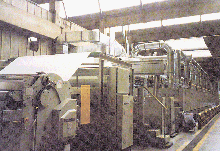
It was in this light that Mascioni chose the Monforts Montex 5000 stenter. Mounted on the
Montex 5000 is a Koenig heat-recovery and fumes-purification unit.The line has been in operation
for less than a year and has resulted in sizeable operational and qualitative benefits, Dr.
Mascioni said. We are completely satisfied with it, he said. The results have exceeded
expectations, including the enhancement of the exhaust air quality.The fumes-treatment system by
Koenig has capability beyond the specific needs of the Montex 5000. It also recovers heat from an
older stenter installed in an adjacent room.The numeric evaluation of the operating economy is not
easy, Dr. Mascioni said, but we think we can anticipate a 30-percent savings in comparison with
previous installations. This enhances quality and allows a quick return on investment. Also, the
drying performance of the powerful Monforts stenter is considerable.Mascioni produces nearly 45
million meters of fabric (340 centimeters double width) per year. The company employs 450 people in
an 80,000-square-meter facility. The companys production program, which once consisted mostly of
printed cotton fabrics for household furnishings, is now diversified and includes technical and
apparel materials the result of research conducted jointly with customers. Approximately 70 percent
of Mascionis customers are outside Italy, with the majority in the United Kingdom, France and the
United States. New Machinery Improves EfficiencyNew production machinery has recently come
online at Mascioni, including a preparation and bleaching range, a hot-mercerization line, a modern
singeing machine, a two-phase development system and, of course, the new Montex 5000 stenter. The
plant runs 24 hours a day, five days a week, with three production shifts. The stenter is in
continuous operation. Before purchasing the Montex 5000, Mascioni carefully evaluated the units
running efficiency, quality, economy, reliability and environmental capabilities. The
seven-compartment machine operates at speeds ranging from 80 to 120 meters per minute (m/min),
depending on fabrics being produced, and has successfully replaced an existing 10-compartment
stenter, the speed of which reached only 60 m/min. In addition, it offers a series of technical
solutions, such as high operating flexibility, user-friendliness, very low consumption and minimal
maintenance. 

Worthy of mention, especially, is the great advantage of having an efficient automatic
cleaning filter, an independent air flow (of both upper and lower nozzles), an electronically
controlled process, with the guarantee of a perfect lot reproduction even after a long time, said
Fiorenzo Fumagalli, the plants production manager. The Koenig system has fully come up to our
expectations; we are really satisfied with it.Mascioni bought the Montex 5000 at ITMA 99 in Paris.
It began working at full production capacity in January 2000 and has been running trouble-free ever
since, according to Fumagalli. It operates my favorite way that is to say, install it and forget
about it.

January 2001

At 30 Tekmatex Readies For Industry Rebound

Supply SideBy McAllister Isaacs III, Editorial Director At 30, Tekmatex Readies For Industy ReboundFlowing with the highs and lows of U.S. textiles, Charlotte-based Tekmatex anticipates ‘return of textiles.’ At Tekmatex, there may be a lull in business right now, as the Charlotte-based distribution firm quietly reaches its 30th birthday. But it isnt just sitting around waiting for something to happen. No, the company is gearing up for what Yuji Wada, president, describes as “a return of textiles to the United States.”
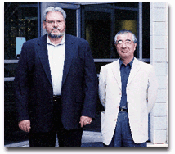
Left to Right: Danny Barrett, general manager, Weaving Division, and Yuji Wada, presidentWada says, “I firmly believe that the textile industry will return in the United States, perhaps with a different structure. But it will come back in the future after structures of apparel, textile industries and textile retailers are reorganized and connected under common value chains with QR systems thus eliminating inventories just as the relationship between automobile assembly makers, parts and components makers.”Tekmatex, located in the heart of the U.S. textile industry in Charlotte, has witnessed a number of peaks and valleys in this industry in its 30-year history.The company opened its doors in 1971 in downtown Charlotte while it awaited the completion of its building, at its current site on Performance Road. Ironically, with American Dornier a nearby neighbor, back then Performance Road was known as Picanol Road. Needless to say, at least two of the current residents on the street pushed for a renamingand got it. Thus, it is now Performance Road.In 1971, Tekmatex began its U.S. history as the sales representative for Nissan water-jet weaving machines and Toyoda open-end spinning machines. Nissan opened its own U.S. office in 1977 (recently purchased by Toyota). Today, of course, Tekmatex handles U.S. sales for Tsudakoma weaving machines, preparatory machines and Toyota spinning systems.Danny Barrett, general manager, Weaving Div., supervises the sales and service of the Tsudakoma weaving machines and preparatory machines. Barrett said day to day contact with textile companies by the companys two regional sales managersLuther Lingle covering part of the Carolinas and all points north and Gary Hinkle covering part of the Carolinas and all points south have advanced Tsudakoma machinery sales to over 12,000 machines. Furthermore, Barrett said close contact with current customers by Tekmatex technical service managersSonny Burr and Alan Reeves has ensured our customers learn of new developments to remain competitive.Ron Wilson, sales manager, Spinning Div., as well as the Woodworking Div., joined Tekmatex 12 years ago and supervises the sales and services of the Toyota yarn-making products.Barrett, a 20-yr veteran at Tekmatex has certainly been witness to the evolution of air-jet weaving from a machine with a highly limited applications capability in its early days to one that has captured the hearts and minds of most weaversespecially in the U.S. With over 12,000 air-jet weaving machines in the U.S., Barrett is certainly well qualified to discuss that evolution.”In the early days,” he says, “most air jets produced plain weave fabricsfrom common yarns, making common products. A lot of folks were making shirtingsoxfords, broadcloths. Machines were all 190-cm wide, except, of course, the 150- to 170-cm machines for glass fiber fabrics. In the beginning, it was all crank shedding.”Over the years, several things happened to change all that:1) Machines became wider.2) Machines were beefed up to produce different and more difficult fabrics.3) Filling insertion evolved to include multiple feeders and capabilities for diverse yarns.Sheeting provides an excellent example of the use of wider air jets. Denim is an application where beefing up the machine generated new use. In fact, where denim was once the sole province of projectile machines, hardly a yard is woven today on anything other than an air-jet machineat least in the U.S. And, of course, its not uncommon to find eight filling feeders with dobby or jacquard shedding on todays air jets.Barrett says, “Tsudakoma has more machines on sheeting than any other manufacturer.”Moreover, in a fabric few ever thought possible, Tsudakoma has more air jets on terry than any other manufacturer, according to Barrett. The company is also producing 230-cm water jets, the widest on the market for the growing automotive airbag market.As for Tekmatex itself, it is owned neither by Tsudakoma or Toyota. Marubeni America corp. owns 80% of the Charlotte-based facility. The Marubeni Group in Japan owns the other 20%. Moreover, The Marubeni Group owns Marubeni America Corp.Wada says the Marubeni Group is one of the largest trading companies in the world. It deals in 30,000 different items such as steel, automobiles, ships, plant construction, power stations, housing, IT, logistics, finance, petroleum, energy, chemicals, food, textiles and machinery, including textile machinery. It has facilities in 150 countries and districts all over the world.In the U.S. the company has the Tekmatex Inc. operation in Charlotte and Swift Spinning Mills and Marubeni Denim in Columbus, Ga, and Wateree Textile in Camden, S.C., in the textile field.

President Yuji Wada firmly believes that “Textiles will return to the United States, perhaps with a different structure.”Wada, himself, has served the parent company with two different stints at the Charlotte operation. He first worked at Tekmatex Inc. from 1976 to 1983. He returned in 1998 as president and has been at the helm ever since. Tekmatex Inc. actually has five divisions. The table shows these divisions with their current and new products. Each division has sales personnel, service technicians and a full complement of spare parts to service each division and more importantly our customers. The bottom line on Tekmatex is over the last 30 years, the company has been through the up and down cycles side by side with its partners in the textile community and plans to remain a leader in the sales and service of its products.October 2001


How To Prevent Metal Bits In Finished Apparel

Chemical TreatmentandFinishingBy Edward J. Elliott PE, Ccol, FSDC How To Prevent Metal Bits In Finished ApparelUltra sensitive magnetic metal detectors help preserve the health, safety and well being of garment sellers and buyers. 

Magnetic detection had a burst of development during World War II when the search for land mines caught everyones attention. Since then, the concepts initiated during those war years have been honed with the sophisticated use of electrical engineering principals coupled with computer science to produce metal detectors which have important applications in todays industrial world.Dr. Mike Randall, chairman and Graham Millward, export sales manager, Lock Inspection Systems Ltd. hosted TEXTILE WORLDS visit to the companys manufacturing facilities in Oldham in Lancashire, England. The U.K.-based firm also operates a production plant in Fitchburg, Mass. Randall explained that one of the largest applications for metal detectors is in the textile industry. Initially it might seem that textile applications would center around finding metal in fabric as a protection to the numerous rubber/composition squeeze rolls used in wet processing. Although these areas are important, the need to detect metal in finished garments is more significant to retailers. Randall says, “We are able to detect metal bits as small as one millimeter in diameter on a continuous production line. Of serious concern are the small bits of a broken sewing needle that gets entwined within the stitches and/or seams during the sewing phase of garment assembly. Although youd like to believe that conscientious sewing machine operators would stop when a needle broke and remove fragmented pieces from garments, it isnt that simple. In many off-shore sewing plants, the operators are more concerned with productivity since it relates directly to personal earnings.” Metal detection has an important application in the food and pharmaceutical industries where metal bits can be a serious safety, health and legal problem if ingested with food or medicine tablets. Lock is able to detect minute quantities of metal fragments based on its sophisticated combination of electrical/magnetic skills and leading edge software that can significantly magnify the detector sensor signal. Lock has developed a technique that can ignore non-ferrous metallic items that are an integral part of the garment design.Millward says, “Many garment designers are using non-metallic components to assure the efficacy of the metal detector to find unwanted broken metal pieces. We now see plastic zippers, plastic or bone-like buttons, etc., all aimed at enhancing the metal detectors ability to find unwanted metal.” The specter of a mother helping a child don a new garment, only to hear fierce screams and appearance of blood from scratched parts of the childs head and body may be isolated events but are certainly real when they occur. Moreover, such an incident is “made-for-TV and the media.” Although the personal damage may look worse than it actually is, the dramatic impact of a crying toddler, a harried mother and a blood-spattered garment is more than a retailer bargains for. Its natural that retailers faced with avoiding liability for metals in foods and medicines would be the driving force behind the use of metal detectors in textiles/garments.The ability of Lock to detect 1-mm metal pieces is a result of its awareness that when a sewing needle breaks, it snaps at or below the weakest part of the needlethe eye opening where the thread passes. Usually only the pointed tip gets trapped in the seam. Normally you dont find a complete needle, since the shank is still in the sewing machine. So accuracy in finding very small metal pieces is critical.In pharmaceuticals the powders are screened to assure uniform particle size. But the stainless-steel screen-sifting wires can erode and eventually break, inserting small bits of metal into the powder. Additionally, when powders are tabletized, the tablet press must be perfectly aligned otherwise minute metal shavings can enter tablets. If either or both of these untoward conditions occur for even a short time, the need for a sensitive metal detector becomes obvious.Such innovation is proof that textiles recognizes progress made in other industries and can accept the positive thrust that gained from accurate and sensitive metal detectors. The cross-pollination between industries is a major contributor to the health, safety and well being of the textile industry and its consumers.Randall says, “Our continued R and D efforts are focused so we can apply a positive(+) influence on a potentially negative (-) problem.” October 2001

Ridgeview To Close Mebane Finishing Facility

Ridgeview Inc., Newton, N.C., will close its finishing facility in Mebane, N.C. Ridgeview has been
finishing and shipping sports-specific socks in Mebane since acquiring Tri-Star Hosiery in July
1998. Ridgeview intends to relocate current Mebane operations to its manufacturing facilities in
Newton, N.C., and Fort Payne, Ala.Hugh Gaither, president and CEO, said, The consolidation is
simply a matter of reducing costs and improving profitability for Ridgeview. It is another step in
an operational restructuring which creates a new, more efficient Ridgeview sock operation.

January 2001

IMS Introduces Hitak-SP For High-Speed Melt Spinning

International Machinery Sales Inc., Winston-Salem, N.C., has recently patented its new Hitak-SP
interlacing jet system for high-speed melt spinning of POY, FOY, SDY and FDY yarns. The jets
low-friction alumina ceramic body with complex channel geometry gives optimum performance without
damaging yarn and offers high wear resistance. Benefits include ultra-high-frequency interlace of
size-free warp yarns at maximum speed and low air consumption at an economical price. The jet has
no moving parts, and a vacuum slot provides easy tread-up and excellent yarn retention, according
to the company.Various surface finishes are available for the precision-ground jet and impact plate
to match yarn friction characteristics. Because there are no metal parts, the jet plate and impact
plate can safely be cleaned ultrasonically. Current jet plates are available for deniers 50 to 600,
with higher-denier plates in development.

January 2001

Hosiery Equipment Show Goes To Four-Year Cycle

Hosiery Equipment Show Goes To Four-Year CycleThe leadership of The Hosiery Association (THA)
approved changing the frequency of its International Hosiery Exposition (IHE) trade show from every
two years to every four years.It was decided that a four-year cycle for both IHE and the European
hosiery show FAST would leave two years between shows in Europe and the Americas, and that this
schedule was in the best interests of hosiery manufacturers and suppliers worldwide.THA President
and CEO, Sid Smith, said, With the advent of the FAST show in Europe and the need to provide
equipment manufacturers time to develop new technologies, this move makes sense. While it does
extend the period of time before our technicians can see new technology, the cost of trade shows on
exhibitors is no small matter, and we want to help control those costs for all of our members.
January 2001

News From The Mills

NEWS FROM THE MILLSBBA Nonwovens, Old Hickory, Tenn., selected Datastream Systems iProcure as its automated industrial procurement product. iProcure is a Web-based procurement marketplace.BreatheTex Corp., Port Elizabeth, South Africa, opened a technical textiles lamination facility. The plant is for laminating PTFE, polyester and polyurethane membranes to fabric, foam or other substrate.Glen Raven Custom Fabrics, Glen Raven, N.C., updated its Dickson Web site to include photos of the awning product line. Dickson awning fabric is solution-dyed acrylic available in 100 solids and stripes.Guilford of Maine received the Governors Award for Environmental Excellence in the Smart Production Category. Guilford manufactures textiles for commercial interiors.National Nonwovens, Easthampton, Mass., introduced its new line of WoolFelt colors, Natural Elements. The colors base on natural surroundings.Saez Merino, Spain, purchased an automatic inspection system from Elbit Vision Systems. The system includes the I-Tex 2000 Denim, and SVA for dyed fabric shad variation measurements and an I-Tex 100 for greige fabric inspection.Springs Industries, Fort Mill, S.C., named Kenneth E. Kutcher executive vice president and chief financial officer. Also, Springs associate Wendell Bowers, a clerk at the Grace Distribution Center, was awarded the South Carolina Mfrs. Alliance Manufacturing Citizen of the Year Award.Shuford Mills, Hickory, N.C., received ISO 9002 certification for its Hudson Cloth Plant in Hudson, N.C. The plant produces scrim fabrics, medical fabrics and the Outdura line of solution-dyed acrylic fabrics.SI Geosolutions, Chattanooga, Tenn., named several members of its senior management. Greg Wilkerson is vice president and general manager, Al Schnitkey is director of marketing, Jack Rooke is director of technology, R. Lee Pierce is national sales manager and Eddie Cooper is customer operations manager. SI Geosolutions produces materials to stabilize soil and control erosion.Textus, New York City, incorporated Terratex fabrics into its line of upholstery products. Interface Fabrics Group, Guilford, Maine, produces Terratex from recyclable or compostable materials.Willacoochee (Ga.) Industrial Fabrics purchased warp-tying equipment from Batson YarnandFabrics Machinery Group, Greenville.November 2001

Sponsors