ATMI OFFERS SUPPORT FOR WAR EFFORT AGAINST TERRORISMThe president of the textile industrys national trade association has notified the defense supply center in Philadelphia (DSCP) that the U.S. textile industry stands ready to do whatever is necessary to support anti-terrorist military activities. He also has urged companies to make plans now to meet any additional military textile needs. According to the DSCP, the textile industry provides more than 13,000 items for the military, ranging from uniforms and combat gear to shelter and protection from extremes of weather and chemical weapons. Through two world wars and the conflicts in Korea, Vietnam, Panama and the Persian Gulf, the U.S. textile industry mobilized its resources to meet sharply increased demands of the military while continuing to supply civilian needs.In a letter to textile industry chief executive officers, Charles A. Hayes, president of the American Textile Mfrs. Institute (ATMI) said, “As our government evaluates the situation and decides on actions it will take, Ithought it prudent to urge each and every one of youregardless of the products you currently offerto immediately begin thinking of what your company can do if our nation calls on us for help.”He said ATMI has been in touch with DSCP and pledged the industrys cooperation in responding to the attack, and we have offered to work with them in any way we can should circumstances dictate that they need additional supplies of items currently produced or any new items that may be required. As part of its reorganization earlier this year, ATMI created a government textile procurement committee, under the chairmanship of Mike Kilkenny of Greenville Mills. That committee will be working closely with military procurement officials.At ATMIs 2001 annual meeting last March, Gen. Henry H. Shelton, chairman of the joint chiefs of staff, said the American textile industry has always been a “reliable partner of our nations military in times of peace and war.”In a related development, the Apparel Foundation immediately launched a program to provide apparel and footwear to victims and rescue workers. In New York City, there was a critical need for steel-toed footwear for fire fighters and clothing and blankets for other search and rescue workers. Many of those needs were quickly met by suppliers in the area, and the foundation is coordinating continuing offers of help from apparel and footwear manufacturers.October 2001
Dry-Heat Lamination Offers Options
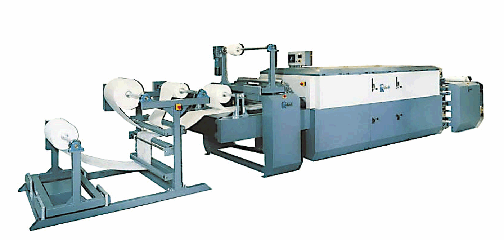
Dry-heat laminating is best described as high-volume production bonding of two or more different
substrates in a continuous reel-to-reel operation, using dry adhesive, at relatively low
temperatures.Low-temperature laminating is an effective, controlled and flexible procedure, which
allows for a wide range of substrates to be bonded together on the same production line with quick
changeover times between production runs.The process of flat-bed, dry-heat laminating involves a
combination of heat, pressure and the speed at which the substrates are transported through the
laminating machine. The machine is a heating tunnel consisting of an upper and lower conveyor,
which sandwich and transport the layers of materials to be laminated, and inter-layers of adhesive.
The process relies on moving the upper and lower conveyors until they come into contact with the
materials, and then applying heat to the upper and lower surfaces of the sandwiched materials.
Heating is achieved through a series of parallel, electrically heated elements, which are sited
immediately behind both conveyors. The materials are transferred through this heating section at an
optimum speed, which ensures the inter-layers of adhesive medium are melted to produce a strong
bond between the materials.At the end of the heating section, the materials then pass through nip
rollers that run the full width across the middle of the machine. The nip rollers exert pressure on
the materials and molten adhesive, which spreads the adhesive, expels any trapped air and creates a
permanent bond.Immediately after the nip roll section, cooling of the laminate takes place. This is
achieved using parallel aluminum cooling modules, which are found immediately behind the upper and
lower belts. Refrigerated water from a central chiller system is pumped through the modules, which
cool the laminate and solidify and cool the inter-layers of adhesive. Finally, the product can be
rewound on a separate rewinding station after leaving the laminating machine. Dry-Heat
Lamination AdvantagesBecause of increasing worldwide concerns and legislation regarding the release
of toxic emissions into the atmosphere, as well as the need for clean, safer working environments,
textile and lamination companies have been forced to seriously consider cleaner, safer
alternatives. These concerns include the elimination of high isocyanate and chemicals emissions and
heavy energy usage associated with solvent- and flame-lamination processes. Moving to dry-heat
laminating technology can provide the following advantages: complete elimination of toxic
emissions; clean, dry and safe production processing; lower energy use; processing temperatures as
low as 80°C; controlled production with the ability to stop mid-flow without causing problems;
flexible or rigid bonding possibilities for different substrates up to 150 millimeters thick on
flat-bed laminating tunnels; fast or slow production speeds; heating and cooling both sides of the
lamination to reduce energy consumption; continuous reel-to-reel production or piece-by-piece panel
production; no shelf-life problems and no need for special storage conditions for adhesives; and
quick changeover of adhesives.The technology is being used by producers of laminated materials as
they come under increasing pressure to produce stronger and more durable textile laminates. Another
advantage is the ability to change production rapidly and automatically to cope with just-in-time
(JIT) manufacturing, while retaining quality control and process control, and eliminating
batch-to-batch variations as demanded by the customer.Textile laminates can be used in a wide
variety of end products. Some of the possible applications include: automotive interior components
(carpeting, headliners, air bags and seat construction); defense (gas-mask filters and body armor);
footwear and apparel uses (sports shoes, inner soles, interlinings and fabric coatings); and
medical uses (bandages, filters and protective fabrics), just to name a few. Adhesives
AvailableIn order to remain at the forefront of adhesion technology, adhesive manufacturers must
develop and produce the best adhesive solutions for new lamination technology. These producers have
invested a large amount of research and funding to develop the optimum adhesive medium for the
industry.One example of this adhesive technology at work is an automotive interiors application,
whereby the laminated substrate is subjected to temperature extremes over a continuous cycle
program to ensure the adhesives used will perform as intended during a vehicles lifetime. When used
in the production of an automotive interior laminate, the adhesives are expected to withstand
temperatures of more than 130°C to less than minus 40°C over a 900-hour continuous cycle. At the
end of this cycle, a delamination test is done to assess the adhesives performance. Only then is
the adhesive approved for usage.Obviously, with an infinite number of different substrates and
materials to be bonded, there needs to be a sizeable range of different adhesives available to
provide the optimum bonding strengths for different structures. There is also a need to provide
these adhesives in different formats to suit the applications. The most common formats in which
adhesives are available are webs, films and dry powders. These are normally derived from
thermoplastic compounds such as EVA, polyurethane, polyamide, polyethylene or acetyl. They can also
be provided in various widths and lengths to suit the application. They are inert and completely
safe. No special storage is required for these adhesive formats.These thermoplastic materials have
the ability to be melted again and again if necessary, which may be useful for multi-pass
laminating, whereby a user may prefer to build up the lamination layer-by-layer.There are also
thermoset adhesives, which, once heat-activated, will melt into the fabrics, set permanently and
give a very powerful bond.
Benefits Of Low-Temperature BondingThere are several reasons why it is important to
maintain relatively low-temperature bonding for a wide range of substrates, including: ability to
process heat-sensitive materials; elimination of material shrinkage; prevention of laminating
problems, such as strike back and strike through; importance of maintaining the original appearance
of the materials; and possibility of lower temperatures and higher speeds in longer heating
tunnels.In most dry-heat laminating applications, processing temperatures between 60°C to 150°C are
the normal temperatures at which bonding between substrates will take place. The temperature will
vary, however, according to the thickness, density and number of layers of material through which
the heat must penetrate.It is also important that heating take place simultaneously above and below
the substrates to maximize process efficiency for best results. ConclusionBecause of industry
demands for faster production and shorter lead times with JIT manufacturing, as well as the
necessity to reduce or eliminate harmful toxic emissions, dry-heat laminating provides an excellent
alternative to and improvement upon traditional processes of flame, solvent and calendering
production.
For more information on dry-heat lamination technology, contact Ian Field, sales manager,
Bandwise Reliant Ltd., United Kingdom, at 44 01494 792299.
January 2001
Texbid Launches Texquote TM
Texbid Launches Texquote(TM) – A Fastand Reliable Solution For Sourcing Technical Textile Products
Enables Users to Globally Source Products Not Listed on Texbid’s Exchange Site STAMFORD, Conn.,
Jan. 24 /PR Newswire/ — Texbid, an Internet-based business service provider for the technical
textile industry, recently launched Texquote, a new service that provides buyers with a venue on
the Texbid site to source the products they need. According to Eric Kamisher, Texbid founder and
CEO, “Texquote is more than a global bulletin board. It allows members to use our global network to
source products. Through our extensive database and in-depth knowledge of the industry, as well as
our partnership with the Industrial Fabrics Association International, we have access to a wealth
of industry contacts. It enables our staff to quickly match buyers with potential sellers, for
highly specified products.” Texquote will be particularly helpful for buyers to access products
that are currently not listed on the Texbid exchange or in industry catalogs. Texquote transactions
are monitored through to completion by the Texbid staff. Posting requests are free-of-charge to all
Texbid members, who also have access to value-added services provided by GE Capital Commercial
Services, Kuehne and Nagel, and Dunand Bradstreet. A partial list of leading companies committed to
using the Texbid exchange includes Bradford Industries, Dupont, Cooley, Inc., Freudenberg, Glen
RavenCustom Fabrics, Seaman Corporation, the Astrup Company, John Boyle and Co.,Murdock Webbing
Co., The Wolf Machine Company, Rubans Gallant, Dubar-Warneton,and S. Kaplan Sewing Machine Company.
Texbid (http://www.texbid.com) provides the worldwide and highly fragmented industrial/technical
textile market with specialized business services, including private trading networks, a global
trading hub, extensive sourcing capabilities, and third-party value-added solutions. Texbid, a
subsidiary of Textera, Inc., is a private company head quartered in Stamford, Connecticut (USA),
with offices in Geneva, Switzerland; Raleigh,North Carolina (USA); and Seoul, Korea.SOURCE
TexbidWeb Site: http://www.texbid.comCopyright 2001 PR Newswire
Novelty Textile Bases Success On Different Approach To Market
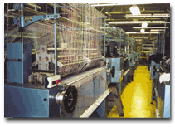
Fabric FormationBy David Gross, Consulting Editor Novelty Textile Bases Success On Different Approach To MarketQuick response to customer needs key to small knitting operation. Novelty Textile Mills LLC, Wauregan, Conn., is a different kind of company, and Allan R. Taylor, its owner and president, who purchased the operation in February 2000, takes a different kind of approach to the market.The company is a moderate-sized warpknit operation selling mostly to the apparel trade with sales of this year less than $10 million. Novelty’s edge, according to Taylor, is that it is not a commodity house.”Most of our development work is in apparel and in unique fabric. If we want to maintain our ‘unique’ niche in the market we have to continue to provide products that others can’t make easily or copy easily,” Taylor says.Using that philosophy, Taylor reports, the company’s sales in the less than two years he has owned it have doubled.Among the apparel markets Novelty Textile caters to are misses and juniors. “But what we sell on the California market requires a little bit brighter fabric than what we sell on the New York market.” Most of the fabric goes into women’s tops and jackets with some into cut-and-sew sweaters, according to Taylor. “We also make the trims that go with our products.”The company also produces technical textiles, to which Taylor also takes a different approach than larger companies. “My approach is to develop one technical product at a time. I can’t afford to set up a technical division and hire the people and take on the overhead and then wait two to three years to see whether the division pans out.””To me it’s much smarter to work on one product and become knowledgeable on that and work with one potential buyer to develop it. Once you’ve developed a product in the technical field for a customer, you don’t have to worry about it every season. You don’t have spring and fall and holiday. You often don’t have to remake that product for two, three, four, five or six years.”

Novelty also makes meshes, accessories and throws. Taylor says, “I would probably be receptive to almost anything else somebody else has an idea about. We don’t say no to something until we take a look at it. We’re in business to make money, and to do it where it’s conducive to the operation we have set up. If somebody has a product or an idea, and it’s conducive to our equipment, then we’re interested. We’re a specialty house. We’re not a commodity house where we’re locked into a certain type of thing. We’ll do almost anything.”

For someone working in the knitting industry and heading a knitting operation, Taylor is the first to point out that he is not a technologist. “My strengths are in organization, finance, economics and personnel,” he says.”I’m an accountant by education from Pace.”He joined Novelty in 1980 to fill a temporary management assignment, after working 11 years for McGraw-Hill and heading several departments doing cost analysis, and then about two years at Summy Bircher, the company that owns the song “Happy Birthday” and the North American rights to the Suzuki method of violin and cello, moving that company from Chicago to the New York market.
Taylor purchased Novelty Textile from Arthur Feinberg, who, after serving in World War II, had taken over the original company from his father, eventually moving it from Manhattan to Connecticut. Officially, Novelty was established in 1952. Feinberg continues to be “an adviser, assistant and councilor to our success. He’s a great technician and has been important in the development of new products,” Taylor says.
In the 1970s, Novelty went into equal partnership with Thomas HodgsonandSons of Suncook, N.H., giving the company a guaranteed source of yarn. Today, Taylor notes, Novelty is still buying almost all of its facing yarns from Thomas HodgsonandSons, now a part of Kennebunk Weavers, which is a subsidiary of Perfect Fit. Novelty still has a strong relationship with Hodgson. Taylor says,”They still work with us, and the’ve respected the yarns that we’ve developed and protect us by not selling those yarns elsewhere. That’s important when you’re in a venture business such as mine.”
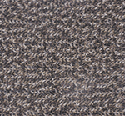
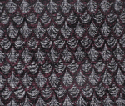
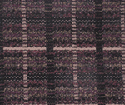
Among the factors that help to maintain Novelty’s uniqueness, Taylor says, are its equipment, the yarns used, the adeptness and cooperation of its employees and the types of fabric knit. “We have equipment that no one else has and we have the North American rights on some of that equipment so some of the appearance and presentation of our goods cannot be duplicated right now.””Some of those fabrics,” Taylor notes, “include so many different yarns that it’s almost impossible for somebody to copy it.”

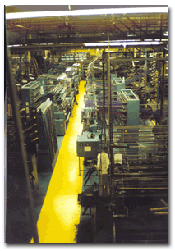
Some styles, for example, use about 38 yarns. “How can we do this We keep a tremendous amount of yarn in inventory at all times of every conceivable color. That gives us the ability, first, to make such fabrics, but it also gives us a tremendous ability to make samples for customers. And we’ll often turn samples for customers in 24 to 48 hours. Being a specialty house we have to be able to make samples and we have to be able to do it quickly.” Taylor notes that Novelty also does its own twisting. “We’ll twist two or three yarns together and make up a unique yarn that no one else has and can’t get. So we’re always looking for something to maintain our uniqueness that can’t be taken away from us. We also tend to work with heavy yarns. We don’t want to go into the fine yarn business. The finest yarn we’ll go to usually is 1,500 yards to the pound. We’ll go to 2,300 once in a while, but most of our yarns are in the 1,000-1,500 range. It gives that heavier but light and lofty look, and it’s unique to us. And we’re known for that.” Novelty’s facility covers 100,000 square feet and is equipped with more than 150 Raschel warp knitting machines. These include an extensive battery of mechanically operated Cidega units. “In addition,” Taylor says, “we bought and developed new electronic machines that provide enhancements to the old Cidega machines. We have the rights on those machines right now. They give us the looks of the Cidega equipment, but some enhancements and improvements and some capabilities we didn’t have with the Cidegas.”I also have the large [Karl] Mayer machines, but I don’t look for any volume production from those. Those machines are not where Novelty’s successes can be realized.” Mayer warp knitting machines are used in many plants in the U.S., Taylor says, noting “What I make on those [machines], most any one can make also. I don’t want to be in a business where I have to compete against somebody else who can make the smae thing. My success is making a unique product that’s not easily duplicated by someone else.”So, Taylor says, the company has modified its Mayer and Kidde Raschel units, both of which were originally designed to produce lace fabrics, to take very heavy yarns. “We’ve modified them to take bulky yarns and we try to run things on them that other people would have difficultry running on that equipment.”Another reason for Novelty Textile’s recent success, Taylor notes, is its development of business with Caribbean Basin countries. “From February on I’ve been shipping containers every week and a half to CBI. This year it’s going to be tremendously advantageous to me. Commitments have been heavy, and up from last year. I already know that the commitments are going to be bigger for next year.”
But, he notes, CBI has a major effect on schedules since those countries need 60 days for their flow-through. That means everything has to be shipped out by May 1, which, Taylor notes, was normally the middle of the heaviest production period for U.S.-based knitters.”If you’re in CBI and producing for those people, you’ve got to work for November-December and it could be heavy work. November, December, January, February, March, those are big prime months now. In the past those were months when you were hurting. What that also means is that you have to have your lines early. Whereas, if you had your fall lines for the following year and you had it ready by September or October, that’s great, you were early. Now, you’ve got to have that ready long before October. You should have your fall lines for the following year ready no later than August, and in some cases people want to see them in June or July.” Taylor says, ” The question is, ‘How long will manufacturers continue to buy my product made in America and not substitute it for a cheaper fabric. It can’t look like mine; they can’t do that, but it can look somewhat like it. Will they leave me behind and suddenly go to warp knitted fabrics from Korea or Taiwan or Indonesia (Indonesia is now more of a threat than China)” Taylor points out that fabrics from those markets often can be shipped to Guatemala, for example, and duties paid on them and still be cheaper than what comes out of U.S.-based mills.”Our fabric used to have a 3-year life. With the changes in the economy and the worldwide nature of the economy, if I can have two years protection, I should come out ahead. We recognize that creativity and design becomes even more important and we’ve taken steps to prepare and insure for that. We have the people on board to provide that ability.”Looking to the future, Taylor says,” When I bought this business a year and a half ago, a lot of people said, ‘you’ve got to be out of your mind. In the texitle industry buying a business, what are you doing It’s crazy.’ Well, I knew Novelty’s business because I helped run it for 20 years. But I also believed there was a future in certain aspects as long as you make unique products. I also knew when I bought the business that the year 2005 was going to be critical.
“So I knew I had to create some revenue flow that would not be jeopardized by 2005. Since I was picking as my instrument a company that was not a commodity house, but was a specialty house, and unique, I recognized that the economies of countries like China, Indonesia and Bangladesh are not going to go after my product because my market is too small. If I grow too large in one particular product, I become much more vulnerable to somebody knocking me off and trying to take away a piece of my business. It was part of the plan that I put together.”I projected that by 2005 we’d be very lucky if the life of a product was 18 months to two years. That means that my design and developmental cost have to at least double, because I’ve got to come out with new ideas, new thoughts, new presentations at twice the volume I did before. We’re setting greater strength in the development stage.” To prepare for life after the quota system is phased out at the beginning of 2005, Taylor has also started new businesses. “At some stage I’m going to have to have an avenue to get to the consumer,” Taylor notes. “I’m prepared to see where the future is. And if it requires me to be in some type of joint venture with people to provide my customers with a product, then I’ll do that. So, I have taken the steps to insure that I will be able to offer them that step or something similar to that step to insure that my fabric is still purchased.”Among his ideas are using components from all the companies going out of business that are left over. That incudes yarns and other components they might have used in manufacturing their product. Taylor says he has found a way to take some of those components and turn them into profit in some other way.”It gives me another profit center and that’s what I need,” he says. ” In my business, I don’t limit myself to one narrow little area. I’ll work on anything where I can efficiently make a profit. You name it, I’m doing it if it’s efficient for my operation. And it seems to be working right now. As long as we work at it hard.”October 2001
2001 An Economic Mix
recession. Real GDP will expand by 3.4 percent, after a strong performance in 2000.Consumer
spending, business investment and exports will drive 2001s expansion.Our balance of trade for goods
and services will deteriorate, with a deficit exceeding $350 billion for the second year in a
row.Expect inflation to come down by nearly a percentage point from 3.4 percent last year.The
Federal Reserve is likely to reverse course by cutting short-term interest rates only if growth
slows down sharply.Hiring will slow down with non-farm payrolls rising 1.2 percent, after gaining
an estimated 2.1 percent in 2000.New homebuilding will remain above the 1.5 million mark in 2001
for the fourth consecutive year.Growth in industrial output will shift to a lower gear.Textile
industry results overall will be mediocre again this year. The U.S. economy was in the fast
lane over the last four years, with growth above 4 percent a year. In fact, last years growth,
estimated at 5.2 percent, was the strongest since 1984. After six interest-rate hikes since
mid-1999 and a sharp upturn in world oil prices, the U.S. economy is showing signs of weakness.
While the jobless rate, at 3.9 percent in October, was down again to the lowest level in three
decades, gains in non-farm payrolls have slowed to less than 150,000 per month. As oil prices
soared to more than $30 per barrel, up from an average of $17.50 per barrel in 1999, the inflation
rate climbed to 3.5 percent by October, up a full percentage point from a year ago. On the bright
side, the sharp upturn in oil prices had little impact on the core inflation which excludes food
and energy price increases. The concern of a slowing economy is more evident in the stock market
prices and, in particular, the technology sector. This, in turn, has added to the fears that the
economy may even go into a recession if the wealth effect kicks in, as some analysts fear.Another
concern is the value of the dollar as the trade deficit reached an estimated record $364 billion in
nominal dollars, an increase of more than $110 billion. While the U.S. trade imbalance reached a
new record, the U.S. dollar has gained strength in foreign exchange markets, particularly against
the Euro.
Despite all the concerns, the expansion the longest ever for
the U.S. economy is expected to remain intact for another year. The latest consensus forecast of
the Survey of Professional Forecasters, conducted by the Federal Reserve Bank of Philadelphia,
calls for a 3.3-percent growth in U.S. economic activity in 2001. Our econometric model of the U.S.
economy forecasts that real GDP will rise 3.4 percent this year, following gains of 5.2 percent in
2000, 4.2 percent in 1999 and 4.4 percent in 1998. Gains in consumer spending, business investment
in equipment and exports will power growth. Further increases in interest rates are unlikely, and
there is a possibility that rates will come down half a point from current levels. Job creation is
expected to decelerate, while remaining strong enough to hold the jobless rate marginally above 4
percent. Inflation will continue to be under control, assuming no further increases in oil prices
beyond $30 per barrel. The dollars value in foreign exchange markets is expected to decline, but
the drop will be modest.

Factors Contributing To OutlookHere are the main reasons for
this outlook. With economic growth in Asia back in the fast lane, world demand for petroleum has
risen by more than a million barrels per day in the last two years. World demand rose to an
estimated 76.1 million barrels per day in 2000, up 6.2 million barrels from 1995, which was an
acceleration from an increase of only 3.9 million barrels in 1990-1995. It is not surprising that
OPEC had little difficulty pushing oil prices up to current levels. Despite a slowdown in economic
activity in the United States, the daily world demand for oil is likely to go up by another million
barrels in 2001, assuming normal winter conditions prevail. This means that OPEC will not be in a
rush to bring oil prices down by increasing production. As a result, oil prices are unlikely to
fall sharply from current levels. The U.S. refiners acquisition price of crude oil is assumed to
average $27.11 per barrel in 2001, down 2.3 percent from $28.95 per barrel in 2000, but up 55
percent from $17.50 per barrel in 1999. This means that the impact of slightly lower energy prices
on this years U.S. inflation rate will be small. With the U.S. population growing by 1.0 percent
per year and the labor force participation rate slowing down, the labor supply gain is capped at
1.4 percent per year. With the economy adding 150,000 jobs a month in 2001, the unemployment rate
will edge up to 4.1 percent from 4.0 percent last year. Faced with a slower growth and squeezed
profitability, the focus of employers will be on increasing productivity gains and tying
compensation to profitability. As a result, wage increases will be modest.
Assuming no major surprise, food prices are expected to move
up not more than the overall inflation rate. Thus, low inflation and a low unemployment rate will
continue to coexist for another year. Year-over-year inflation is seen rising by 2.5 percent in
2001, down by nearly a percentage point from the 3.4 percent in 2000. U.S. exports growth and a
gradual decline of the value of the dollar in foreign exchange markets will be a positive factor on
profits from foreign operations. With the overall industrial operating rate at 82.0 percent in
2001, virtually flat from 82.2 percent in 2000, growth in capital spending on plant and equipment
in manufacturing will follow suit. However, the big boost in capital spending on equipment in the
last five years came from investment in information- and telecommunications-related equipment. In
the telecommunications sector, only the major players can be expected to continue increasing
investment in replacements and on new technologies. With stock prices sharply down, smaller players
will have a tough time raising capital in the financial markets to expand investment. Furthermore,
many of the Internet-related start-up companies, which contributed to the growth in capital
spending on information equipment, are faced with the prospect of going out of business. In short,
real nonresidential investment is seen rising 5.5 percent in 2001, less than one-half the gains of
12.9 percent in 2000, 10.1 percent in 1999 and 13.0 percent in 1998.
As the nations output of goods and services expands by 3.4
percent, non-farm payrolls are expected to increase by 1.8 million over the course of 2001 down
from an estimated 2.4 million jobs created in 2000. With low inflation, growing employment and
rising incomes, consumer spending will be quite healthy rising 3.4 percent in 2001, after surging
5.3 percent last year.Total sales of new light vehicles are expected to ease a bit to 16.8 million
units in 2001, from a record 17.4 million in 2000. This will be the third year in a row having
total unit sales above 16.5 million, and the eighth year above 15 million. New construction will
edge down to 1.55 million, from 1.6 million in 2000. Accordingly, the pace of consumer spending on
durable goods will slow down to 3.8 percent, after double-digit growth in each of the previous
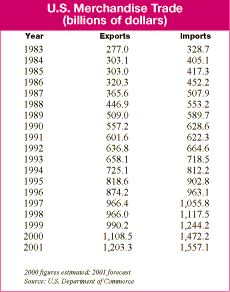
three years.The balance of trade deteriorated rapidly last year, as the U.S. economy grew at a fast
pace and economic activity overseas was modest. Total U.S. exports grew 11.9 percent in nominal
terms and 10.1 percent in real terms, as economic activity returned to high growth in Southeast
Asia. Meanwhile, imports continued to be a sore point for the United States, even after factoring
out the impact of the sharp rise in oil prices. Strong domestic demand and a 3.5-percent
appreciation of the dollars value against most of the currencies combined to push imports up 13.6
percent in real terms in 2000. In current dollars, the trade deficit ballooned to an estimated $364
billion, from $254 billion in 1999.
The return of high growth in Southeast Asia, coupled with a
small decline in value of the U.S. dollar in foreign exchange markets, will help U.S. exports in
2001 grow by 7.5 percent in real terms, led by capital goods down from an estimated gain of 10.1
percent last year, but a major improvement from the anemic increases of 2.9 percent in 1999 and 2.3
percent in 1998.Our growth in imports is expected to slow down, as U.S. economic activity
decelerates from 2000s booming rate. The end result, however, would be a small improvement in the
trade deficit in net exports of goods and services in nominal terms. With surpluses for the fourth
year in a row, after large deficits for nearly three decades, federal government spending adjusted
for inflation is expected to post a modest gain in 2001. This will be the third year in a row that
government spending grows, reversing real spending declines for eight consecutive years.
Furthermore, with the school-age population increasing, spending by local and state governments is
seen growing by 2.9 percent in real terms, down from 3.5 percent in 2000 and 3.8 percent in
1999.
Textile Forecast Shows Little PromiseProspects for U.S.
producers of fibers, textiles and apparel are not very promising for 2001.Clothing prices have been
on the decline since 1992, except for 1998, falling by an average of 1.2 percent per year. The
decline in prices has contributed in part to the strong demand for clothing in real terms. In 2001,
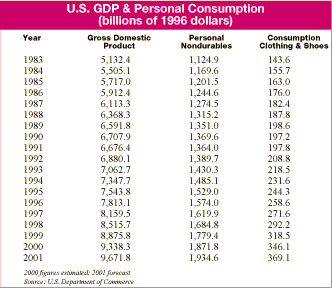
total outlays for clothing and shoes are expected to grow 6.6 percent in volume and 6.0 percent in
dollar terms. Last year, spending on clothing and shoes surged 8.7 percent in volume and 7.0
percent in dollar terms. The trade deficit for apparel ballooned to an estimated $56.6 billion in
2000, from $48.5 billion in 1999 and $45.2 billion in 1998. Unfortunately, all the benefits of
increased domestic demand for apparel accrued to foreign producers because U.S. output of apparel
declined 3.8 percent last year, on top of a loss of 6.4 percent in 1999.Because U.S. industrial
output is expected to soften this year, industrial fibers and textiles will end at their current
levels. With the vacancy rate down to low levels, the addition of 1.8 million new jobs in 2001
bodes well for additional demand for office space and a small improvement in new construction. In
2001, investment in nonresidential buildings is expected to grow by about 1.5 percent in real
terms, after surging 8.5 percent in 2000. With after-tax corporate profits still up by 3.5 percent
in 2001, growth in business spending on carpeting and furnishings will slow down. Demand for
U.S.-made fibers, textiles and apparel is likely to decrease in 2001. Exports will make a minor
contribution to growth as economic activity overseas improves, while imports will continue to gain
ground, resulting in further deterioration in the trade gap.Despite a gain in economic activity,
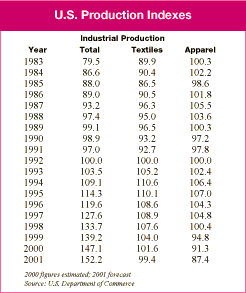
production of domestic apparel and products is expected to decline in 2001 for the sixth year in a
row. In 2000, output was down an estimated 3.6 percent, after falling 5.6 percent in 1999. Textile
production is expected to decline 2.2 percent this year, after falling 2.3 percent in 2000 and 3.4
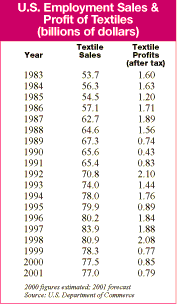
in 1999. Shipments by textile producers are expected to ease to $77.0 billion, from an estimated
$77.5 billion in 2000 and $78.3 billion in 1999. In a slowing economy with low inflation and still
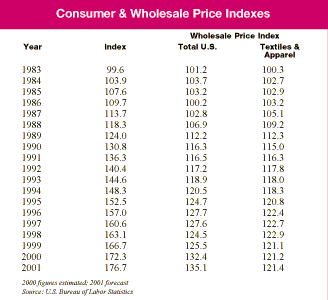
a relatively strong dollar, wholesale textile and apparel prices are likely to remain essentially
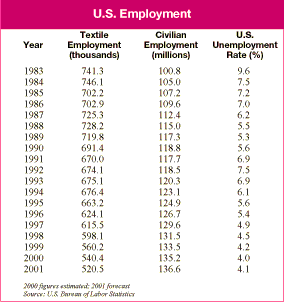
flat for the second straight year.The outlook for the industrys payrolls is for a 3.7 percent drop,
down for the seventh year in a row. Payrolls declined 3.5 percent in 2000 and have declined by
157,200 jobs since 1994. Expect employment to average 520,000 jobs in 2001, down nearly 20,000 jobs
from last year. Finally, hourly wages will rise 3.0 percent in 2001.
In a cutthroat environment, the industrys capital spending
will be concentrated on replacing noncompetitive capacity and increasing efficiency in order to
defend domestic markets from rising foreign competition. In 2000, growth for textile exports slowed
down to a meager gain of $0.1 billion, while imports rose by $1.0 billion, lifting the textiles net
trade deficit for 2000 to $6.3 billion from $4.4 billion in 1999 and $3.9 billion in 1998. Clearly,
the sharp appreciation of the dollar in the aftermath of the Asian crisis is partly to blame. While
the industry is to a large extent insulated from foreign competition due to its capital intensity,
the trade deterioration in the last three years is not likely to go away in the near future.
Moreover, in a low-inflation environment and with squeezed profit margins, rationalization is
unavoidable. With the industrys operating rate down to 81.1 percent from 82.3 percent in 2000 and
83.1 percent in 1999, this years textile spending on plant and equipment cannot be expected to
grow. Risks To The ForecastA major risk to our economic outlook is the uncertainty due to the
possibility of higher oil prices if there is any disruption in the Middle East. A jump in oil
prices will tax consumer budgets, which in turn will accelerate the slowdown in consumer spending.
In this case, economic growth will be in the 2.5- to 2.8-percent range in 2001. On the bright side,
if oil prices subside and fall below the $25-per-barrel mark, inflation will be lower and the U.S.
economy is likely to pick up speed in 2001, with growth at better than 4.0 percent.
January 2001
How Meridian Improved Dyed Yarn Repeatability
Chemical TreatmentandFinishingBy Edward J. Elliott PE, Ccol, FSDC How Meridian Improved Dyed Yarn RepeatabilityValdese plant gets a boost in quality and achieves an amazing 3- to 4-month payback. At the Meridian Industries Inc. Dyed Yarn Group Plant in Valdese, N.C., management is obviously attuned to responding to new technology as frequent changes in customer needs. Tim Queen, dyeing manager, says to achieve prime dyed quality depends on awareness of technology applicable to the companys need to dye approximately 300,000 lb/ 5-day wk, including acrylics, spun polyester, wool, rayon, cotton and blends, with yarn counts ranging Ne 1-150. Dye classes used are vat, direct, reactive, acid, basic and sulfur. Queen says, “About five years ago, most dyed yarns were for apparel. Today the accent is on automotive, homefurnishings and novelty yarns.”And a 200,000-lb inventory of specific manmade and blended dyed yarns allows Valdese to quickly respond to customers needs. Experience shows this to be of the utmost importance to Meridians customer base. Valdese has 18 Gaston County Dyeing Machine Co. package dye machines. The plant can dye up to 2,500-3,500 pounds of a dye shade. Gaston County Dyeing Machine controllers and process control system optimize dye machine performance. Paul Barnes, laboratory manager, says, “A Datacolor color match system is able to efficiently match about 75 shades per day from customer fabric samples, Pantone chips or Pantone fabric standards. Most matching is for new shades, not repeats.”
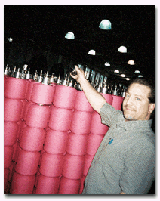
Wayne Powell, dyeing department supervisor, adds one of the company’s new caps to the dye tupbe spindle.Using a Datacolor (Gain) DyeMaster and 108-bottle laboratory dispense unit facilitates the duplication and repeatability of lab dyeings that are efficiently transposed to production package dye machines. Barnes says, “Often we require only 3-4 days from color match to shipping dyed yarn. And in some special cases, we have been able to complete the cycle in one day.”Queen says, “One of the many challenges a dyer faces is to compensate for the yarn shrinkage that occurs during the hot/wet process cycle.”You can expect each package to “shrink” about one millimeter. With eight packages on a spindle, a vertical shrinkage of approximately three inches plays havoc with dye liquor circulation. Usually, this shrinkage is addressed by cooling the solution, opening the dye machine lid, manually tightening the wing-nuts on each spindle, closing the lid and returning to operating temperature. This manual wing-nut tightening (capping) must be done after each separate hot liquid cycle (wet-out, dye, rinse, soap, etc.) so the dye/chemicals are uniformly applied to each part of every package. “Capping” is equally important in drying to preserve dye shade and attain uniform moisture content within all of the yarn.Queen says Valdese found that the patented R-TEX cap answered all the concerns about shrinkage. With the R-TEX principal of using the cap weight and gravity, the device automatically compensates for shrinkage within the machine, with no lost time for opening the kier. This dramatically improves dyed yarn uniformity, avoids the safety concerns of opening a hot kier, conserves cooling water needed to reduce kier temperatures to 190 F, improves machine usage and has a 90-120 day pay-back. With many dye stands containing 1,280 packages per load (in stacks of eight/spindle), wing nuts may be manually tightened in varying degrees of torque depending on operator effort/attention at any particular time. It is a technique fraught with myriad possibilities for chaos on a 3-shift, 5-day/wk operation.Valdese capital expenditures for color match prediction and lab dispensing was to ensure accurate shade samples. But, it’s axiomatic that lab results must be duplicated in production.
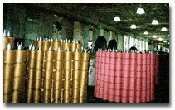
Many dye stands at the Valdese plant contain 1,280 packages per load (in stacks of eight/spindle). Manually tightening wing nuts results in varying degrees of torque, depending on operator effort/attention at any particular time. Valdese recognized that machine process controls were an important aspect of dyeing. But, process controls are dependent on the correct functioning of the parameters they control. It doesn’t help to have state-of-the-art controllers if the seal between yarn packages isn’t stable and assured. The installation of the R-TEX caps on all spindles has proven to be a practical and technological innovation.Queen concludes, “Our combination of lab techniques and strict control of production dye conditions have demonstrated the practically of lab-to-production dye quality controlaka, a high success rate in attaining first-time production dyeing. The Valdese mission statement is to be a customized supplier. The company can, and will, adapt its skills and technologies to match its customers.October 2001
Products That Made News At ATME-I 39 01
Products That Made News Products That Made News At ATME-I ’01Fourth in a series gives some details on products TW editors feel have immediate industry significance.
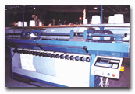
Tandem head machine, Dotti, can produce 12-cut plain trim with its twin single system carriages working over a 79-in. wide needlebed. The computer operated machine features high and low butt needles and electronic needle selection. Vanguard. www.vanguardsupreme.com
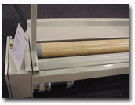
Winder, EcoWinder, is a low-cost machine for standard cloth winding operations. Unit sets up at the weaving machine and winding speeds adjust automatically to weaving machines. Roll width is nominal weaving machine width plus 100 mm. Machine uses a d-c motor and offers a maximum speed of 2 m/min. Neuenhauser (U.S. Rep: Hubtex) www.neuenhauser.de New replacement service replaces top or verge rings and sinker rings at its facility in Greenville. The company offers replacement cylinders for a variety of models including those form Orizio, Terrot and Vanguard. It also offers 46-cut cylinders for Terrot equipment, primarily for industrial uses, as well as cylinders for the recently introduced Charlotte seamless garment-knitting machine from Trustfin-Monarch. Mayer.www.smc-cylinder.com
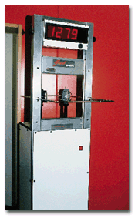
Selvage system, Propeller Leno, produces a full cross fabric selvage on a 2-thread basis. It affords the potential to pull of leno threads from large bobbins. The system enables speeds in excess of 1,200 ppm. Features include customized leno binding sequences, minimum number of movable parts, quick and easy installation using different adapters for respective weaving machines and low operating costs because of its resistance to wear. Components include cross leno cone creels with variable fastening devices for two bobbins, thread reversions with different fastening adapters for two threads and threading aids. Gebr. Klocker (U.S. rep: Grob USA).gebr.kloecker@t-online.de

Four-way loader, Model W-EFY-ES, offers multi-directional handling of warp beams up to 10,000 lb without stabilizers or outriggers. Device has 4-wheel steering and beam carriage offers hydraulic width adjustment. Lift heights are to 236 in., and touch-pad steering allows 360-deg turning range. Williamson. (864) 848-1011.
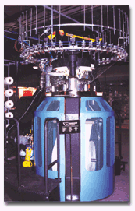
High speed industrial machine, 2SR2/VI, has a speed factor of 1500 and can take up a roll up to 42-ins. in diam. on its industrial frame. The rib unit was exhibited in a 19-in. diam, 14-cut model equipped with a Filter Flow lint cleaning system. It also features one track high-speed camming for the production of 1×1 rib. Vanguard.www.vanguardsupreme.com
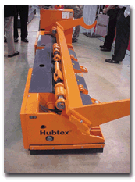
Beam truck, KHW-TSEF-III, has capacities up to 2,000 kg for full and twin beams up to 3,800 mm wide. Machines feature twin drives, power steering, electronic direction selection, steerable cross drive, electronic axial displacement. Hubtex.www.hubtex.com Warp sizing, Penflex 2, a line of products that significantly reduce or eliminate the need for binding materials such as PVA. Strong and flexible. Reduces sizing costs and improves weaving performance. Custom manufactured for each application. Process Chemicals, LLC. www.process-chemicals.com Batching motion, T-2000, requires low maintenance. Dust-tight, heavy steel-end housings, which provide sturdy structural integrity to the machine, enclose all drive components. Features include PermaCoat bed rolls, turning directional rolls, face-in or face-out winding capabilities, adjustable core guides, isolation transformer, high-voltage disconnect, separation of electrical/mechanical components and low power consumption. Options include fabric oscillator, power doff, DA-186 yardage sensors with or without digital readouts and non-lighted inspection stands. Alexander Machinery Inc.www.alexco.com Glove knitting machine, Model SGT, can knit two 14 gauge complete gloves in three minutes. The tandem single system carriages can operate at a speed of 250 rpm and are driven by servo motors. This is a compact computer operated machine available in 7-14-cut. The unit also features two microphones built into the machine to detect any abnormal noises and stop the machine when they do. It also has a vacuum system to clean the yarn trim. Matsuya. matsuya@quartz.ocn.ne.jp
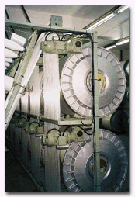
Warp thread tension control, Solex, meets varying weaving requirements on such fabrics as seat belts, airbag fabric selvages, elastic and filter ribbons, fabrics for medical care, etc. The system promotes higher efficiency through fewer thread breaks and machine stops. For higher warp thread tensionsmore than 40 kg per warp, for examplean alternative to the friction drive is available: a power connected drive. The needs come from different industry segments, but particularly tubular weaving. Willy Grob Ltd. 41 55-286-13-4. Wastewater treatment, GTV Size Recovery System, recovery rate of 85%. Reduction of dust emission in the mill. No enzymatic or oxidative pre-treatment for the desizing. Lower fresh water use and smaller wastewater discharge. Reduction of pollution load in the effluent by approx. 50-60%. Lower oxygen demand in aeration tanks. GTV GmbH (U.S. rep: Sourcing Services International). (864) 879-3650
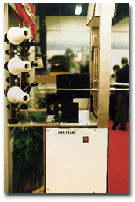
Three-end leno device operates mechanically from the weaving machine by a toothed belt. From the bobbin, the crossing threads pass, via the thread guide, in an almost straight line through high-quality ceramic eyes. This permits processing even brittle, e.g., glass, yarns. With the minimum deflection, you can draw in the crossing threads with the auxiliary needle. The three-end leno device is available in single and double version, for installation on the picking and receiving side of the weaving machine. Schmeing (U.S. rep: Southern Loom Reed). schmeig@schmeig.com
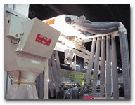
Travelling cleaner, LT-2, is for weaving machines and features automatic sleeve reverse, 14 blowing sleeves, floor sweepers, automatic discharge with electromechanical drive activated by sensors, an alarm light and an individual traction motor. Unit has a 7.5 hp motor and blowing speeds up to 215 fps. Suction speeds are to 158 fps and filtering is 230,000 cfm. Travelling speeds are 36, 72, 92 and 112 fps. Electrojet (U.S. Rep: PSP Marketing)info.jet@electrojet.com Dispensing equipment, liquid and powder equipment, with storage tanks holding from 500-30,000 liters. Computer controlled Interface and Support Package (ISP), can be linked with several color and chemical dispense systems. Stock-control per location. Free programmable dissolving steps and methods. Overview of orders still to be dispensed. Vanwyk Systems. www.vanwyk.nl Drive, Ergodrive, is a servo-device for weaving machines main drive, take-up and let-off. Device offers wide power range and high performances in compact dimensions. Unit operates automatically with any yarn and features input for warp tension control. Communication capabilities allow synchronized weaving, and units are predisposed for remote control operation. Ergotron (U.S. Rep: Lang Ligon& Co.) www.ergotron.it
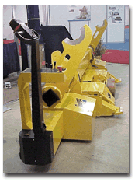
Beam truck, EE-KHUR 30, handles up to 3,000 kg in 1 meter flange diameter or 2,500 kg in 1.1 m flange diameter. Supporting rollers prevent floor damage, and servo motors allow coupled steering. Electronic pulse control allows smooth starting and stopping, and electro hydraulics allow smooth raising and lowering of beam. Genkinger (U.S. Rep: SSI Sourcing International) www.genkinger.deOctober 2001
Zimmer Obtains Contract To Build PBT Plant In Taiwan
Germany-based Zimmer AG received a contract from Chang Chun Plastics Co., Taiwan, to supply a
polyester polycondensation plant designed to produce polybutylene terephthalate (PBT). The plant is
due to go online in early 2002.The plant is to produce 200 tons of polymer per day, using
terephthalic acid and 1,4-butanediol as feedstocks. Zimmer will provide the technology and
equipment for the plant and will also take responsibility for the supervision of erection and
commissioning.
January 2001
Stork Introduces Pigment And Disperse Applications
The Netherlands-based Stork Digital Imaging has completed the application line for the Amber
printer with the introduction of pigment- and disperse- transfer applications. These two new
applications, plus reactive and acid, allow high-quality digital prints on nearly any type of
substrate.Pretreatment of the substrate is no longer necessary with the pigment application, and
aftertreatment is restricted to the standard heat fixation. The pigments can be used on a wide
variety of substrates, including natural and man-made fibers, blends and even Lycra®. Stork says
that high light- and wash-fastness levels, similar to those for conventional pigments, can be
achieved.With the new disperse transfer application, the Amber printer can print a design on
transfer paper. The design is then transferred onto polyester substrates. Again, no pretreatment of
the substrate is necessary. Stork claims this is a truly unique way to print polyester with high
fastness levels, large color space and pin-sharp details.
January 2001
KoSa Names New Chairman Of The Board
HOUSTON, Jan. 17 /PRNewswire/ — The KoSa Board of Directors has named Bill Caffey, Koch Industries
executive vice president, as its new chairman,effective Dec. 11, 2000. Caffey succeeds Isaac Saba,
KoSa’s first chairman,under a plan that rotates board leadership between the company’s owners every
two years. Also, Steve Feilmeier, Koch’s vice president for finance, has been named to the board
and will replace Joe Moeller, President of Koch Industries. KoSa, one of the world’s largest
polyester producers, is owned by Koch International Equity Investments B.V. and Koch Equity
Investments Inc., two subsidiaries of Wichita, Kansas-based Koch Industries Inc., and IMASAB S.A.
deC.V., a Mexican company owned by Isaac Saba. “I am pleased with how much KoSa has achieved since
being established in December 1998,” Saba said. “Our commitment to quality products, strong
customer service, and technological innovation has made us an industry leader.I look forward to
continuing to work with the KoSa board, management and employees to build on that foundation in
2001 and beyond.” KoSa produces commodity and specialty polyester products as part of five global
businesses: Intermediates and Polymers, Packaging Resins, Technical Filament, Textile Fibers and
Tirecord. With global headquarters in Houston,Texas, KoSa employs 10,000 people worldwide.SOURCE
KoSaCopyright 2001 PR Newswire