Apollo Chemical Corp., Graham, N.C., has introduced a new cationic antistat, Barstat PF-1. The
company claims Barstat PF-1 prevents static clinging and crackling with extrememly low application
levels and is very effective in low humidity conditions.
October 2000
Apollo Introduces New Cationic Antistat
Producer Price Index Shows Inflation Is Under Control
T
he evidence from the latest set of economic reports is that the American economy is
slowing down in response to the higher interest rates and rising energy prices earlier in the year.
As a result, the Federal Reserve will most likely avoid another rate hike in its October meeting.
With consumer spending slowing down and exports weakening, manufacturers trimmed their
August payrolls by 79,000. A further drop in the number of temporary census workers took out
158,000 jobs from August’s non-farm payrolls, while the strike by communications workers at Verizon
temporarily reduced employment by 85,000. As a result, total non-farm employment declined by
105,000 jobs in August. After factoring out the effects of the strike, the private sector created
only 102,000 jobs in August. This is a clear sign of a weakening economy.
The August jobless rate edged up to 4.1 percent from 4.0 percent in July.
The Producer Price Index for finished goods fell 0.2 percent in August, as energy and food
prices declined. Excluding food and energy, however, the price index edged up 0.1 percent in August
for the second month in a row. This clearly shows that inflation is under control.
A 5.9 percent plunge in energy prices pushed consumer prices down 0.1 percent in August, the
first decline since April 1986. The core inflation rate was up 0.2 percent for the fifth month in a
row.
Industrial Production Shows Modest Gain
ndustrial production grew 0.3 percent in August, after staying flat in July. A 4.0 percent
surge in utilities’ output was the main factor for the growth. Manufacturing output edged up 0.1
percent in August for the second month in a row, another sign of a slowing economy. Also, the
operating rate of industrial capacity edged up to 82.3 percent from 82.2 percent in July.
New housing construction was virtually flat in August. Housing starts rose 0.3 percent to a
still strong annual rate of 1.53 million units. Single-family units jumped 4.6 percent to 1.26
million, after falling 1.8 percent in July. Multifamily units, however, plunged 15.9 percent to
0.27 million in August, on top of a 6.7 percent drop in July.
The U.S. trade deficit of goods and services ballooned in July to a record $31.89 billion
from $29.85 billion in June. Exports, hurt by a strong dollar and sluggish growth in Europe, fell
1.5 percent to $89.67 billion. The decline reflects declines in exports of industrial equipment,
autos and consumer goods. Meanwhile, record oil imports pushed total U.S. imports up 0.6 percent to
$121.56 billion.
Business sales retreated 0.4 percent in July, as durable goods sales declined 0.8 percent.
Meanwhile, business inventories grew 0.2 percent. As a result, the July inventory-to-sales ratio
inched up to 1.33 in July from 1.32 the previous month.
Textile, Apparel Payrolls Rise; Synthetic Fibers Prices
Rebound
esults for textiles and apparel were mixed. Payrolls rose 0.3 percent in August, after
plunging 1.3 percent in July. The jobless rate for textile mill workers dropped to 3.2 percent from
3.9 percent in July.
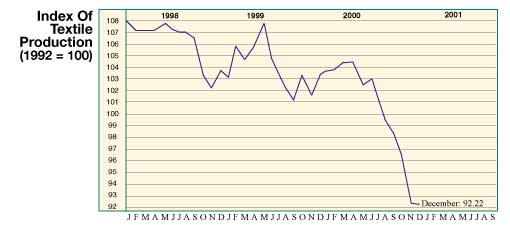
Textile output declined 0.9 percent in August, after falling 0.7 percent in July. Output was
3.4 percent below the year ago level. The utilization rate eased to 81.8 percent of capacity from
82.5 percent in July.
Shipments by textile producers declined 1.0 percent in July after rising 1.7 percent in
June. Inventories grew 0.2 percent, pushing the inventory-to-sales ratio up to 1.61 from 1.59.
August retail sales rose 0.2 percent, after a July gain of 0.9 percent. Dur-able goods sales
were flat, as motor vehicles sales dropped 0.4 percent. Sales inched up 0.1 percent for building
materials and hardware. Sales of general merchandise rose 0.2 percent and surged 1.1 percent for
furniture and home furnishings. Apparel and accessory sales moved up 0.3 percent.
Producer prices of textiles and apparel were unchanged in August. Prices rebounded 0.7
percent for synthetic fibers after falling 0.9 percent in July. Prices edged up 0.1 percent for
finished fabrics and home furnishings, were flat for greige fabrics, and fell 0.1 percent for
carpets and for processed yarns and threads.
Quality Fabric Of The Month: Worth Its Weight In Gold
When Lees Carpets showed its products recently at NeoCon 2000 in Chicago, it racked up several honors, including three “Best of NeoCon 2000” awards for product design and a Buildings Magazine Innovation Award. Lees, a division of Greensboro, N.C.-based Burlington Industries Inc., won the Gold “Best of NeoCon 2000″ award for modular carpet for its Celtic Collection. First introduced in 1999 and subsequently refined, the collection is used primarily in corporate and retail settings and other large public environments. It is available as 18-inch-square modular tiles through Lees Squared, the company’s modular carpet division, and also as a 12-foot broadloom product through its broadloom division.”To better meet the needs of the architecture and design community, we adjusted the colors and face weight of this offering,” said Alex Jauregui, vice president, Lees Squared. “It’s a strategically colored collection that continues to build on the Lees color story by coordinatingwith other products, such as Truth in Color, which is the anchor product for our broadloom division, and Essence, the anchor for our modular division. The Celtic Collection’s aesthetic and performance attributes, combined with competitive pricing, are sure to make it one of our most
versatile products.”
Designs By ClodaghThree small-to-medium-scale patterns in 16 running-line colorways were created by New York City-based Clodagh Design Signature, a division of the acclaimed Clodagh Design International. The original colorways have been modified by the use of multicolored space-dyed yarns, which add visual depth and richness to the carpet and make it suitable for use in many different environments. Because the three patterns share the same colorline, they can be coordinated to differentiate specific areas, while color consistency is maintained throughout the facility.
The carpet is constructed of DuPont Antron® Legacy nylon. Lees’ Elumicolor™, an accent yarn with a metallic luster, adds depth and dimension to the carpet’s appearance. Permanent stain, soil and fade resistance is integrated into the fiber using Duracolor®, Lees’ exclusive, patented stain-resistant dye technology.
New Triax® Technology
The Celtic Collection makes use of Lees’ new Triax® tufting technology to provide texture to the carpet surface and to create a lighter-weight but denser carpet that is also moderately priced. According to Bob Hutchison, vice president, styling and design, Lees Carpets, the technology involves an ultra-sophisticated yarn-feed control that enables the drawing of more accurate and detailed figures and also results in clean, precise edges like those found on woven carpet — all with no loss in performance.
The broadloom carpet features Lees’ Unibond™ backing system, which has a bond three times stronger than that of latex carpet backing. Modular tiles feature Lees’ Integrated Cushion Thermobond™ backing system, a thermoplastic coating with reinforced fiberglass construction that is moisture- and mildew-proof. Both backings carry lifetime warranties.
Self Lock™ Adhesive
Lees Squared’s Self Lock™ patented, environmentally friendly, factory-applied, pressure-sensitive, releasable adhesive system — a feature specific to the division’s modular tiles — received the Buildings Magazine Innovation Award in the Workplace Flexibility Solutions category. Self Lock allows clean, easy installation and immediate access to the newly carpeted area. The tiles are particularly suitable for raised-access floors, as they can be taken up without weakening the adhesive, and repair and replacement of the tiles are easily accomplished.
For more information about Lees’ Celtic Collection, contact Michele Kottcamp, director of
marketing and communications, Lees Carpets, (336) 379-4546.
October 2000
Federal Trade Commision Votes On Care-Labeling Rules
The Federal Trade Commission (FTC) has voted to amend its care-labeling rule for clothing.The
Commission approved an amendment that affects the current reasonable basis standard, clarifying the
evidence needed to substantiate cleaning instructions for a garment. Every garment manufacturer
relies on having a reasonable basis to determine and defend the care instructions placed on each
garment. These changes may affect the way garments are labeled.The FTC also approved an amendment
that updates water temperature definitions to conform to current industry standards. The current
definitions of “hot,” “warm” and “cold” water will be updated. Changes in technology have altered
these definitions and may affect how a reasonable basis for care labels is determined by
manufacturers.The FTC voted not to make a change to the rule that would mandate home-wash
instruction. A proposed amendment suggested that all garments that could technically be washed at
home be labeled for home washing. It was noted, however, that manufacturers must be careful not to
mislead consumers on washing instructions. A manufacturer using a “Dry-clean Only” label must have
a reasonable basis of stating this warning against home washing.
October 2000
Evergreen Makes Nylon Live Forever
More than 200 million pounds of post-consumer nylon 6 carpet waste will be kept out of U.S.
landfills each year because of the efforts of environmentally conscious Evergreen Nylon Recycling
LLC (ENR), Augusta, Ga.Honeywell International (formerly AlliedSignal Inc. Performance Polymers),
Colonial Heights, Va., and DSM Chemicals North America Inc. (DCNA), Augusta, Ga., are the joint
venture partners of ENR. The recycling plant, which celebrated its grand opening in November 1999,
is the first economical, large-scale recycling operation for the recovery of first-quality
caprolactam from waste carpet and nylon scrap, according to Richard Lawson, manager, total quality
and training, DCNA. The operation allows nylon to be recycled repeatedly in a truly closed loop.The
recycled nylon can be used in any nylon application, including new carpet, because the process
produces material that is exactly the same as that made from new raw materials. Even the by-product
fibers from the carpet backing will be reclaimed and marketed for use in cement and other products.
Lawson noted the $85 million facility would keep more than 200 million pounds of post-consumer
nylon 6 carpet waste out of U.S. landfills each year. “Carpet represents about 2 percent of total
waste in U.S. landfills, and this business enterprise will reclaim nearly 20 percent of all
discarded nylon 6 carpet,” he said.The demand for recycled content in products continues to rise in
response to environmental, legislative and consumer pressure. A number of vehicle manufacturers are
now reacting by specifying percentages of recycled content in their components. Dave Mezzanotte,
general manager, ENR, and vice president and general manager, Honeywell, said, “This venture allows
us to do something that has never been done before we can make a nylon product live forever. Not
only do our products offer significant environmental benefits, but they are made with the same
quality as virgin nylon products, so you would never know they were recycled.”Lawson added,
“Quality is very important to all products, including nylon. In 1992, DCNA achieved ISO 9001
certification. Through its well- developed quality system, and the extensive in-depth training
given employees, ENRs product quality is second to none.” Nylon 6 Polymer FacilityLawson
explained that, through a polymerization process, the plant converts monomer (caprolactam) to nylon
6 polymer. The monomer feedstock is both virgin monomer from the DCNA plant and recycled monomer
from the ENR plant.The facility consists of two parallel polymer trains and shared utilities. One
polymer line is currently the largest of its kind, producing polymer for carpet fiber applications.
Most of the output of this line is dedicated to one of the largest carpet manufacturers in the
world. The second, smaller line produces polymer for engineering plastic applications, with most of
its output dedicated to DSM Engineering Plastics, a DCNA affiliate company.”This facility is
state-of-the-art with smart instrumentation, computer-based DCS [digital control system] control,
and virtually 100-percent conversion of monomer to polymer,” Lawson said. “Final product is shipped
bulk truck, bulk rail and Gaylord packages.” Carpet CollectionSeveral years ago AlliedSignal
and DCNA launched a pilot facility to recycle carpet. By the end of 1997, the experiment in carpet
recycling was considered a success. The next step was to commercialize the experiment and develop a
facility that could recycle more than 1 billion pounds of post-consumer carpet per year.”In
preparation for this unprecedented commercialization, we have been promoting that industry should
collect carpet,” Lawson said. “This industry of recycling is still in its infancy, but we have
learned a great deal about carpet collection over the past several years and are optimistic that it
will continue to blossom.” Carpet collection is already underway in 75 metropolitan areas
throughout the U.S. In fact, ENR has already collected 70 million pounds of carpet for production.
Carpet retailers can save tens of thousands of dollars each year in landfill fees and other
disposal costs by being part of the collection network, Lawson said.By integrating information and
resources, innovative methods often emerge, as was the case with this joint venture. DCNA In
BriefDCNA is a business unit of the Netherlands-based DSM Fiber Intermediates Business Group. This
integrated international group of companies is active worldwide in chemicals, biotechnological
products and plastic materials. The group has annual sales exceeding $7 billion and employs about
23,000 people at more than 200 sites in Europe, North and South America, Asia, Africa and
Australia.DCNA, originally a joint venture between DSM BV and Pittsburgh-based PPG Industries, was
founded in 1962. Their first venture was a nitrogen fertilizer complex. In 1964, Nipro, Inc. (the
predecessor of DCNA) was organized to manufacture caprolactam, the monomer of nylon 6 used in nylon
fiber production. Subsequent expan-sions of DCNA in 1972 and 1976 made it the largest independent
market supplier of caprolactam in the United States. DSM bought out PPGs interest in the venture in
1973. Construction on the ENR plant in Augusta began in the fall of 1998. Honeywell
(AlliedSignal) In BriefPerformance Polymers is a strategic business unit of Honeywell
Inter-national. Honeywell merged in 1999 with AlliedSignal Inc., an advanced technology and
manufacturing company serving customers worldwide with aerospace products and services, automotive
products, chemicals, fibers, plastics and advanced materials. AlliedSignal was one of the 30 stocks
that make up the Dow Jones Industrial Average and is also a component of the StandardandPoors 500
index. The company employs 70,400 people in some 40 countries.The merged company retained the
Honeywell name and trades under the ticker symbol HON on the New York Stock Exchange. Honeywell is
now part of the Dow Jones Industrial Average, taking the place of AlliedSignal. This merger has
created one of the nations largest companies. In 1999, Honeywell was listed as a Fortune 50
company, with sales of about $24 billion. Honeywell operates in 96 countries and has more than
120,000 employees. The combined market capitalization of Honeywell International exceeds $45
billion. Lawson said the primary reason for the merger was to take advantage of synergies in the
aerospace business.Both Honeywell and AlliedSignal manufactured components used in commercial
aircraft. Their merger is expected to save as much as $750 million by 2002. Some of this savings
will be realized through elimination of redundant jobs, but a large part is expected to come from
an acceleration of AlliedSignals 6 Sigma quality program. The new Honeywell Inter-national will
have businesses in aerospace, control technology, auto-motive, power generation, specialty
chemicals, fibers, plastics, electronics, and advanced materials.ENR is part of Honeywells fibers
and plastics business that makes nylon 6 resin for use in fiber products such as carpet and
industrial textiles, as well as engineering resins that are typically used in automotive
applications. Patented TechnologyNylon fibers can be recycled time and time again back to
their base material without any loss of properties. This post-consumer system is the most complete
form of recycling available, according to Lawson. The recycling process does not produce any waste.
Even the non-nylon 6 materials and the dirt present in used carpet (which, together, form 55
percent of carpet waste), are economically reused as a co-product.The ENR plant uses a jointly
developed, patented technology that depolymerizes nylon 6 into capro-lactam. Nylon 6 is used in
such applications as residential and com-mercial carpet, engineering plastics, automotive parts,
sporting goods, films and packaging. The facility will produce more than 100 million pounds of
caprolactam each year with the same performance and aesthetic qualities as virgin
caprolactam.Caprolactam is the primary raw material used in the production of nylon 6. At DCNAs
plant, it is stored in liquid form in tanks heated to a temperature of 170°F. Molten caprolactam is
shipped to domestic customers who convert it to nylon 6 for end-uses including carpet, tire cord,
monofilament (trimmer/edger line and fishing line) and engineered plastics. DCNA also cools the
molten capro-lactam into a solid state known as flake caprolactam. The flake is then packaged for
export sales primarily for textile applications (apparel and hosiery).The ENR facility is also a
model of energy efficiency, saving 700,000 barrels of oil and 4.4 trillion British Thermal Units
(BTUs) per year compared to conventional caprolactam production. Lawson noted this is enough energy
to heat 100,000 medium-sized homes for a year. Recycling AdvantagesThe key drivers for nylon
6-to-caprolactam recycling are as follows: Caprolactam can be produced economically with quality
equal to virgin material.Material life is extended, saving money in the business chain.The process
is environmentally sound from every aspect.Demand for materials and components with a recycled
content is growing.Because ENR can accept only nylon 6 waste, it became apparent from the start
there had to be a way to sort nylon 6 carpet from forms such as nylon 66 and polyester.Experienced
operators are critical to maintaining product quality. “Therefore, it is extremely important that
workers be trained properly in the use of sorting equipment and other markings, which can be used
to identify carpets,” Lawson said. Indentification CodesIdentification codes are printed
either directly on the back of the carpet as a string of letters or on an attached bar-code label.
This label is called a carpet component identification code (CCIC), which is a 7-digit alpha code
developed by the CarpetandRug Institute (CRI), Dalton, Ga., to identify the construction of a
carpet. This code has been used since 1996. Because the average life of a carpet is between eight
and 12 years, the only carpet likely to have the code on it today are remnants and installation
scraps.The most important digit in the code is the first letter. An A in this position indicates a
nylon 6 carpet, which is the type ENR recycles. B or C indicates a nylon 66 carpet. The second or
third code position identifies the type of primary and secondary backing used. An X in any position
indicates the manufacturer has not identified that part of the code. Melt Point
IndentificationThe simplest and least expensive type of sorting equipment currently identifies
carpet based on the melt point of its face fiber. A simple device can be made to identify carpet
based on the melt point. A device with two or three heated probes can be used to “brand” the
carpet.Such a device is commercially available from Cooper Tools under its brand name, Fiber-Rite.
The major drawback is its inability to distinguish between polyester and nylon 66. However, it
provides an inexpensive method that can be used to presort carpet. It can also be used to identify
carpets closer to their source, reducing the ultimate handling and disposal fees. Near
Infrared Sorting (NIR)The most accurate, reliable and versatile technique for identifying carpet is
based on near infrared (NIR) spectroscopy, according to Lawson. The carpet is illuminated using a
standard light source, and the reflected light is measured. Different materials absorb light
differently in various areas of the spectrum. By measuring and analyzing the reflected light, it is
possible to identify the face fiber type.CarPID, an NIR technology developed by DCNA and Honeywell,
is used as a portable instrument for the fast and safe identification of carpets according to their
face fiber type. The fiber materials nylon 6 (N6), nylon 66 (N66), polyester (PET), polypropylene
(PP) and wool (W) are distinguished. As with all commercially available NIR devices for sorting
carpet, a correct identification of blends is not guaranteed. Blends are normally classified and
displayed according to their major component. Sorting StandardsThere are known standards for
sorting that should be used to ensure that sorting equipment is functioning properly. “If there is
a question about the identity of the carpet, discard it,” Lawson said. Questionable carpets, he
suggested, could be blends. The dye-ability differences of face fibers are used to create styling
effects. For example, a three-color carpet with blue, gray and black, could contain nylon 6 as the
black fiber, nylon 66 as the gray fiber and polypropylene as the blue fiber.Operators can learn to
look for blends and pull the carpet when there is a question during testing. Lawson also said the
carpet should be tested on a clean, dry area. Impurities such as paint and moisture can cause
sorting errors.Another important area is cutting the carpet to be recycled. If using vertical
baling equipment, Lawson said it is best to cut the carpet to the width of the baler and make tight
rolls to place in the baler. “A best practice is to mark the width of the baler on the floor
directly in front of the baler,” he said. “Then the carpet can be spread out on the floor in front
of the baler and cut to the proper width with a rotary electric carpet cutter.”Lawson explained
there are two general types of balers used in the recycling industry: vertical down-stroke and
horizontal. The baler type is based on the orientation of the hydraulic ram used to compress the
material. A vertical baler has a vertical ram, and a horizontal baler has a horizontal
ram.Horizontal balers are generally larger and more expensive than vertical balers. Their advantage
is that they can usually produce larger, denser bales. Baling can also be automated to some extent
using equipment to tie the bale and compress it when the loading chamber is full.Vertical balers
are smaller, less automated and less expensive. They come in two classes: light-duty and
heavy-duty. Most pad recyclers use the light-duty balers for polyurethane foam. However, Lawson
recommended that, for post-consumer carpet, the recycler use a heavy-duty baler because it has a
heavier construction and a higher-horsepower hydraulic ram. Post-Industrial WasteIn addition
to carpet collection, post-industrial (P-I) nylon waste is also being collected throughout the
United States. Examples of P-I waste include waste from casting operations as well as yarn waste
from carpet manufacturers. P-I waste typically has a higher nylon 6 content than discarded carpet
and is valuable feedstock for ENR. As with carpet waste, ENR will divert a portion of P-I waste
from landfills and turn the waste into a product.ENRs system will allow Honeywell to produce its
Infinity, Forever Renewable Nylon, which is recycled and renewable in a truly closed-loop process.
All applications of nylon 6 are acceptable for Infinity nylon, including producing high-performance
carpet fibers with all the design and perform-ance characteristics of virgin nylon.DCNA will market
its share of the recycled caprolactam from the ENR facility under the trade name ReCap, which will
be available to the merchant caprolactam market. ReCap will also be marketed through DCNAs
downstream nylon polymer products, including carpet spinning chips and DSMs Akulon® Renew
engineering plastic resins.Lawson said ENR is working hard to ensure environmental excellence. “We
have made a strong commitment to this project, both emotionally and financially. Plus, we are
constantly searching for ways to make recycling easier and more affordable. We expect to continue
to be a leader in this industry.”
October 2000
Alexander Machinery Thrives On Innovation
World’s largest supplier of off-loom take-ups has more than 40 patents registered. W.
J. “Bill” Alexander cant quite help himself. As chairman and founder of Alexander Machinery,
Mauldin, S.C., he has been the driving force behind the companys philosophy of “Excellence Through
Innovation.”So when highway construction brought a new $200-million expressway bearing down on the
companys headquarters near Greenville, S.C., Alexander couldnt help but make the job of the
construction crews faster, safer and less labor-intensive. He and the plant engineers designed a
gravel-leveling broom and garnered a patent for a pipe lift that drew praise from the construction
crews.For the South Carolina textile machinery company settling into its new facility south of
Greenville a relocation required because of the new expressway more than 40 patents have been
approved to date, with others pending.That pace of innovation in cloth- winding and unwinding
equipment has enabled Alexander Machinery to maintain its position as a world leader in off-loom
take-up machinery. The company can also ship a work force to install, service and maintain its
machines, regardless of location. The company now ships to about 50 countries throughout the
world.”Very few companies integrate the whole range of services that we do,” says Jay Alexander,
son of the founder and the companys new president.The younger Alexander was named president earlier
this year and is helping to lead it into new textile machinery markets that include machinery for
handling specialty fabrics and narrow-width goods such as safety belts, straps and harnesses.Rick
Cothran, who came to Alexander Machinery from Draper TexMaco, is the new general manager, replacing
W. D. Spearman, who retired after 18 years with the company.All this muscling up of administrative
leadership came after the company completed its move to the new 103,000-square-foot plant. The
changes were just in time for the rebounding Asian economies.The orders for take-ups this year are
showing renewed strength, says Jeff Davis, vice president, sales. The trend now is for
custom-designed machines that work with inspection machines and include significant amounts of
automation.”Most of all we do is custom designed and engineered to the customers specifications and
needs,” Alexander said.Since it began in 1977, the company has zeroed in on the winding and
unwinding equipment for open-web fabric goods, ranging from fabric formation to finishing, coating
and other handling of the fabric.In the domestic markets, the company is working with higher-end
fabrics like those used in air bags or carbon-fiber fabrics, which can be delicate and ex-pensive.
The fabrics require precise handling to avoid any wrinkle, stretch or fold.Today, Alexander
Machinery is integrating its equipment with more inspection machines, some of which allow the
mapping of rolls of fabric as they come off the loom.”The interest has never been stronger in
getting the very latest equipment and efficiency gains into the plant,” Alexander said.Along with
winding and unwinding machinery for narrow-web goods, the company has developed a case-packing
machine that packs the goods into boxes.Patent attorney Ralph Bailey ranks Alexander Machinery
among the top companies in the number of patents and innovations. “Its unusual for a company that
size to have that number of patents,” he said. 1,500 Machines In Two YearsAfter about a decade
working with textile machinery, Bill Alexander, a mechanical engineer, stepped out on his own in
1977 to develop a large-roll off-loom take-up.He was convinced that a better machine could be made
to serve the industry and assembled his first cloth-handling device in the basement of his home in
Mauldin. In the first two years, he sold nearly 1,500 machines.Although the elder Alexander was not
a great academic in college, says son Jay, he has demonstrated an extraordinary understanding of
engineering principles and applications.The Alexanders say they have continued to emphasize
engineering innovation in plant operations.”I am constantly telling our staff, We dont ever want to
get where we copy the other guys,” said Bill Alexander. New Ventures
Alexander Machinery has grown by innovating in other product areas as well. In 1987, it
bought the marketing and manufacturing rights to a coalescing compressed-air filter and started
Alexco Pneumatics Division. It improved and patented the design and today sells to all types of
industries, including the textile industry.In 1989, the company installed its new computer-aided
design system for engineering and, in 1998, purchased a high-definition plasma/punch machine to
enhance its quality production capability.In 1993, the company started Alexco Mechanical Millwright
Division to manufacture and install gantries for jacquard looms and other industrial
applications.For Alexander Machinery, the success has bred a climate of innovation throughout the
organization and an environment in which employees are constantly seeking ways to improve whatever
the company makes or does. Like the company founder, they cant help themselves its their business.
October 2000
A Guide To Digital Textile Printing Evaluation
With the growth of the digital textile printing market has come a dizzying array of process
components, each of which individually and collectively will affect the results. Digital textile
printing output is a reflection of the design and color management software, RIP (raster image
processing software that provides the interface between the design software and the printer), the
printer, the printing environment, the ink, the fabric, the pre-treatment, the post-treatment and
last, but not least, the operator.With so many variables to evaluate, many of which are subjective,
how does one review digital printing output with the goal of finding the right printer or service
bureau This was but one of many questions answered in “A Realistic Guide to Digital Printing,”
presented during the CItdA 2000 NY Symposium offered at the CADExpo in New York City. In
preparation for the symposium, Alison Hardy of FabriCAD submitted test files to a number of service
bureaus, as well as hardware, software and media vendors. The vendors pro-vided several vari-ations
of output, each with a dif-ferent ink, medium, fabric treatment, hardware, software and RIP. While
the 181 resulting printed swatches paint a revealing arrangement of print designs, they are
meaningless without parameters against which to measure the results. Defining ParametersStep
number one in evaluating digital printing output is to define the parameters of the job. Issues to
be considered include the type of graphics being printed and the specification of colors to be
matched. The colors to be matched should be defined up front in conjunction with the
color-definition profile, be it swatches, process color (RGB or CMYK), spot color, L*a*b* or L*C*h,
or a digital color system such as those available from companies like Pantone, Datacolor or
GretagMacbeth. Another important parameter to be considered is the intended use for the printed
fabric. Is your output in-tended for storyboarding, sampling, trade-show displays, flags and
banners, or production Does it need to be flame-retardant The answers will determine the type of
fabric and inks to be used and determine what, if any, pre- and post-fabric treatments are
required.The industry segment for which the printed fabric will be used is an important
consideration. For example, in a review of test files of floral prints, some showed the colors
brilliantly, while others reflected more muted tones. There is no right or wrong, good or bad
result when taking market segments into consideration. Depending on the final use of these florals,
any of the results might be acceptable. Its a subjective decision.Ironically, it is the freedom of
this subjectivity that has created the greatest limitations and barriers to entry for this new
technology. The traditional industry still looks at digital textile printing parameters from the
context of what it “cant do,” compared to analog printing. According to industry veterans, the
technology is too slow and cant be used for production. They argue that process color printers dont
have enough of a color gamut, digital printing is too expensive, post processing is a pain, and the
fabrics are too limiting.For a much smaller group of designers, textile artists, fine artists,
costumers, wide-format printers and the like, this technology is much more about what it “can do”
to provide products and services the market has never before seen. For these people, textile
printing offers parameters not available with analog printing unlimited repeat size, tonal
graphics, engineered designs that cross several seam lines, quicker samples, customization and
short-run production.The traditional textile industry needs to understand that, in the same way the
Internet is not going to replace the television as a form of entertainment or information, this new
digital technology isnt about replacing existing analog processes, but rather about leveraging the
expanded parameters to offer new niche products and services. Distributing And Printing Test
FilesWhether shopping for a service bureau to handle printing, or looking to purchase a printer,
you will want to run test files that reflect the type of graphics to be printed on the appropriate
fabrics. Because software, inks, fabrics and post-treatment all affect color, results will vary.
While all equipment and media vendors will offer sample printed fabrics for review, the best way to
test results is with sample files that reflect the type of designs you plan to print.While most
software applications provide color charts that can be printed to test color selections on various
substrates, there are shortcomings to consider. These charts were developed for printing on
commercial paper, which has a much more consistent surface than textiles. In addition, these charts
represent only flat color, not the tonal colors that are an advantage of digital printing. If you
are using color charts to test colors for proofing on a digital printer, it is important to keep in
mind these colors will change when they are rotary screen-printed for production. Getting 40MB
files (or larger) to potential vendors can be a project in itself. While Hardy used zip disks,
several disks ruined in transit caused her to believe that writing the files to a CD-ROM would have
been more reliable.The ideal solution is an ftp site from which prospective vendors could download
the files directly. Files should be in a TIFF format, the established industry standard for image
files. Be sure to provide information on the parameters of the job. Evaluating OutputThe
final and most difficult part of the process lies in the evaluation of the printed results. How do
you compare product that, by virtue of strategic alliances between the software, hardware, ink and
fabric vendors, is likely the result of variables difficult to manage and evaluate.As a baseline,
you should start with the standard textile evaluation attributes of hand, wicking and performance.
If colorfastness, lightfastness and crocking are on your list of parameters, then be sure your
evaluation fabric has received the post-treatment required to give it these attributes.To evaluate
the actual image on the fabric, it is necessary to check the dots, lines and solid areas
(See Table 1).Once this evaluation has been made, quality “bins” can be established that
will categorize output as to its acceptability for production, marketing, concept or reference.
Table 2 shows a sample chart one might develop, using any choice of scales (i.e. 1-10, A-Z,
low/medium/ high, etc).As a part of the evaluation process, it is important to determine the
quality observation points based upon the relevance to the product. Here again, you want to
identify the parameters critical to your particular designs. These parameters may include the
intensity of black, the line quality for images with straight lines or text, and the smoothness of
color in solids. Watch for bleeding or drifting, check for dithering (which is most noticeably
found in neutrals and pastels), and check the quality of the color space by observing if design
elements such as subtle shade change steps are noticeable.On the subject of color, it is important
to control the environment in which you are checking color. Keep in mind that color changes with
the light source, so if you are checking color in an office setting, colors will appear differently
than when viewed in natural light. It is also important to be aware of the distinctions between
spot color and process color, with spot color being a pure pigment, and process color being a
combination of several different inks. Process color, the technology most often found in digital
printers, is a combination of cyan, magenta, yellow and black, though some of the newer printers
allow for process printing with up to 12 colors.Process colors, by being a combination of inks, do
not always have the clarity or brightness achieved when using spot colors. There is also a smaller
gamut of colors that can be achieved through process color. On the plus side, process color can
achieve tonal variations that are not possible with the use of spot color.
It’s SubjectiveDespite all of the research, development and technology behind digital
textile printing, in the final analysis, the evaluation of results is very subjective. Results
using a particular fabric, ink and medium may be fine for one company, market or end-use, but they
may not be satisfactory for another. The key is in defining parameters and objectives, be they for
concept, sampling, marketing or production.Because the technology is changing rapidly, so, too, are
the results. Dont assume that what couldnt be achieved last year isnt possible today. Keep in mind
the color results you see may not be the best possible. “Its all about the people operating the
machines,” states Hardy. “The designers, and not the machine operators, will be much better at
obtaining the desired results their subjective results. What you see isnt as good as you are going
to get if you tweak the colors yourself,” she adds.
Editors Note: Teri Ross is a writer, speaker and consultant focusing on CAD/CAM technology and
process improvement strategies for the sewn products industries. She is owner and president of
Imagine That! Consulting Group, publishers of the award-winning techexchange.com. She can be
reached at tross@techexchange.com or at (952) 593-0776.
October 2000
Textile And Apparel Imports Continue To Surge Exports To NAFTA CBI Countries Remain Strong
Fueled by a strong domestic economy, the continuing expansion of trade between the United States
and its NAFTA partners, and the desperation of Asian exporters to earn U.S. dollars, imports of
textiles and apparel reached record levels during the first half of 2000, the American Textile
Manufacturers Institute (ATMI) reported.However, the trade figures also showed that U.S. textile
and apparel exports to NAFTA and Caribbean Basin Initiative (CBI) nations remain strong.According
to U. S. Commerce Department data, during the first six months of the year, textile imports of 8.44
billion square meter equivalents (sme) shot up 22 percent over the comparable period in 1999, while
apparel imports of 7.6 billion sme showed a 16 percent gain. The combined total of 16 billion sme
represents an increase of 19 percent over the comparable period in 1999. U.S. textile exports
continued to show strong growth, rising 12 percent to $5.2 billion during the first six months of
the year over the comparable period in 1999. Textile exports to NAFTA partner Mexico continued to
surge, up 45 percent, to reach a record $1.9 billion and accounting for 35 percent of all U.S.
textile exports. Textile exports to Canada showed 3 percent growth, totaling $1.4 billion for the
first half of the year. Textile exports to CBI nations, after a fall-off last year, increased by 6
percent to $389 million during the first half of this year. In addition, U.S. exports of cut pieces
of apparel fabric to CBI countries rebounded after a fall-off last year, rising 5.7 percent to
reach $2.1 billion.ATMI President Roger W. Chastain underscored the point that, despite the
still-robust economic situation, the textile business remains challenging and second-quarter
industry indicators have softened. He noted that producer prices for textile goods remained well
below pre-Asian-crisis levels, and competition from low-cost Asian textiles continues to put
downward pressure on prices. “Although consumer spending slowed, expenditures on services and
non-durables, which include apparel, remain firm,” he said.
October 2000
Cotton Holds Its Own Against New Synthetics
Cotton is “the fabric of our lives,” or at least so the folks at Cotton Incorporated, New
York City, would have us believe in their highly successful integrated marketing campaign a
communications blitz that permeates virtually every sector of American popular culture and has made
the Seal of Cotton among the most recognizable logos in the world.The Seal of Cotton, according to
the companys trade magazine ad (one that frequents these very pages) is more recognizable than
several other American icons, including Microsoft, Kodak, Prudential and Delta Air Lines.So the
question is: how does Cotton Incorporated engineer the positioning of natural products against the
new “cool” and trendy synthetic fibers and yarns that seemingly crop up on a daily basisATI found
some answers to this question during a visit to Cotton Incorporateds recent Denim and Casual
Bottomswear Conference at Pinehurst, N.C.The conference focused on product development, innovation
and marketing. Experts from throughout the textile, apparel, retail and marketing channels gave
presentations about the future of cotton yarns, fabrics and apparel.Innovation, responsiveness to
customer needs, speed to market, verticalization, strategic alliances and aggressive marketing are
the keys to success for companies that manufacture and sell in this market, the presenters agreed.
The market itself is very hot at the moment. Cotton crops are strong, employment in cotton-related
jobs is increasing substantially across all sectors, and retail sales are up 10.7 percent.”The
cotton market is very strong,” said Bob McCormack, president of GaleyandLord, Greensboro, N.C.
“Because of delivery issues, the numbers are even better than the retail numbers indicate.”Reasons
for the cotton boom, McCormack said, include the trend toward more companies implementing casual
days either full- or part-time, which has resulted in a marked increase in demand for dress and
casual cotton pants. Denim, as well, is enjoying resurgence because of a return to more basic denim
styles by younger consumers.The Caribbean Basin Initiative (CBI) offers some opportunity for
increased sales, McCormack said, but the World Trade Organization (WTO) presents a number of
challenges.”We wont be able to compete on price alone with the Far East,” he said. Availability of
labor and government subsidies will preclude American companies from selling on price. In addition,
he said, duties will still be in place.”I see the American textile industry becoming more flexible.
The U.S. must focus on product development and maintaining the best quality in the world. We must
be faster in development and faster in getting our products to market. We must see service
improvement.” McCormack said. American companies must be capable of rapidly fulfilling orders and
be able to quickly adapt to the demands of the marketplace, he added.Opportunities before the U.S.
textile industry include: the continued consolidation of textile companies to maximize strength and
resources; concentration on the higher-end products at which U.S. manufacturers excel;
verticalization into garment manufacturing or strategic alliances with apparel manufacturers;
increased service and more timely fulfillment; management of vendors in order to keep shelves
stocked; and the realization of export opportunities.From the apparel standpoint, aggressive
inventory management, flexibility and delivery are key, according to William W. Compton, chairman
and CEO, Tropical Sportswear International, Tampa, Fla.”We need to keep a consistent flow of water
through the hose,” he said. The goal of Tropical Sportswear is 30 days from source goods to
shipping.Tropical strives to carry no more than five days of raw materials to ensure flexibility
and customer responsiveness. As well, the company carries no more than 10 days work in process at
any facility.Quality remains, of course, a major issue, said Peter M. McGrath, vice president and
director, quality and sourcing, JCPenney, Plano, Texas. “Quality is the price of admission now,” he
said. “It is not an added value; it is an expectation.”
In product development, consumers are looking for fashionable, comfortable garments that are
complementary to their lifestyles and careers, according to Cindy Bellamy, vice president,
technical services, Avondale Mills Graniteville Fabrics Division, Graniteville, S.C. Mills and
apparel manufacturers need to concentrate on adding value to products as well as new technology,
environmentally-friendly product development and rapid customer response, she said. “And products
must be affordable,” she added.Throughout the conference, one theme came to the forefront from
presenter to presenter: the need for U.S. manufacturers to remain innovative in product
development. Perhaps nowhere is there more evidence of how successful innovation can be than in the
casual market.”The casual market is an American icon,” said Joe Don Long, fabric finish developer,
Dockers Product Development, Levi StraussandCo., San Francisco. “It is as American as cowboys and
jeans.”Long took his audience through a typical Dockers product launch, from concept through
product introduction. In the line-build stage, when the product is in concept, factors to consider
include business objectives, design initiatives and product opportunities. At line launch, the
transition begins from development to production.At this stage, sales samples are produced and
evaluated. Next come pre-production runs, in which a small amount of product is processed to
identify areas of concern and make final modifications. At the first of production stage, mass
production begins. Any glitches are reviewed and corrected before product gets in the
channel.Fitting the product to the customer is essential, Long said. He generated a ripple of
laughter in the audience when he likened product development to the building of Noahs Ark.”We know
God had something specific in mind when he told Noah to build the Ark,” he said, showing a drawing
of the Ark as it often appears in religious literature.”But, is that what Noah had in mind” he
asked, showing a slide of a sleek sailboat in sunny tropical waters. “Nice, but obviously not
equipped for the task,” he continued. “Now, Im not trying to say that designers and product
developers are gods,” he quipped. “But, then, Im not saying they arent.”Beyond innovation, speed to
market, alliances and such, the other key factor is aggressive marketing. Creative, targeted
marketing strategies do not guarantee success for any endeavor. They do, however, create the
opportunity for success if product, price, distribution, service, etc., are competitive. Marketing
is, as well, an arena in which many companies could stand to be a bit more aggressive including any
number of U.S. textile manufacturers.The powers that be at Cotton Incorporated, as evidenced by the
presentations at the conference, understand the fundamental maxim of marketing: all things being
equal, brand name always carries the day. As proof, Cotton Incorporated points to research that
shows merchandise carrying the Seal of Cotton sells 27 percent more than merchandise without it.
Cotton Incorporated innundates America with its advertising and promotional messages. The
organization is on television, in magazines both consumer and trade, on billboards, and in the
malls especially in the malls.Cotton Incorporated is well aware of who is in a position to make
purchasing decisions. Spurred by the popularity of “Casual Fridays,” sales of denim and casual
bottomswear have steadily increased over the past few years. So it makes perfect sense for Cotton
Incorporated to target the young professional in its advertising campaign. But the company also
pays considerable attention to Generation Y, the hip youngsters who determine the very definition
of cool.This same generation is often seen as the scourge of the mall. Youngsters walk by, run by,
even much to the consternation of some security folks skateboard by. They tend to disrupt the
activities of the slightly older Generation-X shoppers and bring downright outrage to aging Baby
Boomers.But as these young people go by, they also go buy. And Cotton Incorporated knows this. So
when Glendale, Calif.s Galleria Center decided to undertake an innovative and risky concept to
accommodate this younger generation, Cotton Incorporated was among the first on-board.The Zone at
Glendales Galleria is a new specialty retail and entertainment destination created within the mall
to specifically address the lifestyle preferences of Generation-Y consumers. In addition to a
collection of Generation Y-targeted shops, The Zone also features, among other things, its very own
internal television station Channel Z TV and the popular “Cotton Cam.” Cotton Cam, sponsored, of
course, by Cotton Incorporated, invites Generation-Y visitors to show their cotton fashions and
stylish, graceful moves. Images from Cotton Cam are broadcast live throughout The Zone, and those
with the coolest apparel and graceful moves have the opportunity to win prizes.”The Zone concept
has been a tremendous success,” Annette Bethers, senior marketing director for Glendale Galleria,
told attendees at the bottomswear conference. What many regard as a liability of mall shopping
loitering teens has been turned into a considerable asset with substantial purchasing power.Cotton
Incorporated also has an advertising presence on The WB Network, which is now the number one
television network among Generation-Y viewers, according to Jamie Kellner, WB Networks chief
executive officer. The Seal of Cotton has become a visible symbol of a new age of consumers who
refuse to sacrifice either fashion or comfort. Cotton Incorporateds aggressive marketing tactics,
coupled with its continuing driving for innovation, have obviously played a major role in the
increasing demand for natural fabrics. Functional Finishes Enhance Cotton Fabrics By Improving
PerformanceInnovation and enhancement are two of the hot catchwords in the market today, according
to Donald L. Bailey, vice president, textile research and implementation, Cotton
Incorporated.Bailey, speaking at Cotton Incorporateds annual Denim and Casual Bottomswear
Conference, said the consumer wants innovation, and the industry is trying to respond.”Innovation
is also known by other names,” he said. “These include high-tech, intelligent textiles,
nano-technology and others. At Cotton Incorporated, our efforts to achieve innovation center on the
concept of enhancement by functional finishing.”Cotton Incorporateds efforts in providing multiple
finishes to cotton products result in a steady stream of new and innovative products to the
industry. “In functional finishes, the most important new concepts are soil release and repellency,
water repellency, moisture management, antimicrobial properties, stain resistance, UV protection
and other concepts such as scented fabrics,” Bailey said.Fabrics and garments can be enhanced by
many methods, he added. These can be physical, chemical or a combination. Although enhancement has
traditionally been performed in the textile arena, more and more products are being developed for
use by the consumer in home laundering appliances.Hydroenhancement of fabrics is based upon the use
of hydro-entanglement equipment commonly used to form nonwoven substrates, Bailey said. The system
uses micro-jets of high-energy water to impact yarns, causing them to bloom and entangle with
adjacent yarns in a fabric, layered fabrics or fiber webs.When the micro-jets of water strike the
fibers in the yarns and cause them to be further entangled, the result is improved bulk and cover,
improved abrasion resistance, reduced pilling, reduced seam slippage, increased yield, lower
shrinkage, reduced color (if desired), cleaner substrates, physical patterning and, when two or
more layers are enhanced together, lamination. An overall patterning effect can be achieved, he
said.Hydroentanglement of denim, for example, can produce a number of desirable results, he added,
such as uniform color loss as a result of fabric-width coverage by the micro-jets. A pin striping
can be achieved using only a fine, localized stream of jets. By using a patterned screen on the
backside of the fabric, patterns and surface effects can be achieved.Needle enhancement makes use
of the traditional needle-punching equipment utilized extensively in the nonwovens industry, Bailey
said. Multiple strokes of specially designed needles penetrate the fabric and entangle fibers
within the structure. Many fibers are pushed though to the side opposite the needles penetration.
The results can vary from entanglement of a single fabric to lamination of fabric and fiber
webs.Home product-care enhancements give the consumer a voice in how garments look after repeated
launderings, he said. “For some time now, detergents have included enzymes to remove the hairiness
from laundered cotton products,” Bailey explained. “The result has been a smoother surface and
better color definition. Today the consumer can choose among products that contain liquid fiber,
which is used in the washer to lubricate or protect cotton fabric from becoming scuffed and
worn.”In addition, dry cleaning systems are offered for home use to eliminate stains, spots and
odors from “dry-clean only” fabrics. “Soon to be offered,” he said, “are detergent substitutes for
indigo and black denims to reduce color loss during laundering.” These products have shown
remarkable color retention improvements in garments that have gone through more than 30 laundering
cycles. Cotton Incorporated is also developing a home wrinkle-resistant finishing system for cotton
garments to enable the consumer to improve the smooth-drying charac-teristics of those garments.”In
conclusion, these innovations are just the tip of the iceberg of new and improved concepts that
must come forward in the future,” Bailey said. “As researchers, we must constantly think outside
the box to create new products.”
Cotton Incorporated’s Donald L. Bailey
October 2000
Johnson Controls And Polymer Group Partnership
Johnson Controls Inc., Milwaukee, Wis., and Polymer Group Inc., North Charleston, S.C., have
announced a mutually exclusive strategic supplier partnership.The Polymer Group will work with
Johnson Controls to develop and supply a variety of fiber-based products for headliners and other
automotive interior components.”The Polymer Groups unmatched reputation for innovation and
manufacturing excellence coupled with its outstanding technological capabilities made this
partnership a natural fit,” said Bob Stander, vice president and general manager, product and
business development, overhead systems, Johnson Controls. “As a result of this partnership, our
customers will not only benefit from Johnson Controls vehicle interior integration experience, but
also from the Polymer Groups APEX technologies and their experience in nonwovens and engineered
materials,” Stander added.
October 2000