Burlington To SellDecorative Mats Business To RonileBurlington Industries Inc., Greensboro, N.C.,
has signed a definitive agreement to sell its decorative mats business to Ronile Inc., Rocky Mount,
Va. The mats, marketed under the Bacova® name, are manufactured in Low Moor and Bath County,
Va.Ronile will operate the company under the current name, Bacova Guild Ltd., and will continue to
sell products under the Bacova brand name.Burlington Chairman and CEO, George W. Henderson, said,
The sale of this operation completes the divestiture of the Burlington House Floor Accents
Division. This action is in line with our initiatives to reduce debt and focus our resources on our
core businesses.
August 2001
Burlington To Sell Decorative Mats Business To Ronile
Lessons To Learn
A
n open-end spinner opened his comments to the Yarn Market by saying, “Yarn sales for our
markets aren’t too bad. The larger knitters seem to be okay, but the smaller knitters are having
some difficulty in keeping their machinery running. Unfortunately, the ‘T-shirt mentality’ has
drifted toward the hosiery trade. We spinners are really messing up the markets, and no one is
forcing us — we are doing it to ourselves. Even our customers can’t understand — one customer said
to me, ‘If you people would just price yarn realistically, everything would be okay.’“
The spinner was speaking of the volume of yarn being offered at ridiculously low prices to a
market already saturated. He went on to say, “We all know that there is not enough in the markets
to satisfy all producers, but the way we work it, when the demand goes down, the supply goes up.
Then some spinners cut prices and throw the markets into turmoil. This has been going on for years,
but I thought this year would see a turn-around.”
He ended his comments by saying, “If it weren’t so sad, it would be laughable. All I can do
is hope that someone will finally see the light and reduce production.” For this to happen, someone
is going to have to assume a leadership role to lead all spinners to consistent pricing and
production practices.
It is interesting that this spinner never once said imports are the cause of the problem
facing the textile industry. He recognizes imports affect the markets but feels other factors are
causing us to “shoot ourselves in the foot.” Weavers are also fighting poor market conditions by
curtailing their operations. The textile industry did learn one thing back in the seventies — don’t
build an inventory when demand is down! Every spinner, weaver and knitter today will say something
to the effect, “We may not have many sales, but we have controlled our inventory. We learned that
the hard way!”
Is it time to learn another lesson about the value of pricing that at least allows realistic
profit?
Change Is In The Air
Recently, the CEO of a large sales yarn company was asked about the impact and future potential
of the Caribbean Basin Initiative (CBI). He responded by saying, “So far, it hasn’t had much of an
impact. There are several reasons for this. First of all, many of us were already doing some
business there. Secondly, we don’t know what the rules of the game are; they have not been clearly
spelled out. Lastly, and probably much more important, is the fact that Asian yarns are coming into
that area at a lower price than domestic yarns, so our yarns are at a competitive disadvantage. We
realize there are a lot of competitive players out there, and we have to work smarter to become
more competitive. In general, we think the CBI will benefit us in the near future.”
“Where in the heck is the textile industry going?” was the response from a weaver. He went on
to say, “To find the answer, we must determine where we are today and how we arrived there.”
One large spinner said, “The entire industry working together — customer, retailer, …
spinner, fiber producer — is what is necessary for the textile industry to survive.” Talk about
change — this is a change from the typical way of doing business. An organization can no longer
work independently thinking it alone has the secret formula for success. True success will require
working together, forming partnerships and sharing ideas. Maybe we should ask: are our domestic
neighbors our real competitors? This same spinner went on to say, “This market is consumer-driven.
The consumer is king, and the consumer is looking for value, cost savings, faster and cheaper.”
Aren’t spinners and weavers looking for the same things? Survival depends on the entire
pipeline — all segments, not working as individuals, but working together, for the benefit of
all.
Changing Demand Causes Switch In Markets
Another respondent stated, “The woven yarn market has become very soft. Specifically,
medium-count yarns that were going pretty well last year have really slowed. I feel this slowing is
due to changes in demand for apparel. Suppliers to those markets are switching their production and
entering our markets. Their entry has caused inventories to build, the pipeline has become
saturated, and prices are weaker — the age-old law of supply and demand.”
August 2001
Fiber Focus

In an increasingly competitive global market, fiber companies and trade associations are
taking another look at the business of producing and selling fiber. Attention is being directed to
all levels of the supply chain, with new products, end-uses, partnerships and marketing tactics
being developed in anticipation of what will be cost-effective to produce, safe for the environment
and attractive to the consumer.Marketing and product development are being conducted and evaluated
on a global scale. Comfort, performance and fashion are still key. Machine-washable woolens;
wrinkle-free linens; fabrics that offer UV protection, control body temperature, reduce friction
and resist bacteria all are there. Stretch is in everything from linen to leather. Technology is at
work to provide new fibers, yarns and fabrics that look good, offer protection and are
easy-care. Ultra-Fine Nylons At BASFAt Charlotte, N.C.-based BASF Corp., Tristine Berry,
merchandise manager, Intimate Apparel and Swimwear, directs her attention to emerging trends. She
researches world markets, then reports her findings to customers four times a year. Individual
presentations focus on specific product and marketing areas. We develop the fiber; our customer
develops the fabric. This way we are able to change with speed, and were a lot smarter working
together than alone, she said. We look at both the product and the ultimate customer, said
Berry.

Ultra-light stretch satin is a fabric high on Berrys list. Working with Liberty, BASF
perfected a lustrous nylon microfiber to blend with spandex for satin tricot. We expect to see a
lot happening with satin in both intimate apparel and swimwear, Berry continued. Going forward, we
see a lot of embellishment. Berry showed a variety of beaded, embroidered, burned-out, flocked and
foil-printed satins. And there are floral prints reminiscent of the 60s and 70s, especially
daisies, she added. Other fabrics noted are lace, sheers, chenille and mesh. She mentioned papery
hands, cracked and coated surfaces and openwork.Seamless technology is another area BASF is
promoting for both intimate apparel and swimwear. The company has developed bright luster,
partially-oriented (POY) and flat-filament nylon yarns for this industry, marketed under the Ultra
Touch® and Ultra Micro Touch nylon trademarks. Unifi Inc., Greensboro, N.C., is a partner in this
venture. Global Fashion At BayerAt Bayer Corp., Rock Hill, S.C., Jan Nolen, marketing and
merchandising manager for fibers, said new product categories showing growth in stretch are
menswear, outerwear and childrenswear in both woven and knitted fabrics.Currently Bayers Dorlastan®
spandex has wide usage in warp knits, circular knits, hosiery, narrow fabrics and weaving. Intimate
apparel, activewear and swimwear are major product areas.Seamless is another area Nolen mentioned,
Bayer has a full-production Santoni process in our labs in Germany. We work on R and D developments
continuously, while at the same time, we bring our expertise directly to our customers.Seamless
items have become a category within the swimwear and intimate apparel industries, Nolen said. They
are also joining ranks in the performance/activewear industries. Nolen sees seamless going from
designer to mass market, in a wide variety of clothing. Comfort is the main reason she gives for
its popularity.Dutch trend consultant Marian de Ruyter forecasts color and fabric direction for
Dorlastan. For 2002, fabrics focus on four areas Texture: irregular, rough, rustic, hairy, spiny,
leathery; Reflection: luster, glitter, iridescence, gloss; Tactile: soft; NudeandNaked: light and
transparent. Celanese Opens Acetate Resource CenterGlobal marketing at Celanese Acetate, New
York City, is directed to spinners, mills, converters, manufacturers and retailers through forecast
presentations. Researching trends, Jim Siewert reports on fabric weight, weave and texture, and
color direction. The ideas he presents apply to apparel fabrics that can be knitted or woven with
acetate. At his most recent presentation, Siewert noted the return to color: The need for stronger
color ranges is seen for the season ahead. There is an infusion of intense shades not all of them
bright but certainly pure, rich color.Fabrics have sheen and luster. They are lightweight and
fluid, or they can have a paper touch. Dry-hand jersey, drop-stitch knits, and fine cobweb effects
are mentioned. Metallics and iridescents are still important; pearlized surfaces show all-over
shimmer. Irregular, slubbed or thick-and-thin yarns provide texture. One new look for prints is
large florals with a misty, lingerie feeling.Apparel producers and retailers who view Siewerts
presentations frequently stay to find new fabric resources at the Celanese Fabric Libraries. Called
Celanese Acetate Global Studios, libraries are open in New York City and Los Angeles (See K/A News,
July 2001). Cotton Covers The WorldCotton Incorporated, Cary, N.C., is working with nations in
the Caribbean Basin to develop cotton products and recently sent a trade team to three leading
garment-supplying countries in Sub-Saharan Africa.We are looking to build new markets for cotton
and cotton products, said Dean Turner, senior vice president, Global Product Marketing. Mauritius
is one Sub-Saharan African country that offers new trade opportunities for cotton growers and
producers of cotton yarns and fabrics.Mauritius imports 40,000 tons of cotton yarn and 10,000 tons
of cotton fiber a year. There are 250 apparel-manufacturing facilities, 33 textile companies and
one spinner that sells yarn to denim weavers. Elizabeth Ah Chong, deputy director, Mauritius
Industrial Development Authority, said they hope to increase spinning capacity.
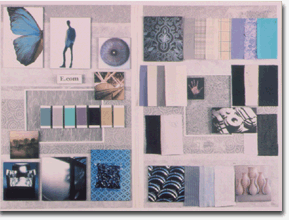
Showing colors and fabrics for Spring/Summer 2002 apparel, Kathryn Gordy Novakovic, director,
The Cottonworkers® Fabric Library, said, Theres a renewed desire for natural fabrics that suggest
their raw, unprocessed state. In color, white is important this season. Its the link color, a mixer
with which to create fresh pastels now that we have become used to more intense color, were adding
it with impunity.Fabrics and colors are divided into five groups. There are energetic fruit colors.
Warm shades of red-brown, mustard and cactus are reminiscent of a western desert. Greyed off-aqua
blues and violets are shown with blackened navy and two shades of off-white. Yellowed green is
surrounded by deep neutrals, aqua and violet; and a blue-and-white group is accented by coppery
red.Traditional fabrics include ginghams, seersuckers, calicos and brushed bottom weights. Another
range includes fabrics with a crisp hand, metallic appearance, or light and open look. There are
steep twills, reps, bedford cords and chambrays. Other fabrics have rustic textures or fancy
weaves. There are coated fabrics with a leathery look, basket weaves, small herringbones, tie-dyes
and animal prints.Denims are shown in cotton and in blends with linen or wool. They are brushed,
coated or stretch; and they are available in many weights and with different application
treatments. The Many Facets Of DuPontFocus at DuPont is on Lycra® elastane and Tactel® nylon.
Along with color and fabric trend presentations for ready-to-wear, athleticwear and intimate
apparel, special market areas include hosiery, knitwear, seamless technology and nonwoven fabrics
for apparel.DuPont Fashion Director Roseann Forde researches color and fabric trends for apparel.
Her current presentation shows five color ranges. There are dusty pastels and skin tones in a pale
group. Pinks, roses and mauves with a dried flower look are another. Cool blues and greens are
pared with black and white. Rich spice shades are suggested for pattern and print. Saturated
brights are shown with deep teal, bordeaux and khaki. Fabrics are related to garments and shown in
three groups. Power silhouettes have a military/safari look. Fabrics include black and white
graduated stripes from Dogi U.S.A.; stretch leather from Imprime Plonge of France; stretch twills,
sateens and knits from Milliken, Texfi, Burlington and Darlington; and several new nonwovens from
the DuPont Neotis Studio collection.

Printed sheer blouses, ruched jackets, embroidered cardigans and sequined skirts are in the
Sensuality group. Fabrics are light, sheer and lustrous. There are metallic meshes, satins, laces,
open-work knits and crinkled surfaces from Symphony Fabrics and Ge-Ray, Billon Freres, Tricot
Liesse and Birken International.Shapes in the Freedom group are relaxed. Stretch leather skirts,
pants, jeans and unique combinations of separate pieces are suggested silhouettes. Nylon/Lycra
denim from Eurojersey, satin knits from Welbeck, double-faced stretch knits from United Knitting,
and stripes and checks from Fabrictex and H. Warshow are some of the fabrics.DuPonts Leather with
Lycra program took a giant step forward this year when Easy Spirit® introduced eight shoe styles
ranging from dress to casual.DuPonts global knitwear consultant, Sheila-Mary Carruthers, developed
over 200 knitdowns made with commercial yarns containing Lycra and Tactel. Development fabrics and
concept garments include sleek, luxurious fabrics knitted with Tactel and Lycra combined with
cashmere, silk, merino wool, metallic fibers or viscose. Weights and textures range from light
cobweb effects, transparent mesh open-stitch patterns, lace and satin, to sweater stitches and
double knits.

Novelty patterns include ripple effects, openwork patterns, pleats, fringe, touches of
cellophane and floating yarns. Yarns are from Grignasco, Catfil, Saint-Lievin, Utexbel,
ToddandDuncan, Meadowbrook Inventions and others.Seamless garments are selling at retail in
intimate apparel, activewear and swimwear markets. Body, leg and comfort wear are new areas where
Tactel Soft Black, Tactel metallic and Lycra Soft are have been developed to give a new reach to
this technology.Iris LeBron, fashion director for Intimate Apparel, shows functional shapewear and
seamless body slimmers from resources such as Natori as an example of the fashion level seamless
has reached. Mens underwear is another area to watch, advises LeBron.In October 2000, DuPont
introduced Inova at Premiere Vision (See K/A News and Classic Revival At Premiere Vision, ATI,
December 2000). Now called Neotis Studio, this newest business unit of DuPont produces nonwoven
apparel fabrics.According to Ninabeth Sowell, global director of marketing and sales for Neotis
Studio, the most popular end-use areas are shoes, intimate apparel, swimwear and fashion
sportswear. She describes the current collections as engineered apparel fabrics with comfort and
performance. They are lightweight, versatile and multi-functional.

Neotis Studio is making two categories of fabrics: fashion-driven Metropolis and
performance-driven Enviroreact. Enviroreact includes thermally-adaptive materials that insulate,
shelter and draw moisture away from the body. They are intended for lifestyle functionality in the
sports and leisure markets.Fabrics in the Metropolis group range in weight, drape and texture. Some
are as light as 1.2 ounces. The focus is on lightweight, floaty and amorphous, Sowell said.All
fabrics are machine-washable. Most are fused microfiber cobwebs made from slash-spun polyethylene.
Some are multi-blends containing hemp, cotton, polyester, Kevlar® and/or Lycra. Because
polyethylene has a low melt and cant be dyed, fabrics are printed using a new process similar to
transfer printing. Through garment-washing, a distressed leather look can be achieved.Neotis Studio
has over 700 customers worldwide, including Nike, Lee Cooper, Georg Reich Sport, Mela, TKN,
Girbaud, and in Brazil, Carlos Miele. According to Sowell, customers claim this is the most
innovative thing theyve seen. It is also cost-effective because it eliminates several stops in
garment production. Hyosung Introduces Creora®With a recently opened U.S. headquarters and
distribution center in Charlotte, N.C., and offices in New York City and Los Angeles, Korea-based
Hyosung Corp. is making its presence known in America. Creora®, the companys trademarked name for
spandex, made its debut in Asia and Europe in 1992.The name Creora, according to James R. (Rusty)
Ford, vice president, Hyosung (America) Inc., is a combination of the words creation and ora.
Creation means the best spandex that opens a creative world of the 21st century, and ora means gold
in Greek.Ford noted that initial customer reaction has been excellent. We are a supplier of quality
and value, he said. Creora has a unique modulus and stress-and-strain curve, which makes it an
ideal fiber for warp and circular knitting and for use as a covering yarn. Some of the current
end-use areas are swimsuits, athletic wear, intimate apparel, tights, diapers, support hosiery,
socks, woven fabrics for fashion apparel, lace and narrow fabrics. Linen Can Be Easy
CareAccording to Pauline V. Delli-Carpini, North American representative, Masters of Linen, there
is increasing interest in knitted linen fabrics for apparel. A library of yarns and fabrics in New
York City changes seasonally. Some of the new developments in linen include blends. Linen/nylon is
good for performance, she said. Linen/wool is increasingly popular as a year-round concept, and
linen/spandex is in demand.Linen fabrics are being manipulated to give them an antique appearance,
Delli-Carpini continued. Shine remains, either through finish or by blending linen with a metallic
fiber. Twill weaves are popular; they take advantage of linens natural luster.Washable and
wrinkle-free linens are one reason for the resurgence of linen. The consumer is asking for them. We
are also getting requests for traditional qualities, said Delli-Carpini. Through tighter weaves and
new finishes, some of the heavier 100-percent linen fabrics can be made wrinkle-free. Pliana
For ApparelFounded in 1972, Pliana Inc., headquartered in Mexico City and Charlotte, N.C., produces
polypropylene yarns. Over the past 20 years, the annual growth rate for polypropylene has been 8.6
percent. Don Clark, president and CEO, attributes this increase to the high quality, aesthetic
value, performance and low cost of polypropylene yarns.Traditionally, polypropylene has gone into
products for the home and industry. Using new technologies, Pliana has developed microfiber yarns
for apparel. Development is underway to increase the melt temperature and create a dyeable
fiber.Pliana microfiber yarns are available textured and flat. There is a wide color range,
including both fashion and basic shades. Development fabrics shown include soft, lightweight
suedes, satin and twill weaves. Color cards and fabric trend information are some of the marketing
services provided.Another new development is Pliana Silken chenille yarns for the home, contract
and apparel fabric markets. These yarns are soft, lustrous, and stain- and moisture-resistant. They
are being used in woven and knitted fabrics and have been launched in 40 colors. Custom colors can
be matched in two to three weeks. Radici In North AmericaItaly-based Radici Group entered the
U.S. and global spandex market in March 2001 by purchasing the assets of Globe Manufacturing Corp.,
manufacturers of Glospan® spandex yarns.Fabrizio Calenti, RadiciSpandex president and general
manager of RadiciNylon Fashion Fibers, noted that purchase of Globe gives Radici its first North
American operation, which makes the company a global player in the fibers arena. He also commented
on the synergy that exists between nylon and spandex.RadiciSpandex Corp. continues to be
headquartered in Fall River, Mass. The Glospan trademark will continue, because of its high brand
recognition, said Calenti.Bill Girrier, vice president of sales, said sales and marketing are now
organized into fashion and performance fiber components. All marketing programs are continuing.
Recently, RadiciSpandex sponsored a fashion show at the High School of Fashion Industries in New
York City. Tencel® Focuses On DenimWith the current popularity of denim, Tencel® is focusing
on the jeans market. Workshop in Denim, held at Tencels New York office, presented new fabrics,
garments and finishing techniques to denim weavers, jeans manufacturers and retailers.June Lauck,
marketing communications manager, said innovations in the denim market are raw denim, accordion
finishes, pele denim and customized painting. All need the application of resins, polyurethane or
pigments, which make traditional denim stiff. Due to the softness of Tencel, the hard and stiff
surface is alleviated in Tencel/cotton blends.Another innovation mentioned by Lauck is Tencel
Natural Stretch. Because of the swelling properties of Tencel, up to 20-percent stretch can be
achieved through finishing.New denim fabric developments were presented by Dr. Nicola Willmott,
product development technical specialist, and Enrique Silla of Spain-based Jeanologia. Collections
included rustic denims woven with Tencel/cotton/wool; dark denims woven with Tencel A-100 a
non-fibrillating cellulosic fiber; bleached, silicone-sprayed, acid-washed, sandblasted,
screen-printed and metal spray-painted denims. The treatments give garments a frosted look, flat
appearance, tonal effect and variegated pattern.Overall apparel trend direction at Tencel is
reported by British futurist Sandy Maclennan. Fall colors are soft, misted and tonal. There is a
group of greyed blues, another of browns that go from warm amber and camel to deep chocolate. In
the red family, there is orange, coral, copper, pink and plum. Greens are yellow-cast. White, beige
and shades of mahogany are in a range called a taste for contrast.

June Lauck, marketing communications manager, Tencel® Unifi Introduces New YarnsAt the
recent Expofil yarn fair in Paris, Unifi Inc., introduced several new products and concepts. Minx
is a new dull yarn developed for weaving and knitting. It is available in nylon or polyester and
has the strength of synthetic fibers with the look and touch of natural fibers. Fabrics woven or
knitted with Minx are soft and drapeable.Avada is a polyester yarn that gives fabrics a shimmering
appearance. It is a combination yarn with the feel of a microfiber, and it imparts a soft, supple
hand.One product of special interest is Sorbtex, a soft, cotton-touch, moisture-movement yarn. It
has been adapted by Nike and JCPenney for socks and is of special interest for automotive
upholstery.Color and fabric direction for Fall/Winter 2002/03 is another service being offered by
Unifi. Color is shown in three groups. Black is teamed with misty shades of oyster, dove and
mid-grey, and with cool blues. Some shades have a metallic cast. A warm range of soft ginger, hazel
and chocolate brown flows from pale to dark. Bright shades of amber, tomato and lacquer red, plus
indigo, olive, and cool aqua are in the third range.Fabric direction is related to Unifis yarns.
Tweeds, tone-on-tone effects, marls and other fabrics with surface interest are shown woven with
Donegal or Eclypse. For sparkle or a metallic appearance, there are jerseys and woven fabrics
containing Myriad. Sultra appears in suedes. Success For WellmanSince the introduction of
Sensura less than a year ago, John Anderson, vice president, Wellman Inc., Charlotte, N.C., said
the fiber is well-positioned in the market. Gastonia, N.C.-based Parkdale Mills, collaborator in
the development of Sensura, has sampled 60 weaving and knitting mills around the world. The fiber
is being used in a wide variety of products for apparel, the home and technical end-uses (See
Quality Fabric Of The Month, ATI, December 2000).Guilford Mills has adapted Sensura for fabrics
selling to intimate apparel and swimwear markets (See K/A News, July 2001).At Ge-Ray, Sensura is
used in sportswear fabrics. Delta Woodside has blended Sensura with wool. Dan River is developing a
yarn-dyed shirt line. GaleyandLord has a collection, and Sensura is found in every major name in
socks. Sara Lee is looking at Sensura in all divisions.Parkdale is selling Sensura-content yarns in
South America, Canada and Europe. Anderson reports that apparel containing Sensura will be in
stores worldwide this October, one year from the launch date of this fiber. We are now looking at
selling Sensura in dyed fiber form, he said. Carefree WoolJohn McGowan, president and group
manager, Woolmark Americas, New York City, said that with funding from Australian merino wool
growers cut off, Woolmark is now a licensing organization and technical consultancy. As a result,
he said, we can work with other animal products, such as U.S. wool, mohair and cashmere.We are
continuing to develop Easy Care wool, McGowan said. We are working with licensees in Western Europe
and Japan to develop Easy Care woven fabrics. Fabrics are being tested for mens slacks by a major
catalog. We expect to see merchandise in stores for Fall 2002.One major program at Woolmark, in
partnership with ProcterandGamble (P and G), is a program with JCPenney. Over one million Total
Easy Care sweaters for men and women, will be in JCPenney stores. Yarn is from Grignasco.Woolmark
is also working with Whirlpool and P and G on a clothing revitalizer. It is like a personal valet,
said McGowan. The concept and products are being test-marketed in Raleigh, N.C., and Indianapolis,
Ind.
August 2001
Textile Employment Rates Hours Worked Show Improvement
Consumer Spending Floats Economy
Most of the latest economic reports indicate that the U.S. economy was weak, but the resilience
of consumer spending is the main reason for keeping the economy out of recession. The Federal
Reserve reduced short-term interest rates by a quarter point in June, and the round of rates cuts
is likely to come to an end with a possible quarter point rate reduction in August. The risk of a
recession, however, is still high and it could be unavoidable if consumer spending slows down from
current levels.
Non-farm payrolls declined by 114,000 jobs in June, with nearly all of the job losses coming
from manufacturing. Construction employment eased by 7,000 jobs after adding 34,000 jobs in May.
Payrolls in the private service sector, which was the engine of employment growth in the 1990s,
fell in June and were down as a whole for the second quarter.
This was the first quarterly decline since 1958, indicating persisting weakness in labor
markets in the near future. Total non-farm employment declined in the second quarter by 103,000
jobs, following a gain of 295,000 in the first quarter. The second quarter decline in total
non-farm payrolls was the first since the January-March quarter of 1992. On the bright side, a
rebound in economic activity is likely to reverse some of the employment losses realized in the
service sector, which came from temporary employment.
Inflation Still Behaving
The Producer Price Index (PPI) for finished goods declined 0.4 percent in June, as energy prices
took a 2.5-percent dive. The core rate, which excludes food and energy, edged up 0.1 percent in
June, and inflation outside the energy sector appears to be well-behaved.
Consumer prices rose 0.2 percent in June. Energy prices, down 0.9 percent in June, were still
up 8.4 percent from a year ago, while consumer prices rose 3.2 percent over the same period. The
core inflation, however, was up by a modest 2.7 percent.
Industrial output plunged 0.7 percent in June. Factory output dropped 0.8 percent, with
declines across all industries. Second-quarter industrial production fell at an annual rate of 5.8
percent.
The operating rate came down to 77.0 percent in June, the lowest level in nearly 18 years.
June housing starts rose 3.0 percent to 1.658 million units, with gains of 1.4 percent in
single-family units and 9.3 percent in multi-family dwellings.
The U.S trade deficit fell to $28.34 billion in May. Exports rose 0.9 percent to $87.73
billion. Imports fell 2.4 percent to $116.07 billion.
Business sales advanced 1.1 percent, while the inventory-to-sales ratio fell to 1.42 in May.
The relatively low inventories bode well for growth once demand picks up speed.
Textile Shipments Increase
Results for textiles and apparel were mixed. The industry’s jobless rate came down to 6.7
percent in June, down from a high of 9.6 percent, and the average weekly hours worked increased 0.7
percent. Payrolls declined 1.1 percent.
Shipments by textile producers were in the plus column, rising 0.5 percent in May after
falling 0.7 percent in April. Inventories were drawn down by 0.8 percent in May. As a result, May’s
inventory-to-sales ratio fell to 1.70 from 1.73 in April.
Textile production fell by 3.1 percent in June, on top of a 1.0-percent drop in May. In the
second quarter, textile output dropped at a 15.9-percent annual rate, following an 8.2-percent drop
in the first quarter. Meanwhile, the June operating rate for textiles edged down to 72.5 percent
from 72.6 percent in May.
Consumer spending rose 0.2 percent in June, following gains of 0.4 percent in May and 1.4
percent in April. Automotive dealers sales jumped 1.5 percent in June. Excluding autos, retail
sales were down 0.2 percent in June, following a 0.4-percent increase in May. Sales at apparel and
accessory stores eased 1.0 percent in June.
The producer price of textiles and apparel was unchanged in June. Prices jumped 1.1 percent
for greige fabrics, rose 0.4 percent for finished fabrics and were flat for home furnishings.
Prices declined 0.6 percent for carpets and for synthetic fibers and went down 0.5 percent for
processed yarns and threads.
August 2001
Nim-Cor Differential Winding Air Shafts Reduce Downtime
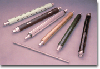
Nashua, N.H.-based Nim-Cor® Inc. now offers two new differential winding shafts: the GDS-2300
gripper and the CDS-4300 clutch. The differential air shafts can be custom-designed for specific
applications and are well-suited for the textile, plastic, film and tape industries.Designed to
reduce maintenance downtime, the GDS-2300 features quick-change inserts for different core widths,
accommodating plastic, paper or fiber cores. Nim-Cors CDS-4300 eliminates dust caused by core
abrasion, providing a dust-free environment.
August 2001
HRS Textiles Completes Modernization Upgrades
Nonwovens roll-goods producer HRS Textiles Inc., Darlington, S.C., has completed a modernization
upgrade of one of its five nonwovens production lines. The upgraded line will be dedicated to the
air-filtration market and will increase production capacity by up to three million pounds per year.
August 2001
Bologna Fair Acquires International Flair
Tecno TMA TextilBy Pier Guiseppe Bullio, European Correspondent
Bologna Fair Acquires International Flair
Tecno TMA Textil 2001 offered excellent chance to make, seal deals. With the only,
though undeniable, limit of being a fair that is substantially aimed at the knitting sector, Tecno
TMA Textil in Bologna, Italy, became a truly international affair this year.A lot is said and
written about exhibitions, and much of it is frequently far from favorable, often not without good
reason: there are too many fairs; they cost too much; they absorb excessive company resources (in
terms of people and means); too often, the number of visitors is insufficient; and those who come
lack interest and are not professionally prepared.The list could carry on, with dates failing to be
ideal, and host towns lacking the background of an attractive market.But at the same time, it is
evident that, especially for the textile machinery industry, a machinery exhibition that is
well-organized in terms of place, times and marketing (aimed not only at exhibitors but also at
visitors) remains a means of communication for manufacturing and trading companies. It also offers
an opportunity to sow seeds and an unrivaled chance to set up or seal deals, especially for small
or medium size companies.These benefits apply especially to the category of exhibitors that can
reap considerable additional advantages, such as the opportunity to compare their products with
those of larger competitors or to contact agents and representatives for new areas. More generally,
these exhibitors are able to view the general situation of the sector, drawing some often
inspirational ideas from a discreet glance at other operators exhibits.For visitors, on the other
hand, there is no more convenient, faster and safer system for comparing the best products in a
particular segment. On some occasions, a few hours suffice in order to make a choice, guaranteed by
the fact that potential suppliers are all gathered under the same roof just a few meters apart. So
the knitting mill from Carpi, the finisher from Prato and the dyer from a small woolen mill in
Biella find they have the same chance to examine and select products as managers from larger groups
(for example, Benetton, Marzotto, Zucchi, Miroglio and others), who are regularly visited by
salesmen from major manufacturers.Therefore, the conclusion is disarmingly simple: when a fair is
well-organized, highly specialized, and truly international, the opportunity exists to provide
maximum satisfaction for both exhibitors and visitors.The sting, however, is that exhibitions that
really meet these basic requirements are becoming increasingly rare. Fairs such as INDEX,
Techtextil and FAST meet these standards, all three of them being pipeline fairs, and therefore
somewhat different from conventional textile machinery exhibitions. The directors of the Italian
Association of Textile Machinery Manufacturers (ACIMIT) came to this same conclusion on returning
from ITMA 99 in Paris after the decision to move to Birmingham in autumn 2003.Deciding to set aside
the gentlemens agreement that has been in force for decades, according to which the national
associations of the eight member countries of The European Committee of Textile Machine
Manufacturers (CEMATEX) would not hold competing events on their own territory, ACIMIT decided to
compete wholeheartedly by developing existing machinery fairs in Italy. ACIMIT
InitiativesExcluding the so-called local fairs, such as the latest held in Busto Arsizio and
Biella, as well as niche events, which are not influential for the majority of associates, the
choice remained to reinvigorate long-standing fairs FAST in Verona and Tecno TMA Textil in Bologna.
In Verona, there were no extraordinary needs. FAST is a fair for hosiery machinery, a sector in
which Italian manufacturers are unrivaled leaders on the market, holding more than 80 percent of
the world market. The great relaunch of Tecno TMA Textil was a more involved affair. The fair has
good tradition to its credit, but it still lacked credentials for being truly international. The
efforts based on modern ideas and large investments systematically made by Bologna Fiere, ACIMIT
and the Italian Trade Commission (ICE) combined to hit the mark and render the event convincing.
Indeed, during the five days of the fair at the end of May, and due to a significant increase in
the number of exhibitors, exhibition spaces and visitors, the managers of the three organizing
bodies met with significant success.The fair was lively, interesting and rich with innovative
products; and run by a highly professional staff in the lavish stands. The fairs image was also
well-thought out it attracted a crowd of interested and professionally qualified specialists, many
of whom came from abroad.The chairman of ACIMIT, Alberto Maria Sacchi, said he was very pleased.
His company, HTP Unitex, was an exhibitor at the fair. [There have been] numerous visitors, with
articulated and concrete needs; many new contracts that will certainly prove interesting in the
short term; positive confirmation from important professionals we met, he commented. We have reason
to be satisfied!

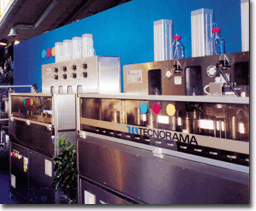
Obem booth at the show.

A synergy of roles between Loris Bellini and Gualchierani in dyehouse automation. Sacchi
was also a protagonist in the additional events that ran parallel to the fair. He participated as a
speaker at the congress organized to highlight the importance of the Italian textile machinery
industry to support Italian fashion as a world leader.Sacchi once again underlined the value of
integration between the two categories of manufacturers and textile specialists (their customers
and partners). These two sectors have, especially recently, set up intense and convincing forms of
collaboration in developing new machinery, equipment and production technology with concrete,
important and enviable results.From other speakers, a clear picture of the current market situation
on a world level also emerged. On the whole, orders for manufacturers are slowing down, and for
many, this situation has meant meeting (finally) delivery times after months of frantic production,
leading to inevitable delays.The fact would be worrying if it were not for two precise
circumstances related to high-level economic policies, both of which should soon disappear. In
Italy, it is no mystery that the wait for a new Tremonti law (which will create new tax advantages
for companies) has practically frozen many orders that were only a step away from a successful
conclusion. The law is expected to come into force within the next few months.On the other side of
the Atlantic, the United States is expecting a refuel from a tax reduction amounting to around $100
billion. This is an enormous amount even for the giant U.S. industry, which hopefully should as a
consequence return to full steam in the second half of 2001, dragging the entire world economy with
it. Furthermore, many of the textile operators interviewed had just come for the opening of the
fair, their plane ticket already safely in hand for China, where Shanghaitex 2001 was to open the
following Tuesday. China is in a period of substantial renewal of its textile plants, and has
almost doubled machinery imports from Italy in the past two years, purchasing at a rhythm that
alone could cover all the growth needs of the textile machinery industry. In the orders placed by
the Chinese, the most significant demand is for modern, reliable, versatile machines and systems,
especially those equipped to process fine fibers such as cashmere and silk. A Close LookAs
mentioned previously, one of the best-appreciated tangible advantages for all the participants at a
successful exhibition, which Tecno TMA Textil certainly was, is having the chance to meet a large
number of important operators and to profitably exchange opinions, information, experience and so
on.Exhibitors and attendees at Tecno TMA Textil were generally satisfied, but they were somewhat
restrained by the bounds of a limited presentation of the knitting sector. In particular,
professionals in the finishing segment said it was time at last for Italy to offer a large
exhibition to host all the sectors in the pipeline spinning, weaving and technical textiles
included.Naturally, for insurmountable reasons of logistics and district traditions, such an
exhibition would have to be held in the north of Italy, where the majority of spinners, weavers,
and cotton and woolen mills are based. This is an age-old problem, but a solution could be strongly
stimulated by two highly probable and contingent factors, the first being the low-profile forecast
for ITMA 03 in Birmingham.The second, which is making progress in this period, is the building of a
site external to the Milan fairgrounds. Once the problems of space and access are eliminated, the
project for a new high-level textile machinery exhibition could take shape, and certainly meet with
favor from foreign professionals.This conclusion was expressed by entrepreneurs and managers who
visited Bologna and whose credentials are unquestionable.
August 2001
Printing Without Boundaries
Printing Without Boundaries
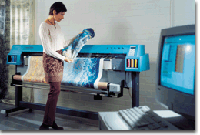
Digital printing offers possibilities for sample production, mass customization in global
environment. Digital printing is not a new concept. MillikenandCompanys Millitron® and
Zimmers ChromoJet have been commercially successful for carpet and upholstery markets for more than
20 years. Stork introduced the first digital jet printer developed specifically for textiles at the
1989 International Exhibition of Textile Machinery (ITMA) in Hannover, Germany.Many of these early
machines were extremely slow. Recent developments, though, promise true innovation in the way
textiles are developed, printed and brought to market. Much progress has been made in machine
reliability and speed, as well as in the formulation of dyes and inks. The ConceptPerhaps what
is more important than the digital ink-jet printer itself is the way designers and textile and
apparel companies can interact to bring new products to market almost in the blink of an eye.
Instantaneous data transfer over the global Internet and similar data exchange via local area
networks (LANs) make it possible to exchange ideas faster than ever.Actual fabric samples of new
designs are possible at a fraction of the cost and in a fraction of the time formerly needed. For
example, one prominent textile printer put the cost of an individual screen at $350 to $1500
depending on whether the image originated from hand art or CAD. Thousands of dollars must be
invested in a pattern that may never be accepted or once accepted, never sell enough yardage to
recover the cost to develop the original set of screens. Inventory and maintenance are also costly
overhead expenses for screens. Digital printing enables the designer and customer to tweak the
design for little cost. Once a design is finalized, short yardage can be printed digitally, and
large orders still can be printed economically by traditional flat and rotary screen equipment.Even
so, the new technology is not without its limitations. At this time, digital printing is unable to
print metallics and pigment whites from the CYMK and related machines. The color gamut with these
spot-color systems is not as wide as with process colors. Process colors are often referred to as
CMYK (Cyan, Yellow, Magenta, and Black) but seven to 12 colors are actually used in practice,
including, for example, light cyan, light magenta, orange, and green. Since our eyes are not as
sensitive to changes in yellow, there is no light yellow.According to Roland Zimmer, president and
CEO, Zimmer Machinery Corp., Spartanburg, S.C., high resolution (up to 1440 dpi) is required to
prevent color areas from appearing granular and pixel-like. The resolution actually achieved on
fabric is much coarser, because several droplets can wick together to form super pixels. Pastel
shades can have a dithered look, as too few droplets are printed for the eye to merge them into one
cohesive image.Digital printing, compared to rotary screen printing at high production speeds, can
actually be too perfect. Printing wet-on-wet allows the print to merge and have track marks. Slow
digital printing freezes the design exactly where placed. Sample table printing using one screen at
a time has had the same problem. When one color is printed, it dries before the sample printer is
able to change screens and print the second color. The sample is much sharper than what will be
achieved on a production machine. Todays software, however, has gone to great lengths to dumb down
the design so it wont be too perfect just as carpet manufacturers of machine-woven Oriental-design
carpets have for years deliberately introduced errors in their designs to simulate the natural
errors in handmade carpets. The MachinesThe Netherlands-based Stork, a pioneer in textile
ink-jet printing, has three commercial machines available. The Amber is the oldest, most versatile
and most compact of the current line. It is most suitable for samples and one-of-a kind boutique
designs. It is capable of printing 1.8-square-meters-per-hour (m2/h) at 720-dpi resolution using
six inks: cyan, light cyan, magenta, light magenta, yellow and black (CYMK plus). These colorants
are available as reactive dyes for cellulosics and as acid dyes for nylon and related
polyamides.The new Zircon II enables the rapid and economical printing of samples and short
production runs onto a variety of polyester substrates, including textured and embossed upholstery
fabrics. Eight-color printing is standard. Print width is up to 1600 millimeters (mm). Print speed
is 10 m2/h in the high-speed, lower-resolution mode. The intended market is flags, banners,
backdrops and fashion. Direct output from CAD files, scanned images or digital photographs allows
the customer to respond quickly to the market.The Amethyst is the continuous ink-jet flow machine
for rapid, economical coupon printing in conventional volume textile manufacturing operations.
Printing on substrates up to 1650 mm wide, the Amethyst can produce 350 square meters (m2) of
printed fabric per day. Rolls of up to 250 meters (m) in length can be loaded, while a print buffer
allows continuous running for up to 16 hours without intervention by an operator. Reactive dyes are
used to print cellulosics and polyamides.Stork and France-based Lectra Systs have established a
worldwide cooperative agreement to provide Lectra CAD creative software and the Stork color
management systems for digital and rotary screen printing. With a distribution and service network
covering more than 100 countries, the two organizations provide comprehensive support to customers
around the world. The globalization of the textile and apparel market becomes much more secure when
a printer has local support and can confidently transfer design ideas from New York to print
locations around the world in a matter of minutes.
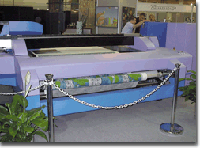
Zimmer, the pioneer in ink-jet printing for carpet, recently introduced the Chromotex© SPM, a
true color printer, at the American Textile Machinery Exhibition-International (ATME-I) 2001 in
Greenville, S.C. The use of true mixed colors and the fact that Zimmer developed this machine for
textile printing rather than modifying a paper print machine separate this printer from the rest of
the field.The Chromotex uses a continuous flow system and prints through 80-micron-diameter
nozzles, which stand 60 mm above the moving apron. The likelihood of clogging is low. The volume of
ink delivered, 1,400 picoliter, is up to 10 times greater than other systems with smaller nozzles
can deliver. The resolution is much coarser equivalent to 125-mesh rotary screen printing. Print
speed is said to be 15 m2/h using eight colors and 30 m2/h using four colors across a
225-centimeter (cm)-wide bed. Colorant supply has been opened to multiple vendors, including
DyStar, Ciba, BASF and others.Later this year, Zimmer plans to introduce the Chromotex PM, a true
production model capable of printing 100 m2/h using 48 jets per color.

The Wilmington, Del.-based DuPont Artistri Color Control and Management System with the Ink
Jet 3210 digital printing machine was also introduced to the U.S. market at ATME-I 2001, following
its world premiere at Heimtextil 2001 in January. The 3210 prints 3.2-m-width fabrics roll-to-roll
in eight colors CYMK, light C, light M, orange and green at 30 to 60 m2/h. The current version will
print pigment inks and binder, which dry and cure as they exit the machine. The Ink Jet 3210 is
aimed at the home furnishings industry, and beta site work is being conducted at a leading home
furnishings company. Apparel printing using other dye systems should follow at the end of the
year. Rapid PrototypingMass customization is based on the idea of modifying or enhancing
previously designed products how, for example, to make a customized dress and deliver it to the
customer a few days later. Rapid prototyping, on the other hand, is the ability to conceive an
original design idea and see a physical creation of that idea in a very short time.How are people
using these new machines Home furnishings companies use them to generate one-of-a-kind sets of
sheets, comforters, drapes, and all soft goods to take to market shows. Boutiques use the machines
for one-of-a-kind scarves, pennants, flags, banners and custom apparel.In the summer of 1998,
researchers at the College of Textiles at North Carolina State University (NCSU), Raleigh, N.C.,
began digital printing on soft goods with a small Encad TX1500 digital thermal printer using
polyester substrates. A Digital Design Center opened in January 2000 following the purchase of two
Stork Amber printers and a Stork TCP 4000 sample printer. The concept of rapid prototyping using a
TC2 BMS full-body scanning system, coupled with Gerber CAD design and the printers, has come to
life. Students create new designs on CAD and port the designs to markers within the Gerber system.
The printers print only on the markers, thereby saving ink and eliminating color on the trimmings.
Within a short time, the final garment is ready to wear. Scarves, place mats, neckties and anything
else imaginable are quickly ready with this integrated system. The fabric is pretreated with an
alginate, an alkali and urea, then dried and trimmed to width for the printer used. After printing,
the reactive dyes are developed in a Xorella autoclave/steamer. Following drying, the creations are
cut and sewn as needed. Elsewhere, Philadelphia University, Philadelphia, has just announced the
creation of a Digital Design Center as well.Also at NCSU, Dr. David Hinks has a project to develop
and evaluate disperse-dye ink formulations for piezo ink-jet printing on polyethylene terephthalate
(PET) and poly trimethylene terephthalate (PTT) polyester fabrics. There is no doubt that digital
printing has moved from being a curiosity for textiles to finding its place on the production floor
as a true production method both for short runs and for samples.
August 2001
Rhovyl39 AS Introduced For Woven Applications
Rhovyl and Duo TechStyle Co., both based in France, have partnered to offer a range of products for
the woven ready-to-wear market using RhovylAS® antibacterial fiber.Plain weaves and twills, as well
as double-faced, figured and jacquard weaves are included in the product range. A stretch fabric
with a warp of either man-made fiber or silk is also available, as is a comfortable, easy-care
stretch denim suitable for travelwear. RhovylAS retains its antibacterial properties for the life
of the fabric and provides the additional benefits of thermal comfort and moisture transfer.
August 2001
ATYC-Argelich UPC INTEXTER Developing Dyeing Process
Spain-based ATYC-Argelich, Termes y Cia. S.A. is working with the UPC Catalonian Polytechnical
University through the Instituto de Investigaciextil y Cooperacindustrial de Terassa (INTEXTER),
both also located in Spain, on a new electrochemical dyeing process.The cooperative was formed to
develop machinery and a fabric-dyeing process for electrolytic dyestuff reduction of sulfur, vat
and other dyes requiring a reduction step in processing. Trials have already been initiated in a
pilot laboratory machine installed at INTEXTER.
August 2001