Superior Fabrics Introduces Fleecelock Nonwovens

Superior Fabrics Inc., Pompano Beach, Fla., has developed Fleecelock, a new nonwoven
fabric.Fleecelock fabrics, constructed of 100-percent polyester staple fibers using a modified
stitchbond process, have similar properties to those of a traditional stitchbond fabric, but do not
use a separate yarn system.The fabrics are available in weights ranging from 2 to 8 ounces per
square yard and may be dyed using finishing techniques used for other polyester fabrics. To add a
soft back or to create a bulky, soft fabric, Fleecelock is ideal for laminating to other fabric
composites, according to Superior.

October 2001

New Dyestuffs Improve Palettes

Textile manufacturers are constantly looking for more economical ways to run their plants and
produce their products. However, the standards are becoming higher high fixation, good wash-off
properties and lower environmental impact are all becoming increasingly important. Improved light-
and washfastness are the result of customer demands especially from the automotive
industry.Improved communication and globalization of companies require the quality of products to
be the same anywhere in the world. Sourcing is changing at the speed of light. Apparel bottoms
sourced in Kenya must match knit tops sourced around the world. New Dyes: Fiber-ReactiveCiba
Specialty Chemicals, Switzerland, now has three complete dye ranges for fiber-reactive exhaust
dyeing: the Cibacron® FN range for warm dyeing; the Cibacron LS range to reduce the amount of salt
needed in dyeing; and the Cibacron H range for hot dyeing. New products include dyes for black
formulations that offer versatility and a more economical choice:Cibacron Orange ROE; andCibacron
Brown DER.Also new are two greens that offer better shade consistency and quality of dyeing. These
products produce fewer variations within dye lots:Cibacron Green FN-BL; andCibacron Green H-BL.New
products in the Cibacron H range include:Cibacron Yellow H-G;Cibacron Orange H-R; andCibacron Red
H-F. Cationic DyesGermany-based DyStar L.P. has introduced a new physical form of cationic
dyes that are flowable powders. Designated Astrazon® Micro, they are designed for dry dye
dispensers. Conventional powders can cause problems with dusting, bridging and static build-up on
silo sides. Disperse DyesAnother important trend in the market is the need for improved
washfastness, particularly in polyester, polyester/cotton blends and polyester/spandex. To meet
this trend, Ciba has introduced the Terasil® W disperse dye range. New products in this range
include:Terasil Red W-FS;Terasil Black W-NS; and Terasil Navy W-RS.Other products will be
introduced next year to expand the Terasil W range. The products in this range are used in
continuous, package and exhaust dyeing.Ciba has also introduced a new liquid range for automotive
applications. The Ciba Terasil range is made up of stable liquid formulations that give exceptional
lightfastness. Included in this range are:Terasil Blue HL-B, LIQ 75 percent;Terasil Pink 2GLA, LIQ
50 percent;Terasil Blue BGE, LIQ 50 percent;Terasil Yellow GWL, LIQ 50 percent;Terasil Violet
PX-BL, LIQ 75 percent; and Terasil Yellow HL-G, LIQ 40 percent.Also from Ciba are the Terasil C
dyes engineered for continuous and exhaust dyeing for carpets. These products exhibit excellent
leveling and shade repeatability:Terasil Yellow CR;Terasil Blue C3R; andTerasil Red
CB.Switzerland-based Clariant will announce availability of a new line of high wetfastness disperse
dyes: Foron Navy SWF, Black SWF, Rubine SWF and Yellow Brown SWF. A new line of alkaline-clearable
disperse dyes with excellent washfastness includes Foron Navy SAC, Black SAC, Rubine SAC and Yellow
Brown SAC.DyStar has introduced the Optidye series of computer programs in partnership with
selected customers such as Burke Mills, Valdese, N.C., the first polyester-yarn-dye operation in
the country to use Optidye P. There are currently four versions covering polyester, nylon, acrylic
and wool dyeing. The programs use fiber, auxiliary and equipment data to recommend dyeing
procedures for individual shades. The program gives the shortest, safest time/temperature profile
possible. By reducing cycle times without compromising reproducibility, it has been proven to
maximize dyehouse profitability. The program is the product of more than 30 years of continuous
improvement at Bayer and DyStar in the development of such expert systems. PigmentsDyStar has
introduced a line of high-lightfastness pigments under the Imperon® HF label. These pigments offer
in the order of 500 hours in pastel shades. They are also stable to shade changes that can occur
during binder curing. Sulfur DyesClariant has available a new sulfur black Diresul Blue Black
RDT-2B with a blue cast that offers greater versatility in matching black shades on
cellulose. Auxiliary ChemicalsLeveling and migration are important aspects of exhaust dyeing.
Yorkshire Americas, Charlotte, N.C., has a new leveler/migration aid for disperse dyeing of
polyester. PatLev PL has the same migration enhancement and strike rate control as PatLev DDL-LO
for todays low liquor ratio machines.Afterclearing improves the wet-fastness of disperse dyes.
Yorkshire Americas Intratex MSB is intended as a replacement for a caustic/hydro afterclear. It has
also been used to remove spots and deposits from deep shades dyed at low liquor ratio. Often these
goods have a bronzy surface appearance. Intratex MSB cleans the surface to give a deeper, richer
shade. Significant DevelopmentsClariant reports one significant update in the field of dyeing
Fadex ECS: UV-Absorber for polyester fabrics. This product provides very high sublimation fastness
and can be applied by package and beam dyeing. The product is mainly used for automotive fabrics.
Currently available products, which are applied mainly by means of package dyeing, provide
significantly less sublimation and fogging. Dosing SystemsThe VaryFlow system from United
Kingdom-based Kinder International Systems Ltd. offers solutions for dye-dispensing headaches. The
VaryFlow system proportionally controls the pneumatic dispensing valve. The valve can be on, off,
or anywhere in between the on/off state. This allows the dispensing system to determine the optimum
flow rate for the required quantity of dye.The VaryFlow system allows a single valve to dispense
from grams to tens of kilograms of dye because the flow rate can be adjusted from as low as 1 gram
per second (g/s) to more than 1,000 g/s. The system is impervious to fluctuations in the ingredient
supply pressure, and because small orifice valves arent necessary, valve blockages are eliminated.
Kinder claims that a customer can save money and achieve greater reliability by using the VaryFlow
system. Dye Machines

The Millennium by Mount Holly, N.C.-based Gaston County Dyeing Machine Co. continues to offer
great versatility. Fabrics handled include tricot/raschel; spandex (elastane) blends; athletic
wear; wovens; and specialty fabrics.Specialty fabrics processed now include: cotton jersey;
polyester microfiber suede; athletic wear mesh; thermal knit; satin; chenille woven; crepe; poplin;
fleece; high-stretch woven; micro-sanded twill; nonwoven; polyester/rayon twill; polyester/cotton
cuffs and collars; cotton/spandex jersey; nylon flock; and spandex knit.Since the machine was
introduced in 1999, the chamber size has increased, thereby increasing the load per port. Trial
data run over the past two years have shown the capacity to run up to 518 pounds per port.The major
advances continue to be the incorporation of support for the dye machine. The Millennium Dyeing
System consists of an interconnected system from the control center to the dye machines with a
central charge tank, to the automated weighing, dye dissolving and automatic chemical
dispensing.Jet-dyeing technology has taken many directions over the past 10 years, and Sclavos
S.A., Greece, has always looked to the most pressing needs of the customer to bring forth
technology that addresses both the short-term and long-term needs. The TwinSoft Flow, along with
the AquaChron rinsing system, addre-ssed quality and cost issues. Water, steam and energy continue
to represent major costs that impact the profitability of any operation in the United States or
around the world.The Sclavos Venus has several features. The use of a specially designed pump
claims to reduce energy consumption by 30 to 40 percent. The use of the AquaChron allows continuous
rinsing and a reduction in total water consumed. A heat exchanger saves the waste energy and
preheats incoming wash water. Sclavos claims that a customer dyeing 300,000 pounds per week will
save more than $750,000 a year using Sclavos technology when compared to conventional
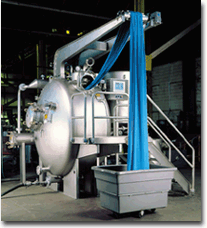
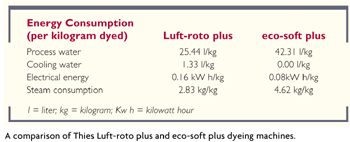
machines.Germany-based Thies GmbHandCo. Luft-roto plus jet-dye machine and DyStar textile dyes have
partnered to introduce a new short cotton dyeing system with very low 3.5:1 liquor ratio. The
previous state-of-the-art process of the Thies eco-soft plus machine required a liquor ratio of 6:1
and a cycle time of 286 minutes. The new procedure runs in 189 minutes. The new process therefore
requires less thermal energy, less electrical energy and no cooling water. The new procedure calls
for a five-minute high-temperature bleach, and a combined cooling rinse and dye cycle, in which dye
and half the salt are added first, followed by alkali and the rest of the salt. The dye solution
enters the venturi and uses a patent-pending technique for positive liquor exchange. 

Research IdeasSee Dyeing, PrintingandFinishing,
TI, this issue, for some of the latest ongoing wet-processing research at North Carolina
State University.

October 2001

Porous Materials Develops Multi-Chamber Porometer

Porous Materials Inc., Ithaca, N.Y., has developed a multi-chamber and multi-mode porometer for use
on such materials as nonwovens, cosmetics, filters, paper and ceramics.The porometer contains five
sample chambers. Four chambers are used for fast sample characterization. The fifth chamber is used
to perform more sophisticated tests.The instrument uses Windows-based software to measure the
pressures and the corresponding flow rates that determine the largest pore diameter, mean flow pore
diameter, pore size distribution, gas permeability and hydrohead of the sample.The porometer can
also measure liquid permeability.

October 2001

Cationic Fiber Modification In Development At NCSU

Dr. Peter Hauser, associate professor, North Carolina State University (NCSU), College of Textiles,
Raleigh, N.C., is developing a greener process, cationic fiber modification, for cotton
dyeing.Sponsored, in part, by Dow Chemical Co., Midland, Mich., Hausers research involves treating
the cotton with the Dow chemical, N-(3-chloro-2-hydroxypropyl) trimethylammonium chloride. The
permanent positive charge on this cationic chemical provides a permanent site to attract
negatively-charged cotton dyes. Because of the small molecular size, however, the chemical cannot
be exhausted from a batch process prior to dyeing.The new process is much more efficient and saves
about half of the time normally required to dye cotton, said Hauser. It uses one-third of the
energy and only 20 percent of the water used in traditional methods, and no salt. In addition, less
dye is needed as a result of the strong attraction of the dye to the surface of the fiber.The next
phase of Hausers research involves developing ways to streamline the new process to make it a
continuous process that does not slow down production in dyeing and finishing.

October 2001

ADMTronics

ADMtrONICSAdhesive, 73F, is a water-based primer/adhesive for extrusion, laminating and printing. Product is water- and moisture-resistant on most substrates. Minute applications give high bond strengths. One gallon of product covers up to 90,000 sq. ft of substrate. Substrate may be primed and rewound for use up to 90 days later with no blocking or reduction in bond strengths. ADMTronics sales@admtronics.com.October 2001

Cotton Test Center Gets New Equipment

COTTON TEST CENTER GETS NEW EQUIPMENTAustralias textile research body, CSIRO TFT, has announced investments worth more than U.S. $500,000 in cotton processing equipment, targeted at helping the countrys cotton growers.The research organization will install a full-scale yarn production line, with bale-to-spinning equipment from leading European technology suppliers Trutzschler, Zinser and Schlafhorst. Both ring and rotor spinning routes will be used.The aim is to test various raw cottons to see how harvesting and ginning procedures affect yarn characteristics. The line also will test fiber properties and research possible new yarn production techniques.CSIROs Gary Robinson said the project would directly benefit Australian cotton growers: “Using the new equipment, well be able to process different batches of cotton under a variety of conditions whether the batches are small from breeding programs, or large from individual growers and ginning groups. In this way, we can build up a comprehensive picture of fiber performance.”October 2001

Italian Rapier Loom Targets Quality Fabrics

ITALIAN RAPIER LOOM TARGETS QUALITY FAbrICSPromatech, the Italian textile machinery group that comprises the Somet and Vamatex weaving machine brands, has launched a new flexible rapier loom. The Somet Alpha will be targeted initially at high-quality fabric producers in Europe and Asia, with its commercial debut in the U.S. scheduled for early next year. The machine is claimed to offer an “incomparable relation between flexibility and speed,” with its development brief having focused on versatility, reliability, ergonomics, the use of advanced technology, and lower running costs.Fuller details of the machine, and an update on the Promatech group recent purchaser of Sulzer Textil — will be published in our next issue.October 2001

Federal Reserve, Consumers Key To Future


Eighth Rate Cut Not Likely To Be Last

Evidence from the latest set of economic reports shows the U.S. economy weakened further in
August, and in the aftermath of the terrorists’ attacks, a recession is likely to be already in
progress. On the bright side, consumers keep spending, and the Federal Reserve stepped in with a
one-half-point cut in short-term interest rates. Further rate reductions are likely to follow to
prevent the economy from going into a deep recession.

The jobless rate increased to 4.9 percent in August from 4.5 percent in July. This climb was
the sharpest monthly increase since early in 1995. Nonfarm payrolls declined by 113,000, despite a
gain of 72,000 jobs in the service sector. Since March, total nonfarm employment is down by 323,000
jobs. With factory output down and a declining business investment, manufacturers slashed 141,000
jobs in August, bringing the total losses from a year ago to more than one million jobs.
Manufacturing employment is at its lowest level since 1964 — a sign that the weakness in U.S.
economic activity has turned into a recession.

The Producer Price Index for finished goods rose 0.4 percent in August, after dropping 0.9
percent in July. The increase was due to a 1.1-percent rebound in energy prices following a 5.8
percent drop in July. Excluding food and energy, the price index slipped 0.1 percent in August,
after rising 0.1 percent in July.
OctBFgraph_1068


Consumer Energy Prices Continue Decline

Consumer prices edged up 0.1 percent in August, after falling 0.3 percent in August. Energy
prices fell 1.9 percent in August on top of a 5.6 percent drop in July. Core inflation was up 0.2
percent for the second month in a row.

Industrial production dropped by 0.8 percent in August, after edging down 0.1 percent in
July. July’s figures had raised hopes that manufacturing was on the verge of a rebound. The monthly
decline was the 11th in a row, matching the longest stretch of industrial output weakness, which
occurred in 1960. The operating rate of industrial capacity fell to 76.2 percent from 76.9 percent
in July, the lowest level since July 1983.

With consumer confidence down, new housing construction fell 6.9 percent in August to 1.527
million starts.

The U.S. trade deficit of goods and services narrowed in July to $28.83 billion from $29.07
billion

in June. Both exports and imports declined, reflecting economic conditions in the U.S. and
abroad. Exports fell 2.5 percent to $83.73 billion, while imports came down 2.1 percent to $112.56
billion.

Business sales bounced 0.4 percent in July, after falling 1.5 percent in June. Meanwhile,
business inventories eased 0.4 percent. As a result, the July inventory-to-sales ratio edged down
to 1.42 in July from 1.43 the previous month.


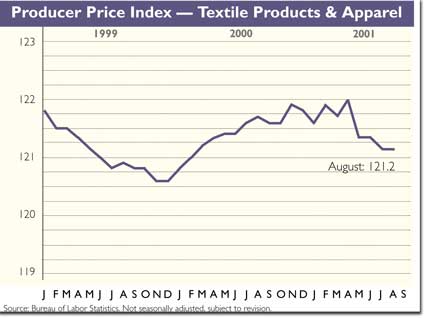
Mixed Results Show Textile Output, Utilization Rate Rebound

Producer prices of textiles and apparel were unchanged in August after edging down 0.1 percent
in July. Prices jumped 1.9 percent for greige fabrics and rose 0.2 percent for home furnishings.
However, prices came down 0.4 percent for processed yarns and threads, fell 0.9 percent for
finished fabrics, declined 1.0 percent for synthetic fibers and dropped 1.3 percent for carpets.

Results for textiles and apparel were mixed. The industry’s payrolls declined 0.2 percent in
August, after falling 1.1 percent in July. The volatile jobless rate for textile mill workers came
down to 8.3 percent from a high of 9.1 percent in July.

Textile output increased 0.8 percent in August, after falling 2.4 percent in July. Output was
13.8 percent below the year ago level. The utilization rate for textiles moved up to 71.6 percent
of capacity from 70.8 percent in July.

Shipments by textile producers declined 0.8 percent in July after rising 1.7 percent in June.
Inventories were pared down by 1.3 percent. As a result, the inventory-to-sales ratio edged down to
1.66 from 1.67.

U.S. retail sales rose 0.3 percent in August, paced by sales gains of 1.2 percent at gasoline
stations, 0.9 percent at building materials and supplies stores and 0.6 percent at department
stores. Sales eased 0.2 percent for motor vehicles and parts and edged down 0.1 percent at
furniture and home furnishings stores. At apparel and accessory stores, sales declined 0.8 percent
in August after rising 1.0 percent in July.


October 2001

Lantech Designs Automated Turntable Wrapping System

Lantech, Louisville, Ky., has designed the Q-1000 Automated Turntable Wrapping System with added
protection for operators.The system features an in-feed and exit conveyor separated by a turntable
that rotates while stretch film is attached to the load. Film loading of the roll carriage is from
the side, providing unobstructed access and ergonomically sound operation.The roll carriage is
safety-guarded to prevent hand injuries. Transition photocells are mounted on either side of the
turntable for easy access. If a photocell beam is broken during wrapping, the machine will shut
down immediately.The E-Z Thread® roll carriage provides loading with no threading required. All
controls are adjustable from the color-coded control panel without the use of a plug-in external
computer.

October 2001

Steel Heddle Files Chapter 11 Sells Textile Business

Steel Heddle Files Chapter 11,Sells Textile BusinessSteel Heddle Group Inc. and its U.S. subsidiaries, including its primary operating entity, Steel Heddle Manufacturing Co. Group Inc., Greenville, S.C., has voluntarily filed a reorganization case under Chapter 11 of the U.S. Bankruptcy Code in the Delaware Bankruptcy Court. The petition was filed, in part, to consummate the sale of the textile business, which includes the textile loom accessories manufacturing and design operations.Steel Heddle is also completing negotiations for a Debtor-in-Possession (DIP) financing facility.Robert W. Dillon, president and CEO, said that with the DIP financing in place, Steel Heddle should be able to consummate its going-concern sales; meet its going-forward obligations to employees, customer and vendors; and ensure a smooth transition of its operations to the purchasers.October 2001

Sponsors