Quality Fabric Of The Month: Intelligent Fabrics


qofm_1312I
n an effort to eliminate materials and processes that generate pollution or waste,
initiatives are being taken to manufacture “intelligent” fabrics that use environmentally sustainable processes as well as eco-friendly raw materials such as biodegradable or recyclable fibers and optimized dyestuffs/auxiliary chemicals.Biodegradable materials are returned to the earth as “biological nutrients” at the end of their useful lives. Recyclable materials, or “technical nutrients,” are reused over and over in new textile products.

A number of players within the industry — such as visionary architect William McDonough and chemist Michael Braungart, McDonough Braungart Design Chemistry (MBDC), Charlottesville, Va.; textile manufacturers Rohner Textil AG, Switzerland, and Victor Innovatex Inc., Quebec; textile distributor DesignTex (a Steelcase Company), New York City; and others — are collaborating to introduce at competitive prices such fabrics for use in contract furniture and transportation
applications. These fabrics include Rohner’s fully biodegradable Climatex® LifeguardFR™, a blend of wool and Austria-based Lenzing’s Redesigned LenzingFR™ — a beechwood-based cellulosic fiber
containing a flame retardant derived from a natural source and developed by Switzerland-based Clariant. Rohner has granted Victor Innovatex exclusive rights to manufacture the jacquard-woven fabric in North America.

Climatex LifeguardFR is a redesign of Rohner’s award-winning Climatex Lifecycle™, a wool/ramie climate-control seating fabric that complies with MBDC’s Sustainable Design Protocol™ for environmental soundness of materials and processes used. The fabric is dyed using 16 dye
chemicals from Switzerland-based Ciba that are free of negative environmental impacts, while complying with industry standards for lightfastness, durability and color process reproducibility. All colors except black can be produced.

Flame retardation has been among the least environmentally compatible properties found in commercial fabrics. Rohner claims the addition of Clariant’s sustainable flame retardant meets the most stringent flame-retardation standards, including those for aviation applications.

Climate-control properties are inherent in the fibers used. Wool conserves heat and absorbs moisture, while Redesigned LenzingFR transports moisture.

Victor Innovatex is introducing Climatex LifeguardFR as part of its Eco Intelligence™ Initiative (EII), which also includes fully recyclable Eco Intelligent™ Polyester made using titanium, a safe alternative to antimony, a toxic heavy metal. The fabrics are among others the
company is developing for Steelcase and DesignTex.


For more information about Climatex® LifeguardFR™, contact Jean François Gagnon (418) 227-9897;
or Beth McInnis (212) 741-4016, Ext. 21.


January 2002

Celanese Acetate And Teijin Form Marketing Alliance For Acetate Filament

KRONBERG, Germany, Dec. 20 /PRNewswire/ — Celanese AG (NYSE: CZ)(Frankfurt: CZZ) and Teijin
Limited announced today that they have signed a Marketing and Sales Assistance Agreement. Under the
terms of the agreement, Teijin will market Celanese Acetate filament products in Japan as an
independent consultant and assist in sales inthe Asia region. In a related move, Teijin will
discontinue production of acetate flake at its Matsuyama site in December 2001 and acetate filament
inFebruary 2002. The marketing alliance evolved out of ongoing joint venture discussions between
the parties. Both companies acknowledged that a contemplated jointventure was no longer viable due
to market conditions. The marketing alliance is the best way to meet the ongoing needs of Teijin
and Celanese acetate filament customers in the region. Celanese Acetate Textiles is the world’s
largest cellulose acetate filament producer. Its products are found in women’s and men’s apparel
fashions, linings, home furnishings and industrial end uses. Celanese acetate filament is currently
manufactured in the United States, Mexico and Belgium. Teijin Limited, established in June 1918,
was the first Japanese companyto produce rayon yarn and remained an innovator and leader in the
developmen tand commercialization of fibers. Today, the company’s operations encompassfour segments
— fibers, chemicals and plastics, pharmaceuticals and medical products, and diversified
businesses. The company has production and sales subsidiaries and affiliates in more than 10
countries. The parent company also has five overseas offices, as well as six plants and six
research institutes in Japan. Consolidated sales for the year ending March 2001 were761 billion
yen. Celanese AG is a global chemicals company with leading positions in itskey products and world
class process technology. The Celanese portfolio consists of five main businesses: Acetyl Products,
Intermediates, Acetate  Products, Technical Polymers Ticona and Performance Products. The
Performance Products business consists of oriented polypropylene films (OPP), sweetenersand food
ingredients. Celanese generated sales of around euro 5.2 billion in2000 and has about 12,700
employees. The company has 30 production plants andsix research centers in 11 countries mainly in
North America, Europe and Asia.Copyright © 1996-2001 PR Newswire Association Inc. All Rights
Reserved.

Flexico Aims For Early 2002 Narrow Elastic Production

Flexico Inc., Mexico, a joint venture between The Moore Co., Westerly, R.I., and Grupo Industrial
Zaga, Mexico, is preparing for production of its narrow elastic fabrics beginning in early 2002.We
signed our agreement only one year ago, and Im pleased to say that progress at our new
manufacturing facility is on target. Well be shipping product to intimate apparel and orthopedic
soft-goods customers in just a few months, said Goran Elovsson, president, Flexicos U.S. Division
and executive vice president, George C. Moore Co., Moores narrow elastics division, Greensboro,
N.C.The 50/50 partnership initially increases George C. Moores capacity by 40 percent and expands
overall product lines, including the new Goflex®, an embossed knit product for use in intimate
apparel.

December 2001

Datacolor Introduces New Package Flow Machine

Datacolor, Lawrenceville, N.J., has introduced the Ahiba Multiprecise TC machine, representing the
latest technology in package flow machines. The machine was designed to help correlate laboratory
dye recipes to production-scale dyeings improving accuracy and repeatability for processes
requiring a flow technique.The Ahiba Multiprecise TC features programmable dyeing parameters; two
high-temperature dyeing chambers that run independently; specially designed sample holders; and a
patented pump that allows the dyebath to flow from the inside to the outside of the package,
ensuring level dyeing, according to Datacolor. Circle 261.

December 2001

PGI Develops Restructuring Plan Produces Fabric For DuPont

Polymer Group Inc. (PGI), North Charleston, S.C., is in the process of finalizing a restructuring
plan, which the company hopes will result in a fourth-quarter restructuring charge of no more than
$150 million.Jerry Zucker, PGI chairman, president and CEO, said, This decision will result in a
repositioning of assets throughout our system, reducing much of the trial, qualification and
commercialization costs of our Apex® programs and a material reduction in our manufacturing costs.
This restructuring will result in annual savings in the range of $55 to $60 million once fully
implemented.In other company news, PGI recently entered into a supply agreement with Wilmington,
Del.-based DuPont. Under the agreement, PGI will use DuPonts Nomex® fiber in the manufacture of its
Miratec®/Apex® fabric for the DuPont Advanced Fiber Systems business. DuPont introduced various new
thermal-protective apparel fabrics made from Nomex earlier this fall.The combination of the Nomex
fiber and the Miratec/Apex technology yields a fabric that capitalizes on the thermal-protective
properties of Nomex fiber and the unique characteristics of PGIs Miratec/Apex technologies, said
Grant Reeves, COO, Oriented Polymers Division, PGI.Miratec fabrics are manufactured using PGIs
proprietary Apex laser and fabric-forming technologies.

December 2001

FiberBuys Offers Contact Feature

FiberBuys.com, an on-line fiber resource center, is offering a supplier contact feature for all
products in hopes of facilitating quick, easier communication between buyers and sellers. Motivated
by customer demand, the feature allows buyers that have questions about specific products to
contact suppliers directly.To use the supplier contact feature, customers log on to the
Fiberbuys.com website, click on an envelope-shaped icon adjacent to the specific product and type a
question or comment. An e-mail is sent directly to the supplier of the designated product.The
supplier contact feature gives us the ability to find out what our buyers really want and to get it
to them in the most efficient, effective manner, said Patricia Liskoff, director of operations.
December 2001

Burlington Receives Final Approval On New Financing Agreement

GREENSBORO, N.C., Dec. 13 /PRNewswire/ — Burlington Industries, Inc.(OTC Bulletin Board: brLG)
announced today that it has received final courtapproval for its Debtor-in-Possession (DIP)
financing. The final agreement,which is underwritten by JPMorgan Chase Bank, increases the
availablefinancing from $125 million to $190 million, subject to the terms of theagreement. This
additional financing provides significant liquidity and willsupplement the company’s resources, if
needed, during the reorganizationperiod. The company’s operations and delivery of products are
continuingwithout interruption. Burlington Industries, Inc. is one of the world’s largest and
mostdiversified manufacturers and marketers of apparel and interior furnishings. This press release
contains statements that are forward-looking statementswithin the meaning of applicable federal
securities laws and are based uponthe company’s current expectations and assumptions, which are
subject to anumber of risks and uncertainties that could cause actual results to differmaterially
from those anticipated. Such risks and uncertainties include,among other things, global economic
activity and the implications thereon ofthe attack on September 11 and the U.S. government’s
response thereto, thesuccess of the company’s overall business strategy including
successfulimplementation of the company’s restructuring plan, the confirmation of therestructuring
plan and the DIP financing commitment, the terms and conditionsof the DIP financing, the impact
that public disclosure of the company’sChapter 11 filing may have on the company’s relationships
with its principalcustomers and suppliers, the success of the company’s expansion in
othercountries, the demand for textile products, the cost and availability of rawmaterials and
labor, the company’s ability to finance its operations andrestructuring activities, the level of
the company’s indebtedness and abilityto borrow, and the exposure to interest rate fluctuations,
governmentallegislation and regulatory changes, and the long-term implications of regionaltrade
blocs and the effect of quota phase-out and lowering of tariffs underthe WTO trade regime and other
factors identified in the company’s filingswith the Securities and Exchange Commission.SOURCE
Burlington Industries, Inc.Copyright © 1996-2001 PR Newswire Association Inc. All Rights Reserved.

ATMI Opposes Removal Of Duties On Pakistani Imports

In response to the proposal by the Bush Administration to eliminate duties on imports of textiles
and apparel from Pakistan, Charles Hayes, American Textile Manufacturers Institute (ATMI)
president, said: The U.S. textile industry is already reeling from imports from Pakistan and other
Asian countries at artificially low prices resulting from devalued currencies across Asia.
Eliminating duties will depress prices still further and dramatically increase imports.As an
alternative to eliminating duties, ATMI is urging importers to continue to order goods from
Pakistan, even though U.S. textile companies compete directly with Pakistani companies. Importers
including Nike, the Gap, Russell and JC Penney have said they will not cut orders. Eddie Bauer is
planning to increase orders.ATMI notes that there are other steps the U.S. government could take to
stabilize the business situation in Pakistan. One step would be to authorize the Overseas Private
investment Corp. (OPIC) to provide government-paid insurance for all textile and apparel shipments
coming from Pakistan over the next three years. This step would guarantee importers and retailers
against any disruptions due to political or economic instability. ATMI believes this move would
return the situation to normal and cause no further hardship for U.S. textile workers.
December 2001

James H Heals Redesigned Orbitor Offers Flexibility

James H. HealandCo. Ltd., United Kingdom, has reengineered its Orbitor pilling and snagging
tester for use on woven or knitted materials.Offering flexibility, the two- or four-position
instrument can be configured with any combination of pilling box, snagging box, pilling drum or
snagging drum.The new design includes six speeds in addition to three standard speeds, with the
option to reverse for non-standard test applications and developmental work.Equipped with
individual position counters, the Orbitor enables the operator to monitor multiple tests
simultaneously. An inverter drive maintains constant speed and features an over-torque sensor that
will safely stop the instrument if obstruction is detected.The tester complies with requirements of
EN ISO 12945-1 and MarksandSpencer test methods P18A, P18B and P21A.

December 2001

AATCC Photo Flash Report

 The American Association of Textile Chemists and Colorists (AATCC) 2001 International
Conference  and Exhibition, held October 21-24, at the Hyatt Regency Hotel in Greenville,
S.C., billed itself as the world’s largest technical conference dedicated to wet processing. The
theme of this year’s event was “Technical Innovations for Global Challenges.”A. Blanton Godfrey,
dean of the College of Textiles, North Carolina State University, delivered the keynote address
October 22. In his speech, Godfrey focused on trends, challenges and observations of a global
marketplace.Almost 50 exhibitors presented a wide range of software, equipment and solutions for
the wet-processing industry.

Russell J. Crompton, president, Benjamin Cartwright, sales/service engineer, and Marvin De
Witte, manager, with SDL America

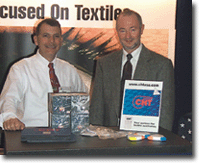
Gary Champion, technical sales representative, and Danny Thompson, customer service center
manager, represent CHT R. Beitlich Corp.

Omnova booth

Tony Mobley, technical sales, and Laurence F. Bond, general manager, national sales, both
with Atlas Material Testing Solutions

Bob Griswold, account executive, and Tim A. Cassell, regional manager, both with X-Rite Inc.

Norm Demers, technical support manager, Minolta Corp., demonstrates the CM-2600d portable
spectrophotometer.

Joe D. Parker demonstrates one of GretagMacbeth’s systems to a visitor.

 
December 2001

Sponsors