
Fi-Tech To RepresentHastem In The United StatesFi-Tech Inc., Richmond, Va., was named distributor in the United States and Canada for Germany-based Hastem Transportber GmbH.Hastem holds numerous patents for aprons used in the nonwovens and textile industries. The company has developed plastic slot profiles for efficient transport of nonwoven webs during processing. Individual slats can be replaced as needed with Hastems patented system.February 2002
Xetma Group Installs New Finishing Line In Korea
Xetma Group InstallsNew Finishing Line In KoreaThe Xetma Group, consisting of Germany-based Xetma Gematex GmbH and Switzerland-based Xetma Vollenweider AG, has installed a textile raising, emerizing and shearing production line at the Soodo KnittingandDyeing Co. Ltd., Korea.After several trials, Soodo decided to purchase the complete installation from Xetma Group. Soodo cited the flexibility of the machinery which allows treatment of both knitted and woven fabric on one range as a key factor in its decision. The installation includes Xetmas Optisystem XR, Optisystem XE and Optima XSmachines.February 2002
ProcterandGamble Donates Patents To Clemson University
ProcterandGamble DonatesPatents To Clemson UniversityProcterandGamble (P and G), Cincinnati, has donated its proprietary Capillary Channel Film and Fiber (CCF) technology to Clemson University, Clemson, S.C. By creating grooves in fibers and films, the new micro-capillary technology could make materials feel drier next to the body. The technology may also add benefits to feminine hygiene products, baby diapers, acoustical insulation, air-filtration systems and wound-care dressings.The technology donation includes rights to 10 U.S. patents and 84 foreign and pending patents, as well as all intellectual property from CCF development.According to Clemson, the pairing of the P and G patents with existing Clemson patents to successfully commercialize CCF technology could result in annual sales of fibers and films in excess of half a billion dollars. The university would benefit from royalties on product sales. We are thrilled that Clemson will be able to continue the development of this significant technology, said Al Dierckes, director, Baby Care Technology Division, P and G. It presents a real-life laboratory for Clemson students to further develop and commercialize a promising technology that can lead to a new source of funding for the university.Dierckes said P and G chose Clemson because of its research strength in the field of films and fibers, as well as its excellent track record in taking a technology from the workbench to the workplace.February 2002
U S Cotton Exports Exceed Domestic Consumption
U.S. Cotton ExportsExceed Domestic ConsumptionAt the National Cotton Councils 02 Beltwide Cotton
Production Conference held in Atlanta, William B. Dunavant Jr., chairman and CEO, Dunavant
Enterprises, Memphis, Tenn., had good news to report regarding consumption of U.S. cotton.Dunavant
said that of an estimated 20.05 million bales produced in 2001, 9.8 million were exported, compared
with U.S. consumption of 7.6 million bales. Dunavant projected 2002-03 crop-year production at 18
million bales, including 7.8 million for U.S. consumption and 10 million for export. Anderson D.
Warlick, CEO, Parkdale Mills, Gastonia, N.C., citing the U.S. textile industrys severe decline and
its loss of more than 60,000 workers, as well as the 26- to 30-percent drop in average prices of
Asian yarn and fabric imported into the United States, called on the industry to demand enforcement
of U.S. trade laws. He noted that enforcement of rules governing trans shipments would enable U.S.
mills to consume an additional 1 million bales of cotton.J. Berrye Worsham III, president and CEO,
Cotton Incorporated, Cary, N.C., said the U.S. cotton sector must become more export-oriented due
to the changing distribution of its customer base. His organizations objectives for improving
demand for and profitability of cotton include improving the yield, value and quality of U.S.
cotton production and development of stronger foreign markets for cotton exports, among other
goals.
February 2002
Clariant Launches E-Business Center
Clariant Launches e-Business CenterSwitzerland-based Clariant International Ltd. now offers customers in Europe access to its new on-line business center. Currently available in English and German, the center will be available to clients in North and South America by no later than mid-2002, Clariant hopes.Using the business center, customers can complete on-line transactions, access technical information and use various Web-based project management tools. In addition, Clariants enterprise management system (ERP), SAP, and numerous business-related databases are available. The center is divided into Shop, Products and Service sections. Each section has been designed for simple and intuitive use.February 2002
Acsis Offers Console Pocket PC 2002 For SAP Console
Acsis Offers Console Pocket PC 2002 For SAP ConsoleAcsis Inc., Marlton, N.J., has launched the Console Pocket PC 2002 for SAP R/3 data collection. The new Pocket PC provides an easily navigated graphical user interface (GUI) for SAP Console transactions that are run on Pocket PC-based mobile data collection computers, according to the company. The program includes Windows-familiar navigation buttons, touch screens, menus and more. Users can use the Pocket PC browser to obtain information from their ERP systems via SAP Consoles direct radio frequency (RF) connection or via the Internet.February 2002
Glenro Offers New Catalytic Oxidizer
Glenro Offers New Catalytic OxidizerPaterson, N.J.-based Glenro Inc. now offers a new catalytic oxidation system that removes multiple solvents including aldehydes, ketones, alcohols, esters and non-volatile vegetable oil and odors from a process exhaust stream at a rate of 13.3 pounds per hour. The system reduces fuel consumption by running at a lower temperature than a direct-fired oxidation process, and by using an air-to-air exhaust preheat exchanger subsystem, according to Glenro. The system is designed to maintain catalyst temperature at 750°F to 800°F, ensuring complete destruction of solvents, oils and odors, thereby meeting air quality regulations.February 2002
INDA Announces Winner Of 2002 Visionary Award
INDA AnnouncesWinner Of 2002 Visionary AwardThe Association of the Nonwoven Fabrics Industry (INDA), Cary, N.C., announced that ProcterandGamble has won the inaugural INDA Visionary Award for its Swiffer Wet Jet product. The award recognizes new products utilizing nonwoven fabrics and technologies. Finalists made formal presentations at INDAs Vision 2002 Consumer Products Conference in New Orleans in January. Conference attendees voted to determine the recipient of the 2002 Visionary award.The other finalists were: Abeil-Destex Nomex fire blanket, Destex SA, Switzerland; ComforTemp, Frisby Technologies, Long Island, N.Y.; Cottonelle Rollwipes, Kimberly-Clark, Dallas; and CIF Double Action Wet Wipes, Unilever, The Netherlands.February 2002
Model Mill Italy39 S Torcitura B And B
Italian Textile IndustryBy Piergiuseppe Bullio, European Correspondent Model Mill: Italy’s
Torcitura B and B
Italian yarn producer combines years of art and tradition with modern technologies to stay
competitive.
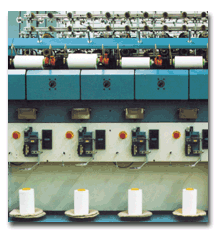
Torcitura B and B, a silk manufacturer in Italys Crema province, has demonstrated its lively
legacy of experience, knowledge and business skills for more than 25 years, blending innovation and
tradition in typically Italian style.For years, by scrupulously pursuing production quality in raw
silk and man-made yarn processing, as well as continuously updating technologies, B and B has
asserted its competitive presence on the market in Italy and the world.B and B traces its origins
to SATEX, a raw silk thrower founded in the late 19th century. At that time, the cultivation of
silkworms in Italy, which had flourished from the turn of the century until after World War II, was
in decline because of insufficient production to meet market demand. Raw material was imported from
China because of its high quality and later from Brazil. B and B was established in 1976 and, in
the 1990s, added to its silk-throwing activities by throwing yarns such as acetate, viscose, nylon
and polyester. Today, the B and B plant covers 10,500 square meters. Production of yarn totals
300,000 kilos per year, of which 70 percent is silk and 30 percent is man-made.Originally from
China, silk culture was introduced to Mediterranean countries around 500 A.D. In the centuries to
follow, silkworm culture spread throughout Europe. Italy, the worlds top producer of yarn and
fabrics until the 18th century, is still famous for the high quality of its silk products.Imported
raw silk, especially from China, comes for processing in the form of a hank. Through the various
treatment processes, different types of yarns are produced that can be used for anything from
scarves to shirts, and from ties to bridal gowns. The first treatment phase consists of a bath in
natural substances part of each companys secret recipe which makes the yarn softer and more
pliable. Then, the hank goes to the winder, where the yarn is wound on a spool and then loaded into
the uptwisting machine. This is followed by steaming, doubling and, finally, spooling, where the
yarn goes from the twisted bicone to the final package.A 1-kilogram bobbin raw yarn of 20 to 22
deniers produces a yarn approximately 428 kilometers long, the distance from Turin to Venice. At
this point, using new-technology machines, any imperfections in the yarn are removed through
slub-catching, measuring, antistatic oiling and precision traversing, which facilitate and prepare
the yarn for dyeing or weaving processes.After this meticulous crafting with an entire production
process lasting from one to two months the scientifically processed yarn is entrusted to human
skill and experience for quality control. Under expert eyes, even the tiniest defect can be
spotted. Of course, man-made fibers undergo the same production treatment before being presented
for dyeing and weaving. These fibers can be mixed with each other or with silk, depending upon
market demand and fashion, which uses the yarn for knitwear and apparel fabrics. Today, the trend
is to use silk crepe combined with viscose or cotton mixed with polyester in various combinations
obtained by high-technology machines.Traditional craftsmanship is still a part of the initial
phase, production control and final inspection. The 1980s were an important turning point for
Torcitura B and Bs productive innovation and the potential created by the introduction of new
technologies. As the textile sector adopted new high-speed looms and new coloring techniques,
production parameters for winding also needed to be changed, making yarn processing overall more
modern, efficient and rapid. Throughout the companys existence, there has always been constant
cutting-edge attention to updating machinery, which needs to follow the rhythms of the textile
sectors entire cycle. The process is accompanied by the increasingly attentive pursuit of quality
in the workplace and the environment in general. Wastewater from the yarn-bathing process has been
eliminated to avoid pollution. Clean technologies have been adopted for purification, and natural
substances are now used to better protect the environment and its natural equilibrium.By using the
most advanced technologies in processing silk and man-made yarns, Torcitura B and B has become one
of the leading textile mills in Italy, with a reputation for high quality and a large array of
products released on the market every year. In Italy, this market, handled by a network of sales
agents, consists of large fabric weavers and converters around Como, Biella, Prato and Carpi areas
known worldwide for their ancient textile history. Outside of Italy, B and B sells its yarns
primarily in Switzerland and Germany, which, in turn, supply the U.S. market. Of course, fashion
trends influence production decisions, which today are experiencing an increase in demand for pure
silk as well as fibers combined with silk; such as silk and viscose, silk and wool, silk and nylon,
and silk and acetate.The company is now committed to more strongly asserting its presence within
Italy and Europe by strengthening a more widespread network of sales agents. In addition, the
company maintains a strategy that constantly pursues product quality, environmental quality and
increasingly advanced technological updating. It believes this is the only way to meet the
competition from other countries. By implementing strategies designed for the immediate future, B
and B counts on increased sales of its textile products and higher revenues.In order to stem the
flow of imitation Made in Italy products that have appeared in recent years, B and B, in
collaboration with the Associazione torcitori italiani della seta, has established a quality mark
for Italian twisted silk. The various products from the entire silk-processing cycle, from
spinneret to finished fabric, may be released on the market with the associations certification and
mark. This mark will also indicate the social commitment of the producers, which operate in full
compliance with silk production processes, from working conditions to environmental protection.
February 2002
Quality Fabric Of The Month: Strong & Silent
Q uietness, durability and resistance to extreme cold are much desired qualities in fabrics used in hunting apparel. With these requirements in mind, Glen Raven Knit Fabrics, Glen Raven,
N.C., introduced its Microsuede® with DuPont’s abrasion-resistant Cordura® to the hunting and outdoor apparel market in early 2001.The fabric represents a new generation of the company’s original warp-knit Microsuede hunting fabric, which was introduced about five years ago as an alternative to traditional woven fabrics and the newer fleece fabrics being used for hunting and outdoor apparel. According to Hal
Bates, marketing manager, Microsuede offers advantages of quietness and softness over louder, stiffer woven fabrics and of burr-resistance over wooly fleece, as well as being more wind-resistant than most fleeces. In addition, he said, the brushed surface of polyester Microsuede shows a more photo-realistic, non-fading printed camouflage pattern than cotton. The fabric also is treated with Glen Raven’s Repelzz® water management system for long-lasting water repellency.

Sportchief uses Glen Raven’s Microsuede with Cordura in a range of outerwear products
including the archery jacket, shown above.
Collaborative Efforts
With all these advantages, the fabric’s quietness has remained its primary advantage for hunters. However, Glen Raven sought to improve the fabric further by adding abrasion resistance. The company has had a strong association with DuPont for a number of years and worked with the fiber company to develop a warp-knit version of Cordura nylon, which is normally used in woven applications, Bates said.
In Microsuede with Cordura, the two yarns are knitted together in two layers, with Microsuede presenting a brushed face to be printed and a lightweight, 160-denier Cordura in the back layer to provide the abrasion resistance.Initially, Glen Raven granted an exclusive license to
Canada-based Sportchief, an outdoor hunting apparel manufacturer, which introduced the fabric as Durasupple® in a range of outerwear products. Sportchief sells its products in the northern United States, Canada and Europe, and its customers require heavy, durable apparel to wear in extremely cold climates.
Glen Raven is now licensing other companies as well to use Microsuede with Cordura in products for activities such as hiking, backpacking and snowboarding, in addition to hunting.
For more information about Microsuede with Cordura, contact Hal Bates (336) 586-1325.
February 2002



