No Shortage Of Solutions

No Shortage Of Solutions
Textile industry looks to suppliers for chemistry that simplifies processes, improves quality
and adds value.
 What trends do leading suppliers to the industry see on the horizon in
textile chemistry Customers are looking for better removal of waxes and oils, and to improve the
rewetting of the fabric so that wetters and other dyeing auxiliaries are kept to a minimum or
eliminated altogether, stated Scott Jacobs, marketing communications manager,Cognis Textile
Technology, The Netherlands. The trend for volatile organic compound (VOC), and HAP-free
chemistries is continuing we observe a new push for reduction of alkyl phenol ethoxylates in many
areas of the country. Best known for the manufacturing of flame-retardant (FR) chemicals for
the textile and paper industry, Apex Chemical Corp., Spartanburg, S.C., is also looking to the
future. Jeffrey Chamberlain, technical sales manager, said, Today, a large portion of our business
now rests with auxiliary type products such as ultraviolet (UV) absorbers, fluorochemicals, stain
blockers and dye assistants such as levelers, deaerators and dispersants.
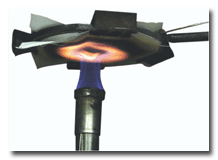
Flame test is performed on a 100-percent cotton sample treated with Apex Chemical’s
Flameproof 1725 FR coating. Because we are conventionally a flame retardant manufacturer, we
can look at our market driven somewhat in this order: regulation; innovation; and customer
expectation. We have recently developed a sublimation-fast UV absorber (Uvapex CFW) for
polyester, which contains a unique dispersion package that inhibits spotting on jet-dyed polyester
while offering great lightfastness. The product allows the user to run many more lots of goods
through a jet without cleaning, as our product prevents spotting which commonly occurs due to
build-up of trimer in the jets. Flame RetardantsIf it were not for regulation, there would be
virtually no need for flame retardants, said Chamberlain. We have developed solutions for pending
regulations relating to the manufacturers of mattress ticking and furniture upholstery.We have also
seen an increased need for flame-retardant back coatings, which offer to the consumer a soft hand.
Too often it is felt that certain desirable fabric properties must be compromised in order to meet
flame retardant regulations often this is not true.On other areas of development, Chamberlain
added, There seem to be many innovations introduced using wool. Although wool is an inherently
flame-retardant product, there are certain applications where FR treatment is required. For that we
have developed Apex Flameproof 1694, which rivals the acclaimed Zirpro process in performance but
surpasses it in ease of application.Mike Zavaglia, vice president, Amitech Inc., Oxford, N.J.,
said, We see excellent growth for the domestic textile industry for flame retardants. In the last
few years, we have come out with over two dozen brand new FRs, plus we carry most of the me-too
products. One wrinkle we have focused on is making halogen-free exhaustible FRs for almost every
fiber type. We now have exhaustible products in our line for polyester, nylon, acrylic, wool and
other synthetics. Among the benefits of exhausting over padding [are] softer handle, less color
change from finishing on a frame, better wash durability, better uniformity of the application of
the flame retardant and, in the case of the polyester, the FR actually has increased dye yield
slightly.Our intumescent line is another hot area. We are working with customers in so many
different areas: knits, wovens and nonwovens. The new mattress flame-resistance regulations pending
in California are giving us many opportunities to meet the new requirements with intumescents. Our
intumescent products, we call Pyromescents, can be coated, sprayed or padded on. They can be made
durable to washing, and our entire line has very low smoking properties when the flame is
applied.Pyrozyl 6P is our exhaustible, durable FR we sell mostly into the airline blanket and
automotive industries, said Zavaglia. Improving PerformanceBayer Corp. has a lot of new
protective finishes for textiles and carpets under our BayProtect® hang tag, said Brad Potter,
sales and marketing manager, Technical Textiles. Specific products include Baygard® EDW, which is
an oil/water durability extender based on polyurethane chemistry. Also, along the same lines, is
our line of Baypret® polyurethane finishes for improved abrasion resistance and hand modification.
A recent improvement in our fluoropolymer line of Baygard water repellents is offering new
opportunities in traditional apparel finishing that was not present before.Within the dye
auxiliaries category, Bayer has developed Tanasperse OLG, a unique in-bath trimer reducing
agent.OMNOVA Solutions, Performance Chemicals, Fairlawn, Ohio, recently announced the formation of
RohmNova, a joint venture of OMNOVA and Rohm and Haas Co., Philadelphia. According to OMNOVA, the
joint venture will market, sell and service latex binders, synthetic pigments, and specialty
chemical additives for coating applications in the global paper and paperboard industry. The
parties had been operating successfully as a strategic alliance for more than a year. Products
introduced in late 2001 to the floor care, carpet, and specialties markets, including applications
utilizing the companys proprietary PolyFox fluorochemical technology, are also gaining market
acceptance.Endurion, OMNOVAs high-performance, coated, woven fabric brand, recently was introduced
for upholstery applications in heavy-traffic environments in the hospitality and healthcare
markets.NOVEON Textile Chemicals Inc., Charlotte, reports from a finishing perspective that recent
trends call for apparel manufacturers to produce garments that provide the wearer a new level of
comfort, durability and functionality. Mark Carlough, product manager, textile chemicals, said,
Several products recently introduced to the market to assist textile manufacturers to achieve these
goals are Permax® 200, a first-generation of patent-pending polymers that can be engineered to give
controllable moisture-vapor transport properties in breathable fabrics for sportswear, protective
apparel and other technical fabric substrates. “Fabritone® LT-M8, a new silicone softener, provides
a softer, silkier hand to apparel substrates than previous product offerings. Freecat® brF is a new
catalyst developed for improved efficiencies in Durable Press Resin fixation by utilizing either
lower curing temperatures or greater operating speeds. Unidyne® TG-532, an aqueous fluoropolymer
emulsion originally developed for the nonwoven industry, provides excellent water- and
oil-repellency properties to apparel fabrics with a high level of durability to abrasion and
home-laundering conditions. In addition, the product is free of isocyanate compounds.Carlough
added, Noveon continues to develop new products for the domestic fabric and upholstery markets,
such as print binders and back coatings that enhance end-use properties such as colorfastness,
fabric softness, flexibility and flame retardancy.Cognis Jacobs said, Fabric performance is where
we see the industry moving. There are more and more requirements to improve the hand, moisture
management and durability of soil and water repellency. Cognis has recently introduced a line of
Repellan® durable water and oil repellents to the U.S. market and is in the process of completing
testing of a new line of products called Skin-Tex. These new products are designed to bring the
performance of our cosmetic-base chemistry together with textiles. They would include odor control,
fragrance and other skin nutrients. In addition, we currently have a global agreement with Microban
to provide antimicrobial finishes to the textile industry. Adding ValueRobert Casciani, Ph.D.,
market development manager, Sanitized® antimicrobial products, Clariant Corp., Charlotte, points to
a growing trend of adding value with antimicrobials. The Sanitized brand has offered solutions in
extruded products as well as finishes. Sanitized has been an active brand for over 70 years, and
globally since 1952. Casciani added, The T96-21 product is a versatile antimicrobial finish for
many fabrics and end-uses. On polyester and nylon fabrics it can be applied during dyeing, and can
be applied to polyester, nylon and cotton during frame finishing we need a pH of 5 for the product
to be substantive and provide durable protection.Casciani said, With a growing trend of consumer
awareness regarding chemical finishes on apparel fabrics, the sister product to T96-21 in Europe,
T96-20, has been approved by Oeko-Tex, Switzerland, which certifies products as consumer-friendly.
This is the only antimicrobial product registered under the current Oeko-Tex standard. The trend is
strong in Europe and South America, and we see it strengthening in the United States.As Betty
Tilley, product manager for dyeing and finishing, Apollo Chemical Corp., Burlington, N.C., noted,
Trends that we see are in value-added performance chemicals. Our customers want to separate
themselves from their competitors. Performance is critical, but so is pricing. There are several
segments of the textile industry doing very well, like denim, flat wovens, sheeting these companies
are looking for good products at a very competitive price.Tilley continued, Apollo Chemical Corp.
introduced new patent-pending technology in the area of moisture modifiers. AQUATEK UNO is a
hydrophilic nylon polymer which imparts hydrophilicity to nylon 6 and nylon 6,6 fabrics. When
applied by exhaust to nylon fabric, the product provides absorbency, vertical wicking and moisture
transport to the nylon fabric. With an application of AQUATEK UNO, nylon fabrics have a quicker
evaporation rate than typical nylon fabric. Application by exhaust ensures excellent durability to
home launderings. Application amount varies by weight of fabric and desire to have a durable
finish.Apollo also distributes BioShield AM500, an antimicrobial from BioShield Technologies,
Norcross, Ga. This patented technology inhibits growth of both gram-positive and gram-negative
bacteria, and also controls mold and mildew formation, which often creates odors and discoloration
on fabrics. 
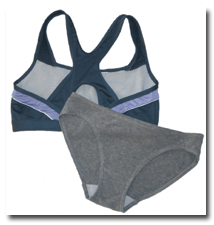
trAPTEK’s carbon finishing technique imparts UV protection, as well as odor and moisture
control, to a variety of textile products.Gregory Haggquist, director of technology, trAPTEK LLC,
explained the startup company located in Longmont, Colo., and Bedford Hills, N.Y., is introducing a
durable finishing technique incorporating activated carbon into a wide range of textiles. The
activated carbon adds three major performance features, according to Haggquist: odor management
(trapping odors both from the wearer and the environment); moisture management (increasing the base
fabrics wicking power by up to 100 percent); and UV protection (enhancing the UV protection factor
(UPF) by up to 400 percent) leaving the wearer feeling cool, clean, fresh and natural. 
Haggquist continued, The integrity and effectiveness is retained through extensive home laundering,
and potential applications are in the activewear, sock, hunting apparel, carpeting, upholstery,
military, intimatewear, baby products and medical industries. “ATAC” Pretreatment SystemSusan
Cellura, manager, marketing communications, NAFTA, with Ciba Specialty Chemicals, Switzerland,
noted, In pretreatment, we see a trend in simpler recipes at a lower cost constantly trying to make
the pretreatment process more efficient. The demand to reduce cycle times and save water is greater
than ever. Control of iron is becoming a big issue due to customers trying to use a cheaper,
poorer-quality cotton to reduce costs. Preparing cotton under pressure at high temperatures is
becoming more and more common this again is due to mills trying to compensate for a poorer cotton
quality. The use of enzymes to neutralize peroxide is growing rapidly.

Ciba’s Tinofast CEL liquid provides protection against UV radiation when applied to
cellulosics, according to the company. Ciba launched its new ATAC pretreatment system this
year. Cellura reports the system allows mills to significantly reduce the time it takes to prepare
fabric for dyeing and dramatically reduces the amount of water required to effectively prepare the
material. According to the company, it does all this at a price that has saved most plants 10 to 40
percent in their cost to prepare goods. The system includes three products:TINOCLARITE COM is a
combination product and is all that is needed in the bleaching or scouring bath. No additional
lubricant is necessary, and in most machines a defoamer is not required.INVATEX AC is a washing-off
agent that contains special dispersants that allow customers to reduce the number of rinses while
still effectively cleaning up the fabric. It also neutralizes remaining alkali, eliminating the
need to use additional acetic or citric acid. TINOZYM CAT is an enzyme for neutralizing peroxide
that can be carried over into the dyebath without problems eliminating the need for a fresh bath
and saving time and water. Unlike other products in the market, it has an extremely wide pH and
temperature application range this allows you to go straight into any type of dyeing without
worries, Cellura noted.When asked about iron, Cellura said, We are recommending INVATEX AC. This
product is extremely effective at controlling iron. It is effective in a very wide pH range, making
it suitable for addition into any pretreatment step where extra iron control is needed. Dyeing
AuxiliariesThe dyeing industry is constantly seeking improvements in efficiency, energy savings and
product quality, commented Danny Thompson, technical advisor for dyeing auxiliaries, CHT R.
Beitlich Corp., Charlotte. It looks like there are two current trends in the textile industry that
will affect the wet processing of textiles microfibers and stretch fibers particularly in the
apparel area. In general, these fibers create additional challenges for the dyer to achieve level
dyeings with acceptable fastness.Thompson continued, Rewin KMB is used in nylon dyeings as an
in-bath fixing agent. By eliminating the traditional fixation cycle at the end of the dyeing
procedure, this product can save considerable time. The Rewin KMB has leveling properties as well.
And in some cases, it is used as a one-bath leveler and fixative. Because of its special chemistry,
it helps avoid a common problem of residual leveling agent in the yarn or fabric. This residue
carries into the post-treatment fixative bath, where incompatibilities create a precipitation
(usually brown spots) on the dyed substrate. Rewin KMB avoids this precipitation to produce clean,
level, first-quality dyeings. 
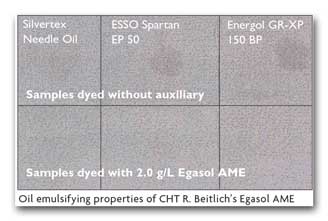
 Egasol AME for polyester dyeings has a unique chemistry that allows it to function as
both a leveling agent and an emulsifying agent. This combination of properties can help the dyer
eliminate the traditional pre-scour step on most polyester styles. While still fulfilling its role
as a leveling agent, Egasol AME will emulsify any residual processing oils typically removed during
pre-scour during the dyeing process.For cotton dyeing, CHT R. Beitlich has developed Sarabid LDR,
which can eliminate off-quality dyeings caused by streakiness in piece dyeing and unevenness in
yarn-dyed packages, said Thompson. This product is a special dispersing agent and sequestering
agent that works to prevent agglomeration of reactive dyes. In a non-classical way, the Sarabid LDR
acts as a leveling agent for reactive dyeing of cotton by keeping the dye particles finely
dispersed and protected from water hardness.BASF AG, Germany, has developed the ECOFIT product
range for pretreatment. The ECOFIT products include detergents, wetting agents, extracting agents,
peroxide stabilizers and complexing agents and have been introduced as ecologically and technically
adapted to the meet the requirements of tomorrow.Cyclanon ECO is an ecologically advanced reductive
aftertreatment for use on PES fibers. Cyclanon ECO is supplied in a easy-to-handle liquid form and,
according to the company, the product lowers process costs because there are no pH adjustments
needed anywhere in the process. This, in turn, ensures faster colors in significantly faster
times.Steve Glosson, senior applications chemist, Boehme Filatex Inc., Reidsville, N.C., stated,
Trends that we are responding to with our products are ones that enable savings of cycle/processing
times, energy and water. Our customers are interested in technologies that enable them to get
more performance out of traditionally limited processes. An example would be obtaining better
fastness properties from pigment dyestuffs, enabling darker shades/prints (usually produced with
more expensive dyes with better fastness) to be produced more economically.In the case of the
dyeing of medium to dark shades, our Tabanol RFK-Jet-R, designed for cellulosic dyeing on jets,
enables the dyer to run an abbreviated preparation cycle, along with eliminating several other
chemicals traditionally used in the cycle. The Tabanol RFK-Jet-R eliminates the need for a
defoamer and contains wetting, lubricating, dispersing, and calcium- and magnesium-chelating
properties. Thus, one product takes the place of separate chelate/dispersant, defoamer and
lubricants. This translates into savings of time, energy and chemical inventories.For the
processing of nylon substrates we have developed Durofin SPDX, which is an antioxidant that
protects the fiber from yellowing during dry heat processes during fabric finishing, or, in the
case of intimate apparel, during molding/forming operations. Chemical Supply ChainAt a recent
presentation in Europe titled New Strategies for Catering to Customer Needs, K. Michael Lanham,
commercial director, Xiameter, explained that Xiameter.com is a Web-enabled business introduced by
Midland, Mich.-based Dow Corning that is focused on reducing costs and offering the lowest base
price for standard silicon-based products. Dow invested more than $100 million in back-office over
a five-year period, utilizing the SAP® global platform to create one global Enterprise Resource
Planning (ERP) System. The system offers the ability to view global activities in real-time
ordering, scheduling, production and shipping.Xiameter benchmark product pricing is posted daily on
the site and offers customers choice, low cost and an easy way to do business on-line targeting
customers who buy in large volumes and know what they need in the way of mature silicones.The
company has received a positive reception for Xiameter. According to Lanham, Its a win-win.
Compounders and formulators who know the products they are looking for can get them at lowest cost
with a firm commitment on guaranteed shipping date. Xiameter brings Dow Cornings silicone
technology into the supply chain in an easy, cost-effective way for customers who know what they
want. We still maintain the Dow Corning service level for those who need it as well.DyStar,
Germany, took over the business operations of Color Solutions Inc., Charlotte. As a leading
supplier of color standards to the industry, Color Solutions primary customers are retailers,
producers of brand-name goods and purchasing organizations with global textile interests. Color
Solutions establishes customized color standards on the basis of the customers technical,
commercial and ecological requirements. The company will operate independently under the name Color
Solutions Inc. John Darsey, former co-owner, responsible for global sales, stated, Through its
worldwide presences, DyStar can support the implementation of color standards in textile
mills. Better ChemistryThe textile industry continues to look to suppliers for chemistry that
simplifies processes, improves quality and adds value that differentiates products. There is no
lack of activity in fact, the added-value proposition seems clearly in focus for suppliers. Strong
emphasis on process optimization and quality is a point of consensus, and new products are
appearing on the horizon to assist dyers, printers and finishers to move well beyond commodity
products.

September 2002
House Okays Dyeing Finishing Printing Trade Requirements

House Okays Dyeing,Finishing, Printing Trade RequirementsThe final supplemental appropriations bill
passed by the U.S. House of Representatives includes a provision that U.S. fabrics used under the
Caribbean and Andean preferential trade programs also must be dyed, finished and printed in the
United States.This is a major victory for U.S. textile companies and U.S. textile workers, said Van
May, chairman, American Textile Manufacturers Institute (ATMI), Washington. It shows that, by
working together, our industry and our supporters in Congress can succeed in making sure that we
have a U.S. trade policy that is fair to American textile manufacturers.
September 2002

Kreyenborg Opens Facility

Kreyenborg Industries the North American subsidiary of Kreyenborg GmbH, Germany recently opened a
new 16,000-square-foot facility in Lawrenceville, Ga. The official ribbon-cutting ceremony was
followed by a two-and-a-half-day open house featuring demonstrations of its new lab line, as well
as technical presentations.Capable of outputs of up to 2,500 pounds per hour, the new lab line will
be used to conduct demonstrations, customer trials and short production sample runs. The line
features Kreyenborgs screen changers, extrusion gear pumps, BKG brand underwater pelletizers, a
58-millimeter compounding twin-screw extruder, three loss-in-weight feeders and a completely
integrated control system from its sister company, BSG.

September 2002

Quality Yarns New Look

Quality Yarns, New Look
Reorganized Yarn Fair International show is attracting key buyers. With a change in
time, place and organization, Yarn Fair International is attracting a new group of quality
exhibitors and buyers. The 1,963 attendees looking for new yarns from international resources came
from a diverse group of greige mills, knitters, hosiery manufacturers, fashion designers and
retailers. Key people from Burlington, WestPoint Stevens and Springs, among others, were shopping
for weaving yarns.Among the knitters visiting the show were representatives from Ge-Ray, Malden
Mills and H. Warshow. Hosiery manufacturers included Dominion Hosiery, Hot Sox and Royce. Fashion
designers and yarn buyers came from Calvin Klein, Ellen Tracy, Tommy Hilfiger, Jones Apparel Group
and Ralph Lauren. JC Penney, J.Crew, Victorias Secret and Nordstrom were among the
retailers. On display were yarns for outerwear, underwear, casualwear, activewear, dresses,
suits, hosiery, sweaters, hand knitting, home furnishings, floor coverings, blankets, trimmings,
automotive interiors, protective clothing and insulation. With close to 100 exhibitors from 17
countries, there was variety at every level.Robert Lachow, director of sales, home furnishings,
J.B. Martin Velvets, was looking for solution-dyed and novelty yarns. We are doing well with our
mohair velvets and other high-end upholstery fabrics, he said. To be competitive in world markets,
we are also looking for resources for commodity yarns. 

Fabric samples on display at the Trend Forum showed exhibitors’ products for the Fall/Winter
03-04 season to buyers and stylists. Elizabeth Amoroso, president, Hathaway Textiles, was
looking for yarn for suede-type fabrics. Patricia Lounis, JC Penney, said, This show is very
helpful. I am looking for novelty, space-dyed yarns and textures such as chenille bouclfor
knitting.Anne Ewing, senior designer, intimates, Jockey Brand, Jockey International, was a
first-time visitor. It is incredible to have all of these spinners together. I am getting an
overview of the season and expect to find new resources. Nilit And Unifi OfferingsThe Unifi
and Nilit stands were adjacent. Both were promoting Arafelle, a nylon 6,6 textured heather effect
yarn with a cotton-like touch (See Under Cover,
TW, April 2002). We are introducing Sensil Arafelle for the seamless market for underwear
and outerwear, circular knitting, legwear hosiery and socks, as well as yarn covering, said Molly
Kremidas, merchandising manager, Nilit America, Greensboro, N.C. Kremidas noted that flat, bright
yarns combined with dull yarns were of special interest. We have seen a lot of sock manufacturers
here and buyers from South America.Greensboro-based Unifis Kimberly Lewis, director of marketing,
said, We are focusing on innovation and economics. Its all about how we can make our customers more
successful. Lewis said Unifis Novva, Augusta, Reflexx and Mynx yarns were of special interest.
Ge-Ray has developed fabrics that have drape and a soft touch using Novva. The fabrics are going
into sportswear and intimate apparel garments. Victorias Secret has adapted Mynx, which offers
ultraviolet protection, for yoga attire. Burlington will be using Augusta in menswear fabrics, both
tops and bottoms, this Fall.Lee Gordon, senior vice president, who handles product development at
Unifi, said that some of the new yarns the company is working on include super microdeniers,
odor-control yarns, polymer additives and modifications, and NatureWorks PLA, the corn-based fiber
from Cargill Dow.At Meadowbrook Inventions, Bernardsville, N.J., Vice President Roberta Ruschmann
said new end-uses for Angelina® metallic yarns are swimwear, upholstery and automotive interiors.
We are selling all areas of the contract market, from hospitality and healthcare to office seating
systems, she said. On display were flame-resistant products for upholstery and drapery
fabrics.Iridescent, metallic and holographic Angelina fibers have been blended and spun by Brodnax
Mills, Brodnax, Va. Two-way stretch fabrics blending Angelina and Lycra® with wool, nylon, cotton,
silk and flax are being used for swimwear, intimate apparel, activewear, outerwear and pile
fabrics. Some of the textile mills involved are Absecon Mills, Culp, Newcastle Fabric Corp., Bentex
Mills, Phifer Wire Products, Dorr Woolen Mills and H. WarshowandSons.Ilaria, an Italian spinner of
fancy yarns for knitting and weaving, showed Angelina blended with kid mohair, and in combination
with wool and nylon. Hologram fibers adhered to wool/alpaca yarns give irregular spots of
luster. Opossum Yarns From India And New ZealandWorsted spinner Jaya Shree Textiles of India
shared a booth with its joint venture partner, wool spinner WoolYarns of New Zealand. Both firms
showed a yarn blending ultra-fine merino wool with opossum a hollow fiber that is lightweight,
ultra-soft, warmer than wool, pill-resistant and less costly than cashmere. Another innovation at
Jaya Shree is Finolana, a line of ultra-fine worsted wool yarns that have been stretched and set
using a process called Optim, developed by Woolmark. Filati Maclodio of Italy showed yarns
containing a new wood-based fiber called Lenpur®, produced by Texinpro, located in Brescia, Italy.
It has been in the market for a year and is going into yarns for both weaving and knitting. The
first garments woven with Lenpur are in a collection of mens shirts that will be in Dillards stores
this Fall. Yarns can be mercerized on the cotton system or self-mercerized in dyeing. Maclodio is
blending Lenpur with wool, cashmere, linen, cotton, silk and acrylic fibers.Belgian linen spinner
Procotex showed flax yarns for knitting and weaving that have exceptional elongation. Spun on the
cotton system, the E-lin (for E-lasticity and E-longation) yarns are fine, long and strong, and
have 6.5-percent elongation. Davis L. McNulty, agent for Procotex, is also sales manager for
Pickens, S.C.-based Kent Manufacturings worsted yarns. Kent was showing basic natural, undyed wool
yarns and total easy-care wool called Superwash. Cotton/Wool BlendsThere was an increasing
amount of cotton blended with wool at the show. Reiner Elend, sales manager, export, Schoeller
Eitorf AG, Germany, said, America likes cotton, even in the winter months. Europe likes wool, even
in summer, so we blend them to please everyone. Cotton/wool blends at Schoeller range from tweeded,
coarse-gauge yarns that are light in weight to fine, washable yarns with a cashmere touch.French
spinner Groupe Saint Lin showed yarns for knitting and weaving, as well as technical yarns from its
Paul Bonte division. Damien Lestienne, sales director for the knitting division, is also president
of Expofil and Yarn Fair International.Yarns of special interest at Saint Lin include space-dyed
yarns of wool/acrylic/mohair, multi-colored yarns with elastane and a new bouclith stretch. For
Fall, there are 12 new yarns in the Saint Lin knit collection. The Paul Bonte collection includes
Chimere, a dissolvable yarn. There are lightweight stainless-steel yarns that provide
electromagnetic protection, retro-reflective yarns and yarns that have special telecommunication
properties. 

Giuliano Marelli is using Grignasco yarns in a unique collection of knitted garments.The most
heavily sampled yarns from Italian spinner Grignasco are ultra-lightweight with a soft touch. They
can be fine or bulky. There are multi-colored yarns, heathers, tweeds and printed yarns. Most are
spun using extra-fine merino or blends with cashmere. A lot of the merino yarns are total
easy-care, including wool/cotton blends. Stretch yarns contain either Lycra or ElitGrignasco spins
on the woolen and worsted systems, and the company sells to the knitwear, hosiery and weaving
industries. High-performance yarns contain silver. They are antistatic and antibacterial, and have
thermal-regulating properties. Another Italian spinner, Lanerossi Yarns, part of the Marzotto
Group, spins yarn using fine, extra-fine and ultra-fine merino. Most yarns are anti-pill. A lot
contain Dorlastan® or Elitor stretch. Andrea Saccardo, sales manager, said intimate blends of
extra-fine merino/cotton are selling well, especially in the South. The hand is soft, but not too
wooly, and fabrics knitted or woven from these yarns can be machine-washed/tumble-dried.
Cotton/wool yarns at Italy-based Overfil are heathered and twisted. According to agent Roger Markay
of Yarn Sales Corp. Inc., New York City, a lot of the same yarns are going into knitted and woven
fabrics for matched separates. There are lightweight bulky yarns, boucl#44; brushed yarns,
bicolored and multicolored yarns in blends of wool/acrylic/nylon.Luxury Fibers From
ArgentinaHilanderia Capen, Buenos Aires, Argentina, spins luxury fibers cashmere, angora, alpaca,
silk and wool. Of special interest are dehaired llama yarns. The hair is exceptionally soft and
fine, and according to Alejandro Battistelli more beautiful than alpaca. There are 100-percent
dehaired llama yarns and blends with cashmere or cotton. Another yarn unique to Capen is spun of
wild Argentinian rabbit hair. The hair is so fine that each rabbit can provide only 0.30 grams of
hair. Capen yarns are sold for circular and flat knitting, and for weaving.Spanish yarn producer
Himiesa showed classic and fancy acrylic-based yarns and blends for knitwear, hosiery and weaving.
Mnge tweed yarns, wool/acrylic bouclwith space-dyed loops, and moulines were pointed
out.Coren-Indik Inc., Feasterville, Pa., a wool spinner with mills in Millbury, Mass., and
Newburgh, N.Y., is selling wool blended with cotton, silk or acrylic. Some of the novelty twisted
yarns have a tweed or homespun look. They are especially popular for hosiery and sweaters.
Upholstery and industrial yarns of nylon or polypropylene are selling well.Another firm selling
polypropylene yarns for technical end-uses is Spanish spinner S. Vilarassa. Half of its line is
geared to technical and home textile products, while the rest goes into apparel. The best-selling
apparel yarns are indigo and black-dyed cotton for denim. U.S. Spinners Offer Variety And
PriceU.S. companies were pleased with the turnout at the show. Jim Laney, executive vice president,
marketing, Meridian Industries Inc., Valdese, N.C., said, I saw more quality customers in one day
here than I expected to see in three days.Laney noted that with space-dyed yarns and color in
fashion, Meridans business is excellent. Our sales to the automotive and woven sectors are way up,
he said. According to Laney, there is interest in novelty yarns. With our hollow spindle twisters
we can make hundreds of different novelty yarns.

Jim Laney, executive vice president, marketing, Meridian Industries Inc. For the
decorative market, Meridian is selling shiny, textured chenille yarns and flame-retardant yarns.At
S&O Industries, New York City, Richard J. Flaster, vice president, sales, said 100-percent
indigo-dyed cotton chenille is its best-selling yarn. When the chenille is cut, it has an aged
appearance. Other yarns are spun with acrylic that has a wool touch or with Micromattique for a
suede touch. S&O is selling high-tenacity core-spun yarns to the carpet industry. Ninety
percent of its yarns go into products for the home.Amy Seiler, director of sales and marketing,
Kennetex, Kennett Square, Pa., said sheen and texture are selling. Polyester space-dyed yarns and
novelty bouclare two she mentioned.Nortex Yarns, Fall River, Mass., a division of Quaker Fabric
Corp., sells fancy yarns for home furnishings, knitwear, hand-knitting and industrial end-uses.
According to Jennifer Doyle Fischer, yarn sales representative, 80 percent goes to home textiles
and 20 percent to apparel and hand knitting. The hand-knitting yarn business is growing, Fischer
said. We are selling smaller quantities to more high-end buyers. Chunky bouclwith slubs and nubs
are yarns she pointed out. For the home, Fischer noted multicolored chenilles and bouclare selling,
especially those with a vintage look.Jimtex Yarns, Philadelphia, spins its yarns with recycled,
predyed cotton waste. Jimtex stocks more than 50 colors of open-end, blended yarns. Current
favorites are novelty marls that have the look of space-dyed yarns. According to Peter Sagal,
president, Silk City Fibers, Paterson, N.J., more of its line is going into woven fabrics for the
decorative market and specialty trimmings and fringe. Matte viscose with good drape, finer-gauge
yarns and linen are in demand. For apparel, there is a greater interest in wool. Textile
Machinery Producers Sell ServiceTwo German textile machinery companies showing at Yarn Fair, Stoll
and Schlafhorst, showed off the advantages of their equipment for end-product quality and
performance. At Stoll, the display focused on the variety of knitted fabrics that can be created
using its equipment. Schlafhorst promoted its Belcoro® quality trademark.

 
September 2002

Vanson HaloSource Funding To Boost Development

In its latest round of equity financing, Vanson HaloSource, a Redmond, Wash.-based developer of
antimicrobial biomedical products using chitin/chitosan- and N-halamine-based technologies, has
raised $5 million to be used to expand marketshare of its existing products and bring new products
to market.Existing products using chitin and its derivative, chitosan, include a medical device for
a Fortune 500 company. Vanson HaloSource also is developing other biomedical products that use the
polymer, which is refined from crustacean shells and exhibits unique chemical binding properties,
to speed healing of wounds and treat burns.Under an agreement with G. HirschandCo., Burlingame,
Calif.,the company is using N-halamine technology to develop medical bedding in which chlorine
atoms are bonded to the fabric to destroy odor-causing and infectious bacteria. N-halamines improve
and prolong the antimicrobial performance of chlorine and dramatically reduce its toxic,
carcinogenic and corrosive effects by binding the chlorine tightly to the surface of the fabric and
minimizing the leach rate, according to Vanson HaloSource. The N-halamines act as a recharger
during laundering with chlorine bleach, giving the bedding continued antimicrobial properties.

September 2002

Solutia Adds Companies To Partners For Renewal Program

Solutia Adds Companies ToPartners For Renewal ProgramSaint Louis-based Solutia Inc. has expanded
its Partners for Renewal Program with the addition of the Los Angeles Fiber Co., Los Angeles, and
Nyloboard LLC, Covington, Ga. The goal of the program is to manage carpet waste by putting recycled
content back into new carpet fiber,or by discovering non-carpet outlets for post-industrial and
post-consumer products.Los Angeles Fiber will take consumer commercial carpet from Solutias
customers and recycle the waste into carpet cushion and other thermoplastic products.Nyloboard also
will use carpet waste from Solutias customers in its Nyloboard synthetic waterproof construction
materials.
September 2002

ATMI Calls For New Quotas On Surging Chinese Imports

Washington, DC — Citing a record 119% increase in textile imports from China during the first six
months of 2002, the American Textile Manufacturers Institute (ATMI) is petitioning the Committee
for the Implementation of Textile Agreements (CITA) to impose special textile quotas on the
following products: knit fabric, gloves, dressing gowns, brassieres and textile luggage. (Note:
CITA is the interagency committee which administers the United States textile/apparel import
control program.)ATMI is also asking CITA to prepare a case for the possible imposition of a quota
against imports of textured filament yarn from China in the event that imports of that product
continue to rise. The ATMI request covers categories for which ATMI member companies make the
products or the components that go into the products. ATMI is urging such action under the
provisions of the China WTO accession agreement, which allows countries to impose textile-specific
quotas in the event that Chinese exports cause or threaten to cause market disruption. The use of
the temporary quota is allowed until December 31, 2008 only for products that have already been
removed from quota-control under the terms of the WTO Agreement on Textiles and Clothing.An ATMI
analysis of trade figures shows that imports of Chinese textile products are currently experiencing
their largest surge in history. ATMI notes that the textile safeguard provision was specifically
included in the China WTO accession agreement to restrain such surges. Last year, under
extraordinary pressure from currency-devalued imports from China and other Asian countries, the
U.S. textile industry closed 116 textile mills and lost 67,000 jobs.During the first six months of
the year, Chinese exports of textile and apparel products to the United States increased by almost
900 million square meters, with the textile portion increasing by more than 700 million square
meters. On the strength of this increase, China surpassed both Pakistan and Canada to become the
second largest textile and apparel exporter to the United States, shipping 1.9 billion square
meters during the first six months of the year. China accounted for 60 percent of the increase in
world-wide imports of textile and apparel products during the first half of the year.The Chinese
increase has come mostly in categories from which quotas were removed on January 1, 2002. In almost
every case, these increases have gone hand in hand with double-digit price declines for imported
Chinese goods. In terms of individual categories, these stand out:1) Knit fabric Chinese knit
fabric exports rose 22 thousand percent and the average price of Chinese knit fabric dropped by 60
percent, catapulting China from being the 26th largest supplier of such exports to the U.S. to the
5th place among all foreign suppliers;2) Gloves Chinas exports of gloves to the United States
tripled over the last six months, with the result that Chinese exports are now twice as large as
those from the next largest supplier;3) Nightwear/Dressing Gowns Chinese exports of nightwear more
than quadrupled, vaulting China from seventh to first place among supplying countries. The Chinese
surge was accompanied by a 47% drop in Chinese prices;4) Brassieres In less than six months, China
leapfrogged the top two long-standing largest suppliers Mexico and the Dominican Republic as Chinas
price per dozen dropped to $29, by far the lowest of any major supplier;5) Luggage Chinese exports
of textile luggage have quadrupled to 71 million kilograms while imports from every other supplier
have simultaneously dropped, some by as much as 60 percent. Chinese prices fell by 62% during the
same period of time. China now ships more than five times as much as the next largest supplier;6)
Textured filament yarn Chinese exports have only recently begun to surge and remain relatively
small. However, over the past two months, Chinese exports increased at a rate of 400,000 kilograms
a month. In its request to CITA, ATMI stressed that “it is now time for CITA to act expeditiously
in restraining the import surges already occurring in order to prevent further damage to an already
beleaguered U.S. domestic sector.” ATMI also noted that the Chinese surge “further damage an
industry that in 2001 suffered its worst year since the Great Depression.”

ESLTest II With Extensometer Ensures Accuracy

The ESLTest II with Extensometer offered by Electro Standards Laboratories (ESL), Cranston, R.I.,
utilizes an advanced counterbalance design technique of attachment to the test specimen, ensuring
accurate measurements. The ESL Extensometer includes a spring-loaded, plunger-style attachment
closure that clamps directly to the sample for accurate elongation. Up to 35 inches of follower
separation can be achieved.

September 2002

Bill Praised And Damned


C
ongress has granted President Bush broad new international trade negotiating authority
that many expect will bring about major changes in the world of textile and apparel trade.

It won’t be a revolution; it’s more of an evolution. Initially, there is not likely to be a
major increase in imports, except for a few products, such as T-shirts and some others that are
being sewn in the Caribbean. For the longer term, it will mean U.S. textile manufacturers and
importers will have to take a hard look at just where they will fit in an increasingly globalized
textile and apparel industry.


Bill Praised And Damned

As the bill neared final passage in the Senate, Van May, chairman of the American Textile
Manufacturers Institute (ATMI), pointed out that this year, the U.S. textile industry has lost
67,000 jobs and closed 116 textile plants. He said the bill “fails to recognize our suffering, but
will exacerbate it.” Because of the Andean and African preferences in the bill and other
import-liberalization provisions, ATMI opposed its passage.

U.S. Trade Representative Robert Zoellick was effusive in his praise of the bill, saying it
was a “landmark victory” that will enable the administration to advance its international trade
agenda. In particular, he said the legislation will open America’s markets “right away” to
developing countries in Africa, Latin America and the Caribbean.

Zoellick said the bill will help the United States play a stronger role in the global
negotiations that are in their preliminary stages at the World Trade Organization (WTO), and he
also believes the new TPA authority will help the United States move forward immediately with
bilateral negotiations with Chile and Singapore. Those negotiations have been sidetracked for some
time because the president lacked authority to negotiate without fear of second-guessing by
Congress.

Textile and apparel importers were generally pleased with the legislation. Kevin M. Burke,
president of the American Apparel and Footwear Association (AAFA), said the legislation contains “
many initiatives that will help our industry compete in the future.” Julia K. Hughes, vice
president for international trade and government relations for the U.S. Association of Importers of
Textiles and Apparel (USITA), pretty much echoed his sentiments, adding that she sees many
opportunities to develop new partnerships and markets in the Western Hemisphere, where proximity to
U.S. customers is increasingly important for just-in-time manufacturing and deliveries.

p20_2316

President Bush signs the Trade Act of 2002. Photographed by Tina Hager.


What It All Means

Recognizing that the legislation is a done deal, ATMI President Parks D. Shackelford said his
organization now will concentrate on seeing that existing trade laws are enforced, including better
Customs policing of transshipments and other forms of illegal trade. ATMI will continue to oppose
any speed-up in the timetable for eliminating quotas by 2005, and it will press for other nations
to bring tariffs down to U.S. levels, before any additional reductions in U.S. tariffs are
considered in the WTO negotiations. In connection with any future bilateral negotiations, ATMI will
seek rules of origin that will protect U.S. manufacturers.

Hughes says the increased trade with the Sub-Saharan African and Andean nations that is of
such concern to ATMI should not be a problem for the U.S. industry, because those nations are only
minor players in the overall trade picture. She does not foresee any major increases in imports
from those areas but gradual growth. She does, however, see the possibility of a shift in sourcing
away from Asia to Western Hemisphere manufacturers, primarily because of their proximity to U.S.
markets and a growing concern by manufacturers, retailers and lawmakers over working conditions and
environmental considerations in trading nations.

Because the legislation created new or increased quotas for apparel from the Andean, African
and CBI nations, there is an opportunity for U.S. manufacturers to sell more yarn and fabric in
those areas, at least for the short term. The increased apparel quotas for the CBI have a
requirement that U.S. yarn must be used in order for the apparel to qualify. Large, regional fabric
use quotas also were created for the Andean and African nations. At the present time, those
countries do not have the capability to fill the needs of the increased apparel quotas, and this
opens up opportunities for U.S. fabric and yarn manufacturers to establish partnerships with
cutters and sewers in those areas until such time as they develop their own capabilities.


The Role Of ATTAC

The newly-formed American Textile Trade Action Coalition (ATTAC), headed up by Roger Milliken
and textile union UNITE’s Bruce Raynor, will be pursuing many of the same goals as ATMI, but how
closely these efforts will be coordinated remains to be seen. ATTAC’s Washington consultant, Auggie
Tantillo, said his organization’s primary goal is preserving textile jobs, and it will align itself
with organizations and lawmakers who can further that goal.

He emphasized the importance of what’s in the final package and all of the details in
agreements. With respect to some of the upcoming issues, ATTAC will seek in any future bilateral
agreements, rules of origin that are at least as strong as those in the North American Free Trade
Agreement (NAFTA), and it will press the U.S. government to keep textile and apparel tariffs at
their present levels and resist any future cuts until other countries reduce theirs.


A Big Job Ahead

With the new legislation on the books, but subject to wide-ranging interpretations, the textile
industry and importers face an enormous job of sorting out just how the law can be used to benefit
them. Up until now, the Bush administration has remained committed to the nine-point program
announced last December to help the industry through its current times of difficulty.

Commerce Secretary Don Evans has formed an interagency Textile Working Group with eight task
forces that will recommend actions, including establishing trade negotiating objectives, ways to
improve enforcement of existing trade agreements, and ways to get greater overseas market access
for U.S. textiles and apparel.

Importers will be looking for more flexibility and fewer restrictions in trade agreements,
and opportunities to develop long-term relationships with reliable vendors and partners throughout
the world. All of this will be aimed at doing business in what will be a vastly changed, quota-free
textile world in 2005.


Trade Act Of 2002

The basic Trade Act passed by Congress gives President Bush trade promotion authority (TPA),
which will enable him to negotiate international trade agreements that can only be accepted or
rejected, but not amended, by Congress. However, as Congress is often wont to do, it added several
more provisions to the bill that will have a direct effect on textile and apparel trade. In its
final form, the Trade Act of 2002:

• Eliminates a Senate-approved provision sponsored by Sen. John Edwards (D-N.C.) that laid
out specific textile negotiating objectives, which, among other things, said the U.S. should not
reduce its tariffs until other nations bring theirs down to U.S. levels. A Senate/House conference
committee substituted watered-down, generalized language that industry trade experts feel will be
meaningless where textiles are concerned.

• Increases the amount of apparel made of African fabric and yarn that can enter the U.S.
duty-free, which could amount to more than a billion square meters a year by 2005. The bill did
contain a stipulation that third-country (Asian) fabric and yarn cannot be used under the increased
cap.

• Provides for a major increase in the amount of knit apparel made of Caribbean fabric that
can enter the U.S. duty-free.

• For the first time, includes textiles and apparel in the trade preferences granted to the
Andean nations of Colombia, Peru, Ecuador and Bolivia. In the first year, this will allow duty-free
treatment of up to 320 million square meters of apparel, and this eventually could increase to a
billion square meters.

• Weakens language designed to protect U.S. anti-dumping and other laws designed to combat
unfair trade practices.

• Liberalizes adjustment assistance given to workers whose jobs are displaced by imports.


September 2002


SML Sells Breathable Film Line To Pegas

SML Sells BreathableFilm Line To PegasAustria-based SML Maschinen GmbH has sold a coextrusion cast film line to Pegas A.S., Czech Republic. The line, which is expected to be operational by November of this year, features an integrated monoaxial stretching unit and in-line nonwoven lamination.The extruded film produced on the line will be stretched and embossed before being laminated to a polypropylene nonwoven in a hot-melt lamination unit. The resulting textile backsheet will be slit in-line using a a fully automatic SML winder 2000 with circular knives. The backsheet will be used in the production of baby diapers.August 2002

Sponsors