ITMA 2003: SARS Poses No Threat, Forum Program AvailableFollowing the decision by two major textile
machinery manufacturers not to exhibit at ITMA 2003 this October because of concerns over Severe
Acute Respiratory Syndrome (SARS), exhibition organizers have released a statement reassuring show
exhibitors and visitors that the disease poses no threat in the United Kingdom (UK).SARS is not and
has never been a matter for concern in the UK. There has never been any restriction on incoming
visitors to the UK as a result of SARS, and there are no active cases of SARS in the UK, said Andy
Bird, ITMA exhibition director. The idea that there is a risk or threat to the successful running
of ITMA 2003, its visitors or exhibitors is wholly unrealistic and factually incorrect.According to
the statement, Bernard Terrat, president of ITMA sponsor CEMATEX, stated the groups support for
ITMA 2003 in Birmingham, and rejected SARS as an acceptable reason for cancellation. Additional
support for the Birmingham venue was confirmed by Lukas Sigrist, Ph.D., secretary general of the
Swissmem Textile Machinery Division. [T]he [Swiss Textile Machinery Association] board sees no
reason for a postponement or cancellation of ITMA 2003. Moreover, the board emphasizes the
importance of ITMA as the global leading event, and it confirms its consent with the CEMATEX
exhibition policy, Sigrist said.While we are sorry to lose these companies, plans for ITMA 2003
continue to progress well, with the latest figures demonstrating a marked increase in both visitor
pre-registration figures and countries represented by exhibitors, Bird said. We remain very
confident that ITMA 2003 will prove a very successful event.In other news, the ITMA 2003 Organizing
Committee has published the program for the ITMA Forum, New Frontiers in Textiles Moving
MarketsandStrategic Innovations, scheduled for October 23-25. The forum will be presented for the
first time at this years ITMA exhibition (See Textile World News, TW, May 2003). The program is
available at the ITMA website: www.itma.com/forum. In addition, advance questions to the forum
speakers may be posted on-line.
July 2003
ITMA 2003 SARS Poses No Threat Forum Program Available
Radici Group Signs Ingeo Agreement
Radici Group Signs Ingeo AgreementThe Radici Group, Italy, has signed a master license agreement
with Cargill Dow LLC, Minnetonka, Minn., to produce and sell Cargill Dows Ingeo fibers in
Europe.Ingeo, made from polylactide, a polymer derived from 100-percent annually renewable
resources, is a brand concept based on the sustainable principles of economic viability, social
responsibility and environmental soundness.Radici will develop and produce filament textiles using
undyed, solution-dyed and package-dyed Ingeo fibers. The textiles will be branded as Ingeo fiber
and sold to accredited home furnishings, apparel and other textile products manufacturers. The
company can supply a broad range of filament yarns to downstream producers for sampling or
commercial programs.
July 2003

Tim Eynon, Cargill Dow LLC (left), and Luciano Radici, The Radici Group
Joint Venture To Produce Recycled PET Carpet Backing
Italy-based Freudenberg Politex, a Freudenberg Nonwovens business group, and Germany-based
Rethmann/Rhenus, a disposal logistics and waste separation company, have formed first*PET, a joint
venture to recycle plastic polyethylene terephthalate (PET) soda bottles into raw materials, which
in turn will be made into primary carpet backings.Jean Skinner, a spokesperson for Freudenberg,
said trial rolls have been delivered to customers, and actual production will begin this month in
Mannheim, Germany.Freudenberg claims the joint venture will be the first company in the world to
supply primary carpet backings that contain 25- to 100-percent post-consumer recycled content.
July 2003
Glenro Regenex RTOs Destroy VOCs
 Glenro
Inc., Paterson, N.J., reports its new Regenex regenerative thermal oxiders (RTOs) can achieve
guaranteed efficiencies of more than 99 percent for volatile organic compound (VOC) destruction in
manufacturing process exhaust streams. The compact, adaptable systems provide high heat recovery
and process application flexibility. They are suitable for low-VOC applications where
catalyst-destroying chemicals in the solvent mixture prevent the use of a catalyst, catalyst
replacement is uneconomical, or numerous products using different solvent mixtures and exhaust air
volumes run on the same line.A common combustion chamber connects two or three heat exchange beds.
Heat is stored in the mass of the heat exchange media, which also allows air to pass. Reversing the
airflow through the heat exchange beds conserves combustion heat within the RTO, allowing up to 95
percent recovery and recycling of the heat combustion.
July 2003
Vietnam Deal Can Provide Leverage
W
illis C. Moore, chairman of the American Textile Manufacturers Institute (ATMI), recently
addressed the 95th annual meeting of the Southern Textile Association in Savannah, Ga. Moore gave
specific details of the recently negotiated trade agreements with Vietnam.
While Department of Commerce (DOC) Under Secretary for International Trade Grant Aldonas was
assuring the textile industry that the US Trade Representative’s office would “hold the line,” the
deal was cut to allow Vietnamese textile imports to rise to $1.65 billion this year — almost double
last year’s import levels.
Moore said he couldn’t believe this deal was signed, even after evidence emerged that some
imports labeled as Vietnamese were actually transshipped from China. He indicated ATMI had
requested the negotiations be forestalled until the extent of the transshipments were determined.
According to Moore, this entire deal is an embarrassment to members of the Bush
administration. He feels now is the time for the industry to leverage this to get government action
on a number of critical issues. He contends the industry must speak with a single voice and pick
the battles that can be won.
For example, the DOC took almost 16 months to publish the rules governing the textile
safeguard provisions, which China accepted as part of its agreement to join the World Trade
Organization. These provisions were to allow US textile manufacturers the right to petition for
quotas if they could show imports were causing “market disruption.” According to ATMI, China’s
share of the textile import market has increased from 7 percent to 21 percent since 2001. Moore
contends ample proof exists that the market has been disrupted, and it is time for the government
to “stand and deliver.”
Moore also indicated it is time to push the administration to live up to its commitments
concerning the reduction of illegal transshipments. He pointed out that the Vietnamese Trade
Agreement was finalized based on recent trade levels. In fact, spot checks by the US Customs
Service indicated a large volume of Vietnamese imports may be transshipments from China.
The House Appropriations Committee on Homeland Security just approved a bill to provide an
additional $9.5 million to Customs to hire 70 additional personnel to enforce trade regulations.
Moore feels the timing is right for the industry to demand an explanation as to why the
administration has not lived up to its promises of tougher enforcement and to help get this
additional funding for Customs into the 2004-05 budget.
Prices Stable Despite Rising Inventories
Retailers are increasing discounts to clear excess Spring inventories. In fact, most retailers
report apparel inventories have grown by more than 8 percent during the first quarter, while sales
were up less than 3 percent for the same period.
The problem has spread to almost all segments of manufacturing, as orders fell by 2.4 percent
last month, according to the DOC.
A number of yarn manufacturers are operating plants at well below capacity, and took an
extended Memorial Day holiday in an effort to work down their inventories. As one major spinning
executive said, “Our knitting business is off, but our weaving business has simply disappeared
since May.”
A plant manager commented, “We are doing business for customers we wouldn’t have looked at a
year ago — not big orders, but you put enough of them together and at least you keep running.”
Despite sluggish demand, yarn prices remain relatively steady, reflecting what is happening
in the general economy as measured by the Flat Rate Consumer Price Index reading for May.
However, the Labor Department also reported the Producer Price Index actually fell 0.3
percent in May. This has some economists concerned about the possibility of deflation, which would
represent a serious threat to the already weak economy.
Yarn manufacturers report margins are still thin. However, they are being helped by the lower
prices for cotton and polyester.
As one major fiber producer joked, “We could get more for a pound of fill dirt than a pound
of polyester.”
July 2003
Dunleary Named Dow Reichold Distributor
Research Triangle Park, N.C.-based
Dow Reichhold Specialty Latex LLC has appointed Baltimore-based Dunleary Inc. distributor for its
specialty latexes used in nonwovens, adhesives and construction products applications. The product
line includes styrene butadiene, acrylic, styrene acrylic and butadiene acrylonitrile latexes.
Dunleary will represent Dow Reichhold in Alabama, Delaware, Florida, Georgia, Maryland,
Mississippi, North Carolina, South Carolina, Tennessee and Virginia.
June 2003
Gneuss Celebrates 20th Anniversary
Germany-based Gneuss
Kunststofftechnik GmbH recently celebrated its 20th anniversary by presenting a symposium
highlighting the company’s progress and technologies, as well as product development and marketing
trends in the plastics-processing industry. The company was founded in 1983 to develop, manufacture
and market its rotary filtration systems for the processing of plastics.
Gneuss reports it has achieved record sales for the past three years, with 70 percent of its
products exported. The company plans to continue concentrating on its core competence areas and to
offer the latest technology to its customers.
June 2003
June 2003
Gregory S. Rogowski
was recently appointed global general manager of
Honeywell Performance Fibers, Colonial Heights, Va.

Rogowski
The
Textile/Clothing Technology Corp. ([TC]2), Cary, N.C., elected the following
officers at its annual meeting:
Peter N. Butenhoff
, chairman and CEO;
Michael T. Fralix
, president and COO; and
L.E. “Bo” Gibens
, chairman, compensation committee.
Charles Whalen
was elected to the executive committee.
Edward Emma
,
Philip Looby
,
Susan Olivier
and
Monica Ward
were elected to the Board of Directors.
The
North Carolina State University (NCSU) College of Textiles, Raleigh, N.C.,
recently named
George R. Perkins Jr.
, chairman and CEO of Frontier Spinning Mills Inc., its 2003 Leader of the Year.

Perkins
Fairlawn, Ohio-based
Omnova Solutions Inc. recently elected
David R. Holmes
,
Kevin M. McMullen
and
R. Byron Pipes
to serve new three-year terms on its Board of Directors.
Kellwood Co., St. Louis, has appointed
Scott Felder
senior vice president, sales and merchandising, Kellwood Menswear; and
John Windham
senior vice president of strategic sourcing, Operating Services Division.
Ann Taylor Stores Corp., New York City, has named
Jerome Jessup
senior executive vice president, merchandise and design.
Sato America Inc., Charlotte, has appointed
Jan Svoboda
printer product manager.
In addition to serving as CFO of
Pillowtex Corp., Kannapolis, N.C.,
Michael R. Harmon
has been promoted to president.
Oakdale, Minn.-based
Dyneon LLC has appointed
Marc Normandin
marketing manager, US wire and cable segment, Fluoroplastics.

Normandin
Meridian Manufacturing Corp., Memphis, Tenn., has named
Michael Griffith
awning and marine products manager.
Leviton Manufacturing Co. Inc., Little Neck, N.Y., has promoted
William Marshall
to vice president, sales and marketing.

Marshall
The Hickory, N.C.-based
Carolina Hosiery Association recently honored
Billy Lawson
, vice president, sales, Nilit America, with its Supplier of the Year Award at the
association’s annual meeting.
Andy Uhl
has been promoted to vice president, business development, Fiber Composites Division,
Alhstrom Corp., Finland.
Albert A. Berard
has joined
Cranston Print Works Co., Cranston, R.I., as operations manager of the company’s
plant in Webster, Mass.
Bosch Rexroth Corp., Hoffman Estates, Ill., has appointed
Steven D. Roberts
senior vice president of corporate finance. The company also has named
Ernst Iseli
vice president and general manager; and
Bill Demuth
director of controlling and administration, linear motion and assembly technologies.
The
Society of Dyers and Colourists (SDC), England, has elected
Chris Sargeant
president.
Paris-based
Lectra has named
Patrick Simon
director, marketing; and
Claudio Saita
, director, Lectra Japan.
DuPont, Wilmington, Del., has appointed
Richard R. Goodmanson
chairman of DuPont Textiles & Interiors (DTI). Goodmanson will be joined on DTI’s
Board of Directors by
Charles O. Holliday
;
Gary M. Pfeiffer
; and
Steven R. McCracken
, who will serve as president. DuPont also named
George F. MacCormack
group vice president, strategic projects.
Clariant Corp. Switzerland, has appointed
Gary Nestle
director of operations, Archroma Global Services.

Nestle
Warren, Pa.-based
Blair Corp. has appointed
Craig N. Johnson
chairman of the board and
Michael A. Schuler
a board director.
June 2003
Industry Launches Campaign Against Chinese Imports
Industry Launches Campaign Against Chinese ImportsStunned by a rising tide of Chinese textile and
apparel imports, leaders of the six major trade associations representing US textile manufacturers
met in Washington June10 to develop plans to seek government help in stemming the tide. The
industry leaders said they have made an “unwavering commitment to take any and all political steps
to ensure the industrys survival.”Joining in the effort are the American Textile Manufacturers
Institute (ATMI), American Yarn Spinners Association (AYSA), National Cotton Council (NCC),
National Textile Association (NTA), American Manufacturing Trade Action Coalition (AMTAC) and the
American Fiber Manufacturers Association (AFMA).With Chinese imports reaching record-breaking
levels, particularly those in the 29 product categories where quota restraints were recently
removed, the association executive said they will seek government action in three areas. Firstly,
they have called on the administration to implement the special “safeguard mechanism” in the
Chinese bi-lateral agreement that permits the US and China to negotiate new bilateral quotas in
cases where market disruption can be shown, and if that is not successful, the US may impose
unilateral quotas. Secondly, the industry officials say the US should not agree to inclusion of
so-called Tariff Preference Levels (TPLs) in future bi-lateral or regional trade agreements. TPLs
permit a given amount of imports from third countries, not parties to the agreement, to enjoy the
duty-free treatment given products made in the participating countries. Finally, the new coalition
will seek government action urging the Chinese government to correct a currency imbalance, which
they say amounts to a 40 percent price advantage for the Chinese. At a news conference announcing
the new effort, the coalition released a report from ATMI
(Download the ATMI report here.)
that says unless the US government acts, China will gain control of between 65 percent and 75
percent of the US apparel market once quotas on Chinese imports are removed on January l, 2005. The
report claims this will “destroy the U.S. textile and apparel industries.” In a press release
issued at the news conference, the coalition said: From twelve months ending in March 2002 to
twelve months ending in March 2003, the U.S. government has stood by while Chinas textile and
apparel exports to the United States have surged 140%, the biggest increase in history. During the
same one year period, the U.S. textile industry closed more than fifty plants and more than 40,000
textile workers lost their jobs. U.S. trade policy toward China is the most important factor
leading to the bankruptcy of many of the nations largest textile companies, the closure of hundreds
of textile and apparel plants, and the loss of 267,700 textile and apparel industry jobs from
January 2001 to May 2003.Moreover, despite pleas by the U.S. textile industry and dozens of other
manufacturing groups, the U.S. government has refused to move against Chinas illegal currency
regime that gives its exports a 40% price advantage over U.S. manufactured goods. At a time when
U.S. manufacturing has experienced its sharpest falloff in employment since the Great Depression,
Chinese exports of manufactured goods have reached record highs. To secure congressional passage of
trade promotion authority (TPA), numerous Administration officials made promises to the U.S.
textile industry. President Bush even issued a statement on December 6, 2001, saying, “In short, I
intend to ensure that the interests of our textile industry and workers are at the heart of our
trade negotiations.” With the textile industry in crisis and in light of the highly damaging
textile bilateral agreement with Vietnam, among other actions, it is critical that the
Administration fulfill its commitments made to the industry in 2001. The six organizations
represented above view the full and aggressive implementation of the special textile China
safeguard as one “litmus test” as to whether those commitments have been fulfilled.Allen Gant, ATMI
Second Vice Chairman and CEO of Glen Raven Mills said, “When Japan and Australia eliminated their
textile quotas, Chinese exports quickly cornered 75% of the market. Unless the U.S. government acts
decisively before Chinas textile quotas expire in January 2005, Chinese exports undoubtedly will
dominate the U.S. market in a similar fashion eviscerating the U.S. textile industry. Concluded
Jonathan Stevens, NTA Vice Chairman and President of Ames Textile Corp., “Chinas massive surge into
the market will render all U.S. trade agreements with Western Hemisphere countries obsolete and
cause the loss of millions of textile jobs from Chile to Canada and every country in
between.”TEXTILE SUMMIT ATTENDEESATMI Press Contact Info:Cass Johnson (202) 862-0545,
cjohnson@atmi.org,www.atmi.orgATMI Summit Attendees:Billy Moore, ATMI Chairman and Executive Vice
President for Governmental and Investor Relations of Unifi, Inc. located in Greensboro, N,C.; Allen
Gant, ATMI Second Vice-Chairman and CEO of Glen Raven Mills located in Glen Raven, N.C.; Parks
Shackleford, ATMI President, Washington, DC;Cass Johnson, ATMI Senior Vice President, Washington,
DCAYSA Press Contact Info:Mike Hubbard (704) 824-3522, mshaysa@aol.com,www.aysa.orgAYSA Summit
Attendees:##Jim Chesnutt AYSA President and President/CEO of National Spinning Company located in
Washington, N.C.; George Moretz AYSA Man-Made Fiber Committee Chairman of Carolina Mills located in
Maiden, N.C.; *Mike Hubbard AYSA Exec. Vice President, Gastonia, NC.NCC Press Contact Info:Marjory
Walker (800) 377-9030, mwalker@cotton.org,www.cotton.orgNCC Summit Attendees:Kenneth Hood NCC Past
Chairman, Gunnison, MS; Gaylon Booker NCC Immediate Past President, Memphis TN; John Maguire NCC
Senior Vice President for Washington Affairs, Washington, DCNTA Press Contact:David Trumbull (617)
542-8220 x 2, dtrumbull@nationaltextile.org, www.nationaltextile.orgNTA Summit Attendees:Jonathan
Stevens NTA Vice Chairman and President of Ames Textile Corp. located in Lowell, MA; James Robbins
NTA Vice President and President of Elastic Fabrics of America located in Greensboro, NC; Karl
Spilhaus NTA President, Boston, MAAMTAC Press Contact Info:Lloyd Wood (202) 452-8493 or (703)
307-7662 (cell), lwood@amtacdc.org,www.amatacdc.orgAMTAC Summit Attendees:Roger Milliken AMTAC
Co-Chair and CEO of MillikenandCo. located in Spartanburg, SC; *George Shuster AMTAC Co-Chair and
CEO of Cranston Print Works located in Cranston, RI; Augustine Tantillo AMTAC Washington
Coordinator AFMA Press Contact Info:Paul ODay 703-875-0432, oday@afma.org,www.afma.orgAFMA Summit
Attendees:Geoff Schofield AFMA President of Drake Extrusion Inc. located in Ridgeway, VA; Paul ODay
AFMA President, Arlington, VAAlso Attending:Jerry Rowland CEO of National Textiles located in
Winston-Salem, NC; Jock Nash Washington Counsel, MillikenandCo.* Attended meeting via conference
call.## Mr. Chesnutt is also ATMI Fist Vice Chairman. By James A. Morrissey, Washington
Correspondent
June 2003
Poised For Survival
Poised For Survival
The US man-made fiber industry adjusts its sights to focus on industrial and home fashions
markets.Recent statistics from the Fiber Economics Bureau (FEB) present interesting and
encouraging patterns of capacity and capacity utilization in the man-made (non-cellulosic) portion
of the fiber industry. This industry has suffered mightily in the recent past, particularly in the
face of increased fiber, fabric and garment imports. The data, however, seem to indicate that,
while these external forces have been substantial, man-made fibers, particularly nylon and olefin,
have weathered this storm with capacities rationalized to levels consistent with a non-apparel
future. The industry looks ready to survive, focusing on submarkets less susceptible to imports
industrial and home fashions while allowing imports to dominate apparel unchallenged. Market
opportunities for US fiber producers will be examined without addressing the minutiae of fiber
price points and relative price advantage. It is axiomatic that the industry must adjust its
capacities to selected markets before price stability and price increase opportunities can replace
the opportunistic pricing confusion of the past five years. This article addresses the
supply/demand balance.All is not rosy; some work remains, particularly with polyesters traditional
and continuing reliance on apparel. Moves have been made, but more are needed. The nylon and olefin
models are instructive, providing continuing operational direction to the remainder of the
industry, and investment perspective to industry participants considering further rationalization
or consolidation in a very mature market.
The SurvivorsIt comes as no surprise that the US man-made fiber industry has seriously
rationalized capacity plans in the recent past. Fiber imports have risen approximately 50 percent
in the past 10 years, having stabilized at this level in 2000. Similarly, fiber exports have risen
approximately 50 percent from 1992 levels, fueled by the economic boom of the 1990s, the North
American Free Trade Agreement (NAFTA) focus toward Canada and Mexico, and some amount of salting
export markets by domestic and international producers. Admittedly, the US fiber export base was,
and still remains, smaller than import opportunities, so comparable percentage gains show a greater
absolute impact on imports than on exports. In the past decade, fiber in the United States has
turned from a net export market to a net import market, a posture unlikely ever to reverse in the
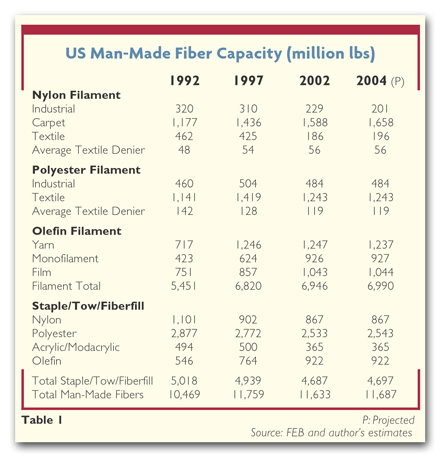
face of actual and planned capacity additions in the developing world.Table 1 details man-made
fiber capacity in the United States from 1992 to 2004. It dramatically demonstrates aggressive
moves by the US fiber industry to reallocate resources toward import-resistant areas of the market,
such as home fashions and industrial, and away from labor-intensive apparel. In the 90s, nylon
producers, facing the combination of polyester incursions in tires and reduced industrial spending
engendered by the late-decade economic slowdown, dropped industrial capacity by one-third and,
facing imported fibers and garments, dropped textile denier capacity by more than half, while
adding 50 percent 500 million pounds to floor covering fiber capacity; all this while operating
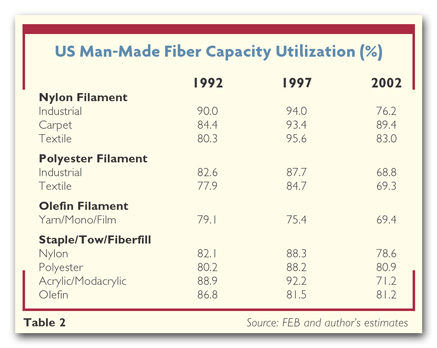
rates for carpet fiber production grew from the low- to the high-80s
(See Table 2). The late-90s reversion of leg fashion from hosiery to bare legs helped
capacity utilization by driving the average textile denier up from the high-40s to the mid-50s.
Honeywells recent purchase of BASFs fiber business and the now-outed secret talks between DuPont
and KoSa for DuPonts nylon properties both look much better in a marketplace supply/demand
analysis. Olefin producers continue to expand filament and staple capacities with the firm belief
that industrial, diaper and carpet end-uses will support this unbridled enthusiasm. Olefins
chemical disaffinity for dyeing long ago inhibited producers spending on development of olefin in
apparel. Rather, the fibers were positioned as inexpensive utilitarian substitutes for some
existing end-uses and attractive alternatives to other materials in new end-uses including:
geotextile fabrics for new markets; fine-denier staple to replace rayon, then polyester, in diaper
coverstock; and relatively inexpensive man-made backing to complement both olefin and competitive
face fibers in carpets. Olefin fibers are not cheap. They are designed to add function to
technology, and producers are rewarded appropriately.As with nylon, market expansion of olefin
fibers has been hindered by the recent US economic malaise. Industrial investment is down, leaving
olefins to survive on low-margin nonwoven materials recent market share battles between
Kimberly-Clark and ProcterandGamble have done much to cap returns for coverstock materials. And the
carpet market has slowed, as the consumer catches up with his industrial counterpart in reducing
spending. If the economy is ever to recover, these two components must start to spend again. Then,
olefin producers, dogged by mid-60s to -70s operating rates, will enjoy the market expansion for
which they have developed fibers.
The ProblemsAcrylic fibers have found several niches that should sustain them, at least in
the short-term. The domestic hosiery industry probably will continue to shrink under import
pressure, but the combination of upholstery, some carpet and acrylics natural affinity for outdoor
use should provide a sufficiently large market to support at least a portion of current capacity.
Recent low operating rates, despite past industry capacity reductions, suggest that further
industry cuts may be in the offing.Unfortunately, polyester fibers are not quite so well-positioned
as are olefins and nylon. Polyester staple was developed as an apparel fiber witness durable press;
and polyester filament fibers were modified into apparel fibers through texturing. Thankfully, the
era of the polyester double knit disappeared into better-styled fashion, but even this fed the
polyester maw in staple blends with cotton.In filament apparel, the decrease in average denier for
polyester in part signals a specialty approach to lightweight apparel 70-denier untextured filament
versus 150-denier for texturing. The recent relatively poor Japanese silk crop, impacted by
reportedly even poorer-quality silk from China, thrust very high-quality fine-denier polyester into
the fashion scene. Demanding quality encouraged many fabric manufacturers to buy domestically; the
logistics/quality/time risk was so great that it offset any price advantages available
offshore.Additionally, filament polyester has found several large markets in home fashions such as
window treatments and nonwovens for the home, and automobile seating structures. To reduce the
fibers reliance on apparel, these must be expanded. Also, while the movement of polyester filament
into tires appears to have slowed, additional efforts must focus on other areas of automotive use
such as hoses, belts, body cloth, tarpaulins and upholstery, to enlarge the position of polyester
filament in specification-driven, import-resistant market areas.Unfortunately, polyester staple is
viewed as an apparel fiber, with significant but not sufficiently large enough to rescue the
industry quantities of fiber going to home fashions and even-smaller-yet quantities going to
industrial fabrications. Until new end-uses are found for polyester, staple and filament alike will
remain under pressure from both domestic and international sources. The likely result is continued
capacity rationalization until a supply/demand balance is reached. Microdeniers, in both staple and
filament, are a partial answer at the upper end of the market, but they will not absorb broader
distribution market losses from continued import pressure.Looking AheadDesign and distribution,
home fashions and industrial these are what the US textile industry does best. The United States is
the largest market in the world. Market control involves concentrating on areas in which there is
competitive advantage. The US textile industry does not have the advantage in labor rates;
labor-sensitive activities, such as garment manufacturing, will continue to move to lower-cost
production areas. It does have the advantage in design and marketing, and knows the market and has
or can develop the skills to service it fully.The US textile industry is a prisoner of downstream
capital and labor offsets in fiber production and must step up and control the future, or it will
be dictated to by a competitor. US producers must develop fibers and encourage rapid development of
fabric and component manufacturing systems unavailable to the competitor that needs six-week
logistics windows. They must target areas less susceptible to imports home fashions, where
logistics advantages and quick response times mean a satisfied consumer. Additionally, US producers
must investigate and actively support new uses for fabrics construction, support, filtration of
both liquid and gaseous materials, ablative materials, heat- and light-sensitive or -resistant
materials, and so on. Then, producers must develop materials, fibers and films to enhance the
natural characteristics brought to the end-use by traditional textile manufacturing techniques.
June 2003