
Promatech ShanghaiProduces First K88 LoomItaly-based Promatech S.p.A.s Shanghai subsidiary,
Promatech Shanghai Machinery Textile Co. Ltd., recently completed production of its first K88 Made
In China rapier loom the first in an order of 30 being produced by a team of 20 associates in its
first year of operation. Promatech Shanghai plans to produce 100 looms by the end of 2003, and to
increase output to 2,000 looms annually by 2005. The K88, designed especially for the Chinese
market, will be the only model produced during the Shanghai facilitys initial phase.The loom was
built by our Chinese personnel under the supervision of Italian technicians with the dual goal of
both beginning local production and training local staff by providing all the skills and knowledge
necessary to make the Shanghai productive unit completely autonomous in assembly and final
inspection testing operations, said Eugenio Bruletti, China project manager.
November 2003
Promatech Shanghai Produces First K88 Loom
Near-Term Sluggishness Persists
P
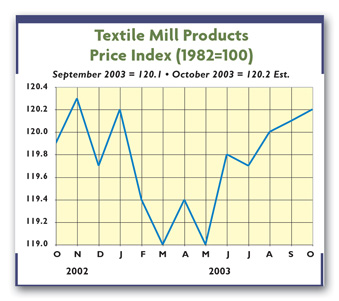
reliminary indications suggest another dismal quarter for the hard-pressed textile
industry. Fourth-quarter production will be lucky to equal poor third-quarter levels, as imports
continue to gain at a double-digit clip. Even previously strong denim is impacted by the rising
tide of foreign shipments. Similar disappointing trends are noted for prices, which remain pretty
much mired at recent low levels.
Not surprisingly, profits (where they still manage to exist) continue to shrink. All the
above virtually assure that final 2003 results won’t make for a pretty reading.
According to most forecasts, domestic textile activity could be off 7 to 10 percent
vis-à-vis last year. Compare projected 2003 levels to the recent 1997 peak, and the decline has
been even more precipitous — something in the order of 25 percent. And all this has occurred at the
same time the overall US economy has continued to advance. Textiles and apparel now account for
only a miniscule 0.7 percent of overall US economic activity.
Rising Imports Also Hurt
Nor is it realistic to expect any appreciable slowdown in import gains — certainly not over
the next few quarters. To be sure, both industry spokesmen and many lawmakers continue to press for
changes in an undervalued Chinese yuan — a move that would tend to increase that nation’s asking
prices. But little in the way of any appreciable near-term upward revaluation is anticipated. The
Chinese and many international economists fear that a significantly higher yuan could precipitate a
global financial crisis.
Moreover, it’s not altogether clear how such a revaluation (even if it could be affected)
would impact our overall import totals. Many think any slowdown in Chinese shipments would simply
be offset by increased textile and apparel imports from other cheap-labor nations.
But Not Everything Is Negative
Despite all the above, there are some positive signs that suggest some fractional textile
advances will again be possible — perhaps by as early as next summer. Much of this optimism is
based on expectations of more robust GDP growth.
Right now, business forecasts call for a solid 3- to 4-percent growth rate over the next few
quarters, as the impact of recent tax cuts spreads through the economy. This, in turn, should begin
to translate into improved textile activity.
Changing company strategies also could play a major role as most big firms continue to
solidify and expand overseas supply contacts. True, this will contribute to further import gains.
On the other hand, these moves ensure survival, allowing the domestic industry to focus on what it
does best — establishing niche markets, as well as fine-tuning product design and development,
sales and marketing, and customer relationships.
Another upbeat sign —a just-released Labor Department study shows these annual efficiency
gains over the past 15 years: fiber, yarn and thread mills — 3.7 percent; fabric mills — 3.5
percent; textile and fabric finishing mills — 1.4 percent; apparel knitting mills — 2.7 percent;
and cut-and-sew apparel — 4.7 percent.
A Longer Look Ahead
All the above suggest the worst is over, and there’s still a future for this hard-pressed
industry. Also supporting this relatively optimistic prognosis are the latest projections from
economic forecasting firm Global Insight. The company sees a bottoming out by the second half of
2004, with textile mill product activity for next year as a whole likely to be off only by about
2.4 percent in real terms. That’s a lot better than the current year’s estimated 8.4-percent
decline.
Beyond 2004, Global Insight analysts are even more upbeat, seeing relatively flat activity
through 2007 — the first non-negative numbers since 1997.
Gross operating profit margins are expected to edge ahead — rising from 18.8 percent this
year to 19.8 percent in 2004 and into the 20-percent-plus range over the subsequent three years.
Absolute gross profits are also targeted to rise — from $11.6 billion this year to $11.9 billion in
2004, with the uptrend continuing into 2007, when totals are expected to hit $12.6 billion.
November 2003
Strahm Sells Santex Shares Starts New Company
 Santex
Holding AG, Switzerland, has purchased all shares held by Christian Strahm, founder and formerly
the largest single shareholder of the company. With the sale, Santex said, Strahm also has resigned
as director of the board.In related news, Strahm has announced the founding of Strahm Textile
Systems AG. The company, headquartered in Switzerland, will develop drying and thermobonding
convection ovens for textile and other industries. The company said new systems will be branded
with the name HiPer.
November 2003
Ross To Address NTA Annual Meeting
Ross To AddressNTA Annual MeetingTurnaround specialist Wilbur L. Ross Jr. will present the keynote
address at the Boston-based National Textile Associations (NTAs) 149th Annual Meeting, to be held
Nov. 9-11 in Ponte Vedra, Fla.Ross, chairman and CEO of WL RossandCo. LLC, New York City, is
expected to describe his plan for revitalizing US manufacturing industries. Following earlier
investments in the US steel industry, Ross recently has turned to textiles, having made a
successful bid to acquire Burlington Industries Inc., as well as a bid to purchase Cone Mills
Corp., which recently filed for Chapter 11 bankruptcy protection.The meeting also will present two
panel discussions. Penetrating Markets Worldwide will feature panelists Filiep J. Libeert,
Libeltex, and president, Euratex; and Duncan Whitehead, Quaker Fabric Corp. Healthcare Cost and
Workers Compensation will feature Bonnie Brook, StephensonandBrook; and Neil Trautwein, National
Association of Manufacturers.
November 2003
Gaston International Changes Name
Gaston International LLC, Lincolnton, N.C., has changed its name to TPS Machinery LLC. According to
the company, the new name reflects its world-class technology, competitive pricing and local
support. All contact information remains the same.
November 2003
JLG Unveils Pro-Fit Electric Scissor Lifts
JLG Industries Inc., Hagerstown, Md., now offers the Pro-Fit Series of electric-powered scissor
lifts. The company says the lifts provide economical operation with longer duty cycles, higher
capacities and larger platforms than other scissor lifts.Features include an electric drive system
with two independent electric motors for the drive wheels, and a hydraulic system that has a single
assembly combining the hydraulic lift pump, reservoir and motor with the lift cylinder.
November 2003
AFA GDITT Lead Delegation To Domotex
AFA, GDITT Lead Delegation To DomotexThe American Floorcovering Alliance (AFA), Dalton, Ga., and
the Georgia Department of Industry, Trade and Tourism (GDITT) are set to lead a group of companies
to Hannover, Germany, for Domotex, to be held Jan. 17-20, 2004. Any Georgia-based company that
wishes to exhibit at Domotex is invited to participate at the Georgia Pavilion, hosted by AFA and
GDITT. The pavilion, to be located in Hall 5, Stand B32, will offer a community lounge, meeting
space and exhibit space.
November 2003
Gulistan Gets New Investment Financing
Gulistan GetsNew Investment, FinancingHampton Capital Partners LLC, Roanoke, Va., has made an
equity investment and will provide mezzanine financing to support ongoing operations at Gulistan
Carpet Inc., Aberdeen, N.C. In addition, Gulistan will receive from Fleet Financial Corp.,
Glastonbury, Conn., a new credit facility, which consists of a term loan, a revolver and a capital
expenditure line. This new investment and recapitalization guarantees the long-term continuity of
Gulistan as an independent company, said Charles D. Kennedy, president, Gulistan.According to
Kennedy, Gulistan will continue to use DuPont Stainmaster® and Wear Dated® fibers in its products.
The company is set to roll out several new Stainmaster carpet styles, as well as Tactesse®
products.
November 2003
BP Introduces PolyBac Berber Primary Backing
BP Introduces PolyBac® Berber Primary BackingDalton, Ga.-based BP Carpet Backings has developed
PolyBac® Berber primary carpet backing, designed specifically for textured, low-stitch-rate loop-
and cut-pile berber carpet styles.BP works closely with our customers to develop products that add
value to the carpets they design, said John Dowdell, general manager, North American Carpet
Backings. PolyBac Berber emerged as a solution to a specific challenge. Our team created this
backing to enhance berbers unique qualities without additional costs.
November 2003
ITMA 2003 Exceeds Expectations
ITMA 2003 Exceeds ExpectationsThe latest edition of ITMA exceeded the expectations of exhibitors
and visitors alike close to 125,000 visitors attended the eight-day exhibition. Orders were taken,
and talk on the show floor was upbeat and optimistic concerning show attendance and new
innovations.On average, close to 18,000 people visited ITMA at the National Exhibition Centre in
Birmingham, England each day. Half of the total number of visitors came from Europe; almost 25
percent came from Asia, Southeast Asia and the Middle East. Countries with the strongest visitor
showing were the United Kingdom, followed by Turkey, Germany, Italy, India, France and
Pakistan.According to the ITMA 2003 Organizing Committee, Weaving was the strongest sector,
followed by Spinning; and visitors to the Knitting sector reached the same numbers as ITMA 99, held
in Paris. Alberto M. Saachi, president of the Association of Italian Textile Machinery Producers
(ACIMIT), commented on the continuing relevance of the global textile machinery show. ITMA is still
perceived by exhibitors and visitors as the crucial sector trade fair and is still a byword for
success, also because of the considerable innovation of the products exhibited, Saachi said. This
is why ACIMIT will now work even harder so that the next edition, to be held in 2007 in Munich,
Germany, can once again be a not-to-be-missed opportunity for textile machinery manufacturers and
for textile operators the world over.Look for
Textile Worlds ITMA 2003 Flash Report in the November issue.
TW‘s December edition will focus on general highlights of the show. ITMA 2003 coverage
continues in 2004: January will focus on innovations in opening, blending, carding, spinning and
material handling; February will feature weaving preparation, weaving, knitting and nonwovens; and
March will highlight dyeing, printing, finishing and quality control developments.
November 2003



