A B Carter To Close Paper Tube Facility

Gastonia, N.C.-based A.B. Carter Inc. has announced plans to close its American Paper Tube
Division, acquired by the company in 1981. According to Rick Craig, president, A.B. Carter, the
current and future volume potentials are not enough to justify keeping the 106-year-old facility
open. Based in Port Gibson, Miss., American Paper Tube will fill all customer orders before closing
its doors, and will transition its customers from paper to plastic tubes so they can continue to do
business with A.B. Carter.

April 2004

Avondale Licenses Nano-Tex Technology

Avondale Mills Inc., Monroe, Ga., has licensed nanotechnology developed by Nano-Tex LLC,
Emeryville, Calif., to enhance its casualwear, sportswear and workwear fabrics. Avondale will use
NANO-CARE® and NANO-PEL to repel liquids and resist stains on cotton and cotton-blend fabrics.

“Avondale has earned a reputation for quality and trust among some of the countrys leading
clothing brands,” said Renee DeLack Hultin, president, North America, Nano-Tex. “We’re honored to
be a part of Avondale’s inventive product strategy and look forward to helping them add value to
their workwear and everyday lines through the most comfortable performance treatments available.

April 2004

Implementing RFID In The Supply Chain


W
hen Wal-Mart, the world’s largest retailer, announced last year that its top 100
suppliers will have until January 2005 to become radio frequency identification (RFID)-compliant,
it created quite a stir. Watching the move, Wal-Mart’s competitors started wondering if they should
be looking at implementing this technology to manage their supply chains as well. Within a short
period of time, the buzz surrounding RFID technology soared to a level that some industry experts
liken to the heady days of the 1990s.

As a technology, RFID is nothing new – scientists first started looking into its commercial
applications in the 1970s. However, it wasn’t until the 1990s that standards were developed and the
technology bore fruit in its commercial deployment, such as in automatic toll collection on
highways and keyless entry in automobiles. On the other hand, applications in manufacturing such as
in supply chain management  – which is the case with Wal-Mart – only now are being adopted.

chip_Copy
At the heart of RFID technology is the RFID tag — a miniature computer chip with an
antenna, which stores a code that provides a variety of information. The code is deciphered by a
RFID reader, which is capable of reading the tag and capturing the information from a
distance.


Textile World
recently interviewed Marshall Gordon, industry executive for retail, apparel and footwear at
SAP America Inc., Newtown Square, Pa. SAP is a partner in the Metro AG Future Store Initiative,
which was presented at the National Retail Federation Show in January. The initiative has equipped
a store in Germany with a number of technologies, including RFID, to study their potential
commercial applications.


TW

: Why is RFID being implemented now?

Gordon: RFID is not new. The challenge has always been to identify when it is
appropriate to apply the technology to your particular supply chain model. While the costs of many
of the components of a RFID system have come down, the cost of what I call the “disposable
component,” which is the chip itself, is of greatest interest. The price of the RFID tag went from
about $1 each in 2000 to somewhere between 25 cents and 40 cents in 2003. It’s expected to drop
further to somewhere around 5 cents, which seems to be a general target for the next few years. The
prospect of a 5-cent tag makes RFID a compelling option in many consumer product, apparel, footwear
and textile applications.

The other important improvement from a textile standpoint is that the durability of available
tags has greatly improved over the past few years. The high heat and moisture challenges we have in
textile processing are now manageable.


TW
: What are the benefits of RFID?

Gordon: The technology itself offers an opportunity to scan many items
simultaneously because it does not need individual line of sight for each item. Thus, a pallet
arriving in a warehouse with 10 cases is scanned once, reading all 10 cases simultaneously –
including the two in the center of the pallet hidden from the human eye.

Additionally, the ability to store more information on a tag than a bar code enables
application of the electronic product code (EPC) to identify items uniquely, versus just by SKU.
What it is, when and where it was made, and where its components came from are types of information
manufacturers might save on a tag. This information is useful, for example, if you have a recall
situation. Let’s say you are recalling fire-retardant blankets from a store – with RFID tags
attached to the blankets, you know the manufacturer and fabric lot origin of each blanket. A recall
can be targeted – instead of recalling every blanket, you’re only recalling those that truly are
harmful based on their fabric lot origin. The recall is far more effective, less costly; and you
don’t have to clear the shelves of every retailer in every market.

gordon_Copy
Marshall Gordon, industry executive for retail, apparel and footwear, SAP America
Inc.


TW
: How does it benefit textile manufacturers?

Gordon: Many opportunities across inventory management, batch management and
logistics exist.

One opportunity with RFID is automating basic tracking of products. Current manual processes
require employees to scan and record data as items move. RFID can help automate this. For instance,
if a pallet of yarn has a RFID tag on it and your forklift has a RFID reader aboard, your driver
has immediate information of the contents of the pallet when he pulls close enough for the reader
to communicate with the tag. Based on that, he knows where that pallet belongs. When it is time to
load a knitting machine with yarn, RFID helps locate the pallet stored in the warehouse, wherever
it may have been moved, and alerts the driver to its current location.

Another benefit is in the area of batch management and quality assurance. For instance, the
possibility of mixing lots of yarn on a knitting machine will be reduced, as you now match a
particular lot of yarn with the knitting machine and the production order. The reader on the
knitting machine will alert the operator if yarn entering its perimeter is incorrect.

Finally, the logistics benefit comes from automating the manifest as a container is being
loaded. As a roll of fabric passes through the RFID-enabled dock door to the truck, that roll is
automatically added to the manifest. If you were to have the truck pass through a second canopy on
the way out of the yard, you can again match what’s on the truck with the manifest.


TW
: What should suppliers do to prepare for implementation?

Gordon: Avoid the hype – there’s a lot of interest and a lot of misinformation and
hype out there. It’s very critical that the first goal for everyone is education. There is plenty
of material to help you learn, stay up to date and understand what’s going on.

Build the internal business case – every company is somewhat unique, and you must understand
how RFID contributes to your specific processes.

Remember, technology is the enabler – your processes must be your focus, and you must be able
to take advantage of what the technology offers.


TW
: How difficult is it to implement RFID?

Gordon: It’s a matter of having the proper expectations, and allowing enough time
for disciplined testing and piloting of the technology – don’t wait until you’re forced to do
something and scurry around paying for it. Implementation is not overly complex, but it’s
engineering – there’s an awful lot of physics involved from the standpoint of testing conveyor belt
speeds and reader fields of overlap, determining the distance between readers and how pallets are
tagged, and so on.


TW
: How do suppliers know if the investment will pay off?

Gordon: As I mentioned already, you need to roll up your sleeves and take a
critical look at your business to understand what can be improved and what that is worth. Also,
watch the folks ahead of you who are investing. For Wal-Mart to enable its facilities, the amount
of money it spends will be enormous; I think they’re going to be pretty serious about it and have
done some pretty significant due diligence. Go slow if you can, but as you watch your supply chain
and others in the industry go down that path, I think you’d be foolish to not have some
understanding of what they’re doing and why. At least have an understanding of your future target.

April 2004

Saint-Gobain, Hongfa Form Joint Venture

The Reinforcements Division of France-based Saint-Gobain has entered into an 80/20 agreement with
HongFa Co., China, for the creation of Saint-Gobain Technical Fabrics HongFa (Changzhou). The joint
company will provide technical fabrics at competitive prices to the Asian market. According to
Saint-Gobain, HongFa’s composite and geotextile products sales and marketing abilities and its
knowledge of the Chinese market made the company a good fit with Saint-Gobain’s technical
capabilities and global reach.

April 2004

Democrats Urge Bush To Break Down Trade Barriers

The top leadership of the US House of Representatives has urged president Bush to take immediate
action to address overseas trade barriers standing in the way of a wide range of US exports
including textiles and apparel. A sharply worded letter signed by all 10 leaders of the Democrats
in the House says:”It is not enough simply to sign a trade agreement and move on to negotiating the
next one. To restore credibility to the trading system, agreements have to be enforced.”

The letter was a response to release of the annual National Trade Estimates report on trade
barriers to US exports of goods and services, investments and intellectual property rights. The
letter says the US Trade Representative (UStr) has carefully documented problems, but has taken no
action to redress or eliminate them.

Each year the report documents a variety of tariff and non-tariff barriers used by other
countries to protect their markets. Those where textiles and apparel are affected include China,
India, Bangladesh, Pakistan, South Korea, Taiwan among others.

“After the loss of almost 3 million manufacturing jobs since January 2001, and the growing
problem of outsourcing the services sector, it is time to stop taking inventory and time to start
producing results for American workers, farmers and businesses,” the letter says. “In the three
years that the Bush administration has been in office, the USTR has brought an average of fewer
that three cases per year to the World Trade Organization (WTO), while the Clinton Administration
brought approximately 10 cases per year.”

The letter comes down hard on China, charging that its trading rights and distribution rights
effectively bar imports that compete with Chinese goods, and it urges the administration to take
immediate action under the WTO’s dispute system to ensure that China complies with its WTO
commitments. The Democratic leadership also singles out India because of its $9 billion textile and
apparel trade surplus with the United States. They charge that India is one of the most protected
markets in the world, that Indias barriers to textile trade have been identified for three years
running, and that no action has been taken.

The congressional leaders said they plan to introduce legislation to revive a key tool of the
US law used in the past that would require the UStr to prioritize dealing with overseas trade
barriers.


April 2004

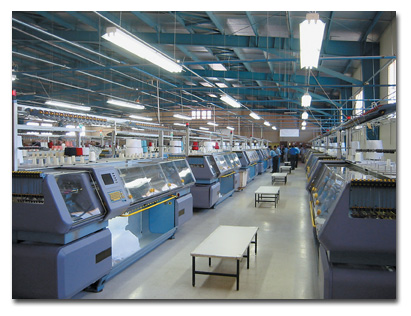
National Spinning Opens Sweater Facility In El Salvador

Leveraging the yarn-forward rules of the Caribbean Basin Trade Partnership Act, Washington,
N.C.-based National Spinning Co. has opened a new sweater manufacturing operation in the Miramar
Free Zone in El Salvador. Fuenta de Ropa de las Americas (FRASA) will utilize a new installation of
H.Stoll GmbH & Co. flat-bed knitting machines and Jumberca circular knitting machines to
provide sweater packages to a variety of customers in the United States. James W. Chesnutt,
National Spinning president and CEO, stated the objectives of the new company are to provide a knit
product at the quality, price and timeliness demanded by the company’s sweater jobber and ladies
apparel customers.

“We began this process by meeting with 14 sweater jobber clients and four ladies apparel
suppliers,” he said. They had a growing dissatisfaction with imported garments and were seeking
alternate supply. This operation will allow us to not only use our acrylic yarn spun and dyed in
the United States, but also will enable us to source other US yarn, including cotton yarns.”

nationalspinning
H. Stoll flat-bed knitting machines have been installed at National Spinning’s new sweater
facility in El Salvador.


Photograph courtesy of Mike Todaro, American Apparel Producers Network

Regarding the new operation, Chesnutt spoke highly of Bill Wilson, vice president, apparel
marketing and sales, FRASA. Wilson brings his past experience in El Salvador, as well as in
logistics, quality and production management to FRASA.

“I can’t say enough about the folks at PROESA [El Salvadors investment promotion agency] as
well. Patricia Figueroa [executive director] and her team really helped with the decision to locate
in El Salvador,” Chesnutt said. We are talking about making 300,000 to 500,000 sweaters out of US
yarn that previously were made in China. That is good for the United States and good for the
hemisphere.”

The apparel division operates under Matt Rauschenbach, president, who brings 20 years of
experience to the position. He is based out of National Spinning’s headquarters. Stuart Mays,
formerly with Beldoch Industries, manages the El Salvador facility.

April 2004

Cerberus To Acquire Guilford Mills

An affiliate of New York City-based Cerberus Capital Management LP has made a cash tender offer
valued at $107 million to acquire Guilford Mills Inc., Greensboro, N.C., an engineered automotive,
technical and apparel fabrics producer. According to terms of an agreement approved by Guilford’s
Board of Directors, Cerberus has offered to pay $19 per share for all outstanding Guilford shares.
The deal is expected to be completed by the end of this quarter.

Guilford emerged from bankruptcy in late 2002. Last fall, the company retained Goldman Sachs
& Co., New York City, to help it explore strategies, including possible sale of the company, to
maximize shareholder value.

Following the acquisition, the Cerberus affiliate will merge with Guilford Mills, and
Guilford’s current management will continue.


Guilford Mills’s product offerings include automotive fabrics.

“I’m very excited to see Guilford placed in the hands of people who share our vision for
building this company,” said John A. Emrich, president and CEO. “They believe in this company and
our operations, and they fully support our plans for growth.

April 2004

Donaldson, PGI Cooperate On Filter Bag Media

The Donaldson Co. Inc., Minneapolis, has teamed up with North Charleston, S.C.-based Polymer Group
Inc. (PGI) for the production of industrial filter bag media.

PGI’s Durapex nonwoven fabric, made using PGI’s APEX® process, will be used by Donaldson
Torit® in its line of first fit and replacement baghouses.

Durapex was designed to meet the Environmental Protection Agencys Air Quality Standard, which
specifies a 2.5-micrometer particulate matter limit.

“Teaming up with PGI enables us to deliver industrial air filtration solutions that offer
superior value to our customers,” said Steve Groves, global product director, Donaldson Torit.

April 2004

UCO-LDC Establishes UCO Performance Fabrics

Belgium-based UCO-LDC NV has established a new business unit, UCO Performance Fabrics, to handle
its industrial fabrics products. UCO-LDC, part of the UCO-Textiles Group, produces man-made fashion
fabrics and industrial fabrics. However, the success of its industrial product lines and the need
for a clear product identity led the company to create the new industrial fabrics business unit.
According to the company, UCO Performance Fabrics still will benefit from UCO’s experience,
investment and research capabilities, but will be able to offer improved customer service and
fabrics engineered for customers specific requirements. Products manufactured by UCO Performance
Fabrics include flame-retardant, medical, industrial and outdoor application fabrics.

April 2004

Fifield Celebrates 80 Years

Fifield Inc., Hingham, Mass., recently celebrated its 80th anniversary. The company was founded in
1924 by Charles W. Fifield in Gloucester, Mass., as a manufacturer of protective flannel for the
silver industry. Today, it produces flannel, simulated velvet, linen, suede and leather fabrics for
display and packaging.

Fifield and later his son, Richard, ran the company until it was purchased in the 1970s by
then-vice president Randall Martin. Martin’s son, Edwin, is current president. Today, Fifield is an
international company with locations also in Hong Kong, Mexico City and Italy.

April 2004

Sponsors