Agrotextiles: A Growing Field


T
extile fabrics have a long history of use in agriculture. The term “agrotextiles” now is
used to categorize the woven, nonwoven and knitted fabrics used for agricultural and horticultural
applications including livestock protection, shading, weed and insect control, and extension of the
growing season.


Shade Cloth Uses


One of the first major uses for agricultural shade cloth was as cover for large fields of
tobacco. Lightweight cotton cloth was used to shade plants destined for use as cigar wrappers.

Most plants purchased for indoor household and office uses are of tropical origin, from
Central and South America and from Africa, and grow in jungle-type environments. Nurseries in South
Florida and other Gulf Coast states import these tropical plant seedlings and grow them to the
appropriate size in fields covered by shade cloth. Fabrics are woven to provide different degrees
of shade according to individual plant requirements. 
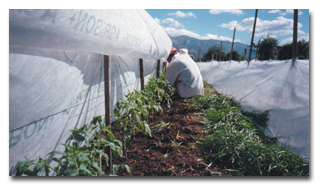
agribon
A worker uses Polymer Group Inc.’s Agribon™ nonwoven fabric product in the fields to
provide temperature control and light filtration, and to deter pests.


Woven Shade Cloth Fabrics


Polypropylene (PP) is the most-used polymer for woven shade cloth fabrics. The resin is
formulated with additives and pigments to provide resistance to sunlight and weathering. Black
pigmentation helps provide a high degree of sunlight resistance. Much of the shade cloth is made
from monofilament yarn, although some film fiber yarns also are used. Wide-width fabrics minimize
the amount of seaming needed for installation.

Calendering is an important finishing operation that aids in giving a fabric the desired
shade percentage. Where greater stability is needed in a woven shade cloth, leno weave
constructions such as NicoShade® can be used. NicoShade is a leno/lock woven PP shade material for
the agricultural marketplace manufactured by Ten Cate Industrial Fabrics – an operating unit of the
Netherlands-based Royal Ten Cate.


Other Woven

Polyolefin Agrotextile Applications


Woven fabrics made with PP monofilament also are used as side curtains for wooden poultry
houses. The curtains provide ventilation, yet protect  birds from foul weather. Some fabrics
are extrusion-coated and then run through spiked rollers to improve their porosity.
Extrusion-coated PP fabrics are used for hog houses in some areas of the country. Farmers use white
woven PP fabric for barn wall siding as a way to add ventilation and reduce building costs.

Insect screening for greenhouses is another important application for woven agrotextiles.
These fabrics are made from fine-denier polyethylene (PE) or PP monofilament, typically with a size
of 0.018 inch. More closely woven fabrics, with a hole size as small as 0.0075 inch, are required
in areas of the country where pests such as Western flower thrips prevail.


Netting Products


Extruded netting products, which usually are classed as nonwovens, have found extensive uses
in agrotextile applications. Extruded nettings are polymeric mesh-like or scrim-like structures
produced by extrusion. Smith & Nephew Extruded Films, a division of Smith & Nephew,
England, developed much of the initial technology for these products.

The company patented a method of producing net-like fabrics from polymeric materials by
importing grooves in both sides of a continuous sheet of film with grooves that extend through the
sheet, so that the added depth of the grooves in each surface is only slightly less than the full
thickness of the sheet. The grooves on one surface of the film are arranged to cross the grooves on
the other. The crossing points have only the reduced thickness of the material separating the base
of the grooves. The sheet of film is then subjected to biaxial stretching, such as on a tenter
frame, to give the thinned parts of the sheet at the crossing points of the grooves a permanent
set, so that they split and form perforations at the point.

Conwed, Minneapolis, is one of the largest US merchant producers of extruded nettings. Its
original oriented extruded nettings were made through a proprietary process of uniaxial or biaxial
orientation. After extrusion, the netting is stretched under controlled conditions to maximize the
strength-to-weight ratio per strand. The orientation process also regulates netting thickness,
flexibility, width and strand count. Realignment of the resin’s structure during orientation
produces a monofilament, square mesh construction with a high strength-to-weight ratio. Each joint
becomes an integral part of the netting, allowing for equal distribution of the stress.

In 2004, Conwed introduced BioGrid, the first truly biodegradable oriented netting. Early
this year, the company unveiled its OxyGrid™ degradable netting, made with polymers that oxidize
and degrade from exposure to heat and moisture. This product is effective in erosion control
applications where it immediately begins to break down. Exposure to sunlight accelerates the
breakdown process.

Conwed sells Sodnet® turf reinforcement for accelerated turf grass production. According to
the company, Sodnet enables grass to grow as the roots entwine with durable mesh, resulting in the
early harvesting of thinner turf in strong slab or roll form. The extruded nettings are of the
biaxial type of PP and are pigmented green or black.

The advantages of Sodnet for reinforcing turfgrass include:

•    an earlier harvest – in many cases cutting in half the time to harvest;

•    improved handleability – sod can be cut more thinly and is
lighter-weight;

•    reduced irrigation and other maintenance costs due to shorter growing
cycles;

•    minimized waste – reduces scrap from broken rolls;

•    ability to grow varieties that lack well-developed root systems such as
tall fescue and ryegrass; and

•    maximized effective use of land – frees up land for alternative crops.

Conwed also supplies a range of extruded netting fabrics that protect fruit crops from bird
damage. Birdnet is used to protect grapes, blueberries, strawberries and cherries. Tests cited by
Conwed demonstrate Birdnet can be mechanically applied or removed at a rate of 1.5 to two acres per
hour. The average installation cost would be $25 to $35 per hour, plus an average initial netting
cost of 8 to 13 cents per linear foot.
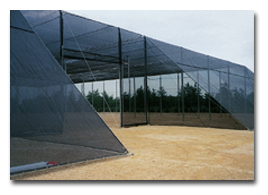
biobarrier
Ten Cate Industrial Fabrics’ NicoShade® is a leno/lock woven polypropylene shade material
for the agricultural marketplace.


Capillary Mats For Greenhouses


Placement of needlepunched PP fabrics under growing plants in greenhouses was one of the
earliest uses of nonwovens as agrotextiles. The nonwoven fabric saturates easily by capillary
action, and helps to keep the plants moist and to raise the humidity level in the greenhouse.

The advantages of PP capillary mats over the rayon products they replaced include: lighter
weight; higher wet strength; resistance to rot, mildew and chemicals; ease of cutting and shaping
to table size; quick absorption of water and quick wicking action; crush resistance; and
reversibility.


Tyvek® Irrigation System


International Irrigation Systems,  Niagara Falls, N.Y., sells its Irrigro® system for
home gardeners and garden centers. The system uses the micropores in Wilmington, Del.-based
DuPont’s spunbond high-density PE Tyvek® in tubular form to efficiently irrigate planting areas.
The tubing can be layered beside plant stems or buried under several inches of soil for uniform
continuous watering of the root zone. The system also may be used to deliver plant nutrients and
insecticides. The millions of fine fibers in the fabric allow droplets of the irrigation water to
escape the tubing uniformly. A threshold of pressure is required before any significant emission of
water starts. As soon as the entire system is filled with water and the pressure exceeds 1 pound
per square inch, simultaneous emission of water starts throughout the entire system. This prevents
the first few feet of the area from being overwatered. The system can be operated continuously for
a month with the same volume of water that a sprinkler uses in an hour. 


Nonwovens As Crop Covers Or Row Covers


Nonwovens are replacing some of the straw, glass and plastic films that have been used for
many years to protect crops from freezing. They now are used to accelerate plant growth early in
the season. 

Lightweight cotton fabrics were used for many years to prevent newly planted seeds from
being washed away. Stabilized spunbond PP fabrics that weigh in the range of 0.3 to 1 ounce per
square yard are replacing cotton fabrics for this use and also may be used as a crop cover.

Most vegetables respond well to the use of floating row covers of nonwoven materials.
Generally, covers are used from a week before the frost-free date until flowers appear four to six
weeks later. Covers are stored and sometimes put back in the fall to protect the fruit or
vegetables from an early frost. Early yields bring more dollars per pound for the farmer, and
higher yields result in more total dollars.

Strawberries are a crop for which early and total yields have been enhanced by floating row
covers. They can be protected with row covers down to 22°F to 24°F, depending on wind speed and
freeze duration. Tree seedlings and nursery stock also benefit from use of row covers, which
prevent the heaving of seedlings by hoarfrost as well.
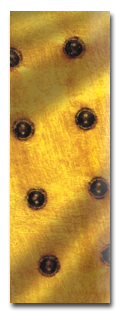
realbiobarrier
Biobarrier® fabric from Reemay Inc., a member of BBA Fiberweb™, features an in-soil
herbicidal barrier that can block roots without harming plants.


PGI’s Spunbond

Fabric For Harvesting Better Bananas


Polymer Group Inc. (PGI), North Charleston, S.C., has added Agribon® barrier spunbond to its
line of nonwoven products for agricultural use. Among other uses, the fabric protects banana
bunches on the tree against physical external damage, diseases and pests without the use of
insecticides. PGI has participated in extensive studies in Central and South American
banana-growing areas using the Agribon barrier products. The bananas covered by Agribon had
enhanced fruit coloration and better distribution of the fruits in the bunch from the top to
bottom, in addition to being protected from insects. Agribon may be reused with appropriate
handling of the bag. PGI’s spunbond plant in Colombia will be the source for spunbond fabrics used
for these applications.


Nonwovens As Landscaping Fabrics


PP spunbond nonwovens are the dominant products used for landscaping fabrics because of
their durability and relatively low cost. Some of the major landscaping uses for the fabrics are as
follows:

•    soil retention and weed control for landscaped areas and gardens;

•    soil retention for retaining walls made of timber;

•    weed control under decks;

•    brick walkway and patio support;

•    planter and pot drainage;

•    linings for interceptor trench drains; and

•    protection for newly seeded areas.

One successful specialty agrotextile is Biobarrier® fabric for root control, manufactured by
Hickory, Tenn.-based Reemay Inc. – a member of BBA Fiberweb™. This product combines a spunbond PP
fabric with a time-released herbicide, creating an in-soil herbicidal barrier that can block roots
without harming plants. The system is guaranteed for 15 years. The pellets that are adhered to the
spunbond are impregnated with the herbicide trifluralin. The herbicide is mixed with carbon black
and PE and molded into pellets. The specific formulation selected controls the rate of release of
the herbicide.

Metallized woven and nonwoven agrotextile products are finding applications in greenhouses,
plant nurseries and orchards. These fabrics may be used in greenhouses to prevent heat loss.
Installations of these fabrics also can be designed to protect plants from excessive solar
radiation.

Diversified Fabrics Inc., Kings Mountain, N.C., uses its Reflec-Tex® process for metallizing
nonwoven and woven fabrics for agrotextiles and other applications. F.J. Broadwell, president,
reports the company is metallizing these fabrics for use in greenhouses and orchards. A specific
application he cites involves using the metallized woven fabrics under apple and peach orchards.
The reflected sunlight from the fabric hastens fruit ripening and provides fruit with more uniform
color. The first pickings are larger, and often a fewer number of pickings are required. The
fabrics also minimize weed growth in the orchard.


September 2005

DuPont Transfers Centek Interest To INVISTA

Wilmington, Del.-based DuPont has finalized the transfer of its interest in Grupo Centek, a
Mexico-based joint venture for the manufacture and marketing of nylon and spandex fibers and
intermediates, to Fibers Mexico Holdings S de RL de CV, a subsidiary of Amsterdam-based INVISTA BV.

“The transfer of shares of Centek represents our commitment to the textile and apparel
business in North America, which is one of the key markets for Invista,” said Bill Ghitis,
president of Wilmington-based Invista Apparel.

September 2005

Coalition Attacks China-EU Textile Deal

The 97-member Global Alliance for Fair Textile Trade (GAFTT) which represents 97 trade groups from
55 countries in Europe, Asia, Central America, Mexico and the United States has blasted a European
Union-China plan to release some 83 million in textile imports that had been embargoed when China
exceeded it quotas. The EU/China agreement is expected to allow immediate entry of all of the
textiles and clothing that had been embargoed. Under the new arrangement, 50 percent of the goods
will be permitted to exceed the quota agreement and the remaining 50 percent will be charged
against 2006 quotas.

Charging that the importers caught in the embargo took a calculated business risk and got
burned, Cass Johnson, president of the National Council of Textile Organizations, a GAFTT member,
said: “The EU-China textile deal unfairly penalizes textile and clothing producers from the rest of
the world who play by the rules.”

Auggie Tantillo, executive director of the American Manufacturing Trade Action Coalition,
another GAFTT member, said China contributed to the EU embargo problem by eliminating its export
licensing requirements early this year. He said granting China additional access to the EU market
simply rewards China for its own irresponsibility.

Last June, China and the European Union agreed to place import quotas with annual growths
ranging from to 8 to 15 percent on 10 product categories. The action was taken in response to an
increase in imports from China that EU officials called an unprecedented surge of imports in
several product categories.

GAFTT used the EU action to reiterate its efforts to persuade the World Trade Organization to
take actions that would prevent China, India and a handful nations from monopolizing the world
textile markets. GAFTT wants to see a permanent safeguard mechanism to protect domestic
manufacturers in countries where it can be demonstrated that imports are disrupting their markets.

September 2005

Brückner Consolidates Production At Two Sites

Brückner Trockentechnik GmbH and Co. KG recently announced it has consolidated production and
company operations at two of its sites in Germany. Production is now concentrated at Brückner
Stahlbau GmbH at the company’s Tittmoning site in Bavaria. As a result, Brückner Stahlbau has
established a new, more efficient production structure.

Administrative operations such as development and design, purchasing, sales and marketing,
and after-sales service remain at company headquarters in Leonberg.

September 2005

Cotton Incorporated, Gymboree Launch Fabric

Cotton Incorporated, Cary, N.C., has teamed up with children’s apparel retailer Gymboree
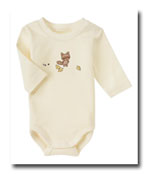
Corp., San Francisco, to offer SuperSoft 100-percent cotton fabric for newborns’, toddlers’ and
children’s apparel. The fabric is double brushed and washed to provide exceptional softness,
according to the companies. A line of SuperSoft garments is now available at Gymboree stores in the
United States and Canada.

 
onesie

“For newborn babies, you want the softest and highest quality fabrics against their tender
skin,” said Lisa Bayne, senior vice president, marketing, Gymboree. “That is why Gymboree developed
SuperSoft. This joint marketing campaign with Cotton Incorporated reinforces Gymboree’s expertise
in bringing the best possible products to its customers.

September 2005

Quality Fabric Of The Month: Less Is More

ARC Outdoors, Broken Arrow, Okla., and NanoHorizons Inc., State College, Pa., have formed a partnership to promote and license nanotechnology to textile manufacturers and brands.

ARC Outdoors sells body heat-reflective cold weather apparel and manufactures outdoor
activewear with scent-elimination properties. NanoHorizons was established by Stephen Fonash,
Ph.D., founder and director of the Penn State Center for Nanotechnology Education and Utilization,
to develop solutions based on nanotechnology licensed from Pennsylvania State University.

“We had problems we wanted to resolve with existing products when we met NanoHorizons and began investigating what nanotechnology could do to improve our products,” said Rus Huffstutler, executive vice president, ARC Outdoors. The company has introduced a line of E47™ Nano Technology branded fabrics and yarns, and through the ARC Materials Licensing Program will offer the technology to other manufacturers. Huffstutler noted E47 application areas will include more than just performance apparel, mentioning carpet, baby clothes and footwear, among other areas.

qfom_Copy_22

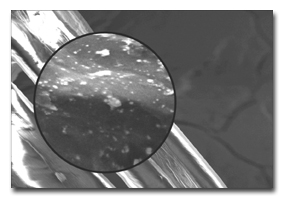
E47™ cotton fiber magnified 2,650 times looks unaltered. Inset: Magnification of 40,000
times shows embedded E47 nanoparticles.

The first E47 products offer anti odor properties through an additive that the companies claim provides truly permanent, safe and effective protection without compromising a garment’s other performance properties or comfort level; and offers an inexpensive solution that allows the use of conventional manufacturing
machinery in downstream processing.

The antiodor technology embeds silver particles measuring less than 15 nanometers (nm) in diameter throughout the fiber. Dennis Schneider, director, sales and marketing, NanoHorizons, explained that, volume for volume, particles of this size offer far more surface area to produce microbe-fighting silver ions than larger nanoparticles. Therefore, less silver is needed to accomplish the same end.

E47 additives have been developed for cotton and polyester, and versions for nylon and polypropylene are planned. Schneider said the cotton additive bonds permanently to the cotton fiber and is applied using a process similar to dyeing. “We believe we have created the first antimicrobial additive that creates permanently antimicrobial cotton — and the only one that allows the end product to still be ‘just like cotton,’” he said.

The polyester additive is pelletized for use in a hot-melt extrusion process. “Our Master Compound is blended with standard polyester pellets in a very specific recipe in the fiber extruder, creating a polyester fiber that has an even distribution of our custom nanoparticles bonded directly and permanently into the polyester itself,” Schneider said.

He also noted the E47 additives will not clog extruders or affect fiber quality, as other particle additives are prone to do.

Huffstutler said E47 technology can be customized. “The effectiveness of a property can be increased or decreased according to the end-use,” he explained. “The technology will allow brand manufacturers to innovate their own products.”


For more information about E47™, contact Bob Parker or Bill Douglas, ARC Outdoors (918)
258-8788;
 www.e47nano.com.


September 2005

Küsters Donates FlexNip To Pakistani University, Commissions Range In Turkey

Germany-based Eduard Küsters Maschinenfabrik GmbH & Co. KG recently donated a laboratory
version of its FlexNip chemicals applicator to the National Textile University of Faisalabad,
located in Pakistan. Students will be able to use the new applicator to conduct practice-oriented
laboratory tests.

kusters_Copy_4
Küsters’ laboratory version FlexNip chemical applicator

Küsters presented the machine to the university earlier this year during Igatex 2005 – an
international conference and trade fair held in Pakistan for the textile, apparel and leather
machinery industry.

In other news, the company successfully commissioned a complete system at Zorlu Linen Dokuma
Emprime, Turkey, a manufacturer of bed linens. The system consists of a continuous bleaching range
with FlexNip applicator, a pad-batch dye range with Contidos SF dosing station and a HyCon-L
textile calender.

September 2005

EU Commissioner Announces Agreement On Chinese Textiles

“We have found a satisfactory and equitable solution” says EU Commissioner Peter Mandelson in a
press conference on the Chinese textile issue. In a press conference held in Beijing after the
signature of an agreement between the EU and China to unblock the current textile imports blocked
in the EU borders, the EU Trade Commissioner reminded that the agreement still has to be discussed
among the EU member states and referred to the difficulties risen on implementing the agreement
signed in Shanghai in June: “when member states were pressing me to negotiate I said that there
were difficulties to operate an agreement like this. We have to make sure that the agreement is
managed smoothly and that we listen to all, importers, suppliers, retailers and textile producers.”
The agreement concluded today could mark the end of goods blocked in EU ports. “I hope it will be
possibly quickly to unblock the goods currently at the EU border,” Mandelson said, referring to the
urgency to solve the current situation. On questions about trade war, Mandelson answered that
“textile issues have been out of proportion this summer but it has increased the importance of free
trade, and China and Europe have not, are not and will not be at war. We have common interests and
we want this relationship in the long term” and reminded those asking for protectionist measures
that “the laws of comparative advantage persist even if China is a major economic power”. Mandelson
finally explained that “this is not about the return to quotas of the past, the textile quotas of
the old agreement are not coming back, we are moving to an era were there will be no quotas at all,
but Europe needs two to two and a half years to manage the transition”. The Commission spokesperson
Franse Le Bail earlier announced today that a special meeting of the trade committee (the 133 committee) in the Council would discuss the agreement reached.

Press Release Courtesy of the European Union

September 2005

AATCC Acquires CITDA Assets

The American Association of Textile Chemists and Colorists (AATCC), Research Triangle Park, N.C.,
has acquired selected assets of the Charlotte-based Computer-Integrated Textile Design Association
(CItdA). The assets include the CItdA name, logos, members list, website and CItdA Student
Scholarship Competition.

According to AATCC, the CItdA assets will enhance its ability to offer new programs and
activities through its Concept 2 Consumer interest group, which offers publications and events, and
conducts specific projects of importance to textile designers and manufacturers.

September 2005

US-China Textile Trade Talks Bogged Down

As a second round of negotiations failed to reach a US/China comprehensive agreement on textile and
apparel imports, the US government is continuing to consider and approve petitions to limit imports
using the safeguard mechanism China agreed to as a condition or its admission to the World Trade
Organization. On August 31, the Committee for the Implementation of Textile Agreements (CITA) added
two more product categories brassieres and man-made filament fabric to the list of some 30 product
categories where the safeguard mechanism is being used. Decisions on four other cases covering
sweaters, dressing gowns, wool trousers and knit fabric were delayed until October 31.

The US government in July imposed quotas on cotton trousers, cotton knit shirts and
underwear, and an embargo already has been placed on those products for the remainder of this year
as the quotas were quickly filled. If additional quotas are approved, they would extend only to the
end of this year, and the textile industry would have to submit new applications demonstrating
market disruption. In the case of petitions decided upon after October 31, the quotas would be in
effect for a full calendar year if the petitions are approved.

While the safeguard mechanism has restrained some imports and likely will do it for more, US
textile manufactures would like to have a comprehensive import limitation agreement through 2008.
Importers of textiles and apparel, while opposed in general to import quotas, would if necessary
like to see an agreement that would result in some certainty in the marketplace.

The US and Chinese governments continue to be interested in reaching agreement on a
comprehensive bilateral agreement. Following the second round of unsuccessful negotiations, Special
Textile Negotiator David Spooner said he is consulting with the Chinese on a date and place to
resume the talks and he remains optimistic that progress can be made toward resolving remaining
issues.

After the talks broke down, textile importers called for renewal of the negotiations while
cautioning that the United States should proceed cautiously and not agree to quotas that would not
necessarily bring production back to the United States. In a statement following the collapse of
the talks, Laura E. Jones, executive director of the US Association of Importers of Textiles and
Apparel, said: “We are extremely concerned by reports that the United States presented a proposal
in Beijing that was even more restrictive than what the US side presented during negotiations in
San Francisco earlier this month. If the United States really wants an agreement, it should be
moving toward a compromise, not in the opposite direction.” She said any agreement should reflect
the interests of the United States and whole including importers, retailers and consumers, as well
as textile manufacturers.

When the talks were broken off, the major textile and apparel manufacturers trade
associations praised the US negotiators for taking a strong stance on behalf of the domestic
industry. Karl Spilhaus, president of the National Textile Association, said the industry is united
in its belief that no agreement is better than a bad agreement. Cass Johnson, president of the
National Council of Textile Organizations, said that in view of the failure to reach a
comprehensive agreement, the US industry will continue to be aggressive and shortly will be filing
additional safeguard petitions.

September 2005

Sponsors