The Status Of The Present – A Very Good Year

The Status Of The Present-A Very Good Year!It was a very good year – 1986. Mill shipments increased
4%. Exports were up 20% to $1.7 billion, but imports were up 17% to $4.3 billion, a textile trade
deficit up 15% in 1986.The multi-fiber agreement (MFA) was renewed for five years, with new
provisions covering products made of fibers previously not subject to the agreement, such as ramie
and silk blends. The U.S. also renegotiated bilateral agreements with Hong, Kong, Taiwan and South
Korea to include limits on these newly covered fibers and to restrain growth.Nevertheless, the
industry had learned not to depend for help on political promises. The Textile and Apparel Trade
Act of 2987 was introduced in the House and Senate on February 19, and prospects were better than
in 1986 that passage would result, with enough backing possible to override a veto.Investment Hits
$1.7 billionIndustry spending on new plant and equipment had averaged $1.7 billion a year in the
1980-85 period, but this had resulted in very little expansion of total productive capacity because
of plant closings. Use of existing capacity rose substantially in 1986 and the early months of
1987.The population grows ever more urban, and city folks spend far more on clothing than do
farmers.The per capita consumption of fiber ranges 53-59 pounds per year for the U.S., but in the
1960s, was 20 pounds less. World per capita consumption has climbed from 10.9 pounds in 1960 to the
15-pound range. The opportunity for increase is obvious.Labor SlidesThe numbers and influence of
most labor unions have been slipping. There was a surge of union organizing just after World War I,
and after World War II.For the textile and apparel industries there is a greater degree of union
membership, but that membership is overwhelmingly concentrated in the clothing industry not in the
textile mills. Declining Mill NumbersThe Census of Manufacturing data show how the number of
textile mills shrank in one 15-year period:

  • 1967 7,080 operating establishments
  • 1972 7,203
  • 1977 7,202
  • 1982 6,630

The closed mills were scattered far and wide in the Southeast, for the most part, not as
concentrated as those abandoned in New England towns and cities in the last massive movement to the
South.The visual impact of imports devastating effect on the textile/apparel industries is perhaps
greatest in the New York garment district, those 17 square blocks of midtown Manhattan that are
home to some 12,000 businesses. From 1969 to 1980, manufacturing jobs in the garment district fell
from 40,000 to 25,000. Imports of clothing soared from 21% of total U.S. sales in 1973 to 55% in
1983.Imported Machinery SagaImports of textile machinery began to be significant in 1964, and
thereafter accelerated rapidly, so that by 1968, they surpassed the exports of U.S.-made
machinery.Education For AllThe education of the textile work force still leaves much to be desired
vis-a-vis todays complex machinery, but is light years beyond the standard of 100 years ago when
the entire country produced in one year fewer than 62,000 high school graduates.The young have
completed more years in the classroom, though some will dispute that years in school equal
educational attainment.Census Bureau data as of March, 1984 show these differences in age groups as
to years of school completed.Despite the lack of substantial enrollment in the textile colleges,
the instruction has moved on to seminars and workshops for those working in the mills and needing
to keep abreast of rapidly advancing technology.Take Clemson as an example. Theres scarcely a week
without a conference or workshop. Among those scheduled for the early months of 1987:

  • color science workshop, with such subjects as correcting color in the laboratory and in
    production, color instrumentation, color matching and shade sorting.
  • advanced textile materials; the latest directions for carbon, ceramics, aramid, graphite, steel
    and glass fibers and high performance composites.
  • just-in-time and quick response in textile manufacturing; value-added manufacturing, bar
    coding, strategic response, short lot dyeing, the retailers view, textile/apparel linkage.
  • current technology in spinning and yarn preparation; air jet spinning, friction spinning, wrap
    spinning, machine conversions, etc.
  • carpet manufacturing technology; market and styling forecast, yarns, backing, jet printing of
    tiles and other carpet materials, fluoro-chemical finishes.
  • improved textile profits through machine productivity analysis.
  • statistical quality control.
  • electronics in textiles; manufacturing automation protocol; robotics and vision in textile
    manufacturing, computer applications: MAP, bar coding and bi-directional communications, monitoring
    and control, dyeing and finishing.
  • polyurethane technology the past and the future.
  • novelty, specialty and effect yarns; wrap spinning, air-jet texturing, flocked yarns, novelty
    yarn machines, loop and other special effects, slub, nub, novelty effects, glass texturing novelty
    twisting and winding.
  • developments in filtration technology.
  • yarm-making systems, the present and the future.
  • twisting and winding, new technologies and processes.
  • drawing, combing, lapping and roving, new developments for long and short staple fibers.
  • the natural and man-made fiber forum.
  • new technologies in shuttleless weaving.
ATMI Presidents 1920-1930

ATMI PresidentsAllen F. Johnson, 1920-1921, began his career driving the mule at the mule-powered
cotton gin. From the cotton business, he moved in 1894 to West Point Manufacturing Co. as assistant
superintendent, then to Unity Cotton Mills, LaGrange, Ga. He was vice president and manager of
Milstead Manufacturing Co., Conyers, Ga., 1904-1912, then president of Exposition Cotton Mills,
Atlanta, until 1920 when he became vice president of Consolidated Textile Corp., New York. Later,
he was president of American Spinning Co., Greenville, and Florence Mills, Forest City, N.C.L. D.
Tyson, 1921-1922, served as brigadier general in World War I, winning the Distinguished Service
Medal for bravery in action. He was elected U.S. Senator from Tenn. in 1925. He organized Knoxville
Cotton Mills, Knoxville, and was its president for many years.C. E. Hutchinson, 1922-1923,
organized a small yarn mill at Mount Holly, N.C. in 1892, purchased or constructed others in later
years and consolidated them in 1921 as American Yarn and Processing Co. of which he was president
and treasurer. He served for three years as president of the North Carolina Cotton Manufacturers
Association, represented Gaston County in the North Carolina legislature and was a director of the
Piedmont and Northern Railway.W. E. Beattie, 1923-1924, received his early business training in the
First National Bank of Greenville, of which his father was president. On the death in 1899 of J. D.
Charles, he was elected president and treasurer or Reedy River Manufacturing Co., later Conestee
Mills. Six years later, he resigned to become president of Piedmont Manufacturing., a post he
continued to hold while taking on additional responsibility as vice president and treasurer of
Victor-Monaghan Co. in 1916, the firm resulting from the reorganization of Parker Cotton Mills Co.
He was elected president in 1920, and retired in 1923.A. W. McLellan, 1924-1925, established a
library and statistical department and stressed the dangers of foreign competition during his
administration. He was born in New Orleans soon after the War Between the States and entered the
textile industry in 1891 with a borrowed $3,000 used to organize Alden Hosiery Mill. He served as
president of Alden Mills until his death in 1943.W. J. Vereen, 1925-1926, first worked in the
Moultrie Cotton Mills, Moultrie, Ga., which had been founded by his father in 1900. He became
secretary-treasurer in 1907. He also was active in real estate and in the garment manufacturing
business. He served as mayor of Moultrie, as president of the Georgia Cotton Manufacturers
Association and was a founder of the Cotton-Textile Institutte.S. F. Patterson, 1926-1927, died May
28, 1926, nine days after his election. At the time of his death, he was also president of the
North Carolina Cotton Manufacturers Association. Born in Salem, N.C. on October, 1867, he was only
19 when he took charge of three mills for Odell Manufacturing Co. in Concord, N.C. He was later
associated with Thistle Mill, a silk mill at Ilchester, Md.; Patterson Mills co.; Roanoke Mills
Co.; and Rosemary Manufacturing., all located in Roanoke Rapids, N.C.

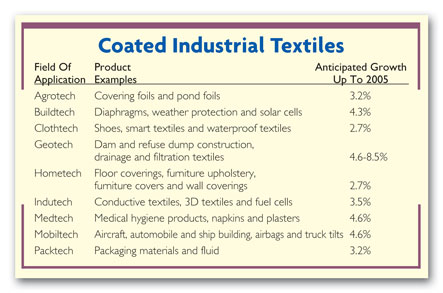
Coating Of Industrial Textiles


T
he

above-average growth in the market
for industrial textiles calls for special range concepts designed to meet the diverse demands this
growth has brought about. The growth is characterized by an increasing number of new functional
layers, particularly in the field of solid gelatin-based finishing coats.

Following is an overview of the fields of use, of application and drying techniques and
range concepts currently being used or in development for industrial textiles. It describes a
complex range suitable for finishing by coating, using the example of the production of truck
tilts. The range components, taken from the proven Montex modular system from Germany-based A.
Monforts Textilmaschinen GmbH, were tailored to the individual requirements of the textile
finisher. The application units and calenders came from Jacob Weiss & Söhne Maschinenfabrik
GmbH, also based in Germany.

Industrial textiles — defined here as innovative products manufactured by using new and
intelligent high-performance fibers and/or a special finishing of textile fabrics — are
characterized by their special physical and chemical application and functional properties.

An important step in the production of industrial textiles is the finishing of the fabrics,
in particular by coating. Here, the desired functionality is created by applying coating compounds
to one or both sides of woven, knitted or bonded fabrics using coating units and subsequent thermal
treatment such as drying or gelling.

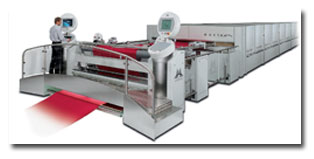
Monforts’ 6000 tenter


Popular Application Treatments

The following application treatments
are used prominently today.

Slop padding involves washing on the coating compound using immersion/transfer rollers from
below. It is used for thin coatings and produces a relatively undefined coating.

An air knife may be used to meter the coating compound above the freely spread fabric web.
This method is used for fine coatings and primer coatings, at application rates of approximately 5
to 50 grams per meter (g/m). The coat thickness depends on the fabric tension.

Air knives may be used over a roller to meter the coating compound at application rates of
30 to 500 g/m. The coat thickness depends on the distance of the air knife from the substrate
surface.

For heavy coatings, air knives may be used over a table or taut rubber cloth to meter the
coating compound. Here again, the coat thickness depends on the distance of the air knife from the
substrate surface.

In the reverse roll coater method, the coating compound is metered and transferred using
direction of rotation, differential speed and gap distance between the rolls and the substrate.
Uniformity is determined by the concentricity of the rolls.

An embossing cylinder may be used for thin coatings. Metering depends on the type and depth
of the embossing on the engraved cylinder.

The rotary screen-printing method involves metering via the mesh width of the screen; and
has application rates of approximately 5 to 120 g/m. This method is used for designed, porous and
spot-like — sometimes invisible — coatings.

Special processes such as double-sided coatings and application by spraying or scattering
may also be used.


Picturing The Process

Coating compounds are generally
film-forming natural substances or plastics that are predominantly dissolved or dispersed in
organic solvents or water to facilitate handling. Therefore, application of the compound onto the
substrate is followed by a drying or gelling process during which the liquid phase evaporates and
the remaining film is predominantly cross-linked.

The thermal processes, which frequently take place at temperatures of 100°C to 220°C, result
in undesirable dimensional changes in the textiles that are countered by fixed-width guidance in
the tenter.

A product-specific range configuration put together individually from a proven modular
standard system provides an example.

The range is a two-stage coating line for the production of, for example, polyvinyl chloride
(PVC) tarpaulins or starting material for sunshade lamella.

The range consists of two roll unwinder stations with downline comb-type fabric scray to
permit continuous operation during roll changing. The backing material for PVC tarpaulins generally
is polyester (PES) or polyamide (PA) woven fabric, with an average weight of 160 to 200 g/m.

Downline of the comb-type fabric scray, the fabric is dried in two cylinder driers in order
to equalize any non-uniformity in the moisture content resulting from storage. The moisture content
is set prior to the coating process. Particularly with PA backing material, an excessively high
initial moisture content results in problems with film formation and adhesion.

After drying, the fabric is cooled using a cooling roller and fed to the coating unit. The
precoating agent is applied in a twin coater to both sides of the backing material at a rate of
approximately 50 g/m per side.

The fabric then is dried contact-free in a convection dryer. After passing through a
centering unit, the surfaces are smoothed in a heated smoothing calender and subsequently
roller-cooled.

The precoated fabric now is fed continuously into a roller air knife application unit, where
the upper side is coated. The application rate ranges between 300 and 400 g/m.

Gelling of the top coat is performed in a tenter with an upline infrared drying section. The
substrate is guided in the tenter by a horizontally guided, life-lubricated special-version
Herkules pin/clip chain designed for tenter forces of up to 15,000 nips per minute.

The aerodynamically optimized TwinAir Plus air circulation system guarantees extremely
homogenous, uniform gelling and cross-linking of the applied film, according to Monforts. Separate
air circulation systems allow the area reaching the product to be infinitely varied to meet the
requirements.

Apart from a high-performance 150-millimeter-thick insulation to reduce heat loss, the
Monforts Exxotherm indirect gas heating system and an integrated heat recovery system are available
as options.

After unpinning, the fabric is heated by infrared radiators to the optimum calendering
temperature and smoothed in a smoothing calender or embossed, depending on the requirements.

The fabric then is cooled using cooling rollers and passes through the comb-type fabric
scray before it is rolled up in two winding positions. The winding unit designed as a center winder
ensures a continuous operation of the range, whereby the two winding positions in conjunction with
the comb-type fabric scray offer sufficient time for reel preparation and reel removal.

The fabric treated in this way has a precoat on both sides and a top coat on one side.

In order to finish the second top coat, which normally is a different color, the fabric is
fed into the middle inlet section. Discontinuous reel changing is provided and depends on the
colors specified by the customer and the number of meters to be produced.

With correspondingly large production volumes, the fabric also can be fed in again from the
front unwinding position. Coating and further process stages are performed during the first top
coat, whereby selvage trimming is performed after unpinning downline of the tenter.

The final treatment step is lacquering to produce a dirt-repellent and ultraviolet-resistant
surface on the weather or visible side. This generally solvent-based coating is applied in a
separate, explosion-proof range. Such ranges also can be configured from the Monforts Montex
modular system.


Editors Note: Ernst Klas, head of development, and Thomas Pgen, head of application
technology, A. Monforts Textilmaschinen GmbH, contributed to this report.

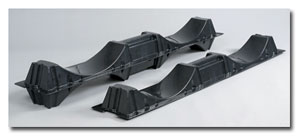
Rollguard® Unveils Thermoformed Roll Cradle

Rollguard®
Products, part of Appleton, Wis.-based Great Northern Corp.’s Specialty Group, now offers the
dust-free Thermoformed Roll Cradle made from reusable, recyclable polyethylene terephthalate. The
cradle is suitable for loading and shipping of roll goods having diameters ranging from 18 inches
to 22.5 inches.

rollguard

The company reports the new cradles locking hubs and end tabs provide significantly improved
loading and shipping safety and stability; while its construction provides cushioning for sensitive
goods, and its design enables nesting of more cradles per pallet. Other features include denesting
hubs that facilitate separation of stacked cradles, a smooth surface that protects rolls from
damage, and a crowned contour that relieves pressure on roll edges. Cradle lips to protect roll
ends and help prevent slippage are available as options.

October 2005

1987 The Future Of Man-Made Fibers

The Future ofMan-Made FibersIt was during ATIs first 100 years that man-made fibers made their
first appearance. Their influence has been both extensive and profound, altering virtually every
aspect of the textile industrys way of doing business, from processing the fiber, through new end
uses, to new and revolutionary ways of marketing.The words wool and cotton in ATIs original name,
The American Wool and Cotton Reporter, echoed conditions that had existed for thousands of
years in the textile industry when linen, silk, wool, and cotton were the dominant fibers.A New Age
For TextilesBut with the birth of the 20th century, the textile industry was caught up in the
relative rapid pace of industrial development when a cellulose filament was successfully produced:
artificial silk. This happened in the early 1900s, and soon the mills were offered viscose rayon,
viscose acetate, and cuprammonium rayon.But it was just prior to World War II that the most
significant developments started, when the polymer fibers made from complex chemical compounds and
branded pure synthetics (as apposed to the cellulosics) came on the scene.These fibers included
nylon, to be followed after the war by polyester, acrylic, and the olefins. In between, there were
a batch of short-lived man-made fibers such as Aralac, Darvan, Saran, and Velon, to mention a few,
using a wide variety of raw materials, including casein and soybean.It is interesting to note that
right from the start the man-made fibers attempted to identify themselves with the natural fibers
by liberal use of such terms as wool-like, silk-like, and cotton-like. Indeed, the same references
are made today and will be in the foreseeable future as fiber producers continue to modify
polyester, for example, to improve its cotton-like structure while retaining the best of the
man-made properties.An Overwhelming ProspectAn attempt to look into the next 100 years is
forbidding. One is overwhelmed by the clichThe World of Tomorrow, particularly when considering
what has taken place in recent years. One significant development after another has been compressed
into a relatively short time.We can look ahead in terms of what is now known, but clearly this will
change as new products and new concepts are introduced.Drastic changes have marked the man-made
fiber industry in recent years. During the 1960s it seemed as if the bonanza would never end. Hugh
marketing budgets were made available backed by stupendous brand advertising. But cutbacks, still
being felt today, started to be implemented in the late 1970s and continued into the 1980s. During
that time, both marketing and research suffered.These conditions became evident in many parts of
the world, and fiber producers in Western Europe hastened early on to reduce production and to
emphasize specialization. It is evident that they may have done a better job than those in the
United States and Japan. But the cutbacks are viewed as temporary, and after a period of further
adjustment there will be renewed marketing programs.U.S. Producer In Best SpotFavoring the United
States producer will be his ability to offer local service by being located right in the middle of
one of the most important markets in the world.It is obvious that he future belongs to the
synthetics. For one thing, they can be more readily adapted to processing on the new machinery that
will be introduced in the years ahead. Important trends already evident all require vast
consumption of the man-made fibers. Just a generation ago, world consumption of synthetics was
beginning to assume significant numbers, but estimates show that the next generation synthetics
will be consumed at an annual rat e in excess of 20 million metric tons, or better than half of
world fiber usage. In the next 100 years, the man-made fibers will become the dominant
factor.Probing the future has always been a risky business, and more so today with such a high rate
of technological change. And the closeness of one world, for example, affects man-made fiber
operations, especially in the United States, where producers must face governments of many
competing countries with business practices and attitudes vastly different from those in the United
States.Over the long haul, are we going to move toward them, with the accompanying danger of lower
standard of living, or are they going to move toward usMeanwhile we will see a trend where the key
to the fiber producers success in the developed countries will lie in the production of fibers
containing high technology and other specialized types involving high added value. Nor can the
giber producer escape the effects of the trade imbalance and the import problem with their
unfavorable bearing on U.S. manufacturing operations.New Foothold For RayonGeneral trends reveal
that while world output of the cellulosics is on the decline, current popularity of viscose rayon,
the first man-made fiber, is at peak levels in the United States, an admitted pleasant surprise to
those who had budgeted for a drop in sales.While the next 100 years will likely show a decline in
the market share for cellulosics, current efforts reveal new technology aimed at improving the
properties of viscose rayon. Examples include solvent spinning, which will give rayon a new
foothold in certain specialized areas.R and D Keeps Nylon StrongNylons market share is being
squeezed, after a lengthy reign as leader among the man-mades. But while it has dropped to second
place, behind polyester, nylon will continue to be a popular fiber in the years to come, banking on
its many well-known advantages. Research continues in many parts of the world on new nylon
developments, which include technology to improve its comfort properties in apparel. Work continues
on nylon 4, offering many of the properties of cotton and silk. It may well be that other nylon
types besides 6 and 6.6 will be developed in the future.Bright Future For AramidsOne of the
brightest futures belongs to the aramid high performance fibers, an offshoot of nylon. Their
projected use in composites is tremendous. This also applies to other fibers such as the new
carbons, which, when embedded in plastic, emerge as high tech construction material offering, for
example, competition to steel in the automotive industry. Their use will expand as a primary
construction material in aircraft and other important uses.Polyester Gets Lions SharePolyester is
the world leader, and in another 10 years will represent over half of all man-made fiber
production, while nylon slips less than 25%. Polyesters popularity will continue well into the
future. Its production is now outpacing that of nylon and acrylic combined. Polyester, which got
its start in the U.K., has in recent years seen its most rapid production growth in Taiwan, South
Korea, and China.China is an entirely new area as a fiber producer, with access to world technology
helped by the United States and the U.K. Fiber producers in the United States have noted a decline
in export business, and a decline in shipments to Asian markets is one reason, as these countries,
particularly China, become self-sufficient in these products. Such a trend will have to be taken
into consideration when peering into the future.There is great emphasis on super-soft, ultra-fine
dpf polyesters, pointing up the importance that fiber producers attach to comfort perception for
polyester in apparel. In newer industrial areas, research continues in engineered fibers where such
properties as strength and wear resistance are necessary.Much of the so-called comfort factor is
being achieved by moisture vapor transport, which moves moisture away from the skin and through the
fabric into the air. Already fiber producers are saying that the new polyester staple will replace
the old staple in a matter of 5 years, and then something will come along to replace the new, and
so on and on.One can see how the pace will quicken while the future unfolds numerous technological
advances. Polyester, with its durability and aesthetics, will be around in one form or another for
a long time.Acrylics Might Level OffAcrylic is holding steady, but in the long term it faces
decreased demand. But right now, in many countries acrylics are enjoying boom conditions, largely
because of good fleece and sweater business. However, these conditions will not last forever, and
U.S. producers have already made plans on how to operate profitably at reduced levels.Acrylic
competition is evident from the Far East and developing nations. Meanwhile, producers in developed
countries will cut production while at the same time coming up with new products such as improved
producer-colored types and high growth industrial applications such as carbon fibers. While the
olefins, polypropylene in particular, represent a relatively small percentage of world man-made
fiber production, they are making tremendous strides and they must be considered in any valuation
of the future.Indeed, the world fiber production trend shows increases for polyester and
polyolefins, while that for nylon and acrylic indicates decreases.PP Meets Special NeedsPresent
growth for polypropylene (PP) is noted mainly in the United States, Japan, and Western Europe,
where these areas account for upwards of two-thirds of total production. Polypropylene fiber
production in the Unites States has been increasing at a rate of 5% a year and, according to
suppliers of resin and extrusion equipment, it should continue to increase for some time.In placing
PP fibers into the future, it must be considered that they are not a general purpose product but,
as of now, are limited to specific areas, which include floor coverings and thermal bonding
applications in nonwovens. The technology for PP production is relatively simple and is readily
available. While the world markets are dominated by several large companies, there are many small
concerns in the business; and this affects prices from time to time.Some of the research in PP
fibers covers improved bulk continuous filament (BCF) for floor coverings and the possibility of
continuous filament for apparel, especially in the area of activewear, where a fine denier PP might
be acceptable.Comparatively inert PP fiber is of significance in fabric construction, and its
popularity in geotextiles is on the increase. Geotextiles reportedly are the second largest end use
for nonwovens in Europe, and they are growing steadily. Market reports state that PP in granule or
fiber form is the most important polymer used n the European nonwovens industry, mainly because of
the increase in the spunlaid area and higher production of heat-bonded nonwovens.Extended Chain PE
WinsAttracting considerable attention and due for expansion in the future are the extended chain
polyethylene fibers, which are said to be 10 times stronger than steel and 75% stronger than any
other organic fiber available. Such a fiber gained praise when it played a part in sail
construction which helped return Americas Cup to the United States.A Ready Market For
FilmNoteworthy for the future is the growing use of recycled polyethylene bottles into film with
textile applications, especially in the floor covering industry.It is expected that the future will
see more use of the films, which are likely to replace certain nonwovens in the years ahead. Right
now the film industry ha so many possibilities that it has not turned full attention to textile
replacement. It is anticipated that development of more discontinuous film surfaces will aid this
movement.Imagination The Only LimitAs to the fiber spinning process itself, the future holds
nothing but increased automation as computers and microprocessors, for example, take over more and
more responsibilities. As one producer says: Automation in the fiber plant is limited only by the
imagination.Basic Robot With 14 HandsOne of the chief goals in any fiber producing plant is to
reduce the amount of labor. Formost fiber producers in the developed countries, this has been a
high priority and much has been accomplished. However, the trend to further automation in plant
production particularly in the use of robotics, is steadily increasing, and there is no doubt but
that such a trend will affect fiber production in the coming years.The co-founder of Unimation, the
Worlds first industrial robot company, point out that even today a basic industrial robot can be
outfitted with a wide selection of attachments, such as 14 different kinds of hands and several
different styles of fingers. Already the Japanese have moved in the direction of plant robots to
the extent that union membership has become involved!Computers Designed FibersAs we move into the
next 100 years it is obvious that the old order will be challenged to a much greater degree than at
the present time.The fiber producer is becoming caught up with the new faster information
requirements of Quick Response and its related developments such as electronic data interchange
(EDI). The world computer assisted design (CAD) has entered the world of the fiber producer and it
is bound to occupy an ever-increasing role. Only recently a domestic nylon producer introduced a
new nylon apparel yarn offering a new computer designed cross section.Cooperation And New
AttitudesFiber producers have also become closely involved with the trend to automation in the
garment industry, as evidenced by participation in the (TC)2 program now in the hands of a sewing
machine manufacturer. This step was taken in the knowledge that the future must witness a close
cooperation between fiber producer, textile manufacturer, and garment maker with completely new
attitudes.

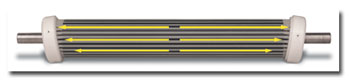
Webex Launches Expander Roll For Web Handling

Neenah,
Wis.-based Webex Inc. has developed an expanding web-handling roller that removes wrinkles during
winding, slitting, coating, laminating and embossing, among other web-handling processes. The
Expander Roll features elastic cords on the roll face and specially engineered cams that stretch
the cords as the web travels over them, pulling from the webs center to the outer edges, thereby
removing wrinkles, according to the company. The roll also is available with a drive pulley for
low-tension applications.


expanderoll


October 2005

Ten Cate Thiolon Invests In Capacity Expansion For Synthetic Turf

As a result of further sales growth of synthetic turf, investment projects amounting to EUR 10
million for Ten Cate Thiolon, part of the sector Industrial Fabrics and Grass of Royal Ten Cate,
have been approved. Taken into consideration the total amount of investments in fixed assets of
Royal Ten Cate during the whole of 2004, this is a substantial investment for the company. The
investment is aimed for capacity increase as well as for future cost reductions and improvements of
logistics. Investments will take place in both the US and The Netherlands. The sector Industrial
Fabrics and Grass showed a sound organic growth. For 2006 Ten Cate Thiolon sees a continuation of
its growth, which will also take place in other segments than specific sport applications.
Landscaping is such an example. In the United States multi-sport pitches for universities and
high-schools form an important area of sales as well.

In the sports market the brand Thiolon Grass(R) stands for high-grade synthetic turf that has
a prominent position with marketing companies and installers in the offerings of their systems.
Especially in the US and the top segment of the European market, there is growing demand for such
products for several applications. Thiolon Grass(R) combines durability with slide-friendly
properties for players. Soccer is currently a substantial growth market and there is a gradual
shift in perception with top clubs towards the use of synthetic turf. This is also caused by
stimulating activities by UEFA and FIFA. Synthetic turf creates improved possibilities for regions
with less favourable climate conditions, which will stimulate soccer globally. Similar developments
are seen with other sports. An increased need to save water is an argument to use synthetic turf as
well. Injury-related costs are a major aspect for top clubs and synthetic grass provides, with its
constant and predictable surface, a positive contribution to medically safe and individually
targeted training methods and control over physical aspects.

Ten Cate Thiolon works together with education institutes and includes health and safety in
its research and development. For the further growth of the market and a broad acceptation of
synthetic turf it is important that this knowledge is broadly applied. In particular for the
further growth in the volume market for soccer and other “contact sports” like American football
and rugby, an affordable, safe and durable grass surface is a key development. Ten Cate Thiolon is
well positioned to meet the requirements of the market and will maintain its leadership.
Concluding, the current developments in terms of quality and performance will lead to a greater
acceptance of synthetic turf, which stimulates market growth.Therefore Ten Cate Thiolon foresees
good opportunities for further growth in the future.

Press Release Courtesy Of PR Newswire

October 2005

ATMI Presidents 1940-1950

ATMI Presidents 1940-1950F. W. Symmes, 1940-1941, was in office when the industry faced the
challenge of clothing and equipping hundreds of thousands of troops. Before World War I, with the
late Lewis W. Parker and others, he founded Nuckasee Manufacturing Co. to make athletic underwear.
When Nuckasee was sold to Union-Buffallo Mills , he became a director, then, in 1932, president and
treasurer. He was involved in the development or management of Piedmont Plush Mills, the Camperdown
Co., and the F. W. Poe Manufacturing Co., all of Greenville. He was a director of the Textile Hall
Corp.W. N. Banks, 1941-1942, began his career in his father’s hosiery mill at Grantville, Ga.,
became secretary when a yarn mill was built in 1905 to supply the hosiery plant and became
president when his father died in 1909. He served as chairman of the Cotton-Textile Institute,
president of the Cotton Manufacturers Association of Ga., chairman of the Carded Yarn Group and
director of the Southern Hosiery Manufacturers Association.Herman Cone, 1942-1943, became treasurer
of Proximity Manufacturing Co., Greensboro, N.C., after serving in the Navy as an ensign in World
War I, his father, the founder, having died. He succeeded his uncle as president in 1938. He also
served as president of the North Carolina Cotton Manufacturers Association and as chairman of the
Cotton-Textile Institute.Hugh M. Comer, 1943-1944, gave freely of his time in working with the
Quartermaster General, the War Production Board and the War-Manpower Commission. He had served in
World War I as an officer in the 82nd Division. He was a brother of Donald Comer, 1936-1937
president of the Association. Returning from service, he worked at various plants of Avondale Mills
as a manager. In 1946, he was chairman of the board of the Cotton-Textile Institute and served as a
director of the National Cotton Council and the Alabama Cotton Manufacturers Association.W. H.
Hightower, 1944-1945, oversaw reorganization of the Association, broadening the scope of its work.
He was born November 25, 1887 and died at Thomaston, Ga., on February 9, 1947. He went to work in
his father’s plant on graduation from college in 1909. He became vice president in 1915 and
president in 1925 when his father became chairman of the board. He was a director of the
Cotton-Textile Institute and a president of the Cotton Manufacturers Association of Georgia.Charles
A. Cannon, 1945-1946, was the first cotton manufacturer to hold the position of Chairman of the
Board of Government, as the Association changed its bylaws at the 1945 meeting, elevating the
ranking cotton manufacturer to the chairmanship and making the president a paid executive. His
administration worked vigorously to have the war-time controls lifted. He was born November 29,
1892 at Concord, N.C.; attended Davidson College; and, in 1962, as chairman of the board of Cannon
Mills, Kannapolis, N.C., celebrated both his Golden Wedding Anniversary and 50 years in the
industry.Walter S. Montgomery 1946-1947, worked for the lifting of federal controls on prices,
production and distribution, which came during his administration. He had previously served as
chairman of the ACMI Print Cloth Group. Born at Spartanburg, S.C., October 18, 1900, he was a
graduate of Virginia Military Institute. He has served as manager, treasurer, president or chairman
of a number of textile mills, including Spartan Mills, founded by his grandfather, Startex and
Beaumont Mills. He was an organizer of South Carolina Mills, a mail order firm dealing only in
items of cotton, an organizer of the Spartanburg County Foundation and a long-time director of
Textile Hall Corporation.Harvey W. Moore, 1947-1948, an alumnus of the University of Georgia,
served as president and treasurer of Brown Manufacturing Co. and Roberts Manufacturing Co.,
Concord, N.C.; secretary/treasurer of White-Parks Mills Co., Concord; vice president of Highland
Park Manufacturing Co., Eastern Manufacturing Co., Park Yarn Mills and as a director of Cannon
Mills. He served also as president of the Carded Yarn Association, mayor of Charlotte, member of
the North Carolina State Ports Authority and trustee of Davidson College. He was born May 1, 1884,
in Augusta, Ga., and died in 1958.E. S. McKissick, 1949-1950, was graduated from Alabama
Polytechnic Institute in 1915; employed by Grendel Mills, Greenwood, S.C. and Ninety-Six Cotton
Mill, Ninety-Six, S.C. during 1915-1917; elected vice president of both mills in 1917 but left to
serve with the American Expeditionary Force, winning the Silver Star and promotion to Captain in
the Meuse-Argonne offensive. He then joined J. E. SirrineandCo., becoming a partner in 1923. Later
that year, he and his father purchased Alice Mill, changing the name to Alice Manufacturing Co. He
was the grandson of a former ACMA president, Captain Ellison Smyth. He served as president of the
South Carolina Textile Manufacturers Association in 1954.

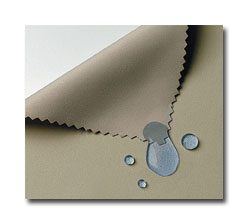
Milliken Adds To StainSmart® Technology

Milliken & Company, Spartanburg,
has expanded its StainSmart® line of fabric technology with the introduction of StainSmart 3™, a
back-to-face finish application that combines stain repellency, stain release and moisture wicking
in polyesters and polyester/cotton fabric blends.

Milliken’s new StainSmart® 3 fabric technology combines stain repellency, stain release and
moisture-wicking properties.

Through a precision finishing
process, the outer face of the fabric repels liquid-based spills, preventing most stains. The
inside of the fabric wicks moisture away from the body, making the wearer more comfortable. The
entire fabric contains a releasing technology that works on ground-in penetrating stains such as
salad dressing, enabling these stains to wash out during at-home laundering, and making it suitable
for a variety of uniform and apparel applications.

StainSmart 3 is available via custom development through Milliken.

October 2005

Shaw To Acquire Honeywell Nylon Carpet Fiber And SI Carpet Backing Operations

Shaw Industries Inc., Dalton, Ga.,
plans to expand carpet manufacturing operations by acquiring businesses from two of its suppliers.

The company has agreed to purchase Morris Township, N.J.-based Honeywell International’s US
nylon carpet fibers business, with closing expected in the fourth quarter of 2005. The acquisition
includes nylon fiber manufacturing operations in Anderson, Clemson and Columbia, S.C.; the
Zeftron® and
Anso® nylon brand names; and Honeywell’s 50-percent interest in Augusta, Ga.-based
Evergreen Nylon Recycling.

Honeywell, which will retain its nylon intermediates business, will supply caprolactam and
nylon resin to Shaw to use in its nylon fiber production. Honeywell also will retain its nylon
fiber operations in Shanghai and Canada, and its textile operations in Anderson.

Shaw also has agreed to acquire Chattanooga, Tenn.-based SI Corp.’s woven carpet backing
operation in Chickamauga, Ga., with closing expected this fall. Shaw, which has been one of the
facility’s customers for some years, will continue to supply carpet backing to other plant
customers as well.

Calling the acquisition a “perfect fit” for Shaw, Joe Dana, SI’s president and CEO,
commented: “Not only is it a large, efficient woven backing plant, but it is also centrally located
to most of Shaw’s major carpet plants. In addition, our Chickamauga employees get to join one of
America’s premier flooring companies.”

October 2005

Sponsors