Quality Fabric Of The Month: Warm, Dry And Odor-Free

Indera Mills, Yadkinville, N.C. – a maker of circular-knit underwear since1914 – today specializes exclusively in thermal and winter-weight rib underwear sold under its own Indera brand or for private-label product lines. Its customers include small specialty outdoor, big-box and catalog retailers. The company carries out all design, knitting, cutting, distribution and administrative functions in Yadkinville; and contracts with two sewing operations in Mexico to construct and package the garments it sells.

Counting itself among the top three US makers of thermal underwear, Indera can ship most orders within 24 to 48 hours of their receipt. According to John Willingham, president, the company’s relatively small size – with roughly $20 million in annual sales – allows it to be more nimble in responding to customer needs.

qfom
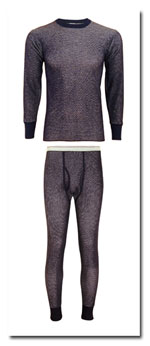
Indera’s performance thermal underwear styles with HydroPur® include this dual-face raschel
knit for men.

With the development of special performance technologies for apparel of all kinds, even underwear – especially that worn during rigorous outdoor activities in extreme weather conditions – may be expected to provide more than basic comfort or extra insulation. Five years ago, Indera introduced a highly successful line of thermal underwear with moisture management.

Now, it has added odor control to the mix, using Charlotte-based DAK Americas LLC’s Delcron® HydroPur® polyester staple fiber – which combines Hydrotec™ moisture-management fiber and SteriPur®AM antimicrobial fiber. SteriPur incorporates Spartanburg-based Milliken & Company’s silver-based antimicrobial AlphaSan® technology. HydroPur’s moisture-management and antimicrobial properties are permanent and evenly distributed throughout the fiber because they are incorporated during polymer formation, according to DAK Americas.

Willingham stressed the role of the complete supply chain in creating Indera’s new product — beginning with Milliken’s AlphaSan chemistry and its integration into DAK’s fibers. Indera then contracts with a spinner to spin the HydroPur fiber into yarn for its products.

The response to the new line has been “very good — better than expected,” Willingham said, adding: “We are offering these performance features at a very reasonable price. Milliken developed the AlphaSan chemistry in a very creative, economical way — at about one-third the cost of the high-end silver-based technologies.” He also said AlphaSan enables superior dye-ability when compared with the other technologies.

Indera offers several styles in its performance thermal line. Included are rib-knit 100-percent HydroPur styles for men, women and children; and three other men’s styles — a two-layered rib knit with HydroPur inside and a polyester/wool blend outside; a raschel knit containing a blend of HydroPur, cotton and wool; and a dual-face raschel knit with HydroPur inside and cotton outside.


For more information about Indera’s performance thermal underwear line, contact John Willingham
(336) 679-4440;
 jwillingham@inderamills.com


May/June 2006


Innofa Plans Expansion

Reidsville, N.C.-based Innofa USA, a
subsidiary of The Netherlands-based knitted fabrics manufacturer Innofa BV, is in the process of
acquiring a new facility that will allow it to expand its operation.

Innofa USA, established in 2003 to produce knitted mattress ticking for the US market,
currently employs 28 people. According to General Manager Wieger Hulst, the planned expansion will
bring currently outsourced dyeing and finishing functions in-house, and will add 70 to 75 workers
to the company’s payroll over the next three to four years. Hulst said the company also ultimately
may add knitting capacity at the new facility.


May/June 2006

Avoid Missteps By Dispelling Marketing Myths


F
rench author and journalist Françoise Giroud said, “Nothing is more difficult than
competing with a myth.”

The term marketing conjures up hundreds of definitions, varying opinions and common
misperceptions that could be considered marketing myths. Marketing gurus Alexander Hiam and
Anaheim, Calif.-based D.C. Woolsey & Associates warn that many of these widespread myths are
downright dangerous to those who buy into them when developing marketing plans and programs. Here
are some of the most common marketing myths:

Marketing and sales are different things.

All marketing is about sales. Marketing is developing the tools and techniques — advertising,
collateral materials, public relations programs, promotions — to sell your product or service.
Accepting an ADDY® award for an advertisement or brochure is wonderful, but that ad or brochure is
valuable only if it helped you sell your product.

If your marketing and sales departments are separate, consider combining them to improve
communication and ensure company sales goals and objectives are shared and pursued in tandem.

Marketing is a set of formulas that deliver successful sales.

The old marketing rule of thumb said an ad must run three to six times before it reveals its
effectiveness and profitability. There are a couple of ways to look at this myth. One is to ask, if
an ad flops in the first month, why will it do better in the fourth? An ineffective ad doesn’t
improve over time.

However, new studies indicate the onslaught of media messages has grown to more than 3,000
per day, so it takes more impressions to break through the clutter. The new rule of thumb indicates
it takes nine times seeing an ad before a customer is ready to buy. However, for every three times
your ad appears, customers aren’t paying attention two of those times. So, it takes 27 runs to
achieve the desired nine impressions.

Focus groups can be beneficial when developing ad campaigns. Ask your best customers or top
prospects to review your ads before they run. You’ll get valuable feedback, and your customers will
appreciate your interest in their opinions.

It also is vitally important to know your marketplace. Perhaps your customers aren’t reading
the magazines in which your ads are appearing. Maybe they receive industry updates via the
Internet, or prefer catalogs or direct mail for new product announcements. Find out how your
customers receive information, and try reaching them through those media.

The best product or service will win.

Perception equals reality. Most people are convinced their perceptions are correct, so the
winner in marketing is the prospect’s perception.

As an example, when the Coca-Cola Co. introduced “new” Coke, the product flopped despite the
fact that Coca-Cola had conducted more than 200,000 taste tests, and “new” Coke had won out. The
problem was customers’ perceptions that Coke was better than “new” Coke.

If your intention is to change long-held perceptions of your product, you’d better be
prepared to spend a lot of marketing dollars.

I know this product like the back of my hand, so I’ll be able to sell it.

In truth, you must know the marketplace just as intimately as you know your product or
service.

In addition to constant changes in the competitive landscape, there are continuing changes in
the way your customers receive information. Knowing your marketplace, and developing effective ways
with which to approach it and communicate with it will ensure your success much more than product
or service knowledge.

Everyone loves my product or service, so I won’t have a problem selling a lot.

People often tell you what they think you want to hear. Rather than a formal presentation,
try casually showing or explaining your product or service to people to get a genuine reaction. If
they are wowed by it, you may have a winner. Offer them one on the spot or offer to procure the
service for them. If they don’t express interest in purchasing it, it may not be as big a winner as
you thought.

Attack your competitors’ weaknesses with your marketing.

Customers buy from your competitors because of their strengths, not their weaknesses. You
need to be as familiar with those strengths as your own, and develop ways to effectively sell
against them.

The Internet is an easy place to make money.

Here’s how Internet revenues break down, according to D.C. Woolsey: Of all revenue spent on
the Internet, 60 percent is related to pornography; 20 percent to computers; and 20 percent to
everything else combined.

“The Internet reminds me of the California Gold Rush back in 1849,” Woolsey writes. “A few
people struck it rich and the rest had to get a real job.”

You should cut back on your marketing and advertising expenditures in a recession.

According to a study conducted some years back by New York City-based Ogilvy & Mather and
the Strategic Planning Institute and published in Business News Week, the opposite may be true. The
study found that the more a company spent as a percentage of actual or projected sales compared
with their competitors, the greater the percentage of the market they captured.

Market share has a dramatic effect on profitability. Those companies with greater than
40-percent market share experience an average return on investment of 41 percent, while those with
shares under 10 percent return profits around 9 percent, according to the study. Effectively
marketing during a recession can help you increase your share of a diminishing market. When the
economy rebounds, your company will be in the stronger sales position.

Anyone can do marketing.

Designing a great ad, letter or brochure, making a great sales presentation, designing an
effective website, or developing and positioning a new product take different skill sets. A good
all-around marketer should understand all of the marketing disciplines and be able to manage the
experts in areas where they themselves are weaker. Many small business owners and executives have a
great understanding of product development and operations, but know very little about marketing.

It makes no sense to invest in research and product development if you spend little to
nothing on marketing. Marketing is developing the tools and techniques that improve the quality and
quantity of your sales. Avoiding its myths will help improve your bottom line.


Good Marketing Takes Practice

Most everything we become good at requires practice. The same is true for marketing. All of your
employees, from the switchboard operator to the CEO can and should practice their marketing skills
so your company never misses an opportunity to sell.

Here are some practical marketing principles that can be put into practice immediately to
improve sales:

Never miss an opportunity to present your company well.

Every contact with the outside world is a marketing and sales opportunity. From the way the
telephone is answered to the manner in which you present yourself at a trade show, first
impressions are lasting. Dressing well, always having your business cards, smiling and listening
all make good first impressions.

Know your point of differentiation.

In other words, know what makes you special to customers and prospects. What is motivating
your customers to buy from you? What are your product strengths? What is getting a prospect’s
attention?

Many marketing managers will tell you they are not quite sure how a prospect found out about
them, or what prompted a sale. Asking simple questions like “How did you hear about us?” and “What
do you like best about our product or service?” can help you focus limited marketing resources in
the best direction.

Spend 10 minutes a day marketing your company.

Again, good marketing takes practice. It’s not a one-shot deal, and it’s not a miracle
worker. Take time to read a marketing tip each day or work on ways to put a marketing principle
into practice.

Separate the browsers from the buyers.

Each time you make a sales call on someone who can’t or isn’t ready to buy, you are wasting
valuable marketing resources.

Develop a customer profile for your product or service that allows you to quickly weed out
prospects that do not match that profile.


Screening for the highest-quality leads is perhaps the single-most powerful way to boost
sales and profits in the short term.

Simplify your marketing strategy.

If your marketing plan is complicated or confusing, it is not finished. Success in business
comes from simple, powerful ideas that are well-executed.


May/June 2006

Collins & Aikman To Quit Automotive Fabrics Business

Troy, Mich.-based automotive systems and cockpit modules supplier Collins & Aikman Corp.
announced it will exit the automotive fabrics business, pending approval by the US Bankruptcy
Court. The action will impact approximately 1,200 employees in three fabric manufacturing plants in
Roxboro, N.C., one in Farmville, N.C., and a laminating plant in El Paso, Texas. It will be
implemented over a transitional period depending on when the business can be transferred to other
suppliers.

The company is seeking a buyer for the El Paso operation, but it has abandoned efforts to
sell the rest of the fabrics business, according to David A. Youngman, vice president,
communications. He said the business has been unprofitable, and a turnaround is not projected.

“Despite an aggressive cost-cutting program, the business is projected to continue to be
unprofitable,” Youngman said, noting also that the company has invested heavily in technologies to
produce fabric styles, such as velour, that no longer are popular with consumers. In addition, he
said, “Sales have dropped from more than $300 million in 2004 to a projected $150 million in 2006,
and we have an extensive amount of excess capacity.”

Other factors in the business’s misfortunes include escalating raw material prices and the
transfer of manufacturing offshore, according to Gerald Jones, executive vice president, Fabrics.

The company’s automotive carpets business remains profitable, and is not included in the
decision, Youngman said. “Our other automotive operations still offer value-added products. For
example, there are three automotive carpet plants in North Carolina and others elsewhere. That is
one of our core competencies, along with injection-molded panels and other products.”

Collins & Aikman filed voluntary petitions to reorganize under Chapter 11 bankruptcy
protection in May 2005. The company plans to complete the shutdown of its Fabrics business before
the end of September 2006, when it expects to emerge from bankruptcy. Youngman said the company
could emerge as a stand-alone company, or it could be sold. Among those parties who have expressed
interest in the company, he said, is New York City-based financier and chairman of the Greensboro,
N.C.-based International Textile Group, Wilbur L. Ross Jr., whose recently formed International
Automotive Components Group has acquired Collins & Aikman’s European businesses.

April 25, 2006

Fleissner, Neumag Partner For Nonwovens Technologies

Fleissner GmbH and Saurer GmbH &
Co. KG business unit Neumag — both based in Germany — have entered into a cooperation to provide
certain nonwovens production solutions. According to Fleissner, the agreement makes the companies
the first on the market to offer complete solutions for all major nonwovens production processes.

Under the agreement, Neumag will be able to include Fleissner’s AquaJet spunlace technology
in its processing lines; and Fleissner will be able to include Neumag’s M&J Fiberetech airlaid
technology in its systems. The two companies also will use their synergies to develop new
technologies. In addition, the new Neumag Carding Center in Austria will install Fleissner’s
LeanJet system — a small-capacity spunlace system for specific applications — and an optimized
card, in order to present spunlace capabilities to Neumag customers.


April 25, 2006

X-Rite Bids For GretagMacbeth Parent

Grandville, Mich.-based X-Rite Inc. recently offered to purchase all of the outstanding
registered shares of Switzerland-based Amazys Holding AG — the parent company of GretagMacbeth,
also based in Switzerland — for approximately $280 million plus 2.11 shares of X-rite stock per
share. The two global providers of color measurement and communication hardware, software and
services expected to close the deal in late spring of this year, following shareholder and
customary regulatory approvals.

X-Rite reported that upon completion of the sale — which would unite the “best-of-the-best in
terms of innovation, products and talent,” and would extend its market and geographic reach, a team
of X-Rite and GretagMacbeth executives would lead the consolidation of the two companies. The
resulting organization would have global headquarters in Grandville and European headquarters in
Regensdorf, Switzerland. Current X-Rite shareholders would own majority share of the combined
entity — 74 percent — with the rest belonging to Amazys Holding’s current shareholders.

In addition, X-Rite’s Michael C. Ferrara would remain CEO, current Amazys Holding’s CEO
Thomas J. Vacchiano Jr. would be appointed president and chief operating officer, X-Rite’s Mary E.
Chowning would keep her post as chief financial officer, and Francis Lamy would be named chief
technology officer of the proposed company. Six X-Rite and three GretagMacbeth members would
comprise the new Board of Directors.

“X-Rite is excited about the opportunity to achieve greater scale, reduce operational costs
and leverage combined [research and development] efforts,” said Ferrara. “With the combined
company, we will be in a position to deliver more innovative and high-quality solutions.”

April 25, 2006

Berkshire Hathaway To Acquire Russell Corp

Atlanta-based athletic and sporting goods company Russell Corp. and Omaha, Neb.-based investor
Warren E. Buffett’s Berkshire Hathaway Inc. have signed an agreement whereby Berkshire Hathaway
will acquire the outstanding shares of Russell for $18 per share, or approximately $597.3 million.
Subject to stockholder and regulatory approvals, the transaction is expected to close in the third
quarter of 2006.

According to Jack Ward, chairman and CEO, Russell, the deal will strengthen the company’s
financial position.

“Russell will be better positioned against our worldwide competitors in all three segments of
our business, and that includes apparel, sports equipment and athletic shoes,” he said. “We also
owe our gratitude to the thousands of people who have played roles in the development of this
organization from a small Alabama apparel operation founded in 1902 to a major player in the global
sporting goods marketplace of today.”

Russell would become the third company with ties to the US textile industry among Berkshire
Hathaway’s portfolio of more than 40 companies representing a wide range of markets. Bowling Green,
Ky.-based underwear, T-shirt and activewear maker Fruit of the Loom Inc. and Dalton, Ga.-based
floor covering manufacturer Shaw Industries Inc. also are part of the conglomerate.

April 18, 2006


United States And Peru Negotiate Free Trade Agreement

The United States and Peru have entered into a free trade agreement (FTA) that includes a
yarn-forward textile and apparel provision that will require textile and apparel products to be
made from components manufactured in the participating countries. It does not contain any of the
cumulation or tariff preference levels that have been opposed by US textile manufacturers in some
of the other FTAs.

In 2005, the United States imported $821 million worth of textiles and apparel from Peru and
had exports worth $21 million.

The agreement is particularly important to farmers in both countries, but there also are
elements affecting industrial and consumer products. Upon implementation of the agreement, 80
percent of consumer and industrial products and more than two-thirds of current US farm exports to
Peru will immediately become duty-free.

US Trade Representative Robert Portman said the Peru agreement is part of the administrations
strategy to “advance prosperity within our hemisphere.” He expressed the hope that Colombia and
Ecuador would soon join the agreement. As a participant in the Andean Trade Preference Act, Peru
already has considerable duty-free access to the US market, but that act expires this year. As a
result, the United States initiated negotiations in May 2004 on a new Andean agreement with Peru,
Colombia and Ecuador; and Bolivia has participated as an observer.

April 18, 2006

GE Advanced Materials-Toshiba Joint Venture To Build Silicones Plant In China

GE Toshiba Silicones has entered into
an agreement to develop a new silicones manufacturing plant in Nantong, Jiangsu province, China.
The company — a joint venture between Wilton, Conn.-based General Electric Co.’s (GE’s) Advanced
Materials business and Japan-based Toshiba — will invest US$78 million to build the new plant. GE
Toshiba Silicones says the facility, scheduled to begin production by the end of 2007, will enable
it to provide silicone technologies to companies in China faster and more easily through a
shortened supply chain.

“GE Toshiba Silicones has always envisaged China as one of the most important markets in the
world,” said Eddy Wu, president and CEO, GE Toshiba Silicones. “We are committed to introducing the
latest silicone technologies to China based on profiles of local demands, aiming to convert
[research and development] results in advanced technologies into cutting-edge products that meet
the requirements of our customers.”

“The rich resources in world-class technologies and profound understanding of the market of
GE Toshiba Silicones will combine well with Nantong’s geographic advantage as an industrial center
in the [Yangtze River Delta] to provide a major driver to regional economic development,” added
Chen De Xin, director, Nantong Economic & Technology Development Zone.


April 11, 2006

Sole-Mate Tests Footwear For Hazardous Static Charge

Lakewood, N.J.-based Newson Gale Inc.
reports its Sole-Mate® tester determines whether workers are wearing nonconforming, nondissipative
footwear or gloves that can build up enough static charge to ignite dust clouds or solvent vapors
in hazardous areas.

The device, which typically would be installed at the entrance to a hazardous area, tests
the path of resistance from a floor plate, through the worker’s shoes and to the person’s finger,
and gives a pass or fail reading in seconds, according to the company. A shrill alarm and bright
light indicator will indicate whether the worker is wearing inappropriate shoes or gloves. One
version of the tester also features an integral doorway interlock that prevents access to a
hazardous area without a pass reading.

The Sole-Mate line includes models that connect directly to a 100-volt or 230-volt source.
The testers are dust- and water-tight, can measure footwear resistance according to U.S. and
European standards and are calibrated to National Measurement Accreditation Service standards,
Newson Gale reports. Also available is a calibration module that confirms the device’s
accuracy.


April 11, 2006

Sponsors