Polymer Group Inc. Announces New Corporate Headquarters In Charlotte Region

[NORTH CHARLESTON, S.C.] — Polymer
Group, Inc. (OTC Bulletin Board: POLGA/POLGB), one of the world’s leading producers of engineered
materials, today announced it will establish a new corporate headquarters in the Charlotte, N.C.
region, to better serve its customers and accommodate future growth of the business.

The new headquarters will bring together the company’s senior leadership, finance,
purchasing, human resources, sales, customer service and other administrative functions, currently
located in several locations in the U.S., into one central site with approximately 100 employees.

The relocation from the current headquarters in North Charleston, S.C., is planned to take
place by August, 2006. About a dozen executive management positions have been based at the North
Charleston site since 2003. Additionally, employees will be relocated from sites in Dayton, N.J.
and Mooresville and Raleigh, N.C.

The move puts PGI in closer proximity to its Mooresville, N.C., manufacturing site, where
the company is in the process of a $40 million expansion. The plant expansion is expected to be
completed by the middle of this year and will add approximately 50 jobs in the North Carolina area,
in addition to the positions being relocated from the headquarters consolidation.

“This relocation is very much in line with our plans for deliberate growth and expansion,
and makes perfect sense for the business,” said James Schaeffer, PGI’s chief executive officer. “
Bringing together these different disciplines under one roof will foster even greater collaboration
and cooperation across the company, and also puts us closer to our manufacturing operations and
customers. In addition, it will improve our efficiencies and provide us with the infrastructure we
need to continue to grow our business.”

Press release courtesy of Polymer Group, Inc.

February 21, 2006

Andritz, Küsters Develop Joint Venture

Austria-based Andritz AG and Germany-based Jagenberg AG, which took complete ownership of the
shares of Eduard Küsters Maschinenfabrik Gmbh & Co. KG in August 2005, have created Küsters
Technologie GmbH & Co. KG — a joint venture in Küsters’ paper and nonwovens industries. The new
enterprise will employ approximately 500 employees and have an annual turnover of 70 million to 80
million euros, the companies reported.

Jens Kellersmann, public relations representative for Eduard Küsters, said the joint venture
would be renamed Andritz Küsters GmbH & Co. KG following an antitrust evaluation. The companies
expect that evaluation to be completed by the end of March, according to Kellersmann.

As part of the change, Andritz gains majority share of the venture — 60 percent — and
industrial leadership of the new Krefeld-based business, which includes the Spartanburg-based
subsidiary Küsters Paper Machinery Corp. Jagenberg owns the remaining 40 percent of the new
business and maintains complete ownership of of Zittau-based Küsters Textile GmbH, formerly named
Küsters Zittauer Maschinenfabrik.

According to the companies, the joint venture clearly separates Küsters’ three industry
areas.

The wet-finishing textile machinery business, which was restructured before the latest
changes, operates exclusively out of Küsters Textile. Additionally, Küsters Textile’s Zittau site
is the only location for the group’s textile business, as the Krefeld textile site was closed in
December 2005. Küsters Textile also directs the company’s textile subsidiaries in India, China and
the United States.

Küsters Technologie in Krefeld, on the other hand, produces products for the nonwovens and
paper industries, including nonwoven and textile calenders and nonwoven wet finishing; and paper
roll technology, calenders, and press modules and sections.

“We follow the primary aim of creating industrial framework conditions for the individual
Küsters business fields which best support their successful continued existence,” said Erich W.
Bröker, CEO, Küsters. “Whereas, in view of intensifying global competition, a certain painful
restructuring step was unavoidable. The tie-up with Andritz opens up a markedly broadened market
access ….”

February 21, 2006

2004 US Organic Cotton Acreage Increases By 37 Percent

A 2005 survey from the Greenfield, Mass.-based Organic Trade Association (OTA) shows 12 US
farmers planted 5,550 acres of organic cotton in 2004 — a 37 percent increase from 2003 totals of
4,060 acres. Of that acreage, 5,020 contained organic upland cotton, while 530 were planted with
organic Pima cotton. Most of the acreage was in Texas, followed by California, New Mexico and
Missouri.

In 2005, there were 6,577 acres of planted organic cotton, mostly of the upland varietal.
That total represented a 19-percent increase over 2004.

In terms of harvesting, 2004 saw 6,814 bales of organic cotton, compared to 4,628 in 2003,
according to the survey and additional information from the Lubbock-based Texas Organic Cotton
Marketing Cooperative. Harvesting figures for 2005 are not currently available.

OTA reports that of the 52 people surveyed last year in seven states, 21 farmers responded,
including 12 organic cotton farmers and nine who did not grow organic cotton in 2004. The
association also notes that because only eight of the 16 Texas Organic Cotton Marketing Cooperative
members answered the survey, the organic cotton acreage and farmers numbers may be lower than
actual figures.

The survey was funded by a grant from Cary, N.C.-based Cotton Incorporated.

February 21, 2006

VISION 2006 Recognizes Disaster Relief Blanket

Nearly 400 attendees from the
consumer products and engineered fabrics industries recently came to Denver for the VISION 2006
Consumer Products conference, and to honor the 2006 Visionary Award winner. Chicopee, a division of
North Charleston, S.C.-based Polymer Group Inc. (PGI), won the award for its Disaster Relief
Blanket.

Attendees of the conference, which was organized by Cary, N.C.-based Association of the
Nonwoven Fabrics Industry (INDA), chose the blanket over the Mr. Clean Magic Reach from
Cincinnati-based Proctor & Gamble Co.; Disposable Mitt with Body Wash from Dallas-based
Kimberly-Clark Corp.; Stayfree Advanced Protection from New Brunswick, N.J.-based Johnson &
Johnson and Cotton Enhanced Baby Wipes from PGI Nonwovens.

“The Vision 2006 attendees recognized the contributions the Chicopee Disaster Relief Blanket
is making in emergency situations around the world, and it was chosen over four other extremely
deserving and successful consumer products from some of the biggest names in the business,” said
Michael Jacobsen, Visionary Award project coordinator.”


February 21, 2006

Trade Deficit Alarms Textile Makers

A
s the US government announced the US
trade deficit in 2005 reached an all-time high of $726 billion, textile manufacturers warned the
deficit is resulting in job losses not only in textiles, but in other key manufacturing industries.
The 2005 record was $108 billion higher than 2004, and China’s role in the deficit rose to a record
high of $202 billion.

With regard to textiles and clothing, the trade deficit rose by $21 billion to a record
level of $82 billion. At the same time, textile and apparel employment fell to 639,000, a decline
of 408,000 since January of 2001. Overall manufacturing jobs fell by 2.9 million over the past five
years.

The report triggered a call from the Washington-based American Manufacturing Trade Action
Coalition (AMTAC) for “immediate action” by the US government to restrain Chinese imports of
textiles and other products. AMTAC Executive Director Auggie Tantillo said: “Clearly the United
States must reform its trade policy with China if it is to meaningfully confront the overall trade
problem. China is one of the five largest economies in the world and is a superpower in terms of
international trade. Yet China manipulates its currency, subsidizes its banking and industrial
sector and misreports its economic numbers. Clearly China is using predatory trade practices to
destroy US jobs and factories.”

In addition to citing concerns about textile trade, Tantillo said China is becoming a major
factor in automobile and auto parts manufacturing.

While textile manufacturers are alarmed by the trade deficit, Kevin Burke, president of the
Arlington, Va.-based American Apparel and Footwear Association, said 2005 was “another banner year”
with 98 percent of all shoes and 92 percent of all clothing sold in the United States imported.
However, he expressed concern over what he called a “disturbing trend” in trade with Central
American countries as clothing imports from that area declined. He blamed a delay in implementing
the Dominican Republic/Central American Free Trade Agreement, which was targeted to be in place at
the beginning of the year. Burke said the delay is threatening hundreds of thousands of apparel
jobs in both the US textile and Central American apparel industries.

February 14, 2006

Lone Star Assumes Control Over Moenus

Dallas-based Lone Star Funds, a
global equity fund that focuses on distressed investments, has taken over the business activities
of Germany-based textile machinery manufacturer Moenus Textilmaschinen GmbH, including the company’s
German business sites in Gera, Mönchengladbach and Hamburg, and its Olomouc site in the Czech
Republic.

The January 2 takeover of the sites, which employ approximately 400 employees, occurred to
put the company in a better financial position, Moenus reports. The company expects the move will
revitalize its growth and strengthen its market position.

February 7, 2006

Springs Global Announces New Organizational Structure

Springs Global US Inc., Fort Mill,
S.C. — a subsidiary of Springs Global Holdings S.A, Brazil, which was formed by the merger of
Springs Industries’ home textile business and Coteminas, Springs’ Brazil-based supplier — announced
a new organizational structure for the merged company.

Crandall Close Bowles and Josué Gomes da Silva, co-CEOs of Springs Global Holdings, said
Springs’ key account strategy is the model for the new organization.

Tom O’Connor, executive vice president, is in charge of all North and South American account
teams, and also is responsible for expanding share of existing markets, building market share in
Europe and developing new markets. He also is responsible for bed, bath and fabric window treatment
merchandising, marketing, design and product development. Reporting to O’Connor are Tom Gaffney,
head of bedding merchandising, and Dick Grissinger, head of bath merchandising. The Creative
Products, Baby, Basic Bedding, Owen Blankets, Canada, Wholesale and Springs Direct businesses,
which have retained their current leadership and structure, also report through O’Connor.

Pedro Bastos, formerly vice president of operations, Coteminas, leads global manufacturing
operations, which include approximately 25 bedding and bath manufacturing facilities in the United
States, Brazil, Argentina and Mexico.

Jeff Nigh, formerly senior vice president, bedding operations, Springs, oversees customer
service, demand planning, production planning and scheduling, capacity integration, international
and domestic transportation, and a bath products distribution center.

Chris Baker, formerly executive vice president and president of Springs’ Bath business,
heads up the global sourcing and purchasing organizations. He has responsibility for raw materials,
energy, finished goods and component sourcing, global supplier management, global strategic
alliances and Springs Asia.

Mario Sette, formerly director of export, Coteminas, is responsible for merging the two
companies so as to optimize cost savings and efficiencies, and to develop and help implement
related programs.

Roberto Cristofanilli, controller and head of information technology, Coteminas, heads up a
new Shared Services organization, with responsibility for integrating finance and technology
functions.

February 7, 2006

Performance Fibers Moves Headquarters

Global industrial polyester supplier
Performance Fibers Inc., formerly of Colonial Heights, Va., has moved its corporate headquarters,
along with 50 local employees, to downtown Richmond, Va., as part of its separation from
Morristown, N.J.-based Honeywell International Inc.

The company has left the Honeywell Technical Center on Woods Edge Road, where it had been
located for more than a year, and moved its staff in various executive, commercial, finance,
technical and administration positions to a new office in the Merrill Lynch building, 707 E. Main
St., Suite 1800.

“Our new location, in the heart of Richmond’s financial and legal community, reflects the
company’s position as one of the global leaders in the industrial fibers industry,” said Greg
Rogowski, president and CEO, Performance Fibers. “It puts us closer to the Richmond International
Airport, making travel to our global customers more accessible.”

Performance Fibers became a stand-alone partner of Boca Raton, Fla.-based private investment
firm Sun Capital Partners Inc. in December 2004.

February 7, 2006

Some Cautious Optimism


T
he first quarter – after a moderately impressive holiday season – seems to be getting off
to a reasonably good start. In any event,

TW
does not see any meaningful near-term erosion in overall textile activity, despite continuing
trade questions. Indeed, preliminary reports suggest domestic mill production over the current
January-March period should remain pretty much unchanged when compared to year-ago levels. That’s
not all that bad considering the flood of Chinese textile and apparel imports that came into the
country over the past year.

Look at dollar shipments of textile mill products, and it’s pretty much the same story – with
a sizable year-to-year gain in more highly fabricated textile products such as home furnishings,
rugs, and industrial products helping to offset a modest decline in basic mill items like yarns and
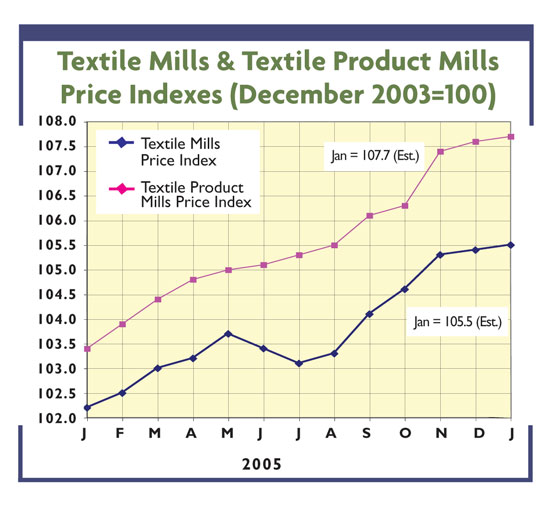
fabrics. Mill prices for the most part also have remained tolerably firm. For example, quotes in
the basic mill and mill product categories were running 3 and 4 percent, respectively, above a year
ago, according to the latest figures. Zero in on a few more detailed areas, and some of the price
advances are equally impressive -6 percent in the case of floor coverings and 4 percent in the more
basic greige goods area.

Febbusinessgraph


Another Plus: Trim Inventories

Equally encouraging are recent inventory trends. Generally speaking, mill holdings are quite
trim, with few if any disturbing stock overhangs. Credit this to a combination of much improved
market forecasting techniques and the pressing need to keep inventory carrying costs down.

New government figures tell the story. Stocks at the basic mill level now represent only
about a 1.25-months’ supply of shipments. Two years ago the average stock/shipment ratio was up in
the 1.5-months’ range. This keep-’em-lean approach is also noted for more highly fabricated textile
products – with the current 1.31-months’ supply again significantly under the nearly 1.7-months
reading of two years ago.

The current close-to-the-vest inventory strategy may also, to some extent, reflect the
industry’s need to keep up with today’s increasingly volatile markets – ready to meet any sudden
shift in buyers’ demand at virtually a moment’s notice. Other things being equal, this calls for a
lot more flexibility and opting for smaller production runs – and by implication, keeping less
unsold merchandise on warehouse shelves. This same trend toward slimmer stocks, incidentally, is
also noted for most other domestic industries as they struggle to stay afloat in today’s
competitive global markets.


The Economy Helps, Too

Further industry optimism is being engendered by the continuing general business uptrend. Gross
domestic product (GDP) – the broadest measure of how the economy is doing – racked up a solid
3.5-percent annual rate of growth over the last three months of 2005. And while some deceleration
is anticipated, gains through spring and early summer should still be fairly impressive, with
consensus GDP forecasts calling for gains in the 3-percent range.

Behind this optimism are rising employment, a further inching-up in spendable incomes, low
inflation and still-relatively-low interest rates. All these, in turn, are being reflected in
continuing consumer confidence, which at last report was hovering near its highest level in years.
Put all these into the forecasting equation, and it suggests continuing solid demand for apparel,
home furnishings and other textile products. To be sure, imports will continue to take an
increasingly large bite out of this still-rising 2006 textile demand. But early trends indicate
these import gains aren’t likely to run any higher than last year, when incoming shipments on a
square-meters-equivalent basis rose by about 9.5 percent. 


Current Profit Trends

Bottom line performance – given all the above – hasn’t been all that bad either. Indeed, new
numbers show surprising buoyancy. Latest government figures – third quarter 2005, for example, put
the industry’s after-tax earnings at $516 million. That’s significantly above the $288 million
reading of one year earlier. Compare the first three quarters of 2005 to the first three quarters
of 2004, and improvement is just as impressive, with the year-to-year after-tax advance put at
nearly 65 percent.

The news is equally upbeat in terms of margins, with mills on average earning 4.1 cents for
each dollar of sales. That’s again well above the 2.3-cent figure of 12 months earlier. This leads
to the conclusion that the American textile establishment is alive and well, at least as far as
overall performance is concerned. And – as pointed out in

TW
s 2006 textile industry forecast last month
(See “Surviving the Game Of Textiles,”
TW, January/February 2006)
– economic forecasting firm Global Insight sees
this profit trend continuing, especially in the more highly fabricated mill product sector.


February 2006

A Year Of Watersheds – Yarn Mills Rode A Roller Coaster In 2005


T
he year 2005 was one of the most dynamic years ever for the US textile and fiber
industries and spinners certainly had a front-row seat. The year kicked off with the January 1
expiration of quotas on textile and apparel products.

In March, trade figures for January become available. Imports from China in major apparel
products doubled when compared to January 2004. Some products, such as cotton trousers, saw import
increases of as much as 1,000 percent. China took a 35-percent share of the US import market for
textiles, and a 22 percent share for apparel. The total Chinese share of the US import market was
29 percent – the highest share of any single country in history.

“The quota phaseout was a landmark, watershed event,” said Gary A. Raines III, manager, fiber
economics, Cotton Incorporated, Cary, N.C. “It completely changed the playing field and was a shift
in paradigm. We began to see a dramatic increase in textile shipments coming into the United States
from China. Basically what everyone was afraid would happen ended up happening. Not only did the
Chinese volume come in much faster than expected, but we also saw that the cost per unit (kilogram
or square meter equivalent) was dramatically lower on the Chinese product in the absence of
quotas.”

In July, the House of Representatives passed the Dominican Republic-Central American Free
Trade Agreement (DR-CAFTA). Two of the industry’s major trade groups – The National Council of
Textile Organizations (NCTO) and The American Manufacturing Trade Action Coalition (AMTAC) – took
opposing views on the trade measure. NCTO strongly backed DR-CAFTA and said, “The passage of
DR-CAFTA means that the jobs of US textile workers are more secure today than they were yesterday.”

AMTAC described the agreement as a “job killer” and voiced concerns it could cost an
estimated $1 billion in US textile and apparel exports. Most spinners sided with NCTO, seeing
DR-CAFTA as essential to the industry’s future.

“DR-CAFTA was really a matter of saving the industry,” said one spinner just after the
agreement’s passage. “Critics said we would lose jobs, and I don’t disagree. But I think it was a
matter of losing jobs or losing the industry. Some of the more labor-intensive work, which has been
going out of the United States for many years, will continue to move out. But there will be a base
left that might not have been possible without DR-CAFTA.”

“We view DR-CAFTA as necessary legislation to enable continued opportunity for the Central
American apparel industry,” said one specialty ring spinner. “We must have a healthy apparel
industry in Central America.”

In September, Hurricanes Katrina and Rita hit the gulf coast. Oil and man-made fiber prices
spiked. The fallout from these natural disasters also set some spinners scrambling to find
transportation to get their yarn to customers domestically and in Central America.

In November, the United States and China reached a comprehensive 3-year bilateral textile
trade agreement, which cut China’s market access in 14 core apparel categories during 2006 by 2.5
percent, compared to what the US industry could have expected under a safeguard reapplication
process. In addition, the agreement placed 20 new textile and apparel categories under three-year
quota control including combed cotton yarn, knit fabric, swimwear, sweaters, fiberglass fabrics,
ramie trousers, industrial fabrics and textile blinds.


2006: Eyes On China


As mill executives survey the issues confronting them in 2006 — including implementation of
DR-CAFTA, continued industry consolidation, man-made fiber prices, retail trends and future trade
agreements — China will continue to demand the lion’s share of their attention.

“China is not the only story, but it is a big story that only continues to get bigger,” said
Raines. “Estimates for Chinese cotton mill use continue to grow and are now roughly 43 million
bales for this marketing year. This has more than doubled in the last seven or eight years. And I
believe that the 43 million-bale estimate is too low.”

According United States Department of Agriculture estimates, China will import 16.5 million
bales of cotton this year, compared to 8.8 million bales last year. About half of China’s cotton
imports will come from the United States, according to Raines. In other words, roughly one in three
bales grown in the Unites States this year will be used in a Chinese mill. China also has become
the world’s largest importer of cotton yarns.

“This year for the first time since Reconstruction [after the Civil War], a foreign country
will use more US cotton than the United States does,” Raines said.


January/February 2006

Sponsors