Outlast, Kelheim Fibres Team To Incorporate PCMs Into Viscose Fiber

Outlast Technologies Inc., Boulder,
Colo., and Germany-based specialty fiber manufacturer Kelheim Fibres GmbH have developed the first
patented viscose fiber with incorporated Outlast® phase change materials (PCMs) to provide
temperature-regulating properties to the fiber.

According to Outlast, PCMs previously have been incorporated only into acrylic fibers. The
company anticipates the new Outlast viscose fiber will open up new apparel and home furnishings
opportunities. “With their ability to absorb excess heat, PCM fibers in apparel provide excellent
temperature buffering and comfort,” said Pat Gruber, CEO, Outlast. He mentioned applications
including intimate apparel, knitwear, dresses, shirts and blouses, and pants; as well as
bedspreads, blankets, mattress ticking and sheets. The new fiber, which retains all the inherent
properties of viscose, can be blended with cotton, polyamide, polyester, aramids and practically
any other fiber.

“[Kelheim’s] focus on innovative products and flexible technologies was well-suited to
successful incorporation of Outlast’s phase change technology into the viscose fiber,” said Martin
Bentz, managing director of Germany-based Outlast Europe GmbH. The two companies worked quickly to
develop Outlast viscose, making use of Kelheim’s pilot plant, and Kelheim now has created a special
unit to manufacture the product.

“We are very pleased with the high level of incorporation of microcapsules we have been able
to reach while still retaining the critical properties of viscose, such as processability,
dyeability and soft [hand],” said Robert Gregan, CEO, Kelheim.

October 17, 2006

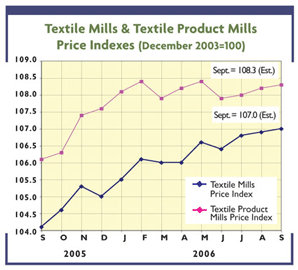
The Numbers Aren’t Bad


L
atest statistical evidence continues to support

Textile World
’s contention that the textile industry is doing tolerably well. A case in point: profits,
where new Census Department data — carrying through midyear — show after-tax mill earnings running
close to 12 percent above comparable 2005 levels. Margin trends are equally upbeat, with profits
per dollar of sales over the same period put at about 3.4 percent — significantly above the
3-percent reading noted during the first six months of 2005. That’s also the highest level for this
key indicator of textile health in more than a decade. To be sure, earnings in the downstream
apparel sector are down a bit. But here, too, dollar and margin levels remain solidly in the black.

More importantly, all this basically encouraging profit news is likely to continue through
the entire year. At least that’s how analysts at economic forecasting firm Global Insight see
things. Their latest forecast, for example, calls for a solid 15-percent margin gain this year for
mills turning out finished products — rugs, home furnishings, etc. And even in the more competitive
basic mill sector — yarns and fabrics, current forecasts suggest a much smaller margin decline than
last year, with an even better picture, a basically flat pattern, anticipated here for upcoming
2007.
Oct06BFChart


Demand Is Holding Up, Too


Nor are activity figures all that discouraging. Mill production, for example, has remained
pretty much unchanged since last December. In any event, that’s a heck of a lot better than some of
the steep declines reported over the past few years. Behind this somewhat brighter picture: a still
basically strong economy — more about this below — plus smaller than previously expected textile
and apparel import gains.

This somewhat improved mill production picture is also confirmed by better than anticipated
manufacturers’ dollar shipments, where — as reported in earlier months — an actual uptick in more
highly fabricated textile mill products has been helping to offset some of the continuing erosion
in the basic yarn and fabric sectors of the industry. Still other positive signs: manufacturers’
apparel shipments, which also are up of late, plus better inventory management. On the latter
score, stock/sales ratios remain quite low, suggesting that new bookings — rather than being billed
by inventory drawdowns — are now quickly being translated into new production and shipments.


Strong Economy Will Help


Some further thoughts on the impact of continuing economic growth: To be sure, the housing
market has been weakening of late. But there are now plenty of areas that are likely to pick up the
slack. For one, considerably lower gasoline prices should leave a bit more money available for
clothing or other textile-related products. Household compensation — which at latest report was
rising at double the rate of inflation — should also help loosen up consumer purse strings, as well
as today’s somewhat smaller share of income going to pay down consumer debt.

Still another economic plus: the double-digit growth in US exports over the past year.
Finally, there are signs that capital spending on new plants and equipment — something that
accounts for more than twice as much gross domestic product as housing — is beginning to pick up.
This is a gain that also has positive ripples, helping to generate a secondary wave of jobs and
income for consumers. Given all the above, the current year-to-date modest boosts in apparel and
home-furnishing sales are likely to persist — not only through the remainder of the year, but also
into early 2007.


Chinese Concerns Persist


But not everything is coming up roses. That’s certainly true when it comes to resolving the
still-growing trade imbalance with China. To be sure, the United States’ current textile and
apparel imports from that nation are under earlier double-digit levels. Nevertheless, the
4.5-percent jump recorded so far this year can’t be ignored. Nor can the recent declines in the
United States’ Western Hemisphere imports be regarded as any sort of positive offset. The reason:
Double-digit slippages from Canada, Mexico and the Caribbean mean that these countries will be
buying less US-made yarn and fabrics for their operations.

There also are more questions about the Chinese yuan. Clearly, the near 4-percent upward
revaluation in that country’s currency over the past year or so hasn’t really helped stem imports.
Indeed, almost everybody now agrees that a much larger yuan adjustment is needed. But this seems
highly unlikely, given Washington’s approach to view such revaluation as part of a much broader
agenda — one that also calls for Beijing to reduce subsidies granted to its domestic industries and
allow for a more freely flowing capital market.


September/October 2006

BASF, Arch Form Global Alliance For Freshness Enhancers

In an effort to enter new market
sectors such as home textiles and apparel, the Performance Chemicals for Textiles business of BASF
AG, Germany, and Arch Chemicals Inc., Norwalk, Conn., have teamed to market Arch’s Reputex™ 20
antimicrobial treatment for cellulosic textiles and its Purista® label for finished consumer
products.

As part of the partnership, the companies will combine BASF’s global textile network and
technical expertise with Arch’s Purista branding efforts and freshness-enhancing technology as they
assist manufacturers that are incorporating Reputex 20 into their production processes.

“The benefits and strong position of the Purista brand open up new market sectors, and bring
BASF closer to the retailer and brand, as well as consumers,” said Michael Schmitt, Ph.D., head,
Innovation Textiles, BASF.

October 10, 2006

PGI Opens Medical Fabrics Plant In China

Polymer Group Inc. (PGI), Charlotte,
has opened a facility in Suzhou, China, for the manufacture of medical fabrics. The company reports
it now is the largest spunmelt fabric producer in China and the only vertical medical fabrics
manufacturer in the country.

The new facility is located in the China-Singapore Suzhou Industrial Park near Shanghai and
now is PGI’s Asian headquarters, employing 145 people in all functions at the site including
administrative, finance, information technology, sales and marketing, as well as manufacturing.

The manufacturing plant is equipped with a multi-beam Reifenhäuser spunmelt line and a
finishing line. Markets served include not only medical, but also industrial protective and
hygiene. Products include ultra-high-performance spunmelt medical barrier fabrics including the
company’s MediSoft™ line and spunlace medical fabrics including Provia™, which is finished using
proprietary processes and advanced treating systems.

“As more of our customers move to this growing area, we are committed to delivering the
highest-quality product from this new state-of-the-art facility,” said Jay Cheng, vice president
and general manager, PGI Asia. “The strategic location and combination of our manufacturing and
back-office functions at the same location will enable us to better serve our customers in this
region. We would like to thank the members of the Suzhou Industrial Park Administration Committee
for their support in making this a successful venture for PGI.”

Although the new facility now is open, the company will officially celebrate its opening in
early November, when it will invite elected officials and customers to participate.


October 10, 2006

Solutia Inventors Net Temperature-Sensitive Polymer Manufacturing Process Patent

The US Patent Office has granted a
patent to two St. Louis-based Solutia Inc. researchers for a process to produce specialty polymers
and plastics using the company’s Therminol® VP-3 heat-transfer fluid. Jerry L. Brown, retired, from
Solutia’s Anniston, Ala., plant, where Therminol products are manufactured; and Patrick P.B. Notte,
a research chemist at the company’s European headquarters and technical center in Belgium, received
US Patent No. 7,091,309 for their process.

According to Solutia, Therminol VP-3, with its boiling point of 243°C, enables vapor phase
heat transfer at lower temperatures than is practical when using conventional biphenyl/diphenyl
oxide eutectic fluids. Textile applications include spinning or processing of nylon 6 or specialty
polyester-based polymers. The fluid can be used at continuous operating temperatures of up to 330°C
in the liquid or vapor phase, and it crystallizes at 2.4°C. The company reports the fluid is easy
to handle and has a milder odor than other vapor-phase organic heat-transfer fluids.

The new patented process offers a commercially viable method for the manufacture of
temperature-sensitive polymers and plastics, solving problems that previously made such a method
impractical, according to Solutia. Although the patent covers a variety of chemistries, Therminol
VP-3 is the preferred chemistry, the company reports; adding it also is more environmentally
friendly than traditional fluids, offers improved health and safety attributes, and is more
economical to use.

October 10, 2006

Gildan To Restructure US Sock, Canadian Textile Distribution Operations

In an effort to remain
cost-competitive in the global marketplace, Gildan Activewear Inc., Montreal, reports it soon will
close and downsize textile and hosiery facilities in Canada and the United States, resulting in the
loss of approximately 540 jobs. The company plans to shift production capacity to its offshore
facilities in Honduras and the Dominican Republic.

During the next three to four months, the company will close and downsize its sock
production operations in Mount Airy, N.C., and Hillsville, Va., impacting approximately 335
employees in total. In December 2006, Gildan will shutter its Canadian textile manufacturing plant
in Valleyfield, Quebec, resulting in downsizing at its knitting facility in Montreal, Quebec. Those
actions will affect approximately 155 and 50 employees at the Valleyfield and Montreal locations,
respectively.

In addition, the closure of a Montreal distribution center at the end of October 2006 will
result in the elimination of six jobs. The company will outsource distribution operations in Canada
to a third-party logistics partner.

Gildan has pledged to “make every effort to alleviate the impact of this transition for the
employees whose positions are eliminated.”

The branded basic apparel manufacturer and marketer’s recent offshore investments include
the expansion of its manufacturing complex in Honduras, including the addition of a large-scale
athletic sock facility; as well as the establishment of a new textile plant in the Dominican
Republic. The company recently reduced production and cut more than 60 jobs at plants in Quebec and
Bombay, N.Y., as part of a strategy to grow large-scale basic T-shirt production in the Dominican
Republic and Honduras.

October 3, 2006

Congress Defers Trade Bill Action

An omnibus trade bill strongly
opposed by US textile manufacturers was pulled from the House of Representatives calendar last week
as Congress took a recess until after the November elections. It is uncertain at this time if the
bill will be offered again when Congress returns for a brief session November 13.

The bill, introduced by Rep. Bill Thomas, R-Calif., chairman of the House Ways and Means
Committee, covered a number of trade issues affecting textile trade. It would extend until 2008
special treatment of textile and apparel imports from sub-Saharan African nations; it would grant a
liberal tariff preference level (TPL) to imports from Haiti, using a value-added approach — which
textile manufacturers contend is unenforceable and would give a tax credit to US companies
investing in facilities in sub-Saharan Africa.

Textile-state members of the House played a key role in getting the bill removed from the
calendar, as the procedure for considering it would have required a two-thirds majority vote. In
view of the opposition by textile state members, the leadership did not believe it had sufficient
votes to win passage.

Cass Johnson, president of the Washington-based National Council of Textile Organizations,
whose members are strongly opposed to the bill, says the TPLs will benefit China at the expense of
the countries that have preferential trade agreements with the United States.

October 3, 2006

Wellman Announces Restructuring Plans

Wellman Inc., Fort Mill, S.C., has
announced plans to restructure its US fiber operations in an effort to improve its operating
results, and reduce overall debt and working capital. As part of the restructuring, the company
will close its fiber production operations in Johnsonville, S.C., and consolidate all US fiber
production operations at its Darlington, S.C.-based Palmetto plant, which has an annual polyester
fiber production capacity of 500 million pounds. Wellman also plans to sell its Material Recycling
Division, a converter of post-consumer polyethylene terephthalate (PET), and production equipment
for its specialty coarse-denier Wellstrand® fiber. The restructuring will result in the loss of
some 300 jobs out of a total 550 positions in Johnsonville, according to Wellman spokesman Michael
Bermish, who added that the company will continue to produce nylon engineering resins in
Johnsonville.

The restructuring is expected to be complete by the end of 2006.

“Consolidating our US fiber production is expected to increase operating income and reduce
working capital,” said Thomas M. Duff, chairman and CEO. “We will be able to operate one fiber
facility at close to full capacity rather than operating two underutilized facilities. This will
allow us to lower our overall costs and remain more competitive in our domestic fiber operations.”

Wellman also is exploring strategic alternatives for its European fiber and PET resin
businesses, according to Duff. “We are reviewing the performance of these businesses and exploring
strategic alternatives with the goal of improving our overall corporate value,” he said.

October 3, 2006

ATHM Plans Exhibit Revamp

The American Textile History Museum
(ATHM), Lowell, Mass., has unveiled plans for the redesign of its “Textiles in America” core
exhibition. The revamped exhibition will include an introductory video and interactive-enhanced
exhibits spanning textile history from pre-industrial to 21st century state-of-the-industry
developments.

Pre-industrial exhibits will include fiber processing, early tool and machinery
demonstrations, a flock of sheep, a cotton field and a general store. Visitors will be able to pet
the sheep, walk through the cotton field and observe the bartering system used to trade goods in
the store.

A technology room in the industrial area will include demonstrations of spinning, knitting
and weaving machinery; and a 1920s- to ‘30s-era tenement house display will show the home life of
mill workers during that time.

New fibers and textiles will be featured in the section depicting the 20th and 21st century
textile industry. Applications illustrated will include apparel, automotive, fire-protective,
geotextiles, home furnishing, industrial, medical, military, space and sports, among others.
Visitors will be able to compare a contemporary lightweight parachute with the heavier parachutes
of the World War II era. Also on display will be a cross-section of an automobile showing all the
various textiles used today in its manufacture.

Construction of the new exhibits is expected to begin in mid-2007. The museum has invited
the public to submit exhibit ideas by e-mail to designideas@athm.org.

October 3, 2006

Senators Back Off On Punitive Chinese Tariffs

Sens. Charles E. Schumer, D-N.Y., and
Lindsey O. Graham, R-S.C., who have been sponsoring legislation that would impose a 27.5-percent
tariff on Chinese imports, have backed off that proposal and say they will seek a less punitive
course of action next year. They took the action in order to give the Bush administration time to
negotiate problems related to China’s currency exchange rate and other trade issues. Many US
manufacturers, including those of textiles, say China’s refusal to raise the value of its yuan
against the dollar amounts to an unfair trade subsidy that is forcing plants to close and wiping
out hundreds of thousands of jobs.

While the senators did not say specifically what approach their new legislation would take,
it is likely to be something along the lines of legislation already introduced in the House and
Senate. Sen. Jim Bunning, R-Ky., has introduced a bill that would make manipulation of currency
actionable under US countervailing duty and anti-dumping laws. The bill is similar to one
introduced in the House by Reps. Tim Ryan, D-Ohio, and Duncan Hunter, R-Calif.

The Washington-based American Manufacturing Trade Action Coalition (AMTAC) has endorsed
those bills, saying they would be a good start toward correcting what the coalition sees as a
number of problems with Chinese trade. “US manufacturing has lost nearly 3 million jobs since 2001,
and currency manipulation is one of the chief reasons why,” said AMTAC Executive Director Auggie
Tantillo. “This legislation gives some industries the right to use US trade law remedies to fight
back.”

With Congress in recess until after the November elections and planning to return for a
lame-duck session following the elections primarily to deal with appropriations, action on the
currency issue will be put off until next year.

October 3, 2006

Sponsors