Glen Raven To Acquire Astrup, John Boyle

Glen Raven Inc., Glen Raven, N.C.,
plans to acquire The Astrup Co., Cleveland, and John Boyle & Co., Statesville, N.C. — leading
suppliers of materials, including Sunbrella® and other Glen Raven performance fabrics, for awning,
casual furniture and marine applications.

“Glen Raven remains committed to growing and supporting the industrial fabric industry,”
said Allen E. Gant Jr., president, Glen Raven. “Merging Glen Raven’s resources with those of Boyle
and Astrup will create a stronger, more diversified organization that is capable of providing
enhanced value throughout the entire supply chain. This strategic initiative will allow us to grow
each of the markets we serve by working more directly with our customers.

“Timing is ideal for the merger of our companies,” he continued. “Today’s global markets
demand innovative products, efficient supply chains, close working relationships with customers and
strong consumer brands. We can achieve all of this and more by joining forces with the talented
people at Boyle and Astrup.”

Astrup and Boyle have had business relationships with Glen Raven for more than a
century. Astrup brings 14 distribution centers located throughout North America to the deal, while
Boyle brings its knitting, coating and laminating capabilities and 300,000-plus square feet of
manufacturing, distribution and administration facilities.

The acquisitions are expected to be completed by mid-May 2007.


January/February 2007

ITG Sells Mattress Assets To Culp

International Textile Group (ITG),
Greensboro, N.C., has sold its Burlington House mattress fabrics product line to Culp Inc., High
Point, N.C., for $2.5 million in cash and approximately 880,000 shares of Culp common stock. ITG
will use the proceeds of the sale, which includes inventory and production rights for its mattress
fabric patterns, to expand its global core businesses. Culp’s mattress fabrics focus and
cost-competitiveness in that area are expected to benefit mattress customers.

“ITG continues to implement its business strategy of being a global textile fabrics and
solutions provider focusing on markets where it is able to differentiate itself through innovative
products, styling and competitive manufacturing facilities,” said Joseph L. Gorga, ITG’s president
and CEO. “With its entry into the automotive fabrics business, through the merger with Safety
Components International, ITG is also focusing on highly engineered technical fabrics.”

“We view this as a great opportunity for Culp,” said Robert G. Culp III, chairman of the
board and CEO, Culp Inc. “Mattress fabric … accounted for approximately 40 percent of the company’s
sales in our second fiscal quarter.” He said Culp recently has invested substantially in its
mattress fabrics business, and the acquisition of the Burlington House assets will allow it to grow
annual mattress fabric sales by some $25 million to $30 million without investing in fixed assets.
He also said Culp’s existing capacity will accommodate the additional volume.

Delores Sides, director, corporate communications and human resources, ITG, said the
transition of the product line from Burlington House to Culp will take two to four months. The
exact impact on Burlington House employees isn’t yet clear, although Sides said there will be a
reevaluation of capacity needs at the company’s Pioneer operation. “We do not expect significant
change at our Burlington Finishing plant, as we are in the process of moving apparel fabrics into
that plant, which we expect to balance our employment needs,” she added.


January/February 2007

Thies Presents New Innovations

More than 160 customers from 21
countries recently attended an open house at Thies GmbH & Co. KG, Germany, a supplier of
discontinuous dyeing machines. The company presented a new concept in the area of atmospheric and
high-temperature jigger dyeing, and unveiled a new beam-winding machine.

Visitors also spent time in Thies’ research facilities and attended a lecture on the
company’s powder, dye and chemical dispensing systems.


January/February 2007

Textiles In 2007: Off And Running


L
ooking ahead, 2007 promises to be an interesting year for US textiles. Although
technological developments seem to enter the market without any predictable cycle these days, ITMA
2007, to be held in Munich this September, will be a strong opportunity to catch the latest
innovations.

Textile World
editors are already taking a peek at what’s new and planning coverage for this “Super Bowl”
of textile technology.

If you are drawn to technical textiles, INDA’s IDEA show, set for April in Miami, will
provide a chance to warm up, see the ocean and learn about the latest nonwovens trends. Then it’s
off to Frankfurt in June for TechTextil — fans of the North American edition will appreciate the
size and scope of this show. Save time for Las Vegas in October, when the ever-popular IFAI Expo
will continue to attract new exhibitors and visitors. The 2006 colocation with ATME-I® in Atlanta
was a great chance for many members of the industry to see IFAI in action.

The apparel sector, though smaller in recent years, has some very strong innovations. Whether
it’s fiber, yarn, fabric, finishing, apparel manufacturing or the ever-elusive relationship with
retailers and brands — striving to collaborate in a lean, proactive supply chain — there will be
plenty of activities in 2007. It is a little late to mention the January Outdoor Retailer show,
which has grown in popularity. MAGIC is set for Las Vegas in February, and AAPN has announced two
networking meetings this year beyond its regular slate of activities. In mid-March, AAPN will host
a meeting in Santa Monica, Calif., to mix it up on the West Coast, and in early August, it will
support the Apparel Conference of the Americas in Antigua, Guatemala. AAPN has been working hard to
link everyone from fiber suppliers through retailers in a no-politics environment — it’s all
business.

VESTEX has organized the 16th edition of the Apparel Sourcing Show in Guatemala for
mid-April, and don’t forget Material World this May. This is the expanded edition — with the SPESA
Expo, Material World and Technology Solutions colocated in the triennial event format that brings
together the major components of the sewn products industry. One badge allows access to all three
events. Material World will also head for New York City in mid-September as it pursues the NYC
market. And Messe Frankfurt’s second edition of Texworld USA will move to the Javits Center for the
July show in NYC.

In other sectors, AFA’s FloorTek Expo is scheduled for October at the NorthWest Georgia Trade
& Convention Center in Dalton. It is always interesting to see the latest in flooring
manufacturing.

This just scratches the surface of the many textile industry events. As the US industry
continues to change, so do the events industry participants choose to support. Learning the market,
learning the technology and engaging the entire supply chain helps. As TW ‘s Economics Editor
Robert Reichard points out in this year’s economic outlook, the US industry has entered a
stabilizing trend. Having invested more than $36 billion over the past decade in plants and
equipment, some of the payoff has happened, and many believe there are significant signs of more to
come.


January/February, 2007

BJ Textile Processing, Maxim Install Monforts Units

BJ Textile Processing Ltd., India,
has taken delivery of a Toptex compressive shrinkage unit from A. Monforts Textilmaschinen GmbH
& Co. KG, Germany. The machine will be used in the processing of knitwear products. It is the
first Toptex unit to be installed in India and joins two Monforts Montex tenters BJ Textile already
has installed. The company is using the Monforts machinery to process a range of fabrics up to 220
centimeters (cm) wide, and weighing between 140 and 320 grams per square meter (g/m2).

Dyeing and finishing knitwear specialist Maxim SA, Greece, has installed a fully automatic
Montex 6500 tenter with an energy heat recovery system to process difficult fabrics that must meet
stringent customer specifications with regard to quality, response times and price. The new tenter
is the third Montex unit the company has installed since the late 1990s. Maxim is using all three
tenters to process fabrics up to 240 cm wide and weighing 80 to 350 g/m2.


January/February 2007

Martex Partnership Grows Central American Eco-Friendly Initiative

Martex Fiber Southern Corp. — a
Spartanburg-based manufacturer of recycled industrial textile products — has formed a partnership
with Pride-Tex — a Honduras-based subsidiary of Karim’s Group, a full-package apparel manufacturer
also based in Honduras — to collect and market textile waste in Central America. The new
partnership expands Martex Fiber’s Central American textile-waste recycling initiative, established
in 2004 when it partnered with Honduras-based INVEX S. de R.L. to sell textile waste collected in
Honduras and El Salvador.

Martex and Pride-Tex will collect, process and broker waste — such as table cuttings,
seaming waste, wiping rags, and remnant and roll-end fabric — generated through textile and apparel
mill production including T-shirts, underwear and other knitted or woven products.

“This waste could otherwise be designated for landfill or incineration …, which are both
environmentally unfriendly alternatives,” said Jimmy Jarrett, president, Martex. “As the
availability of textile waste dwindles in the United States due to factors such as domestic
production closings and offshore migration, this arrangement with Pride-Tex ensures that we are
able to still salvage valuable waste and recycle it for end-uses that include apparel and bedding
and other textile applications.”


January/February 2007

Milliken Chemical Opens European Microbiology Lab

Milliken Chemical Europe, a business
unit of Spartanburg-based Milliken & Company’s Milliken Europe NV subsidiary, has opened the
Milliken Europe Microbiology Laboratory at its technical center in Belgium. The lab will offer
in-house material and finished-part testing, offer support and service to customers in Europe that
use Milliken’s Alphasan® silver inorganic antimicrobial technology, and support Alphasan-related
research and development projects.


dpfnews


“This new resource forms part of our strategy to expand our service in Europe, reinforcing
Milliken’s commitment to prioritizing the needs of customers by providing quicker and more
efficient technical support,” said Elke De Clerck, Ph.D., the new lab’s technical services manager,
who oversees testing and interacts with customers and sales personnel. “We are looking forward to
the opportunities this closer cooperation will bring, in particular with regard to exploring new
application areas.”

The lab features inoculation and colony-counting facilities, incubators, safety cabinets,
sterilization autoclaves and microscopy services. Assisting De Clerck is a lab coordinator who
organizes and performs daily activities.


January/February 2007

Cognis Expands Jinshan Chemicals Production Plant

Germany-based Cognis Deutschland GmbH
& Co. KG’s Process Chemicals business unit has invested US$4.9 million to update its Jinshan,
China, plant and expand production capacity there for textile and leather intermediates and final
blends, as well as the range of products, including scouring agents, degreasing agents, softeners
in pill form and fatliquors.

“By building new production facilities and modernizing our process technologies, we have now
further improved our ability to serve our customers, both in China and throughout Asia, keeping
pace with the continued economic growth in the region,” said Xiaolan Wang, Ph.D., head of textile
technology, Greater China.


January/February 2007

Ansell Healthcare Uses Dyneema® Fibers In Gloves

Ansell Healthcare Products Inc., a
Red Bank, N.J.-based international manufacturer and marketer of natural and synthetic latex
surgical and medical examination gloves, is now using Dyneema® fiber — produced by DSM Dyneema, The
Netherlands — in a line of cut-resistant gloves offered under its Polar Bear Paw Gard® brand.

The US Food and Drug Administration recently approved the fibers for use in the
food-processing industry.

The gloves combine up to ASTM-ISEA Level 5 cut resistance to deliver the protection of a
heavyweight sleeve or glove with the close fit of a lightweight glove.


January/February 2007

Where Quality Counts


T
he 10th anniversary of Buhler Quality Yarns Corp. in Jefferson, Ga., is a celebration of
quality — quality product, processes and people. Although 10 years is not an incredibly long time
in an environment of textile companies often more than 100 years old, the anniversary of Buhler’s
opening in 1996, and its growth during the textile business turbulence of the last 10 years, is
worth celebrating.

Buhler crafted its business plan from the global perspective that cotton, and the market for
cotton yarn, was in the United States. Buhler would enter manufacturing in the United States
bringing fine-count spinning expertise from Switzerland-based Hermann Buhler AG, its parent
company.

In the early days, Buhler was off to a strong start. With its spinning operations set up to
supply large weavers and because of a recent expansion, the company’s prospects were good. However,
by 1999, all bets were off. “We had just expanded and we were really positioned for big weaving,
but in 1999 things went sour and the business went East, not South,” said Werner Bieri, Buhler’s
president and CEO. “We needed to quickly change our plan.”

buhlerhq_Copy


Shifting Quickly


Change Buhler did, swiftly refocusing on supplying fine-count yarn to knitters and
developing an export business serving Central and South American companies. The building block was
American Supima™ cotton — the company’s complete supply of which continues to come from one source:
the Pasadena, Calif.-based J. G. Boswell Co.


“J.G. Boswell is the largest Pima grower in California’s San Joaquin Valley, with about 25
percent to 33 percent of all Pima cotton grown in the Valley,” Bieri said. “What makes this cotton
very valuable is the fact that Boswell controls the process from seed to selling the ginned and
specially packed bales. Through controlling the whole process, they can supply a consistency in
quality over 12 months which is hard to match by others.”

Premium extra-long-staple Supima was, and continues to be, a successful platform for the
company, but Bieri sees challenges ahead. “We need to diversify. Boswell supplies highly consistent
and high-quality cotton. With the Engineered Fiber Selection (EFS®) system, supplied by Cotton
Incorporated, we have not had a major complaint regarding quality or consistency in the two years
the system has been in full swing,” he said.

According to Cary, N.C., based Cotton Incorporated, “the EFS system is a high-tech
computer-based cotton-management system that, through the use of high volume instrument (HVI) data,
provides optimized cotton purchasing, warehouse management and laydown selection solution. The EFS
solution assists management analyzing mill and end-product cotton requirements to improve inventory
management, spinning quality and end product quality. It also provides electronic communication
between and among mills and merchants.”

“Supima cotton, however, is being exported to Asia and coming back as finished goods,” Bieri
said. “This will drive us to further diversify in order to compete. We just invested $1 million in
a new opening line, and this allows us to develop and produce MicroModal® blends with Supima as
well as 100-percent MicroModal yarns and other blends.”

The Buhler Group worldwide is reportedly the largest consumer of Austria-based Lenzing AG’s
MicroModal fiber for apparel. Although the fiber has presented production challenges, it presents
an opportunity for the retailer to offer another differentiated premium product to the consumer.

Lenzing — maker of Lenzing Modal®, MicroModal and Tencel® — has positioned MicroModal as a
premium soft-touch fiber based on beechwood, a renewable resource. The fiber’s properties —
including its performance in dyeing and fastness — make it an excellent blending partner for
premium long-staple cotton.
buhlerrieter

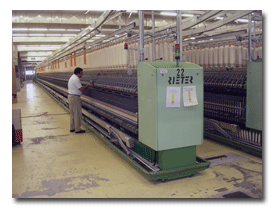
Buhler uses a full complement of fiber preparation and spinning machinery from makers
including Rieter, Trützschler, Zinser, Marzoli and Schlafhorst.


Retailers Key

The diversification brings
opportunities — as well as pressure on sales and marketing to explain the Buhler advantage. “We can
really help the retailer with critical programs where being more consistent and reliable pays off,”
said David Sasso, vice president, sales. “We are known for the fine counts, but we show the impact
of yarn on the quality of the garment. We have a relationship focus, and we really need to explain
the opportunity with premium products.” MicroModal broadens Buhler’s offering while maintaining its
premium focus.

“Right now, about 50 percent of the MicroModal goes into garment dyeing, so that shows you
it is quick-turnaround — fashion,” Bieri added. “It isn’t in the big-box retailer yet. It looks
good and it feels good. That is probably why a primary market is ladies’ tops.

“We need to convince the retailer that it is to his benefit. Why should he pay more? He
needs to increase sales volume, he needs growth — we need to convince him that he can make a better
margin, have fewer write-offs. We are going the extra mile, making product, doing trials. What
happens when the product is washed and worn five times? Ours looks like the original and often even
feels better. The other one is twisted, it’s torqued, it’s wide, it’s short,” Bieri added.

Victor Almeida recently joined Buhler as a textile engineer in customer support. His role
allows Buhler to follow the yarn through the supply chain, solving problems and helping refine the
manufacturing process. “Victor has helped us become not just someone who sells the yarn, but
someone who provides the know-how in subsequent processing,” Bieri said.

Regarding the addition of the MicroModal line, Almeida said: “It is luxurious but maintains
the comfort factor. The absorbency makes it very, very comfortable on the skin.”

“I broadcast to my customers that we could now supply MicroModal efficiently in this
hemisphere and had a great response,” Sasso said. “Some asked, ‘How can Central America compete?’
At Buhler, we know that MicroModal is a very limited fiber.” Sasso went on to explain this scarcity
helps Buhler-supplied retailers differentiate themselves from their competition.

“Over time we have proven ourselves, and we often get the more critical programs where the
retailer can’t risk a yarn choice just because it may be cheaper,” Sasso continued. “We are working
with an intimate apparel company on a program in Mexico. Hopefully, if that fabric turns out right,
they will pull that program out of China and put it in Mexico.”


buhlermen


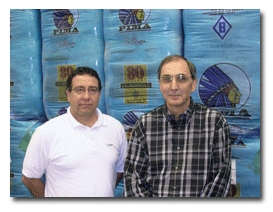
David Sasso (left), vice president, sales, and Victor Almeida, textile engineer, customer
support, with bales of J.G. Boswell cotton


Lean And Efficient

Touring the Buhler facility, one gets
a sense of a limited inventory of raw materials on hand. Virtually every machine is running at full
speed. There is also very limited staged product on the floor and limited finished inventory. “We
have very low carrying costs and turn our inventory 70 times a year,” Bieri said. While other
spinners may spin for inventory in counts that are big sellers, Buhler is a spin-to-order business.

buhlerbieri


Buhler President and CEO Werner Bieri


The Future

“In 1991, I went to a show in Hong
Kong for the first time,” Bieri said. “I had yarn with me. In 1992, I didn’t have yarn, I had
fabric with me. And now, I was in California recently, and we have people who say ‘Can you show us
garments?’ They don’t even want to see the fabric. ‘Show me a finished garment.’ And that is part
of what we need to do.

“Everyone is pushing everything back. The retailer doesn’t want inventory, but wants quick
supply. The garment people don’t want to keep fabric inventory, and the fabric supplier doesn’t
want to keep inventory of yarn,” Bieri said. And he sees other challenges. “The process needs to be
controlled — the chemicals can’t be changed to cut a corner — but changed to upgrade and to invest.
That is a big challenge and a change in the mindset.”

Have 10 short years changed Buhler? “I think we have learned to forget the business plan and
to not just focus on one issue,” Bieri said. “Keep your eyes open. Have a plan, but be willing to
specialize — to invest. David [Sasso] is creative and working with the brands and retailers; Victor
[Almeida] is technical and bringing in ideas and know-how,” Bieri continued. “We cannot be
everything to everybody. The products and processes need to fit. They need to be market-driven and
fit within the economics of scale, which is different for every mill.”


January/February 2007

Sponsors