Lectra Upgrades VectorFashion Solutions

Paris-based Lectra has introduced
upgraded versions of its VectorFashion cutting solutions software for apparel industrialists.
VectorFashionFX is an advanced solution suitable for restocking collections and prototype cutting,
providing maximum productivity, Lectra reports. VectorFashionFP is targeted to first-time users of
automated cutting technology. VectorFashionMH is designed for large apparel makers that process
high-volume spreads. VectorFashionM88 is designed specifically for producers who cut by hand.

VectorFashionMX is suitable for large-volume manufacturers facing increased orders, reduced
lead times and the need to optimize production. The MX line also features VectorLingerieMX for
small pieces of undergarments, and VectorDenimMX for denimwear manufacturers.


March/April 2007

Using The Internet To Relieve The Price Squeeze


I
t’s the same song, 92nd verse, it seems. A small US apparel maker is being pummeled by
imports. Major customer sales that once yielded a margin of $12 to $15 per unit now have shrunk to
$2 to $3 per unit.



worldwideweb
While many domestic textiles, apparel and machinery makers conceded and closed up shop, Rice Mills
Inc. was not willing to throw in the towel. A Belton, S.C., family-owned business with $5 million
to $10 million in annual sales, Rice was doing 85 percent of its business with major retailers that
continually put the squeeze on earnings.


On a referral, company owners hired a marketing and website development company to design and
launch a new online business unit to give the apparel maker the ability to sell its high-quality
fleece jackets, pajamas and bathrobes directly to the consumer. The company spent $70,000 on a
custom-designed site, photography, and the HTML code to make it run, and another $50,000 on print,
broadcast and Internet advertising to drive traffic to the site. The Internet advertising effort
included search engine marketing (SEM). SEM is online advertising whereby a search engine is paid
an agreed-upon amount for each click delivered to a website from a listing keyed to a specific
search term.

“We were paying 50 cents per click to the search engines and it was taking about 100
visitors to get an order,” said Jim Billig, a longtime business consultant for Rice Mills. “It was
costing us $50 in advertising per order. With an average order totaling $52, search engine
marketing simply wasn’t sustainable, so we discontinued it and re-evaluated the feasibility and
options of an e-commerce business unit.”

It was about that time that Billig made contact with Jose Ferrer, owner and president of
Greenville-based Practical Business Systems (PBS). Ferrer’s successful transformation of
Williamston, S.C.-based Allstates Textile Machinery’s website into a viable marketing tool that
doubled Allstates’ sales in the first year was local business lore.

A worldwide supplier of all types of pre-owned textile machinery and equipment, Allstates
had a presence on the World Wide Web that was averaging 400 unique visitors per month in August
2002. After a PBS revamp of the site that optimized its ability to talk to search engines,
Allstates’ site now is averaging 27,000 unique visitors each month. Product views went from around
1,100 per month to 71,000, and purchase inquiries went from zero to about 45 per day.

Doing business via the Internet has generated many claims about how a website can
revolutionize a business, but it takes more than a flashy website to make money online, Ferrer
said. “A lot of money and a lot of hype have been thrown at e-commerce, but like any other
marketing technique or business venture, you need to make sure you can balance the risks against
the benefits before you jump in. If you’ve built a great website but you’re not getting any hits,
it’s likely because your site is not optimized and is not being indexed by the search engines.”

According to Allstates Owner Jeff Willis, search engine optimization (SEO) transformed his
small business into one that competes effectively with larger companies on both a domestic and an
international scale. “We’ve become more productive in an increasingly competitive market, and we’ve
tripled our sales and added only one salesperson,” he said.


Making It Work: SEO Versus SEM


A true e-commerce site allows any
size business to expand its market size, selling to a larger geographical area 24 hours a day,
seven days a week, 365 days a year.

The most successful e-commerce sites are those that are fully integrated with a back-end
database that allows for automatic uploads and updates, tracking of inventory, and the ability to
immediately access data on website traffic, according to Ferrer.

A quick Google search using the generic phrases “used textile machinery” and “used textile
equipment” shows Allstates in the first spot — a coveted position that was achieved without having
to invest in banner ads or SEM.

The benefits of SEO, according to Ferrer, are long-lasting when done correctly and allow
even the smallest companies the same functionality as large corporations and mass merchandisers.
With SEO, online advertising is free and far more keywords and phrases can be targeted, which leads
to more visitors and increasing sales as natural byproducts.


Page36_Copy

A big SEO advantage is immediate
access to reports that show who is visiting your site, how they got there and how long they stayed.
“The important part is to track results, particularly if you are paying for visitors,” Ferrer said.
“At PBS, we include architecture so that we can more effectively determine what’s working. This is
valuable marketing data that traditional advertising methods like broadcast and print don’t offer.”

Billig agreed, saying that a huge downside to Rice Mills’ initial e-commerce site was the
time and money it took to access data and run reports on website traffic patterns. And it cost an
additional $1,000 each time Rice wanted to add a new product online because the website structure
did not allow them to update the site themselves.

To prove the benefits of SEO versus SEM, PBS built a second Rice Mills website — Apparel By
Rice Mills — to run concurrently with the existing one — Fleece By Rice. As the sites were running
simultaneously, Rice Mills continued to pay $10,000 to search engines in pay-per-clicks and banner
ads for the Fleece By Rice site. The result was 17,000 visitors. By comparison, no money was spent
to advertise the optimized Apparel By Rice Mills site, which reported 20,000 unique visitors in the
same amount of time. Within three months, the integrated website designed by PBS was reporting 17
times more visitors than Fleece By Rice and within six months had achieved 16 times more in sales.

The optimized site also allows Rice Mills to experiment with new products and to immediately
measure results. And with the ability to add new features without having to hire a web developer,
Rice experimented with loyalty programs such as an online newsletter with special promotions and
discounts. About 200 consumers are opting in every month to receive the newsletter via e-mail,
Billig said.

“Search engine optimization gives you the opportunity for new product development at very
low risk,” Ferrer said. “You can update your site yourself with a photo and description of a new
product, then wait for sales. If it sells, you make more of them, if it doesn’t, try something
else.”


March/April 2007

Pantone Clariant Team To Provide Color Development Tools, Services

Carlstadt, N.J.-based color standards
provider Pantone Inc. and the Textile Business of Clariant International Ltd., a Switzerland-based
colorant and chemical manufacturer, have formed a partnership to develop new technology, tools and
services to aid color development specialists in the fashion and home furnishings industries.

Pantone will contribute its color and trend know-how to the effort, while Clariant will
supply its worldwide network of colorant and application technology experts. Users of the
1,925-color Pantone® Fashion + Home Color System will have access to Clariant’s expertise, enabling
them to match any color in the system accurately and efficiently, and reduce color development
times and related management costs by half or more.

“There is a great deal of synergy between Pantone and Clariant that enables us to
dramatically improve the color development process with a variety of new tools, technologies and
support services,” said Lisa Herbert, executive vice president, Pantone. “Through this partnership,
we are now able to provide tools and services for every aspect of the design process from
inspiration through production, empowering our customers to maintain the integrity of their
creative vision.”

“Clariant’s technical expertise makes us the best company in the industry to provide true,
accurate matches to Pantone Colors,” said Peter Piringer, head of Clariant’s Textile, Leather &
Paper Division. “This means that today’s top name brands and retailers save money and critical time
in the color development cycle.”


March/April 2007

A Positive Industry Appraisal


M
ore confirmation for

Textile
World’s
cautiously optimistic outlook this time from the Washington-based
National Council of Textile Organizations (NCTO’s) 2006 industry review. Some of NCTO’s basically
upbeat findings: Textile mill shipments were off only 2 percent; import volume was up only 3.5
percent; textile and apparel exports eked out a 2-percent advance; textile profits were up
fractionally; and industry spending on new, more efficient plants and equipment pretty much equaled
the previous years $1.3 billion-plus reading. If nothing else, this relatively high investment
figure suggests US producers plan to remain key players in the competitive global textile market.
Moreover, the continuing influx of state-of-the-art equipment seems to indicate industry
productivity will continue to rise at close to the 3-percent annual clip of the past few years.
Other things being equal, this should be enough, or even more than enough, to offset moderately
higher pay costs up only 2 percent in 2006 and thus hold critical unit labor costs at or even a bit
under current levels. 


Headaches Remain

All the above doesn’t mean there aren’t problems. With productivity rising and demand off a
bit, industry employment continues to shrink. The aggregate textile and apparel workforce fell
almost 6 percent last year, with further declines virtually inevitable. And when it comes to
international trade, even with better numbers noted above, the US textile and apparel trade deficit
is still rising, with this past years red-ink figure up another 4.4 percent to near $76.7 billion.
China, of course, is the major culprit. Beijing’s trade surplus with the United States topped $27
billion in 2006 enough to account for more than 35 percent of our global textile/apparel trade
shortfall. Nor is it clear how the new year will play out what with all of today’s changing
groundrules. Its still too early to judge the full impact of the implementation of the recent
US/China bilateral agreement; the Central America-Dominican Republic Free Trade Agreement;
Vietnam’s joining the World Trade Organization; and free trade pacts with Peru, Colombia and
Panama.

Page16

Zeroing In On China

Coming back to China, it is also important to keep in mind that safeguards are targeted to
end in 2008. More importantly, its quite obvious the slow appreciation of the Chinese currency up
only 6 percent since mid-2005 hasn’t been nearly enough to redress that currency’s big
undervaluation. Clearly, a much more significant upward move is needed to level the playing field.
But just how much upward revision will be forthcoming is still anybody’s guess. As NCTO Chairman
Smyth McKissick notes, “With a host of new fair trade voices in Congress, Chinese currency
manipulation is going to be a major issue.” Ditto, the equally disturbing problem of Beijing’s
subsidies to its producers. To deal with this, Washington lawmakers are already considering new
legislation that would put China under US laws that use tariffs to punish countries that unfairly
subsidize their exports.


Statistical Note

Starting this month,

TW
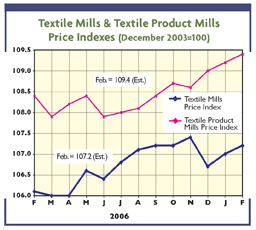
is adding import prices to the “Textile Barometers” table. These recently introduced
indexes track both the basic textiles and textile product segments of the industry and should
permit comparisons with their domestic price counterparts shown in the accompanying chart. As of
latest report, the average import price for basic textiles fibers, yarns and fabrics was running
close to 4 percent above a year earlier, somewhat more than double the 2-percent increase noted in
the comparable domestic price index. Other things being equal, this suggests domestic producers may
be making some modest progress in narrowing the overseas price advantage. On the other hand, in the
more highly fabricated textile mill product sector, the import price increase was only in the order
of 0.5 percent not so different from the 1-percent domestic advance. To make room for the
additional data,

TW
is dropping textile production worker employment numbers which have pretty much followed
the more inclusive overall textile employment numbers, which
TW will continue to monitor.


March/April 2007

DyStar Opens Shanghai Service Center, Offers Packages

Germany-based DyStar Textilfarben
GmbH & Co. Deutschland KG has opened a new service center in Shanghai to serve textile
finishers and retailers in China and Asia. The 3,000-square-meter facility is equipped with
latest-generation laboratory dyeing and printing machines and testing equipment, enabling it to
test for such properties as lightfastness and wetfastness, and also to develop customized solutions
for its clients.

Service packages offered by DyStar Textile Services include: Testing Solutions, including
colorfastness tests and analytical services based on international standards; Color Solutions,
providing improved color communication in order to reduce lead times; Ecology Solutions, providing
advice and recommendations to enable customers to comply with ecological specifications; and Expert
Solutions, offering advice, customized solutions and new technologies to help customers improve
productivity, comply with quality standards and protect brand image. These service packages are
available not only at the Shanghai service center, but also globally


March/April 2007

Huntsman To Sell US Business To Koch Subsidiary

The Woodlands, Texas-based chemicals manufacturer and marketer Huntsman Corp. has agreed to sell
its US Base Chemicals and Polymers business to Koch Industries Inc. subsidiary Flint Hills
Resources LLC (FHR) — a Wichita, Kan.-based producer of fuels, base oils for lubricants and other
petrochemical products — for approximately $761 million.

The US Base Chemicals and Polymers business employs some 900 associates. The deal includes
Huntsman’s olefins and polymers manufacturing assets located at five US facilities in Texas,
Michigan and Illinois. The company will retain its Port Neches, Texas, facility, location of its
Performance Products division and the captive ethylene unit, which will receive ethylene and
propylene from Flint Hills and provide feedstock for Huntsman’s downstream derivative units.

According to Peter R. Huntsman, president and CEO, Huntsman Corp., the sale is part of
Huntsman’s strategy to divest its commodity petrochemical businesses and focus on the manufacture
and marketing of differentiated products — which serve such diverse industries as chemicals,
textiles, footwear, automotive, aviation, paints and coatings, and furniture, among others.

“Our entire product line will now experience higher growth rates and much lower sensitivity
to energy costs,” Huntsman said. “Looking forward, we have transformed our business into one
producing highly innovative products that serve an expanding global economy.”

“The assets, skills and capabilities of this operation will complement FHR’s existing
framework,” said Jeff Ramsey, vice president of chemicals, FHR, “We are acquiring an experienced
team, a robust technical service and development capability, and a global customer service function
that is focused on creating value.”

Ramsey will manage the business once the acquisition is complete, which is expected during
the third quarter of 2007.


March/April 2007

Internal Communication Is The First Step In A Successful PR Campaign


A
n often misunderstood part of the marketing mix, public relations is much more than
sending out news releases and pitching stories to the industry or consumer press.

The PR umbrella covers a multitude of activities, all of which involve communicating specific
messages to various target audiences — both internal and external. Too often, companies and
organizations forget that some of their largest, most important and most influential constituents
are on the inside — their employees, board members or association members.

Public relations programs create awareness and support among a company’s or organization’s
target audiences for its products, services, mission, philosophy and approach to doing business. It
helps build credibility that advertising cannot. It helps manage risk and establishes reputations
that drive sales. But it is only the image that employees and other company insiders themselves
have of their company or organization that can be properly presented and secured in the public
consciousness. Therefore, a regular flow of information to employees, board members or association
members is required for a successful public relations effort. It only stands to reason that until
all of the internal players are singing off the same song sheet, any external effort is going to
fall far short of the goal – no matter how much money you throw at it.

Whether it’s designed for a for-profit business or for a nonprofit trade organization, a
solid internal public relations program can improve loyalty and help retain valuable employees and
members. Here are some tried-and-true steps in establishing an essential internal public relations
program that will enhance your external PR:

Survey The Landscape: The internal PR plan cannot be created in a vacuum. The
process should begin by gaining insight from a variety of sources. From one-on-one executive
interviews to employee surveys or focus groups, every level of the organization must provide input.
A word of caution here, however: Nothing kills morale and the potential for good PR more quickly
than asking for input and then ignoring it. If you collect the data, you must use them to address
key issues and develop a plan that communicates issues to every level of the organization.

Develop A Core Communications Document: Based on the research gathered in step
one, this document will serve as the guideline for all future communications. It outlines the
organization’s priorities and goals, the key messages to be used in all communications, the desired
employee or member behaviors, and other foundational concepts. It is critical that the content of
the document is consistent with the external message used for the media, stockholders and other
target audiences.

Get Senior Management On Board: Any company initiative will die on the vine
without the support of senior management. Without their support and involvement, the initiative is
likely to fail. The executive team also needs to understand its role in supporting and
communicating the internal PR plan to everyone in the organization.

Engage Middle Management: Research shows that middle managers are some of the most
influential members of any organization. By making them an integral part of the ongoing information
loop, they will become active supporters of the company’s PR efforts and make sure others are on
board. The most effective internal PR plan includes regular communication with mid-level managers.
The plan gives them the proper training and communications tools and makes them the primary
communications channel.

Have A Dialogue With Employees, Not A Monologue: Internal PR will take hold much
more quickly if employees play a role in it. Employees who feel they’ve had a voice typically serve
as the most passionate company ambassadors, both internally and externally. Provide a forum that
allows employees to ask honest questions — and receive honest answers, share good ideas — then see
them implemented, and express their concerns —then have them addressed candidly.

Determine The Right Communications Channels: Less is more when it comes to a
company’s communications channels. Strip away the unnecessary levels of management and communicate
directly wherever possible. One of the worst things that can happen is when employees learn of a
new program or change within their own company from the media.

Measure And Report Results: A good internal PR program is ongoing. Results should
be measured and shared with employees to continuously reinforce the message. Progress may be
visually reported through graphs or charts

at each of the company’s locations, and through an Intranet system, through CEO messages and
manager discussions.

Stay The Course: Effective communication is a matter of discipline and the
day-to-day conversations that address questions and issues candidly. Use the communications
channels initially put in place to keep the information flowing and continue the dialogue. By doing
so on a regular basis, employees will be able to put major company changes, announcements, events
and news in the proper context.


March/April 2007

Italian Textile Machinery Makers Report Turnaround In 2006

Preliminary data provided by the
Association of Italian Textile Machinery Manufacturers (ACIMIT), Milan, show the Italian textile
machinery industry experienced a recovery in 2006, reversing the negative trend of previous years.
ACIMIT reported the value of machinery produced increased over the 2005 value by 4 percent, to
2,650 million euros; and the value of exports was 3 percent higher, at 2,100 million euros. The
value of machinery delivered to Italian textile manufacturers was 9 percent higher than in 2005.

Approximately 30 percent of the exports went to textile manufacturers in China and India.
Sales also increased to Latin America and Africa, ACIMIT reported.

“It is obvious that these preliminary
balance figures need still to be confirmed by definitive results and have to be considered as the
starting point of a development course which should be consolidated during the current year and in
the years to come,” said Paolo Banfi, president, ACIMIT. “Only in this way we shall be able to
consider as concluded the shake-up phase of the sector and can feel confident about the
future.


March/April 2007

Cytec To Expand Carbon Fiber Capacity In Greenville

Cytec Industries, Inc., a global
specialty chemicals and materials company based in West Paterson, N.J., has selected a site
adjacent to its existing carbon fiber plant in Greenville to build a new facility that is expected
to double the company’s carbon fiber manufacturing capacity and enhance its capability to provide
next-generation fibers. Cytec plans to invest some $150 million in the project, which is now in the
assessment and engineering definition phase, with construction expected to begin in 2008 and
start-up expected in early 2010.

Once the new facility is fully online, it is expected to provide approximately 225 skilled
and professional jobs, and will produce Thornel® T300, T650 and T40/800 carbon fibers, used in
commercial aerospace and military applications, in addition to new fibers being developed.

“The proposed facility … will leverage the surrounding developed land, rail access and some
of the current infrastructure,” said Steve Speak, president, Cytec Engineered Materials, the Cytec
business unit that manufactures carbon fibers and other high-tech materials used in extreme-demand
applications including aerospace, high-performance automotive, launch and others. “And when you
factor in the pool of highly skilled talent already available and the in-depth training that the
South Carolina Technical College System can provide, South Carolina’s value proposition is clear
and compelling.”

Cytec Engineered Materials will use approximately two-thirds of the carbon fiber it
manufactures in its own advanced composites production. Third-party materials manufacturers
specializing in aerospace products will use the remaining one-third.


March/April 2007

CNC To Open New Facility

With the aid of an incentive grant
from the Lincoln County, N.C., Board of Commissioners, Carolina Nonwovens Corp. (CNC), Lincolnton,
N.C., will open a 33,000-square-foot facility in the Indian Creek Industrial Park in that city. An
initial $4.2 million investment will enable CNC to hire 15 employees, with the hope of hiring an
additional 12 in the near future; and to install a state-of-the-art Laroche airlay line supplied by
Cornelius, N.C.-based Allertex of America.

The line will manufacture thermobonded nonwovens for a wide range of industrial and consumer
products, making them stronger, lighter-weight and less expensive than conventional products,
according to John Gearhart, vice president, CNC. The company, which has developed several
proprietary products for its customers, will process natural and recycled fibers.

“This new facility is the culmination of intensive market research and product development
over the past 18 months,” said Fred Fink, president, CNC. “The Lincolnton Economic Development
Association team has been instrumental in attracting Carolina Nonwovens to the area. The CNC
management team is excited about locating in Lincolnton with its strong labor pool and convenient
access to our customer base. We expect the new facility to ramp up production no later than May
2007,” he added.


March/April 2007

Sponsors