IBM Partners Offer ScheduleFLEX

IBM, White Plains, N.Y., has signed
an agreement with Greenville-based eBridge Technologies Inc. whereby IBM’s global business partners
will make available eBridge’s ScheduleFLEX Web-based manufacturing process scheduling and logistics
package. ScheduleFLEX also will be offered through IBM’s Global Solutions Catalog.

“eBridge is very excited to have ScheduleFLEX included as an IBM Solutions Proven product,
because now we are going to be able to offer our clients an even more cost-effective production
scheduling and logistics solution,” said Brad Cunningham, president, eBridge. “ScheduleFLEX
provides a very low cost of ownership and tremendous flexibility to our clients, by enabling supply
chain and customer collaboration, and enables great improvements for lean manufacturing.”<
/font>


April 2004

VF Completes Sale Of Intimates Business To Fruit Of The Loom

VF Corp., Greensboro, N.C., has
completed sale of its international intimate apparel business — including such brands as
Vassarette®, Curvation®, Bestform®, Lily of France® and Vanity Fair® — to Fruit of the Loom Inc.,
Bowling Green, Ky., for $350 million. VF will use the proceeds from the sale to repurchase shares
in 2007. Fruit Of The Loom will operate the business as a wholly owned subsidiary under the name
Vanity Fair Brands.


April 3, 2007

Gildan To Complete Offshore Manufacturing Consolidations

Montreal-based branded basic apparel
manufacturer Gildan Activewear Inc. announced plans to shutter its two remaining textile facilities
in Montreal and its Bombay, N.Y.-based cutting facility during the fourth quarter of fiscal 2007,
which ends September 30. In addition, the company is closing two Mexico-based sewing facilities
that receive fabric from its Canadian operations, effective immediately. These operations, which
employ some 465 people in Canada and the United States and 1,365 people in Mexico, will be
consolidated into expanded company hubs in Central America and the Caribbean Basin, which upon
consolidation will manufacture Gildan’s full range of fleece, sport shirt, T-shirt and underwear
products.

The company also will move its corporate offices from its knitting plant in Montreal to
leased facilities in the Montreal area.

Gildan expects the consolidation of manufacturing and ongoing expansion of capacity offshore
will contribute annual savings of $45 million in activewear manufacturing and freight costs and
duties beginning in fiscal 2008. The company also has expanded its sock manufacturing facility in
Honduras, and said it plans to use the efficiencies created by these offshore expansions to help it
increase its retail mass-market and wholesale screenprint market presence.


March 28, 2007

Wellman To Raise Fortrel Fiber Prices

Effective April 15, Wellman Inc., Fort Mill, S.C., will increase the prices of all Fortrel®
polyester staple fiber products by 5 cents per pound. The company said the price hike is necessary
to cover increased transportation, raw material and feedstock costs.


March 20, 2007

RadiciSpandex Names Carmen Marc Valvo To Judge Design Scholarship Contest

RadiciSpandex Corp., Gastonia, N.C.,
has named Carmen Marc Valvo to serve as designer judge and honoree for its eighth annual “Stretch
to the Future” Design Scholarship Competition. The competition encourages design students in their
creative development and in their use of fashion fabrics containing technical fibers such as
RadiciSpandex’s elastane fibers. This year’s contest will take place in April in New York City.

Entries will be submitted by members of the junior class of The Fashion School of Kent State
University, Kent, Ohio. The school also maintains studios in New York City and Florence, Italy,
where students may spend one semester of study.

Valvo — a celebrated designer whose fashion collections have been sold in top-of-the-line
department stores such as Saks Fifth Avenue, Neiman Marcus and others since 1989 — will lead a
panel of judges including fashion editors and journalists, fashion school faculty members, and
textile executives. The panel will judge entries in garment categories including eveningwear,
swimwear, women’s sportswear and fantasy/bridal wear; and will award one Grand Prize, one First
Prize and one Second Prize scholarship from among all categories and one “Best Of” prize in each
category. Prizes will be awarded at a reception in New York City in May, at which time also Valvo
will receive the “Stretch to the Future” Designer Honoree Award.


March 20, 2007

ATHM Names Whatley Adjunct Curator Of Machinery

The American Textile History Museum
(ATHM), Lowell, Mass., has named Lowell McKay “Mac” Whatley as adjunct curator of machinery.
Whatley — a lawyer based in Asheboro, N.C., whose earlier professional career revolved around
archaeology and architectural history — has long had an interest in Southern textile history.

ATHM hired Whatley in conjunction with its decision to store much of its collection of
industrial-period textile machinery in Franklinville, N.C. The museum plans eventually to open a
satellite museum in North Carolina, recognizing that state’s strong textile history.

“The museum is very pleased to welcome Mac to our collections department,” said James “Jim”
Coleman, president and CEO, ATHM. “Mac is passionately interested in textile history, and we are
confident in his ability to promote the preservation, study and use of the museum’s machinery
collection. We see this as an important step toward becoming more of a national museum, with
greater public access to our vast collections.”


March 20, 2007

Hills Develops Nanofiber Meltblown Fabric Technology

Hills Inc., a West Melbourne,
Fla.-based specialty fiber extrusion equipment producer, has developed technology to produce
meltblown fibers with an average size of 250 nanometers (nm) and a range between 25 and 400 nm.

Hills said its development of meltblown nanofibers grew out of the company’s development of
true bicomponent meltblown extrusion equipment. The company has used its patented
printed-circuit-style extrusion dies to produce the fibers from high-melt-flow-index polypropylene.
According to Hills, a hole count of 100 holes per inch and up and extremely high length-to-diameter
ratios enable production of these nanofibers at reasonable rates, and puts meltblown production in
the same size range that was previously the exclusive domain of multicomponent spinning or
electrospinning technology.


March 20, 2007

HunterLab Introduces New Spectrophotometer


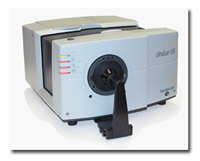
dpfhunterlabReston, Va.-based Hunter Associates Laboratory Inc. (HunterLab) now offers
the UltraScan® VIS spectrophotometer designed to measure the full range of human color perception
while meeting International Commission on Illumination (CIE) and ASTM International guidelines for
accurate color measurement. Tristimulus color calculations are performed between 360 and 780
nanometers (nm), as is recommended by the CIE, and spectral data are reported every 10 nm. The
UltraScan VIS features automated specular component inclusion/exclusion and uses diffuse/8°
geometry for measurement.


The spectrophotometer measures both transmitted and reflected color using its D65
illumination source, which is calibrated and controlled in the ultraviolet region to accurately
measure whitening agents.

Color sorting and sequencing of data measured by the spectrophotometer are simplified with
EasyGroup software. EasyMatch® QC software is available for research and quality control
applications.


March/April 2007

DuPont™ Nomex® Marks 40 Years Of Safety And Protection

DuPont™ Nomex®, the heat resistant
fiber used in products ranging from protective apparel to electrical insulation, marks its 40th
anniversary this year, as demand increases for the high-performance material and its numerous
applications.

Nomex® is an inherently flame-resistant, high-temperature fiber that will not melt, drip or
support combustion in air. It also delivers outstanding resistance to a broad range of chemicals
and is offered in paper, felt, fabric and fiber forms.

Nomex brand fiber is used across a diverse range of applications, but it is perhaps best
known as a critical component in protective apparel. Today, more than three million firefighters
around the world are protected by turnout gear, stationwear and accessories made of Nomex due to
its unique combination of flame protection, durability and mobility. Nomex also is used in apparel
worn by military pilots and combat vehicle crew; auto racing drivers, pit crew members and track
officials; and industrial workers at risk from flash fire and electric arc hazards. Troops in Iraq
are being outfitted with Nomex apparel to protect them from burns caused by roadside bombs, one of
the greatest threats to American troops.

“The world is a safer and more energy efficient place as a result of Nomex and its
innovative applications. Over four decades, the Nomex brand has become synonymous with safety and
protection. We continue to invest aggressively in the development of new Nomex applications to help
solve the world’s evolving needs,” said William J. Harvey, vice president and general manager —
DuPont Advanced Fibers Systems.

DuPont introduced Nomex in woven and non-woven forms in 1967. While Nomex grew out of
fundamental R&D work done by Paul Morgan and Stephanie Kwolek, Wilfred Sweeny unveiled the
discoveries leading to the final development of Nomex at the DuPont Experimental Station in
Wilmington, Del., the company’s global R&D headquarters. Building on the earlier research,
Sweeny found a way to make a high-molecular-weight product that could be spun into a tough
crystallizable fiber (later named Nomex) which possessed outstanding thermal and flame-resistant
properties. In 2002, Sweeny was recognized for his contributions with a Lavoisier Medal, the
highest honor of science excellence awarded by DuPont.

Committed to continuing to deliver innovation and strong customer service, DuPont last year
announced a $100 million global expansion plan to increase worldwide capacity for Nomex and support
exciting new applications including:

* Wind Power — Expanded Nomex applications, providing solutions for the growing use of wind
power in countries like Spain and China

* DuPont Nomex Limitedwear for Military — A lightweight, limited- use garment designed as
specified by the military to help protect soldiers from flash fires.

* Selective Permeable Membrane (SPM) Technology — DuPont is working with the U.S. Army
Soldier System Center in Natick, Mass., on new lightweight suits featuring DuPont’s SPM technology,
which will help protect front line defenders from chemical and biological agents.

* DuPont Tychem ThermoPro — A single garment that combines flash fire and chemical
protection.

In addition to its use in protective apparel, Nomex(R) brand paper has been providing
high-performance electrical insulation for motors, transformers and generators for decades. The
electrical, mechanical and thermal properties offered by Nomex(R) help extend the life of
electrical equipment, as well as reduce premature failures and repairs. Honeycomb of Nomexpaper is
used for lightweight structural support and helps substantially improve the performance of most
commercial aircraft. Nomex paper can also be found in consumer appliances, industrial equipment and
transportation equipment such as high- speed trains.

DuPont is a science-based products and services company. Founded in 1802, DuPont puts
science to work by creating sustainable solutions essential to a better, safer, healthier life for
people everywhere.

Operating in more than 70 countries and regions, DuPont offers a wide range of innovative
products and services for markets including agriculture and food; building and construction;
communications; and transportation. The DuPont Oval Logo, DuPont, The miracles of science, Nomex
and Tychem are registered trademarks or trademarks of DuPont or its affiliates.

Press Release Courtesy of DuPont and PR Newswire



March 13, 2007

Pantone, Clariant Team To Provide Color Development, Tools Services

Carlstadt, N.J.-based color standards
provider Pantone Inc. and the Textile Business of Clariant International Ltd., a Switzerland-based
colorant and chemical manufacturer, have formed a partnership to develop new technology, tools and
services to aid color development specialists in the fashion and home furnishings industries.

Pantone will contribute its color and trend know-how to the effort, while Clariant will
supply its worldwide network of colorant and application technology experts. Users of the
1,925-color Pantone® Fashion + Home Color System will have access to Clariant’s expertise, enabling
them to match any color in the system accurately and efficiently, and reduce color development
times and related management costs by half or more.

“There is a great deal of synergy between Pantone and Clariant that enables us to
dramatically improve the color development process with a variety of new tools, technologies and
support services,” said Lisa Herbert, executive vice president, Pantone. “Through this partnership,
we are now able to provide tools and services for every aspect of the design process from
inspiration through production, empowering our customers to maintain the integrity of their
creative vision.”

“Clariant’s technical expertise makes us the best company in the industry to provide true,
accurate matches to Pantone Colors,” said Peter Piringer, head of Clariant’s Textile, Leather &
Paper Division. “This means that today’s top name brands and retailers save money and critical time
in the color development cycle.”


March 13, 2007

Sponsors