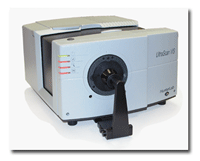
HunterLab Introduces New Spectrophotometer


dpfhunterlabReston, Va.-based Hunter Associates Laboratory Inc. (HunterLab) now offers
the UltraScan® VIS spectrophotometer designed to measure the full range of human color perception
while meeting International Commission on Illumination (CIE) and ASTM International guidelines for
accurate color measurement. Tristimulus color calculations are performed between 360 and 780
nanometers (nm), as is recommended by the CIE, and spectral data are reported every 10 nm. The
UltraScan VIS features automated specular component inclusion/exclusion and uses diffuse/8°
geometry for measurement.


The spectrophotometer measures both transmitted and reflected color using its D65
illumination source, which is calibrated and controlled in the ultraviolet region to accurately
measure whitening agents.

Color sorting and sequencing of data measured by the spectrophotometer are simplified with
EasyGroup software. EasyMatch® QC software is available for research and quality control
applications.


March/April 2007

DuPont™ Nomex® Marks 40 Years Of Safety And Protection

DuPont™ Nomex®, the heat resistant
fiber used in products ranging from protective apparel to electrical insulation, marks its 40th
anniversary this year, as demand increases for the high-performance material and its numerous
applications.

Nomex® is an inherently flame-resistant, high-temperature fiber that will not melt, drip or
support combustion in air. It also delivers outstanding resistance to a broad range of chemicals
and is offered in paper, felt, fabric and fiber forms.

Nomex brand fiber is used across a diverse range of applications, but it is perhaps best
known as a critical component in protective apparel. Today, more than three million firefighters
around the world are protected by turnout gear, stationwear and accessories made of Nomex due to
its unique combination of flame protection, durability and mobility. Nomex also is used in apparel
worn by military pilots and combat vehicle crew; auto racing drivers, pit crew members and track
officials; and industrial workers at risk from flash fire and electric arc hazards. Troops in Iraq
are being outfitted with Nomex apparel to protect them from burns caused by roadside bombs, one of
the greatest threats to American troops.

“The world is a safer and more energy efficient place as a result of Nomex and its
innovative applications. Over four decades, the Nomex brand has become synonymous with safety and
protection. We continue to invest aggressively in the development of new Nomex applications to help
solve the world’s evolving needs,” said William J. Harvey, vice president and general manager —
DuPont Advanced Fibers Systems.

DuPont introduced Nomex in woven and non-woven forms in 1967. While Nomex grew out of
fundamental R&D work done by Paul Morgan and Stephanie Kwolek, Wilfred Sweeny unveiled the
discoveries leading to the final development of Nomex at the DuPont Experimental Station in
Wilmington, Del., the company’s global R&D headquarters. Building on the earlier research,
Sweeny found a way to make a high-molecular-weight product that could be spun into a tough
crystallizable fiber (later named Nomex) which possessed outstanding thermal and flame-resistant
properties. In 2002, Sweeny was recognized for his contributions with a Lavoisier Medal, the
highest honor of science excellence awarded by DuPont.

Committed to continuing to deliver innovation and strong customer service, DuPont last year
announced a $100 million global expansion plan to increase worldwide capacity for Nomex and support
exciting new applications including:

* Wind Power — Expanded Nomex applications, providing solutions for the growing use of wind
power in countries like Spain and China

* DuPont Nomex Limitedwear for Military — A lightweight, limited- use garment designed as
specified by the military to help protect soldiers from flash fires.

* Selective Permeable Membrane (SPM) Technology — DuPont is working with the U.S. Army
Soldier System Center in Natick, Mass., on new lightweight suits featuring DuPont’s SPM technology,
which will help protect front line defenders from chemical and biological agents.

* DuPont Tychem ThermoPro — A single garment that combines flash fire and chemical
protection.

In addition to its use in protective apparel, Nomex(R) brand paper has been providing
high-performance electrical insulation for motors, transformers and generators for decades. The
electrical, mechanical and thermal properties offered by Nomex(R) help extend the life of
electrical equipment, as well as reduce premature failures and repairs. Honeycomb of Nomexpaper is
used for lightweight structural support and helps substantially improve the performance of most
commercial aircraft. Nomex paper can also be found in consumer appliances, industrial equipment and
transportation equipment such as high- speed trains.

DuPont is a science-based products and services company. Founded in 1802, DuPont puts
science to work by creating sustainable solutions essential to a better, safer, healthier life for
people everywhere.

Operating in more than 70 countries and regions, DuPont offers a wide range of innovative
products and services for markets including agriculture and food; building and construction;
communications; and transportation. The DuPont Oval Logo, DuPont, The miracles of science, Nomex
and Tychem are registered trademarks or trademarks of DuPont or its affiliates.

Press Release Courtesy of DuPont and PR Newswire



March 13, 2007

Pantone, Clariant Team To Provide Color Development, Tools Services

Carlstadt, N.J.-based color standards
provider Pantone Inc. and the Textile Business of Clariant International Ltd., a Switzerland-based
colorant and chemical manufacturer, have formed a partnership to develop new technology, tools and
services to aid color development specialists in the fashion and home furnishings industries.

Pantone will contribute its color and trend know-how to the effort, while Clariant will
supply its worldwide network of colorant and application technology experts. Users of the
1,925-color Pantone® Fashion + Home Color System will have access to Clariant’s expertise, enabling
them to match any color in the system accurately and efficiently, and reduce color development
times and related management costs by half or more.

“There is a great deal of synergy between Pantone and Clariant that enables us to
dramatically improve the color development process with a variety of new tools, technologies and
support services,” said Lisa Herbert, executive vice president, Pantone. “Through this partnership,
we are now able to provide tools and services for every aspect of the design process from
inspiration through production, empowering our customers to maintain the integrity of their
creative vision.”

“Clariant’s technical expertise makes us the best company in the industry to provide true,
accurate matches to Pantone Colors,” said Peter Piringer, head of Clariant’s Textile, Leather &
Paper Division. “This means that today’s top name brands and retailers save money and critical time
in the color development cycle.”


March 13, 2007

WestPoint International Reports Q4 FY 2006 Losses

WestPoint International Inc. (WPI), an indirect subsidiary of New York City-based American Real
Estate Partners LP (AREP) that comprises AREP’s Home Fashion segment, reported net revenues of
$236.6 million and an operating loss of $40 million in the fourth quarter (Q4) of 2006. These
figures represent a decrease of 18.2 percent and an increase of 131.2 percent, respectively,
compared with Q4 2005 results. The operating loss includes restructuring charges totaling $12
million.

For fiscal year (FY) 2006, WPI reported revenues of $957.6 million and an operating loss of
$150.6 million. As the company did not begin operations until August 2005 as a result of its
acquisition of the assets of West Point, Ga.-based WestPoint Stevens Inc., comparable FY 2005
figures were not available.

Looking forward, AREP reported it expects 2007 will see significantly improved results for WPI,
with gross margins more than doubling from the 6 percent average in 2006. AREP also said it
anticipates earnings before taxes, depreciation and amortization will potentially break even by the
end of 2007.


March 13, 2007

Congressional Group Backs New Trade Policies

US textile manufacturers and other
industries have thrown their support behind a bipartisan group of House members and senators who
are calling for a “new direction for trade.” The congressional coalition, with a few new members
added, was influential in supporting the Central America-Dominican Republic Free Trade Agreement.

At a Capitol Hill news conference, members of the congressional coalition did not lay out
any specific agenda, but they are calling for more congressional involvement and oversight on trade
matters. They said they will be playing an active role in the proposed extension of the president’s
trade promotion authority (TPA), promoting overseas labor standards, addressing currency
manipulation and “ensuring that the American work force can compete in global markets.”

The Washington-based American Manufacturing Trade Action Coalition (AMTAC) endorsed the
coalition’s call for new directions in trade, and called for a “comprehensive approach” to a number
of trade issues likely to come before Congress this year. AMTAC’s list of priorities includes TPA
extension, which it opposes; action on currency manipulation addressing the problem of value-added
tax rebates in other countries; and the South Korean free trade agreement (FTA) currently being
negotiated. AMTAC has been urging the US government to use access to the US market as leverage to
open more overseas markets for US goods.

The Washington-based US Business and Industry Council (USBIC) — which represents some 1,500
small and medium-sized companies — strongly supports the coalition, saying its legislative goals
could ensure the survival of US manufacturing. USBIC joined other organizations in attacking
currency manipulation, value-added tax rebates and extension of TPA; and went even further by
calling for a moratorium on additional FTAs.

USBIC President Kevin L. Kearns noted the United States has lost 3 million manufacturing
jobs since 2000 and had a record $763 billion trade deficit in 2006. He said that while
international labor and environmental standards are important goals, they cannot by themselves
create new US jobs and help domestic manufacturers. “The only market that we can truly regulate is
our own, and we need to use that lever of access to promote our own domestic industries,” Kearns
said.


March 13, 2007

Russell To Close Alexander City Facility

Atlanta-based Russell Corp. — a
freestanding subsidiary of Bowling Green, Ky.-based Fruit of the Loom Inc. — has announced it will
close its Plant #10 facility in Alexander City, Ala., by Oct. 31, 2007. The closure will affect
approximately 425 employees.

“This decision is in no way a reflection on the efforts of our employees,” said Phillip
Young, vice president, human resources. “Plant #10 has always been considered a premier operation
for the company, and we want to thank our dedicated employees for their service.”

According to the athletic and sporting goods manufacturer, the closure will improve Russell’s
position as it competes with apparel and textile imports from Asia.


March 6, 2007

Victor Forstmann To Shutter East Dublin Plant

Due to changing market demands,
apparel and specialty fabrics manufacturer Victor Forstmann Inc. — a wholly owned subsidiary of
Quebec-based Victor Woolen Products — has announced it will close its facility in East Dublin, Ga.,
by the end of next month. Approximately 124 employees will be affected.

“The news is unfortunate for everyone involved,” said Richard Duval, president. “We are
deeply saddened for the employees and this community. These employees have done an outstanding job
for us. We will do everything possible to assist these employees during this transition.”


March 6, 2007

Springs Global Sells Creative Products Business

Springs Global US Inc., Fort Mill,
S.C., has sold its fabric and specialty product business, Springs Creative Products Group, to
Derick Close for an undisclosed price. Close has managed the business, which employs about 160
associates, since 2000.

Operating as Springs Creative Products Group LLC with the trade name Springs Creative, the
company — which sells sewing and craft fabrics, and specialty and licensed products to regional and
national retail customers — will retain its distribution center as well as its design, sales and
marketing offices in Rock Hill, S.C.

According to Crandall Close Bowles, co-chairman and co-CEO, Springs Global, Springs Creative
was operating as a somewhat independent niche business within Springs Global. “We believe this sale
will allow Creative Products to better control its destiny and grow,” she said.

“I am excited about this opportunity to control and grow this business,” said Derick Close. “
Our products and customer base are unique, and our success is based on continually innovating and
developing new products for customers and consumers.”


March 6, 2007

Hudson, DuPont Launch New Membrane Technology For Bedding

Hudson Industries Inc. — a Richmond,
Va.-based manufacturer of products for the medical and consumer industries, and DuPont — a
Wilmington, Del.-based provider of science-based solutions for a wide range of sectors including
apparel, safety, protection and health care, among others, have partnered to launch HMT (Hybrid
Membrane Technology) for incorporation into luxury allergen-barrier bedding products marketed under
Hudson’s Science of Sleep® brand.

The technology provides the most efficient barrier to pet dander, dust mites, pollen, fungal
spores, viral allergens and most microscopic allergens, according to the companies. The new line of
bedding protection offers 95-percent efficiency after more than 50 washings.

Bedding products will become available in March and April.


March 6, 2007

Environmental Defense, DuPont Seek Public Input For Nano Risk Framework

New York City-based environmental
advocacy organization Environmental Defense and Wilmington, Del.-based science-based products and
services company DuPont have released a draft of A Framework for Responsible Nanotechnology for
public consideration. The two organizations now are soliciting public feedback in order to
fine-tune the document and provide the “greatest degree of relevance” for nanotechnology
applications in all sectors, with the expectation of publishing a final framework this summer.

The framework is intended to provide a flexible, practical system for assessing possible
environmental, health and safety risks related to nanoscale materials; and for documenting and
communicating methods and parameters to deal with those risks. “We believe that the adoption of the
Framework can promote responsible development of nanotechnology products, facilitate public
acceptance, and support the formulation of a practical model for reasonable government policy on
nanotechnology safety,” the draft framework states.

Environmental Defense and DuPont began their collaboration to develop the framework in
September 2005, putting together a multidisciplinary team comprised of experts from both
organizations in the fields of science, medicine, law, occupational safety and health, product
development and business development. The team received initial feedback from government, academic,
private-business and public-interest sectors; and incorporated that input into the draft framework.
They are currently pilot-testing the framework on a range of materials and applications, and they
are welcoming additional input, including any feedback from companies developing nanotechnology and
related products in the textile sector, in order to broaden its scope. The deadline for submitting
feedback is March 30.

The draft framework and an editable worksheet are available at
www.nanoriskframework.com


March 6, 2007

Sponsors