Lenzing Opens Second Viscose Fiber Facility In Asia

Austria-based Lenzing AG has opened
its second viscose fiber production plant in Asia — its sixth site worldwide.

Launched with an investment of 65 million euros (US$87.3 million), Lenzing (Nanjing) Fibers
Co. Ltd., China, is a joint venture with China-based Nanjing Chemical Fibre Co. Ltd., which holds
30 percent of the new facility’s shares. Lenzing holds the remaining 70 percent.

Lenzing (Nanjing) has a production capacity of 60,000 tons of viscose fiber per year,
increasing Lenzing’s total capacity to 560,000 tons annually. Expansion is expected to occur as the
market demands. The plant currently employs 540 associates.


April 10, 2007

Ten Cate Expands Artificial Grass Activities With Mattex Acquisition

The Netherlands-based Royal Ten Cate
has completed its acquisition of the United Arab Emirates-based Mattex Leisure Industries for $178
million.

Mattex, a manufacturer of artificial grass fibers, will be incorporated into TenCate Thiolon
Middle East LLC, a new company that will be wholly integrated into Royal Ten Cate’s Grass Group.

The company expects the new business to make a strong contribution to its net profit as a
result of TenCate Thiolon’s low cost base and favorable local tax regulation.


April 10, 2007

Megtec Unveils Process Heat Recovery System

Megtec Systems, De Pere, Wis.,
reports its new Process Heat Recovery System reduces operating expenses by capturing waste heat
generated by process dryers, ovens and air pollution control systems to heat areas of a plant or
process.

Compatible with existing or new product lines, the easy-to-install system delivers heated or
cooling air according to ambient conditions. The system also features automatic heating or cooling
in response to preset conditions. Other features include: simple interface with existing building
climate controls; automatic interface with oxidizer or other heat source; prevention of
condensation formation from the regulated air stream; and automatic system volume modulation for
maximized energy recovery.


April 10, 2007

Quality Fabric Of The Month: Wool Is The New Cool

Cocona™, TrapTek LLC’s patented innovative technology that incorporates activated carbon derived from recycled coconut shells into fibers and yarns, has received accolades as a natural, sustainable technology that provides evaporative cooling and moisture management, and traps odors and ultraviolet (UV) rays within the activated carbon’s pore structure. The technology was developed in 2002 by Gregory W. Haggquist, Ph.D. — the Longmont, Colo.-based company’s founder — and made its consumer market debut in 2006 in knitted cycling apparel developed by United Knitting, Cleveland, Tenn., and Bethel, Conn.-based Cannondale Bicycle Corp.

Last year, Burlington WorldWide (BWW), a business unit of Greensboro, N.C.-based International Textile Group Inc., received exclusive rights to develop, license and market woven fabrics using Cocona technology, first offering a line of man-made fiber fabrics primarily for activewear, and then adding cotton blends and entering more mainstream markets. Just recently, it added a collection of wool-blend fabrics to its Cocona line, which now includes about 20 man-made, 15 cotton and six to 10 wool styles.

According to Nelson Bebo, vice president of Burlington Labs, BWW’s research and development division, BWW, with its global reach, has been working with TrapTek for 18 months to two years, and Burlington Labs was instrumental in bringing the Cocona technology into commercial yarn and fabric markets.

“TrapTek came up with some pretty interesting intellectual property (IP), but it was just a small IP company and needed help in commercializing the technology,” Bebo said.
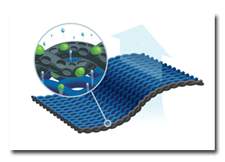
qfom_Copy_5

The nanoscale pore structure of activated coconut carbon used in Cocona adsorbs moisture, odors
and UV rays, which are then released during laundering using a scent-free detergent and dyeing
using a heat source
.


The Cocona Story

The Cocona technology imbedsactivated carbon from coconut shells into polyester or nylon polymers. The coconut shells, recycled waste from the food industry, are burned at 300°C followed by a 1,000°C steam-activation process. The activated carbon thus produced is imported by suppliers to water and air filtration, wastewater treatment, and other such industries. The microscopic, ultrafine particles that are too small for those applications are just what TrapTek needs to incorporate into its fiber and yarn.

“Not only are we using a green material, but we’re recycling what would have been thrown into landfills,” said Jonathan Erb, a principal at TrapTek. “This is encapsulated to provide a durable surface that allows the activated carbon to go through the very rigorous processing of polyester or nylon fibers and survive that process. The protective coating actually comes off during the course of fiber extrusion, and that releases activated carbon to be very much a part of that fiber.”

According to Erb, the coconut shell’s hardness, created by the nanometer-scale pore structure, gives it an advantage over softer activated carbon materials, which have fewer and bigger pores. The coconut pore structure is very complex, and the size of the pores is very even, he said. These pores adsorb moisture, odors and UV rays and through the exothermic adsorption process cause moisture to evaporate quickly. TrapTek says activated carbon from coconut shells
exhibits a greater exothermic reaction than any other known substance, and garments containing Cocona activated carbon show 45-percent greater wickability and significantly higher drying rates than garments offering conventional moisture-management technologies.

Cocona fabrics and garments are rejuvenated and trapped odors removed by laundering using scent-free detergents and drying using a heat source and no dryer sheets. Bebo said 60 to 70 percent of odors are removed during washing, and the heated drying causes the remaining odors to vibrate and move out of the pores.

Erb said most alternative moisture management fabric treatments are topical chemical applications, “whereas ours is integral to the fiber, which can be combined very nicely with other fibers such as man-made, wool or cotton to give new attributes to those fabrics.”

In blends, the ratio of Cocona to other fibers is based increasingly on end-use profiles, Bebo said. “For knit socks, you might want more Cocona than for everyday apparel to get the full benefits of the technology as it relates to odor control. In most applications, the percentage of Cocona is based on fabric weight, and 40 percent tends to be ideal for the types and weights of fabrics BWW does. As a fabric goes up in weight, the percentage could go down so the weight stays
the same,” he explained.
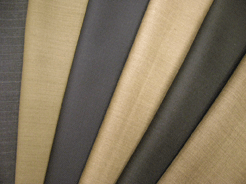
CoconaWool
Burlington WorldWide’s Cocona Wool fabrics are offered in a range of weights and constructions
suitable for military and service uniforms, business suits, dress apparel and everyday wear.


BWW’s Cocona Wool
 

Bebo noted the Cocona technology, combined with the sustainability movement, makes it a natural especially for better brands participating in the activewear market, but it also has moved into mainstream, everyday apparel. He said BWW offers its man-made and cotton-blend Cocona fabrics in both of those markets.

The new wool fabrics, offered in a range of weights and constructions, are targeted to military and service uniform sectors, as well as for business suits, other dress apparel and everyday wear — and even possibly “as an item in a golf collection,” Bebo suggested. Some also offer a bit of stretch.

“There’s been lot of innovation lately in wool, whether it be wrinkle-free, washable,
stain-repellent — as with BWW’s new Invisible Barrier™ technology — or whatever,” Bebo said. “ Everything is focusing on the technology to drive easier care, better performance. With wool, for example, take the cool suit: How do you make a wool suit more comfortable? You can take Cocona yarn, blend it with wool, and get performance benefits including exceptional moisture wicking and evaporation to add comfort — plus you have the sustainability story.”


For more information about Cocona, contact Jonathan Erb (720) 652-9726, Ext. 105, jon@traptek.com. For more information about BWW’s Cocona fabrics, contact Nelson Bebo (212) 621-4046, nelson.bebo@burlington.com.


April 10, 2007

Congressmen Seek Aid For Import-Displaced Workers

US Reps. Robin Hayes, R-N.C., and Mike McIntyre, D-N.C., have introduced legislation that would
expand government assistance for textile, apparel and other workers who lose their jobs as a result
of import competition. While retraining and other assistance have been available to workers under
the Trade Adjustment Assistance Act of 1974, the congressmen feel that program is no longer
adequate in view of the burgeoning job losses resulting from trade globalization.

In introducing the Trade Adjustment Assistance Reform Act, Hayes said: “The Trade Adjustment
Assistance (TAA) Act is a good program. I worked hard to expand this program and make it better in
the past, but we must make additional changes to help textile and apparel workers in this
increasingly competitive global marketplace. While it is good that these workers are going to get
extended unemployment benefits, we all know that an unemployment check is no substitute for a
paycheck. When workers are displaced, we want to give them the skills to successfully re-enter the
workforce.”

The legislation would provide automatic eligibility for TAA benefits for textile and apparel
workers. Currently, the Department of Labor rules on each TAA application in 40 days; increases the
Health Coverage Tax Credit from 65 percent to 80 percent; simplifies the health tax credit
application process; and increases TAA funding authorization from $220 million to $440 million.

Hayes said his legislation eliminates considerable red tape and will serve to get job
training benefits to the unemployed faster than ever before. He says it also removes obstacles that
have prevented some workers from receiving TAA benefits.

The bill has nine initial co-sponsors — Reps. G.K. Butterfield, D-N.C., Bob Etheridge,
D-N.C., David Price, D-N.C., Howard Coble, R-N.C., Sue Myrick, R-N.C., Patrick McHenry, R-N.C.,
Heath Shuler, D-N.C., Melvin A. Watt, D-N.C., and Brad Miller, D-N.C.


April l3, 2007

Crown Crafts To Sell Churchill Weavers Assets

Crown Crafts Inc. — a Gonzales,
Louisiana-based distributor of infant bedding, bibs and bath items — has announced it will sell the
Churchill Weavers name; intellectual property; yarn inventory; looms; weaving, sewing and laundry
equipment; and domain name and website to Wilford Morris, owner of Lafayette, Ind.-based Walcot
Weavers, for $275,000. Walcot Weavers manufactures hand-woven baby blankets, throws and window
blinds.

“We are very pleased that we were able to purchase the Churchill brand, which will be
combined with Three Weavers and Grace Richey Clarke under the Walcot Weavers umbrella,” said
Wilford Morris. “We are excited to continue the long heritage of Churchill Weavers.”

A small share of Churchill Weavers archives and antiquities, as well as property in Berea,
Ky., were sold to another individual for $110,000.

These sales are in addition to the previous sale earlier this year of a large share of
Churchill Weavers’ finished goods inventory. Crown Crafts has received orders for the remainder of
the finished goods, with all Churchill Weavers products expected to be shipped by the end of this
month.


April 3, 2007

Avery Dennison To Acquire Paxar

The Boards of Directors of Pasadena,
Calif.-based Avery Dennison Corp. — a developer and manufacturer of pressure-sensitive labeling
materials; office products; and retail tag, ticketing and branding systems — and White Plains,
N.Y.-based Paxar Corp. — a developer of identification solutions to the apparel and retail industry
— have approved an agreement whereby Avery Dennison will acquire all outstanding shares of Paxar
for $30.50 a share in a cash transaction valued at $1.34 billion. The transaction is expected to
close by the end of 2007.

“Combining with Avery Dennison provides substantial benefits to our customers while
delivering compelling value to Paxar shareholders,” said Rob van der Merwe, chairman, president and
CEO, Paxar Corp. “In particular, the broader capabilities of the combined company will better meet
customer demands for improved quality, product innovation and speed of delivery.”

Customer benefits also include the combined companies’ ability to better serve customers in
Europe, Latin America, Asia and the Middle East due to complementary geographic territories.

Avery Dennison and Paxar report they will develop an integration plan with the goal of
retaining systems and people from both companies, although overlapping positions will be
reduced.


April 3, 2007

Ahlstrom To Purchase Fiberweb’s Consumer Wipes Business

Finland-based Ahlstrom Corp. has
signed an agreement to purchase London-based Fiberweb Plc’s consumer wipes business for
approximately 65 million euros (US$86.9 million). Fiberweb’s consumer wipes business currently
produces wiping fabrics used in baby and personal care, and household applications. Subject to
antitrust clearance, the deal is expected to close before the end of the second quarter of 2007.

The acquisition includes four plants — one in Spain, one in the United States and two in
Italy — sites that generated 110 million euros (US$147.1 million) in net sales in 2006 and employed
400 people.

The deal comes on the heels of Ahlstrom’s acquisition of Italy-based Fabriano Filter Media
S.p.A. and the Italy-based Orlandi Group’s spunlace nonwovens business earlier this year. The
company also announced last year that it will invest in a new wiping fabrics production line in
Brazil that will be operational early next year.

“This acquisition further strengthens Ahlstrom’s unique fiber expertise and its versatile
technology base,” said Claudio Ermondi, senior vice president, Nonwovens. “Fiberweb’s leading
pulp-containing wipes technology allows Ahlstrom to introduce additional properties, such as
enhanced softness and increased strength, to its wiping fabrics. This capability combined with
Ahlstrom’s and Orlandi’s pulp-containing technologies positions Ahlstrom as the leading supplier of
pulp-containing wipes products.”


April 3, 2007

DHL Opens Gateway In Merida Mexico

San Francisco-based DHL, a global
express and logistics industry solutions provider, has opened an international gateway in Merida,
Mexico, that will enable the company to increase its handling capacity by more than 87 percent
regionally, allowing the transport of more than 38,000 additional shipments annually.

The new gateway, part of the company’s strategic development plan for Mexico’s Southeastern
Region, provides US and Mexican businesses with a facility for the transshipment of goods across
the US-Mexico border. It has been authorized by the Mexican government to operate as a customs
facility for consolidation of area imports and exports.

Regional customers will no longer have to process shipments in Mexico City. DHL reports that
the facility will reduce average international delivery service times to the cities of Merida,
Cancun, Ciudad del Carmen and Campeche from two days to one.


April 3, 2007

ATNT Organizers Issue Call For Papers

Organizers of the International
Conference on Advances in Textiles, Machinery, Nonwoven and Technical Textiles (ATNT) 2007 have
issued a call for papers to be presented at the conference, which will be held June 18-20 at the
Kumaraguru College of Technology in Coimbatore, India.

Conference organizers include Kumaraguru College and the Institute of Environmental and
Human Health, Texas Tech University, Lubbock, Texas. The conference will present advances in areas
such as natural and man-made fibers, polymer and fiber production, general textiles, textile
machinery, dyeing and finishing, textile testing, nanotechnology, smart textiles, nonwovens and
technical textiles.

The deadline for submission of abstracts, not to exceed 300 words and preferably in
Microsoft Word format, is April 27. Abstracts should be e-mailed to s.ramkumar@ttu.edu. Authors or
coauthors must personally present the papers at the conference.


April 3, 2007

Sponsors



