Teijin To Supply Recycled ECOPET PLUS® Tire Cord Fibers To Toyo

Japan-based Teijin Fibers Ltd. will begin supplying chemically recycled polyester fibers for tire
cord to Japan-based Toyo Tire & Rubber Co. Ltd. Teijin’s ECOPET PLUS® fibers, produced using
its ECO CIRCLE® closed-loop recycling system, will be used in Toyo’s PROXES® Ne tires developed for
use on eco-oriented automobiles.

The Eco Circle system — which breaks down polyester for conversion into virgin-quality raw
polyester, and reduces carbon dioxide emissions and energy use by approximately 80 percent compared
with polyester production from petroleum — enables production of 1,670 decitex recycled polyester
fibers that meet the parameters for use in the tire carcass. Teijin’s Union Tire Cord subsidiary
will prepare the raw Ecopet Plus fiber for its production into tire cord.

Teijin anticipates sales of Ecopet Plus to increase from 10 tons per month — enough to
produce approximately 50,000 tires — in 2009 to 30 tons per month in 2011.

December 16, 2008
NanoHorizon’s SmartSilver™ Acheives Oeko-Tex Standard 100 Certification

State College, Pa.-based NanoHorizon’s SmartSilver™ nanoscale silver antimicrobial additives have
received Switzerland-based Oeko-Tex Association’s Oeko-Tex Standard 100 certification that they are
not harmful to human health.

“SmartSilver textile additives effectively control bacteria, but do so in a way that does not
harm the user of the enhanced product,” said Dr. Manfred Wentz, US director, Oeko-Tex. “Unlike many
other antimicrobials that rely on harsh chemicals to control microbes, SmartSilver uses silver,
which is not on Oeko-Tex’s restricted substances list.”

“Receiving Oeko-Tex approval is an important endorsement of silver’s natural role in safe
bacterial and odor control,” said Dr. James Delattre, vice president, global marketing,
NanoHorizons. “Our SmartSilver nanotechnology unlocks silver’s power to provide permanent,
effective antimicrobial protection that doesn’t wear off or wash out of fabrics. Now that we are
Oeko-Tex approved, we look forward to working with manufacturers who value textile safety as highly
as we do.”


December 16, 2008

Gildan To Restructure Sock Manufacturing Operations, Close Three Plants

Montreal-based branded basic apparel manufacturer Gildan Activewear Inc. has announced it will
close three plants and phase out US sock-finishing operations. The company cited as reasons the
decline in economic conditions during October and November, in addition to the increasing global
competition in the sock market.

The restructuring — scheduled to be complete by the end of June 2009 — will comprise two
phases. In phase one, Knitting Plant #8 in Hillsville, Va., along with the Cherokee Finishing and
Plainsman Finishing plants in Fort Payne, Ala., will close at the end of February 2009. The three
plant closings will affect 180 employees in Virginia and 220 employees in Alabama. In phase two,
Gildan will consolidate the Fort Payne sock-finishing operations at its Honduras facilities by the
end of June. The company plans to maintain the sock-knitting operations as well as distribution and
administrative activities located there.

Gildan will work to provide employees with job transitioning and educational opportunities.
Following acceptance of application for the US Trade Adjustment Assistance Act, impacted employees
will be eligible for additional unemployment compensation and career-transition assistance.

December 16, 2008

Turkish Company Buys 300th Stäubli Delta 110 Drawing-In System

Switzerland-based Stäubli AG recently delivered its 300th Delta 100/110 automatic drawing-in system
to Nazar Textile Industry Co., Turkey. The company, a producer of cotton outerwear and shirting
fabrics, now uses the system for daily production in its weaving mill. A ceremony was held to mark
the installation, and Arif Balduk, mill manager, Nazar, received an award from Stäubli Istanbul’s
sales crew.

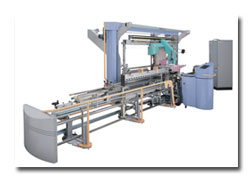
delta
Staübli’s Delta 110 automatic drawing-in system

The Delta 110 has the capacity to draw in six warps in an eight-hour shift. The machine can
draw in J/C-type or O-type heddles or a combination of the two. Warp threads are drawn in from the
warp beam — which can be up to 4 meters wide — into the heddles, drop wires and reed in a single
operation at a speed of up to 140 draws per minute. The Delta 110 can be fitted with up to 20
harness frames or up to 16 heddle carrier rods, and up to eight drop-wire contact rails, depending
on customer requirements.

December 16, 2008

Monforts Expands Mönchengladbach Showroom

Germany-based A. Monforts Textilmaschinen GmbH & Co. KG has expanded its Mönchengladbach
testing and demonstration facility to more than 1,000 square meters. The showroom now includes its
latest-generation heat recovery tower as well as a Montex TT tenter chamber for technical textiles
production.

Other Monforts equipment available for customer trials in the showroom includes: a DynAir
relaxation dryer and flow-through dryer; a Thermex Hotflue with Matex padder and VTG infrared
predryer for continuous dyeing; a Montex 6500 tenter for drying, heat-setting and coating trials; a
soft coating device; a sanforizing unit display model; and several Qualitex plc control working
stations. The showroom also includes a museum section that features an original Monforts raising
machine dating from 1918.

December 16, 2008

ITG To Merge Cone Denim, BWW Into One Business Group

Greensboro, N.C.-based International Textile Group (ITG) has announced it will realign its Cone
Denim and Burlington WorldWide (BWW) apparel fabric divisions into one group doing business as ITG
Apparel & Specialty Fabrics. Going forward, the new apparel fabric group and ITG Automotive
Safety Group will comprise ITG’s principal businesses, while the Burlington House interior fabric
business and Carlisle Finishing also will continue to operate.

“Combining our apparel resources into a single business provides a simpler, more robust
platform to leverage our strengths and offer customers greater support within a more flexible,
cost-competitive structure,” said Joseph L. Gorga, president and CEO, ITG.

BWW President Kenneth T. Kunberger will take the helm as president of ITG Apparel &
Specialty Fabrics. Kunberger joined Burlington Industries Inc. in 1998, serving as executive vice
president, Burlington Sportswear and Burlington Denim. He was named president of Burlington
WorldWide in 2004, after ITG was formed through a merger of Burlington Industries and Cone Mills
Corp.

Cone Denim President Thomas E. McKenna has announced he will leave the company following a
transition period.

“These businesses come together with tremendous brand equity and leadership positions in
their respective markets,” Kunberger said. “As a single, integrated business we look forward to the
opportunity to better support common customers and leverage our strengths in key technologies,
product development, customer service and manufacturing platforms, while preserving the value of
our brands.”

Jeff Peck, executive vice president, technical & specialty products; and Patrick Palmer,
executive vice president, worsted wool products, will have responsibility for specific Apparel
& Specialty Fabrics product lines. Kunberger will have responsibility for the cotton products
group comprising the BWW and Cone Denim cotton casual businesses

December 16, 2008

New British Standard Published For Fabric Snagging

A new British standard, BS 8479:2008, has been published that provides a method to determine a
fabric’s propensity to snagging and other related surface defects. The standard covers knitted and
woven fabrics.

In light of this new standard, ASTM D 3939: Standard Test Method for Snagging Resistance of
Fabrics (Mace), has been modified to allow the testing lab to consider using BS 8479 instead.

“The new POD snagging testing method provides a test method that is more representative from
a real wear test point of view,” said Lee Thompson, technical manager, British Home Stores. “Once
fabrics have been benchmarked, it gives a clear and consistent method for determining pass/fail
suitability of fabrics.”

December 16, 2008

Fiber Society Announces Call For Papers

The Fiber Society, Raleigh, N.C., has issued a call for research papers to be presented at the 2009
Spring Conference, to be held May 27-29, 2009, in Shanghai.

The theme is Fibrous Materials: Science, Technology and Applications, with relation to the
following areas: polymer science and nanotechnology; processing technology; dyeing, finishing and
biotechnology; medical textiles; functional and intelligent textiles; fashion design, history and
aesthetics; and retailing, marketing and management.

The society is now accepting online submissions and has provided a template through a link
at
www.thefibersociety.org. The deadline for submissions
is Jan. 31, 2009. For more information, contact Pam Gabriel,
pam_gabriel@ncsu.edu, or Dr. Michael Ellison,
ellisom@clemson.edu.

December 16, 2008

Jobs Report Triggers Call For Trade Remedies

A leading lobbying organization representing textile companies seized on November’s dismal jobs
report to call on the US government to pursue a range of policies to strengthen manufacturing and “
jumpstart” the economy.

Pointing to 533,000 lost jobs in November, including 85,000 in manufacturing, Auggie
Tantillo, executive director of the American Manufacturing Trade Action Coalition (AMTAC), composed
of textiles and  other manufacturing industries, said: “The only way out of America’s economic
troubles is to create more wealth. Stimulating manufacturing output is the best way to do that and
to create the millions of new middle-class jobs needed to jumpstart the economy.”

Tantillo charged that jobs across the entire economy have been “hammered by unfairly
subsidized foreign imports,” and he added that “fixing America’s broken international economic
policy must be the top priority for President-Elect Obama and Congress.”

He outlined five steps to address international trade problems that have an impact on US
textile and other manufacturers:

• elimination of tax advantages at home and abroad that undermine competitiveness of US
producers or that discourage them from investing in America;

• combatting currency manipulation by passing legislation to make it actionable under US
trade laws;

• aggressive enforcement of US trade laws to halt foreign illegal trade activities such as
dumping, subsidization and intellectual property theft;

• expansion of the Defense Department’s “Buy American” requirements by strengthening them and
extending them to the US Department of Homeland Security; and

• implementation of a comprehensive strategy to reduce US dependence on imported energy.

December 9, 2008

TenCate Gen2™ Order To Generate $35 Million Of Revenue

Union City, Ga.-based TenCate Protective Fabrics has announced that in addition to the continued
high-volume sales of its TenCate Defender™ M fabrics, it has received a $35 million order for
TenCate Gen2™ fabrics to be used to make US Army combat uniforms.

TenCate Defender M Lenzing® FR/ para-aramid-blend fabric is the standard material used for
flame-resistant US armed forces military combat uniforms. TenCate Gen2 fabric also is used for
defense applications, and is made of aramid fibers. The fabrics are manufactured at TenCate’s
Southern Mills plant located in Union City.

December 9, 2008

Sponsors