Raw Material Costs Drop


T
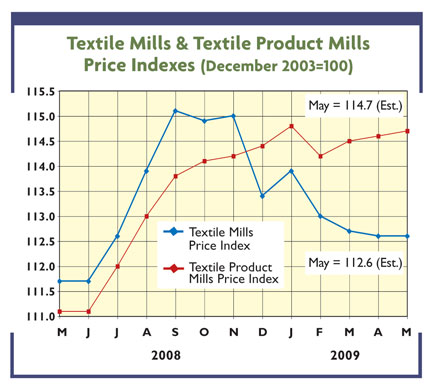
here’s a modicum of good news to help offset still-falling textile and apparel demand —
namely the fact that basic materials going into these products are actually going down in price.
And these new declines are pretty much across the board. In man-made fibers, for example, excess
global capacity and declining petrochemical feedstock costs have helped push the average tab — as
measured by the US Bureau of Statistics — down by a significant 4.5 percent over the past year,
with most of the slippage noted over the past few months. And there’s little to suggest any
meaningful near-term turnaround.

There is also some good news on the cotton front, where prices for the raw fiber, when
compared to early last year, are off by more than 30 percent. Moreover, given the latest
supply-demand projections of both Cotton Incorporated and the US Department of Agriculture, tags
here are likely to remain soft through the foreseeable future as world stocks hold near current
high levels.

Quotes on the other major natural fiber, wool, have also been trending sharply lower as of
late. At press time, for example, both domestic and overseas wool prices trailed year-ago levels by
anywhere from 30 to 40 percent.

Bottom line: All these declines can’t help but have some positive impact on the textile
industry health, especially given the fact that raw material costs in the basic textile sector,
including yarns and fabrics, account for close to two-thirds of every sales dollar. The
raw-material role for more highly fabricated textile products also is quite significant, with
fibers and other material imputs representing about 55 percent of the finished product’s value.

BFChart


Other Costs Also Under Control


Labor isn’t presenting any cost problems either. Over the past 12 months, for example,
hourly rates for basic textile products advanced only about 2.5 percent — a number more than
balanced out by a nearly 3.5-percent decline in the more highly fabricated textile products sector.
Indeed, average those numbers out and adjust for continuing productivity gains, and the industry’s
overall unit labor costs have probably inched a bit lower.

Similar situations also seem to be shaping up in other cost areas. Take transportation:
True, no individual textile numbers are available, but the fact that the nation’s aggregate
trucking rate actually declined suggests mill freight costs are under control.

Finally, there are inventory carrying charges — another big industry cost drain. Here, too,
problems seem to be minimal, thanks to the combination of today’s low interest rates and the
industry’s continuing ability to keep inventories at relatively low levels.

To sum up then: Overall mill production and distribution costs are now probably at, or even
a bit under, where they were last year. And this could well by why, despite continuing production
declines, most US firms are still able to show some profit. Textile World will report more about
the earning pressure in a month or so when first-quarter 2009 figures become available.


The Improving Business Picture


The prognosis for a bottoming out in overall economic activity also has to be regarded as an
industry plus. To be sure, any actual upturn in gross domestic product (GDP) is still a few
quarters away. But clearly the worst is over. Federal Reserve Bank Chairman Ben Bernanke, for
example, notes a wide array of encouraging signs. These include the better-than-2-percent jump in
consumer spending over the first quarter, steadying sales of new and existing homes, the modest
revival in credit markets, and the recent huge drop in business inventories.

On the latter score, the industry stockpiles have been dropping 2.5 times as fast as sales
since the beginning of the year. A decline of this magnitude can’t help but clear the way for at
least a modest resumption in GDP growth toward year’s end as companies boost production to levels
that are in better balance with sales. Still, other positive trends would have to include the
bottoming out of basic material prices, a sign that there’s still demand for commodities used in
industrial output; the stock market gains of recent months; and the turnaround in consumer
sentiment — with people now a bit more upbeat about the economy and the job market.

Bottom line: All of the above can’t help but have a positive spending impact — on textiles
and apparel as well as all other major consumer sectors. Zeroing in on domestic mill activity, for
example, TW editors now see decelerating production and shipment declines over the remainder of the
year, with perhaps even the possibility of some scattered small gains by early or mid-2010.

June 2009

Life-Saving Fabrics


R
ecent ballistic textile developments have been geared toward reducing product weight
while increasing performance to provide warfighters and police officers with better-than-ever
protection that also is more comfortable and manageable than ever. The National Institute of
Justice (NIJ) standards used to certify ballistic armor products also have been updated recently to
require compliance with more stringent parameters, particularly with regard to durability of the
antiballistic function.

Well-established premium ballistic fibers, including aramid and high-modulus polyethylene
(HMPE), are available in increasingly effective, lighter-weight, more cost-effective versions for
both soft armor such as bullet-resistant vests; and hard armor such as helmets, shields, body armor
plates and vehicle armor.

There also are several interesting innovations using recently developed materials or
involving new applications for established high-performance fibers that may provide alternatives to
the traditional materials and/or may be used in conjunction with them to enhance armor products in
various ways.

kevlargal
Soft body armor incorporating new high-performance materials such as DuPont™ Kevlar™, among
others, provides enhanced bullet resistance and reduced backface deformation.


Established Materials


Wilmington, Del.-based DuPont’s Kevlar® aramid materials are offered in several versions to
protect against bullets, sharp objects, shrapnel, or a combination of threats. The newest is Kevlar
XP™, a woven/laminated construction that offers attributes of both woven and unidirectional
technologies.

“Kevlar XP stops a 44 Magnum bullet within the second or third layer of an 11-layer design,”
said Jeff G. Fackler, global marketing manager, DuPont Personal Protection. “Its patented woven
structure stops the bullet, and up to 15-percent backface deformation reduction comes from the
energy-absorbing capability of the remaining layers of material.” Fewer layers of fabric are needed
to provide the performance, resulting in up to a 10-percent weight reduction and potentially
reduced costs to construct a vest.

Kevlar XP is being used in soft bullet-resistant vests. Future applications include hard
armor such as platform armor, helmets and personal shields. “Though XP technology was developed
initially for bullets, it is being developed to address fragments and other threats,” Fackler
added.

Morris Township, N.J.-based Honeywell International Inc. reports its latest-generation
Spectra Shield® II ballistic composite material using HMPE fibers, available in several soft and
hard armor versions, provides up to 20-percent greater ballistic performance than the original
Spectra Shield technology. When a greater level of protection is not needed, using the newer
technology in place of the older can help reduce armor weight by 10 to 20 percent. According to
Jeff Emery, Honeywell’s global strategic marketing manager, armor products, the US military and the
company’s law enforcement customers are specifying the newer technology to replace previous
materials in their armor programs.

Honeywell’s Gold Shield® armor materials use less costly aramid fiber incorporated in the
Shield technology’s unidirectional construction. “We are seeing significant demand for vehicular
armor with our Gold Shield GV-2016 composite,” Emery said. That solution can significantly lower
the vehicle’s weight at a cost comparable to older, bulkier armor solutions, and provide a high
level of protection against bullets, shrapnel and explosions, according to Emery. Vehicles also may
be equipped with explosively formed projectile (EFP) kits made with a Spectra Shield II material to
protect against the highest-velocity threats.

DSM Dyneema, the Netherlands, maker of Dyneema® ultra-high-molecular-weight polyethylene
(UHMWPE) fibers and yarns, has considerably expanded production capacity at its Greenville, N.C.,
facility, largely to supply ballistic materials to the US military and law enforcement agencies.
Among the company’s unidirectional hard and soft armor materials are Berry Amendment-compliant
HB51, produced specifically for the US hard body armor market; and HB26 hard ballistic composite,
used for vehicles and helmets and having potential uses in body armor inserts.

HB51 is a hybrid construction used as a protective backing behind  the armor’s strike
face. According to DSM Dyneema, it offers 20-percent improved ballistic performance over a previous
version used by the US military, without adding weight.

HB26 has seen its first commercial use in helmets supplied by Pittsfield, Mass.-based
Protech® Armored Products to the Denver Police Dept. DSM Dyneema reports the helmets are 15-percent
lighter in weight and exhibit less backface deformation than comparable aramid helmets. In
addition, HB26 requires less handling time and enables increased production speeds.

The company also is developing a tape system for use in vehicle armor to provide
lightweight, superior protection against emerging battlefield threats. The first prototype, X32, is
currently under evaluation for its effectiveness against such threats.
bulletimpact
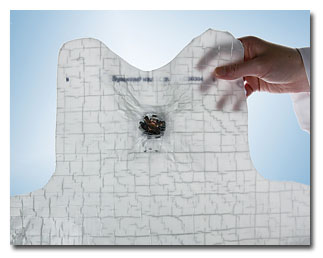
Warwick Mills, New Ipswich, N.H., a developer of ballistic packages from fiber processing
through to finished body armor and testing, uses Dyneema® and other high-performance fibers to
provide bullet resistance and blunt trauma protection  in soft armor incorporating its
TurtleSkin® SoftPlate technology.


Some Newer Materials


Milliken & Company, Spartanburg, contributes Tegris™ polypropylene (PP) thermoplastic
composite to the arsenal of ballistic textile technologies. Tegris technology is based on a
coextruded PP tape yarn with a highly drawn core sandwiched between layers of lower-melt polymer.

“For ballistics applications, layers of fabric are stacked, and using only heat and
pressure, the outer layers melt and fuse the stack together into flat panels and molded parts that
have very good impact properties,” said Todd Kleman, profitable growth strategist, Milliken
Performance Fabrics. The composite, used in combination with metals, ceramics and other composites
for hard armor, enables considerably reduced weight compared with glass-filled composites at a
lower cost than the premium composites.

Simpsonville, S.C.-based Innegrity LLC offers Innegra™ S PP-based ballistic materials for
both hard and soft armor applications. Dr. Brian G. Morin, CEO, said the company has developed
economical, effective hybrid solutions combining Innegra S with aramids and is in the process of
testing Innegra S with UHMWPE fibers. He noted that in testing, soft armor panels containing a
50/50 blend of Innegra S and aramid provide practically the same level of protection as aramid
alone. In hard armor — especially heavy, inches-thick armor — the performance of  blends
containing from 25- to 75-percent Innegra S equals or exceeds that of aramid alone for a lower
cost, in addition to lowering the fabric weight by 10 to 20 percent.

jeep
Honeywell’s latest-generation Spectra Shield® II and Gold Shield® materials have ballistic
uses in vehicular and personal armor systems.


Developing Technologies


A lot of ballistic textile research and development is conducted at the US Army Natick
Soldier Resaarch, Development and Extension Center, Natick, Mass., in collaboration with fiber and
ceramics companies, academic institutions and other entities, with a goal of developing ever
lighter-weight, higher-performance materials that can improve soldiers’ mobility, performance and
comfort.

“There are mechanical fiber properties that we can use to predict the performance of a fiber
in an armor system before the fiber exists, and this is done in part knowing some fiber
manufacturers have a processing envelope for treating the fibers,” said Research Mechanical
Engineer Philip M. Cuniff. “We tell the fiber makers the fiber we would prefer them to make for us,
and we’re still working on ways to gain insight into what would make a better fiber using that
model.”

In one project, Natick is working  with the University of Cambridge, England, and
Concord, N.H.-based Nanocomp Technologies Inc., producer of long carbon nanotubes — in the
millimeter length range — in yarn and nonwoven sheet form. According to Nanocomp, the materials are
100 times stronger than steel, extremely lightweight, and easier and safer to handle than
commercially available powdery carbon nanotubes.

Nanocomp currently is producing small amounts of carbon nanotube yarn and nonwoven sheet
materials in its research-scale facility. CEO Peter L. Antoinette said the materials  will
have applications in composite systems for use in strike and spall layers, plate, and compressed
materials such as helmets; or in layered hybrid systems. “You could expand the area you are
protecting without increasing the weight and compromising mobility,” Antoinette said. He added that
the materials have demonstrated a higher level of fracture toughness than traditional ballistic
textile materials; and are also highly ultraviolet-resistant, immune to moisture and
flame-resistant.

 Nanocomp is preparing to open a 40,000-square-foot (ft2) pilot facility, and within
the next three years plans to open a 100,000-ft2 production facility that would produce more than 1
million kilometers of yarn and 50 acres of 3-by-6- and 4-by-8-foot nonwoven sheets annually.

At North Carolina State University, Raleigh, N.C., high-tenacity polyethylene naphthalate
(PEN) fibers in development under the direction of Drs. John A. Cuculo and Richard Kotek show
potential for both soft and hard ballistic applications. The fibers are melt-spun using a newly
developed process and at 12.5 grams per denier are reported to be the strongest polyester fibers
ever made. According to Dr. Mehdi Afshari, a research assistant professor working on the project, a
hybrid sample made with high-tenacity PEN woven and hydroentangled nonwoven fabrics is
lighter-weight and shows higher ballistic performance than a PEN woven fabric.

Fort Mill, S.C.-based Kuraray America Inc.’s Vectran® liquid crystal polyarylate fiber is
not traditionally used in ballistic applications. However, a new version of the high-strength,
high-cut- and impact-resistant fiber is in development for uses in military hard armor, according
to Bob Knudsen, manager, sales and marketing, Vectran Division.


May/June 2009

RST Introduces Demron™-W Bomb Shield For Nuclear/Ballistic Protection

Miami-based Radiation Shield Technologies (RST) reports its Demron™-W High Energy Nuclear/Ballistic
IED RDD RED Shield offers complete protection against ballistics, improvised explosive devices
(IEDs), radiological dispersive devices (RDDs), radiological emission devices (REDs), fragmentation
bombs and nuclear spills.

“RST’s new Demron-W Nuclear/Ballistic Shield is the only device that enables our first
responders and military to combat all threats faced today, including traditional ballistics and
bombs as well as IEDs, RDDs, REDs and the ever-increasing nuclear and radiological threats,
roadside bombs that are triggered by cell phones,” said Dr. Ronald F. DeMeo, president, RST. “No
other ballistic blanket currently provides significant protection against nuclear or radiological
threats. Demron Shield provides unsurpassed nuclear suppression and outperforms all current
soft-body armor in anti-frangment and ballistic protection.”

Demron comprises a radiopaque nanopolymeric compound fused between layers of fabric and is
offered in two product lines including Demron-W into full-body suits, vests and blankets for
first-responder and military applications; and Demron-M X-ray vests, aprons and other products for
medical applications
(See ”
Quality
Fabric Of The Month: Shielded By Fabric

,” www.
TextileWorld.com, March 20, 2009)
. Its effectiveness in blocking gamma rays,
X-rays and nuclear emissions has been proven by the Lawrence Livermore National Laboratory, Georgia
Institute of Technology and Columbia University College of Physicians and Surgeons. Demron-W
fabrics are flame- and acid-resistant and have received National Fire Protection Association Class
2 Certification for the 1994-2007 Standard on Protective Ensembles for First Responders to CBRN
(chemical, biological, radiological and nuclear) Terrorism Incidents. In tests conducted by H.P.
White Laboratory Inc., the Demron-W Nuclear/Ballistic Shield also has been proven to provide
National Institute of Justice Level IIIA ballistic protection and unmatched protection against
fragmentation.

June 2, 2009

INDA Names Five Finalists For 2009 WOW Award

The Association of the Nonwoven Fabrics Industry (INDA), Cary, N.C., has named five finalists for
the 2009 World of Wipes (WOW) Innovation Award. The award recognizes innovative technology within
the entire wipe value chain, including raw materials and ingredients, roll goods, machinery,
packaging and finished products.

Each finalist will give a short presentation to attendees at the WOW International Conference
to be held June 22-24, 2009, in Atlanta. Attendees will vote for the winner, and the award will be
presented during a session on the final morning of WOW.


Nonwovens Markets, a twice-monthly newsletter covering worldwide developments in the
nonwovens industry, will sponsor the WOW award this year.

The five finalists, selected from products the industry nominated earlier this year, are as
follows:

•    Clorox Green Works Natural Biodegradable Cleaning Wipes, developed by The
Clorox Co., Oakland, Calif.: eco-friendly wipes comprised of 100-percent cellulose fibers and
derived from renewable farm-grown trees;

•    Evolon Exfolia Beauty Cloths, developed by Germany-based Freudenberg
Nonwovens and Boise, Idaho-based Beauty Cloth International and presented by Port Washington,
Wis.-based Kleen Test Products Corp.: exfoliating facial wipes comprised of Freudenberg’s Evolon
fabric, which contains fibers that remove dead cells and impurities without using acids, chemicals,
crystals or machines;

•    PGI Spinlace Nonwoven Fabric, developed by Charlotte-based Polymer Group
Inc. (PGI) using its Spinlace process, which provides added strength, absorbency, texturing and
other performance characteristics that enhance the wipes’ cleaning;

•    Prime Label & Screen Rigid Lens II Resealable Flat Pack, featuring a
thick, resealable closure that allows a high stack count of wipes, uses less material and is less
bulky compared to molded fitments, has a new hinge design that stays open, is more rigid than Peel
‘n Reseal and is more efficiently applied to flow wrap; and

•    Racine, Wis.-based S.C. Johnson’s Windex Outdoor All-in-One Cleaner,
which features Windex’s Special Sheeting Action Formula wipes that prevent streaks and spotting,
enabling users to clean 20 windows with a single pad and reach up to 11 feet to safely clean
outside windows without using a ladder, according to the company.

“Each year the WOW Innovation Award recognizes the ‘best of the best’ of new products and
technologies in the wipes business and the recipient will be chosen by the people who know these
products best – attendees at WOW,” said Rory Holmes, president, INDA. “These are certainly five
deserving products from different aspects of the wipes business and they represent some of the
finest work being done in our industry in 2009.”

June 2, 2009

The Rupp Report: More Attention For Less Money

This is everybody’s dream: more attention for less money. More attention for less money? And I
don’t mean in a relationship between lovers. I’m talking about the relationship between supplier
and customer. You might think of the chicken announcing new eggs are available.

Bang The Budgets

It always happens in the same way: When the wind is turning toward fewer sales, the financial
people in a company start shouting and screaming, “We have to reduce the budgets.” And then with a
magnifying glass, they start to cut. And what is crushed first? Of course, the marketing budget.
Financial people rarely understand communication – “Why should we advertise? Everybody knows us.”
The rhetoric is very well-known. So, if the “everybody knows us” story would be right, why are
big-label companies spending multi-million or even -billion-dollar budgets on advertising and
communication? To be present in the market, always and everywhere. Two examples are Coca-Cola® and
Nike.

Same Recipient

You might say this is related to consumer products investment and not capital investment.
However, it’s the same people. I remember one of my journalism professors who always said:
“Whatever you are writing, and for whom you are writing, don’t forget – your reader is not only
reading the financial times, but also the yellow press. So think about emotion in your message or
story.”

Not Wishful Thinking

Now, the whole textile machinery industry may be moaning: “This is always the tenor of the
press, one should act without regard for cycles. This is your wishful thinking.” No, it is not. Two
scientific studies from Europe have proved this marketing behavior is absolutely “more attention
for less money.” For example, GfK Group, the well-regarded German market research institute,
examined the marketing behavior of 700 brand companies after the 2001 burst of the Internet bubble.

The results are amazing – and to me, not very surprising. They discovered companies that put
more money in communication, even in bad times, gained more market share when the economy went up
again. Why? Because they were always present in their special trade magazines. Thanks to this
trick, Dell became – notably, in two years – one of the five big computer suppliers in the 1990s.

Strategic Thinking

It is never easier to win more market share than in bad times, because your competitor is
keeping silent. Why should you? Shout to your existing and potential customers that you are still
alive. The same results were confirmed in a study of the Boston Consulting Group. To win market
share is by far not a “from quarter to quarter story,” but a medium- and long-term target.

Since last October, the CEO of the biggest sports retailer company in Switzerland has spent
double-digit millions of Swiss francs in advertising. The money was and is spent in sponsoring and
advertising campaigns all over Europe. He had the right idea. In the first four months of this
year, the turnover has increased 6.5 percent globally. Coincidence or not? And, don’t forget, the
chicken always cackles when the egg is laid.

June 2, 2009

Lenzing Announces Price Increases

Effective immediately, Austria-based Lenzing Group will raise prices for its entire range of fibers
by at least 7 percent, with rates varying depending on fiber type. The company cited rising raw
material costs in announcing the price increase.

June 2, 2009

Culp Receives Copyrights For Three Upholstery Fabric Designs

High Point, N.C.-based Culp Inc. – a manufacturer of mattress and upholstery fabrics – has been
granted US copyright registrations for its Palomino, Stampede and Wrangler upholstery fabric
designs. The registrations were issued in April 2009, with June 15, 2006, as the effective
registration date.

Culp has sold more than 15 million yards of fabric featuring the three designs, which have
leather-like appearances and qualities. The company estimates industry competitors and
manufacturers have sold a significant amount of knock-offs of these fabrics. Now that Culp has been
issued certificates of registration, it plans to aggressively pursue enforcement of its rights
against infringers, seeking all available relief including damages and a disgorgement of profits,
as well as injunctions against future sales of knock-off fabrics. The company also is recording its
copyright registrations with US Customs and Border Protection so US Customs can locate and
confiscate imports of infringing fabric.

“We take great pride in our valued fabric designs, including the revolutionary designs
embodied in our Palomino, Stampede and Wrangler fabrics,” said Frank Saxon, CEO, Culp. “Culp has
numerous customers who have consistently bought our authentic fabrics, and the purchase and sale of
unauthorized copies affects not only Culp’s business, but also our loyal customers and the fabric
industry as a whole. We intend to protect ourselves and our valued customers.”

June 2, 2009

Rieter Nonwovens Systems Sells Spunlace Line In China

France-based Rieter Nonwovens Systems – a manufacturer of machinery for nonwovens production –
reports it recently sold a complete spunlace line to China-based Zhejiang Shaoxing County Zhuangjie
Nonwovens Co. Ltd. – a producer of spunlace fabrics for the hygiene market. It is expected the
manufacturing line will come on-line during the third quarter 2009. The line, sold in collaboration
with France-based NSC nonwoven, features NSC cards for web forming and Rieter’s JETlace Advantage
for hydroentangling the web. The line can produce fabrics ranging from 30 to 100 grams per square
meter, and has a capacity of up to 5,000 tons per year.

June 2, 2009

Chinese Standards Delegation Visits SDL Atlas, Other US Textile Facilities

A delegation of Chinese textile standards officials – including Fang Xijiang, director of the
Standardization Institute of the China Textile Academy, and his colleagues studying US and Western
standards used in textile and apparel manufacturing – recently visited the Rock Hill, S.C.-based
North American headquarters and technology center of SDL Atlas – a provider of textile testing
equipment, supplies, consumables and services.

“During the SDL Atlas visit, the emphasis was on reviewing our broad line of standard
consumable fabrics used in textile testing and our wide range of special services we routinely
provide to our textile clients,” said Robert Lattie, SDL Atlas director, product management, and
chair of the ANSI accredited TAG to TC38 for Textiles. According to Lattie, China is becoming an
important market for SDL Atlas, but current textile manufacturing standards differ greatly between
China and the United States.

Other facilities included on the tour included Cary, N.C.-based Cotton Incorporated;
Sanford, N.C.-based Frontier Spinning Mills Inc.; North Carolina State University’s College of
Textiles, Raleigh, N.C.; the Research Triangle Park, N.C.-based American Association of Textile
Chemists and Colorists Research Committee sessions on standards; ASTM International’s headquarters
in West Conshohocken, Pa.; and the US Consumer Product Safety Commission in Bethesda, Md.

June 2, 2009

Milliken To Sell Automotive Fabrics Business To Management Group

Spartanburg-based Milliken & Company has signed a letter of intent to sell its Automotive Body
Cloth division to a management group led by Dirk Pieper and Brian McSharry, with support from
Greenville-based investment firm Azalea Capital LLC. The new company, to be called Autotex, will be
based in South Carolina. An Azalea principal, Jim Micali, who formerly was president and chairman
of Greenville-based Michelin North America Inc., will serve as chairman. The sale is expected to be
complete July 10, 2009.

Milliken stated the sale is in line with its strategy to focus on other existing and emerging
growth markets. Approximately 1,200 associates in the division’s worldwide operation are impacted
by the sale. Of those, more than 1,000 will transfer to Autotex.

Included in the sale are Gayley Plant, Marietta, S.C.; Abbeville Plant, Abbeville, S.C.;
Cotton Blossom Plant, Spartanburg; Avalon Plant, Toccoa, Ga.; Autotex Plant, Brazil; and support
operations in the United Kingdom, Japan and China. Sharon Plant near Abbeville will close,
impacting 140 associates.

In other news, Milliken will terminate 80 management associates worldwide in other company
businesses as a result of recent consolidations unrelated to the Automotive Body Cloth division
sale.

May 26, 2009

Sponsors