FesslerUSA Plant Renovation To Include Solar Power Generating System

A $1.6 million loan from the Pennsylvania Industrial Development Authority to
Orwigsburg, Pa.-based FesslerUSA, announced recently by the office of Gov. Edward G. Rendell, will
help fund construction of a $5.4 million 1-megawatt photovoltaic solar power generating system at
the company’s Deer Lake manufacturing plant.

The loan follows a $1 million grant the company received for the project in late 2008 from
the Pennsylvania Energy Development Authority. The project includes the addition of a new roof for
the plant and installation of photovoltaic solar panels to generate more than 1 million kilowatt
hours of electricity annually, with completion expected before the end of 2009.

The company initiated the project in a proactive effort to control costs at the plant, in
view of an expected 40-percent jump in industrial electricity rates when state caps on rates are
removed Jan. 1, 2010. “Since we use considerable electricity in our manufacturing process, and the
clock was ticking, we wanted to evaluate every option to help us maintain our competitiveness in
this globally competitive marketplace,” said Bonnie Meck, chief sustainability officer, FesslerUSA.

“We soon learned that we were trailblazers,” added CEO Walter Meck, referring to a lack of
infrastructure in Pennsylvania to support industrial-scale solar power generation. “Europe and a
number of states in the USA have made great progress, but Pennsylvania is just learning what it
takes to make solar work. A myriad of financial and regulatory challenges presented themselves at
every turn in the road.”

Meck credited support from state and federal lawmakers, including US 17th District Rep. Tim
Holden, D-Pa., and State Sen. Dave Argall, R-29, as well as the Governor’s Action Team. The
Schuylkill Economic Development Corp. also supported the project.

May 19, 2009

Cotton Incorporated Unveils Fabricast™ Collection, Sustainability Websites

Cary, N.C.-based Cotton Incorporated has introduced its Fabricast™ collection of fabric
developments to provide retailers and suppliers with technical solutions to minimize costs in
cotton fabric construction. The collection, called “Great Cotton Ideas During Tough Economic
Times,” offers detailed directions and fabric swatches for 11 classic knit and woven fabrics
comprising 100-percent cotton or high cotton blends made for apparel and home furnishings
applications.

“In a down market, brands are looking to cut costs and still maintain good quality of the
finished product, and these Fabricast fabric developments show them how to do just that,” said Jim
Grow, director, product development, Cotton Incorporated. “‘Great Cotton Ideas During Tough
Economic Times’ is a valuable resource for those brands and retailers looking to meet consumer
demand for cotton fabrics while keeping an eye on their bottom line.”

Fabricast developments include the “Denim to Weather the Storm” fabric card, which profiles
Cotton Incorporated’s Storm Denim™ water-repellent denim technology and suggests cost-cutting
alternatives such as single-cloth fabrics; and “Dressing Up in a Down Market,” which offers
instructions for a cotton-blend jacquard woven fabric and information on how to perform discharge,
digital and pigment pattern printing at a reduced cost while achieving the effects equivalent to
those resulting from higher-cost processing.

Cotton Incorporated also has introduced two sustainability-focused websites: Cotton Today,
located at
cottontoday.cottoninc.com, which records the cotton
industry’s ongoing research and environmental progress; and Cotton: From Blue to Green®, located at
www.cottonfrombluetogreen.org, which promotes
the company’s nationwide denim recycling program. 

“We are delighted to unveil these sites that demonstrate the cotton industry’s commitment to
sustainability at the trade and consumer levels,” said J. Berrye Worsham, president and CEO, Cotton
Incorporated.

May 19, 2009

Zimmer Introduces Two-Reactor Process

Lurgi Zimmer GmbH, Germany, has developed a two-reactor process, consisting of a vertical cascade
reactor and a disc ring reactor, for improving the melt process during polyethylene terephthalate
production.

According to Zimmer, the new process will provide reliability and flexibility and reduce
investment and production costs.

May/June 2009

JS Humidifiers Unveils Mistifier Plus Humidifier

The Mistifier Plus is a new wall-mounted spray humidifier introduced recently by England-based JS
Humidifiers Plc – a designer and supplier of specialist textile humidification systems.

np

The company reports the humidifier is suitable for processing areas measuring up to 1,000
cubic meters. The system features directional outlets on the top of the humidifier to spray a
rapidly evaporating fine mist of water into the air to control humidity. The unit may be operated
in a simple on/off manner, or a humidistat may be used to maintain a set humidity. According to the
company, the unit features low-energy spinning disk technology that consumes 230 watts per hour
while spraying up to 6.5 liters of water.

The easy-to-maintain, hygienic humidifier also features a purge function and a siphon drain
that forces fresh water through the system; an auto drain system that flushes the system every four
hours when it is not in use to prevent development of stagnant water; an anti-scale cartridge on
the incoming water supply to reduce cleaning and maintenance; and a silver ion dosing system to
effectively manage more than 650 types of microbes.

May/June 2009

Gerber Launches Updated Version Of WebFolio

Tolland, Conn.-based Gerber Technology has released webFolio 2.0, an updated version of the
original webFolio component of its product lifecycle management software suite that enables
designers of apparel as well as of hard and soft goods to create and organize content digitally and
collaborate globally. According to the company, the new version is more user-friendly and offers
powerful new features, an intuitive interface and significant enhancements for design and
development professionals.

May/June 2009

German Nonwovens And Technical Textiles Machinery


I
n view of the ongoing success of the nonwovens/technical textiles sectors and the
upcoming Techtextil exhibition taking place in Frankfurt June 16-18,

Textile World
is publishing country reports, with the support of the national machinery associations, about
suppliers of machinery for nonwovens and technical textiles. The aim is to show the products of the
most important producing countries. The series begins with a report on Germany, compiled with the
kind help of the German Engineering Federation (VDMA) Textile Machinery Association.


TW
prepared a questionnaire, which the VDMA sent out to every member company. More than 20
companies replied, and all operate on a global scale with their own people, supported by local
service offices staffed by local people who speak the language. A summary of the participating
companies can be found
here.

For at least a decade, nonwovens and industrial fabric applications, the so-called technical
textiles, have enjoyed double-digit growth every year. The overwhelming success of these products
is due not only to the constant development of improved raw material, but first of all, to the
success story of the ever-so-sophisticated machinery.

Nonwovens are not an invention of today, nor are technical textiles. Even the ancient
Egyptians knew how to reinforce soil, and felts have been known for thousands of years. However,
with the invention of man-made fibers, the end-uses for these materials have grown over recent
decades. The first true marketable nonwovens for industrial end-uses appeared in the early 1970s.
They were rigid and heavy, and had a coating that was more plastic than anything else. As anyone
who has followed

TW
‘s current series of nonwovens articles knows, these early nonwovens are part of the past.


The VDMA


Sophisticated machinery has brought products to market that were unthinkable 10 years ago.
In this context, German machinery manufacturers have played a prominent role. Most of them are
members of the VDMA Textile Machinery Association. The VDMA, a private non-profit organization
located in Frankfurt, has more than 3,000 members, and is divided into 39 specific branch
associations. The textile machinery manufacturers branch represents approximately 95 percent of
Germany’s total production volume in this sector.

The VDMA’s roots go back to 1890 and the founding of the Verein Rheinisch-Westfälischer
Maschinenbauanstalt. Until 1945, the registered office of the association of textile machinery
manufacturers was in Saxony, which at the time was the center of textile machinery manufacturing.
Then it merged in Frankfurt with other machinery manufacturing groups within the VDMA. Some 120
members are grouped in the textile machinery sector.

In an exclusive interview, Fritz P. Mayer, chairman of the VDMA Textile Machinery
Association, and managing partner of Karl Mayer Textilmaschinenfabrik GmbH, replied to

TW
‘s questions about the association and the technical textiles/nonwovens sector.
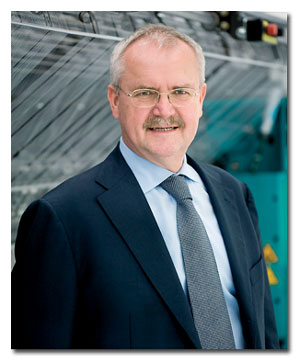
mayer
Fritz P. Mayer, chairman of the VDMA Textile Machinery Association


The VDMA’s Targets


The largest portion of member companies comprises medium-sized businesses. The main target
is to represent the interests of these companies to a variety of entities such as governments,
national and international authorities, exhibition corporations, organizations, research institutes
and service providers.


TW
: What are the association’s achievements?

Mayer: For a single company, it is hard to assert oneself to all the mentioned
groups. But with joined forces within the VDMA network, the member companies have a powerful voice.
In view of exhibitions, for instance, the VDMA Textile Machinery Association is a strong
negotiating partner whose substantial arguments count for the trade fair companies around the
world.


TW

: What advantages do association members enjoy?

Mayer: The benefits for member companies are networking, services and, as mentioned before,
the representation of interests. Networking is an important aspect. Besides their decision-making
function, the different committees of the association – namely the Executive Board and the Fair and
Marketing Committee as well as the Technical Advisory Board – are exclusive panels for the exchange
of experiences. In addition, the association offers member companies numerous events concerning
different topics. The service portfolio for member companies ranges from statistics, observation of
significant markets and reporting on the situation in the textile industries throughout the world,
and active support regarding political decisions relating to exhibitions, to a regular newsletter
and public relations. The VDMA road shows and symposia in key markets are highly appreciated by the
members. These events are platforms for getting in contact with decision-makers of textile
manufacturers in the respective countries. Furthermore, the association is active in promoting
junior engineers for the benefit of all member companies.


Technical Textiles And Nonwovens Group


TW
: Is there a separate technical textiles and nonwovens group within the VDMA, and if so, when
was it instated?

Mayer: Technical aspects of these topics are subject to the work of the Technical
Advisory Board of the VDMA Textile Machinery Association. The Fair and Marketing Committee also
deals with these issues, of course, from another perspective. Since 1999, nonwovens and technical
textiles have regularly been topics of activities – for instance, nonwovens machinery symposia and
networking meetings especially dedicated to these technologies.

Nearly all member companies of the association have, among other products, machinery and/or
components for the production of technical textiles in their portfolios. Some of them are doing a
substantial part of their sales with these technologies. For others, the contribution of this
machinery to overall sales is small at the moment, but for them, the objective is clear to increase
this share. Other members are completely focused on the nonwovens machinery sector.


TW
: What are the activities of the sector group? How are these activities organized, and what
advantages does the group offer its members?

Mayer: Sales support is an important activity. The association supports the member companies
by publishing buyer’s guides, one of them dedicated to nonwovens machinery. Information about the
portfolio of the members in this field is offered via Internet reports and press articles as well
as by organized symposia. Furthermore, members have the opportunity to exchange their experiences
in the nonwovens and technical textiles markets during association meetings and events. Members are
provided with market information by the association.


TW
: What advantages does the group offer the market?

Mayer: Well, the member companies active in the nonwoven and technical textiles
sector are focused on offering customers modern machines and best technologies for the production
of textiles for new applications. This is realized by offering tailor-made solutions.


TW
: What advice do you have for an interested party or producer of this sector’s products for
making contact with your members?

Mayer: A good information source is the association’s Internet sourcing service,
which enables an easy search for both products and companies: www.vdma.org/textile/
sourcingservice. In addition, it is worthwhile to check the website for special reports on
machinery for technical textiles. Interested parties are also welcome to order the new nonwovens
machinery buyer’s guide edition listing products and suppliers.


Market Situation


TW
: How do you see the current market situation?

Mayer: What the German textile machinery sector experienced in 2008 was by far the
strongest slump since World War II. In the period from January to November 2008, altogether
45-percent fewer orders have been registered than in the respective period of 2007. In 2008, the
incoming orders were nearly halved. Overall exports declined by 22 percent. A look at the five
biggest markets in 2007 – namely China, Turkey, India, Italy and the USA – and their development in
2008 underlines how missing orders affect production and delivery: The exports to China decreased
by 22 percent between January and November 2008 compared to the respective period in 2007. With a
fall in exports of 62 percent, the Turkish market nearly collapsed. The deliveries to India
witnessed a downturn of 30 percent; and those to Italy, a downturn of 23 percent. With a 29-percent
rise in exports, the US market performed well in 2008, especially related to increased investments
in nonwovens technologies. The nonwovens and technical textiles machinery business generally
performed better than other sectors. In 2008, the nonwovens machinery business reached
approximately the same level as in 2007.


TW

: Do members have some problems with the market situation?

Mayer: Yes, of course. Numerous member companies had to take drastic measures in
the last months, such as short-time work and even staff reductions.


TW
: Looking into the crystal ball, how do you view the coming years?

Mayer: This is a very difficult question. The uncertainties in the finance markets
and in the whole global economy impede a well-founded prognosis at the moment.

May/June 2009

Turkey Hosts Third ITM


I
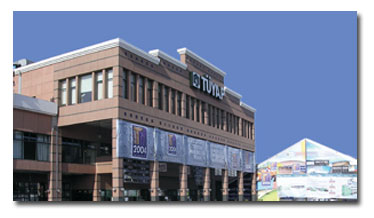
TM 2009, Turkey’s International Textile Machinery Exhibition, will return to the Tüyap
Fair Convention and Congress Center in Istanbul, Turkey, June 6-10. This is the third edition of
the show, held previously in 2004 and 2006 on a biennial cycle, and now on a three-year cycle.

The show is organized by Teknik Fuarcilik, Yayincilik ve Reklamcilik Tic. Ltd. Sti. and Tüyap
Tüm Fuarcilik Yapim A.S., with the help of supporting partners the Turkish Textile Machinery and
Accessories Manufacturers Association (TEMSAD) and the Turkish Textile Employers’ Association
(TTSIS).

itm
ITM 2009 will return to Tüyap Fair in Istanbul, Turkey, the site of the first ITM in
2004.

Since its inception, the show has grown steadily. Organizers report some 1,500 exhibiting
companies from 37 countries and 80,000 visitors are anticipated at ITM 2009. In 2006, the show
featured 1,200 exhibitors and more than 70,000 visitors, while ITM 2004 hosted 880 exhibitors and
more than 60,000 visitors.

At the upcoming edition, exhibitors showcasing a full range of textile manufacturing
technologies will fill 10 halls covering approximately 42,000 square meters at the Tüyap Fair.
Halls will be organized as follows:

•    Halls 1 and 4: computer-aided design, computer-aided manufacturing and
computer-integrated management applications and automation systems; and spare parts and
accessories;

•    Halls 2 and 3: cotton and yarn preparation and yarn twisting machinery,
nonwoven machinery and technical textile technology;

•    Halls 5 and 6: dyeing, printing and finishing machinery; and textile
chemicals, laboratory equipment and quality control systems;

•    Halls 7 and 8: weaving preparation and weaving machinery; and

•    Halls 9 and 10: flat and circular knitting machinery; and embroidery and
quilting machinery.

The International Knitting, Embroidery, Hosiery Machineries, Spare Parts and Accessories
Exhibition has been integrated into this year’s edition of ITM. Visitors from the knitting sector
will find an extensive selection of knitting technologies, including hosiery machinery on display
for the first time at an ITM event.

Visitors may view exhibits from 10:00 a.m. to 7:00 p.m., June 6-9; and from 10:00 a.m. to
6:00 p.m., June 10.

According to ITM organizers, textile manufacturers in Turkey – which globally is a major
textile machinery importer – have postponed investments in new machinery until after viewing the
newest technology at ITM 2009. In 2007, the three top exporters of textile machinery to Turkey were
Germany, with machinery valued at $559 million; Switzerland, $280 million; and Italy, $277 million.

Organizers also anticipate a number of textile investors from the Middle East will attend
this year’s show to plan their future investments.


For more information about ITM 2009, contact Teknik Fuarcilik Ltd. 90-212-592-59-92; fax
92-212-599-38-82;
info@teknikfuarcilik.com;
www.itm2009.com.

May/June 2009

Industry Employment Sags


T
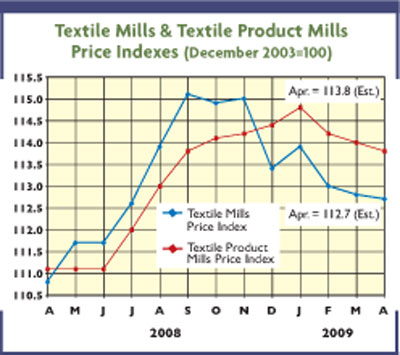
extile job numbers remain dismal. Over the past 12 months, for example, the number of
workers in basic textiles has plunged 19 percent. And the decline in more highly fabricated
products is put at 14 percent. Compare the current figures to those existing a decade ago, and the
slippage has been far more precipitous – 68 percent for basic textiles and 40 percent for more
highly fabricated products. And the picture is pretty much the same in the downstream apparel
sector, with comparable year- and decade-ago declines at 14 percent and 69 percent, respectively.
Nor is there any indication that this workforce erosion will bottom out anytime soon. New Bureau of
Labor Statistics projections call for about a 35-percent drop in textile and apparel employment
over the 10-year period ending in 2016.

Putting a positive spin on all this, however, is the fact that not all of this worker
drop-off can be attributed to declining industry activity. A good part, for example, can be traced
to increasing productivity, which has enabled the industry to meet any given demand with fewer and
fewer employees. And these productivity increases are expected to continue at near a 2.5-percent
annual rate through the foreseeable future. More importantly, these impressive efficiency gains are
probably one of the key reasons that the industry continues to survive and even show some profit in
today’s hotly competitive global marketplace.

MayJune09textilechart


An Improving Business Picture


US textile and apparel sectors should also be helped by the somewhat less dismal economic
outlook anticipated for the next few quarters. To be sure, the nation is still deep in the biggest
recession in more than 70 years. But there now seems to be some light at the end of the tunnel as
consumers and businesses make substantial progress in trimming the imbalances that precipitated the
downturn.

On the consumer front, sky-high family indebtedness is beginning to contract. Mortgage
commitments, which account for three-fourths of all household borrowing, have been declining for
three quarters in a row. Add in the fact that all the new Washington stimulus moves are starting to
boost consumer confidence, and retail sales should show at least a modicum of improvement in the
months immediately ahead.

On a business front, corporate cost-cutting and inventory retrenchment are pretty much
nearing completion, thus paving the way for some increased activity.

Finally, there’s Wall Street. True, the market is still quite volatile, but stock prices do
seem finally to have bottomed out. Given all the above, economists are predicting decelerating
gross domestic product losses, with the  6.3-percent tumble of late last year giving way to
only a 2- to 3-percent drop over the current quarter. And there could even be some fractional gains
toward year end. All this should slow down recent textile and apparel losses – though any outright
gains in these industries would still seem to be a long way off.


Trade Uncertainties


Big import question marks are also keeping the industry on edge. To be sure, incoming
shipments of textiles and apparel in early 2009 were down 14 percent. But this isn’t nearly as
encouraging as it might seem. The decline in US manufacturers’ shipments of textiles and apparel
over the same period were off 24 percent and 12 percent, respectively. Implication: The huge
foreign share of our overall textile and apparel market isn’t declining and may well be continuing
to grow. And that is particularly pertinent for our biggest textile supplier – China. The Chinese
situation will bear especially close watching because Washington seems to be easing its pressure on
Beijing for a further upward revaluation of its currency, the yuan. The Treasury Department is now
saying China is not manipulating the yuan to increase its exports. That’s not to say US officials
are happy about Beijing’s current currency and subsidy policies that clearly continue to make
Chinese products unrealistically cheap to US buyers. The problem is that our options are limited.
It’s far more important to keep China on our side, not only for crucial geopolitical reasons, but
also because that nation’s big economic stimulus program, along with our own, is clearly needed to
put the world back on the road to prosperity.

May/June 2009

VF Corp Acquires Mo Industries Holdings

Greensboro, N.C.-based VF Corp. – an apparel company with a diverse, international portfolio of
brands – now owns Mo Industries and its Splendid® and Ella Moss® brands after acquiring the
remaining two-thirds of the capital stock of Los Angeles-based Mo Industries Holdings Inc. for $161
million plus the repayment of $47 million in existing net debt. VF Corp. will fund the acquisition
through strong cash flow from operations.

VF Corp. initially bought one-third of the company from founder Moise Emquies and Summit
Partners, a private equity and venture capital firm, in June 2008. The Splendid and Ella Moss lines
– which have tripled revenues since 2004 and realized sales of $95 million in 2008 – will become
part of VF Corp.’s Contemporary Brands coalition. VF Corp. expects the new brands to contribute $70
million to company revenues in 2009, and hopes that despite the current slow economy, their
long-term revenues could grow by 10 to 15 percent.

In a related move, the company’s John Varvatos® mens sportswear brand will become part of the
Contemporary Brands coalition, shifting from its Sportswear coalition.

“We’re very pleased to be adding two strong and growing brands to our portfolio,” said Mike
Egeck, president, Contemporary Brands, VF Corp. “These brands not only complement each other well,
but they also complement our 7 For All Mankind® and lucy® brands. The addition of the Splendid and
Ella Moss brands and the move of the John Varvatos® business to our coalition provide us with the
ability to service the contemporary consumer and lifestyle in many different ways.”

At VF Corp., Emquies will hold the title of founder/CEO of Mo Industries and will report to
Egeck. Former Mo Industries CFO and COO Jonathan Saven is now president. Splendid and Ella Moss
Creative Director Pamella Protzel Scott will retain her position under the new organization.

“We’re excited to become part of the VF family of brands,” said Emquies. “This is a great
opportunity for both our business and our associates, and we look forward to partnering with VF to
leverage their size, scale and resources to continue to grow our business both domestically and
internationally.”

May/June 2009

Tuscarora, CloverTex Merge

Mount Pleasant, N.C.-based Tuscarora Yarns Inc. – a specialty yarn spinner with manufacturing
plants in Mount Pleasant, China Grove and Oakboro, as well as an international office in Gastonia,
N.C. – has merged with Clover, S.C.-based specialty yarn manufacturer CloverTex LLC. The merged
company will operate under the Tuscarora name and plans to maintain all existing facilities.
CloverTex CEO David M. Roberts has joined the executive group at Tuscarora’s corporate offices. The
companies aim to create an efficient, unified business for the production of innovative specialty
colored yarns for the United States, Central and South America, and other worldwide markets.

Tuscarora plans to install new spinning equipment to enhance and broaden its product lines
for specialty yarns.

In particular, seeing a gap in the marketplace with the recent closure of two spinning mills
in North Carolina, the company expects to expand its line of natural specialty yarns produced in a
recently opened facility.

May/June 2009

Sponsors