Top Trade Officials Seek Cooperation With China

Two top Obama administration trade officials have made lengthy comments regarding trade and
investments with China, emphasizing the need for cooperation and diplomacy to address the worldwide
economic crisis. They made only scant references to problems with China trade, such as the trade
deficit, currency manipulation, intellectual property violations and illegal subsidies; but they
emphasized the need for a “positive, cooperative and comprehensive relationship.”

In an address at Peking University in Beijing, Treasury Secretary Timothy Geithner said
“global problems will not be resolved without US/China cooperation.” He added that the United
States and China already are working together to help shape a strong global strategy to contain the
world global economic crisis and lay the foundation for recovery.

Turning to trade issues, Geithner said China will have to make a “very substantial shift”
away from export growth to growth made possible by more domestic consumption. In addition, both
countries must cooperate to ensure that the global trade and investment environment remains open,
he said, and opportunities for trade need to expand.

In a brief reference to one of the thorniest issues – China’s alleged currency manipulation
to gain an advantage in trade – Geithner said the Chinese government needs to “continue progress
toward a more flexible exchange rate regime.” There was no mention of any of the retaliatory
measures being considered by Congress with respect to currency manipulation or illegal subsidies.

In an address here at home  at the annual meeting of the US-China Business Council, US
Trade Representative Ron Kirk said President Barack Obama believes the United States needs a “new
fundamental framework for trade” that will make Americans feel the benefits of trade far more than
its costs. He said the administration believes the United States needs to have trade agreements
that incorporate strong labor and environmental standards and that it needs to do a better job of
enforcing its trade agreements. He warned that China must do more to enforce intellectual property
rights and standards for the environment and labor and product safety.

While Kirk said the “preferred course” for dealing with Chinese trade issues is diplomacy, he
warned that if diplomacy fails, the United States will not hesitate to use all of the tools at its
disposal including the dispute mechanism in the World Trade Organization and applying US trade
remedies “fully and fairly.”

Kirk said the administration is “committed to working positively and cooperatively with
China,” but that “we will always put the interests of American businesses and workers at the fore.”

June 9, 2009
Quality Fabric Of The Month: Kenaf — From Temporary Tensile Structures Into Paper Products

Kenaf, a fast-growing plant that absorbs carbon dioxide at one of the highest rates of any plant, is taking its place in the sustainable architecture arena as the raw material for an environmentally friendly biomass architectural fabric membrane that can be used in temporary
installations to cover large areas but which at the end of its useful life can be fully recycled into paper products that traditionally would be made from wood pulp. Birdair Inc. – a Buffalo, N.Y.-based designer and builder of lightweight tensile structures and long-span roofing systems,
and a member of the Japan-based Taiyo Kogyo Group – is offering the membrane, branded Kenafine® and manufactured by Taiyo Kogyo, in North America. According to the company, Kenafine is the first and
only fully recyclable architectural fabric membrane available worldwide.

The bast fiber of the kenaf plant, a member of the mallow family that includes hibiscus and okra, traditionally has been used in Asia and Africa to make cordage. More recently, it has generated interest in the United States and other countries as an annually renewable source of fiber for a range of applications including pulp and paper products as well as insulation, animal bedding, decorative fibers and fabrics, oil absorbents, and various other uses.

According to Birdair, Kenafine, which has a durability range of five to six years, is especially appropriate for use in temporary structures, for example, a venue for an Olympic competition or other short-term event. Comprising a kenaf/polyester base fabric coated with a thermoplastic resin, the membrane contains no polyvinyl chloride and therefore produces no toxic emissions when burned, but the entire product is fully recyclable into paper products via a water-based process that uses no chemicals, unlike the process for making paper from wood pulp.

birdairshade


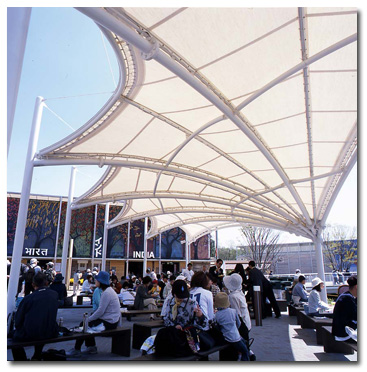
The shade shown above was one of several temporary tensile structures


featuring Kenafine® architectural fabric membrane
at EXPO 2005 in Aichi, Japan. The newest version of the membrane is offered in North America
by Birdair Inc.


Kenafine functions similarly to traditional architectural fabric roofing membranes as a highly moisture-resistant, translucent covering that provides an optimal level of natural daylighting. Use of the membrane also enables structures to receive credits in a range of US Green
Building Council Leadership in Energy and Environmental Design categories.

“Kenafine is a unique step forward in realizing sustainable design through tensile architecture,” said Michele Roth, marketing manager, Birdair. “The ability to now be able to recycle fabric membrane into paper products makes tensile design both an environmentally
responsible and aesthetically pleasing addition to the building envelope.”

Taiyo Kogyo has built several structures in Japan using Kenafine, including facilities featuring an initial version of the membrane at EXPO 2005, The 2005 World Exposition, themed “Nature’s Wisdom” and held for six months in Aichi, Japan.  That first product was designed
for structures that would be used for no longer than one year. Taiyo Kogyo subsequently partnered with Japan-based textile manufacturer Sakai Ovex Co. Ltd. to improve the durability of the material
to more than five years by adding the thermoplastic coating on both sides of the fabric. The newer version of Kenafine debuted on the occasion of the G8 Hokkaido Toyako Summit from June through
August 2008, when it covered the Toyako Visitor Center Eco Gallery – an 800-square-meter structure that housed the Hokkaido branch of the Ministry of the Environment’s environmental learning exhibition.

For more information about Kenafine®, contact Michele Roth, 716-633-9500, mroth@birdair.com.

June 2009

The Rupp Report: Decline Of Global Textile Machinery Shipments In 2008

According to the latest report from the International Textile Manufacturers Federation (ITMF),
Switzerland, the period of heavy investments in most textile machinery segments between 2003 and
2007 ended abruptly in 2008. All segments recorded shipments ranging from 3 to 66 percent lower in
2008 compared to 2007 shipments.

China (Was) The Leader

ITMF says the investment boom until 2007 was closely related to China’s integration into the
World Trade Organization (WTO) structures and the termination of the traditional quota regime under
the WTO Agreement on Textiles and Clothing. Trade in textile and apparel products no longer is
subject to quotas but now is governed by the general rules and disciplines embodied in the WTO’s
multilateral trading system.

The report covers spinning, texturing, weaving, large circular knitting, flat knitting and
finishing machinery. The 2008 survey has been compiled in cooperation with some 133 textile
machinery manufacturers around the globe.

Spinning

Compared to 2007, global shipments of short-staple spindles dropped in 2008 to 8.64 million
spindles — a 33-percent reduction. Nevertheless, this is still well above pre-investment boom
levels. By far the largest part of this new machinery was absorbed by Asia – 8.31 million or 96
percent. China installed 3.69 million spindles, 43 percent of global shipments; followed by India,
2.53 million or 29 percent; Bangladesh, 642,000 or 7 percent; Vietnam, 580,000 or 6.5 percent;
Indonesia, 250,000 or 2.9 percent; and Pakistan, 238,000 or 2.8 percent.

Global shipments of long-staple wool spindles decreased slightly in 2008 to 143,000, a
3-percent drop. While shipments to Asia rose by 17 percent to 115,350 – mainly as a consequence of
higher investments in India and Indonesia – they fell in Europe, including Turkey, by 54 percent to
18,700. Shipments to South America remained almost unchanged at approximately 7,000, while North
America recorded shipments in 2008 of 2,500 spindles, compared with none in 2007. Unlike the
previous year, Africa did not invest in long-staple spindles in 2008.

After an exceptional skyrocketing increase in 2007 to 576,000 open-end (OE) rotors – an
increase of 68 percent compared to 2006 – 2008 investments in OE rotors plummeted by 66 percent to
195,650. Taking delivery of 143,350 rotors or 73 percent of the total, Asia again was the main
recipient of OE rotors. China’s global share reached 46 percent or 89,200; followed by Brazil, 13
percent or 24,400; India, 9 percent or 17,700l and Bangladesh, 6 percent or 12,000. After an
extraordinary investment boom in Turkey in 2007, shipments of OE rotors to that country dropped
considerably in 2008 from 135,800 to only 7,500.

Texturing

Shipments of single-heater draw-texturing spindles for polyamide fell by 20 percent to 5,230
in 2008. China was by far the biggest investor, with 4,300 spindles, representing 82 percent of the
total; followed by Thailand, 430 spindles or 8 percent. Shipments of double-heater draw-texturing
spindles for polyester dropped by 34 percent to 163,000 – back to pre-investment boom levels. The
biggest investor again was China, with 62,600 new spindles or 38 percent of global investment;
followed by India, 45,000 or 27 percent; Syria, 10,800 or 7 percent; Japan, 7,400 or 5 percent; and
Vietnam, 7,000 or 4 percent.

Weaving

Investments in shuttleless looms also plummeted in 2008 — dropping by 34 percent to 44,800
machines – to the lowest investment level since 2000, the first year shipments of Chinese textile
machinery manufacturers were included in this survey. Almost 40,000 machines — 90 percent of the
total — went to Asia. China again was by far the biggest recipient of shuttleless looms, having
installed 28,600 or 65 percent of total shipments in 2008. With 3,300 and 3,050 or 7 percent,
respectively, India and Bangladesh came in at a distant second and third; followed by Indonesia,
1,700 or 4 percent; and Brazil, 830 or 2 percent.

Circular And Flat Knitting

Circular knitting machine shipments recorded a 21-percent fall to 21,150 in comparison to
2007. This was the lowest level during the past five years, but still considerably higher than
pre-2004 levels. Taking 87 percent of shipments, Asia was the preferred region of investments in
circular knitting machines. Again, China recorded the highest portion, with 14,400 or 68 percent of
global shipments. Bangladesh ranked second with 1,070 machines or 5 percent; followed by India, 850
or 4 percent; Turkey, 600 or 3 percent; and Indonesia and Brazil, 530 or 2.5 percent each.

On the other side, the decrease of global textile machinery shipments was less pronounced in
the segment of electronic flat knitting machines, which reported 2008 shipments down by 7 percent
to 20,300. The bulk of shipments went to Asia. which received 88 percent, with Europe absorbing
10.5 percent. Once more, China was the biggest single investor, receiving 8,970 machines or 44
percent; followed by Hong Kong, 7,110 or 35 percent; Italy, 1,120 or 6 percent; Turkey. 760 or 4
percent; and Cambodia, 620 or 3 percent.

June 9, 2009

PGI To Close North Little Rock Plant, Consolidate Certain Operations At Benson Plant

Charlotte-based nonwovens producer Polymer Group Inc. (PGI) has announced it will close its plant
in North Little Rock, Ark., with plans to phase out operations by the end of March 2010 and
consolidate parts of its hydroentanglement and fusible fiber businesses at its plant in Benson,
N.C., in an effort to increase efficiency and minimize costs. The company cited decreased demand
for select industrial products and the need to upgrade process capabilities in announcing the
consolidation.

“PGI’s focus on leading market positions and global growth requires a constant assessment of
our capabilities compared to the market needs,” said Veronica “Ronee” Hagen, CEO, PGI. “As certain
market segments for carded technologies increasingly become commoditized or transition to more
cost-effective technologies, we must constantly streamline business operations and enhance our
capabilities to maintain competitiveness. As a result of these activities, we will be upgrading our
overall asset base to better meet market needs.”

The North Little Rock plant opened in 1956 and became part of PGI in 1995 when the company
purchased Chicopee Inc. from Johnson & Johnson. After PGI completes the consolidation, it will
continue operating seven plants in the United States, located in Benson; Mooresville, N.C.;
Waynesboro, Va.; Kingman, Kan.; Clearfield, Utah; Guntown, Miss.; and Clackamas, Ore. 

June 9, 2009

Trevira Files For Bankruptcy

Germany-based Trevira GmbH – a company of the India-based Reliance Group and a manufacturer of
high-value branded polyester fibers and filament yarns for the apparel, home textiles and
automotive industries as well as hygiene and technical applications – has filed for bankruptcy. The
action follows the company’s efforts to combat the impact of the industrial decline in Europe,
particularly in the automotive and textile sectors. Trevira recently announced restructuring plans
that included the appointment of restructuring expert Elke Bäuerle as new managing director

(See “Trevira Begins Restructuring,” www.TextileWorld.com, May 19, 2009)
.


June 9, 2009

Universal Fibers® Garners Innovative Green Design Award For ReFresh® Fibers

Universal Fibers® Inc., a Bristol, Va.-based manufacturer of solution-dyed man-made-fiber carpet
yarn, has been honored by New York House magazine as a winner in its inaugural Innovative Green
Design Awards. Universal’s ReFresh Fibers®, made using a multi-step process that converts
post-consumer carpet into useable nylon 6,6 fiber, were recognized in the Flooring/Floor Coverings
category. Award recipients were selected based on a number of criteria including: use of greenest
materials and green innovation; most sustainable methods of production; energy efficiency; minimal
carbon footprint; and design appeal.

“The caliber of entries in our first-ever Innovative Green Design Awards was inspiring,” said
Jonathan A. Schein, CEO and publisher, ScheinMedia. “We at New York House celebrate not only the
winners, but all efforts to promote true sustainability.”

“We are so excited to be recognized by those in the industry who understand the importance of
improving our processes and products to be better stewards of our environment,” said Bill Goodman,
vice president of sales and marketing, Universal Fibers. “Universal Fibers strives to be a pioneer
in environmental stewardship while continuing to create a superior product for our customers. This
award confirms that we are achieving that goal.”

Universal manufactures its products based on a sustainable program called EarthSmart
Technology®, which promotes an attitude of environmental and social concern by the company and its
employees while maximizing manufacturing processes and equipment, developing waste-saving systems,
promoting facility conservation, and developing recycled and recyclable product.

June 9, 2009

AATCC International Conference Colocates With ATME-I/Megatex, TTNA And SPESA

The American Association of Textile Chemists & Colorists (AATCC), Research Triangle Park, N.C.,
has announced it will colocate its International Conference alongside three other US-based textile
industry trade shows – the American Textile Machinery Exhibition – International (ATME-I)/Megatex,
Techtextil North America (TTNA) and SPESA Expo – at the Georgia World Congress Center in Atlanta
for Textile & Sewn Products Industry Week 2010, scheduled to take place May 18-20, 2010

(See “Three Major Textile Trade Shows To Colocate In Atlanta In 2010,” www.TextileWorld.com,
May 6, 2008)

. The event will allow attendees to take in all four exhibitions in one location and also will
offer networking opportunities, educational seminars and business and technical workshops.

The US Department of Commerce is promoting the colocated shows through its International
Buyers Program, which recruits qualified foreign buyers to attend some 35 selected trade shows
annually.

June 9, 2009

APDN Uses SigNature® DNA To Mark Raw Cotton Fibers

Applied DNA Sciences Inc. (APDN), a Stony Brook, N.Y.-based provider of DNA encrypted and embedded
authentication solutions, announced it has successfully marked more than 500,000 pounds of raw
cotton fiber with its patented SigNature® DNA solution as part of a collaborative pilot study
conducted in partnership with a major US cotton producer. According to the company, this is the
largest use of a commercial DNA marker to date.

The project complements APDN’s Biomaterial™ Genotyping platform, known as “Fibertyping,”
which tracks cotton’s native DNA and authenticates it. Native DNA can be used to identify the plant
cultivar and country of origin of the cotton fiber. SigNature DNA markers enable a producer of
natural or man-made fibers to track specific batches of fiber through to finished textiles and
apparel.

“SigNature DNA is very versatile,” said Dr. James Hayward, CEO, APDN. “It can be embedded
into any fiber or polymeric raw material used in technical textile products. Medical textiles,
protective clothing, performance clothing for work or outdoor activities, as well as nonwoven
materials, can also benefit from SigNature DNA identification and authentication. SigNature markers
can enable any manufacturer of synthetic fibers or any farmer of natural fibers to trace the
inclusion of their fibers in retail goods.”

According to the National Cotton Council, cotton is America’s premier value-added crop and is
the main fiber used in apparel. Counterfeiting and fraud have become important issues in the
apparel and textile industries, creating a need to validate the original cotton fiber used
throughout the cotton supply chain.

June 9, 2009

Thrace-Linq Commissions NSC Nonwoven Needlepunch Line

Summerville, S.C.-based Thrace-Linq Inc. – a manufacturer of woven and nonwoven polypropylene
geosynthetic technical fabrics; and a member of The Thrace Plastics Group, a subsidiary of
Greece-based Thrace Plastics Co. S.A. – recently commissioned a state-of-the-art needlepunch line
from France-based NSC nonwoven.

Burnsville, N.C.-based Ford Trimble & Associates – a supplier of equipment and systems
for the production of nonwovens, technical fabrics and traditional wovens – worked with Thrace-
Linq and NSC nonwoven to deliver the high-performance line for technical fabrics that met
Thrace-Linq’s specifications.

“Our newest nonwovens line brings Thrace-Linq into the new millennium, and the purchase
allows us to maintain focus on our key target markets, strengthen our core competencies and
accelerate growth while improving operational efficiencies and returning shareholder value,” said
Davis Taylor, vice president, Thrace-Linq.

June 9, 2009

WestPoint To Produce Izod Home Goods

New York City-based apparel and accessories manufacturer and marketer Phillips-Van Heusen Corp.
(PVH) has licensed WestPoint Home Inc. – a New York City-based manufacturer and marketer of bed and
bath home textiles – to design, produce and market a collection of bed, bath and kitchen products
under PVH’s Izod brand.

WestPoint Home will sell Izod-branded sheets, bedding, bath towels and accessories, blankets
and throws, down comforters, pillows and mattress pads to department and specialty stores in the
United States beginning in Spring 2010.

June 9, 2009

Sponsors