Kraton Introduces Nexar™ Polymers

Houston-based Kraton Polymers LLC – a global producer of engineered polymers and styrenic block
copolymers (SBCs) – has introduced Nexar™ polymers for use in applications including water
desalination, industrial separation and enhancement of high-performance textiles and apparel. The
polymers provide permselectivity in coatings and membranes, allowing moisture to flow in one
direction while preventing other substances such as potentially harmful chemicals from passing
through. According to Kraton, the nonporous membranes offer benefits including high strength in wet
and dry environments and improved performance as temperatures rise; and they will not clog or lose
performance abilities over an extended period of time.

“We are pleased with the positive customer responses we have received since we introduced
Nexar polymers,” said Jim Dieter, vice president of marketing development, Kraton. “The early
success of Nexar polymers is a good indication of the interest in an innovative moisture-management
system that is compatible for high performance athletic apparel, outdoor survival equipment (tents,
sleeping bags etc.), military uniforms and biochemical garments. We strongly believe Nexar
polymers’ superior performance is unmatched by the competitive materials currently available in the
marketplace.”

Kraton reports that Nexar polymers can easily be applied as either a single- or
multi-laminate process using current commercial equipment.

September 1, 2009

Greenology Selects SmartSilver™ For Do No Harm Scrubs

Dallas-based Greenology USA LLC has selected SmartSilver™ – a nanoscale silver antimicrobial
additive developed by State College, Pa.-based NanoHorizons Inc. – to provide permanent
antimicrobial properties to its Do No Harm™ line of medical scrubs. The scrubs contain recycled
fibers that are Oeko-Tex®-certified free from hazardous levels of more than 100 substances believed
to be harmful to human health.

“In order to live up to the Do No Harm ideal of scrubs that do no harm to the planet, to
patients, or to the medical personnel themselves, we needed to select our antimicrobial additive
with great care,” said Jim Noble, vice president, sales and marketing, Greenology. “SmartSilver met
every performance and sustainability criteria we set.”

“SmartSilver was developed originally for the medical market,” said Dr. James Delattre, vice
president, global marketing, NanoHorizons. “Now that SmartSilver additives are available for
textile and apparel applications, partnering with Greenology to launch a line of antimicrobial
scrubs is the perfect extension.”

September 1, 2009

Gehring And Massif Partner To Supply FR Products To Military

Garden City, N.Y.-based Gehring Textiles Inc. – a manufacturer of warp- and circular-knit fabrics
for markets such as aviation and aerospace, military, fire prevention, utilities, medical equipment
and apparel, outdoor apparel, and activewear, among others – and Ashland, Ore.-based Massif
Mountain Gear Co. – a supplier of flame-resistant (FR), high-performance outdoor apparel for
markets such as military, law enforcement, and fire prevention, among others – are collaborating to
develop and supply a new generation of FR fabrics and apparel to global military forces. Gehring
will supply the newly developed fabrics exclusively to Massif, which will use them for military
apparel, headwear and gloves. The companies report they have begun developing several products that
will provide the military with improved protection and performance.

“This is an exciting collaboration between two product focused companies with a penchant for
innovation,” said Skip Gehring, president, Gehring. “Our shared expertise in fabric development
coupled with Massif’s outstanding garment development and customer service capabilities will enable
this team to invent the next generation of protective apparel for our troops.”

Gehring also will provide certain styles of its current line of FR fabrics to existing
customers. Last year, the company purchased Norton, Mass.-based Tweave Inc., a manufacturer of two-
and four-way stretch woven fabrics, and the first weaving mill globally to produce spandex fabrics
(See ”
Gehring
Textiles Acquires Tweave
,” November 18, 2008)
. That acquisition has expanded Gehring’s
manufacturing capabilities for the markets it serves.


September 1, 2009

Textiles Exempt From Lead Testing Requirements

The Consumer Product Safety Commission (CPSC) has decided to exempt virtually all textile products,
including natural and manufactured fibers, from the lead testing requirements of the Consumer
Products Safety Improvement Act (CPSIA).

In making the announcement, CPSC Chairman Inez Tenenbaum said the staff had reviewed hundreds
of test reports submitted by interested parties and concluded that most textile products are
manufactured using processes that do not introduce lead or result in an end product that would
exceed the CPSIA lead limits. The blanket exemption does not apply to all products that may be
altered by dyeing or printing, but the commission said the exemption could apply in most
circumstances. Specific guidelines for those processes will be outlined in a forthcoming Federal
Register notice.

A notice published by CPSC on its website listed the following exempt textile fiber products:
•    natural fibers – cotton, silk, wool, hemp, flax, ramie, linen, jute,
kenaf, bamboo, coir, sisal, kapok, alpaca, llama, mohair, cashmere, angora, camel, horse, yak,
vicuna, qiviut and guanaco.

•    manufactured  fibers – rayon, nylon, lyocell, acetate triacetate,
rubber, polyester, olefin, nylon, acrylic, aramid, azion and spandex.

Components of apparel products such as buttons, snaps, zippers, trim and fasteners are not
exempt.

Tenenbaum said this determination does not address every issue of every manufacturer using
these kinds of materials, and the commission will take action on component testing in the future to
clarify what is required of products made up of some component materials.

August 25, 2009

The Rupp Report: Intertextile Shanghai With Same Size

With 115,000 square meters of display space reserved in 10 halls, the 2009 Intertextile Shanghai
Apparel Fabrics show will take place again at the Shanghai New International Exhibition Center
(SNIEC), October 20-23, 2009. As one of China’s premier textile trade events, the show brings
together exhibitors and prospective buyers in an organized manner and offers suppliers a trade
platform for conducting business directly on-site.

Last year, more than 49,000 visitors from 85 countries and regions attended the well
organized show, including key buyers from apparel fabrics-related importers, wholesalers,
manufacturers and designers. With its diversified and extended product range, Intertextile Shanghai
Apparel Fabrics provides an important business framework for textile trade in China.

Gate To The Domestic Market

Organizers report the show is an ideal business platform for entering the Chinese market.
Each autumn, thousands of textile fabric manufacturers show their latest designs and fabrics,
including group exhibitors Invista, Lenzing, Dow and Cotton USA, which will demonstrate the various
functions of their materials throughout the event. In addition to featuring key suppliers from
China and abroad, the exhibition will have special overseas pavilions: Germany will present a
series of high-tech fabrics; Japan, high-quality fabrics; Italy, sophisticated designs; Korea,
fancy womenswear and Taiwan, functional fabrics.

Among the many fabric mill suppliers participating in Intertextile Shanghai Apparel Fabrics
are exhibitors from several European Union (EU) countries including Austria, Belgium, France and
Great Britain. As mentioned, Italy and Germany will be present in country pavilions. The event in
Shanghai plays an important role in contributing to textile trade between Asia and the EU.

Chinese Market Remains Stable

Despite the global economic crises, China’s domestic consumption continues to rise, and its
growth is expected to remain stable at a rate of 6.5 percent, resulting in a marketplace rich with
opportunities for apparel fabrics suppliers and manufacturers. China’s customs statistics reported
a rise of 12.91 percent in 2008 over 2007 in textile imports from the EU. This segment of the
textile and garment industry in China reflects the growth in consumer wealth demand for
higher-quality fabrics.

Support From The Government

Reinforcing the region’s commitment to furthering trade is the Chinese government’s pledge to
continue buying from the EU. China is sending buyer delegations from the textile and garment sector
to visit fabric mill suppliers across the EU.  Led by the China Chamber of Commerce for Import
& Export of Textiles (CCCT), the trips will include important industry discussions on imports,
investment and brand cooperation. Many experts believe the Chinese government’s support and
cooperation are necessary in order to restore growth, expand trade and to help boost the overall
global financial system. It also signifies the Chinese government’s essential role in maintaining
and developing international trade.

Intertextile Shanghai Apparel Fabrics 2009 is organized by Messe Frankfurt (HK) Ltd and the
Sub-Council of Textile Industry, CCPIT-Tex and the China Textile Information Centre. More
information is available at
textile@hongkong.messefrankfurt.com.

Source: Messe Frankfurt (HK) Ltd.

August 25, 2009

Polysols Inc To Locate New Facility In South Carolina

The South Carolina Department of Commerce and the Economic Futures Group of Spartanburg County have
announced that Polysols Inc. – a subsidiary of Germany-based Polywert GmbH, a manufacturer of
nonwoven heat and sound insulation materials using recycled polyester fiber – is investing $1
million to establish its new manufacturing facility in Spartanburg County. Polysols’ plant will
recycle polyester fiber production waste materials into new products, the first of which will be
equine footing material. The enterprise is expected to create 10 new jobs.

“We are pleased to locate our first US facility in the Upstate of South Carolina,” said
Christoph Bock, treasurer and member of the Board of Directors, Polysols Inc. “Spartanburg County
is an excellent fit for our company, providing us with an excellent business environment, an
excellent labor force and great market access. We appreciate all the support we’ve received from
state and local officials.”

“We are extremely pleased that Polysols Inc. is locating a new facility here,” said Carter
Smith, executive vice president, Spartanburg County’s Economic Futures Group. “Polysols decision to
locate their facility in Spartanburg County adds to our growing list of ‘green’ companies, as their
process reduces wastes that could end up in a landfill. Their decision also demonstrates our
community’s ability to attract quality companies providing excellent job opportunities for the
citizens of Spartanburg.”

August 25, 2009

Zschimmer & Schwarz Acquires TEMA’s Colormix Division

Germany-based Zschimmer & Schwarz GmbH & Co. KG – a producer of high-performance chemical
auxiliaries for textile, fiber, ceramic, leather, fur and other applications – has acquired
Italy-based T.E.M.A. S.p.A.’s Colormix business, which supplies tintometric solutions and
integrated color management systems for the textile, ceramic, paint and inks industries. The
acquisition will strengthen Zschimmer & Schwarz’s global position in the ceramic auxiliary
industry.

Colormix – including all product development, manufacturing and customer service operations –
will be integrated into ZS Tech Srl Technology Solutions in Sassuolo, Italy. All Colormix
specialized personnel and its customer base are included in the acquisition. 


August 25, 2009

PGI To Sell FabPro Unit To Tricor Pacific Capital

Charlotte-based nonwovens manufacturer Polymer Group Inc. (PGI) has announced it will sell its
wholly owned subsidiary, FabPro Oriented Polymers LLC, to an affiliate of Tricor Pacific Capital
Inc., a private equity firm with offices in Chicago and Vancouver, British Columbia, as part of
PGI’s strategy to focus on its core nonowovens business in the hygiene, medical, wipes and
industrial markets.

Kingman, Kan.-based FabPro was established in 1975 as a greenfield operation for Exxon
Chemical Co. and was acquired by PGI in 1998. FabPro manufactures high-performance polymers and
man-made fibers for agricultural, construction, and commercial applications. The sale will include
its manufacturing plants in Kingman and Clearfield, Utah; and a converting facility in Guntown,
Miss.

“We are proud to add a high-quality asset like FabPro to our portfolio,” said Brad Seaman,
Tricor Pacific Capital. “FabPro has top leadership positions in the agriculture and construction
segments in North America and recognized brand names. We are eager to assist the management team in
executing their growth plans and see strong growth potential as synthetic fibers increasingly
replace steel and wire in many applications.”

The transaction is expected to be completed before the end of September.

August 25, 2009

NCTO Leaders Discuss State Of Textile Industry


L
eaders of the National Council of Textile Organizations (NCTO), at its annual meeting
held recently in Washington, took a look at the state of the industry and where it is likely to be
headed in the near future. Despite some positive developments, there also are difficult times
ahead. On the plus side are signs Congress and the Obama administration seem more inclined than
Congresses and administrations in recent years to address some industry issues, particularly in the
area of international trade. But on the other hand, the worldwide recession, a chronic trade
deficit and a global oversupply of production present daunting challenges.

In an overview of industry conditions, NCTO Chairman Anderson Warlick, Parkdale Mills Inc.,
cited significant accomplishments during the past year, but he warned the industry must step up its
efforts to have a greater impact on issues being addressed in Washington. Warlick said that while
the industry faces a variety of issues, “the greatest threat is apathy,” and he challenged every
CEO in the industry to become more involved in Washington-related issues and make it a part of
their daily jobs. He cited increased funding for the NCTO political action committee, “Hill to
Mill” visits by members of Congress to manufacturing facilities and contacts executives made with
their representatives in Washington as key elements in some of the successes the industry enjoyed
in the past year.
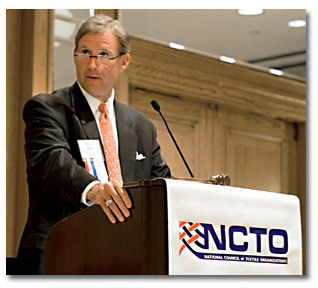
NCTOWarlick

NCTO outgoing Chairman Anderson Warlick said

the textile industry must broaden its political reach

if it hopes to influence government decisions

impacting the industry. He called on

industry CEOs to join with NCTO in an

effort to become more politically active.


Major Accomplishments Seen


NCTO cited a number of successful efforts during the past year, including a reinvestment
program for cotton textile products that could provide US textile mills with as much as $75 million
annually for capital investments. Under the program, mills may receive 4 cents per pound of
eligible cotton used and must use the funds to invest in updating plants and equipment. The program
is seen as a key element in making the industry more competitive.

Another major accomplishment was getting a letter from President Barack Obama saying he is
“especially aware of the trade challenges faced by those working in our textile industries.” Obama
gave his support for a textile import monitoring program to pin down problem areas and said he
would use the monitoring system to ensure that imports from China do not violate applicable laws
and treaties.  He endorsed the idea of Buy American requirements for textile purchases by the
Department of Defense (DoD) and other agencies, and he also supported a yarn-forward provision in
free trade agreements to ensure that those special trade agreements do not become conduits for yarn
and fabric sources outside of the participating countries.


Also in the past year, and continuing into this year, NCTO developed a strategy to deal with
problems arising from the elimination of Chinese safeguard import quotas including a statistical
monitoring program and consideration of trade remedy actions under US anti-dumping and
countervailing duty laws. It also is looking for violations of World Trade Organization (WTO)
rules. The industry succeeded in getting Congress to extend for two years a trade agreement with
Colombia, Peru and Ecuador that grants duty-free access to the US market for apparel made from US
yarn and fabrics. In order to combat illegal textile and apparel imports, Congress funded $9
million specifically for textile customs enforcement. And after years of failed efforts, the
industry and its supporters in Congress got the DoD Buy American textile and apparel procurement
requirement expanded to include agencies of the Department of Homeland Security.

Despite these and other accomplishments, NCTO sees some major problems on the horizon.


Global Trade Outlook


At the meeting’s opening session, Robert Antoshak, president of FCStone Fibers and Textiles,
a global consulting firm that keeps a close watch on textile trade developments, outlined a number
of major challenges the US textile industry faces in today’s global economy. He predicted major
changes in textile trade as nations cope with the combination of the global recession and
overcapacity not only in manufacturing, but also with retailers. He warned that prices are being
squeezed downward and there is little room to pass on rising costs. The key to success, and even
survival, Antoshak believes, lies in a textile company’s ability to make high-value products and
manage the risks in today’s changing business climate. That, he says, will require four basic
elements: doing a better job of managing costs; placing more emphasis on technology; developing new
products; and using better marketing techniques. He predicted the next year and beyond will see
more volatility in textile trade, with many risks, but he believes those companies that attempt to
understand those risks and have plans to address them will survive.
NCTOtable


Ambitious Trade Agenda


Looking ahead, NCTO leaders have an ambitious trade agenda as they seek ways to cope with a
persistent trade deficit, continuing job losses and what they believe are unfair trade practices
running rampant throughout the world, particularly in China. They see a need to find ways to combat
unfair trade practices and open more overseas markets to US goods through bilateral and regional
trade agreements, and they will be making efforts to remove barriers that make it difficult if not
impossible for US exports to enter a number of markets. High on the agenda is an effort to do
something about Chinese currency manipulation, which they believe is an illegal subsidy that gives
China an unfair advantage in international trade. NCTO has joined with other affected industries
and labor unions in a broadly-based Fair Currency Coalition that has launched a renewed effort to
support legislation pending in Congress that would declare currency manipulation an unfair trade
practice and provide for greater use of US anti-dumping and countervailing duty laws to offset that
trade advantage. Although similar anti-currency-manipulation legislation died in the last Congress,
it appears to be gaining more bipartisan support in the current Congress. NCTO also strongly
supports textile import monitoring programs conducted by two government agencies and designed to
pinpoint problems with import surges and illegally subsidized imports. These efforts could result
in impositions of tariffs and/or quotas.

In addition to addressing the currency issue, NCTO will launch major efforts under three new
initiatives during the coming year. It has joined with other import-impacted industries to support
legislation that would address a long-standing problem with value-added tax programs used by many
US trading partners. It also supports legislation that would permit duty-free treatment for
finished apparel imports that use US-made yarn and fabric, and it is considering filing cases with
the US International Trade Commission seeking relief from import surges from China in a number of
product categories in which safeguard quotas were removed at the beginning of this year.

NCTO also is keeping a wary eye on efforts to restart the WTO’s deadlocked Doha Round of
trade liberalization talks, as textile manufacturers have problems with some proposals currently on
the negotiating table.

July/August 2009

Select Comfort Offers In Balance™ Sheets With Outlast® Technology

Boulder, Colo.-based Outlast Technologies Inc., developer of Outlast® temperature-regulating
technology and phase-change materials (PCMs) and applications, has announced that Minneapolis-based
Select Comfort Corp. has added a sheet set and lightweight blanket to its line of In Balance™ sleep
products featuring Outlast technology. Select Comfort’s Outlast Sleep System also includes Sleep
Number® mattresses, mattress pads and layers, and pillow protectors.

Outlast technology features microencapsulated Thermocules™ that absorb excess body heat,
store it and then release it when the body is cold, thereby balancing a sleeper’s skin temperature,
according to Outlast. The company reports the Outlast Sleep System of bedding products provides
optimal sleep for everyone from normal sleepers to thermally incompatible couples and women
experiencing menopause.

The 350-thread-count, machine-washable In Balance sheets and pillowcases are made using a
50-percent cotton/50-percent Outlast Viscose fiber blend.

August 25, 2009

Sponsors



