DuPont Forms Protection Technologies Business Unit

Wilmington, Del.-based DuPont has merged its Advanced Fiber Systems, Nonwovens and Personal
Protection businesses into DuPont Protection Technologies, based in Richmond, Va. Products and
technologies offered include Tyvek® and Sontara® nonwovens, Kevlar® and Nomex® advanced fibers, and
Tychem® protective apparel, among other offerings.

“We believe we will be able to quickly simplify internal processes, increase the speed of
decision-making, and more fully leverage our large investments in research and development across
market segments,” said Thomas G. Powell, vice president and general manager of the new business,
who formerly led Advanced Fiber Systems. “These changes will lead to more rapid innovation and
improve our responsiveness to customers.”Production and research facilities of the three businesses
will continue to operate as before. “These businesses … represent applications and technologies
that DuPont is counting on for future growth. We are committed to continuing to invest in capacity
and innovation to meet the current and future needs of our customers,” Powell said.

September/October 2009

Short, Quick Runs Dominate Production


A
s the close of the third quarter draws near, spinners are beginning to ask themselves one
oh-so-important question: Where are the holiday orders?

“Normally, we would have seen at least some begin to trickle in by now,” said one Georgia
specialty spinner. “But I expect it will be just like everything else this year – at the last
minute, with very tight turnaround and delivery. Retailers still seem to be waiting until they just
can’t wait any longer to place orders.”

Another spinner agreed: “In a typical year, we would already have some idea of what to
expect. This year, who knows? We’ll get what we get when we get it. Hopefully, it will be enough to
keep us going.

“It’s the same story most of the industry has been telling for the past six months. Orders
are good for ring spinning, just short. “We’re running flat out,” one spinner noted, “but our
pipeline is four to six weeks. It makes planning difficult. Two months from now, we may still be
running flat out, or we may be idle. Fifteen years ago, I might have been running with a year’s
worth of orders in the pipeline. This time last year, the backlog could be measured at least a
quarter out. Now we are down to just a few weeks, four or five at the most. The good thing is that
these short orders keep coming in.”

Another spinner said he also is running a full schedule, but with lots of small orders.
“There are some days when we think things are going to turn around and we get a number of orders,
and other days when the phone doesn’t ring at all. There is just no long-term business out there
right now. In normal times, 10,000 to 20,000 cases would be a good-sized order for us. Today, it’s
more like 5,000.”

As is often the case, shorter orders are accompanied by very tight delivery schedules. “Our
customers don’t want much, and what they do want, they want yesterday,” said one spinner. “We
consider ourselves to be very good at customer service and quick turnaround, but we’ve had to turn
down some orders based on what the customer wanted and when. It was high-volume work, but we just
couldn’t get it done quickly enough. It’s painful in today’s climate to turn down business.”

Additionally, he said, small orders, combined with quick turns and fierce competition, have
placed a burden on margins. “We had to cut some prices earlier in the year to get the business, and
we haven’t been able to get those prices back up. That’s the standard today: customers want it
cheap, and they want it quick.”


Payment Cycle Issues

Placing additional burden on already razor-thin margins is the tendency of many customers to
use a delayed payment cycle. “To me, it seems that many companies in Central America pay late,
often 120 days or more out. We are carrying a lot of receivables, which creates a potentially
difficult situation for us. Their problem is that they are waiting on the retailers to pay, and
they have been slow as well. It’s just a Catch 22.”

Hope for improvement before the end of 2009 is waning, driven by continued reluctance of many
consumers to resume their pre-recession spending habits. “Right now, we hope to see some movement
in the first quarter of 2010. From what I hear, that’s where everyone is looking for some possible
relief,”said one spinner.


Business Investment Remains Crucial

In times of economic difficulty, a competitive advantage becomes more important than ever.
That’s why several spinners say they continue to invest in new equipment, even when orders are not
materializing in the desired quantity and quality.

“It is tremendously important to take advantage of the productivity and quality improvements
of newer machinery,” said one North Carolina spinner. “We’re currently doing that at [one of our
plants]. We’re taking older equipment out and replacing it with spinning frames that provide better
quality and speed. And we’re overhauling older stuff, such as roving frames, where you can’t really
buy productivity gains with newer equipment. We continue to reinvest money we’ve earned back into
equipment because that’s the only way we are going to survive. We have got to have the absolute
best quality available. The demands put on yarns today are immeasurable compared to what they were
just a few years ago.”

Even many smaller companies are following suit. “We can’t do it on a large scale, but we are
constantly updating our equipment here and there. Our situation dictates that we pay for what we
get out of earnings, not financing. But we can’t afford to be without the latest improvements in
quality and productivity.”


September/October 2009

An Improved Cost-Price Picture


E
ncouraging cost and price trends continue to blunt the impact of this year’s
recession-driven drop-off in mill activity. Costs are still pretty much under control, and prices
for the most part remain fairly firm.

Looking at raw material costs, tabs for man-made fibers are now lagging year-earlier levels
by about 5.5 percent. And the news is even more encouraging for cotton, where latest spot prices
are off by 13 percent. And this fiber weakness is likely to persist – especially in man-mades,
where tags will be pressured by both continuing relatively low feedstock costs and more-than-ample
global capacity. And in cotton, any increases should be held in check by expectations of another
good crop year, a substantial inventory overhang, and less-than-sensational global demand.

The picture is pretty much the same for labor. Specifically, average mill pay has remained
virtually unchanged over the past 12 months. Add in the fact that productivity continues to inch
ahead, and it suggests unit labor costs may even have inched lower.

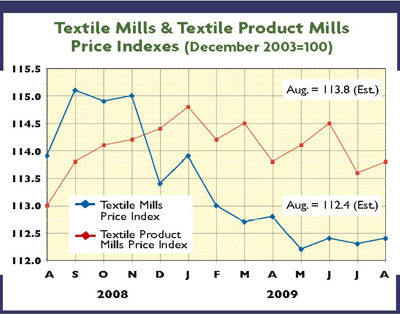
Meantime, prices haven’t fared all that badly either. Indeed, greige goods, finished mill
products and industrial textiles have increased 2 percent, 1 percent and 2.5 percent, respectively,
over the past year, thus helping avoid any cost-price squeeze. All this is why mill profits – while
still falling because of lower demand – are managing to remain in positive territory.

bftable


More Thoughts On Demand

A few words on the demand outlook may also be in order. To be sure, 2009 numbers continue to
paint a dismal picture – with this year’s expected production total likely to tumble some 15
percent. And compared to just four years ago, the drop should be an even more precipitous 35
percent. On the other hand, all these negative numbers have to be put in proper perspective. As
pointed out previously, this huge drop-off seems to be coming to an end. Thus, production activity
has been bottoming out, with little or no appreciable change noted for some four straight months.

The Institute for Supply Management (ISM), which monitors change at the grass-roots
manufacturing level, also seems to back up the changing industry climate. Specifically, four of its
textile indicators – production, order backlogs, inventories, and export orders – have turned
positive over the latest reported month. One top mill executive seems to confirm all this, noting
his firm now sees the first signs of improving activity – though he adds that much of this may
reflect customer rebuilding of inventories. Upshot: The worst seems to be over, and what happens
over the next few quarters will depend on both how fast the economy recovers and how effective the
United States is in keeping textile and apparel imports under control.


Near-Term Question Marks

As far as the overall economic trend is concerned, the news is basically a little better than
it was only a few months ago. Indeed, the bottoming out in gross domestic product – first noted in
the second quarter when this key indicator fell only about 1 percent – is expected to continue.
Most business analysts now predict some growth through the remainder of the year – a marked change
from the decline of the previous five quarters. On the other hand, any gains that do occur are
expected to be relatively modest, probably something in the order of 1 to 2 percent. Implication:
only a limited positive impact on textile and apparel activity.

Meantime, it’s also doubtful whether there will be any help from imports. For one, China
shows few signs of making any further upward revisions in its currency, the yuan, and also seems
determined to provide its producers with additional tax and other incentives. Moreover, other
foreign suppliers seem equally determined to push their exports to the United States as they strive
to recover from their own business downturns. Still another big  import problem is continuing
lax US enforcement of trade rules, as texile fraud – most notably in the form of country-of-origin
mislabeling – soars to new heights. The inescapable conclusion: Given all of the above, textile and
apparel imports are likely to remain a king-sized headache – not only for the remainder of the year
but also for the foreseeable future.

Trützschler Restructures Into Three Units

Trützschler GmbH & Co. KG, Germany, has reorganized into three groups -Trützschler Spinning,
Trützschler Nonwovens and Trützschler Card Clothing – to better serve its customers. Its management
team consists of Managing Partners Heinrich Trützschler and Dr. Michael Schürenkrämer, and Managing
Directors Dr. Dirk Burger, CEO, and Andreas Ebenhöh.

Trützschler Spinning, based in Mönchengladbach, Germany, includes an operation at American
Truetzschler Inc., Charlotte; Trumac, India; Truinco, Brazil; and TTMS, China. The division offers
fiber preparation equipment including blow room and carding machinery, draw frames, and combing
machinery.

Trützschler Nonwovens, led by Marc Wolpers, comprises Fleissner GmbH, Egelsbach, Germany,
led by Managing Directors Hans-Georg Buckel and Dr. Dieter Zenker; and Erko Trützschler GmbH,
Dülmen, Germany, led by Managing Director Erwin Kock and Director Stefan Flöth; and an operation at
American Truetzschler. The division offers complete systems and solutions for nonwovens production;
and a product range including staple fiber preparation and web formation machinery, crosslappers
and web drafters, and polyester staple fiber production machinery and equipment.

Trützschler Card Clothing, Neubulach, Germany, also uses plants in Brazil and India. The
division manufactures a complete range of card and roller card clothings; as well as metallic wires
for openers or opening rollers for open-end spinning machinery.


September/October 2009

OC Oerlikon Names Ziegler Acting CEO

The Board of Directors of OC Oerlikon Corp. AG, Switzerland, has named Hans Ziegler a delegate of
the Board of Directors and acting CEO, effective immediately. Ziegler, a corporate restructuring
and turnaround management  specialist who has served on the Board since 2008, replaces
previous CEO Dr. Uwe Krüger, who is leaving the company.

“Our decision was made in light of OC Oerlikon’s semiannual results,” said Vladimir
Kuznetsov, chairman of the Board of Directors. “OC Oerlikon’s sales fell by 40 percent and order
intake by 39 percent in the first half [H1] of 2009 compared to H1 2008 amid an economic downturn
of unprecedented proportions. The company urgently needs to secure coordination of strategic
portfolio decisions with operational measures of OC Oerlikon’s businesses. The announced management
change ensures the alignment of the company’s strategy with the interests of all stakeholders.”

The company has identified more than 700 initiatives to cut operating costs, including site
consolidations, temporary plant closures, reductions in workforce and work hours, vacation
extensions, hiring and pay freezes, product line discontinuations, supplier contract
renegotiations, and other measures. In H1 2009, the company eliminated almost 1,500 jobs across all
businesses, and it plans a further reduction of 2,500 positions in the second half of the year.

OC Oerlikon’s textile business, Germany-based Oerlikon Textile GmbH, reported H1 2009 orders
47 percent below H1 2008 levels, with sales 55 percent lower than year-earlier sales. Restructuring
initiatives undertaken thus farto improve performance include consolidation of three manufacturing
sites, elimination of 700 jobs worldwide and reduction of work hours for some 2,000 employees. Its
performance has shown some improvement, with higher incoming orders than sales in the second
quarter of this year, and the company reports what appears to be a “sustainable upward trend” in
the man-made fibers market. Improvement in sales is expected in the second half of the year.

Overall, OC Oerlikon spent 100 million Swiss francs in research and development in H1 2009,
and it anticipates sustained improvements in performance and a return to profitability in 2010.

September/October 2009

Invista Licenses BDO, PTMEG Technologies To Jian-Feng, Increases Stake In Ashburn Hill

Wichita, Kan.-based Invista, a global integrated fibers and polymers manufacturer, has signed an
agreement to license its 1,4 butanediol (BDO) and polytetramethylene ether glycol (PTMEG)
technologies to China-based Chongqing Jian-Feng Industrial Group Co. Ltd. Jian-Feng is investing 2
billion renminbi (approximately US$300 million) to build a manufacturing complex that will produce
BDO and PTMEG at Chongqing Chemical Industry Park in the Fuling district of the Chongqing
Municipality.

“We are proud to support Chongqing’s continuing technological and industrial development
through our licensing of BDO and PTMEG technologies,” said Jeff Gentry, CEO and chairman of the
Board of Directors, Invista. “Our technology licensing organization, Invista Performance
Technologies, has over 40 years of technology transfer experience and has participated in over 40
projects in China. We are pleased to provide Jian-Feng with the design and know-how for its
manufacturing operation in Chongqing.”

The agreement includes the manufacturing processes, required technologies, product
formulations and the expert engineering services for the complex’s two plants, which are expected
to produce 60,000 tons of BDO and 46,000 tons of PTMEG annually. BDO is used to make polyester
resins and polyurethanes. PTMEG is a polyether glycol used as a building block in high-performance
polyurethanes, polyesters, copolymers and other polymers, with end-uses including spandex fibers,
thermal plastic elastomers and cast elastomers for apparel, automotive and industrial
applications. 

In other company news, Invista’s Performance Surfaces and Materials division has announced it
will enlarge its investment in Ashburn Hill Corp., a Greenville-based manufacturer of
fire-retardant (FR) apparel for industrial and firefighting applications. Invista announced last
year that it would collaborate with Ashburn Hill to create a new generation of industrial FR
apparel
(See ”
Invista
Partners With Ashburn Hill To Expand Product Offerings
,” Dec. 2, 2008)
.

“Invista is delighted to be able to invest additional funds in order to support Ashburn Hill
in realizing its potential,” said Jeff Brown, vice president, Invista Performance Materials. “We
anticipate that the revolutionary protective apparel developed with Ashburn Hill Corp.’s Tecgen®
fiber will offer significant improvements in comfort and protection to workers requiring protection
to NFPA 2112 and 70E standards.”

September 8, 2009

DyStar Partners With ATEEPL, ICES

DyStar India Pvt. Ltd. – the India-based subsidiary of Germany-based DyStar Textilfarben GmbH &
Co. Deutschland KG, a manufacturer of textile dyes and auxiliaries and a provider of related
services – and A.T.E. Enterprises Pvt. Ltd. (ATEEPL) – part of India-based A.T.E. Group, a provider
of textile engineering, print and packaging solutions, machine-to-machine solutions, clean
technology and flow technology – have partnered to provide customers training in a range of textile
applications.

ATEEPL will work with DyStar’s Expert Solutions consultancy unit, an independent global
platform DyStar launched last year to provide professional advice, technical service and training
programs to textile finishers, brands and retailers. The companies are planning to roll out the
first training in September for yarn-dyeing customers in Tirupur, India.

In other company news, DyStar Singapore Pte. Ltd. has signed a Laboratory in Research
Institute (Lab-in-RI) agreement with the Institute of Chemical and Engineering Sciences (ICES),
Singapore, a member of the Agency for Science, Technology and Research (A*STAR). Under the
agreement, ICES will collaborate with DyStar and provide research infrastructure at the initial
stages of its research and development (R&D) projects.

DyStar’s six-member R&D team – led by Dr. Roxana Barbieru – will be working with a number
of research groups at ICES. The Lab-in-RI agreement with DyStar is ICES’ 10th since it launched the
program in October 2004.

September 8, 2009

QuestaWeb Introduces FTZ Module

Westfield, N.J.-based QuestaWeb Inc., a provider of Web-based integrated global trade management
(GTM) solutions, has released a fully automated, integrated Web-based software module that manages
Foreign Trade Zone (FTZ) operations and related manufacturing actions. According to QuestaWeb, the
FTZQW combines rule-based functionality with rich content, reporting and integration tools; and
offers multiple electronic links to government agencies. The company further reports the software
allows users to accurately control US Customs-supervised inventory, including compliant movements;
FTZ manufacturing; and overall compliance with Customs’ rules and regulations. FTZQW does not
require a transaction fee.

The software can be used as a stand-alone system or as part of QuestaWeb’s TradeMasterQW
suite of integrated GTM applications, and can interface with an importer’s enterprise resource
planning system to allow data sharing. The module provides immediate compliance verification and
supports management “by exception,” by which processes continue automatically unless a problem
arises. QuestaWeb’s FTZQW also is flexible, allowing the functionality to expand as an importer’s
needs change.

“The release of an automated, integrated FTZ module is a natural progression in the evolution
of our GTM application suite,” said Felix Pekar, COO, QuestaWeb. “Knowing our client base, and the
broader importer market, we knew some firms would prefer to file themselves and need ABI
connectivity, while others would need electronic connectivity to their brokers for filing purposes.
QuestaWeb`s FTZQW module supports all requirements – and more – due to its high degree of
automation and seamless integration. FTZ operators, regardless of business scope or model, can
achieve total compliance, manage by exception and never have to pay transaction fees.” 

September 8, 2009

Kimberly Glas Named To Key Textile Trade Post

Kimberly Glas, former legislative director for Rep. Mike Michaud, D-Maine, has been named deputy
assistant secretary of commerce for textiles and apparel, a post that plays a major role in
developing and carrying out the administration’s textile trade policies. She will head the Office
of Textiles and Apparel (OTEXA) and serve as chairman of the Committee for the Implementation of
Textile Agreements (CITA), an interagency group that administers trade agreements and takes action
in situations in which there are illegal textile or apparel imports. OTEXA supports CITA by
providing staff and collecting data that are the basis for CITA’s administration of textile trade
programs.

The National Council of Textile Organizations (NCTO), which supported Glas’ appointment, says
she helped organize the House Trading Group, which was co-founded by Michaud. That bipartisan group
of House members supports fair trade policies, and its members have been outspoken on issues
involving trade with China and loss of manufacturing jobs. NCTO says Michaud and Glas have been
helpful in connection with a number of textile trade issues, including enactment of the Kissell Buy
American amendment and measures to monitor and control Chinese textile imports.

September 1, 2009

Military Textiles Procurement Meeting

The Textile Industry Coalition on Government Procurement is sponsoring a one-day interactive forum
at which textile and apparel manufacturers can meet with military officials and learn about the
specific needs of the military and how they might be able to fulfill them.

The meeting, sponsored by the National Textile Association (NTA), American Manufacturing
Trade Action Coalition, National Council of Textile Organizations and the US Industrial Fabrics
Institute, will be held Thursday, September 24, from 9:45 a.m. until 2 p.m., in conjunction with
the Industrial Fabrics Association International (IFAI) Expo 2009 at the San Diego Convention
Center in San Diego.

Participating in the meeting will be Army, Navy, Marine Corps and Air Force procurement
officials, who will discuss their current and future needs for textiles and clothing. Former
Congressman Duncan Hunter, who served as chairman of the House Armed Services Committee and who is
a leading authority on the Berry Amendment  covering procurement of military textiles, will
speak at the luncheon. 

Registration for coalition members is $129 on or before September 11, and $159 after that
date. Registration for non-members is $179 on or before September 11, and $209 afterwards.
Participants may register online at
www.ifaiexpo.com. For more information, contact Jane Lomas at
NTA, +617-542-8220.

September 1, 2009

Sponsors