Maidenform Signs Licensing Agreement With Komar

Iselin, N.J.-based global intimate apparel marketer Maidenform Brands Inc. has entered into an
agreement with New York City-based intimate apparel manufacturer Komar Co., giving Komar the
exclusive right and license to manufacture, market, sell and distribute women’s and children’s
sleepwear, women’s long underwear, and women’s swimwear under certain Maidenform brands to select
retailers in the United States, Canada and Mexico. The agreement is effective immediately.

“Our partnership will further establish Maidenform as a lifestyle brand and bring more brand
exposure to both current and new customers in the [United States], Canada and Mexico,” said Maurice
Reznik, CEO, Maidenform. “These are natural line extensions for Maidenform, and will serve
different consumer needs and market segments while increasing our visibility at department stores,
chains and mass merchants.”  

“As the Donna Karan® and DKNY® sleepwear licensee, we have come to know and respect
Maidenform,” said Charles Komar, president and CEO, Komar. “We are very excited to be partnering
with Maurice and his team to expand the Maidenform family of brands into new categories.”

September 15, 2009

Cherokee Expands Home Textiles Business Into Mexico

Van Nuys, Calif.-based Cherokee Inc. – a marketer, licensor and manager of brands in the family
apparel, fashion accessories and footwear, home furnishings, and recreational products markets –
has extended its Cherokee brand of home textiles into Mexico through Controladora Comercial
Mexicana S.A.B. de C.V., a Mexico-based retailer.

“The category expansions at Comercial Mexicana exemplify the consumer acceptance of the
Cherokee brand in categories beyond clothing,” said Lala Somma, senior global brand manager,
Cherokee. “In addition, it continues to demonstrate the strength of our retail direct licensing
model.”  

“We continue to experience great results with the Cherokee brand throughout our store as our
consumers appreciate the style, quality and value associated with the Cherokee brand,” said Adolfo
Blasco Ruiz, DMM, Comercial Mexicana. “Home textiles is a natural extension for the brand and we
look forward to much continued success.”

September 15, 2009

Simparel Expands Enterprise Solution To PLM

New York City-based Simparel Inc. – a provider of global supply chain management and enterprise
resource planning (ERP) solutions – has expanded its Enterprise business solution to now offer
design, concept, planning, and preproduction product lifecycle management (PLM) features. Customers
now can have a fully configured PLM designed specifically for their business.

“With a Simparel system in place, fashion companies can have the PLM they need without buying
modules or having to compromise their business processes to fit inflexible software,” said Richard
Farb, vice president, sales and marketing, Simparel. “The biggest failings for PLM are complicated,
long and expensive implementations that often cause more problems than they solve.”

Simparel’s 100-percent metadata-driven application allows users to choose what they like and
change what they don’t like about the solution. According to the company, the solution – which is
open to every member of the company for individual viewing and managing – can generate any form,
add any field, manage any business hierarchy and display any grid result in real time without
writing programming code, resulting in a flexible system that can adapt to change.

September 15, 2009

Buhler Set To Debut New Yarns At Material World

Jefferson, Ga.-based Buhler Quality Yarns Corp. will introduce four new yarns – Supima® and
MicroModal® fashion slubs, Supima Royal, TransDRY™ and Supima Outlast® Viscose – at the upcoming
Material World show to be held September 30-October 2 in Los Angeles.

Supima and MicroModal fashion slubs is a 100-percent extra-long-staple cotton ring-spun yarn
targeted at the T-shirt market.

Supima Royal is a plied yarn that offers properties found in both single and plied yarns
including evenness, low hairiness, soft hand and strength. Buhler reports this economical yarn is
suitable for high-end apparel, luxury intimate apparel, hosiery, bed linens and other home
furnishing products.

Buhler has created a yarn featuring Cary, N.C.-based Cotton Incorporated’s TransDRY
technology – a moisture-management application for 100-percent Supima cotton products
(See ”
Cotton
Incorporated Debuts TransDRY™ Technology
,” September/October 2008)
. The high-performance
technology is targeted at the performance apparel market.

Buhler’s fourth new yarn features Outlast Viscose from Boulder, Colo.-based Outlast
Technologies Inc. blended with Supima cotton. Supima Oulast Viscose yarn was designed to offer
comfort and thermal management properties in a single yarn. The yarn is suitable for performance
apparel, but has also found a market in sleepwear for menopausal women.

“Buhler is already known for its quality and service throughout the region,” said David
Sasso, vice president, sales, Buhler. “Our new yarns demonstrate our drive to be innovative and to
offer our customers the ability to differentiate themselves for their competitors.”

September 15, 2009

Web Guiding And Spreading Systems


T
oday, the manufacturers and users of processing machines for web-type materials are
confronted with ever-increasing demands, such as faster and more precise production processes,
improved product quality; and reduced personnel, waste and, above all, downtime. Web guiding
systems decisively fulfill these requirements.


Principle

Typically, web-type materials are fed from a reel to the machine, processed and then
rewound. During these stages, various position errors may occur. Web guiding systems are designed
to eliminate these negative process influences and assure permanent, precise web alignment and
winding. Depending on the type of material application and task, a wide variety of systems are
specially designed to improve quality and increase productivity.

In web guiding systems, a sensor detects the web position compared to a reference point.
This is usually the web edge, but it may be a printed line or a strong color contrast on the web.
The current actual web position value is compared with the set value by the controller, which then
sends the difference of these two values as a signal to the system-actuating element, which, in
turn, corrects web travel.


Detection Systems

With progressive technology, detection systems have come a long way from being simple
mechanical sensors to sophisticated digital infrared sensors, wide-band arrays, or charge-coupled
device (CCD) cameras. The right choice of sensor specific to the application is important to
guarantee optimal results.

Infrared sensors are in wide use, for example, in tenter infeed systems, highly accurate
edge guiding on printing lines, and center-positioning on laminating processes. These sensors
typically have a very narrow detection range and, therefore, provide highly accurate detection of
any type of edge. In principle, an optoelectronic, infrared edge sensor distinguishes itself by a
highly compact and stable construction with an integrated CCD chip. Due to the permanent adjustment
of the sensor to ambient conditions, practically all webs can be reliably scanned, including those
with very little light reflection.

figure1
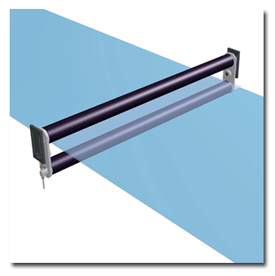
Figure 1: Wide band sensors can be used for edge detection, center guiding and width
monitoring.

Wide band sensors allow various-width materials to be processed without mechanical sensor
position changes
(See Figure 1). The sensor operates with infrared transmitters and receivers placed on
opposite faces of the web, and senses the edges using special scanning techniques. It is, however,
not as accurate as a stand-alone infrared edge detector and is primarily used for guiding
applications in which less precision can be tolerated. Detection accuracies can vary from 3 to 7
millimeters (mm), depending on the technology used. Wide band sensors can be used for edge
detection and center guiding, and, because of their construction, also as width monitors.


Correction Devices

There is a wide range of different correction devices available in combination with the
different detection systems to make a perfect fit to any process in the textile industry. Subject
to the application and the fabric type, the device may be a segmented roller guide, a steering
roller, a pivoting frame or a web guider.

The most economical guiders – the well-known two-roll edge guiders – have been around for
decades. The web edge is detected either mechanically by a sensor lever or without contact using
optoelectronics. The sensor signal controls a diaphragm cylinder or a lifting magnet that presses
the control roller against the counter pressure roller. The web edge is controlled by roller offset
and nip pressure. For more accurate edge guiding, a built-in broadband sensor with web edge
fluctuations up to +/- 80 mm is available due to the large scanning range – 120 mm – of the
infrared sensor system. For delicate webs, an additional electrical drive for the top roller
ensures that the friction torque on the rollers is compensated and stretching of the web is
avoided.

figure2
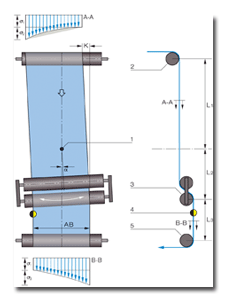
Figure 2: Steering roller assemblies perform two different movements in one correction
procedure.

A steering roller assembly consists of two or more rollers and performs two different
movements in one correction procedure
(See Figure 2). First, it tilts toward the web direction of travel to achieve a continuous
righting of the moving web. Second, it assumes a lateral offset vertical to the web direction of
travel to effect an immediate reparation. This rectifying action is achieved by a lever system as
shown in the sketch. The web must be friction-locked to the guide rollers.

figure3
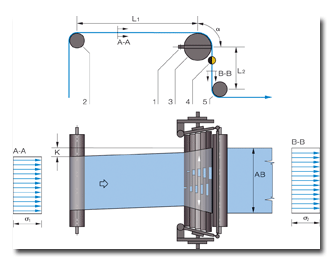
Figure 3: Segemented roller guides maintain uniform distribution of tension across woven,
knitted or nonwoven webs.

The segmented roller guider is the optimum web guiding system for all applications across
the entire textile-processing spectrum
(See Figure 3). It guides woven, knitted, and, to a certain extent, nonwoven fabrics in
dry, damp or dripping wet conditions, in steamers exposed to high temperature and finishing
chemicals. In the event of major corrections, the guider maintains a uniform distribution of
tension across the web, thus minimizing weft distortion. The web rests on the guiding slats along
its full width. The slats carry the web around the roll while moving laterally, providing a minimum
offset – thus eliminating the risk of a skewed web. The guide rollers can be designed with split
slats and perform web guiding and web spreading simultaneously. Scroll rollers or pneumatic
uncurlers can also be added for uncurling and additional spreading capability. A good degree of
friction between the segmented roller guiding slats and the fabric web is essential for an
efficient web guiding process. Many modern quality fabrics feature extremely sensitive surfaces
that may be slightly impaired by the contact areas of the guiding slats should these be too
aggressive. Various slat coverings offer the possibility to process these fabrics safely.

figure4
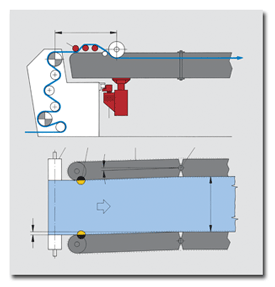
Figure 4: Tenter rail guiding systems ensure precise positioning of tenter frame clips or
pins to the fabric edges at the infeed of the tenter frame.

Tenter rail guiding systems ensure precise positioning of tenter frame clips or pins to the
edges of the fabric at the infeed of the tenter frame, which is critical to producing quality
fabric with consistent width
(See Figure 4). As speeds have greatly increased, this control has been improved through
the development of highly accurate infrared edge sensors, digital controllers, and positioners with
encoder feedback. The rails can be moved at rates from 120 to 180 mm per second to exactly follow
the fabric edges.

Many textile processes require the use of unwind or rewind systems to properly control the
fabric into the process and to produce rolls of fabric with uniform edges at the rewind station.
Various sensors – such as edge, line, or center-guiding – can be used; and various actuators are
available for different strokes and forces.

A range of control systems consisting of sensors, controllers and actuators can be adapted
for many other positioning applications, such as coater-dam positioning and slitter positioning,
for example.


Heightened Control

Despite a consistent specialization in web guiding systems for the various automation and
production processes in the textile industry, a broad range of products, from individual mechanical
components to multifunctional systems, is available to meet the requirements. This means that even
the most complex projects may be completed cost-effectively. These efficiency solutions provide
manufacturers with heightened control of processing variables, which ultimately increases
productivity, reduces waste, and improves the quality of the end product.


Editor’s Note: Udo Skarke is CEO of Erhardt + Leimer Inc., Duncan, S.C.

Innovations In Knitting


K
nitting machinery manufacturers offer a range of technologies to answer the needs of end
product manufacturers’ constructions. Following are some recent developments in knitting technology
from six leading machinery manufacturers.
shimaseiki
Shima Seiki’s WholeGarment technology enables production of fully fashioned garments in one
piece, with no sewing or linking required.


Seamless Technology

Interest in seamless knits has manufacturers in all segments – whether flat, circular or warp
knitting – developing machinery to enable ever newer concepts to be produced. The apparel and
therapeutic medical textile sectors are especially interested in seamless technologies. Apparel
areas include activewear, outerwear, swimwear, lingerie, hosiery and shapewear. Medical
applications include compression hosiery and a range of garments geared toward promoting wellness.

Shima Seiki Manufacturing Ltd., Japan: Shima Seiki’s WholeGarment seamless flat
knitting technology enables production of a garment in one piece, with no sewing or linking
required. MACH2X, the latest model in the WholeGarment line, offers more than twice the
productivity of previous versions.

“WholeGarment production utilizes 3-D shaping technology, which allows the garment to conform
to the body for unprecedented fit and comfort,” said Masaki Karasuno, Shima Seiki’s creative
director, noting the technology’s labor-, time- and cost-saving benefits, including the possibility
of on-demand knitting and mass-customization of knitwear; the ability of knitters to stay
competitive with knitters in low-labor-cost countries; and resource savings because yarn
consumption is limited to what is needed to make the garment.

Masaki said a MACH2X15L machine was shown at ShanghaiTex 2009, knitting a ladies’ pleated
pullover with structured design knit in 23 minutes, 19 seconds. “The MACH2X is capable of sustained
knitting speeds of 1.6 meters per second, the fastest production specs for a flat knitting
machine,” Masaki added.

H. Stoll GmbH & Co. KG, Germany: Stoll has improved the productivity of its
Compact Class CMS flat knitting machines, which are able to partially use different gauges on one
machine without replacing needles or converting gauges. Intarsia knitting capabilities are standard
on most models. The machines also offer short setup times, enabling quick changes and fulfillment
of large orders.

Two new entry models include the CMS 502 and CMS 502 multi gauge, which feature two knitting
systems, a 45-inch working width, take-down comb, cutting and clamping on the right side, yarn feed
on the left side, moveable display slide, additional yarn control units, two adjustable plating
yarn feeders, adjustable main take-down, increased productivity, and gauges ranging from E5 to E18.

Stoll also offers accessories and software solutions, including intarsia kits, plating yarn
feeders and kits, a new ASCON® automatic stitch control yarn measuring device, and enhanced M1plus®
pattern software.

Santoni S.p.A., Italy: New electronic seamlesswear circular knitting machinery
from Santoni includes its patented SM8-TOP1 V and SM12-EVO3 single-jersey machines, and the SM9-MF
double-jersey machine. Apparel applications include undergarments, outerwear, activewear, swimwear
and sanitarywear.

SM8-TOP1 V features eight yarn feeds with one selection point per feed. SM12-EVO3 has 12 yarn
feeds with three selection points per feed; and can process natural- and man-made-fiber yarns, and
bare and covered elastic yarns. Both models offer optional terry capabilities; and enable high
production of single body-size garments, and eight or 12 feeds of high-definition patterns with
distinct colors, depending on the model.

SM9-MF is suitable for knitting ribbed garments in a continuous tubular fabric or single
garments using one weft or separation yarn. The machine’s needle-to-needle selection in three
configurations on the cylinder and two on the dial, as well as transfer positions, enable
production of all styles of ribbing and inlaid structures.

Karl Mayer Textilmaschinenfabrik GmbH, Germany: This warp knitting machinery
manufacturer sees significant opportunities in the seamless market and has been expanding its
activities in that area. The latest version of its DJ narrow Seamless Smart double bar raschel
machines -the DJ 6/2 (EL), 44″ – can produce a variety of seamless or virtually seamless products
such as pantyhose and stockings, undergarments and sportswear. The machine features four ground
guide bars – two more than the earlier-edition DJ 4/2, is available in gauges E 24 and E 28, and
can be equipped with an electronic guide bar drive (EL) – which allows a high degree of patterning
flexibility and enables very efficient processing even of small batches, the company reports. 
It also features a jacquard system with two jacquard guide bars, piezo technology to control the
jacquard needles, KAMCOS® control and monitoring system with Multi-Speed, and electronic beam
drives.

“The number of orders has been better than expected since the DJ series was introduced,” said
Oliver Mathews, sales manager, Karl Mayer. “In the light of the current economic situation,
companies are trying to improve their competitive edge by coming up with new ideas and trying new
approaches. Our DJ 6/2 can help them to do this.” 
pailung
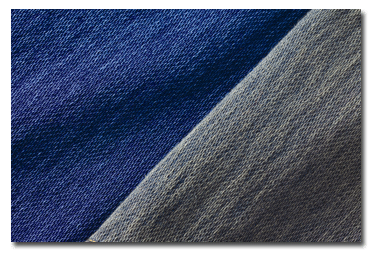
Pai Lung’s float plating technology produces knit fabrics that look like wovens and has
applications for denim, suiting and corduroy fabrics.


Float Plating Technology

Pai Lung Machinery Mill Co. Ltd., Taiwan: Circular knitting machinery manufacturer
Pai Lung offers its PL-KSFP four-track single-jersey float plating machine to produce a knit fabric
that looks like a woven but has the feel and breathability of a knit. The technology, first
developed for automotive seat cover fabrics, is now being used to produce denim, suiting and
corduroy fabrics.

“Pai Lung developed and patented the structure using knit and float, using knit cams and
sinker cams as well as sinkers to do a knit on one side of the fabric and a very tight float on the
other. The float gives the woven effect. Depending on the cylinder cam arrangement, the machine has
the ability to do one-, two- and three-needle floats,” said Mike Moody, vice president of Monroe,
N.C.-based Nova Knitting Machinery – joint partner with Pai Lung, and the company’s exclusive
representative in North and Central America and Colombia.

“The fabric has gone through extensive testing to measure air penetration, sewing strength
recovery rates, durability and pilling. In all tests, the float plated fabric either matched or
excelled beyond the woven results,” he added.

Moody said a 26-inch-diameter 20-gauge machine can knit 900 to 1,000 pounds of 18/1 cotton
thread in 24 hours. A lighter-weight polyester suiting fabric would be produced using a 24- to
28-gauge machine.


Technical Textile Solutions

Comez S.p.A., Italy: Comez, a maker of crochet knitting, warp knitting and narrow
weaving machinery, lately has put a certain emphasis on technical textile solutions. Machines
suitable for such fabrics include its ACO and ACOtronic crochet knitting, and double-needle-bed
DNB/EL warp knitting machines.

ACO and ACOtronic machines are used to produce rigid and elastic technical textiles, ribbons
and laces; and can process natural-fiber threads in the warp. Both feature compound needles, and
are available in gauges ranging from 10 to 20 and in operating widths of 400 and 600 millimeters
(mm).

The 410 ACO and 610 ACO machines feature eight weft bars controlled by link chain, and the
BPO/S supplementary warp tube bar, which can function as a second warp bar to produce a lock-stitch
effect on the fabric. The compound needles enable production of constructions such as simple or
double lock-stitch when the BPO/S device is used with the standard warp bar, which is driven by
Tricot/S cams.

The ACOtronic 400 and 600 machines feature 10 weft bars with electronic drive and one weft
bar controlled by a weft device.

DNB/EL machines are used to produce sports equipment and food netting; high-resistance
ribbons made with special fibers; fabrics and ribbons for automotive, construction, geotextile and
industrial applications; medical textiles such as netting, bandages and dressings; and other
products. The two needle beds enable production of double-faced articles that are identical on both
sides.

The DNB/EL-800-8B offers an 800-mm working width and four, six or eight pattern guide bars.
The DNB/EL-1270-12B features a 1,270-mm working width and 12 pattern guide bars. Both models
feature electronic drives; use latch needles; can process any type of yarn, depending on machine
gauge; and come equipped with the Data Control 4 Controller with color display. Comez Draw 4 or
System.win software are used to program the pattern.

September/October 2009

Nilit Presents EcoCare Recycled Nylon 6,6 Fibers

Nilit Ltd., Israel, has introduced EcoCare, a recycled nylon 6,6 fiber with deep, uniform color.
Targeted end-use applications include intimate apparel, legwear, activewear and ready-to-wear
applications.

“This is the first recycled fiber that retains the properties of our virgin fibers and gives
excellent color depth and uniformity in the regular dye process,” said Oded Breier, marketing and
sales manager, Nilit. EcoCare is certified to the Recycled Content Standard by Scientific
Certification Systems, Emeryville, Calif., to have at least 89-percent recycled content.

September/October 2009

Invista Offers Lycra® Sport Program

Invista, Wichita, Kan., has unveiled the Lycra® Sport performance standard for outdoor and active
apparel fabrics containing Lycra® fiber. The launch includes a new logo and hangtag as well as an
advertising program and a new website. The program emphasizes high technology and performance
standards associated with the Lycra brand, and its testing procedures and fabric qualification
standards are being shown to certain mill partners. Apparel fabric and sock manufacturers and
brands that participate in the Lycra Sport program must comply with the new standard in terms of
Lycra fiber content, fabric weight, recovery power, bi-directional elongation, fabric set, fabric
shrinkage and fit.

September/October 2009

Agion® Earns Cradle To Cradle™ Gold Certification

Wakefield, Mass-based Agion Technologies Inc.’s silver-based Agion® antimicrobial technology has
received Gold Level certification according to the Cradle to Cradle
SM protocol for environmental, health and safety, and social responsibility – the first
such technology to be certified at that level.

“We’re honored by this environmental stamp of approval for Agion,” said Cyndy Hunter,
director of marketing, Agion Technologies. “Achieving Gold Level Cradle to Cradle certification is
further proof that Agion’s naturally-based, non-toxic antimicrobial technology truly is a green
alternative to synthetic chemicals.”

September/October 2009

Polartec Launches FR Fabric System

Polartec LLC, Lawrence, Mass. – manufacturer of Polartec® performance fabrics for consumer and
military apparel – has introduced the Polartec flame-resistant (FR) total layering system, offered
as an alternative to what the company describes as typically bulky, uncomfortable FR apparel.
According to Polartec, the system is durable, lightweight and breathable; dries quickly; and does
not interfere with range of motion.

The system comprises a Power Dry® FR base-layer fabric that wicks moisture from the body and
dries quickly; a Power Stretch® FR mid-layer; a Thermal FR® lightweight thermal-insulation layer;
and a Wind Pro® FR weather-protective outer layer. The fabrics have undergone independent testing
and have passed relevant industry standards, the company reports.

September/October 2009

Sponsors