Quality Fabric Of The Month: New Antimicrobial On The Block

Gainesville, Fla.-based Quick-Med Technologies Inc., developer of antimicrobial and matrix-metalloproteinase-inhibitor (MMPI) technologies that have applications in healthcare, consumer and industrial markets, has introduced Stay Fresh™ antimicrobial technology developed specifically for textiles. The company reports the new technology features an eco-friendly active ingredient in a skin-friendly formulation, and provides unsurpassed durability and efficacy in
killing a very broad spectrum of pathogens — including both Gram positive and Gram-negative bacteria, as well as fungi and viruses — even after as many as 75 home launderings. The formula, which can be applied using conventional processes to fabrics made with a wide range of natural and man-made fibers, also is claimed to brighten colors and facilitate the cleaning process.
qfomstayfresh
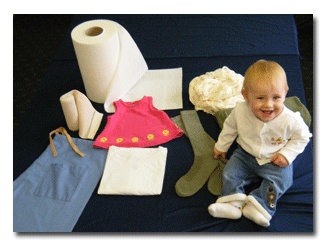
Potential applications for Quick-Med’s Stay Fresh™ antimicrobial technology pictured above
include fabrics and pulp for hygiene and medical applications, infants’ and children’s wear,
pajamas, socks, T-shirts and surgical scrubs.

While the company will not divulge the technology’s active ingredient because patents are pending, Dr. Jerry Olderman, vice president of research and development, did list a number of
antimicrobial substances it is not: “It’s not anything that’s being sold for textile use today, such as silver, copper, triclosan, biguanides, cationic lipids, organic halides, light-activated antimicrobials or other substances. All those things it is not come with their own special
shortcomings,” he said, noting such issues as limited spectrum efficacy, durability beyond only a few launderings, discoloration of the textile and environmental issues related to various established technologies. “In addition, Stay Fresh is durable to bleach; and is non leaching, nontoxic and OSHA [Occupational Safety and Health Administration]-compliant.”

Olderman said the active chemistry is already being used on a different material and is registered with the Environmental Protection Agency (EPA) registration for that use. Quick-Med is in the process of applying for EPA registration for the new textile use. The company also will be
seeking approval from the Food and Drug Administration for certain medical textile applications. In the meantime, said Quick-Med CEO J. Ladd Greeno, the company is offering the technology for its ability to destroy odor- and stain-causing bacteria and fungi.

Quick-Med’s product platforms also include two other technologies: NIMBUS® (novel intrinsically micro-bonded utility substrate), which uses advanced antimicrobial polymers that destroy bacteria at the cellular level and has FDA approval for use in wound dressings and related products; and MultiStat® MMPI technology, which inhibits MMP production in the skin that is triggered by chemicals, sun exposure and natural aging. Stay Fresh is an outgrowth of NIMBUS, but
is a completely different technology for textile use, Greeno said.

How It Works

Asked about the technology’s effect on beneficial bacteria, Greeno explained: “The treatment is on the textile, and it controls bacteria in the treated textile. It won’t leach into the skin surface, and it won’t cause problems with home laundry water effluent,” he added noting reports of silver washing off in the laundry under certain circumstances.

“The mechanism of destruction is very different from cations, which break the cell wall and membrane so that the walls fall apart, the cell collapses and its contents leak out, and the cell is no longer viable,” Olderman said. “Stay Fresh technology works on the outside of the cell, and destroys the chemistry of the cell wall, converting the cell components to inert, nonviable matter.”

Greeno noted that garments treated with Stay Fresh can be laundered in hot or cold water using anionic detergents offered widely for home laundering, with or without chlorine or non-chlorine bleach, without impacting its efficacy or causing discoloration. “Many antimicrobials
are blinded by some of the popular detergents and softeners,” he said.

Stay Fresh is applied to the fabric using a conventional padding process. “The finishing process can be combined with other finishing steps including softening, wicking and/or antistatic treatments,” Greeno said. “The finishing process is compatible with other activities and equipment
in the mill, and the cost of the substance is low, so the overall cost is a fraction of the cost of other technologies.”

Downstream Use

Greeno said Quick-Med is working with a range of customers to bring Stay Fresh to consumers. “We developed the technology and will license it to customers. We are targeting broadly essential apparel such as underwear, T-shirts, socks and intimate apparel; sportswear for both the casual sports enthusiast and the serious user; uniforms for utility workers, first responders and service workers; and bed linens and towels. We’re looking at both consumer and commercial markets, and have had discussions with customers in each of those areas. We think Stay Fresh really runs circles around what’s currently available and can offer our customers a way to differentiate their products,” he said.

One customer is a cotton apparel manufacturer that plans to use Stay Fresh for an underwear application for a government agency. “The customer set extremely rigorous requirements,” Olderman said. “Nothing up to now has proven acceptable, and the closest is too expensive. After five months of third-party testing and four trials, the customer found that Stay Fresh met all its requirements, and will replace its current solution with Stay Fresh once its current inventory is
depleted.”

For more information about Stay Fresh™, contact J. Ladd Greeno +888-835-2211 Ext. 102; lgreeno@quickmedtech.com.

December 2009

Obama Appoints Intellectual Property Czar

President Barack Obama has appointed Victoria Espinel, a lawyer and former assistant US trade
representative, as the first-ever intellectual property enforcement coordinator.  That
position was created by Congress last year in the wake of widespread charges of piracy of US
patents and copyrights by overseas manufacturers.

Kevin Burke, president and CEO of the American Apparel and Footwear Association, whose
members have been concerned about piracy, hailed the appointment as an effort to combat what he
said is the “growing prevalence of counterfeit products crossing our borders.”

“Each year Customs and Border Protection (CBP) consistently seizes more counterfeit apparel,
footwear and fashion accessory products than any other goods imported into the United States,”
Burke said. “In 2008, fake footwear, apparel and fashion accessories accounted for more than 58
percent of all goods confiscated by CBP. Countless millions of dollars are lost each year because
of counterfeiting.”

At her Senate confirmation hearing, Espinel said: “I will work side-by-side with agencies,
Congress, stakeholders and the public to ensure that the jobs that depend on intellectual property
are not compromised by others unwilling to respect and enforce the rules of law.”

December 8, 2009 

Trade Officials Promote Completion Of Doha Round

At the conclusion of two and a half days of meetings at the World Trade Organization (WTO) in
Geneva, trade officials from 153 nations made a strong commitment to conclude the Doha Round of
trade liberalization negotiations in 2010.

The Doha Round, started in 2001, has been bogged down as a result of differences between
developed and developing nations on a number of issues, and while there was a good deal of talk
about the economic importance of trade, little in the form of specific commitments came out of the
meetings. Although WTO Director General Pascal Lamy said there is “political energy” to move the
talks forward, a good deal of skepticism surrounded the sessions.

In a statement following the meetings, US Trade Representative Ron Kirk said: “WTO members
have repeatedly committed this year to moving the Doha Round forward. It is time to act on those
commitments, move outside of our comfort zones and make the hard choices required of those who
would lead the WTO.” He added that “the proof is in the pudding.”

Kirk repeatedly underscored the importance of creating greater market access throughout the
world and said the United States believes it is important to “rebalance” the Doha Round to ensure
it creates better opportunities for US exports. While Kirk, in his public statement and a press
conference following the meetings, did not mention the concerns of US manufacturing industries over
the impact of imports on the economy, he said only that was pleased that the WTO members had not
turned to “protectionist measures” during the world economic crisis.

Kirk said: “In the US we recognize trade can be an important pillar of growing economic
recovery and economic recovery at home, particularly by creating the well paying jobs that
Americans want and need. He assured the less developed countries that the US recognizes the
necessity of the Round for the poorest countries “to which the Obama Administration has made a
special commitment.”

Chile’s Finance Minister Andrés Velasco, who chaired the ministerial meetings, said there has
been a “strong convergence” on the importance of trade and the Doha Round to economic recovery and
poverty alleviation in developing countries. He said the “development dimension” should remain
central to the Round and “particular attention should be paid to issues of importance to developing
countries.”

The ministers agreed to have a stock-taking meeting during the first quarter of 2010.

December 8, 2009

Sans Technical Fibers To Expand Stoneville, NC, Plant

Gastonia, N.C.-based Sans Technical Fibers LLC — a manufacturer of nylon filament and yarns, and a
wholly-owned subsidiary of South Africa-based AECI Ltd. — has announced plans to expand its
Stoneville, N.C., plant. The company will invest more than $2.8 million to increase plant capacity
to 8,000 metric tons per year. Production will concentrate on low-shrinkage, high-tenacity products
from 60 to 630 deniers using a variety of specialized polymers. Primary end-uses for the filaments
and yarns include sewing threads, automotive timing belts, cure wrapping tapes, and narrow and
broad woven items for military applications. The new capacity is expected to be online by the end
of third-quarter 2010. According to President Zach Zacharias, Sans Technical will use in-house
technology as well as modern equipment transferred from a closed plant in South Africa for the
expansion.

“We are extremely pleased to announce this expansion, which will ensure that we maintain our
position as the premier supplier to the global nylon 6,6 sewing thread market,” Zacharias said.
“Most of the capacity from this cost-effective expansion will be exported into Europe, South
America and Asia.”

The investment will be aided by a One North Carolina Fund grant of $60,000. The fund offers
financial assistance to businesses through local governments to draw business projects to the state
to boost economic activity and create jobs.

December 8, 2009

Gerber Scientific Acquires Yunique Solutions

South Windsor, Conn.-based Gerber Scientific Inc. — a developer of computer-aided design and
computer-aided management and product lifecycle management (PLM) solutions for the apparel and
flexible materials industries — has acquired Yunique Solutions Inc., a New York City-based
developer of Web-based software solutions for the fashion industry.

“Yunique … will give Gerber Technology an advanced PLM software offering,” said Marc Giles,
president and CEO, Gerber Scientific. “Integrating Yunique’s advanced technologies and expertise
will expand our capability for building substantial value for customers and shareholders.” 

“This is a powerful combination,” said Daniel Pak and Darioush Nikpour, co-founders and
principal owners, Yunique. “Our customers will now be supported by a global team of PLM solutions
consultants that is unmatched in the industry. Innovation will accelerate. Gerber’s global
footprint and resources will enhance sales penetration and service delivery.”

December 8, 2009

The Rupp Report: The Volatile Cotton Markets

According to recent market information from Germany-based Bremen Cotton Exchange and the
Washington-based International Cotton Advisory Committee (ICAC), global cotton production is
projected to total 22.2 million metric tons in 2009-10. This is a 5-percent decrease from 2008-09
production resulting from reduced yields. It also represents the third consecutive season of
decline in global cotton output for reasons including decreased price competitiveness of cotton
compared with competing crops and a weakening in cotton yields in the last two seasons. Globally,
average cotton yield increased from 566 kilograms per hectare (kg/ha) in 1998-99 to a record 792
kg/ha in 2007-08.

Decreased Yield

The increase between 1998-99 and 2007-08 was driven by several factors, for example, the
introduction of new technologies, an expanded use of existing techniques, and shifts in areas used
for cotton production. However, since 2007-08, cotton yield has declined. In 2009-10, global cotton
yield is projected to total 726 kg/ha — the lowest in six seasons. ICAC’s look in the crystal ball
indicates world cotton yield might have entered a period of slow growth that could last for several
years.

Mill Use

Global cotton mill use is projected to rise by 2 percent to 23.8 million tons in 2009-10.
This increase is said to be driven by the global economic recovery. Of the seven largest cotton
consumers, only China, India, Pakistan and Bangladesh are expected to see increases in cotton mill
use during this period, with a projected 70-percent combined share of world cotton mill use. Also,
prices are showing a slight improvement: The Cotlook A Index continued to increase during November.
It reached 74.05 cents per pound on November 30 — 10 cents higher than the price at the beginning
of this season.

Last week, according to information from England-based Plexus Cotton Ltd., New York futures
traded lower, as March futures closed  at 74.24 cents — a loss of 98 points. With some fears
regarding a potential debt crisis in Dubai receding, the cotton market had a rather uneventful
week. Even though prices moved lower for a few days, there was hardly any downside momentum behind
it, Plexus reported.

The Plexus report, dated December 3, continues: “We currently seem to have a standoff between
mills and merchants, with both sides unwilling or perhaps unable to make price concessions. Mills
are still not ready to accept the big jump in prices that has occurred over the last two months,
during which the nearby futures contract has risen from 61 cents in early October to over 74 cents.
… [S]ince merchants operate primarily from basis-long positions, they are forced to follow the
lead of the futures market and are therefore unable to meet the lower price ideas of mills.”

Buyers Should Pay Attention

Markets are quite volatile this season. Plexus reports there is a significant production gap
and warns of impending short supply of high grades. Just to hope for lower prices and to expect
continuing availability of the desired qualities into next spring or summer seems to be the wrong
way. However, some people are buying: Two weeks ago, Plexus reports, “the US sold 250,700 running
bales of Upland cotton to 22 different markets, with China taking the biggest portion at 68,300
running bales. During the same week, unfixed on-call sales increased by 361,200 bales net, with
unfixed sales on the March contract jumping by 541,300 bales. Overall there are once again nearly 5
million bales of unfixed on-call sales open ….”

The report continues: “In a market that is moving higher, this strategy of leaving the price
open is backfiring on buyers. … A 13 cents move over two months on a rolling position of roughly
5 million bales of unfixed on-call sales amounts to around $325 million. By keeping such a large
number of unfixed contracts open, mills are essentially defeating their purpose, because these
unfixed contracts create tremendous support underneath the market and keep potential corrections
well contained.”

Consolidation In The Markets

In conclusion, the report adds: “The market seems to be in the process of consolidating the
price jump that was brought about by the Dec/March spread. … Outside markets continue to act in
support of commodities, with the dollar showing further weakness and stock markets holding steady
at the moment. Barring any unforeseen events in the world’s financial markets, we expect current
crop futures to climb above 80 cents in the months ahead.”

December 8, 2009

Earth Day Network Names Anvil Official T-Shirt And Knitwear Partner

New York City-based activewear manufacturer Anvil Knitwear Inc. has been named the official T-shirt
and knitwear partner of Earth Day Network, an organization established to promote environmental
citizenship. Anvil will be a leading sponsor of Earth Day — to be celebrated April 25, 2010 — and
will participate in the associated 40th anniversary activities. The company will design and develop
knitwear comprising organic, recycled, transitional and reprocessed polyethylene terephthalate
fibers for Earth Day’s apparel line, which will be sold online and through retail stores. The line
also will be available to consumers at all Earth Day events, including Earth Day on the National
Mall in Washington and celebrations scheduled in 40 cities globally.

Anvil also is developing an exclusive apparel line for Earth Day Network’s The Green
Generation™ campaign, which encourages people globally to find solutions for issues such as climate
change and the global water crisis. The Green Generation line will feature AnvilSustainable™,
AnvilOrganic® and AnvilRecycled® apparel, and will be available beginning in 2010 at Earth Day
Network events and online.

Established after the original Earth Day in 1970, Earth Day Network now has more than 17,000
partners and organizations in 174 countries. In addition, more than 1 billion people worldwide
participate in Earth Day activities.

December 8, 2009

Leigh Fibers Debuts SafeLeigh™ FR Shoddy

Wellford, S.C.-based Leigh Fibers Inc. — a manufacturer of reprocessed textile waste and fiber
by-products — has debuted a new fire-retardant (FR) shoddy in its SafeLeigh™ product line.
Comprising 100-percent recycled material and FR aramids, SafeLeigh FR Shoddy complies with current
and new standards such as the US Department of Transportation Federal Motor Vehicle Safety Standard
(FMVSS) 302 for flammability of automotive interior materials. According to Leigh Fibers, it is a
cost-effective replacement for materials typically used in trunk liners, headliners, upholstery
backing, interior acoustical departments and interior engine components; and also is
environmentally friendly, as the FR aramids are blended into the material, eliminating the need to
use chemical treatments, as well as associated drying times. SafeLeigh FR shoddy is compatible with
all common forming systems.

December 8, 2009

Providencia Resurrects Plans For Nonwovens Plant In United States

Brazil-based nonwovens producer Companhia Providência Indústria e Comércio has resumed work to
establish its first manufacturing plant in North America after suspending plans because of the
global economic crisis. An official groundbreaking ceremony is scheduled to take place early in
2010. It was announced in September 2008 that Providência USA would be built in Statesville, N.C.,
and was expected to be operational by mid-2009
(See ”
Brazilian
Firm To Establish US Nonwoven Operation
,” September/October 2008)
. The plant now is
expected to be up and running sometime during the first half of 2011.

“This announcement further underscores the company’s plans for expansion,” said Hermínio
Freitas, CEO, Providência. “For some time now, we have been examining the company’s structure and
consequently its capacity, but with the world financial crisis, we had put new investments on hold.
In the past few quarters, we have noticed the increase in demand and the resumption of this project
will be instrumental in meeting this need — increasing our production capacity to 100,000 tons per
year.”

The scale of the project is smaller than originally planned, but the still significant
expected investment of $80 million will include land and a 90,000-square-foot facility as well as
machinery. Planned installed nonwoven fabric capacity is 20,000 tons per year, and the plant will
employ 56 people.

“At the revised investment and jobs level, Providência USA still represents the largest new
capital project in Statesville in more than a decade,” said Bill Leach, chairman, Greater
Statesville Development Corp. “We certainly understand and are sympathetic to the economic
conditions that [led] to delaying the start of construction and the changes in capital investment.
We are happy that the company never lost confidence that Statesville was the right place and
continued to work with us to find the right time.”

December 8, 2009

Industrial Microwave Systems Retains Allertex Of America As Manufacturer’s Representative

Morrisville, NC   (December 1, 2009) – Industrial Microwave Systems, L.L.C. (IMS), a
manufacturer of patented microwave heating and drying equipment headquartered in Morrisville, NC,
has entered into an agreement with Allertex of America, a leading manufacturer’s representative for
nonwoven and textile equipment companies.  The agreement establishes Allertex as Industrial
Microwave Systems’ sales agent for the nonwoven and textile markets in North America.

“We’re excited to partner with Allertex and leverage their expertise and experience to
further promote and establish our technology in these markets,” stated Darian Spell, Market Manager
at Industrial Microwave Systems.

IMS manufactures industrial heating and drying equipment that employs microwave energy to
efficiently heat and dry webbed substrates.  The company’s patented designs and technology
excel at providing rapid, uniform heating in a precisely controllable manner.  These features
enable nonwovens and textile producers to increase productivity, reduce operating costs, improve
product quality, and develop new innovative products.  Conventional drying technologies
(convection and conduction) heat from the surface inward; microwave energy rapidly heats the volume
of moisture throughout the product.  This attribute makes it particularly effective in drying
less porous and dense fabrics.

According to David Culp, CEO of Allertex of America, “We see potential value with Industrial
Microwave Systems’ technology for two types of customers – those that have existing drying lines
and those who are putting in new lines where drying of moisture is an integral process.  For
companies retrofitting existing drying lines, this technology can increase productivity while
reducing operating costs. For customers installing new lines, traditional oven technology can be
reduced or possibly even eliminated.”

The modular design of IMS dryers typically utilize a smaller footprint than traditional
drying equipment and can be designed to effectively serve multiple drying functions.  The
technology can act as a:

•    Stand-alone, total drying solution

•    Pre-dryer to efficiently heat moisture to evaporative temperature prior
to entering a conventional dryer to boost overall drying capacity

•    Post-dryer after a conventional dryer to efficiently remove final
residual moisture and optimize drying uniformity

IMS operates a one meter wide drying unit at its facility for customer trials.  In
addition, to assess the value of adding a microwave drying system into a production line, IMS will
complete a custom economic benefit analysis based upon a company’s specific requirements.

December 1, 2009

Press Release Courtesy of Allertex of America

Sponsors