Shaw To Increase Filament Yarn Processing Capacity, Add 200 Jobs

Shaw Industries Group Inc. — a Dalton, Ga.-based floor covering provider and subsidiary of
Berkshire Hathaway Inc. — will reopen a facility in Calhoun, Ga. that was idled in April 2009,
creating up to 200 jobs in the process.

The plant previously produced spun yarn for residential carpets, but because of changing
consumer demand and marketplace trends and to allow for future growth, Shaw will expand its
filament yarn processing capability, converting the Calhoun facility to a filament yarn plant. The
company will add equipment and infrastructure at the facility and expects to reopen it by mid-2010.

Based on seniority, previously displaced Shaw associates who have not transferred to other
Shaw locations will receive priority consideration once hiring begins.

“Shaw is committed to investing for the future, even during the current downturn,” said Bill
Barron, Shaw’s vice president, manufacturing. “The reopening of this facility is an example of that
commitment and another step in giving Shaw the best competitive advantage and position for the long
term.”

“It’s great news for Georgia that one of our longtime manufacturers is planning for future
growth in the state,” said Governor Sonny Perdue. “It’s a testament to the strength of our
workforce and infrastructure that, even during this economic downturn, Shaw still finds Georgia the
best place to invest in its future.”


November/December 2009

Want Jobs? Get Manufacturing


L
istening to politicians and policy pundits go on and on about how they are going to
create jobs is getting really annoying. If you want to create jobs, smooth the way for US
manufacturing. Focus on reducing business risk and uncertainty; enforce existing trade laws and
eliminate fraud; and how about creating a tax structure that rewards and incentivizes investment in
people, plant and R&D?

Though many of

Textile World
‘s readers are in the middle of incredible struggles, many are poised to respond to the
slightest bright spot. This has been a year of making difficult decisions, of reducing and closing
operations, of laying off long-term, skilled employees – and nobody finds that rewarding.

At the same time, few are looking for a handout. Many resent the government’s willingness to
select certain sectors of the economy to support with taxpayer dollars, while others — in many
ways just as or more significant to the country’s welfare — don’t receive any level of reprieve.
Even CIT’s challenges created another barrier for textile trade — lack of trade finance.

And, although the United States doesn’t have a domestic manufacturing policy, plan or agenda
– investing in US manufacturing is good policy on many levels. It solves many problems. Most
manufacturers provide above-average wages, they tend to provide healthcare benefits, and the
manufacturing environment has improved dramatically over time.

The prevailing elitist attitude that US manufacturing isn’t necessary, isn’t the future and
isn’t a key component in US economic recovery seemingly defies the law of gravity. The math seems
simple. As NCTO President Cass Johnson testified recently to an interagency group in
Washington,  “… over the last ten years, one in four manufacturing jobs has been lost, over
five million jobs in total, the sharpest drop in our nation’s history.”  He added that 1.1
million manufacturing jobs have disappeared since the Obama administration took office – one out of
every 11 jobs in that sector.

Skip the politics — if you want real jobs, incentivize US manufacturing. In textiles, the
opportunities range from ultra-high-tech applications to basic essential components – some of which
are significant to the more than 8,000 products sold to the US military.

The math? Well, pick the number — five million jobs, 1.1 million jobs — that void can’t be
filled by working at the mall, fast-food joint or big-box retailer. It is about starting a
restorative process that is more than creating a couple “green” jobs. It’s about putting real
incentives in place that focus on making things of value in the US and consuming them or exporting
them.

At a recent open house at a German machine manufacturer’s facility here in the US, one of the
owners, after speaking about years of successful supply and service to the US textile industry,
alluded to the decline of the industry. His voice trailed off as he observed that the government
was either not interested or for some other reason failed to see the need to promote US textiles.
His disappointment was real, and as a global player, more amazingly, he seemed simply baffled at
the lack of attention to something so significant.Why aren’t more people baffled?


November/December 2009

Hanesbrands Sells Yarn Operations To Parkdale

Hanesbrands Inc., Winston-Salem, N.C., has announced it will discontinue its own yarn production
and source all yarn from major yarn suppliers. The branded apparel maker plans to sell three yarn
manufacturing operations to Gastonia, N.C.-based sales yarn spinner Parkdale Mills and shutter a
fourth operation.

Hanesbrands stated it is not strategically advantageous to continue to produce its own yarn,
and outsourcing that production will not change material costs for the company. In addition, it
expects to realize $100 million in balance sheet benefits within six months after the sale, which
is expected to be completed this quarter.

Parkdale will acquire the operations of Hanesbrands’ Rabun Gap, Ga., Mountain City, Tenn.,
and Galax, Va., yarn facilities, which altogether employ 780 workers. The plants will continue to
supply yarn to Hanesbrands, as will other Parkdale plants in the United States. Hanesbrands reports
these supplies will satisfy its needs for a significant portion of its Western Hemisphere apparel
production.

Hanesbrands has closed its yarn plant in Sanford, N.C., impacting some 150 employees; and
also its cotton warehouse in Advance, N.C., and its yarn warehouse in Clemmons, N.C. Together, the
warehouses employed 25 workers.


November/December 2009

Concern But No Crackdown On Chinese Currency


E
ven though the US China trade deficit is on a course to exceed $200 billion for the fifth
consecutive year, the Obama administration seems to be avoiding any get-tough measures that might
provoke the Chinese and instead is pursuing a diplomatic solution to the problem.

In its latest semi-annual report to Congress on world currency practices, the Treasury
Department expressed its “serious concern” about the value of China’s currency but failed to name
China a currency manipulator, a step that could lead to US trade sanctions. The National
Association of Manufacturers said the failure to cite China was a “missed opportunity to move ahead
on the Chinese currency issue.”

As the report was released, the Fair Currency Coalition, an alliance of manufacturing,
agriculture and labor groups, stepped up its appeals for Congress to pass the Currency Reform for
Free Trade Act, which provides for use of US anti-dumping and countervailing duty laws when it is
determined that a country is manipulating its currency in order to gain an advantage in
international trade. Placing little faith in administration efforts to get a diplomatic solution to
the problem, the coalition said, “Negotiating without leverage is wistful thinking.” It added that
“only by treating Chinese currency as the export subsidy that it is can our negotiators gain the
leverage they need to end this problem by diplomatic means.”

While the administration clearly sees an undervalued Chinese currency as a problem that
contributes to the continuing trade deficit, perhaps more importantly, it also sees China as a
major player in the broader picture of addressing global economic woes. While the Treasury report
addressed the currency issue, it also says China needs to become less dependent on exports and
encourage more domestic consumption. That will require policy changes, and in that regard, the
United States can only make suggestions, because China will do what’s best for its citizens,
without much regard for the wishes of US manufacturers and workers.

wo
Former Congressman and House Armed Services Committee Chairman Duncan Hunter (left) accepts
the Award of Outstanding Military Merit from Benjie Reynolds, Milliken & Company, chairman,
National Textile Association Government Textiles Committee and Textile Industry Coalition on
Government Procurement. The award, presented during the coalition’s military textile conference
held in conjunction with IFAI Expo 2009, recognizes Hunter’s support of a strong Berry
Amendment.


More Government Business Sought

In the face of the economic downturn, more and more textile companies are seeking ways to do
business with the military and other government agencies. At a recent conference on military
textiles sponsored by the Textile Industry Coalition on Government Procurement – comprised of the
National Textile Association, the American Manufacturing Trade Action Coalition, the National
Council of Textile Organizations and the US Industrial Fabrics Institute – attendance exceeded
expectations as companies showed an increasing interest in supplying the military.

In addition, textile industry trade associations are pressing the Department of Homeland
Security (DHS) to open doors for more purchases of US-made textiles and apparel. Together, the
Department of Defense (DoD) and DHS could purchase nearly 100 textile and apparel products.

The DoD has projected textile and apparel procurement totaling $2.7 billion in the current
fiscal year (FY), an increase from $2.4 billion in FY 2008. Items for the military include a vast
array of textile and apparel products, including dress and combat uniforms, extreme-cold-weather
gear, body armor, protective outerwear, tents, tarpaulins and medical supplies.

In view of the continuing demands, US textile manufacturers are working with military
procurement officials to clarify and simplify procurement processes so that domestic manufacturers
can meet military needs and in the process bolster the US textile and apparel industries. At the
textile coalition conference, military procurement officials outlined projections for funding and
discussed new items under development. They expect FY 2009’s funding of $2.7 billion to be reduced
somewhat next year, although demand will remain high.

Participants in the coalition conference emphasized that improving the contracting process by
awarding contracts more quickly and smoothing out ordering practices and delivery schedules will
help US manufacturers respond quickly and more effectively to their often changing demands.

Meanwhile, textile manufacturers are pressing for a broad interpretation of the Buy American
provisions in the American Recovery and Reinvestment Act. Sponsors of that legislation emphasize
that the purpose of the act’s Buy American provisions was to create jobs, but they feel the initial
regulations published by DHS fall far short of that goal and open the door to too many imports.

The problem centers around DHS classification of items “directly related to national
security.” Textile manufacturers say the current classifications are confusing and will make it
difficult for manufacturers and government contracting officials to implement the law.

In addition, US manufacturers are particularly concerned about the fact that Mexico, Canada
and Chile, which have FTAs with the United States, are not subject to the Buy American requirement
because those nations were not properly notified of the legislation. Textile industry and organized
labor organizations are pressing the Obama administration to act promptly to resolve the issue as
quickly as possible, as hundreds of millions of dollars of sales could be involved.

While military demands will fluctuate depending on what’s happening in Afghanistan, Iraq and
other areas of military involvement, homeland security requirements are likely to increase. How
much depends on the willingness of the DHS agencies involved to issue regulations that will require
domestic procurement.

In many cases, DHS and DoD agencies have resisted Buy American provisions because they likely
result in higher costs than overseas procurement, but the Obama administration and Congress seem
committed to maximizing the job-creation potential of government procurement of textiles and
apparel.


Some Legislation Likely This Year

While President Barack Obama and Congress both have for the most part avoided getting
involved in major international trade issues, some legislation of interest to textile manufacturers
still may be dealt with during the remainder of this year.

There is a miscellaneous tariff bill that grants temporary duty suspensions to products that
no longer are produced in the United States. The current exemptions, which must be renewed by the
end of this year, include some textile products and textile machinery, and additional products may
be added to the list.

Also expiring at year’s end is the Andean Trade Preference Act, which extends duty-free
benefits to Colombia, Ecuador, Peru and Bolivia. Congress likely will extend it.

A separate free trade agreement (FTA) with Colombia that was negotiated by the Bush
administration has been held up by Congress in view of some concerns over labor and human rights
abuses. President Obama strongly supports the Colombia agreement and has urged Congress to approve
it. If recent steps taken by Colombia to address congressional concerns satisfy organized labor,
the Democratic leadership in Congress is likely to give it a go-ahead.

A FTA with South Korea also is awaiting congressional action, but it is much more
controversial, and nothing is likely to happen very soon, if at all.

US textile manufacturers are urging Congress to strengthen textile and apparel Customs
enforcement when it acts on legislation re-authorizing US Customs and Border Protection. Claiming
that the textile sector attracts more fraudulent activity than any other industrial product, Cass
Johnson, president of the National Council of Textile Organizations, is pressing for more Customs
resources to be dedicated to policing textile and apparel trade.

November/December 2009

The 2009 Holiday Season


N
ear-term textile and apparel trends could well depend on how the upcoming Christmas
season fares. Most of the predictions making the rounds these days suggest a basically flat pattern
over the next month or two – though a few, like the one from the National Retail Foundation, expect
some fractional declines.

Textile World
, however, is somewhat more positive — anticipating a small gain over last year’s numbers.
If

TW
is correct, it would be a considerable improvement over 2008, when November/December retail
sales dropped 3.4 percent. Part of

TW
‘s optimism is based on the fact that consumer confidence is now significantly higher than it
was just a few months ago. Adding to this confidence is the fact that pay from wages and salaries
has turned upward for the first time in nearly a year. Still another reason to expect a buying
pickup: Households have managed to recover more than $4 trillion in recession-lost net worth over
the past two quarters — thus recouping a modest percentage of the $14 trillion lost during the
previous year or so. Last, but not least, clothing is expected to do a bit better than other goods
during the 2009 gift season — primarily because consumers are still wary about making purchases of
more expensive items. Throw all of the above into the computer hopper, and there would seem to be
little reason to anticipate further textile/apparel declines. Indeed,

TW
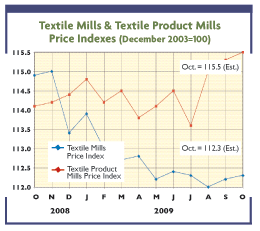
‘s equations suggest the bottoming out in both mill production and shipments noted over the
past six months will continue, hopefully setting the scene for an improved 2010.

Page14


Employment

A less rosy picture is seen when it comes to industry jobs, which should continue to shrink.
Much of the worker decline over the past few years can be traced to the big slide in mill activity.
But another part simply reflects increasing productivity. As such, even with the expected leveling
off in mill activity projected over the next few years, the number of industry employees is
expected to continue shrinking. One recent long look ahead by the Bureau of Labor Statistics
projects a 2.75-percent annual rate of employment decline in the basic textile mill sector over the
10-year period ending in 2016. The rate of decline in the more highly fabricated textile product
sector over the same period of time — though at a lower 1.25-percent annual rate — can also be
considered significant. It means the overall US industry workforce, which has been more than halved
since 2000, will continue to contract. But, as pointed out previously, there is a brighter side to
all this. Specifically, the increasing productivity factor noted above, along with only minimal pay
increases – expected to average in the low 2- to 3-percent range over the next few years — will
continue to reduce unit labor costs, and in the process help keep the US industry competitive in
today’s one-world textile/apparel market.


Cotton Prices

Calling the turn on cotton quotes may be a bit easier now. That’s because the US Department
of Agriculture (USDA) has removed its long-term ban on forecasting prices of this key natural
fiber. In fact, the agency’s economists have developed a new mathematical model that predicts
prices on the basis of changes such as variables in US and global supply/demand factors,
macroeconomic developments and global policy shifts. Some of the model’s findings: A 1-percent
increase in US supply from the previous year will cause US cotton tags to drop about 0.9 percent in
real terms; changes in foreign supply affect US prices on a nearly one-to-one basis, with quotes
falling as supply rises; a 1-percent increase in end-of-season stocks covered by the government’s
loan program, with stocks measured as a proportion of US cotton use, raises tags by 0.4 percent;
and a 1 million-bale increase in China’s net imports raises prices by 3.1 percent. More detailed
information on the model is available at
www.ers.usda. gov/publications/err80.
While the USDA has not as yet published any overall price forecast, an already-existing model
developed by the International Cotton Advisory Committee (ICAC) suggests a slight price rise may be
in the making for the 2009-2010 marketing year. Specifically, the ICAC model, noting a 1-percent
expected decline in global supplies, suggests a current year’s price advance of about 5 percent.
But that would still leave tags well under recent peaks.

November/December 2009

Karl Mayer Malimo Launches Malitronic® Multiaxial

Karl Mayer Malimo Textilmaschinenfabrik GmbH, Germany, has launched the Malitronic® Multiaxial
machine for production of reinforcing textiles, which can be used for prepreg applications for wind
turbines, aircraft, boats and building repairs.

One unit is available for customer trials and training at the company’s technical center. A
second machine already is in place performing trials for a multiaxial textile producer.

Mayer reports the machine, which features a modular design for optimal flexibility and can be
configured to meet customer specifications, offers 20- to 25-percent increased productivity
compared with the previous-generation model.

Other features include: a full-width, continuous conveyor belt to feed materials such as
chopped glass mats or pretensioned weft layers to the bonding section of the machine; an optional
wide cutting unit for producing chopped glass mat feedstock from glass rovings; a compensating yarn
tensioner to provide constant yarn take-off from the package and even out differences in yarn
tension as the yarns are laid on the conveyor belt; an optimized drive system for the weft laying
system; and simplified and optimized filler thread delivery, offering constant thread tension;
among other features.

November/December 2009

Dystar Resumes Deliveries, Restarts Investor Search

After filing for bankruptcy in September 2009, Germany-based DyStar Textilfarben GmbH, DyStar
Textilfarben GmbH & Co. Deutschland KG and DyStar Holdings GmbH — providers of dyes,
auxiliaries and services for the textile and leather processing industries — report talks with
banks and secured creditors are moving forward and the companies have been granted permission to
continue supplying their customers. DyStar Textilfarben GmbH & Co. Deutschland KG also has
restarted production at its manufacturing facility in Geretsried.

Prefinancing of insolvency payments owed to DyStar Textilfarben GmbH’s 73 employees as well
as staff at DyStar Textilfarben GmbH & Co. Deutschland KG has been negotiated.  “We are
setting up a control point with the agency for labor to look for a good solution for
extraordinarily affected employees,” said Dr. Stephan Lauabereau, preliminary insolvency
administrator of DyStar Textilfarben GmbH & Co. Deutschland KG.

DyStar also has resumed a search for investors. “We have already conducted initial talks with
potential investors,” said Miguel Grosser, preliminary insolvency administrator of DyStar
Textilfarben GmbH. “It is still too early, though, to assess the situation.”

November/December 2009

Brückner Celebrates 60 Years

Germany-based Brückner Trockentechnik GmbH & Co. KG, a manufacturer of textile finishing and
dyeing machinery, is celebrating its 60th year in business. Brückner was founded in 1949 by Kurt
Brückner as an air conditioning unit manufacturer. Soon after it opened, the company changed
direction and began to focus on drying machines, which still comprise Brückner’s core business
today. The company reports it has supplied more than 5,000 lines to its customers over the past 60
years.

dpf
Brückner’s latest-generation Power Frame tenter

Currently, the company is run by Regina Brückner, the founder’s daughter, and her husband,
Axel Pieper.

November/December 2009

Schoeller Offers Coldblack® Finish For Wool

Schoeller Technologies AG, Switzerland, reports its coldblack® textile finish is now available for
wool products. Coldblack technology enables black fabrics to reflect rather than absorb the sun’s
rays, offering both ultraviolet and solar heat protection
(See ”
Cool
Rider,
” Quality Fabric Of The Month, Oct. 9, 2007)
. Schoeller reports temperature changes
are less noticeable when wearing dark wool clothing finished with coldblack technology.

November/December 2009

Denimatrix, ACTEX Team Up

Denimatrix LP, Guatemala — a fully-integrated denim apparel producer, and part of Lubbock,
Texas-based Plains Cotton Cooperative Association’s Textile and Apparel Division — has formed a
partnership with Guatemala-based label producer Accesorios Textiles (ACTEX) under which ACTEX will
establish a state-of-the-art label-production facility to manufacture woven labels, hangtags, heat
transfers, price tickets, size strips and jocker tags at Denimatrix’s plant. Denimatrix will apply
the labels to denim jeans it manufactures for customers including Gap, Banana Republic, Abercrombie
& Fitch and others.

“Our design and development capabilities, combined with our manufacturing flexibility in
high-end products and this new venture with ACTEX, will boost our speed to market by eliminating
the lead time of sourcing outside the region,” said Carlos Arias, president, Denimatrix.

November/December 2009

Sponsors