NCTO’s Hastings Testifies Against Trade Benefits For Bangladesh, Cambodia

National Council of Textile Organizations (NCTO) Vice Chairman David Hastings has urged the House
Committee on Ways and Means not to extend duty-free preferences in textiles to Bangladesh and
Cambodia nor change textile preference rules in any way that might further exacerbate the loss of
US jobs. Hastings presented his testimony during hearings the committee was conducting on trade
preference reform.

To stress the urgency of his plea, Hastings, CEO of Mauldin, S.C.-based textile manufacturer
Mount Vernon Mills Inc., relayed the example of his company’s recent offering of jobs at its Trion,
Ga., facility, which, with more than 1,100 workers, is the company’s largest textile plant and
manufactures products that are exported to Western Hemisphere countries under existing preference
and free trade agreement programs.

“Eleven days ago, on November 7th, Mount Vernon announced that there were several job
openings at the Trion plant and people began lining up outside the plant at 4 a.m. that morning
just to apply. By noon, we had taken 270 applications from people looking for work,” he said,
pointing out that the same scenario has been repeated elsewhere nationwide and “is indicative of
the weakness of the US economy. Mister Chairman, our workers are hurting in this country and I
strongly urge the Subcommittee to keep in mind that our country and our manufacturing sector [are]
hurting badly,” he said.

Among other points, Hastings also warned that additional textile industry job losses could
adversely impact US Department of Defense procurement of US-made textile products, noting as an
example that the Trion plant provides a large portion of those products, but that they represent
only a part of the plant’s total production.

Hastings’ testimony will be reported on further next week in Jim Morrissey’s weekly report
posted on www.TextileWorld.com.

November 17, 2009

Trade Issues Prominent On Obama’s Asian Tour

As President Barack Obama visited five Asian nations over the past 10 days, he received plenty of
advice from home and abroad as to how the United States should deal with what have become
increasingly contentious trade issues.

Several leaders in the nations he visited warned the United States may be in danger of moving
toward protectionist trade policies, and there was general agreement that the future lies in free
and open trade. China President Hu Jintao said, “Protectionism will not help any country move out
of the crisis.” At home, manufacturers urged the president to press China, in particular, about
what they see as illegal trade practices that they say are wiping out jobs and hurting the economy.

Just before Obama left on his first tour of the area as president, the government released
data showing that the US trade deficit jumped by 18 percent to $36.5 billion in September, the
second-highest increase for the year, causing industry representatives in Washington to say China
and other Asian economies must stimulate domestic demand and not rely so heavily on consumers.

Perhaps the most significant and most specific comments came from Sen. Max Baucus, D-Mont.,
who as chairman of the Senate Finance Committee overseas trade legislation. Noting that the US
government has pretty much ignored trade because of the preoccupation of his committee, Congress
and the administration with economic recovery issues and health care reform, Baucus said, “It is
time for a new blueprint on trade.”

In remarks before the Washington International Trade Association, he called for a “new and
comprehensive agenda” that places more emphasis on enforcing existing trade agreements and on labor
and environmental practices in other countries. He also said the blueprint cannot ignore workers
whom trade leaves behind, and there must be more programs to help workers train and transition into
new jobs when their jobs are displaced by imports.

Baucus said a new agenda must recognize that the United States can no longer rely on American
consumers alone to fuel economic growth, and there must be more export-driven growth. In that
regard, he said US trade policies have focused for too long on trans-Atlantic trade, and more
emphasis must be placed on trans-Pacific trade. He praised Obama’s commitment during his trip to
participate actively in the Trans-Pacific Strategic Economic Partnership (TPP) with Singapore,
Chile, New Zealand and Brunei; as well as prospective TPP member countries Vietnam, Australia and
Peru.

Baucus called for congressional approval of the pending free trade agreement (FTA) with South
Korea, but only if Korea lives up to its commitment to abide by scientific standards when
regulating US agriculture exports and addresses the “legitimate concerns regarding trade in autos.”
He did not mention the textile industry’s concerns with the South Korea agreement.

He said his comprehensive approach to trade also must find a way for Congress to approve FTAs
with Panama and Colombia.

With respect to trade with China, Baucus said, “We must continue to encourage China to
rebalance its economy and focus on domestic consumption, and move toward a market-based economy,”
suggestions Obama also has endorsed.

The question is whether Congress and the administration are willing to get into trade issues,
following the contentious debates on economic recovery and health care.


November 17, 2009

The Rupp Report: New Strategic Partner For Uster Technologies

Switzerland-based Uster Technologies Ltd., a manufacturer of quality measurement and certification
products for the textile industry, announced that it has raised 43.9 million Swiss francs and
broadened its shareholder base thanks to a new strategic investor, Japan-based Toyota Industries
Corp. Uster believes the transaction should strengthen its financial and operational flexibility,
and says it also “represents a strong strategic endorsement of the company’s market position by a
major global industrial group offering synergies and new joint business development opportunities.”

Toyota Industries Corp. was founded in 1926 to manufacture and sell weaving machines. Over
the years, Toyota has added other textile machinery as well as automobiles, material handling
equipment, electronics, and logistics solutions to its scope of business.

Uster issued 1.9 million new shares with a par value of 9.40 Swiss francs each from its
authorized share capital. After the transaction, the new shares represent 22.5 percent of the
outstanding share capital.

Flexibility

“The proceeds of the transaction of 43.9 million Swiss francs will primarily be used to
improve the balance sheet by reducing debt positions and to further invest in product and market
developments,” Uster stated. The new funds are said to provide the company with additional
financial flexibility to ensure the build-up of market volume back to levels achieved in 2007. The
main reason for this partnership was to reduce the debt and therefore reduce loan costs. The
trigger for the capital increase was the so-called “uncomfortable balance sheet and shortage of
cash.” Uster looked up to various options, even among its own major shareholders and checked
different possibilities.

Finally, it was determined that Toyota would be the ideal strategic investor. Toyota will
make an important investment in Uster technologies and is convinced that “Uster is a reliable and
valuable partner for a promising future.”

Stronger Partners

In a telephone conference call, Dr. Geoffrey Scott, CEO, Uster Technologies, said he is
“delighted to have Toyota Industries Corporation invest in Uster Technologies Ltd. as a new,
long-term and strategic shareholder.” The new investor is said to be the best partner for a
long-term strategy in the best interest of Uster and its shareholders. Both companies are in a
leading position in their market environment, and the transaction will further strengthen both
partners. Toyota, as Scott mentioned, is the partner of choice because both companies are highly
committed to quality.

Under a lock-up agreement, Toyota is bound to hold the new shares for a period of 12 months
following issuance of the shares. In acknowledgement of the size of the investment and in order to
strengthen the strategic cooperation, it will be proposed for approval at Uster’s Annual General
Meeting in March 2010 that a representative of Toyota will join Uster’s Board of Directors.

Synergies

One may question the synergy potential of such a partnership. It must be noted that Toyota is
working not only in the sector of weaving machines but also in spinning preparation. This, said the
management of Uster, will bring new synergies for both partners. On top of that, there are also
plans for Uster to move toward the development of products for the weaving sector.

Tetsuro Toyoda, president, Toyota Industries Corp., said this investment in Uster
“establishes a basis for us to further develop Toyota Industries Corp.’s business opportunities.”
He believes in Uster’s strong market position and is “pleased to have been given the opportunity to
invest in a highly profitable company with an excellent technology and a product portfolio [with
an] outstanding quality management system ….”

November 17, 2009

Cotton Incorporated Publishes Sustainable Cotton Manufacturing Manual

Cotton Incorporated, the Cary, N.C.-based research and marketing company for US cotton growers and
importers, has published “A World of Ideas: Technologies for Sustainable Cotton Manufacturing,” a
guide that presents 26 technologies or processes that enable substantial reductions in the use of
water, energy and chemicals (WEC) in cotton textile processing. Available in hard copy or as a PDF
that can be downloaded at http://cottontoday.cottoninc.com/sustainability-about, the 56-page
booklet was compiled following two years of research including feedback from more than 40 companies
in China, India and Turkey that process cotton yarn, woven, knit and denim products; and have
incorporated commercial technologies proven to reduce WEC usage.

The booklet presents technologies according to five categories including processes; chemicals
and dyes; equipment; systems, control and management; and wastewater treatment.

In addition to making cotton processing more environmentally responsible, the technologies
presented can help reduce costs of operation, according to Cotton Incorporated. “The global
economic downturn is still having an effect on textile manufacturing around the world,” said Mark
Messura, the company’s executive vice president, Global Product Supply Chain. “As the booklet
illustrates, however, economic and environmental concerns are interrelated.”

November 17, 2009

Weave Corp In Process Of Reopening After Entering Receivership

Hackensack, N.J.-based Weave Corp. — a designer and weaver of decorative upholstery fabrics
including silk, indoor and outdoor fabrics, cotton and jacquard woven fabrics, among others — has
announced it will reopen this week, after ceasing production at its Denver, Pa., plant on October
27. Weave had defaulted on loans to its lender, Pittsburgh-based PNC Bank N.A., following
significant losses in 2009. Pittsburgh-based Meridian Financial Advisors Ltd. was named Federal
Receiver for Weave on November 10, assuming control of the company’s properties and assets.
According to Meridian President Margaret Good, the turnaround specialist is working with Weave to
restart production and service customers this week.

November 17, 2009

More New York Trade Shows


T
rade shows in New York City are on the rise. Newest is Hong Kong-based organizer Well
Link Consultants Ltd.’s SpinExpo, at which products exhibited ranged from fibers and machinery to
yarns and design direction. Karine Van Tassel, SpinExpo director, said that with the current
unstable economy, buyers are less inclined to travel, so it is important to bring information
directly to them. The show’s 75 exhibitors from 16 countries represented the elite of the industry.
“It is a quality show,” Van Tassel said. “We want to bring elegance, innovation and creativity with
fashion impact to New York buyers, and present it in a stimulating setting.”

Two other shows, Direction by Indigo and Printsource, focus on surface design. Lisa
Mainardi, director, Direction by Indigo, said exhibitors were pleased with that show, which offers
customers one-stop shopping for textile design and future direction.
stoll
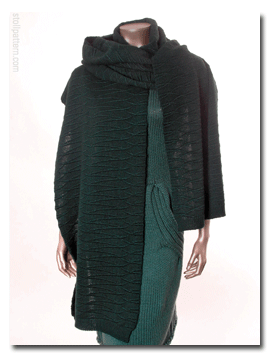
Stoll’s Autumn/Winter 2010-11 pattern collection includes this scarf in gore-look created
by float jacquard with holding stitches and stepped wave structures, and sleeveless dress with
jersey top in Stoll-knit and wear® technique and skirt with box pleat and cross cable.


SpinExpo

New technology, the environment, service, performance and quality were stressed in all
sectors. At Angelina® metallic fiber producer Meadowbrook Inventions, Bernardsville, N.J.,
brilliant metallic and iridescent polyester fibers are made from recycled post-industrial waste.
Aluminum fibers composed of plain or pigmented recycled aluminum are available in a variety of
staple lengths, are dyeable, and protect against ultraviolet rays and electromagnetic waves.
Meadowbrook’s 100-percent silver and copper fibers and silver- or copper-coated polyester are
reported to have therapeutic, anti-inflammatory, antistatic and antimicrobial properties.

Australian Wool Innovation Ltd. focused on technology and fashion. “The consumer wants
luxury and quality,” said Jimmy Jackson, general manager, Product Development, “and it has to
last.” Two new collections are Merino Touch™ and Merino Casual. Some Merino Touch fabrics are made
with merino wool yarn that is mercerized to give an exceptionally soft and silky hand, as well as a
cashmere feel. The yarns have a subtle sheen and color vibrancy. Many fabrics in the Merino Casual
range have unique application treatments. Some have a vintage look, or are permanently crinkled or
pleated; others have high/low or opaque/sheer effects from devoré processing.

Germany-based machinery manufacturer H. Stoll GmbH & Co. KG installed an electronic flat
knitting machine at the show to demonstrate production efficiency and quality of garments produced
by this equipment. At its Fashion and Technology Center in New York City’s garment district, Stoll
provides services such as training and education in knitwear development and production, creative
design development, sample garment execution, and sourcing to the apparel industry. There also is a
reference library.

Santoni S.p.A., Italy, a producer of electronic knitting machines for seamless apparel,
showed a diverse collection of apparel that can be produced on its equipment. The range includes
socks, underwear, sweaters, sportswear, beachwear and outerwear. Garments shown go from trendy to
basic. One dress that was knitted using different yarns and patterns was produced in 12 minutes.

At Buhler Quality Yarns Corp., Jefferson, Ga., buyers showed interest in slubbed and
shiny/dull yarns spun with Supima® cotton or MicroModal®. One bulky Supima yarn spun with
35-percent reduced twist has a shiny surface and silky touch. Moisture management such as transDRY™
technology is a factor. According to David Sasso, vice president, sales, there were more retailers
at the show this year wanting to work directly through the supply chain.

S & O, New Hyde Park, N.Y., showed chenille yarns made with recycled polyester and
organic cotton. Mohair and alpaca chenille yarns also were shown. Cross-dyes and tweed effects,
sparkle yarns and thick-and-thin rayon space-dyed yarns are going into products for the home.

Felise Erdal, president, Yarn Mavens Inc., New York City, said customers will pay higher
prices for quality yarns from European and American spinners. Yarn Mavens develops its own yarns
and represents several Italian and Spanish companies. New yarns include alpaca/merino wool/nylon
brushed and burned yarn, and metallic yarn that looks like chain mail – both from Lanificio
dell’Olivo S.p.A., Italy.

Two other Italian spinners at Yarn Mavens, FiliVivi S.r.l. and Filatura Papi Fabio S.p.A.,
offer stock service and wide color ranges. One popular yarn at FiliVivi is organic Australian
merino wool blended with acrylic. Papi Fabio, a spinner for hosiery and knitwear, blends wool with
cashmere and other precious fibers, and uses organic and natural vegetable dyes.

Custom Fancy Yarn S.L., Spain, also at Yarn Mavens, sells yarns on cones for flat knitting
or in skeins for hand knitting. One spliced yarn has 34 different colors and textures. 

Novelty yarns at Huntington Yarn Mill Inc., Philadelphia, are available in quantities as
small as 20 pounds. There are twisted yarns, bouclés, metallics and yarns spun with merino wool,
rayon or cotton.

Shanghai Tenbro Bamboo Textile Co. Ltd., China, grows bamboo and soy beans and processes and
spins them into soft, silky yarns that sell primarily to knitters and weavers that make
next-to-skin articles such as socks, lingerie and T-shirts.

New at Hilados Dusol S.A., Spain, is the Envirovert open-end spun yarn collection made from
recycled cotton and polyester. Custom colors are created by blending waste materials. Eco-friendly
plied yarns at Huafu Top Dyed Melange Yarn Co. Ltd., China, are available in vintage colors, and
are selling for circular and sweater knits. 

New at Leinefelder, Germany, are blends of cotton with silk, cashmere and baby alpaca. For
activewear, there are antibacterial and temperature-control yarns. The company is known for
ultrafine yarns. Z. Hinchcliffe, England — a spinner of cashmere, angora, camel hair, vicuna and
lambs-wool — stocks 120 colors and has no minimums. “We can twist anything and get it out in a
day,” said com-pany representative Graham Wilby.

Projects and designs based on individual clients’ needs are the specialty of Circular Knit
Services, Fort Mill, S.C. Novelty sample collections are available, or individual designs can be
created exclusively for each client. 

Scotland-based husband-and-wife team Sheila-Mary and Hamish Carruthers, Carruthers
Associates, have an easy-to-use Web-based fabric design service interactive site called Scotcloth,
presenting an archive of more than 70,000 digitally created textile designs that accurately
recreate woven fabrics. Selected designs can be rescaled and recolored, then downloaded. All colors
are Pantone® referenced.
karolinaprint
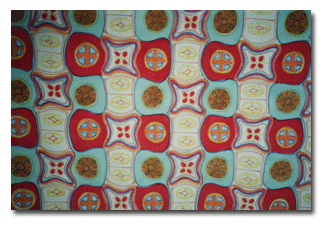
Karolina York Print Studio’s collection includes stained-glass-inspired fabrics such as the
one shown above.


Direction By Indigo And Printsource

At Direction and Printsource, textile designs can be vintage or contemporary. Swirling,
melting and moving images; large graphics; and nature-inspired elements are popular themes.

At Direction, Australia-based Karolina York Print Studio showed a stained-glass-inspired
group with mosaic and marbled abstract fragments in shades of bottle green and cobalt blue. Melting
stripes and washed effects turned up in a color dilution story. Workwear was another theme, with
dark colors and blurred designs. 

Multipatterned mixes at Keelergordon, England, include damask/ tapestry, geometric/floral
and exploding houndstooth designs. Another English studio, Sukhanlee, presented boldly colored
connecting triangles, changing circles, scratchy stripes, color-blocked graphics and architectural
drawings.

Tom Cody Design Inc., New York City, showed large, hand-painted flowers on tonal grounds;
feathery printed burn-outs; flocking; and animal skins. Catherine B. Designs, also of New York
City, showed small, ditsy flowers or gigantic florals on printed textures; chenille embroidery; and
animal conversationals.

New York City-based digital color service ColorEdge creates design folders that can archive
current and past seasons. It will cross-reference designs and collections and shade colors; and
connect them directly to Scotic numbers.

The focus is on weaving and warp knitting at EAT GmbH – The Designscope Co., Germany. The
company’s software creates textures and patterns and connects electronically to the production
machinery.

Amanda Kelly Design Studio and Whiston & Wright, both based in England, exhibited at
Direction and Printsource. Kelly pointed out skin prints, spots on striped grounds, abstract
florals and black-and-white designs. At Whiston & Wright, spotted and splattered patterns,
textured stripes that look as if they were in motion, distorted skins and scarf borders were
pointed out.

At Printsource, The Style Council of New York showed textural and marbleized designs, loose
black-and-white geometrics, and animal/skin graphic mixes. Large-scale prints range from paisleys
to menswear designs. Blugirl Art, Springfield, Mass., uses elements from nature for inspiration.
Wantagh, N.Y.-based Creativo showed optic geometrics, abstract animals, paisley mixes and nature
graphics.

November/December 2009

Nonwovens: Challenges & Trends


H
istorically, the development and success of the nonwovens industry were largely based on
disposable products. When nonwovens appeared on the markets, they were mostly produced to be
disposable. Still today, nonwovens for medical and hygiene products are mainly produced to be
disposable. However, in the last few years, environmental responsibility, sustainability and
reduced raw material consumption have become key concepts in cutting-edge nonwovens production. And
one issue might be the major challenge of tomorrow: flushability.

This past September, the 48th Dornbirn Man-made Fibers Congress took place in Dornbirn,
Austria. More and more, nonwovens are playing an important role at this congress, too. This is not
a surprise, as nonwovens are produced mainly using man-made fibers.

The man-made fibers industry has learned its lesson. Speakers at Dornbirn were known for
years to wholly neglect any environmental impact, and not only from the fiber industry. This time,
many papers challenged the natural fibers industry in different areas: production, finishing and
environmental impact. The conclusion of the event was astonishing. The presentations revealed an
overall new approach by the synthetic and artificial fibers industry that was unimaginable a few
years ago: Sustainability, environmental consciousness and climate change were the topics. What
does this mean for nonwovens?

nwopen
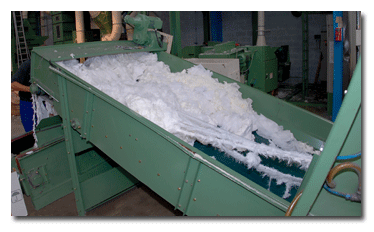
Figure 1: Recycled fiber, shown here being processed on a Laroche machine, will play an
ever-more-important role in nonwovens production.


Water Consumption

Whatever technology is applied to form a web, new requirements are in focus including reduced
water, energy and raw material consumption. Recycling of fibers and textile waste will play a more
important role, too
(See Figure 1). With the apparent climate change, whether generated by mankind or not,
water consumption will be one of the big issues in the future, if not the most important one. Water
might become one of the most desired and expensive raw materials.

Traditional disposables, like hygiene and medical products, are in real trouble because of
tighter environmental laws. There soon will be no more landfills to handle used disposables. The
industry is challenged: Every production stage, from fiber to finishing, must reinvest heavily in
new production technologies. Therefore, the big disposable products labels are looking more and
more for biodegradable products. “Responsibility has to become the key issue of economic, social
and environmental activities,” said one speaker at the Dornbirn congress.


Tailor-made Fibers

Basically, there is no true secret in nonwovens production today. Whether products may be
dry- or wetlaid, spunbonded, spunlaced or needlepunched, future sustainable achievements can only
be concluded if environmental issues are taken into consideration. Technologies that use no water
for the web-bonding process have some advantages – but only at first sight.

By applying the right forming and bonding techniques, water consumption is drastically
reduced. Also, modern wetlaid or spunlaced production lines are recycling almost all of the water
consumed in a closed loop. Furthermore, thanks to ongoing machine improvements, weights are
possible down to 10 grams per square meter, which means reduced fiber consumption. However,
needlepunching technology, with its latest machinery developments, still has a slight advantage
over other bonding technologies, thanks to its versatility.


Biodegradable Fibers

The fiber-producing industry is heavily active in research for new fiber types that are
derived from renewable sources. New and advanced fiber types like polylactic acid (PLA), derived
from corn or other vegetable starches, and viscose, derived from wood, take the environmental
aspects very much into consideration and enable promising new products for changing customer
attitudes. Yarn producers are in the forefront to bring new bio-based products to market. If these
products are competitive, the nonwovens industry will follow suit.

Biopolymers are interesting because of increasing oil prices and limited availability of
fossil raw materials. The materials are even compostable under specific conditions. However, PLA
production uses less fossil fuel but more land and water than petrochemical-based polymers.
Agriculture is needed in the first place for food, but PLA production is said to require less than
0.04 percent of global corn supplies.

Lenzing AG, Austria, produces the three main generic man-made cellulosic fiber types:
viscose, modal and lyocell. Its Tencel® lyocell fibers are made from wood grown in managed forests.
Cellulose from wood pulp is dissolved in an organic solvent, and the resultant viscous solution is
extruded into an aqueous spin bath. During the process, the cellulose is not changed chemically.
The spinning process is a closed-loop solvent spinning system in which the solvent is recovered for
reuse. As a result, there is virtually no release into the environment from the process. The result
is a pure cellulose fiber with good moisture handling, thermal properties, microbiological effects
and biocompatibility. It is biodegradable for safe disposability.

wipes
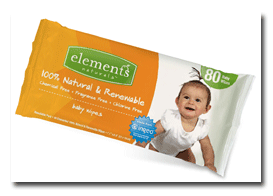
Elements Naturals™ 100% Natural and Renewable baby wipes are made with Ingeo™ bio-based
polylactic acid fibers, which are produced using 68-percent fewer fossil fuel resources than
petroleum-based fibers and also contain no chemical additives or surface treatments.


Medical And Hygiene Applications

According to Lenzing, Tencel is better placed than competing fibers for medical applications
due to its combination of properties. The hydrophilic fiber has a smooth surface with a rounded
cross-section, giving fabrics that are smooth, have low friction and feel good. It is highly
absorbent and provides excellent moisture management.

Tencel C is a new product that is being assessed for applications including apparel, hygiene
and active sportswear. It is produced by treating Tencel with chitosan during manufacturing.
Chitosan is deacetylated chitin – the main structural polymer in the shells of many shellfish and
other invertebrates. Chitosan has been shown to influence wound healing and in the right
presentation performs well as a hemostat. It is also in use for antibacterial products. Clinical
tests have shown the new fiber gives a positive effect on wound healing, morphology and cell
proliferation at the wound margin. One of the main observations with regard to chronic wounds is
that they show a significantly reduced rate of cell proliferation. Lenzing claims Tencel C has
better performances compared to other dressing materials tested.

coinsnw


Flushability

“Carbon footprint” and “life cycle analysis” are key terms for new cutting-edge products.
What can happen if a product is not designed from cradle to cradle, and if these points are not
taken into consideration, is drastically demonstrated with modern wipes.

Wipes are among the most successful nonwoven products. With the improvement of spunlaced
machinery, wipes started their road to success virtually around the world. In stores everywhere,
there are endless shelves full of wet wipes, refreshing towels and other similar products. Problems
occurred right after their success and present the industry with a big challenge – flushability.

Refreshing towels or wet wipes often are flushed down the toilet. After flushing, they do not
entirely disintegrate and can clog the whole wastewater system down to the wastewater plant. The
result is obvious. Thanks to the requisite product performance, the wipes don’t dissolve; the
system collapses, and it takes a lot of money and efforts to clean it up.

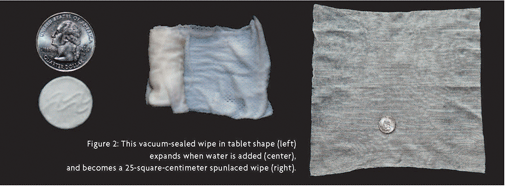
The latest development of a modern wipe is a vacuum-sealed product in tablet shape the size
of a US quarter. When water is added, the product starts growing. The final product is a
25-square-centimeter spunlaced wipe, which certainly will be flushed down the toilet, and the
problems start again
(See Figure 2).

Modern wipes must have not only functional requirements, but also great flushability to
disintegrate as quickly as possible. This is probably the quadrature of the circle and just another
challenge for the ever-so-promising nonwovens industry.


November/December 2009

Sustainable Textile Manufacturing: The Energy Factor


T
extile production has been at the center of the evolution of manufacturing from very
early times. Textiles touch so many aspects of people’s lives, and the ways of making and enhancing
them have advanced over millennia. Textile technology developments were prominent in the escalation
of manufacturing activity that defined the Industrial Revolution; and the conversion of basically
manual processes to power-driven, resource-consuming technologies, as well as the increasing use of
toxic process chemicals whose residues were released into the environment, contributed
significantly to the acceleration of environmental degradation that became a hallmark of industrial
development.

In support of efforts in recent years to reverse the impacts of this degradation on quality
of life and the balance within Earth’s ecosystem, the textile industry once again has a significant
role to play. Enlightened manufacturers are redesigning processes and products to reduce their
environmental impact. In the process, they are reducing energy usage and replacing fossil fuels
with renewable and alternative energy resources when possible or practicable. They are reducing
water usage as well as waste and emissions volumes, and reclaiming and recycling materials that
would otherwise be disposed of and giving them renewed purpose. They are choosing earth- and
people-friendly process chemicals to replace more toxic ones. And these enlightened measures not
only restore the ecological balance and safeguard human health, but also often benefit a company’s
fiscal health.

In a series of occasional articles,

Textile World
will examine how some textile manufacturers are transitioning operations to increasingly
sustainable models. This first article focuses primarily on renewable and alternative energy and
improved efficiencies, taking into account other aspects of sustainability if they apply here.
Later articles will focus on other aspects of sustainable textile manufacturing.

shawsustainable
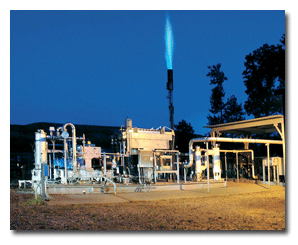
Shaw Industries’ waste-to-energy gasification plant in Dalton, Ga., converts
post-industrial carpet waste and wood flour to steam energy to replace fossil fuel usage at an
adjoining laminate plant.


Interface

Atlanta-based modular and broadloom carpet manufacturer Interface Inc. has been measuring
progress in its journey toward becoming a “restorative enterprise” — one that ultimately gives
back to the planet more than it takes — since 1996, two years after company Founder and Chairman
Ray Anderson’s “epiphany” regarding the notion that business and industry must take the lead in
reversing the environmental damage they have wrought. The company’s goal of reducing its
environmental impact to zero by 2020 includes deriving all of its energy from renewable resources.
Its effort to reach that goal also includes revamping manufacturing processes to reduce energy
usage; upgrading heating, ventilation and air conditioning systems; installing skylights; and
improving the efficiency of artificial lighting systems. “This is a much bigger part of our
initiative than renewable energy,” said Erin Meezan, the company’s vice president, sustainability.

Since 1996, Interface has reduced total energy use per unit of output at its carpet
manufacturing plants by 44 percent, and non-renewable energy use per unit by 60 percent. Renewable
inputs such as solar, hydroelectric, landfill gas (LFG) and geothermal now provide 28 percent of
its total energy needs. Globally, seven of its manufacturing plants use 100-percent renewable
electricity; and 89 percent of its overall electric power is renewably sourced, including power
received directly from the grid, purchased as renewable energy certificates (RECs) or generated
on-site.

Interface also has cut net greenhouse gas (GHG) emissions by 71 percent since 1996, with 34
percent coming from reductions and 37 percent from offsets.

interface
A 17-kilowatt-hour photovoltaic array at Interface Inc.’s Kyle Plant in LaGrange supplies a
portion of the plant’s electricity needs.


Milliken & Company

Spartanburg-based textile and chemical manufacturer Milliken & Company has been
measuring its energy consumption since the early 1990s. According to Cassidy Carlile, director of
corporate environmental, the company generally sets energy reduction goals of 5 to 10 percent per
year. Its GHG emissions from operations have been reduced by 28 percent since 2000. When carbon
sequestration in the company’s considerable forest acreage is added in, Milliken is certified to be
a carbon-negative manufacturer — the only textile or carpet manufacturer to achieve that status.

Milliken receives 5 to 10 percent of its total power needs from its hydroelectric plant in
South Carolina, which provides power to a couple of local plants, with the rest sold locally and
into the grid. The company’s LaGrange, Ga., carpet manufacturing plant uses more than 80 percent of
the LFG produced at the LaGrange landfill, which also provides LFG to Interface’s carpet plant in
LaGrange. LFG comprises 20 percent of the boiler fuel consumed at Milliken’s plant. An LFG project
also is underway to provide fuel to its plant in Inman, S.C.

Since the mid-1990s, wastewater biosolids have been used as boiler fuel at Milliken plants
where they are generated. “This has allowed us to take them out of landfills and get energy value
out of them as well,” Carlile said. The company also diverts solid waste to waste-to-energy (WTE)
facilities for use by other entities.

milliken
The landfill gas plant at the LaGrange, Ga., landfill harvests methane gas and supplies it
to plants operated by Milliken Carpet and Interface Inc. to provide part of their energy needs.


Shaw Industries

Dalton, Ga.-based Shaw Industries Inc. — a manufacturer of carpet, hardwood, laminate and
tile flooring products — annually converts some 18,000 tons of post-industrial carpet waste and
wood flour to steam energy at its WTE gasification plant in Dalton, reporting the energy produced
saves more than 2.5 million gallons of fossil fuel at an adjoining laminate plant. Another project
called Re2E (Reclaim-to-Energy) is underway that will convert more than 38,000 tons of
post-industrial and post-consumer carpet to provide more than 90 percent of the steam and half of
the electricity needs at one of its carpet plants in Dalton. The project is expected to cut steam
production costs significantly.

Shaw’s Andalusia, Ala., yarn plant is replacing some of the diesel fuel that backs up the
natural gas used in its operation with biodiesel derived from used cooking oil it collects from
local businesses, employees and the City of Andalusia. Cary Baker, the plant’s director of
operations, said the “Yellow Grease” reduces the plant’s fuel costs as well as suppliers’ disposal
costs. “We’ve probably saved $10,000 to $12,000 year-to-date,” he said, adding that the savings are
transferred to the plant’s freight account to improve competitiveness in that area of the business.

These measures support Shaw’s goal to derive 10 percent of its power from alternative
sources by 2017 as well as reduce waste sent to landfills.


Victor Group

Hydropower is the source of more than 91 percent of the energy used by Canada-based
contract, residential, outdoor and apparel fabric producer Victor Group Inc. at its Canadian
locations. In addition, the company’s manufacturing facility in Fall River, Mass., offsets a
portion of its electricity usage internally with RECs from the Canadian operations, and is
investigating local green energy options for future use if needed, according to Paul Bennotti,
marketing director.


FesslerUSA

Orwigsburg, Pa.-based knitwear and fabric producer FesslerUSA expects to provide 90 percent
of its electricity needs from a 1-megawatt solar array planned for its Deer Lake manufacturing
plant, making it immune to an expected 40-percent jump in Pennsylvania’s industrial electric rates
after the first of next year. The company also has installed more efficient lighting and variable
speed drives on some motors, and applied reflective paint where it can be effective, said Jenny
Russo, financial analyst.


November/December 2009

IFAI Expo 2009: The Turnaround Begins


T
he Roseville, Minn.-based Industrial Fabrics Association International’s (IFAI’s) IFAI
Expo 2009, held September 23-25 at the San Diego Convention Center, reported a strong turnout
despite the current economic situation. The expo was host to 6,190 participants from 62 countries,
with 344 suppliers from 16 countries exhibiting their products and services to the specialty
fabrics market. Many exhibitors noticed that although the quantity of attendees was down, the
quality was high.

“The show was very worthwhile,” said Rob Obradovich, president, Hartland, Wis.-based Keder
Solutions LLC. “I met people in different parts of the industry that I’d never been associated with
before, which was great because I walked out of there with more knowledge than I walked in with,
and also with a couple of good orders.”

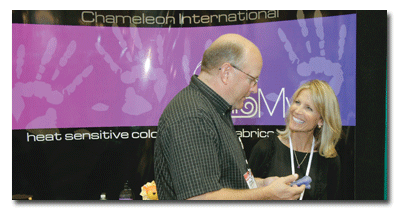
“The IFAI Expo was a huge success for our company,” said Ron Brignac, vice president of
sales and product development, Oak Ridge, N.C.-based Chameleon International LLC, exclusive
manufacturer and distributor of ChroMyx temperature-sensitive, color-changing, flexible sheet
material. “The first two days were nonstop for us, with rarely a time to sit down. We were able to
meet many fine people, and are very pleased with the relationships that were developed. The
networking with vendors was good and is proving to be mutually beneficial.”

ifaibooth
Chameleon International LLC exhibits its ChroMyx sheet material at IFAI Expo 2009.


Focus On Recovery

The economic recovery was the overarching focus for most exhibitors at this year’s expo.
Suppliers and manufacturers are weathering the global financial downturn by innovating products and
exploring new markets for growth, proving the specialty fabrics industry is resilient. “It takes
people and companies thinking outside of the proverbial box to create new or improved products in
their industry,” Brignac said.

insanaKeynote speaker Ron Insana – a CNBC financial expert and veteran financial industry

journalist and observer – gave a positive prediction for the industry in his address, entitled “Now
What? Managing Money Through the Economic Storm.” He reassured attendees, saying, “It’s not the end
of the world. … We will come out of this.”

walker
Janet Lane, executive director of IFAI New Zealand, IFAI’s newest country sector, poses
with IFAI President and CEO Stephen M. Warner


Show Highlights

IFAI Expo 2009 presented more than 100 educational symposiums informing business owners,
manufacturers and design professionals about new technologies and business growth opportunities in
the specialty fabrics market.

The Textile Industry Coalition on Government Procurement’s sold-out annual military textile
conference featured presentations by key military professionals who develop and procure items for
US armed forces. The textile coalition honored former Congressman Duncan Hunter, who served as
chairman of the House Armed Services Committee, presenting him with the Award of Outstanding
Military Merit in recognition of his championship of a strong Berry Amendment and efforts to
nurture a strong manufacturing climate.

The medical textiles symposium, “Patching Holes in Human Tissue -Current Applications of
Textiles in Medicine,” explored the latest textile advancements in medical and biomedical
applications for tissue and bone repair, nanofibrous scaffolds, vascular prosthetics and biotextile
developments in surgical therapies. IFAI’s Safety and Protective Products Division presented
“Technical Textiles Rocketing to Space,” offering insight into the latest research, materials and
design forecasts for technical textiles in aerospace applications. According to IFAI, one of the
best-attended sessions was the “How to Design Green Roofs & Landscapes” workshop, which was
free to licensed architects and outlined how geosynthetic and other textile materials can be used
to design sustainable, energy-efficient environments and buildings.

IFAI announced winners of the 2009 International Achievement Awards (IAA) for specialty
fabrics design excellence in 28 categories. This year’s IAA competition received a record 416
submissions from 17 countries, demonstrating the diversity of specialty fabrics applications. IFAI
also announced first-, second- and third-place winners of the sixth annual Safety Products Student
Design Challenge, a contest that pairs student designers with companies that provide support and
supply them with high-performance fabrics to create their projects. Click
here
to view a complete list of winners of these two competitions.

ifailadies
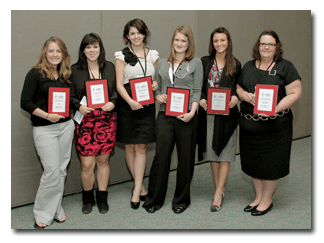
Winners of the sixth annual Safety Products Student Design Challenge display their
awards
.


Outlook

A recent study, titled “State of the Industry” and published by IFAI Research, notes that by
2010, the global technical textiles/specialty fabrics market is projected to grow to 24 billion
tons and to be valued at $127 billion. The organization reports that, based on the fact that 230
exhibitors have already booked booths for IFAI Expo Americas 2010, scheduled to take place Oct.
27-29, 2010, at the Orange County Convention Center in Orlando, Fla., the turnaround began at IFAI
Expo 2009. Allen E. Gant Jr., president and CEO of Glen Raven, N.C.-based Glen Raven Inc. and a
long-time exhibitor at IFAI Expo, said, “In these difficult times, we were pleased with the
attendance and the innovation that was demonstrated at the show.”

Also scheduled for next year is Advanced Textiles ’10, the third edition of IFAI’s
US-European entrepreneurial networking conference, which will be held June 16-17 in Paris. “Based
on the endorsement of an international audience and support from many prestigious European
organizations for our first two conferences in Berlin and Brussels, we are confident the annual
IFAI Advanced Textiles conference is viewed as the leading exchange platform for the technical
textile industry,” said Stephen M. Warner, president and CEO, IFAI.

French technical textile association Clubtex will be the key sponsor of Advanced Textiles
’10. IFAI also has announced it will add an offshoot of Advanced Textiles to next year’s IFAI Expo
in Orlando.

November/December 2009

New Address On The Moon — Or Even Mars


T
he street sign at ILC Dover’s headquarters — One Moonwalker Road — gives a strong hint
about what goes on inside the 260,000 square feet of office, development and manufacturing
buildings located there: Spacesuits for the Apollo astronauts in the 1960s and ’70s; gear for the
space shuttle crew that repaired the Hubble telescope in May 2009; and now, inflatable houses
designed for future outposts on the Moon — or even Mars. ILC may need to come up with a new street
name.

A leader in the development of flexible material systems that withstand extreme
environments, Frederica, Del.-based ILC has provided solutions to the National Aeronautics and
Space Administration (NASA) since the early days of the US space program. The company designs both
hardware and softgoods for the wide-ranging challenges of space exploration — from the high heat
of re-entry, to the profound cold of a lunar night, to the airbags that cushioned the landings of
the Mars Rovers. ILC makes a multitude of earthbound commercial products as well, from innovative
containment systems for packaging powder pharmaceuticals to highly advanced protective military
gear.

Still, it’s the inflatable lunar habitat idea that grabs one’s imagination. From the first
Moon landing in 1969 to the last trip there three years later, no one ever spent more than three
days on the surface, and they took the lunar module with them when they left. In the 21st century,
NASA’s Constellation program — to return to the Moon, set up a permanent base, and from there send
people to Mars – started taking shape. This program created a host of new challenges, including the
most basic one: if a crew is living on the Moon for months on end, where is everyone going to
sleep?

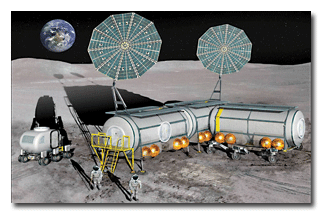
lunarhabitat
ILC Dover is designing habitats for astronauts similar to the cylindrical structures
pictured in this artist’s rendition of an outpost on the Moon, using Abaqus finite element analysis
software from SIMULIA. Image courtesy of NASA.


Launching A House Into Space

ILC’s engineers are working on the answer to that. In partnership with several different
branches of NASA, including Langley Air Force Base and the Johnson Space Center, the company has
been developing ideas for different configurations of lightweight space habitat structures.

“There’s a keen interest among the Constellation management and engineers for softgoods
solutions,” said Cliff Willey, ILC program manager of space inflatables. “When you are launching
equipment into space on a rocket, everything needs to be as lightweight as possible, packed
densely. In the case of a habitat, you want to be able to deploy something that can expand to be
much bigger on the surface of the Moon without a lot of mechanism. An inflatable, soft item is very
good for that.”

ILC recently completed the design work on one such project, a “mid-expandable” habitat with
two hard endcaps and a deployable softgoods section in the center. The endcaps for the current
prototype are being built by NASA Langley Research Center out of low-cost metal, but a lightweight
aerospace composite is envisioned for lunar deployment to reduce mass. For transport, the softgoods
section packs into the endcaps. During deployment, it is unfolded and inflated by air pressure,
more than doubling in length. The midsection’s unique fabric lobe system allows for a structure
that is much lighter in weight but has a higher volume than a similar hard-material configuration
would be. The endcaps are where doors, airlocks and other structures are mounted.

newp21 


Harsh Lunar

Environment Poses Unique Risks

The Moon’s environment contains a host of external hazards, including extreme temperature
fluctuations — which softgoods withstand much better than metals — plus radiation, dust,
bombardment from micrometeoroids, and low gravity. All these are taken into account by engineers
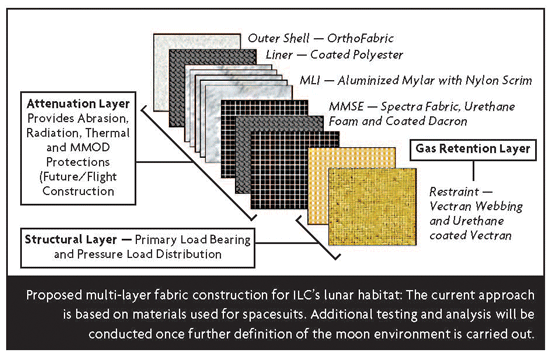
designing the lunar habitat, which has as many as 10 outer protective attenuation fabric layers
built up over two internal structural layers. Although exact material specifications are still
under study, the outermost attenuation layer will likely be constructed of Ortho-Fabric, which
consists of a blend of Gore-Tex®, Kevlar®, and Nomex® materials. The thermal micrometeoroid portion
of the attenuation layers might be constructed of layers of aluminized Mylar®, laminated with
Dacron® scrim.

But the biggest challenge ILC’s engineers faced when designing the multi-layered habitat was
not external: It was the inflation pressure on the two innermost layers of the structure. “You have
to come up with a pretty clever design to handle the high loads inside a dwelling that is
pressurized to a level in which astronauts can live,” said Ric Timmers, ILC senior analysis
engineer. “The skin load on the internal layers is proportional to the internal pressure times the
radius, so you need to find a material that’s able to handle the pressure on a big structure like
this one, which is 3 meters in diameter.”

In the zero-atmosphere Moon environment, not only do you need to control for oxygen leakage
through the habitat walls, but also, any significant fabric failure would result in a devastating
outward explosion of the structure. ILC’s solution was to design an interlocking webbing net over a
gas-impervious, coated fabric. The 2-inch-wide webbing is constructed of Vectran® in a plain weave
and has an advertised breaking strength of 24,000 pounds. The fabric was deliberately oversized so
that it would bulge slightly between the webbing panels, transferring the pressure load to the
webbing. This unique combination of fabric and webbing working together would allow the habitat to
be inflated to 9 pounds per square inch (psi), an acceptable pressure for humans living on the
Moon, while meeting NASA’s space construction safety standards.


Physical Prototyping

Would Send Costs Out Of Orbit

Testing the integrity of the design on the Moon’s surface was obviously impossible. Building
numerous prototypes out of custom fabric, and pushing habitat models to destruction, would also be
prohibitively expensive, as well as time-consuming. 

“Earlier, we were contemplating building a test rig and physically measuring the pressure
load on the fabric, the tension in the webbings, the pressure behind the windows — all
simultaneously — but we were looking at well over $1 million for a test like that,” Willey said.
“That’s when we backed off and decided to go with realistic simulation. We couldn’t be Edisonian
about this, relying on trial and error. We had to be able to build a reliable, finished product
design the first time out.”

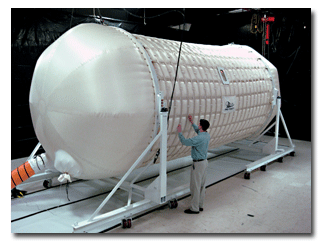
prototype
ILC’s mid-expandable habitat prototype is stored in two hard endcaps during rocket
transport to the Moon and then deployed on the lunar surface using air pressure, more than doubling
in length.


Realistic Simulation

Provides Down-to-earth Answers

So, the group turned to Abaqus finite element analysis (FEA) software, from the SIMULIA
brand of France-based Dassault Systèmes, to test virtual models of the fabric and webbing under
varying load scenarios. They also used FEA to evaluate the robustness of some minor structural
components, such as the metal brackets holding the webbings. “We relied heavily on analysis with
Abaqus for this project,” Timmers said. “It would have been pretty risky to do this without FEA —
you had to sleep at night!” 

Abaqus/CAE, the pre- and postprocessor for the Abaqus Unified FEA product suite, was used to
model the 3-D geometry of the design as the basis for the simulation. The group then ran the
simulation models with two central processing units on a Linux machine using Abaqus/Standard, which
provides all the material, geometry, and loading nonlinearity needed to simulate fabric structures.
“Our models were fairly straightforward, so static loading was appropriate for what we needed to
know,” Timmers said. 


FEA Helps Identify

Safe Fabric Yield Strength Limits

ILC began its analysis of the fabric/webbing system by modeling a unit cell of fabric
constrained by a square of the webbing net. “We used a simple planar approach for this analysis
since the out-of-plane curvature of each unit cell was negligible relative to the full radius of
the entire habitat,” Timmers said. When setting up the model, the group measured the sides of the
cell from webbing center to webbing center instead of from webbing edges. “We used the midpoints
rather than the edges because we wanted to be more conservative in our analysis by imagining that
the webbing wasn’t there, as a sort of worst-case scenario,” Timmers said.

To model the fabric itself, membrane elements were selected, and all degrees of freedom at
the perimeter of the unit cell were held fixed. Then, the model was oversized slightly, using what
Timmers calls “a neat thermal expansion coefficient technique” that raised the temperature until
the fabric expanded to a set percentage, to simulate the bulge of fabric between webbings. Finally,
the nominal 9 psi of pressure was applied to the model, and Abaqus calculated the resulting stress
in the material. With a center load result of 74 pounds per inch (lbs/in), and an edge load of 84,
the material was well within NASA’s required safety factor of four, as the ultimate tensile
strength of the fabric was approximately 500 lbs/in.

“Using Abaqus FEA to identify the allowable limits of the fabric’s performance was very
useful because with this type of structure you have to be really sensitive to total mass,” Timmers
said. “When we found one material that worked, we could use Abaqus to virtually test another,
lighter material to see how much we could save on total weight and still provide the right factor
of safety.” The final fabric selected for the lunar habitat was a 0.0075-inch-thick, 200-denier
Vectran with a urethane coating impermeable to gas leakage. The weave is plain, with a yarn count
of 50 by 50 threads per inch. The ultimate tensile strength is 551 lbs/in in the warp direction,
and 520 lbs/in in the fill direction.


Keeping The Web Of Safety Intact

In addition to low stress in the fabric restraint system, another important contributor to
the habitat’s stability was evenly balanced loading of the ring of webbing itself. To test this
part of the design, the ILC team used Abaqus to simulate just the critical axial, or end-to-end,
length of the webbing. Hoop webbings around the circumference are more isolated from one another
and are less sensitive to any uneven lengths among them. The purpose of the model was to simulate
“manufacturing uncertainties” that might unexpectedly shorten the length of a single webbing.

“Our biggest concern this time was that any deviation in the length of one webbing could
foreshorten the whole system, concentrating 100 percent of the load on a single section and leading
to a cascade of breakage,” Timmers said. The team set up their model with all 26 axial webbings
fixed to a flat plate representing the hard endcap of the habitat. The usual 9-psi pressure load
was applied to the surface of the plate to simulate conditions in an inflated habitat. When one
webbing was shortened by just 0.125 percent, the analysis results showed that the load on it jumped
to 4,815 pounds, versus 3,600 pounds on the rest of the webbings. But since the breaking strength
of the Vectran webbing chosen for the habitat was 24,000 pounds, the safety factor of four was
still met.

How long will such a well-designed structure last on the Moon? “The intended design life of
the lunar habitat is at least 10 years,” Timmers said. While accelerated aging studies on the
component materials and creep testing on webbing material have already been carried out, additional
long-term durability studies are still pending.


Camping On The Moon, Mars

— Or Even Just The Antarctic

With their habitat design complete, ILC teamed with NASA to build a prototype for “Camping
on the Moon,” now on display at NASA Langley. Real-world verification tests of a full model —
including a deployment run-through, a high-pressure test, and tear-resistance evaluation — are
pending further funding.

“We may very well run these tests ahead of time with Abaqus,” Timmers said. “It’s ideal to
use a combination of modeling and testing back and forth, applying FEA to dial into just a few
possible scenarios.”

Whatever the timeline for deploying astronaut habitats on the Moon or Mars, ILC’s unique
approach to such structures has applications closer to home as well: potentially as hyperbaric
chambers for health clubs or hospitals; or, already, as dwellings for polar- or desert-based
scientists. A similar habitat designed with Abaqus Unified FEA has been tested in the harsh
environment of the Antarctic and will be going to the Arctic as well. The polar habitat model had
requirements around wind, snow and ice loading, all of which are absent on the Moon, so the
material selected was several layers of polyurethane-coated nylon separated by layers of
Thinsulate™.

What will the address be in the Arctic — One Icewalker Road? The ILC engineers hope One
Marswalker Road is not that much farther away.

Editor’s Note: Lynn Manning is a science and technology writer based in Providence, R.I.

Sponsors