Picanol Introduces Cordless Air-jet Weaving Feature

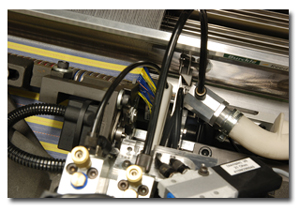
Belgium-based weaving machine manufacturer Picanol NV has introduced a feature for air-jet weaving
machines that enables weaving without the filling catch cord. The Cordless feature has a mechanical
clamp at the right-hand side of the machine that moves along with the reed. According to Picanol,
tests conducted on a range of fabrics have indicated the Cordless design offers advantages
including improved filling tension evenness, decreased air consumption, improved selvage quality,
increased speeds on delicate yarn and significantly reduced filling waste when weaving with elastic
yarns.

cordless

The Cordless feature is fully automatic, owing to Picanol’s integrated concept of using a
central microprocessor to process data from sensors and detectors on its machines, enabling
real-time calculations and adaptations to the system’s valve timings. Picanol also reports the
Cordless feature is compatible with all types of reeds.

June 29, 2010

APDN Customizes DNA Suits, Teams With Bilcare To Offer New Security Solution

Applied DNA Sciences Inc. (APDN), a Stony Brook, N.Y.-based provider of DNA encrypted and embedded
authentication solutions, has successfully customized its first series of suits containing its
botanical SigNature® DNA marker. Each suit is manufactured in Yorkshire, United Kingdom, where it
is custom-made from woolen yarn, then woven and finished into a pinstripe fabric and made-up by a
master tailor. APDN reports its SigNature DNA marker, which is incorporated seamlessly into the
suit during manufacturing, withstood multiple launderings.

APDN also announced it has received its first order from U.K.-based Textile Centre of
Excellence as part of its participation in a multi-year contract, funded by the European Regional
Development Fund and Yorkshire Forward, in which APDN’s technology will serve as a security
platform
(See ”
APDN’s
SigNature DNA Selected For European Anti-Counterfeit Program
,” Aug. 18, 2009)
. The order,
valued at approximately $50,000, begins the government’s three-year, $1,500,000 commitment to the
program.

“This contribution is designed to generate significant additional investment from the private
sector, which should generate at least 2 million pounds over the three-year lifetime of the
program,” said Bill Macbeth, managing director, Textile Centre of Excellence.

In other company news, APDN and India-based Bilcare Technologies, developer of the
nonClonableID™ solution, have signed an agreement to market an integrated version of their
technologies to provide a unique multi-layered security for brand protection, anti-counterfeiting
and logistic and provenance control. The combination of technologies will enable the companies to
offer real-time identification, authentication and verification of marked products in the field as
well as forensic authentication of the items in the lab.

Marked products can be read by handheld scanners that have data stored on a secure remote
server, enabling items to be scanned from anywhere around the world using mobile phone connectivity
in real-time. Using the track-and-trace system, the client will be able to verify product’s
authenticity as well as its inspection, purchase and return history.

June 29, 2010

Huntsman Textile Effects, Genencor Release Gentle Power Bleach™ LCA Results

Singapore-based Huntsman Textile Effects – a manufacturer of chemicals and dyes for textile
processing, and a division of Huntsman International LLC – and Palo Alto, Calif.-based Genencor
International – a manufacturer of enzyme product solutions for a variety of industries, and a
division of Denmark-based Danisco A/S – have released the results of a life cycle assessment (LCA)
performed on their enzyme-based Gentle Power Bleach™ system that was introduced a little more than
a year ago
(See ”
Gentle
Bleaching
, March/April 2009)
.

The two companies hired Quantis International — an organization that provides businesses and
governments worldwide with tools, guidance and knowledge for achieving sustainability by mastering
their product life cycles and reducing their environmental impacts — to perform the LCA, which was
the first study of its kind to assess an enzymatic bleaching solution used in textile processing.
The results, validated in production at existing production facilities using known processes, have
undergone external expert peer review and have been certified ISO 14044 compliant.

“Although the cotton pretreatment processing parameters will differ across the globe, we
found a substantial advantage for Gentle Power Bleach among each of the many environmental impact
categories that we tracked,” said Jon Dettling, U.S. director, Quantis International. “For
instance, the LCA concludes that if the relative benefits of Gentle Power Bleach were applied to
the roughly 26 million tons of cotton produced globally [a 2007-08 statistic], the savings in
freshwater consumption globally could be in the range of 10 trillion liters of water annually,
which is more than 1,000 liters annually for each person on earth. This result depends strongly on
the available information regarding cotton irrigation, but nevertheless, illustrates the large
potential benefits of the technology.

“Significant reductions in global greenhouse emissions are another benefit of this process,”
Dettling added. “It is estimated that Gentle Power Bleach has the potential to reduce global
[carbon dioxide] emissions by 10 [million to] 30 million metric tons annually.”

“Both companies see this technology as a critical step towards a more sustainable textile
processing industry,” said Paul Hulme, president, Huntsman Textile Effects. “Our vision is much
aligned with the one from Genencor, and that is that we need alternative solutions today to tackle
the critical challenges that future generations will face if we don’t act now. The LCA proves that
we are heading in the right direction. But there’s more work to be done in the field of more
sustainable textile processing as both consumers and merchandisers are increasingly demanding more
responsible practices from the industry.”


June 29, 2010

Teijin Sells German Monofilament Business To Serafin Privat Holding

Japan-based conglomerate Teijin Ltd. has agreed to sell Teijin Monofilament Germany GmbH to
Germany-based Serafin Privat Holding GmbH for an undisclosed price. The transaction, implemented as
part of a restructuring of Teijin’s Polyester Fibers business, follows the liquidation of
Spartanburg-based Teijin Monofilament U.S. and the sale of 10 monofilament lines from that business
to Wetekam Monofilaments US Inc. — a new business established in Spartanburg by Germany-based
monofilament and grass yarn manufacturer Dr. Karl Wetekam & Co. KG
(See ”
Teijin
Restructures Polyester Fibers Business, Consolidates US Film Production
,” August 18, 2009; and

Wetekam
Monofilaments US Inc Established In Spartanburg
,” March 2, 2010).


Teijin Monofilament Germany — which in 2009 employed 236 people and realized sales totaling
30.5 million euros — was established in 2001 when Teijin acquired the German and U.S. monofilament
operations of Johns Manville Corp. Johns Manville had acquired both operations in 1999 from former
chemicals manufacturer Hoechst AG, which had established monofilament operations in Germany in 1956
and in the United States in 1969. Teijin and Hoechst established a joint venture monofilament
business in Japan in 1991, and Teijin acquired Hoechst’s interest in that business in 1998. The
Japan-based monofilament business continues to operate as part of Teijin Ltd.

June 29, 2010

Impressive Lineup Of Speakers Highlights Inaugural RISE Conference

CARY, NC — June 24, 2010 — Speakers from industries as diverse as automotives, consumer products
and health care – along with some of the most forward-thinking innovators in the business today –
highlight the impressive agenda at the inaugural Research, Innovation & Science for Engineered
Fabrics (RISE) Conference, scheduled for September 20-23 in Baltimore, Maryland.


Organized by INDA, Association of the Nonwoven Fabrics Industry, RISE is designed to
stimulate innovation in all aspects of the development, production, marketing and sales of
engineered fabrics. The target audience ranges from product managers and technical sales and
marketing executives to product engineers, purchasing managers and research engineers at both
consumer and industrial products companies.


“Our goal for RISE is to start the conversation between technical and marketing professionals
to create new markets and revenues for companies in these markets,” says INDA President Rory
Holmes.


Holmes points out that RISE will bring together some of the most creative, innovative minds
in the global engineered fabrics business, as well as from related industries that utilize the
products made by engineered fabrics companies. “RISE will provide attendees with the tools – and
the motivation – to jumpstart their own progressive thinking in the global engineered fabrics
industry.”


One of the highlights of RISE will be an intense four-hour innovation “boot camp” to help
companies re-align their innovation efforts. It will be led by Karl-Michael Schumann, Innovation
Advisor and Coach and former director of Research & Development at Procter & Gamble.
Companies are invited to submit a specific innovation problem or question to Schumann in advance of
the workshop for a confidential solution.


Another session on Sustainable Innovation – featuring Ron Hageman, Chief Technology Officer,
New Composite Partners; Liila Woods, Senior Consultant, PE Americas; and Suzanne Shelton, President
& CEO, Shelton Group – will discuss Life Cycle Analysis (LCA) as a quantitative tool to measure
the impact products and systems have on the environment.


Among the market-specific sessions being held at RISE:


* Construction: Under pressure to “green up” their projects with alternative
materials and energy saving solutions, architects and builders are caught between outmoded building
codes and the need to introduce innovative practices into their designs. Innovation in building
science requires more than new materials, however. World-class speakers — André Desjarlais,
Program Manager-Building Envelops Program, Oakridge National Laboratory; Helene Hardy-Pierce, Vice
President of Technical Services, GAF Materials; Joe Lstiburek, Principal, Building Science Corp.;
and Jerry Phelan, Bayer MaterialSciences – will discuss where innovation is driving these changes.


* Hygiene-Consumer & Medical. The concerns of consumers and environmentalists
are merging and “green” is becoming a technical standard that must co-exist with other performance
characteristics. Nancy Muller, Executive Director, National Association for Continence; Pricie
Hannah, Vice President, John R. Starr, Inc.; Robert Green, Business Director, NatureWorks LLC; and
Blair Childs, Senior Vice President, Public Affairs, Premier, Inc. will help attendees learn what
consumer needs and wants are and how they can be balanced with green alternatives.


* Innovative Equipment. The latest and greatest in energy-saving technologies and
equipment will be the focus of Steve Lessley, Market Manager-Nonwovens, ITW Dynatec; Alan Lavore,
Executive Vice President, Mahlo America; Hans-Georg Geus, Technical Director, Reifenhauser
Reicofil; and Doug Brown, Biax-Fiberfilm.


* New Markets & Opportunities. Exploiting new market opportunities is vital
for companies to guard against the time when a strong product or service will become static or
declining. The panel of Jerry Fan, Independent Consultant; Rory Holmes, President, INDA; Ram
Maheshwari, Director of Marketing, Ginni Filaments (India); and Keith Osteen, Principal, Smith,
Johnson & Associates, will explore new market opportunities springing from a range of possible
sources. The speakers will investigate the markets of China and India and discover the global
possibilities with a look at recent patent filings and industry “mega trends.”


* Innovative Thinking. John Wilbanks, Vice President of Science, Science
Commons/Creative Commons; Abbie Griffin, Royal L. Garff President Chair in Marketing, David Eccles
School of Business, University of Utah; Karl-Michael Schumann, Innovation Advisor & Coach,
Former Director of R&D, The Procter & Gamble Co.; Chris Andrews, Senior Analyst, Forrester
Research; and Al Dietz, Johns Manville, will explore innovation as the bottom line of our
industry. 


* Advanced Materials-New Developments. Attendees will learn about new developments
with eco-friendly raw materials and innovative ways resins and fiberglass are being used to create
sustainable energy. The panel includes Ralf Taubner, Scientist-Spunbonds & Films, Sächsisches
Textilforschungsinstitut; Rockey (Bin) Zhao, ExxonMobil Chemical; and Andy Campbell, Senior Staff
Engineer, Braskem Polypropylene.


For more information on the Research, Innovation & Science for Engineered Fabrics (RISE)
Conference:
www.inda.org.

Posted on June 29, 2010

Press Release Courtesy of INDA

Nice-Pak’s Eco-Pak Receives 2010 WOW Innovation Award

CARY, NC — June 25, 2010 — Eco-Pak, a new wet wipes delivery system from Nice-Pak, received the
prestigious WOW Innovation Award presented as part of the fourth annual World of Wipes (WOW)
Conference, June 21-23 at the InterContinental Hotel in Chicago, Illinois.


The WOW Conference, organized by INDA, Association of the Nonwoven Fabrics Industry, is
devoted solely to wipes, with a concentration on substrates, active ingredients, packaging, market
metrics, industry challenges and market opportunities. The WOW Innovation Award recognizes and
rewards the industry members who bring new and value-added processes and products to the wipes
market.


Following presentations by the four finalists, attendees at the WOW Conference voted the
Eco-Pak system as the recipient of the 2010 Award.


Eco-Pak is a portable, soft pack delivery system that holds high-efficacy surface
disinfecting wet wipes, which could previously only be packed in canisters. This resealable new
package has soft sides, and yet is able to stand on one end, maximizing store shelf impact and
minimizing storage space under a kitchen sink. This new package provides a more compact footprint
than traditional canisters for more efficient storage and transportation, as well as a more
comfortable fit in the consumer’s hand.


“At Nice-Pak, for more than 50 years, we have been passionate about creating game-changing
products that meet real consumer needs. The Eco-Pak provides the consumer with a significantly
improved use experience and reflects our focus on sustainability,” says Robert Julius, chairman and
CEO of Nice-Pak Products. “Thanks to INDA for supporting innovation and sustainability in the wipes
category.”


The three other finalists, chosen from products nominated by the industry earlier this year,
are:


* Kimberly-Clark … Kimtech One-Step Germicidal Wipe

Kimtech One-Step Germicidal Wipe is a pre-saturated hospital-grade surface disinfecting wipe
with a Clostridium difficile spore kill claim. The wipe is powered by a unique chemistry that
combines hydrogen peroxide and peracetic acid and rapidly kills C. difficile spores and numerous
other bacteria, viruses and fungi on surfaces.


* RPM Technology … PolyWipes

The PolyWipes are an odorless aqueous nonwoven wipe designed to remove uncured silicone,
polysulfide, urethane, epoxy, and virtually any uncured system.


* Seventh Generation … Seventh Generation Disinfecting Wipes


In January 2010 Seventh Generation introduced EPA registered disinfecting wipes that kill
germs naturally using the active ingredient thymol as a component of thyme oil derived from the
thyme plant. This product has combined thymol disinfecting technology, green formulation chemistry,
and a total chlorine-free processed substrate..


For more information on the fourth annual World of Wipes (WOW) Conference and the WOW
Innovation Award:
www.inda.org.

Posted on June 29, 2010

Press Release Courtesy of INDA
Prominent New Resource Now At Concept III Textiles

RED BANK, NJ — June 28, 2010 — “Charles Parsons is known for being a visionary in fabric ideas
geared specifically for apparel and are also known for their excellent service. Those two qualities
are what we require of our partner mills and also what sets Merino State apart from other
suppliers,” says Chris Parkes, Concept III’s national sales manager.

Outdoor business launch Privately owned Charles Parsons has been developing and manufacturing
specialized textile solutions for fashion apparel brands throughout Australia, New Zealand and the
Asia-Pacific region since 1915. Now, working through Concept III’s network, Parson’s and Concept
III are looking to develop a following for its Merino State fine micron premium textile collection
in the U.S., Canada and U.K. outdoor markets.

Quality, ethical and environmental awareness In addition to adhering to strict quality
assurance by its own internal labs, SGS and Qualspec, every product in the Merino State collection
is also tested according to stringent ‘Woolmark’ and ‘Merino Perform’ specifications.

Keenly aware of ethical responsibility and environmental concerns of the outdoor apparel
market, Merino State wool is only sourced from independently audited, certified non-museled farms
in Australia and New Zealand. Farms must comply with regulations governed by the RSPCA and the New
Zealand Animal Welfare Act. Except for seasonal shearing these sheep even graze in a free-range
environment.

Vertical services Parsons has textile-manufacturing facilities in both Australia and China.
It has over 25 years experience in garment production and has manufacturing partners in China,
Fiji, and Singapore. The company offers in-house design, sample and pattern making services, all
geared for speed to market.

Merino State Collection, made with naturally sustainable, renewable and biodegradable Merino
also includes blends with other environmentally favorable fibers like bamboo, milk, hemp and
organic cotton.

A complete range of Merino State textiles as well as apparel samples will be available at the
Concept III ORSM 10 booth #39051 in Salt Lake City, UT August 3-6. Concept III can be contacted at
(732) 530-1976 or
info@conceptiii.com.

Posted on June 29, 2010

Press Release Courtesy of Concept III Textiles International

Obama Calls For International Cooperation On Economic Recovery

On the eve of a meeting of the leaders of the world’s top 20 economies, known as the G20, President
Barack Obama on June 18 wrote a letter to participants calling on them to make a renewed commitment
to work together to continue and strengthen the economic recovery.

While calling for more stringent capital and liquidity requirements, stronger oversight of
derivatives markets, more transparency and disclosure, he also mentioned the need for revisions in
international trade. The G20 members account for 80 percent of world trade.

“Our ability to achieve a durable global recovery depends on our ability to achieve a pattern
of global demand growth that avoids the imbalances of the past,” he said. Without mentioning China
by name, Obama said: “We have agreed that countries with external surpluses would need to
strengthen domestic sources of growth. I also want to underscore that market determined exchange
rates are essential to global vitality. The signals that flexible exchange rates send are necessary
to support a strong and balanced global economy.”

On June 19, the People’s Bank of China announced it plans to move forward with reforms of the
renminbi or yuan exchange rate, but the bank did not say how much of a modification it expected or
when it is likely to take effect. President Obama immediately praised the action as a “constructive
step that can help safeguard the recovery and contribute to a more balanced global economy.”
However, the action is not likely to satisfy congressional and industry critics of China’s exchange
rate policies who say the depressed yuan amounts to a major unfair subsidy to Chinese exports that
is costing U.S. jobs. Sen. Charles Schumer, D-N.Y., who is authoring legislation to impose stiff
tariffs on Chinese imports if China does not modify its currency exchange rate, described the
Chinese action as “a vague and a limited statement of intentions.”

While the Obama administration has been concerned about the U.S./China trade deficit and the
refusal of China to let the value of its currency float, it has been reluctant to formally brand
China a currency manipulator and pave the way for retaliatory actions under U.S. trade laws.
Administration officials also have urged Congress to avoid legislation that would do the same
thing.

Back in April, Treasury Secretary Timothy Geithner delayed releasing a report on
international currency policies because he felt there would be “a series of very important
high-level meetings that will be critical to bringing about policies that will help create a
stronger, more sustainable and more balanced global economy.”  He cited as examples a
Strategic Economic Dialogue with China in May and the July 26-27 G20 meeting in Toronto. 

China’s announcement just prior to the G20 meetings is seen as an effort to lessen the
pressure some of the G20 members have been putting on China to let its currency float.


June 22, 2010

Euratex Holds Annual Assembly, Vice President Vows To Support Textile Industry

The Brussels-based European Apparel and Textile Federation (Euratex) held its annual General
Assembly on June 10. European Commission Vice President and Commissioner for Industry and
Entrepreneurship Antonio Tajani opened the assembly by vowing to support the textile industry and
“improve the functioning of the Internal Market as an instrument to provide jobs.” Tajani stated
that at the end of the financial crisis, the jobs and growth that the European Union (E.U.) needs
depends on the textile industry’s companies and small and medium enterprises (SMEs).

Tajani listed his priorities for the future EU industrial policy in general and the textile
and apparel industry in particular, pointing out six specific areas he intends to focus on in the
next five years including: encouraging more innovation; promoting more efficient use of raw
materials, water, energy and other natural resources; reinforcing policies and programs that
support SME activities; setting policies that support continuing industrial restructuring and
modernization; preserving and promoting a qualified workforce; and working toward global fair trade
for E.U. companies. 

Euratex President Dr. Peter Pfneisl noted successful projects Euratex has implemented in
partnership with the European Commission’s Directorate-General Enterprise and Industry, including
the Lead Market Initiative on Protective Textiles and the eBIZ project. “Vice President Tajani, we
are looking forward to continue working very closely with you and your services to ensure that that
European industrial policy provides a framework contributing to the sustainable competitiveness of
our textile and clothing industry in Europe.”

More than 160 participants and representatives from the European textile industry and
institutions attended the public session titled “Sustainability in the European Apparel and Textile
Industry.” The session included discussions on sustainability in the textile and apparel sector and
actions the industry can take to improve its sustainability.

June 22, 2010

DHS Issues Final Rule Covering Buy American Requirements

The Department of Homeland Security (DHS) has issued its final rule covering Buy American
requirements for its purchases of textile and apparel products under the American Recovery and
Reinvestment Act of 2009. The agency adopted, without change, its interim rule issued last August
17, and in effect rejected a number of objections from textile manufacturers, organized labor and
others.

DHS said it received comments from 26 organizations and individuals and members of Congress
who suggested a number of changes, as they felt the interim rule did not carry out the full intent
of the legislation. Commentators called for changes in the de minimis exceptions to the rule, the
definition of national security interests and the listing of some of the trading partners with
which the United States has preferential trade agreements; and they also called for the DHS to
“mirror” the Berry Amendment, which covers textile and apparel purchases by the Department of
Defense.

In his comments on the interim rule, Rep. Larry Kissell, D-N.C., who authored the textile
provisions, said that “any rule allowing unnecessary use of non-domestic parts will substantially
undermine the job-creating capability of the Kissell Amendment’s provisions.”  He emphasized
that the amendment was enacted to benefit U.S. manufacturers in the textile industry and said, “It
is incumbent upon DHS in drafting final rules to implement the amendment to ensure that U.S.
producers of textile components and products have the ability to compete and seek full procurement
advantages as intended in the statute.”

In turning down the commentators’ suggestions, including Kissell’s, DHS said the Homeland
Security legislation “is not an extension of the Berry Amendment,” and, therefore, it would be
necessary to have its own definition of which products “directly affect national security.” DHS
also insisted on treating participants in preferential trade agreements under its own procedures,
saying “deletion of the named countries (Mexico, Canada and Chile) would complicate understanding
of the rule under legal requirements that exist today and would require each individual contracting
officer to determine the application to those countries.” Other suggestions from commentators also
were rejected.

The text of the final rule is available in the Federal Register for June 9, Vol.75,
No.110/Rules and Regulations,
http://edocket.access.gpo.gov/2010/pdf/2010-13804.pdf.

June 22, 2010

Sponsors