
Eastman To Sell PET, PTA Business To DAK Americas

Kingsport, Tenn.-based Eastman Chemical Co. — a manufacturer of fibers, chemicals and plastics —
has agreed to sell its polyethylene terephthalate (PET) and purified terephthalic acid (PTA)
businesses and the related assets and technology of its Performance Polymers segment to
Charlotte-based DAK Americas LLC — a producer of polyester staple fibers (PSF), PET resins and PTA
monomers, and a wholly owned subsidiary of Mexico-based Alfa S.A.B. de C.V. The transaction, which
is subject to regulatory approvals, is expected to close in the fourth quarter of 2010, with cash
proceeds totaling $600 million.

The acquisition includes three integrated petrochemical plants in South Carolina — one
producing PTA and the other two producing PET — that employ 415 people and have a total annual
capacity of 1.275 million tons. Alfa estimates that during the first half of 2010, the plants
realized $405 million in sales revenues and $46 million in pro-forma earnings before interest,
taxes, depreciation, and amortization.

DAK also will obtain intellectual property of the IntegRex™ PTA and PET technology along with
access to the business’ customer base.

“This strategic acquisition reinforces our presence in the North American PTA and PET
markets, where we supply some of the most important companies in consumer segments such as
beverage, food and personal care, which have traditionally been resilient to economic cycles,” said
Armando Garza Sada, chairman of the Board, Alfa. “With this acquisition, we demonstrate once again
our commitment to the PTA and PET value chains.”

According to industry analyst Alasdair Carmichael, president of Spartanburg-based PCI
Fibres-Americas, the acquisition also will have implications for the carpet industry. “The PCI
Group estimates that, after the acquisition is completed, DAK will be the largest producer of PET
resin in North America with a 41-percent share of U.S. capacity, and also will be the largest
polyester producer in the Americas,” Carmichael said. “This acquisition of Eastman’s PET business
will provide DAK with a strong position in PET resin for packaging and other uses, but also will
reinforce their supply position into the carpet industry.

“The carpet industry has rapidly increased its consumption of polyester bulked continuous
filament (BCF) in recent years, and the ‘chip’ source used for this has been a PET resin chip
rather than a regular polyester fiber chip, because PET resin has a higher intrinsic viscosity.
Much of the initial work to develop polyester BCF was done using Eastman PET resin, and the
eventual success achieved ensured that PET resin, rather than fiber chip, became the industry
standard. DAK has been active in the carpet market with PET resin supplies and also PSF for carpet
spinning,” he said, noting the company’s recent joint venture with Shaw to produce recycled flake,
or chip, from bottles
(See ”
DAK,
Shaw Form PET Recycling JV
,” May/June 2009)
. “The expectation is that a portion of this
flake will be used in the production of polyester BCF,” he added.


October 26, 2010
Leading Australian Retail Group Implementing PLM Solution From Visual 2000

MONTREAL, Canada — October  25, 2010 — Visual 2000 International Inc. announces that leading
Australian fashion and accessories retail group M Webster Holdings Pty Ltd has begun implementation
of the Visual PLM.net® software solution at its Sydney (AUS) headquarters and  Shanghai (CHN)
sourcing and production offices.  Owner of the popular Jigsaw, David Lawrence, and Marcs
brands, M Webster Holdings (MWH) will deploy the product lifecycle management (PLM) software across
more than 70 users in its design, merchandising, product development, sourcing, and other internal
functional departments as well as with its vendor partners in China. MWH expects the new system to
accelerate cycle times, increase visibility into business processes, and improve collaboration
among internal teams and with suppliers.

According to MWH Group Operations Officer Lyle Hudson, “We saw in PLM an opportunity to
centralize all product information and provide the process visibility our teams and vendors need to
make faster and better informed business decisions. After careful evaluation, we chose Visual
PLM.net because of its strong out-of-the-box capabilities and the flexibility it gives us to manage
our specific business needs. Visual 2000’s deep retail industry expertise will clearly benefit us
with a fast implementation and continued business and productivity improvements as we move
forward.”

By leveraging the comprehensive set of standard, fashion-specific tools included in Visual
PLM.net, MWH is advancing on a rapid implementation schedule with plans to go-live on the new
software in December.  Key vendor partners will be deployed in January with the balance coming
online in the spring of 2011.


“We applaud the efforts of MWH as they work to improve their concept-to-consumer
operations”, noted Charles Benoualid, vice president of research and development at Visual 2000.
“The speed of their implementation validates our commitment to building industry tailored solutions
that are comprehensive and easy to implement and use. We look forward to helping Webster as they
achieve their ambitious goals.”

Posted on October 26, 2010

Source: Vision 2000 International

Parts Scanning Platform Reverses Automatically Without Programming

Aston, PA, October 2010 – Amacoil has designed a parts scanning platform which moves in a
reciprocating motion pattern using the Uhing linear drive. The linear motion of the platform is
backlash-free. Reversal is automatic without requiring an electronic control system or reversal of
the drive motor. Additionally, the automatic reversal mechanism is designed to dissipate forward
momentum at the reversal points assuring smooth reversal without jarring or jerking.

A control knob on the assembly enables adjustments to linear speed — without clutches, cams
or gears — while the system is running. Length of travel may be increased or decreased using
adjustable end stops. There is no programming and no hydraulics or pneumatics. The only maintenance
required is periodic shaft lubrication.

Designed for a PCB measurement/cleaning process, the assembly may also be used for scanning
barcodes on parts and in other applications requiring repetitive back-and-forth movement.
Components are precision-machined to limit vertical and horizontal movement of the platform to
within ± 0.001 inches. Amacoil will customize the platform to meet specific application
requirements or OEM design needs.

Posted on October 26, 2010

Source: Amacoil Inc.

Alexander Wang Goes Live On Cloud-Based FashionManager PLM/ERP Solution

Lyndhurst, NJ — October 14, 2010 — RLM Apparel Software Systems Inc. announces that New
York-based fashion brand Alexander Wang Inc. has successfully implemented the RLM FashionManager
On-Demand enterprise software solution. The premier American designer has gone-live with the
cloud-based FM On-Demand software in its product development, manufacturing, distribution, and
financial management operations. Founded by celebrated designer Alexander Wang, the company has
quickly become one of the most prominent names in women’s apparel, footwear, handbags and
accessories. By replacing its in-house systems with RLM’s integrated, web-based software, Alexander
Wang is among the many creative companies that are also innovating in the management of their
business infrastructure. 

“We wanted a system that covered all of our business needs,” stated CEO Aimie Wang. “It did
not make sense for us to license and build costly interfaces for separate PLM, ERP, and financial
packages. We considered best-of-breed systems, but none offered distinct advantages over the RLM’s
fully integrated cloud computing solution.”

RLM FashionManager provides Alexander Wang with the integrated financial, manufacturing, and
distribution tools it needs to keep everyone in the organization as well as outside vendors working
from the same page. It also improves the company’s competitiveness and flexibility by improving its
ability to capture sample room costs, maintain accurate fabric and trim inventory levels, project
demand, and deliver its products on time.

“Since June, RLM has already implemented our merchandising, product development, trim, sample
room, sales, and credit management teams into the system”, continued Ms. Wang. “RLM’s Management
Console concept and system standards have also made it easy for everyone including new hires to
quickly learn the system and meet our rapid growth requirements.”

The cloud-based FM On-Demand provides access to Alexander Wang locations in New York and
across the globe through the internet; enabling Alexander Wang to leverage the benefits of the
software without the need for capital investments in computer hardware and a large IT staff.
Alexander Wang expects to add more system capabilities from RLM’s menu of more than 40 different
application modules to meet future growth.

Posted on October 26, 2010

Source: RLM Apparel Software Systems

Momentive Builds New Liquid Silicone Rubber Compounding Center

ALBANY, N.Y.– October 25, 2010 — Momentive Performance Materials, a global leader in specialty
chemicals and materials, has started construction on a new manufacturing facility dedicated to
liquid silicone rubber (LSR) production in Leverkusen, Germany, already a major production site for
a number of the company’s silicone and sealant product lines.  The new facility will allow for
the increased production of LSR, needed to meet growing demand from global customers and emerging
markets. The first phase of the project will be completed by end of 2010. 

Over the course of the past two years, Momentive has launched a number of innovations in
elastomer technology that have fueled demand for LSR products.  These include a highly
transparent LSR (Silopren* LSR 7000 series that can replace thermoplastics in specific optical
applications; a fully fluorinated LSR that exhibits high resistance to fuels and flex fuels; a
fiber-reinforced LSR with unique physical properties; and a silver-based antimicrobial LSR
(StatSil* antimicrobial elastomers, that can help prevent the spread of microbial infections from
medical devices to the human body.

Momentive’s StatSil platform earned international recognition as a recipient of the 2009
Frost & Sullivan “Product Innovation of the Year” Award and the 2010 Ringier “Technology
Innovation” Award, while Silopren LSR 7000 was a 2009 Material ConneXion MEDIUM Award finalist for
“Material of the Year.”

“Providing customers around the world with high quality LSR is vital to our elastomer
business,” said Dr. Robert Gnann, Senior Vice President and Managing Director Silicones EMEA and
India, Momentive.  “In addition to meeting growing capacity requirements, this investment can
help ensure continued consistency, quality and purity of the liquid silicone rubber we produce,
which contribute to our leadership position in the global LSR market.”

Full automation and state-of-the-art process control will continue to ensure that the highest
quality standards are maintained in the production of Momentive’s LSR offerings.  “By steadily
investing in our LSR capabilities, we can continue to provide customers around the world with the
advanced technology they need to build on their success in different product lines as well as
capitalize on new market opportunities,” said Dr. Ian Moore, Senior Vice President and General
Manager Silicones Americas, Momentive.

Posted on October 26, 2010

Source: Momentive Performance Materials Inc.

United States Prevails In WTO Countervailing Duty Dispute With China

WASHINGTON — October 22, 2010 — Today United States Trade Representative Ron Kirk announced that
a World Trade Organization (WTO) dispute settlement panel found in favor of the United States in a
dispute brought by China concerning antidumping (AD) and countervailing duty (CVD) measures applied
by the U.S. Department of Commerce to a range of Chinese imports.  The panel upheld the right
of the United States to impose both antidumping duties – which respond to unfair pricing practices
– and countervailing duties – which respond to government subsidies – on dumped and subsidized
products from non-market economies such as China.  China also challenged several other
substantive and procedural aspects of Commerce’s CVD decisions, and the panel found in favor of the
United States on the vast majority of these issues.


“This is a significant win for American workers and businesses affected by unfairly traded
imports,” said Ambassador Kirk.  “We are pleased that the panel recognized that the concurrent
application of AD and CVD duties on subsidized Chinese goods to level the playing field for U.S.
companies and workers is fully consistent with our WTO obligations.  This case makes clear
that the Obama Administration, including USTR and our colleagues at the Department of Commerce,
will vigorously defend the application of our trade remedy laws.”


Background

In September 2008, China initiated a WTO dispute settlement proceeding against the United
States concerning AD and CVD measures on circular welded pipe (CWP), certain new pneumatic
off-the-road tires (OTR), light-walled rectangular pipe and tube (LWR), and laminated woven sacks
(LWS).  China challenged the United States’ imposition of CVDs on unfairly subsidized products
from non-market economies such as China, while also applying a non-market economy methodology in
the AD investigations concerning the same products.  In another challenge, China contested
Commerce’s determination that certain Chinese state-owned enterprises (SOEs) and state-owned
commercial banks (SOCBs) are “public bodies” that provide subsidies.  China also contested
Commerce’s choice of benchmarks to find the existence of a “benefit” and Commerce’s finding that
certain subsidies were “specific” to a particular industry or region.  In addition, China
challenged procedural aspects of the determinations, including the use of “facts available” on the
basis of shortcomings in information provided by the Chinese respondents and the time to respond to
questionnaires issued by Commerce.


The WTO established a panel in January 2009 to hear this dispute, and the panel held meetings
with the parties in July and November 2009.


The panel found in favor of the United States with respect to the vast majority of China’s
claims.  Most notably, the panel found in favor of the United States with respect to China’s
challenges to:

·        Commerce’s use of its non-market economy AD
methodology to calculate and impose AD duties concurrently with the imposition of CVDs on the same
Chinese imports;

·        Commerce’s finding that the SOEs and SOCBs at
issue are public bodies that provide subsidies;

·        Commerce’s finding that lending by SOCBs in the
OTR investigation was specific;

·        Commerce’s decision not to perform a pass-through
analysis of subsidies or to “offset” the “positive” and “negative” amounts of subsidies found in
the OTR investigation;

·        Commerce’s choice of benchmarks for certain
inputs – including benchmarks outside of China – in the CWP, LWR, and LWS investigations;

·        Commerce’s choice of benchmarks to calculate the
benefit from government-provided land-use rights in China in the LWS and OTR investigations;

·        Commerce’s choice of interest rate benchmarks to
calculate the benefit from loans from SOCBs in the CWP, LWS and OTR investigations; and

·        The amount of time that Commerce provides parties
to respond to questionnaires.

The panel found in favor of China with respect to China’s challenges to:

·        Commerce’s regional specificity determination
regarding government land-use rights in the LWS investigation;

·        Commerce’s calculation of the existence and
amount of benefit from the purchase of SOE-produced inputs and the benefit of certain loans from
SOCBs in the OTR investigation; and

·        Commerce’s use of “facts available” to determine
the amount of an SOE-produced input purchased from trading company suppliers in the LWR and CWP
investigations.

Both sides have the right to appeal the decision to the WTO Appellate Body within 60 days.

Posted on October 26, 2010

Source: Office of the USTR

The Rupp Report: Short-sighted Egoism

Sometimes it is a phenomenon how fast the human brain, at least in a part of human society, can
forget bad experiences. After the financial crisis in 2008 and 2009, the whole world is showing a
more smiling face these days. However, we face a kind of currency war, one could say. And the fear
of a new crisis is based again on egoism and short-sighted advantages and, last but not least, of
greed of a very well-known part of our society.

Money Makes The World Go Round

Since the financial society discovered the possibilities of betting on the volatility of
currencies, there is a financial merry-go-round among the leading currencies of the world. One
example is the euro. Since February, the decreased value of the euro is more than some 10 percent,
in spite of strong activities from many federal banks in Europe and Switzerland.

Some days ago, the Brazilian minister of finance warned about such a crisis. To prevent any
problem of its own currency, the real, Brazil plans to increase the tax on financial transactions
already existing from 2 percent up to 4 percent to discourage excessive capital imports to the
country.

It’s You, Not Me

This is the outcome of the game that many countries are playing with their own currencies.
And, of course, every country has enough good reasons to defend its activities and blame the rest
of the world for their egoism. In the past, the federal banks of a country whose currency came
under pressure tried to support its currency with adequate steps to regain its strength. This time,
it’s different. For an average citizen, it is quite unbelievable that some nations are quite happy
with their low currencies, which will, they think, increase the chances for a strong export
industry.

This might be right, but it is short-sighted. The consequences could be more dramatic than
the recent crisis. Many experts have warned about artificial currencies and exchange rates. Today,
the global economy is so intermingled that, in the long run, only global concepts can survive. One
of the problems is the low interest rates in the developed countries. These low rates encourage
some people to get cheap money and invest it in so-called developing nations, such as Brazil. This
investment can create a negative pressure on the local currency.

The Real Danger Is Protectionism

If all countries should participate in this vicious circle of currency devaluations, the
effect would remain the same as no devaluations. However, the money supply would further rise. For
emerging countries with strong growth, this devaluation could stir up inflation. It is therefore
more probable that these countries would not defend themselves by manipulating their own currency
but via direct interventions in the capital markets. This is called protectionism, which should be
avoided to prevent long-time damage to the global economy and the upswing of local markets.

Tolerance Is Urgently Needed

Dominique Strauss-Kahn, director of the International Monetary Fund, just warned countries
about a currency war and jeopardizing the current upswing. He fears that worldwide competitive
currency devaluations could trouble the situation and that countries should not use their currency
as a political weapon. Such behavior would represent a serious threat for the global business
recovery. Also, in the long run, the consequences are negative and could cause great damage.

Pascal Lamy, director-general of the World Trade Organization in Geneva, said recently that
he’s optimistic that the countries will not risk starting an economic war. In a global world, he
said, every country must show some tolerance for its counterpart and make some sacrifices to find a
true global balance for the future.

A very strong example of team spirit just ended happily in Chile: 33 miners were saved by a
seemingly endless number of rescue people after being buried in a mine for more than two months.

And the answer to the phenomenon of how fast the human brain can forget bad experiences?
According to news reports, the American banks and financial institutions on Wall Street are paying
bonuses totaling $144 billion. This is a new record-high payment. Isn’t it high time to reshuffle
the cards and play with open rules?


October 19, 2010

Clariant Relocates Textile Chemicals BU, Completes GANO Project

Switzerland-based textile dyes and chemicals supplier Clariant International Ltd. will relocate the
headquarters of its Textile Chemicals Business Unit (BU) from Reinach, Switzerland, to Singapore.
Senior management and the global textile application technology team will operate out of the new
office. The BU’s dedicated European sales and marketing operation and a development laboratory,
both currently based in Reinach, will move to Muttenz, Switzerland.

“Singapore is the optimum location from which to service the key global textile markets
across India, China and South East Asia,” said Thomas Winkler, head of Clariant’s Textile Chemicals
BU. “Positioning our management team close at hand will further strengthen our customer
relationships and enhance our ability to respond quickly to the trends of this dynamic sector. At
the same time, Europe remains an important market for Clariant and our European textile customers
will continue to be served by our dedicated, well-established infrastructure located in the
region.”

In related company news, Clariant recently completed a Global Asset Network Optimization
(GANO) project. The study, which was part of the company’s 2009-2010 restructuring program, impacts
eight Clariant sites and will result in the elimination of as many as 100 positions worldwide.
Approximately 60 Switzerland-based employees will be offered transfers to operations in Germany and
Singapore. All changes related to the GANO should be complete by 2013.

In addition to the changes within the Textile Chemicals BU, research and development
(R&D) staff in Reinach will move to Frankfurt, where Clariant houses its global R&D group;
and the Paper Specialties BU headquarters group will move from Reinach to Muttenz. Clariant will
focus its activities in Switzerland on Muttenz and Pratteln, and will no longer have a presence in
Reinach by 2013.

The company is contemplating moving its French headquarters from Nanterre to Lamotte, and has
begun talks with workers’ representatives.

To reduce costs and simplify management structures, Clariant will close three facilities –
McHenry in the United States, Delta in Canada and Sefakoy in Turkey. Individual manufacturing lines
will be shut down at plants in Roha, India, and Shizuoka, Japan; and three sites in Guatemala City,
Guatemala, will be consolidated into a single manufacturing, warehousing and office operation.


October 19, 2010

Quality Fabric Of The Month: Denim — In Style With Inherent FR

DRIFIRE® Comfortable FR Wear™ — a line of flame-resistant (FR) fabrics and apparel featuring moisture-wicking, quick-drying dri-
release® with FreshGuard® anti-odor technology — first appeared in late 2006, with the technology initially being used in knitted base layer garments and a few outerwear garments and accessories. The
technology — offered by Columbus, Ga.-based Drifire, an Optimer Brands company — was conceived as an alternative to polyester-based technology because it can provide the same moisture-wicking,
quick-drying performance benefits but won’t melt when subjected to sudden extreme heat such as that generated by an explosive device. First targeted uses were for military personnel fighting in Iraq and Afghanistan.Drifire fabrics are made with a blend of 85-percent inherently FR, hydrophobic modacrylic and 15-percent hydrophilic cotton, Tencel
® or other natural fibers. Modacrylic is a self-extinguishing fiber that doesn’t melt or drip, and Drifire apparel now is offered not only for military applications, but also to first-responder and industrial personnel who risk exposure to explosions, fire and/or arc flashes.

qfompicjeans

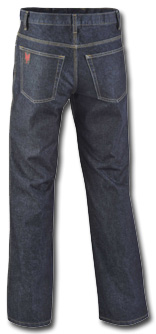
DRIFIRE® FR Denim Fabric provides inherent FR protection, dri-release
® with FreshGuard
® moisture-management and odor-neutralizing performance, and superior abrasion
resistance for jeans, jackets and shirts to dress electrical and utility workers in style.

One of the newest offerings in the line is Drifire FR Denim Fabric, a modacrylic/cotton blend for pants, jackets and shirts for electrical and utility workers. According to Dustin Cohn, chief marketing officer, Optimer Brands, the fabric complies with National Fire Protection
Association (NFPA) 70E electrical safety standards and also hazard/risk category (HRC) 2 standards for arc flash protection, achieving a 16.2-calories-per-square-centimeter Ebt arc rating.

“There are other FR denims, but they are 100-percent treated cotton,” Cohn said, noting that the FR treatment will eventually wash or wear out of the denim. He added that Drifire FR Denim Fabric has a very comfortable hand and feel. “The hand and feel of a Drifire jean are phenomenal. You would never know it’s a FR jean, and the look aspect is also important. Americans love their jeans, and it is important to make denim look and feel like denim.”

Cohn provided test data showing that, compared with traditional FR denims, Drifire denim provides superior performance in the areas of moisture wicking, water release, drying rates and abrasion resistance.

“In Drifire denim, the next-to-skin filling yarn provides the moisture wicking away from the skin to the outer fabric surface,” said Rob Hines, vice president of product development, Drifire. “The filling has the dri-
release hydrophobic/hydrophilic ratio, with the inherently FR modacrylic providing the hydrophobic performance and cotton providing the hydrophilic function,” he explained, adding that the modacrylic in the filling is sufficient to provide the FR self-extinguishing performance to the whole fabric. There also is a bit of nylon in the mix to contribute to the fabric’s abrasion resistance.

The denim fabric is woven by Columbus-based Denim North America, one of the largest denim manufacturers in the United States, Cohn said. “We wanted to partner with someone who does regular denim and can provide the denim look and hand level of quality, so workers don’t have to sacrifice what they love about their regular jeans to have this FR product.” Although Drifire FR Denim has been designed primarily for electrical and utility workers, there are other potential markets as
well, including petrochemical workers and fire fighters who happen to be wearing jeans, he said.


For more information about DRIFIRE® FR Denim Fabric, contact Ana Torres +1-312-878-0806; atorres@optimerbrands.com.; drifire.com.


October 19, 2010

‘Organic Exchange’ Grows To ‘Textile Exchange’ At Its Global Sustainable Textiles Conference October 27-29 In NYC

SILVER SPRING, MD — October 19, 2010 — WHAT: Organic Exchange (OE), the non-profit which has
helped drive global sales of organic cotton apparel and home textile products to an estimated $4.3
billion in 2009, will announce its expanded role as the organization driving  development of
the global sustainable textile industry under the new name, ‘Textile Exchange,’ at its annual
conference in New York City. The broadened focus positions the organization to serve as the
non-profit convener, catalyst, and market-maker for the sustainable textile industry worldwide.

Textile Exchange (TE) will work to increase the global market for sustainable fibers,
focusing initially on those that are bio-based, organic, and recycled while retaining a core focus
on organic cotton.  It will also tackle pressing textile industry production concerns such as
water and air emissions, energy use and its impact on climate change, waste production, and the
widespread use of toxic inputs. Change is vital given the huge and unsustainable economic,
environmental, and social costs of current textile production methods and a projected global
population of over nine billion by 2050, all needing clothing and other textiles.

A focus on textile sustainability enables the entire value chain to find cost savings and
production efficiencies and pass those savings on to customers while reducing the impact of textile
production on people and the environment.

The change will be announced at Textile Exchange’s Global Sustainable Textiles Conference,
with approximately 300 textile industry-related representatives from 29 countries already
registered to attend. TE’s global conference includes representatives from the U.S. Federal Trade
Commission, adidas, Anvil Knitwear, C&A, Disney, Eileen Fisher, Gap, H&M, Lenzing, LL Bean,
Nike, Nordstrom, Patagonia, Puma, REI, Target, Walmart, and Williams-Sonoma. Topics to be covered
include sustainable textile processing, eco-indexing, traceability and transparency, organic fiber
production, and environmental footprinting.

In November, TE will roll out a dynamic website, which will dramatically improve the ability
of producers, manufacturers, brands and retailers, funders, and the general public to interact,
find important information, locate supply chain partners, and improve traceability, transparency,
and integrity in the textile industry supply chain. The website – created by Silicon Valley’s
SourceN, an award-winning digital agency that has also created websites for Apple, MTV, and Time,
Inc. – aims to drive efficiency, cost savings, and visibility in the global textile value chain.

WHEN: October 27-29, 2010.

WHERE: Sentry Centers, 730 Third Avenue (between E. 45th and E. 46th streets), New York City,
10017. Please RSVP (media) or register (companies) BY October 21 or you will not be able to enter
the meeting.

Posted on October 19, 2010

Source: Textile Exchange/On the Mark Public Relations

Sponsors



