IMB Select 2010 Closes With Good Results

COLOGNE, Germany — November 11, 2010 — After a two-day fair, the first IMB Select closed its
doors on Wednesday with good results. The new trade show format, developed in collaboration with
the industry, provided the ideal conditions for the presentation and discussion of new developments
and advancements in process control and data exchange along the textile value chain. “We’re very
satisfied with the response. We would be delighted if Koelnmesse continues to pursue this concept.
This could be the starting signal for a very successful series of IMB fairs in future,” said one
major exhibitor, summing up the good mood that pervaded the hall. “All things considered, the
event’s new approach proved convincing. The results and experiences from the IMB Select 2010 give
us every reason to be optimistic about 2012,” said Gerald Böse, CEO of Koelnmesse. “The combination
of the IMB Select with its high degree of specialisation in information and communications
technology and the IMB – World of Textile Processing here in Cologne represents an international
platform for the global garment industry and textile supply chain that is unique the world over,”
added Böse.

Virtually all the exhibitors were equally impressed by the high quality of the IMB Select
visitors. “Lots of contacts – international ones too,” was the general tenor amongst the exhibiting
companies. In total, 568 trade visitors from 21countries informed themselves about the product
portfolios of the 53 exhibiting companies from 8 countries. Both garment manufacturers like
S.Oliver, Esprit,Hugo Boss, Puma, Wolford, Brax, van Laack and Marc O’Polo – to name just afew –
and retailers like Galeria Kaufhof and Sinn Leffers journeyed to the IMB Select in Cologne. The
exhibitors were particularly satisfied with the quality and decision-making authority of the
visitors.

The IMB Select 2010 encouraged direct dialogue between users and providers within the sector
in ideal fashion. The trade fair’s interdisciplinary approach was also reflected in the first-rate
congress programme. Under the motto “Heading for the future: enhancing global collaboration”, the
agenda covered the entire spectrum, from sourcing to retail and from order placement back to
procurement. On both days of the event, lecture blocks alternated with Speakers Corner
presentations, culminating in Future Talk, the concluding highlight of the fair, on the afternoon
of the second day. Entitled “Dialogue Marketing and CRM: gather, evaluate and entice”, the Future
Talk brought the extremely well attended congress programme to a fitting close.

The IMB 2012 will take place in Cologne from 8 to 11 May.

For further information go to:
www.imb.de.

Posted on November 23, 2010

Source: Koelnmesse GmbH
The Carpet Recyclers Opens Two Facilities

The Carpet Recyclers has opened two facilities — one in Oakland, Calif., and one in La Mirada,
Calif. — to recycle carpet. The facilities, which obtained exclusive rights in the Western United
States to use state-of-the-art carpet recovery equipment, can process 400,000 pounds of carpet
daily. The company notes that 3.2 percent of all waste entering California landfills is old carpet,
totaling 1.3 billion pounds.

November/December 2010

Aurora To Offer Stork Sublimation Inks In U.S./Canada

Stork Prints Group, the Netherlands, has named Aurora Specialty Textiles Group Inc., Aurora, Ill.,
exclusive U.S./Canada distributor of Stork digital textile ink for sublimation printing.

“Stork Prints pioneered digital textile printing 20 years ago which was a natural out-growth
from their dominance in the rotary screen textile market,” said Mike Richardson, director of
sales/marketing, Print Media, Aurora. “Today they are a vertically integrated manufacturer of
premium quality, textile-specific

inks and we at Aurora are excited to be associated with this market leader.”

November/December 2010

A Look Back At 2010


Y
arn spinners enjoyed their most successful year in recent memory in 2010, with many
having little to no excess capacity over much of the first part of the year. “I think I would have
to go back to the mid-1990s, maybe even further, to find a time when business conditions were this
good,” one spinner said earlier this year. Another commented: “A lot of spinning has returned to
this hemisphere. And, due to the weak dollar and the need for quick turnaround, it looks like it is
going to stay around for quite some time.”

That forecast proved accurate, as many spinners produced at or near capacity for almost the
whole year. While there were many reasons for the boom, most spinners interviewed over the year
agreed that three factors were the primary drivers of increased orders:

  • Economic conditions improved throughout the first part of 2010, prompting consumers to begin to
    increase spending. This, in turn, encouraged retailers to begin aggressive restocking of inventory
    goods to sell.
  • Domestic capacity has been reduced to near the equilibrium point. After years of excess
    capacity, enough spinners have consolidated or closed shop to the point that demand and supply are
    roughly equivalent.
  • Major customers have become disenchanted with yarns imported from China and other Asian
    nations. Throughout 2010, prices for Chinese textiles increased without any corresponding increase
    in quality, service or delivery. Additionally, the weakness of the U.S. dollar strengthened the
    position of U.S. yarns against their foreign competition.

Ring-spun yarns were in high demand all year – to the point that, by the end of the second
quarter, spinners had difficulty shipping yarn in a timely manner. Customers used to getting their
orders within a week or two were having to wait four to six weeks, and sometimes longer, to receive
their product. As one spinner noted, “We’ve had some capacity to take on new orders off and on
through the second quarter and the first part of the third, but it has been very limited. Right
now, we’re doing everything we can to fill our existing orders in a timely fashion. Delivery
schedules are slipping out to where they haven’t been in a long time.”

And open-end (OE) yarns, demand for which had been sagging for nearly two years, enjoyed a
resurgence mid-year. As one spinner said, “Ring-spun yarns have been strong for quite some time.
But now, we’re seeing a big jump in OE orders. It looks like a lot of the T-shirt manufacturers let
their product pipelines run almost dry.”


Despite Success, Problems Remained


Despite the near-universal success enjoyed by spinners this year, 2010 was not without
difficulty. In January, one of the largest diversified spinners, Wellstone Mills, was seized by its
creditors. Most of its assets were acquired by Parkdale Mills. But with the closing of R.L. Stowe
Mills in 2009, Parkdale was left as the sole surviving large and diversified U.S. spinner.


Of particular concern for all spinners was the rapidly escalating price of raw materials,
particularly cotton. On Jan. 18, 2010, quotations for the base quality of cotton averaged 67.66
cents per pound. On November 4, the average had increased to 129.54 cents, the highest price
recorded since records were established in 1917.

“We’re lucky, in that we’ve bought the cotton we need to fill our orders,” said one spinner.
“But if you don’t have it in-house or on the way, it is hard

to find.

Added a yarn broker: “I’ve got customers and I’ve got orders. What I don’t have is yarn. With
the way the market is right now, you just have to get in line.”

And man-made fiber yarn manufacturers, hoping to step in and fill the void, also had to face
increasing prices. “We’re concerned that steady increases in our prices will work to negate some of
the advantage [over cotton],” one spinner said.

Of concern to many spinners as 2011 nears is that the current pricing and delivery schedule
for domestic manufacturers will negate the traditional advantages of fast delivery and service that
historically have set U.S. spinners apart from their Asian competition. “This may open the door for
them to get back in,” one spinner said.

November/December 2010

G. Tosi, Tanatex Develop Low-Temp Bleaching Process

G. Tosi S.p.A., Italy, and Tanatex Chemicals B.V., the Netherlands, have developed the Be Green
low-temperature bleaching process for mercerized cotton. The process, which allows bleaching at
75°C, is based on a low-temperature peroxide activator and uses specially selected dispersants and
surfactants as well as the bleaching activator. The activator controls the peroxide decomposition
to help shorten the process for achieving the required whiteness. Tosi reports the system
simplifies mercerized yarn process cycles. Benefits include reduced total time and water
consumption, a 50-percent reduction in carbon dioxide emissions, and a 25-percent reduction in
chemical oxygen demand levels in the effluent. Be Green is suitable for whites to be dyed as well
as for full white bleaching including optical bleaching agents.

November/December 2010

Bustamente Installs Brückner IR Dryer

Textiles Bustamente S.A., Peru, has installed a Power-Infratherm infrared (IR) dryer manufactured
by Brückner Textile Technologies GmbH & Co. KG, Germany. Bustamente, which produces more than 1
million meters of outerwear fabric monthly, retrofitted the dryer on an existing thermosol dyeing
line in order to improve productivity and dyed fabric quality. Brückner’s After Sales Service
tailored the dryer to Bustamente’s needs.

Brückner reports the dryer is energy-efficient and low-maintenance; offers homogenous and
reproducible dyeing, homogenous and migration-free drying, and controlled fresh air/exhaust air
convection; heats up quickly; and has a temperature control range from 500°C to 900°C.


November/December 2010

Energizer Fabrics


S
choeller Textil AG, Switzerland, is well known for its cutting-edge performance textile
technologies, a number of which have won innovation awards at various exhibitions and other venues.
Schoeller’s internal development and design department works closely with universities and
institutes such as the Swiss Federal Laboratories for Materials Science and Technology (EMPA) in
developing its technologies, and the company invests 5 to 10 percent of its annual revenues in
capital improvements including state-of-the-art machinery.

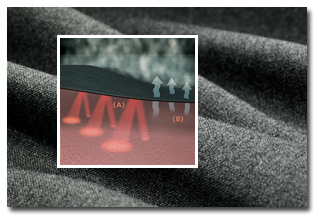
Schoeller’s latest technology, energear™, is claimed to recover far infrared rays (FIRs)
radiated by the body and reflect them back to the body to increase oxygen levels in the blood,
thereby improving performance and preventing premature fatigue, improving energy regeneration,
shortening the warm-up phase of physical activity, and enhancing concentration and general
wellbeing. The technology is a component in a wool/polyester schoeller®-shape fabric that won a
Première Vision Innovation Prize 2010 for its combination of “refined elegance with exceptional
performance underscoring the concept of wellness.”

QFOM

Fabrics featuring energear™ radiate far infrared rays back to the body (A), while retaining
their breathability (B).


Based on a concept long recognized in Asian cultures and developed using biomimicry
principles, energear comprises a proprietary titanium/mineral matrix that utilizes the therapeutic
properties and the ability of those minerals to reflect the body’s FIRs. A component of the
infrared (IR) spectrum between visible light and microwaves, FIRs occur near the microwave end of
that spectrum, and they are emitted by living beings as well as the sun and any material that has a
temperature.

Energear’s concept and performance claims might seem a bit far out, but third-party
science-based tests have shown that fabrics offering the technology do provide the benefits claimed
at significant levels for the majority of test participants. For example, 62 percent of
participants recorded significant to very significant improvement in lactic acid levels — a factor
in muscle performance and fatigue — during physical exercise; and 53 percent recorded significant
to very significant heart rate reduction — of 10 to more than 20 beats per minute.

Test participants ranged from serious athletes such as runners, climbers and the like to the
average person on the street. “Interestingly, the beneficial results have shown up more in people
who are not as physically fit,” said Tom Weinbender, president, Schoeller Textil USA.

Energear can be applied to fabric by direct integration in the fabric, integration in a
coating or a membrane, or as a finish. The technology does not affect the fabric’s breathability or
hand, and it can be applied in conjunction with any of Schoeller’s other technologies without
impacting their performance. The application is permanent, and, as with all of Schoeller’s
technologies, energear complies with bluesign® environmental, health and safety criteria.

Schoeller is offering energear on its schoeller-shape urban-apparel, dryskin performance,
WB400 soft-shell and WB-formula outerwear fabric lines.


For more information about energear™, contact Shannon Walton
shannon@schoellerusa.com; or Tom Weinbender
tom@schoellerusa.com.


November/December 2010

November/December 2010

Invista, Wichita, Kan., has named
Nate Smith III NA outdoor and travel segment end-use marketing manager, Cordura®.

The Raleigh, N.C.-based,
Sewn Products Equipment & Suppliers of the Americas (SPESA) has elected the
following to its Board of Directors:
Mel Berzack, Sewn Products Equipment Co.;
Rolando Bohlemann, Schmetz Needle Corp.;
Per Bringle, Eton Systems;
Dr. Mike Fralix, [TC]
2;
Martin Gopman, Universal Sewing Machine Co.;
Frank Henderson, Henderson Sewing Machine Co.;
Al Irvine, American & Efird;
Rick Ludolph, Productive Solutions;
Nina McCormack, Dürkopp-Adler America;
Eric Schlossman, Consew;
Lonny Schwartz, Superior Sewing Machine & Supply;
Roy Shurling, Lectra North America;
Sam Simpson, Gerber Technology; and
John Stern, Methods Workshop.

The
Industrial Fabrics Foundation (IFF), Roseville, Minn., has awarded scholarships to
the following: IFF Student Scholarship —
Sudheer Jinka and
Vinitkumar Singh, Texas Tech University, and
Alexa Woodruff, Philadelphia University; Architect Scholarship —
Maria Paulina Carvallo, Illinois Institute of Technology; IFAI Membership
Scholarship —
Matthew Sweeney and
Ryan Gatti; Fabric Graphics Association Membership Scholarship —
Ryan Alvarez; and Tent Rental Division Membership Scholarship —
Nicholas Wodetzki.


Maria Malave-Ruiz
, production operations manager at
Oswego Industries Inc., Fulton, N.Y., has received the East Region NISH Products
Award for her efforts in Oswego’s military coveralls project.

PeopleMalaveRuiz

Malave-Ruiz

The
American Association of Textile Chemists and Colorists (AATCC), Research Triangle
Park, N.C., has elected
R. Michael Tyndall, Cotton Incorporated, president; and
Dr. Peter J. Hauser, North Carolina State University’s College of Textiles,
president-elect.

The
International Textile Manufacturers Federation (ITMF), Switzerland, has elected
Bashir H. Ali Mohammad president;
Josué C. Gomes da Silva and
Wang Tiankai vice presidents; and
Bassem Sultan treasurer.

Mahlo GmbH + Co. KG, Germany, has named
Alois Böckmann manager, responsible for accounting, human resources and
information technology.

November/December 2010

Global Textile Groups Rap India’s Cotton Export Policies

Textile organizations in the United States, European Union, Mexico and Turkey have sent a joint
letter to their respective governments urging immediate action to halt cotton trade restrictions by
the government of India. The organizations include the National Council of Textile Organizations
(NCTO), European Federation of Cotton and Allied Textiles Industries (Eurocoton), Cámara Nacional
de la Industria Textil (CANAINTEX), Istanbul Textile and Apparel Exporter Associations (ITKIB) and
Turkish Textile Employers Association (TTEA).

Together, the organizations represent more than 1 million textile workers, whose jobs could
be threatened by what the groups contend are discriminatory and illegal actions by India — the
world’s second-largest cotton exporter — to restrict or ban cotton exports in an effort to protect
its domestic textile industry. The groups note that the actions, imposed in April 2010, caused
global cotton prices to more than double by late October, while India has guaranteed low prices for
cotton consumed by its own textile mills. They further note that resulting price inequities are
skewing competition in favor of not only Indian textile and apparel producers – which are able to
offer their products at subsidized prices — but also Chinese state-owned textile mills — which are
purchasing the remaining global supply at the high prices demanded while also enjoying government
subsidies that allow  “enormous price flexibility.”

The letter states: “If the current scenario of India curtailing and delaying export of its
cotton crop continues to play out, European, Mexican, U.S. and Turkish textile mills will face the
prospect of prolonged high prices for cotton or having no supply of cotton at all. Either way, our
mills cannot survive such a scenario for an extended period of time.” It further asks “that our
governments immediately send the strongest message to India that it must not restrict or delay
export of its cotton to world markets and must abide by international trade rules.”

November/December 2010

Pantone Debuts CAPSURE™

Carlstadt, N.J.-based Pantone LLC has introduced CAPSURE™, a compact, handheld device that enables
design professionals and contractors to accurately capture the color of any surface or material —
including those with small, patterned, multicolored textures; as well as walls, carpets and
open-weave textiles — and match it to a Pantone® Color. The device comes preloaded with all Pantone
Color Libraries, enabling users

to quickly and accurately match more than 8,000 colors.

November/December 2010

Sponsors