Safety And Technical Products’ New Name Reflects High-Tech Growth

ROSEVILLE, Minn. — December 3, 2010 — IFAI’s Safety and Protective Products Division has announced
a strategic name change to better position it in the world of technical products made with
specialty fabrics — an industry that is seeing tremendous diversification and growth
worldwide. 

The new name and logo, Safety and Technical Products (S+TP), represents members from a new,
much wider technical marketplace. According to Managing Director Ruth Stephens, “Frankly we had
outgrown our original name and mission. The division will continue to include technical fabric
applications for safety, since that is its history.” 

Stephens says that there are no other exclusively textile-based safety organizations, but the
traditional safety market has evolved to include many other aspects of technical textiles. The
phrase “technical products” has a broad definition and can cover technologies and products involved
in the entire market chain, including products for medical, recreation, aerospace, and interactive
textiles — areas which may not consider themselves as safety or protective products. 

“The mission of Safety and Technical Products is to be the preeminent resource for personal
and property protection, for interactive and medical textile markets,” Stephens says, adding that
the commonality for this broader membership base will be highly engineered technical textile
solutions for hazard mitigation, monitoring, and healthcare. 

“By emphasizing textile attributes such as IR reflectance, EMI shielding, or conductivity,”
she says, “the focus of the division will incorporate many different market areas. For example, EMI
is an attribute utilized in aerospace, medical and safety.”

Stephens points out that current trends in the safety and protective area include fabrics
that provide comfort and manage moisture, yet remain lightweight and flexible. “In the past, safety
and protective apparel has often been bulky, confining and uncomfortable,” Stephens said, “And many
of the fibers, fabrics and technologies developed for the military/law enforcement textile markets
are also being applied to other safety and protective clothing market segments, such as specialty
sports and motorcycle gear. 

“This includes the use of smart/responsive materials and nanotechnology to improve and add
performance. These technologies allow fabrics to thermoregulate, and regulate the atmospheric
comfort zone next to the skin, controlling temperature and dryness,” she said. 

Safety and Textile Products also serves as a conduit for national and international linkages
and emerging market areas such as interactive textiles, and e-textiles which represent a $2.1B
market for systems which sense/monitor, warm or cool, illuminate, and conduct. The medical textile
market in the U.S. alone is about $8B, with 75% of this nonwovens and 25% knits or wovens. 

Safety and Textile Products recently held its biennial conference,
“The 7th International Conference on Safety and Protective Fabrics — Textiles for Extreme
Applications,”
at IFAI Expo Americas 2010 in Orlando. Read the complete show recap in
Specialty Fabrics Review magazine.  Safety and Textile Products also announced the
winners of its
“7th Annual Safety and Protective Student Design Challenge.”

For more information about Safety and Technical Products, please contact Ruth Stephens at
rastephens@ifai.com, visit
www.safetyfabrics.com, or “Interest Groups” on
www.ifai.com.

Posted on December 21, 2010

Source: IFAI
The Rupp Report: More Good News From The Markets

Looking back over the past year, one must say, it was amazing. After the nightmares of 2008 and
2009, the world markets recovered in general and the textile and the textile machinery industry in
particular.

As the Rupp Report has already reported in the past weeks, there is hope for 2011: Many
companies are reporting an upswing, even in so-called high-labor-cost countries.

Higher Demand …

For the Swiss textile machinery suppliers, Asia is still in the foreground of an increased
demand. They also are noticing a trend toward improved quality, mainly in the spinning sector. This
trend has been confirmed especially by people from Uster Technologies AG and Loepfe Brothers Ltd.
Werner Schlaepfer, Loepfe’s head of marketing, said sales for yarn clearers — that is to say,
products for quality control — are soaring. The problem, as mentioned in a previous report, is
still the supply of raw materials. But, say the manufacturers, it’s not that easy to get better
prices. Yet, everybody is certain that 2011 will be an even better year, thanks also to the
forthcoming ITMA 2011 in Barcelona.

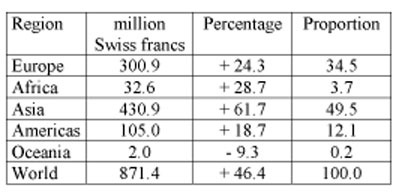
Dr. Lukas Sigrist, secretary general of the Textile Machinery Division of SWISSMEM, has
noticed a considerable upswing of the Swiss textile machinery industry too. From January to
September 2010, textile machinery exports from Switzerland increased by 46.4 percent, compared with
the same period last year. The general situation is as follows:

Rupp-Report-12_14_10-1

These figures don’t include the sales from the manufacturers’ own production plants in Asia.

… And In Particular From Asia

It is no surprise that the Swiss manufacturers are also enjoying the biggest increase from
Asia. China, up by 14.2 percent; India, by 12.6 percent; and, astonishingly, Japan, by 4.5 percent,
show the largest increasing export figures, followed by Taiwan, Thailand and South Korea.

The figures also reflect the upswing by some countries in Europe: Germany, with an increase
of 7.1 percent; and Italy, with a 6.0-percent increase, demonstrate a more favorable market
environment.

But also in the Americas, there is an improvement in the markets: In spite of strict import
regulations, the booming country of Brazil shows an increase of 4.8 percent; and the United States
is also recovering, with a 3.8-percent increase.

Sigrist is convinced that the positive trend will go on. And the forthcoming ITMA in
Barcelona will give the market a further kick. The only clouds for the moment are the volatile
situation among the major currencies such as the U.S. dollar, the euro and the renminbi. Of course,
the current cotton prices play some role in this context.

Weaving

Not only for spinning, but also for weaving, the suppliers are noticing increased demand from
the markets. Stäubli Sargans AG, producer of dobby and jacquard machines for virtually every
weaving machinery producer, is reporting increasing demand from certain market areas such as Asia
for the latest dobby and jacquard machines as well as for carpet machinery. And this demand was
confirmed by the management of the Switzerland-based European headquarters of Toyota Textile
Machinery Division. “We are back to regular sales turnover,” said COO Robert Bieri and Sales
Manager Rudolf Feucht.

Traceability

Narrow fabric machinery producer Jakob Müller Ltd. confirmed an increasing number of orders
around the world too, but mainly in Asia. Today, digital printings on narrow fabrics are enjoying
larger interest to differentiate products. Eduard Strebel, manager, marketing services, said there
is another increasing quality control issue, namely, product piracy and the demand for equipment
that is able to identify a product and trace its life along the whole production chain. The Rupp
Report will come back to this issue in the future.

December 14, 2010

CEMATEX, EURATEX Sign Agreement

The European Committee of Textile Machinery Manufacturers (CEMATEX) – owner of the ITMA textile
machinery exhibition – and the Brussels-based European Apparel and Textile Federation (EURATEX)
have signed a memorandum of understanding for closer collaboration in research, technological
development innovation and industry promotion.

At the signing, CEMATEX President Steve Combes and EURATEX President Dr. Peter Pfneisl noted
that research and technological innovation are of increasing importance if the European textile,
clothing and machinery industries are to maintain a global competitive advantage. They also
outlined plans for upcoming joint activities, the first of which will be a European Textile
Research Pavilion at ITMA 2011, which will take place in Barcelona, Spain, Sept. 22-29, 2011. At
the pavilion, the organizations will host a European Commission delegation, among other visitors.
CEMATEX also will offer a 60th anniversary grant to exhibitors from research and education
establishments.

“I would like to ensure our colleagues from CEMATEX that the European textile and clothing
industry will not stop in its relentless efforts to innovate in its products and processes to
always remain one step ahead of our global competition,” Pfneisl said. “These innovations are
unthinkable without the right machines and equipment with the right functionalities and capacities,
available at the right time. We don’t see anybody better placed to provide us with these innovation
tools than our colleagues from the European textile machinery industry and we look forward to fill
this collaboration agreement at European level with a wealth of mutually beneficial activities for
many years to come.”

“We are keen to participate in EURATEX initiatives such as the European Technology Platform
for the Future of Textiles and Clothing,” Combes said. “We are all familiar with the idea of the
whole being greater than the sum of the parts. We believe that EURATEX and CEMATEX, pooling our
talents and abilities towards a common purpose, will accomplish more than continuing to work
independently. A united textile-making and textile machinery cluster will consolidate our position
in the global market, and help increase our market share.”

December 14, 2010

Lenzing Announces Further Tencel®, Viscose Expansions

Austria-based cellulosic fiber manufacturer Lenzing AG has announced yet more global production
capacity expansion to meet ever-increasing demand for its Tencel® and viscose fibers. This most
recent expansion — the fourth to be announced this year — will add more than 200,000 metric tons of
production capacity to facilities in Austria, the United States, Indonesia and China; and will cost
approximately 285 million euros total.

“This expansion program responds to the dynamic demand development for man-made cellulosic
fibers and is intended to further secure our leading world market position,” said Peter
Untersperger, CEO, Lenzing. “The structural changes in the global textile fiber market, which are
characterized by a tendency towards rising cotton price levels and an ever-increasing volatility of
cotton quantities, as well as the increasing demand for man-made cellulosic fibers in nonwovens,
lead us to continue to expect strong demand for Lenzing fibers over the next years. Moreover, the
capacity expansion program is intended to further secure our leading position in the industry with
respect to cost efficiency and market position.”

Lenzing plans to build the first Tencel production plant at its Lenzing, Austria,
headquarters site, investing 130 million euros and providing an annual capacity of 60,000 metric
tons. The plant will receive pulp from the fully integrated pulp mill in Lenzing, making it the
first fully backward-integrated Tencel fiber production operation.

Tencel production also will be expanded at Lenzing’s site in Mobile, Ala., where a $30
million investment will be used to upgrade and modernize a production line that was shut down by
the plant’s previous owner, adding some 50,000 metric tons of capacity. Fiber from the Mobile
operation will be used in nonwoven wipes and baby care products manufactured in North and South
America.

In Asia, Lenzing will increase viscose production capacity at its PT South Pacific Viscose
(SPV) subsidiary in Purwakarta, Indonesia, as well as at its production facility in Nanjing, China.
SPV will add a fifth production line costing approximately $130 million and adding 80,000 metric
tons of annual production capacity, bringing total capacity up to 325,000 metric tons by 2013.

The Nanjing site already has a second production line under construction that is expected to
nearly double capacity there to 140,000 metric tons by mid-2011. Lenzing will invest $18 million to
add 20,000 more metric tons of capacity at the site by 2012.

The company also will upgrade an existing specialty nonwovens fiber line at Lenzing,
investing some 17 million euros in that expansion, which is expected to be completed by mid-2012.


December 14, 2010

Biosafe Granted Patent For Antimicrobial Polymer

Pittsburgh-based Biosafe Inc., a producer of antimicrobial products, recently was awarded a
composition of matter patent by the U.S. Patent Office for its antimicrobial siloxane polymer.
Biosafe reports the polymer resists leaching and migration by bonding on a molecular level to the
treated surface of nonwovens, films, sheets, molded plastics, metals, wood and other substrates.
Once applied, the polymer provides protection against bacteria, mildew, mold and fungi; and, by
puncturing and rupturing the cell walls of the microbes it is targeting, can stop the microbes from
mutating and adapting to the antimicrobial environment. According to Biosafe, this behavior can
prevent the so-called “super bugs” that currently are causing cross-infection problems in hospitals
and clinics from developing.

The company reports its polymer is less expensive than silver ion-based antimicrobial
products because it can be applied at lower concentration levels. Biosafe’s antimicrobial is
suitable for apparel, sporting goods, building products, medical devices and portable electronics,
among other end-uses.

“The effectiveness of Biosafe antimicrobial can be gauged by its truly remarkable spectrum of
activity and diversity of applications,” said Max Fedor, president and CEO, Biosafe. “In medical
products, Biosafe polymer is being used to combat harmful bacteria and viruses commonly encountered
in clinical settings. Medical textiles treated with the polymer have demonstrated a 99.999-percent
[5 log] reduction of certain microorganisms within five minutes. Among the microbes involved in
tests required for submission to the FDA were [methicillin-resistant
Staphylococcus aureus], [vancomycin-resistant
Enterococcus], Influenza A and
Staphylococcus aureus.”


December 14, 2010

Sanitized AG Introduces Sanitized® T20-19

Switzerland-based Sanitized AG — a producer of antimicrobial hygiene products and material
protection for textiles and plastics — has introduced Sanitized® T20-19 antimicrobial fabric finish
to the North American market. The finish is designed for cotton and cotton-blend items requiring
high-wash durability including apparel such as underwear, outerwear, workwear, sportswear and
outdoor wear; home textiles such as upholstery, bath towels, terrycloth and table linens; bedding
textiles such as mattresses, mattress protectors and bed linens; and technical textiles for filter
systems and nonwovens applications.

The active ingredient in Sanitized T20-19 is quaternary ammonium salt, which not only
prevents bacteria growth and reproduction but also acts as a chemical anchor through an organic
silicium function, which forms a stable and highly wash-resistant bond with all cellulosic fibers.
According to Sanitized, application of the finish requires less solvent to be used than for other
antimicrobial finishes, offering benefits including reduced cost, decreased flammability, improved
work with textile effects such as thermomigration and colorfastness, and reduced product remaining
in the wastewater. Sanitized T20-19 also is bluesign® approved and meets Oeko-Tex® Standard 100,
Class I-IV, requirements.

“We developed Sanitized T20-19 not only as a more economical but also a more ecological
choice,” said Darrell Burnette, North American business development manager, Sanitized AG. “Because
it is easy to apply during either the pad or exhaust processes, textile manufacturers will find it
a less expensive way of providing their customers with more high-wash durability. Meanwhile, the
customers feel the freshness and comfort in wearing cotton or cotton blend clothing treated with
the Sanitized T20-19 antimicrobial finish while benefiting from its ability to reduce bacterial
odors and to withstand frequent washings.”

December 14, 2010

Announcing AT Americas ’11 Call For Proposals

Roseville, Minn. — December 9, 2010 — IFAI is proud to announce that AT Americas ’11 is being
co-organized with the Synthetic Yarn and Fibers Association (SYFA).

Tentative categories

Aerospace · Automotive · Smart · E-Textiles · Reflective Materials · Sustainable
Applications, Research and Alternative Energy · Military

This call for extended abstracts and presentations is issued to create an innovative, varied,
and exciting Technical Program. In addition to traditional sessions, this conference solicits
proposals for activities that will allow professional colleagues to share their expertise through
Paper Presentations, Panel Discussions in these formats.

Abstract Requirements

The technical advisory committee will select extended abstracts and presentations to be
presented based on abstracts of 300-500 words. Please emphasize new developments and future
direction that will impact the marketplace. When submitting your abstract please include your name,
company/university, phone, fax, e-mail and mailing address for the person to whom the speaker
correspondence should be directed. Extended abstracts and papers may only be presented by one
speaker; however co-writers can be listed on the paper presentation. Authors MUST secure any
necessary copyright clearance needed for  presentation/publication of paper or extended
abstract. Accepted Extended Abstracts and Presentations will be published as part of the AT
Americas ’11 on-line proceedings.

Panel Discussions

Panel Discussions are 60-minute sessions that bring professionals together for discussion and
debate about technical subjects and industry issues, such as political influences, social trends
and their impact on engineering or career choices. Panel Discussions have a facilitator with
several panelists to present differing viewpoints. A published summary of the discussion is
possible. Proposals should include an outline and title, a synopsis of the expected outcome of the
discussion, preliminary names for facilitators and panelists, and any plans for publication.

All submissions will be due 1 February 2011. Final presentations will be due by 1 September
2011. Please submit your abstract, panel discussion or presentation description to klmeade@ifai.com

AT Americas ’11 Questions:

Kristy Meade, Director of Education and Event Development

klmeade@ifai.com

Ruth Stephens, Managing Director – Safety and Technical Products

rastephens@ifai.com 

Posted on December 14, 2010

Source: IFAI 

Australian Wool Production Expected To Fall Slightly

The Australian Wool Production Forecasting Committee today released its latest forecast for the
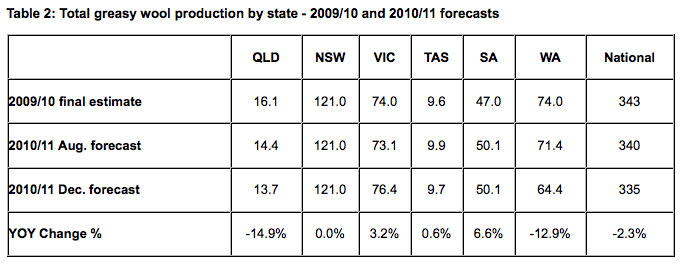
2010/11 season at 335 mkg greasy, making a small downward revision of its previous forecast. 

Committee Chairman Russell Pattinson said that “the small reduction is due largely to
worsening seasonal conditions in Western Australia resulting in lower fleece weights. There has
also been a  substantial turn-off of sheep from that state, including significant numbers
being transported to the eastern states.  It is estimated that up to one million sheep (mostly
“off-shears”) have been transferred from Western Australia to the eastern states in the 2010
calendar year.”

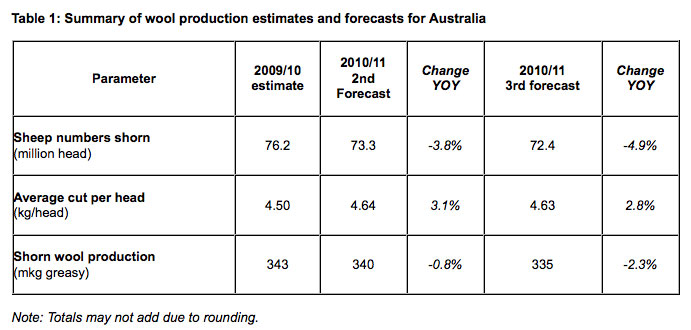
“The latest forecast is 5 mkg greasy lower than the Committee’s estimate of 340 mkg for the
2010/11 clip in August and is a decline of 2.3 per cent on the 2009/10 shorn wool production level.
The number of sheep shorn in 2010/11 is forecast to be 72.4 million head, 900,000 head fewer than
the forecast four months ago
(See Table 1).”

Australiantable1

Despite the further downward revision, the forecast is seen as consistent with a slowing in
the decline in wool production in Australia.

“Not only is wool production tending to stabilise nationally, but producer intent to retain
or increase sheep numbers is apparent from the October producer survey. There are, however,
dramatic differences between States as a result of the varied seasonal conditions across
Australia.”

“Excellent seasonal conditions in New South Wales, Victoria, South Australia and Tasmania are
offsetting the impact of continuing dry seasonal conditions in Western Australia.” In arriving at
its latest forecast the Committee noted the strong year-on-year decline in sheep slaughter and live
export figures in all States except Western Australia.

“This has reinforced the view from State Committees that producers are very keen to retain
older ewes and ewe lambs for breeding purposes, however, the positive impact of these decisions on
wool production is not expected until 2011/12 and beyond.”

The Committee has also forecast a change in the micron profile of the Australian wool clip
with a reduction in the production of superfine and ultra-fine wool (18.5 microns and finer)
together with an increase in broader merino and non-merino wools.  The average fibre diameter
of the Australian wool clip is now forecast to increase by 0.2 microns to 21.4 microns this season,
given the excellent seasonal conditions in south-eastern Australia and the changing structure of
the national flock.

The December 2010 Australian Wool Production Forecast Report involves increased data sharing
between Meat and Livestock Australia and Australian Wool Innovation as part of a new
streamlined  forecasting model.  It also draws on advice and data from the AWTA Ltd,
ABARE, AWEX and ABS, together with the significant input from producers, wool buyers and brokers,
and State agency staff through AWPFC State Forecasting Committees.

Australiantable2


Posted December 14, 2010

Source: Australian Wool Innovation

Zepol Updates Trade Intelligence Tool With Advanced Searching Capabilities

MINNEAPOLIS — November 16, 2010 — Zepol Corporation, the leading trade intelligence company,
announced an upgrade of its flagship product, Trade
IQ™, which improves searching capabilities to fully analyze the U.S. maritime
industry by releasing a series of advanced searching and reporting features. Zepol’s U.S. Customs
database Enterprise subscription option is the maritime industry’s standard to view and sort trade
data from the U.S. government.

This enhancement includes the following features:

1. Analyze a Carrier or NVOs U.S. imports by percent of LCL vs. FCL shipments

2. Narrow and view searches by specific container type including tank and refrigerated

3. See the most accurate shipment totals for ports, countries of origin, and steamship lines

“The reasons why the United States’ top ports and logistics companies have switched from
their legacy provider to Zepol are the innovative ways our users can visualize trade and navigate
the data’s complex relationships with our tools,” stated Paul Rasmussen, CEO & President of
Zepol Corporation. “Our new features allow users of manifest data to research, analyze, and report
trade statistics with unmatched flexibility and accuracy that the maritime industry has never
seen.”

Zepol’s Enterprise subscription option includes high download limits of individual Bills of
Lading and unlimited access to aggregate reporting on nearly 8 years of historical data for both
House and Master records of shipments. Starting at $9,995 and including 10 users for an annual
subscription to Zepol’s trade data tools, affordable, high quality access is within reach for any
NVOCC, Freight Forwarder, Steamship Line, Terminal Operator, or Port. Advanced capabilities
include: trending, charting, emailed reports (can be scheduled to send across an organization), 14
views, and unlimited aggregate reporting.

Posted on December 14, 2010

Source: Zepol Corp.


Hanesbrands Inc. Earns Fair Labor Association Accreditation For Global Social Compliance Program

WINSTON-SALEM, N.C. — December 2, 2010 — Hanesbrands Inc. (NYSE: HBI) announced today that the
company’s global social compliance program has been accredited by the Fair Labor Association, a
workers’ rights group based in Washington, D.C.

“Hanesbrands is a leader in providing workers with a safe, clean and productive work
environment and strictly enforces its global code of conduct for company-owned and supplier
production facilities,” said Hanesbrands Chief Executive Officer Richard A. Noll. “We sought FLA
affiliation and accreditation because we share the organization’s commitment to high labor
standards, and we look forward to continued productive collaboration to provide leadership in the
apparel industry.”

The Fair Labor Association works with industry, civil society organizations and colleges and
universities to protect workers’ rights and improve working conditions in factories around the
world.

After a review process of nearly two years, FLA accredited the social compliance programs of
Hanesbrands and Gear For Sports, Inc., now owned by Hanesbrands.

“The FLA is pleased to have Hanesbrands as an accredited affiliated company dedicated to
protecting workers’ rights and to meeting and exceeding international labor standards,” said FLA
President and CEO Auret van Heerden. “We appreciate the company’s commitment to fair labor
standards.”

To earn accreditation, FLA member companies are required to fulfill 10 company obligations,
including conducting internal monitoring of facilities, submitting to unannounced independent
monitoring audits and verification of company and supplier plants, and managing and reporting
information on their compliance efforts.

Hanesbrands has a formal corporate social responsibility program that consists of five
initiatives: a global compliance and ethics program for all employees; a facility compliance
program that seeks to ensure company and supplier plants meet Hanesbrands’ labor and social
compliance standards; a global environmental management system that seeks to reduce the
environmental impact of operations; a product safety program; and a commitment to corporate
philanthropy assisting the communities where the company does business to provide access to life’s
basic necessities.

As You Sow Report and Newsweek Green Rankings

Hanesbrands scored among the best in the apparel industry for global supply chain compliance
programs in an independent study conducted by As You Sow, a corporate social responsibility
advocate. The San Francisco-based group’s report, “Toward a Safe, Just Workplace: Apparel Supply
Chain Compliance Programs,” was published in November and gave Hanesbrands’ code-of-conduct
compliance program a letter grade of B, the third-highest grade of apparel companies studied.

In the report, Hanesbrands was noted for having 100 percent of its compliance audits
conducted unannounced and for having initial and annual audits verified independently. The full
report may be read on the As You Sow website,
www.asyousow.org.

In Newsweek magazine’s 2010-11 green rankings, Hanesbrands ranks No. 91 on the list of 500
greenest companies. The company has goals for use of renewable energy, carbon emission reductions,
and reduced water use. Hanesbrands earned the U.S. Environmental Protection Agency Energy Star
Partner of the Year award in 2010.

“We have been a quiet leader in social and environmental responsibility for several decades,”
said Chris Fox, Hanesbrands’ vice president of corporate social responsibility. “We are making a
difference, but we know that there is more to be done. We look forward to working together with
groups such as the FLA, As You Sow and the U.S. Environmental Protection Agency to enhance our
leadership in these areas.”

Hanesbrands has detailed information on its environmental and social programs available on
its Corporate Social Responsibility website,
www.hanesbrandsCSR.com. The site is also accessible
through Hanesbrands corporate website,
www.hanesbrands.com.

Posted on December 14, 2010

Source: Hanesbrands Inc.


Sponsors