Woven Rope Technology Offers New Opportunities


F
or thousands of years, rope-making has been of great importance for mankind.
Traditionally, ropes have been manufactured using braiding and twisting processes. There is now a
new rope-making technology available, and Switzerland-based rope maker Seilerei Herzog AG has
played a very important part in its development.

The family-owned enterprise was founded in 1950 by the grandfather of current managing
director Guido Herzog, who in 2010 succeeded his father, who had served as managing director from
1988 until 2010. The company is located in Willisau, near Lucerne, and has eight employees at two
manufacturing sites. Herzog places particular emphasis on training apprentices to become textile
technologists in the areas of rope and lifting technology.

Seilerei Herzog supplies the largest portion of its production to business customers, but it
also sells directly to end-consumers. Manufacturing includes, among other products: braided ropes
for firefighters; nets; climbing ropes and nets for playgrounds; cords and headstalls for animals;
and heavy ropes for industrial and construction applications.The company’s exports, primarily to
Germany, represent somewhat above 5 percent of total sales. However, inquiries from other
neighboring countries are increasing.
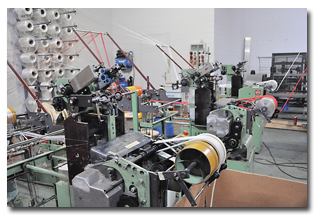
Weavingmachine


Jakob Müller’s MultiSphere NG3M and NG2M weaving machines for woven ropes are offering
Seilerei Herzog new opportunites to remain competitive.


Production And Plant


Seilerei Herzog produces ropes with diameters from 1 to 30 millimeters (mm) on traditional
braiding machines, and woven ropes with diameters from 3 to 10 mm on three new MultiSphere NG2M and
NG3M weaving machines from Switzerland-based narrow loom manufacturer Jakob Müller AG. Textile
World recently visited Seilerei Herzog and spoke with Guido Herzog about his company’s operations
and its use of the MultiSphere technology.


TW: The MultiSphere weaving machines are very particular products. What were the
reasons that your company bought three of these machines?

Herzog: During my textile engineering studies, I had to have an internship, which
I arranged at Jakob Müller. By the time I was writing my master’s thesis, Jakob Müller developed
the first prototypes and the first products, and I thought they could offer something for our
company. My father and I tested the first ropes, and the decision was then certain: We wanted to
buy this machine because it offered great possibilities for us.


System Differences


TW: What are the most important features of the machine?

Herzog: Regarding machinery, there is the longer operating time without
interruptions to change bobbins, and less working staff is needed to run the machines. This leads
to lower labor costs. However, one must understand the weaving technology as such and also develop
the know-how for this machine. You have to know the MultiSphere technology very well to capitalize
on the great possibilities it offers.

Minimum quantities for braided and woven rope orders are quite different. For braided ropes,
a minimum of 500 to 1,000 meters (m) are needed to build a sensible production. For woven ropes, we
require 10,000 to 20,000 m, and sometimes, for complicated items, up to 40,000 m.


TW: Why is that so?

Herzog: Braiding is very easy to handle, but with woven ropes, the setup is much
more complicated and takes much more time. The output is mainly determined by the rope’s diameter.


TW: What are the fundamental differences between the braiding and weaving
systems?

Herzog: Braiding is an old technology for producing ropes. Woven ropes are a
little stiff. Twisted ropes are rather flexible. The MultiSphere needs more setup time, but the
woven ropes are more economical to produce than are braided ropes for the same quantities.


TW: How long have you been running the MultiSphere machines?

Herzog: We got the first machine in 2007. The second followed by the end of 2008,
and the third in 2009. With this setup, we always have sufficient capacity when there is great
demand.


TW: Are you satisfied with the results?

Herzog: Very much so. The spare parts are a little more expensive than braiding
machine parts, but the running characteristics are very good. There are great possibilities to
intermingle the knowledge of braiding and weaving. However, the fiber and yarn know-how should not
be underestimated.


Large Product Range


TW: What are the most important market requirements for your products?

Herzog: These are mainly price and quality. However, quality comes first because
we are also producing for security applications.

TW: Do you develop special products for your customers?

Herzog: Yes, these are joint developments that also are funded by the customer. If
the trials lead to an order, these development costs are compensated, of course.


TW: Do you have a standard range from which the customer can choose?

Herzog: Of course. Standard items have short delivery times. In braiding, we
supply polyethylene terephthalate (PET) ropes in standard diameters from 2 to 16 mm. For woven
ropes, it is 3 to 8 mm. Fiber materials like PET, polypropylene, polyamide; but also Kevlar®, other
aramids and hemp are processed.


TW: How is it possible to protect products? This seems to be very important for a
small company.

Herzog: Yes, but patents do not pay off for small enterprises. One must always
simply be the first to bring new products on the market.
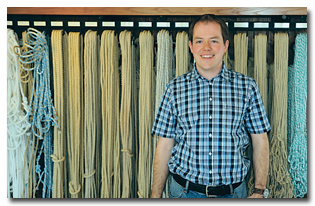
WeavingHerzog

Guido Herzog has served as managing director of Seilerei Herzog AG since 2010.


Innovation First


Herzog was born in 1981. His hobbies are music, walking and skiing. And what is his personal
challenge?

Herzog: One must be innovative — in front with the proverbial one step ahead — and
open up niche markets and not produce exclusively mass products. And, according to our company
philosophy, we want to work with local staff who are trained very well and have a personal
relationship with their company. This is the only way to be successful, and that is our deep
conviction.


TW: How do you see the current market situation for your products?

Herzog: The year 2010 was a good year for us, and the expectations for 2011 are
even better.FutureHerzog said he would buy the MultiSphere machine again any time. Over the last
few years, the required rope quality has further increased. On the other hand, there are price
pressures. Still shorter delivery times are also demanded. One problem is the fact that today,
virtually none of his customers places larger orders. Everything must be produced immediately,
which complicates a regular scheduling of raw material.


TW: How do you see the future for your company?

Herzog: If our experience and the price/performance ratio are correct, we can keep
our production in Switzerland. If the product and the price are correct, it doesn’t matter where
the machines are producing. Perfect service, listening to the customers’ requests and fulfilling
their requirements are the most important prerequisites for success. We are prepared well for the
future with different product groups. MultiSphere technology offers us new possibilities to remain
at the top. We are a Swiss company, and we intend to remain here.

May/June 2011
Texworld USA: Sourcing Showcase


P
roduced by Atlanta-based Messe Frankfurt Inc. — the U.S. subsidiary of international
exhibition organizer Messe Frankfurt GmbH — in partnership with cellulosic fiber manufacturer
Lenzing AG, Austria, Texworld USA integrates Lenzing’s Innovation Asia, a fabrics trade fair
formerly held in parallel with the international fabric shows in New York City. Texworld USA
debuted in July 2006 in New York City, and since then, the show has been held biannually in January
and July. Its eleventh edition will take place July 19-21, 2011, at the Javits Center in New York
City.

Touted by Messe Frankfurt as the largest apparel fabrics show in North America, Texworld USA
presents an international business platform for apparel fabric buyers, R&D and product
development specialists, designers, manufacturers, retailers, wholesalers, merchandisers, trading
companies and sourcing professionals. Product groups to be presented include cotton, denim,
embroidery, fibers, functional fabrics, knits, lace, linen, prints, silk, silky aspects, wool and
findings/trims. End-use groups include activewear, childrens/infantwear, juniorwear, ladieswear,
bridal/ special occasion/cocktail, menswear, sportswear and swimwear/lingerie.

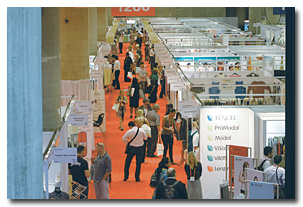
Texworld1

Messe Frankfurt is anticipating record attendance at the upcoming edition of Texworld
USA.


Colocated Shows


Messe Frankfurt has partnered with The Sub-Council of Textile Industry, China Council for
the Promotion of International Trade (CCPIT-TEX) to produce two additional shows that colocate
annually with the summer edition of Texworld USA: the International Apparel Sourcing Show (APP) and
the Home Textiles Sourcing Expo (HTSE). The shows debuted alongside Texworld USA in July 2010, and
altogether, the three shows drew 459 exhibitors and 5,013 visitors.

APP is focused on the production supply chain for contract manufacturing, private label and
original design manufacturing. Product groups include childrenswear, womenswear, menswear and
activewear; knits, wovens, denim/jeans, collections, suiting and contemporary; intimates/lingerie
and loungewear/sleepwear. The inaugural show hosted 108 exhibitors from eight countries, and more
than 1,000 attendees.


HTSE is the only U.S. event focused solely on the sourcing of fabrics and finished soft goods for
home applications, according to Messe Frankfurt. Product groups include finished fabrics/components
including cotton, dobby weaves, eco-friendly materials, fire-resistant materials, jacquard weaves,
knits, lace, leather, linen, outdoor fabrics, pile fabrics, polyester, prints/printers, silk, silk
look, synthetics, trims, vinyl, wool, and man-made cellulosics; and finished products including
bath, bedding, floor coverings, outdoor furnishings, tabletop, upholstery, wall coverings and
window coverings. The inaugural show hosted 66 exhibitors from 5 countries, and 623 attendees.


Expectations


As of

Textile World
‘s press time, Messe Frankfurt had confirmed 170 exhibitors for Texworld USA and more than 60
exhibitors for HTSE.

“The Messe Frankfurt New York textile events — Texworld USA, International Apparel Sourcing
Show and Home Textiles Sourcing Expo — are on track to exceed 600 total exhibitors in July 2011,”
said David Audrain, president and CEO, Messe Frankfurt North America. “This unique sourcing
destination for apparel fabrics, garment production, home textiles and soft goods was established
in an effort to deliver international and domestic resources to the North American marketplace in
one convenient location.”

Both CCPIT-TEX and the Trade Development Authority of Pakistan (TDAP) have committed to
bringing exhibitor groups from their respective countries to all three shows. The Korean Textile
Trade Association has committed to bringing exhibitor groups from Korea to Texworld USA and HTSE.
Messe Frankfurt also expects councils and government agencies from Mexico and India to bring
exhibitor groups.


Partners


Phoenix-based Supima, the organization of growers of Supima® extra-long-staple cotton, grown
in California and the Southwestern United States, partnered with Messe Frankfurt to incorporate the
Supima Premium Fabric Show (PREFAB) into Texworld USA starting with the July 2010 edition. Each
Texworld USA show now has a designated section featuring Supima’s licensees.

Stylesight — a New York City-based global provider of trend content, tools and technology
for the style industry — was named Texworld USA’s official trend partner in 2010, and the companies
debuted their partnership at the January 2011 show.

“The January edition of Texworld USA was just the beginning of our innovative partnership.
[For the July show,] we’ll be offering even more inspiring, cutting edge information and technology
for exhibitors and attendees,” said Frank Bober, founder and CEO, Stylesight.

For the upcoming show, Stylesight is curating and helping to design trend areas/forums
categorized into three themes: apparel, sourcing and home/interiors. The company also will present
a series of eight seminars related to those themes, and its Fall/Winter 2012-13 Materials Forecast
comprising four trends it describes as follows:

Raw Energy: Taking inspiration from the body, materials play with the color red in
a myriad of shades with a tone-on-tone interplay of anatomically sticky coatings. Texture and
volume are inspired by corporeal roundness while energetic surfaces take cue from explosions, blood
vessels and fleshy explorations. Fabrics take on sculptural forms with an organic curve.

Sensing Matter: Sensual materials envelop the body with epidermal-like qualities.
Skin and earthy stonetones synthesize in materials that are soft and gentle, composed of modern
blends or supple leathers. Second-skin materials are gently pleated and delicately textured, while
voluminous shapes are softened when dressed in a second skin.

Wild Craft: Rooted in nature and the wilderness, natural forest foliage, autumnal
mélanges and tactile surface effects mimic nature’s finest features and define this materials
direction. Natural and synthetic blend while surface textures are inspired by mold, fungi and clay.
Delicate growth and wild rustic textures inspire a primitive, back-to-basics story while lost and
found-again fibers abound.

Digital Dimension: Digitally created fabrics are both modern yet comfortable as
3-D rapid prototyping technologies inform a new material aesthetic. Synthetics and blends take on a
new beauty, developing a virtually inspired style. Digitally designed patterns are overtly
intricate, pushing the boundaries of material and form.

Texworld2

Texworld USA trend partner Stylesight’s Fall/Winter 2012-13 Materials Forecast features
four trends: Raw Energy; Sensing Matter; Wild Craft; and Digital Dimension.


Texworld’s July edition marks the beginning of Messe Frankfurt’s collaboration with
Atlanta-based MFG.com, a global online marketplace for the sourcing of custom parts, standard
components, assemblies and textiles. With MFG.com as Messe Frankfurt’s year-round online sourcing
partner, both buyers and suppliers will benefit from a unified offline and online sourcing
experience, Messe Frankfurt reports.

Since the inaugural Texworld USA, Lenzing Fibers has presented a Lenzing Innovation pavilion
spotlighting its customers. At the upcoming show, the company will feature two pavilions — one at
Texworld USA and one at HTSE. More than 30 apparel/fabric companies from countries and regions
including the United States, China, Hong Kong, India, Korea, Spain and Taiwan will exhibit at the
Texworld USA pavilion.

Lenzing also is organizing seminars and panel discussions at Texworld USA and HTSE that will
be open to attendees of all three shows. Texworld USA seminars include Fiber Innovations; The
Cellulosic Gap; Textile Sustainability: Impacts, Integrity & Innovations; and Designing for
Style and Impact. HTSE seminars include Retail Challenges for the Home Textile; and Sourcing Home
Textiles from Pakistan — Challenges and Opportunities; among others.

May/June 2011

May/June 2011

TÜV Rheinland Group‘s consumer products testing laboratory in Bentonville, Ark.,
has been accredited to ISO/IEC 17025:2005 by the American Association for Laboratory Accreditation,
and approved by the Consumer Products Safety Commission as a third-party testing laboratory to
provide certain chemical and mechanical testing on consumer products such as textiles and
children’s toys.

Hohenstein Institute America Inc. has relocated to 1688 Westbrook Ave.,
Burlington, N.C., 27215. Phone and fax numbers remain the same.

Albany, N.Y.-based
Albany International Corp.‘s PrimaLoft® ONE, SPORT and ECO insulation products
have received bluesign® certification.

EzTextiles LLC, New York City, has added a library of more than 325,000
royalty-free vintage print images to its online digital textile design resource center. The company
also has launched a blog at
www.eztextiles.com/blog.

The
Industrial Fabrics Association International (IFAI), Roseville, Minn., has
released the 2011 edition of “Market Watch: Geosynthetics Market Snapshot,” which may be purchased
at www.ifai.com/store. IFAI’s Marine Fabricators Association (MFA) has launched a new website,
located at
www.marinecanvas.com.


Online Textile Dictionary Inc.
, Hollywood, Fla., offers versions 2.5 and 3.5 of
Abraham’s Interactive Textile Dictionary, its multilingual online textile dictionary, together on
an 8-gigabyte USB flash drive key.


Kraton Performance Polymers Inc.
, Houston, has enhanced its website, www.kraton.com,
to showcase the key performance attributes and the latest technological advancements in NEXAR™
polymers sulfonated polymer membrane technology.

Switzerland-based
Santex AG has launched a new homepage, featuring its Cavitec, Santex,
SperottoRimar and Santex Nonwoven brands, located at
http://santex-group.com.

The
Association of the Nonwoven Fabrics Industry (INDA), Cary, N.C., has released The
North America Nonwovens Industry Outlook 2010-2015.

May/June 2011

The
U.S. Association of Importers of Textiles and Apparel, Washington, has elected
Maureen Gray, Polo Ralph Lauren, chairman;
John Clark, Michar LLC, vice-chairman;
Steve Odom, Eddie Bauer, secretary; and
Michael Singer, Macy’s Merchandising Group, treasurer.

FilSpec Inc., Quebec, has named
Peter J. Hegarty vice president, global business development, FilSpec and Richmond
Specialty Yarns.

F. Schumacher & Co., New York City, has named
Gerald W. Puschel chairman of the Board.

Levi Strauss & Co., San Francisco, has named
Laurie Etheridge senior vice president, women’s merchandising & design; and
Rebecca Van Dyck global chief marketing officer; Levi’s® brand.

Spindelfabrik Suessen GmbH, Germany, has appointed
Harald Szczepanek joint managing director.


Concept III Textiles International
, Red Bank, N.J., has named
Mark Sardella eastern sales director.

The
American Apparel and Footwear Association (AAFA), Arlington, Va., has named
Rick Darling, LF USA, chairman of the Board of Directors;
Philip Williamson, Williamson-Dickie Manufacturing, vice chairman;
Joseph Gromek, Warnaco Inc., treasurer; and
Rick Helfenbein, TellaS Ltd. and Luen Thai USA, secretary.

The
National Retail Federation, Washington, has named
Beth Provenzano senior director, federal government relations.

Crypton Inc., West Bloomfield, Mich., has named
Alan A. Barr CFO and COO.

Starlinger & Co. GmbH, Austria, has named
Anton Huber managing director.

The
Industrial Fabrics Association International’s (IFAI’s) Tent Rental Division,
Roseville, Minn., has presented the Bruce W. Wodetzki Award to
Todd Dalland, president and cofounder of Future Tents Ltd. (FTL) Design
Engineering Studio and FTL Solar, New York City.

Royal Ten Cate, the Netherlands, has named
Guido Vliegen global group director, TenCate Grass; and
Mark Edwards president, North American operations, TenCate Advanced Armor.

Demand Dips Slightly


U
ncertainty over prices and inventory control have combined to slow orders for many
spinners over the past month.

“We’re still very busy,” said one spinner, “but we have a little slack here and there for
the first time in a long time. It’s just been in the past several weeks that we’ve noticed a slight
fall-off in orders.”

Said one yarn broker who buys and sells both domestic and imported yarns: “Business is
continuing at a pretty frantic pace, but I believe most people would tell you they are seeing it
ease up a little bit. In the past four weeks, we noticed a drop in business activity in Asia. A
week or so later, we noticed a drop in business on the West Coast, in Los Angeles. Two weeks ago —
the week of April 11 — we started seeing the same thing in Central America. Right now, we’re seeing
a drop everywhere in our order inquiries, although our shipments — which, of course, are from
orders already booked — are very stable.”

He continued: “The question becomes, are people adjusting inventories, which is what we
suspect, or is there actually a significant drop in business demand? We don’t believe this is the
case, but we don’t know for sure at this point.”

Said another spinner: “We’ve seen a bit of drop in order inquiries. I think you can
attribute a lot of this to the fact that people feel a little more secure about product
availability in the last half of the year. Earlier this year, capacity — especially for ring-spun
yarns — was so tight that customers were overbuying to protect themselves. Now, as they feel a
little bit more comfortable that product will be available when they need it, they are slowing
orders to adjust inventories.”


Escalating Pricing Pressures 


Over the past few weeks, cotton prices have dipped substantially for the first time in a
number of months. As of late April, the price of base quality of cotton in the seven designated
markets measured by the U.S. Department of Agriculture averaged $1.7516 per pound, compared with
$1.9511 just two weeks earlier.

“The fact that cotton has come down has suddenly put a lot of pressure on prices,” said one
Carolinas spinner. “This fits with the reduced business activity over the past few weeks, but, in
reality, it does not fit with the costs incurred by U.S. manufacturers. Our cost of manufacturing
is still very high, despite the recent drop in cotton prices. But our customers expect there to be
an immediate drop in our prices in correlation with cotton prices. And, of course, it just doesn’t
work that way. We anticipate pricing pressure to continue, at least until business activity
improves.”


At this point, few spinners expect slight decreases in demand to be long-term or to be the
forerunner of deeper cuts.

“We think that adjustments to inventory will continue through the balance of the second
quarter,” said one spinner. “Inventory is a bad word these days. If you get on the high side and
prices drop dramatically, you can certainly get into trouble.”


Shifting Ordering Recommendations


Earlier this year, when securing manufacturing capacity was a concern for many yarn buyers,
the prevailing wisdom was to book orders well in advance in order to protect against possible
shortfalls in product availability. For the last half of the year, that strategy is changing.

“Right now, I am telling my customers to buy only enough product to fill the orders they
already have,” said one buyer. “From a price standpoint, volatility is a concern for both mills and
customers. Customers do not want to put themselves in a position of having a lot of high-cost
product if prices drop. And mills do not want to be in a position of taking a big hit on margins,
having customers refuse orders or trying to force customers to take product they cannot sell at
prevailing prices.

“He said, “One thing is for certain. The last half of the year is shaping up to be very
interesting.”

May/June 2011

From The Editor: KORUS: Singing A Sad Song

By Jim Borneman, Editor In Chief

There are some interesting themes running through textile industry meetings this spring. There is a sense of opportunity, and a sense that demand for domestic textiles of many varieties may be on the rise. Higher costs and prices are generally understood — not appreciated, but accepted, given the high price of oil and cotton. Manufacturing in general is showing positive signs of increasingactivity.

On the apparel side, U.S. and Western Hemisphere supply chain members are being re-evaluated as a source of supply for U.S. brands and retailers. Rising prices and quality and delivery issues with Chinese imports could be changing importers’ minds. These problems increase risk — risk of stockouts while facing an already fickle consumer, which could reduce same-store sales.

On the other hand, some supply chain members can’t help but feel they have been abused — abused by the importers, abused by trade agreements, and abused by a government that feels no remorse in giving away their industry. And abandoned — left behind in favor of cheap imports, priced in a manipulated currency and subsidized by a government focused on neo-mercantilist policies that accumulate U.S. debt instead of gold as in days gone by.

Unfortunately, the abuse might not be over. Just when you thought it was safe to get back in the water, along comes a resurgence of KORUS — the Korea-United States Free Trade Agreement. Originally signed back in 2007, the agreement lay dormant for years, but it has been revived and, with a few non-textile concessions, it is on the agenda once again.

KORUS appears flawed for several reasons — see Bill Jasper’s Executive Forum in this issue. The concerns are many, but it boils down to complete lack of enforcability, fewer tools for enforcement and a tariff schedule that vanishes rather quickly.

In the past, a country that has a high probability of becoming a place for transshipping goods — for example, passing goods off to the United States as “Made in South Korea”  that really are made someplace else but can benefit illegally from Korea’s agreement — have faced stiffer enforcement policies often referred to as Singapore-style rules. That is not the case with
KORUS, and Korea might just become a transshipping mecca — the Khyber Pass for goods made in North Korea and elsewhere.

There are some fairly high tariffs in place on imports from Korea. Historically, even in hurtful agreements, tariff phaseouts have been done over fairly long periods of time to give domestic suppliers a chance to modify their businesses. This is not the case with KORUS, and some may be hurt quickly and deeply.

Will the government stick it to the textile industry again? And after KORUS, will it pursue the Trans-Pacific Partnership (TPP) with eight countries — including Vietnam, with its government-owned textile powerhouse? It just gets more and more ominous.

This is a bright moment in the industry. Opportunity is in the air, with many sectors improving. Companies are expanding and investing. And there seem to be fewer plant closures. This is not the time for a trade agreement kick in the teeth.

May/June 2011

Rieter Splits Textile Automotive Divisions

Shareholders of Rieter Holding AG, Switzerland, have approved a proposal to split the company and
establish separate independent listed companies for its Textile Systems and Automotive Systems
divisions. Rieter’s Board of Directors announced the proposed split in March, subject to
shareholder approval at Rieter’s annual meeting on April 13
(See ”
The
Rupp Report: Rieter Is Going Strictly Textile
,” www.
TextileWorld.com, March 22, 2011)
.

Rieter Automotive Systems has been renamed Autoneum Holding Ltd. Rieter shareholders received
a special dividend comprising registered shares in Autoneum, which is expected to be listed on the
SIX Swiss Exchange in May 2011.

Rieter Textile Systems continues to operate within Rieter Holding, which has narrowed its
focus onto its traditional spinning machinery and technology components business.

“You have just set one of the most important milestones in Rieter’s history,” said Rieter
Board Chairman Erwin Stoller to the company shareholders following their approval of the split. “I
am convinced that both our automotive supply and textile machinery businesses are well positioned
for a successful independent future.”

May/June 2011

Gildan To Acquire GoldToeMoretz

Montreal-based Gildan Activewear Inc. has agreed to acquire 100 percent of the common shares of
Gold Toe Moretz Holdings Corp. (GoldToeMoretz), Newton, N.C., for $350 million. The acquisition
includes intangible assets associated with GoldToeMoretz’s Gold Toe®, Silver Toe®, GoldToeGear®,
Auro®, PowerSox® and All Pro® sock brands; and its exclusive U.S. licenses to use the Under Armour®
and New Balance® brands; among other assets.

GoldToeMoretz Chairman and Chief Innovation Officer John Moretz and President and CEO Steve
Lineberger will stay on at Gildan, which plans to further develop GoldToeMoretz’s brands.

“In addition to the introduction of leading consumer brands, the acquisition provides Gildan
with enhanced brand management experience and expertise, best-in-class merchandising and strong
technical innovation and design capabilities to complement Gildan’s existing competitive strengths
for retail,” said Glenn J. Chamandy, president and CEO, Gildan Activewear.

May/June 2011

Sciessent Acquires Agion Technologies

Agion Technologies Inc., Wakefield, Mass. — a provider of antimicrobial and odor-control
technologies for textile, medical and industrial markets — has been acquired by Sciessent LLC,
established and headed by Agion’s senior management team. The acquisition includes Agion’s
intellectual property assets, including its national and international patents and patent-pending
applications, as well as its proprietary expertise pertaining to anti-odor agents including Agion®
silver-based antimicrobial technology and Agion Active™ dual-action anti-odor technology.

“With this acquisition, Sciessent assumes Agion Technologies’ role as a global leader in
providing sustainable technologies that benefit and enhance people’s lives through medical devices,
potable water and textile applications,” said Paul Ford, CEO, Sciessent. “We are committed to
innovation and expanded application of existing solutions and integration of other complementary
technologies. … We are also committed to the discovery, development and implementation of next
generation environmentally responsible technologies.”

May/June 2011

Solvay Submits Bid To Acquire Rhodia

Brussels-based plastics and chemicals conglomerate Solvay S.A. and Paris-based Rhodia — a chemical
conglomerate comprising 11 business units including Polyamide & Intermediates, Fibras, and
Engineering Plastics based on polyamide 6,6, among other businesses — have signed an agreement for
Solvay to acquire 100 percent of Rhodia at 31.60 euros per share ex-dividend of 0.5 euros, a cash
offer valuing Rhodia’s equity at 3.4 billion euros and the enterprise at 6.6 billion euros. The
transaction, which is subject to regulatory approvals in the European Union and in the United
States, is expected to create a new group with complementary businesses and synergies, and with
annual sales of 12 billion euros, and earnings before interest, taxes, depreciation and
amortization minus non-recurring elements totaling 1.9 billion euros.

According to the joint announcement made by the two companies, “the creation of a new group
will accelerate the shared ambition to create a large global chemical company committed to
sustainable development. The new group will capitalize on its large geographic footprint, the
quality and balance of its portfolio, its industrial excellence and the solidity of its financial
base to fully capture new growth opportunities, especially in high-growth markets.”

May/June 2011

Sponsors