RISE Technical/Marketing Conference To Connect Innovation With Real World Applications

CARY, N.C. — July 6, 2011 — With the ambitious goal of connecting cutting-edge technical innovation
with real world applications, the second annual Research, Innovation & Science for Engineered
Fabrics (RISE) Conference will be held October 3-6 at the Sheraton Raleigh Hotel in Raleigh, N.C.

Organized by INDA, Association of the Nonwoven Fabrics Industry, RISE will once again provide
information and stimulation for innovation in all aspects of the development, production, marketing
and sales of disposable and durable nonwovens and engineered fabrics to help companies compete in
the 21st century. The inaugural RISE Conference was held in Baltimore last September.

Sessions at RISE will cover a range of growth markets, including Automotives,
Construction/Geotextiles, Equipment, Home Furnishings, Hygiene, Medical and Raw Materials.

Attendees at RISE — ranging from product managers and technical sales and marketing
executives to product engineers, purchasing managers and research and development executives and
staff — at both consumer and industrial products companies — will learn about the latest technical
innovations in nonwovens and will see new technologies that can advance their businesses. 

“A focus of RISE once again will be the use of nonwovens and engineered fabrics in emerging
markets and how to marry technical developments with real-life market needs,” says INDA President
Rory Holmes.

As with all INDA events, networking among suppliers and customers will also be a key
component of RISE, Holmes adds. “RISE will provide significant opportunities for attendees to share
their ideas with their colleagues to help drive our industry as a whole into the future,” Holmes
adds.

An exciting addition to the RISE Conference will be the presentation of the inaugural RISE
Durable Products Award. It will be given to a durable product using nonwoven fabric and technology
that is commercially available and utilized in the consumer or industrial marketplace. Finalists
will present their innovation to the industry at RISE 2011 and the recipient will be selected by
RISE attendees and announced on the final day of the Conference. The list of nominated products
will be posted on August 15 on the RISE website: http://www.inda.org/events/rise11/index.html

Registration for the full RISE Conference and Workshop for INDA members is $1,195 before
August 21 ($1,435 after August 21.) For non-members, registration is $1,675 before August 21
($2,010 after August 21). If you prefer to tailor the conference to your specific interests,
separate registration packages are available for the Durables Track and the non-Durables Track (see
registration form for pricing details).

For a complete agenda and to register for the 2011 Research, Innovation & Science for
Engineered Fabrics (RISE) Conference:
http://www.inda.org/events/rise11/index.html


Posted on July 11, 2011

Source: INDA
The Rupp Report: ITMA Europe Or ITMA Asia – Or Even Both?

In spite of rumors and difficulties, ITMA Europe is still alive and celebrating its 60th birthday.
However, the “most important textile machinery exhibition,” as it has been called for decades, is
still under pressure for various reasons:

First of all, some say there are still too many exhibitions around the world. And more than
ever, companies have to justify every cent spent for foreign events such as exhibitions — not only
for the booth as such, but also for transport and logistics; and the true costs for the attending
personnel can be very high. Many show organizers argue that with low per-square-meter prices, every
little option for the booth is very expensive and raises the costs up to extreme heights. And all
that doesn’t include the hotel prices.

Many will remember OTEMAS, the quadrennial Osaka International Textile Machinery Show in
Japan, in the late 1990s, when transport of the exhibits from Europe to the Japanese port of
Yokohama was cheaper than the transport from the port to the fairground. This is just another in a
long list of reasons, all of which result in the same conclusion: the number of exhibitions must be
reduced, especially in the up-and-coming countries of the Far East, where every show organizer
wants to have a piece of the cake.

ITMA Asia

In the 1990s, ITMA as such was not in question. However, with the booming Asian markets, the
situation was challenging, and the European Committee of Textile Machinery Manufacturers (CEMATEX),
owner of ITMA, decided to start a second ITMA in Asia. After the first and second ITMA Asias in
Singapore in 2001 and 2005, CEMATEX moved the show to Shanghai in 2008, having in mind the soaring
Chinese market. In the beginning, there was the same rhythm as in Europe — every four years and on
an alternating schedule with ITMA Europe; so there would be one ITMA in Europe; and two years
later, one in Asia; and so forth. There were even discussions to establish a third ITMA in the
Americas, but CEMATEX didn’t find a way to bring these three events under one umbrella without
again having too many exhibitions. And ITMA Europe was really under fire to be cancelled — even
forever, especially after the Birmingham show in 2003. But then the surprise came:

There was another ITMA Asia in 2010, and it was rumored that the show would be held every two
years going forward. One of the stated reasons was that with this move, other Chinese exhibitions
could be abandoned. The outcry and head shaking among the European exhibitors began during ITMA
Asia 2010 because the textile industry would now have ITMAs three years in a row — in 2010, 2011
and 2012.

ITMA Europe (?)

The discussions have never stopped about this issue: should ITMA Europe be cancelled or not?

Textile World
asked some European machinery manufacturers and members of CEMATEX what they thought. To
get a broader view of the issue, in the focus were suppliers who are visiting the ITMAs as well as
Techtextil. In general, one may say that as long there is European production of textile machinery,
the Europeans will not abandon an ITMA in Europe.

The answer to the question, “How do you like the fact that there are three ITMAs in a row?”
was crystal clear: None of those interviewed like the idea. The major comment was that everybody
must take the return on investment into consideration, and the visiting customers have to do the
same.

“However,” said Sales and Marketing Director Jean-Philippe Dumon of NSC nonwoven, France, “no
first-class supplier can afford to stay away from ITMA Europe. Today, ITMA has changed: Nobody is
expecting true new developments. That’s why I am pretty sure we will not see too many novelties in
Barcelona.”

Klaus Heinrichs, vice president, marketing, A. Monforts Textilmaschinen GmbH & Co. KG,
Germany, expressed the same opinion, and added: “Every exhibitor is also expecting new impulses
from the markets. An ITMA is not only an exhibition, but also a place for discussions. And, by all
means, ITMA Europe will survive, at least in the mid-term.”

Hermann Selker, head of marketing, Trützschler GmbH & Co. KG, Germany, also doesn’t like
the idea of three ITMAs in a row. “This is too much. In spite of the faster development of new
equipment these days, ITMA is still the showcase to exhibit new highlights,” he said. “But with
such a short period of time [between shows], nobody is able to present true novelties at every
show.” With the reshaping of Trützschler, including the acquisition of Fleissner and Erko, the
Trützschler Group will now have one single booth of approximately 1,000 square meters in Barcelona.
“We are expecting a stabilization of the business,” Selker continued, “and we should not forget
that the textile industry is still the largest industry worldwide. As a European manufacturer, we
strongly support ITMA Europe, which will remain the top event for high-performance textile
machinery.”

Although there have been some logistical problems and misunderstandings, which are not
atypical between trade show exhibitors and organizers, the conclusion is obvious: ITMA Europe in
Barcelona will be a great show in a great town. Let’s hope that the euro will be in better shape by
September, and that Italy will organize a great ITMA 2015 in Milan.

July 5, 2011

Indorama Ventures, Sinterama Complete Trevira Acquisition

Thailand-based polyester precursor and fiber manufacturer Indorama Ventures PCL (IVL) and
Italy-based dyed polyester yarn manufacturer Sinterama S.p.A. have completed the acquisition of
polyester fiber and filament manufacturer Trevira GmbH, Germany.

The acquisition, which closed on July 1, follows Trevira’s emergence from bankruptcy and
reorganization into a new company in January 2010. IVL and Sinterama announced their acquisition
plans in February 2011, contingent upon approvals by relevant regulatory agencies
(See ”
Sinterama,
Indorama Ventures To Acquire Trevira
,” www.
TextileWorld.com, February 22, 2011).

“Trevira is a traditional enterprise with a qualified workforce and great potential for he
future,” said Werner Schneider, who as Trevira Group’s insolvency administrator had shepherded the
company through its reorganization and subsequently served as auditor for the acquisition. He
stated that the acquisition by IVL and Sinterama — two companies directly involved in textile
activities — created the best opportunity for Trevira’s future ongoing development.

Trevira Holdings GmbH, formed by IVL and Sinterama to acquire Trevira, will be headed CEO
Paolo Piana, who also is president of Sinterama and will become chairman of Trevira’s Supervisory
Board. Speaking about Trevira’s future under the new ownership, Piana said: “The main issues will
be to recover a global vision and ambition, competitiveness and capability to lead the market,
innovation and quality leadership. Our customers’ satisfaction, their success with our products,
their pride to be our partners have to be our first and only target.”

Reobert Gregan will become Trevira GmbH’s CEO, joining Managing Director Klaus Holz in
running the company.

Trevira reported satisfactory operations running as planned in the first half of 2011, and
that despite downstream challenges owing to the situation in the raw materials markets, the company
was making full use of its production capacity. Sectors showing the most positive indications
included home textiles and hygiene. Trevira also provides product for apparel, automotive and
technical applications.

July 5, 2011

Mohawk To Shutter Laurel Hill Plant

Calhoun, Ga.-based floor covering manufacturer Mohawk Industries Inc. has announced plans to
shutter its spun yarn facility in Laurel Hill, N.C., citing decreasing demand in the carpet
industry for spun yarn and increasing demand for products manufactured with filament yarn. Mohawk
reports the closing is necessary to realign production with evolving demand. The company has begun
phasing out operations and will close the plant on Aug. 22, 2011, eliminating 197 jobs.

“We respect and appreciate the people at Laurel Hill, many of whom have been here for
decades,” said Jerry Hendrix, senior human resources director, Mohawk. “We hope to welcome them
into new roles as openings become available at other Mohawk facilities. During the weeks ahead, we
will review job openings with the employees, and, of course, we’ll work with North Carolina’s
Department of Labor to identify other available opportunities in the area.”

July 5, 2011

Industrial Nanotech Supplies Nansulate® To Textile Manufacturers

Naples, Fla.-based Industrial Nanotech Inc. — a supplier of nanotechnology-based specialty
industrial coatings — reports that a number of textile manufacturers are applying its Nansulate®
protective coating to equipment such as dyeing machines, steam pipes and heat exchangers. The
company reports that the energy-saving, water-based coating offers thermal insulation and lead
encapsulation; prevents corrosion; and resists mold, fire and chemicals.

According to Industrial Nanotech, Turkish textile manufacturer Henateks Textile reduced its
liquid natural gas consumption by 20 percent after applying Nansulate High Heat insulation coating
to its steam process system, saving a total of $852,437 in 2007 and 2008, with a payback time of 7
months. Turkish textile manufacturer Erenko Textile performed comparative trials on same-capacity
machines running a 60-minute cycle at 60ºC. In the machine coated with Nansulate, steam supply
cycles were reduced from 24 injections to two injections; energy consumption was reduced by 20
percent; and unit material production costs were reduced by 10 percent.

Currently, Industrial Nanotech is conducting a pilot project with Winston-Salem, N.C.-based
apparel manufacturer Hanesbrands Inc. If Hanesbrands is pleased with the results, it will begin
applying Nansulate to heat-process equipment at its plants, reports Stuart Burchill, CEO and chief
technology officer, Industrial Nanotech.

“Considering that Coats Plc, the world market leader in industrial yarns and threads and
consumer crafts, stated publicly that the use of Nansulate on heat process equipment in 37 of their
factories in 27 countries will reduce their steam consumption by 10 percent and their global carbon
footprint by 2 percent, we are optimistic that we will be able to provide the same benefits to
Hanesbrands, Inc. and that this will result in a significant value added proposition for both their
company and Industrial Nanotech, Inc.,” Burchill said.

July 5, 2011

Japan Wool Textile Introduces Products Featuring SABIC’s Ultem* PEI Fiber

Japan-based Japan Wool Textile Co. Ltd. — a manufacturer of yarn and fabrics for uniforms and
related products, and men’s and women’s fashion textiles; and a division of Japan-based Nikke Group
— has introduced a new line of yarn, fabrics and apparel featuring Ultem* polyetherimide (PEI)
fiber from Pittsfield, Mass.-based SABIC Innovative Plastics — a global supplier of engineering
thermoplastics to a variety of markets including automotive, healthcare, transportation, and
building and construction.

Japan Wool Textile is blending Ultem with wool and other materials in the new products,
combining comfort and protection with Ultem’s inherent and permanent non-halogenated flame
retardance (FR) and ultraviolet resistance. Sabic reports that Ultem can be dyed to a large number
of shades using traditional polyester dyeing methods and creates a fabric that is soft and flexible
for improved comfort and wearability. In addition, Ultem meets several standards for heat
resistance including the U.S. National Fire and Protection Association 2112 and the European Union
EN 531/ISO 11612 standards; as well as performing with low smoke and low toxicity.

Shirts, pants, jackets and coveralls, as well as yarn and woven fabrics currently are
available.

“Following a rigorous development process, we launched a completely new flame-retardant
material by using Ultem fiber,” said Takanobu Matsumoto, general manager, Japan Wool Textile.
“Particularly in the areas of improved comfort and colorability, our new work wear products will
provide major benefits for customers and address unmet market needs.”

“This flexible, soft and colorable fiber provides superior comfort and aesthetics, plus
sustainable FR technology and the highest level of protection and durability for workers in
safety-focused industries such as oil and gas and chemicals,” said Kim Choate, global product
marketing manager, Sabic Innovative Plastics. “We foresee many other uses for this versatile fiber,
which has already broken new ground in composite aerospace boards for aviation interiors,
filtration media and other demanding applications.”

July 5, 2011

Gevo Reports Renewable PET Project Developments

Englewood, Colo.-based Gevo Inc., a renewable chemicals and advanced biofuels company, reports that
it has collaborated with its potential customer Japan-based fiber, plastics and chemicals producer
Toray Industries Inc. to manufacture fully renewable and recyclable polyethylene terephthalate
(PET). Gevo manufactures isobutanol, and using prototypes of commercial petrochemical and refining
industry operations, it generated para-xylene from the isobutanol. The para-xylene was then
supplied to Toray, which converted the raw material into biobased PET products using its existing
technology and new technology developed in conjunction with Gevo. Moving forward, the companies
will work to go from lab-scale “proof-of-concept” production to commercial-scale production.

Early last year, the two companies signed a non-binding letter of interest for the future
supply of renewable para-xylene derived from Gevo’s isobutanol sometime in 2012 or later.

“We believe there is strong customer demand for fully renewable, non-petroleum derived PET
and we are working to fill that demand as soon as possible,” said Dr. Christopher Ryan, president
and COO, Gevo. “Last month, we disclosed that we had provided renewable para-xylene to
international brand owners for evaluation and the production of fully renewable bottle[s] from PET.
We are pleased to have validated this technology with Toray and look forward to building a market
for fully renewable PET as soon as possible.”

July 5, 2011

Los Angeles County Confirms Oeko-Tex® Certification For Safe, Reusable Shopping Bag Program

GREENSBORO, N.C. — June 30, 2011 — The County of Los Angeles will require retailers to distribute
reusable carry out bags or recyclable paper bags instead of single use plastic bags. The new
program goes into effect July 1, 2011 for supermarkets and large drugstores and January 1, 2012 for
food stores and pharmacies. To ensure that reusable textile bags are safe for long term consumer
use, L.A. County has approved the Oeko-Tex® Standard 100 as a third party certification of choice
to confirm that reusable textile bags do not contain harmful levels of heavy metal toxins such as
lead or cadmium. L.A. County requires the reusable bags to meet minimum construction and lifetime
performance measures as well so that they last for at least 125 uses.  

In addition to strictly limiting heavy metals in textiles, the Oeko-Tex® Standard 100 also
certifies that textiles have been tested for more than 100 other potentially hazardous substances
such as formaldehyde, phthalates, carcinogenic dyestuffs, and pesticides. Since the bags could be
used for carrying foodstuffs, L.A. County has recommended that they meet the heavy metal limits
specified in the two most stringent Oeko-Tex® certification classes, Class I or Class II, which
apply to textile products intended for close human contact. 

“Not only will Oeko-Tex® certified reusable textile shopping bags be safer for shoppers, they
will ultimately be better for the environment, too,” says Dr. Sam Moore who represents Oeko-Tex® in
North America. “Obtaining Oeko-Tex® certification essentially rules out the use of hazardous
processing chemicals that could leave residues on finished textiles. So the textiles are produced
in a more environmentally-friendly way and, at the end of their useful life, contain no chemicals
that can endanger the environment when they are finally discarded.” 

For more about Oeko-Tex® global textile certifications, visit
www.Oeko-Tex.com. Additional information about L.A. County’s
reusable bag program can be found at
http://dpw.lacounty.gov/epd/AboutTheBag.

Posted on July 5, 2011

Source: Oeko-Tex

AATCC Foundation Awards More Than $14,000

RESEARCH TRIANGLE PARK, N.C. — June 29, 2011 — The AATCC Foundation awards thousands of dollars in
grants and prizes each year. Congratulate the Color Solutions International scholar, the Gavin
Family Scholarship recipient, and the seven Metro Scholarship winners!

Amanda Grisham, from Oregon State University, was awarded the
2011 Color Solutions International Textile & Apparel Design Scholarship. Grisham
recently completed her junior year as an Apparel Design & Merchandise Management major. She is
also pursuing a minor in Business & Entrepreneurship. Grisham says her career goal is to
“create garments that are functional, practical, and beautiful.” Advisor Brigitte Cluver says
Grisham has already sought out “opportunities to better prepare herself for her future
career”-including joining AATCC as a student and attending a regional meeting of the Association.
The US$2,500
Color Solutions International scholarship is awarded annually to a student studying
textile or apparel design.

Rachel Anderson, North Carolina State University, was awarded the US$5,000
Charles E. Gavin III Family Scholarship. The Gavin Scholarship is available for eligible
rising freshmen, sophomores, juniors, or seniors at Auburn University, Clemson University, the
Georgia Institute of Technology, North Carolina State University, or the University of Georgia. (It is the desire and hope of the Gavin Family that those students who are chosen to receive
this scholarship will, someday, consider passing this opportunity on to another deserving
student.
) Anderson is studying Textile Engineering with a minor in Industrial and Systems
Engineering. Though she started as a Computer Engineering student, Anderson realized that she “was
more interested in using computers than making them.” She says, “I have since realized how broad of
a field Textiles is, and I have found a specific niche within the Textile Engineering discipline
that feels almost as if it was created for me.” Anderson hopes to use her skills to model and
optimize outsourcing and response to fluctuations in demand within the textile industry. Professor
Melissa Pasquinelli praises Anderson’s work ethic and intellect. “The types of questions that she
asks both during and outside of class indicated that she not only comprehended the information, but
that she was applying, analyzing, and synthesizing the material. 

The
AATCC Foundation Metro Scholarship is an annual scholarship offered to sophomores and
juniors in New England, New York, and New Jersey attending universities with student chapters of
AATCC. The scholarship can be divided among several student recipients, with a minimum award of
US$1,000 each. 

The 2011 winners of the Metro Scholarship were:

Elizabeth Hogan, University of Rhode Island, considers the Textile Marketing
program a great opportunity to pursue her interests in marketing without being a full-time business
student. She also plans to complete a minor in Art.

Jill Austin, University of Rhode Island, is studying Textile Merchandising and
Design, with a minor in Art History. She says she is obtaining fundamental business skills and
studying “all aspects of fashion,” but designing clothes has been her passion since she was 10
years old. Austin plans to attend graduate school after completing her degree and hopes someday to
show a collection at New York’s fashion week.

Dana deBoer, University of Rhode Island, is pursuing a BS in Textiles, Marketing
& Design. Her minor is in Fine Art. DeBoer created her own fashion magazine and currently
interns for a fashion blog. She hopes to pursue a career with a major fashion publication.

Elina Franco, University of Rhode Island, plans to translate her major in Fashion
Merchandising and minor in Business into a career as a buyer for a major retailer. She says, “No
matter what, I know I will be successful in my career because when I want to achieve something, I
do not give up.” 


Sara E. Hughes
, a University of Rhode Island Textile Merchandising and Design major,
says that “as long as I can remember, fashion has had a huge impact on my life.” Hughes wants to
“spend the rest of my life doing what I love and enjoying the world of fashion.”


Sania Josiah
, a Textile Merchandising and Design major at the University of Rhode
Island, is eager to share her creativity. She explains that fashion is three-dimensional
art-“taking a drawing from a sheet of paper and giving it shape and angles, making it realistic,
bringing it to life.” Josiah plans to return to her home country of Liberia to build a fashion
design school.

Amanda Steele, University of Rhode Island, has the goal of working in the military
textile industry. She says, “Innovations in textiles can provide a huge advantage to the men and
women fighting for America; keeping these men and women safe at battle means a great deal to me.”
She is studying textile science in hopes of being one of the innovators in the industry.

Posted on July 5, 2011

Source: AATCC

The Rupp Report: The Asian Nonwovens Industry

It is no secret that nonwovens are developed for new market applications virtually every day. Just
in the area of disposable products, they qualify today for a seemingly infinite number of end-uses.
For decades, nonwovens were produced only in the West, thanks to the advanced machinery used by
Western nonwovens suppliers. But, as in almost every other sector of the textile industry,
cutting-edge machinery has also arrived in Asia.

Different Results

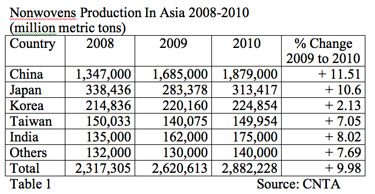
The Asian nonwovens industry shows a different face in various countries. However, China has
been the biggest market player in recent years, and in 2010 was responsible for 65.2 percent of the
total nonwovens production of nearly 2.9 million metric tons; followed by Japan with 10.9 percent;
Korea, 7.8 percent; India, 6.1 percent; and Taiwan, 5.2 percent, according to the latest data from
the China Nonwovens Technical Association (CNTA). Table 1 shows nonwovens production volumes in the
last two years, which correspond to the period of the recent global financial crisis.

RuppTable1

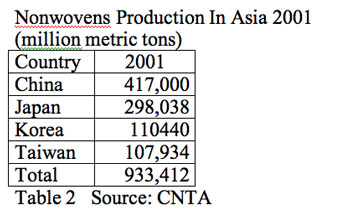
The increase is considerable. If one compares the 2010 production figures to those from 2001,
when India didn’t have any significant production, overall nonwovens production has tripled in Asia
(See Table 2).

Rupptable2

China increased its output nearly fivefold within 10 years, reflecting the country’s heavy
infrastructure investment – for example, for new roads. The other countries also are steadily
increasing nonwovens output, but not as much as China.

For example, according to China’s 12th Five-Year Plan (2011-2015), more than 45 million jobs
are to be created in urban areas, which means there will be a lot of building and road
construction, for which products such as geotextiles made of nonwovens are very much in the focus.

Process Technology

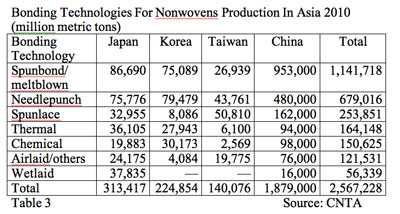
Table 3 shows production volumes for the different bonding technologies used to produce
nonwovens in the four top producing countries in 2010.

RuppTable3

Spunbonds/meltblowns top the list with 44.47 percent of the total, thanks to their
capabilities to produce large quantities. However, needlepunched nonwovens rank second with 26.45
percent, which demonstrates that technology’s unique flexibility to process virtually all fiber
types, whether virgin or recycled. Spunlace technology will be gaining ground in the future, thanks
to its growing flexibility and extended weight range as well as a gradually increasing production
speed — which includes the use of modern high-speed cards, which were the bottleneck up to now.

Bright Future

Nonwovens, or felts, and industrial fabrics are not an invention of the present day and age.
The ancient Egyptians knew how to employ textile reinforcements long ago. Over the last two
decades, nonwovens have been one of the few textile industry sectors to grow between 5 and 10
percent every year.

One big advantage in the sale of nonwovens is their proximity to the market. Most products
are tailor-made. The most important point in production is the know-how, not the quantity to be
produced. Until recently, technical textiles were mainly a success in Western countries, thanks to
the machinery, equipment and superior knowledge of the production processes in those countries.
Those times are gone. Industrial fabrics are by far not a substitute for traditional fabrics, but
the basis for new products. The area of end-uses is seemingly endless, and for Asian producers as
well.

June 28, 2011

Sponsors