
Karl Mayer Revamps HKS 3-M

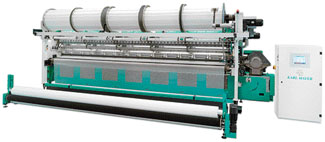
Karl Mayer Textilmaschinenfabrik GmbH, Germany, now offers a third generation of its HKS 3-M
three-bar tricot knitting machine, reporting that the new design enables 15-percent higher speeds
than the previous model, and is more compact in its construction.

The company has completely redesigned the machine’s knitting motion, machine frame and beam
let-off frame. The redesign includes improved access to the warp beam rollers on the right-hand
side of the machine.
KAKarlMayer

Karl Mayer’s revamped HKS 3-M three-bar tricot knitting machine

The new version offers a 210-inch working width and E 28 and E 32 gauges. Other widths and
gauges will be added in the future.

Karl Mayer notes that the design and movement of the HKS 3-M’s knitting elements allow it to
work a wide array of stitch densities and lappings and to process all yarn types that are used in
warp-knit applications. Fabrics that can be produced include tulle and net curtain, lingerie,
sportswear and dense upholstery fabrics; as well as semi-technical mosquito netting and shoe
fabrics.


July/August 2012

Wickers FR T-Shirts Receive USDA Biobased Label

Commack, N.Y.-based Wickers Performance Wear’s Wickers flame retardant (FR) T-shirts have earned
the U.S. Department of Agriculture’s (USDA’s) Certified Biobased Product Label certifying that the
shirts contain 97-percent renewable biobased ingredients.

The shirts are made using Wickers’ 50-percent Merino wool/50-percent Lenzing FR® fabric that
is moisture-wicking and provides an arc flash protection rating of 4.8 small calories of heat
energy per square centimeter.

July/August 2012

Teijin Launches Three-layer Anti-sweat Polyester Fabric

Tokyo-based Teijin Fibers Ltd. has developed a three-layer polyester fabric, with each layer
providing specific functions and all three working together to provide a capillary-like pump
action, to offer comfortable anti-perspiration performance in sportswear, casualwear and uniforms.

The fabric’s hydrophobic inner layer repels moisture and keeps perspiration away from the
wearer’s skin after it has been absorbed by the middle layer, while the outer layer diffuses the
moisture to provide quick drying. The inner layer’s repellency agent is integrated into the yarn
and withstands repeated laundering, Teijin reports.

July/August 2012

Hanesbrands Restructures Global Imagewear Business

Hanesbrands Inc., Winston-Salem, N.C., is restructuring its global imagewear business, which sells
basic apparel to wholesalers in the screen-print market and accounts for 8 percent of the company’s
sales.

The company will sell the European imagewear division to an affiliate of Smartwares BV, the
Netherlands, for some $20 million. Within its U.S. imagewear division, Hanesbrands will discontinue
private-label production and exit its Outer Banks brand business, which produces golf, corporate
and sportswear apparel. The U.S. imagewear operations will be renamed branded printwear and will
focus on Hanes® and Champion® branded products in the United States. 

July/August 2012

Nilit Introduces NILIT® Breeze

Nilit Ltd., Israel, has unveiled NILIT® Breeze flat or textured nylon 6,6 yarn for use in
sportswear, outerwear, workwear, underwear, socks, hosiery and shapewear. Fabrics made with the
yarn have been tested by Centexbel, the Belgian Textile Research Centre, and shown to lower body
temperatures by almost 1°C compared to fabrics knitted using standard yarns.

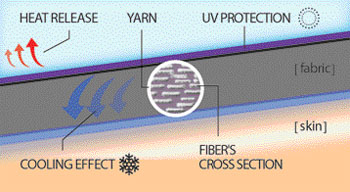
The yarn’s flat cross-section structure offers a wide surface area to transfer body heat
quickly. An inorganic additive integrated into the polymer increases surface area and creates small
channels that promote cooling. A texturing process creates a low-bulk yarn to maximize
breathability and ventilation in the garment. This combination also provides ultraviolet
protection.

FWNilit


NILIT® Breeze offers a cooling effect as well as ultraviolet protection.

July/August 2012

US Fibers To Expand Trenton Plant, Add 48 Jobs

US Fibers, Laurens, S.C., a recycler of polyethylene terephthalate (PET) material and a division of
Pac Tell Group Inc., will expand its Trenton, S.C., manufacturing plant and expects to add 48 jobs.
The $5.5 million project includes the addition of a staple fiber extrusion line and necessary
processing equipment, which will help the company broaden its product range.

US Fibers reports it was one of the first U.S. companies to recycle all forms of PET
material and convert it into high-quality, regenerated staple fiber, diverting more than 250
million pounds of waste from landfills. In 2010, the company increased polyester recycling capacity
at the Trenton plant, and today supplies recycled material to the nonwovens, automotive,
filtration, construction, packaging, home furnishings and other markets.

July/August 2012

Bio-enzyme Trials Point To Processing Cost Savings

Cotton Incorporated, Cary, N.C., and DuPont Industrial Biosciences — a business unit of Wilmington,
Del.-based DuPont — recently reported the results of a joint trial in which they evaluated the
effectiveness of biobased enzymes in preparing cotton knit textiles, compared to the effectiveness
of traditional processing chemicals. The trials showed that a combination of biobased enzymes can
replace caustic chemicals in cotton textile processing, while at the same time reducing water and
energy consumption and processing time.

On average, reductions included 70 percent of water, 33 percent of steam, and 27 percent of
energy across all shade ranges. Cost reductions using the bio-optimized process averaged 66
percent. Time savings ranged from 23 percent for dark shades to 30 percent for light shades.

Used in combination, bio-enzymes for scouring, bleaching and dyeing reduce water usage
because the same water bath can be used for more than one process, said trial supervisor Mary
Ankeny, director of dyeing research, Cotton Incorporated. Energy reductions stem from the fact that
textiles can be prepared at significantly reduced temperatures when bio-enzymes are used in an
optimized process compared to using traditional chemicals in traditional processes.

July/August 2012

Monforts Reports Success Of Matex Eco Applicator

Germany-based dyeing and finishing machinery manufacturer A. Monforts Textilmaschinen GmbH &
Co. KG reports success of its recently introduced Matex Eco Applicator — a soft coating solution
that offers substantial energy savings by reducing drying times, and can eliminate the need to use
a conventional wet-on-wet padder, according to the company.

The process, which uses trough and roller techniques, applies only the necessary amount of
liquid/coating to the fabric via contact with the roller, Monforts reports. Options include
application of liquid/coating to one or both sides of the fabric, or application of different
liquids/coatings on each side — for example, a soil- or water-repellent finish on one side of the
fabric and a softener on the other side. The process uses a twin roller for double-sided
applications.

Monforts reports that compared with a padder operation, the Matex Eco Applicator process
reduces initial moisture content from 60 percent to 40 percent, thereby reducing drying times and
energy costs.

The device can apply finishes including nano coatings, water repellents, softeners, flame
retardants and insect repellents; and is suitable for applications including felt finishes, coated
materials and medical textiles.

July 24, 2012

Tavex Installs Montex Tenter

Tavex Corp., Spain, recently installed a Montex 6500 tenter from A. Monforts Textilmaschinen GmbH
& Co. KG, Germany, at its facility in Tlaxcala, Mexico, to increase production capacity for
stretch denim. Sattex, Monforts’ distributor in Mexico, delivered and installed the tenter.

Adalberto Avendano, manager for dyeing and finishing at the Tlaxcala plant, said the Montex
6500 has features that make it particularly suitable for denim production and that eliminate
several traditional processing steps. The installed tenter has eight chambers and handles fabric
weights from 290 to 460 grams per square meter and widths from 170 to 180 centimeters.

July/August 2012

Wilcom’s AutoTuft Pneumatic Tufting Head Produces Special Tufting Effects

Australia-based Wilcom International Pty. Ltd. — a developer of computer-aided
design/computer-aided manufacturing software for embroidery, carpet and rugs — reports the
Pneumatic Tufting Head option on its AutoTuft automatic robotic tufting machine enables full-speed,
nonstop tufting of a range of pile types, pile heights and stitch lengths using any mixture of
horizontal, vertical, angled or spiral fills and outline tufting.

According to Wilcom, the device includes patented features that enable special tufting
effects not possible via hand tufting. Features include a rotating tufting needle offering fast,
smooth, full-speed cornering with high reliability and low wear; automatic cut/loop capability
allowing the machine to switch between cut pile and loop pile on a tuft-by-tuft basis as specified
in the design; and 3-D tufting enabling the machine to automatically tuft different pile heights
tuft-by-tuft according to design.

The AutoTuft Pneumatic Tufting Head also features a guillotine system for consistent cutting
of multiple ends and a range of yarn types and thicknesses. The system automatically cuts the ends
of loop pile areas before moving to the next area. 

July 24, 2012

Sponsors



